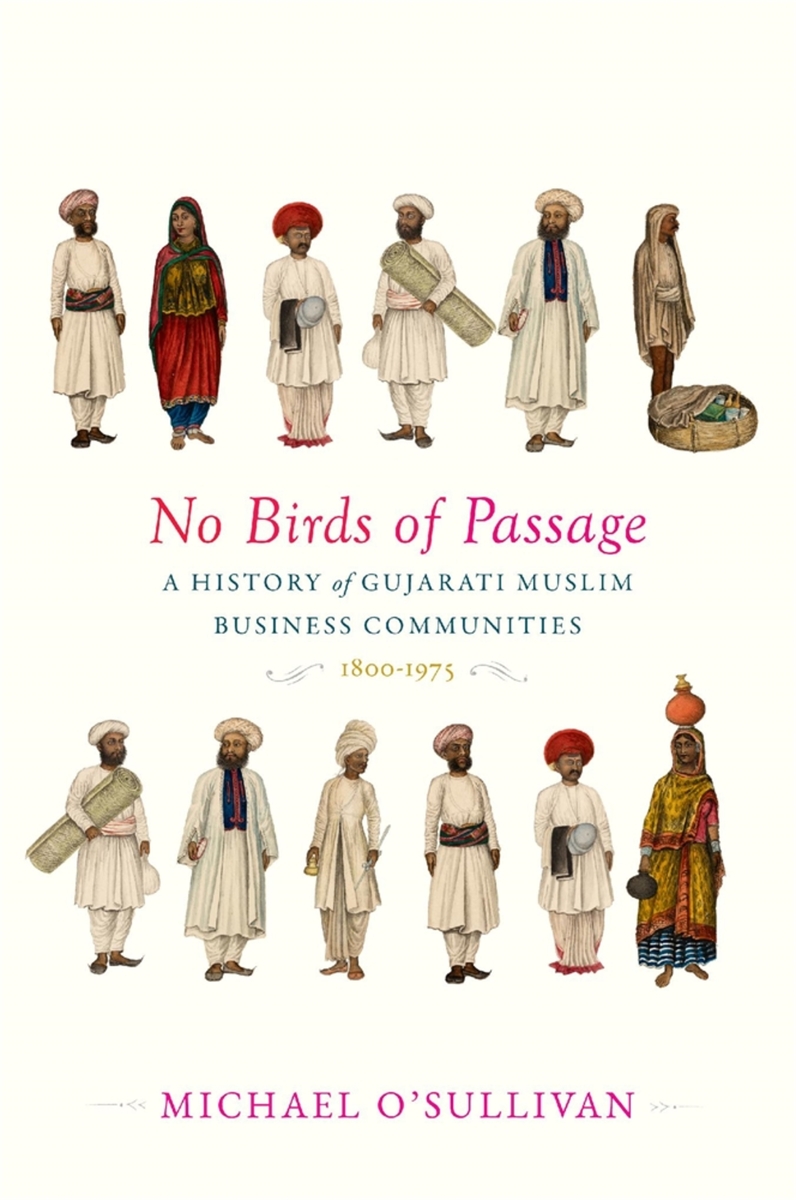
An important contribution to a growing body of scholarship on the internal, social, economic, and religious structures of South Asian mercantile, moneylending, and corporate communities …a masterful argument for studying economic and business history through the lens of Muslim religious authority, legal practice, and identity.
-- Amanda Lanzillo Developing Economies
This is an audacious scholarly conversation between received categories of classical political economy and South Asian Islam that is likely to provoke debate among specialists in the field. For the general student of history however, it is a book that demands close attention for its outstanding contributions to the craft, both in its expansive approach toward the archive as in its deft interweaving of religion, culture and politics within the complex terrain of capitalist enterprise and law. The structure, prose and narrative richness of the book are likely to ensure a life for it outside the scholarly niche of economic history.
-- Madhumita Mazumdar Telegraph India
O’Sullivan’s book offers a pathbreaking analysis of Muslim commercial success and interrogates several assumptions about Islam and capitalism, about custom and economic life, and about the plurality of Islam itself. It is not merely a history of business and networks, but a social history of communities that took business and religion seriously and, in the process, navigated modernity in their unique way.…an extraordinary work of archival richness and narrative skill.
-- Lakshmi Subramanian Book Review
A rich historical account of Gujarati Muslim business communities, emphasising their diverse experiences, achievements, and challenges throughout the nineteenth and twentieth centuries…the concept of ‘corporate Islam’ is a much needed contribution to understand the emergence of global Capitalism especially from the perspective of the global South.
-- Gijsbert Oonk Business History
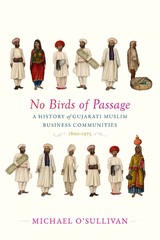
Challenges the colonial image of these three groups as rapacious migratory birds who replicated the voracious capitalism of the East India Company, and later European colonizers, to show that they instead planted deep roots wherever they migrated…makes a significant contribution to the modern history of these communities.
-- Arwa Hussain Reading Religion
Well informed and articulated…the book contributes so impressively on many issues, such as Islam and the capitalist economy, Islam and trade in South Asia, or Islam and social formation in South Asia. O’Sullivan’s work encourages us to rethink key issues…We need to reaffirm his rare competencies as a researcher, his innovativeness with concepts, and his exceptional and unprecedented labour in archives and other resources in several languages.
-- Michel Boivin Journal of Islamic Studies
The history of the three Gujarati Muslim trading groups—Bohras, Khojas, and Memons—has remained obscured by the pronounced orthodoxies that shape scholarship on capitalism and communities…. Michael O’Sullivan’s account addresses this gap by foregrounding the concept of ‘corporate Islam’…Sensitive to the diversity of community histories, the varying push and pull factors, and distinct theological underpinnings, the book presents a complex picture.
-- Danish Khan Economic and Political Weekly
No Birds of Passage is a brilliant and strikingly innovative contribution to the history of trade and diaspora in the Indian Ocean. Based on an impressive array of sources, it tells a compelling story about the emergence of a distinctive form of Muslim capitalism that continues to shape the region today.
-- Sunil Amrith, author of Unruly Waters
The intersection of community, caste, and capitalism is a matter of abiding interest for South Asian historians of both the early modern and modern periods. Michael O’Sullivan’s well-documented and closely argued work on Gujarati Muslim entrepreneurs over two centuries is a significant intervention in this field. It merits a wide readership, and is also certain to provoke debates well beyond the confines of South Asian studies.
-- Sanjay Subrahmanyam, author of Europe’s India
This sophisticated and fine-grained case study is a model of how to write revisionist economic histories that resonate with the experiences of people in most of the world. No Birds of Passage succeeds precisely because its conceptual apparatus is built on giving endogenous institutions their due, bringing together a range of sources in multiple languages, and openly embracing paradoxes without which this story of Muslim capitalism would have remained illegible. This is an exciting contribution to the burgeoning global histories of capitalism.
-- Mrinalini Sinha, author of Specters of Mother India
A major contribution to South Asian history. O’Sullivan’s sweeping account of Gujarati Muslim business communities is more than a business history. It is an impressive examination of how the Khojas, Bohras, and Memons reshaped community corporate identities through their interactions with the colonial state, Indian nationalism, Muslim politics, and postcolonial regimes.
-- Douglas E. Haynes, author of Small Town Capitalism in Western India
This is a landmark work of scholarship, meticulously recovering the transimperial worldviews of Gujarati Muslim business communities both before and after the age of imperial capitalism. Attentive to historical asymmetries of race and sovereignty, O’Sullivan’s dynamic and capacious study will inform future work on imperial and postcolonial economic history as well as on the social-religious logics of capital accumulation.
-- Manu Goswami, author of Producing India