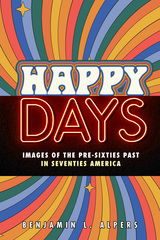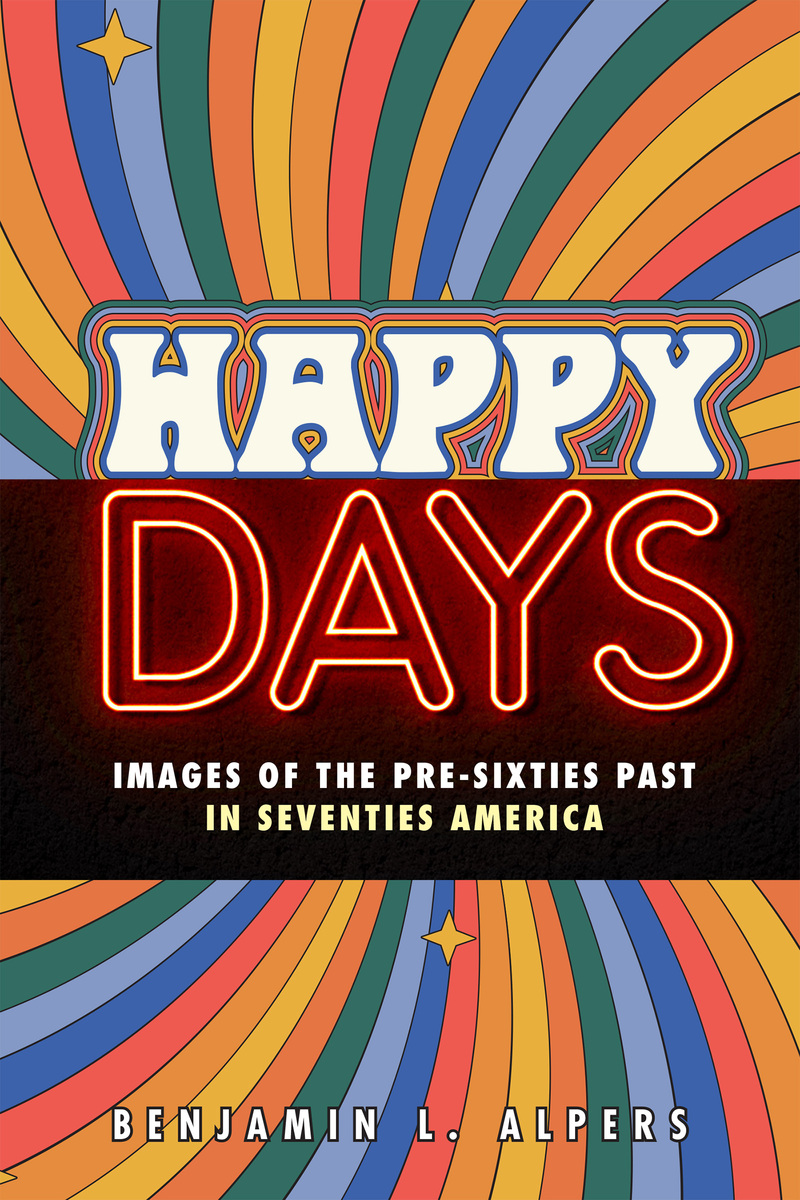
Happy Days: Images of the Pre-Sixties Past in Seventies America
Rutgers University Press, 2024
eISBN: 978-1-9788-3055-4 | Paper: 978-1-9788-3053-0 | Cloth: 978-1-9788-3054-7
Library of Congress Classification E169.12.A3759 2024
Dewey Decimal Classification 973.92
eISBN: 978-1-9788-3055-4 | Paper: 978-1-9788-3053-0 | Cloth: 978-1-9788-3054-7
Library of Congress Classification E169.12.A3759 2024
Dewey Decimal Classification 973.92
ABOUT THIS BOOK | AUTHOR BIOGRAPHY | REVIEWS | TOC
ABOUT THIS BOOK
After the techno-futurism of the 1950s and the utopian 1960s vision of a “great society,” the 1970s saw Americans turning to the past as a source for both nostalgic escapism and serious reflection on the nation’s history. While some popular works like Grease presented the relatively recent past as a more innocent time, far away from the nation’s post-Vietnam, post-Watergate malaise, others like Roots used America’s bicentennial as an occasion for deep soul-searching.
Happy Days investigates how 1970s popular culture was obsessed with America’s past but often offered radically different interpretations of the same historical events and icons. Even the figure of the greaser, once an icon of juvenile delinquency, was made family-friendly by Henry Winkler’s Fonzie at the same time that he was being appropriated in more threatening ways by punk and gay subcultures. The cultural historian Benjamin Alpers discovers similar levels of ambivalence toward the past in 1970s neo-noir films, representations of America’s founding, and neo-slave narratives by Alex Haley and Octavia Butler. By exploring how Americans used the 1970s to construct divergent representations of their shared history, he identifies it as a pivotal moment in the nation’s ideological fracturing.
Happy Days investigates how 1970s popular culture was obsessed with America’s past but often offered radically different interpretations of the same historical events and icons. Even the figure of the greaser, once an icon of juvenile delinquency, was made family-friendly by Henry Winkler’s Fonzie at the same time that he was being appropriated in more threatening ways by punk and gay subcultures. The cultural historian Benjamin Alpers discovers similar levels of ambivalence toward the past in 1970s neo-noir films, representations of America’s founding, and neo-slave narratives by Alex Haley and Octavia Butler. By exploring how Americans used the 1970s to construct divergent representations of their shared history, he identifies it as a pivotal moment in the nation’s ideological fracturing.
See other books on: 1970- | Happy Days | Images | Mass media and history | Nineteen seventies
See other titles from Rutgers University Press