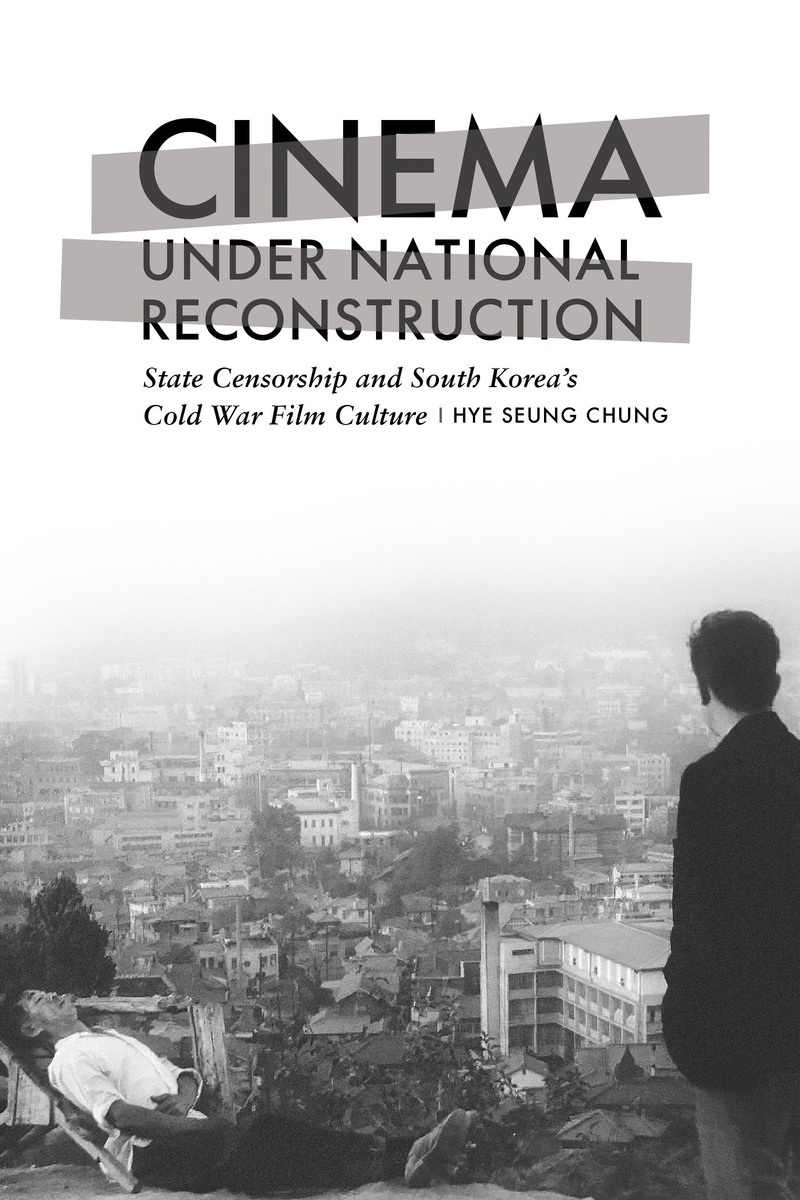
Cinema under National Reconstruction: State Censorship and South Korea’s Cold War Film Culture
Rutgers University Press
eISBN: 978-1-9788-3874-1 | Paper: 978-1-9788-3871-0 | Cloth: 978-1-9788-3872-7
See other books on: Asia | Censorship | Chung, Hye Seung | Film | Korea
See other titles from Rutgers University Press
eISBN: 978-1-9788-3874-1 | Paper: 978-1-9788-3871-0 | Cloth: 978-1-9788-3872-7
ABOUT THIS BOOK | AUTHOR BIOGRAPHY | REVIEWS | TOC
ABOUT THIS BOOK
Cinema Under National Reconstruction calls for a revisionist understanding of state film censorship during successive Cold War military regimes in South Korea (1961-1988). Drawing upon primary documents from the Korean Film Archive’s digitized database and framing South Korean film censorship from a transnational perspective, Hye Seung Chung makes the case that, while political oppression/repression existed inside and outside the film industry during this period, film censorship was not simply a tool for authoritarian dictatorship. Through such case studies as Yu Hyun-mok’s The Stray Bullet (1961), Ha Kil-jong’s The March of the Fools (1975), and Yi Chang-ho’s Declaration of Fools (1983), the author defines censorship as a dialogical process of cultural negotiations wherein the state, the film industry, and the public fight out a battle over the definitions and functions of national cinema. In the context of Cold War Korea, one cannot fully understand or construct film history without reassessing censorship as a productive feedback system where both state regulators and filmmakers played active roles in shaping the new narrative or sentiment of the nation on the big screen.
See other books on: Asia | Censorship | Chung, Hye Seung | Film | Korea
See other titles from Rutgers University Press