
 A SCHOLARLY BOOK REPOSITORY
236 start with A start with A
Each of the twelve essays that comprise this collection sparks new insights about the phenomenon of writing. A must-read for rhetoric and composition scholars and students, Abducting Writing Studies is sure to foster vibrant discussions about what is possible in writing research and instruction.
Foucault analyzes the practices of self-examination and confession in Greco-Roman antiquity and in the first centuries of Christianity in order to highlight a radical transformation from the ancient Delphic principle of “know thyself” to the monastic precept of “confess all of your thoughts to your spiritual guide.” His aim in doing so is to retrace the genealogy of the modern subject, which is inextricably tied to the emergence of the “hermeneutics of the self”—the necessity to explore one’s own thoughts and feelings and to confess them to a spiritual director—in early Christianity. According to Foucault, since some features of this Christian hermeneutics of the subject still determine our contemporary “gnoseologic” self, then the genealogy of the modern subject is both an ethical and a political enterprise, aiming to show that the “self” is nothing but the historical correlate of a series of technologies built into our history. Thus, from Foucault’s perspective, our main problem today is not to discover what “the self” is, but to try to analyze and change these technologies in order to change its form.
Athan Theoharis, long a respected authority on surveillance and secrecy, established his reputation for meticulous scholarship with his work on the loyalty security program developed under Truman and McCarthy. In Abuse of Power, Theoharis continues his investigation of U.S. government surveillance and historicizes the 9/11 response.
Criticizing the U.S. government's secret activities and policies during periods of "unprecedented crisis," he recounts how presidents and FBI officials exploited concerns about foreign-based internal security threats.
Drawing on information sequestered until recently in FBI records, Theoharis shows how these secret activities in the World War II and Cold War eras expanded FBI surveillance powers and, in the process, eroded civil liberties without substantially advancing legitimate security interests.
Passionately argued, this timely book speaks to the costs and consequences of still-secret post-9/11 surveillance programs and counterintelligence failures. Ultimately, Abuse of Power makes the case that the abusive surveillance policies of the Cold War years were repeated in the government's responses to the September 11 attacks.
Zizek argues that Schelling's most profound thoughts are found in the series of three consecutive attempts he made to formulate the "ages of the world/Weltalter," the stages of the self-development of the Absolute. Of the three versions, claims Zizek, it is the second that is the most eloquent and definitive encompassing of Schelling's lyrical thought. It centers on the problem of how the Absolute (God) himself, in order to become actual, to exist effectively, has to accomplish a radically contingent move of acquiring material, bodily existence. Never before available in English, this version finally renders accessible one of the key texts of modern philosophy, a text that is widely debated in philosophical circles today.
The Abyss of Freedom is Zizek's own reading of Schelling based upon Lacanian psychoanalytic theory. It focuses on the notion that Lacan's theory--which claims that the symbolic universe emerged from presymbolic drives--is prefigured in Schelling's idea of logos as given birth to from the vortex of primordial drives, or from what "in God is not yet God." For Zizek, this connection is monumental, showing that Schelling's ideas forcefully presage the post-modern "deconstruction" of logocentrism.
Slavoj Zizek is not a philosopher who stoops to conquer objects but a radical voice who believes that philosophy is nothing if it is not embodied, nothing if it is only abstract. For him, true philosophy always speaks of something rather than nothing. Those interested in the genesis of contemporary thought and the fate of reason in our "age of anxiety" will find this coupling of texts not only philosophically relevant, but vitally important.
Slavoj Zizek is the author of The Sublime Object of Ideology, Tarrying with the Negative: Kant, Hegel and the Critique of Ideology, and most recently, The Indivisible Remainder: An Essay on Schelling and Related Matters. Currently he is a Senior Researcher at the Institute for Social Sciences, University of Ljubljana. Judith Norman is Assistant Professor of Philosophy at Trinity University in San Antonio, Texas.
Academic Library Mentoring: Fostering Growth and Renewal presents a cross-section of mentoring thought and practice in college and university libraries, including mentoring definitions, practice fundamentals, models, program development, surveys, and analysis. Across three volumes, it explores library mentoring programs and the lived experiences of library faculty, librarians, library staff members, graduate library and information science students, and library student employees.
Volume 1, Fundamentals and Controversies, details effective mentoring skills and behaviors, mentoring models, dysfunctional mentoring relationships, conflicts of interest in mentoring, and, through a feminist lens, power differentials in mentoring. Chapters on diversity, equity, and inclusion call for library personnel to understand the exclusion some experience in the profession and to implement more inclusive mentoring practices.
Mentoring of Library Faculty and Librarians, Volume 2, explores mentorship skills, models, purposes and issues, and program development. Mentoring purposes include support for the pursuit of tenure and promotion, other career goals, and psychosocial concerns. Issues incorporate understanding and addressing diversity, equity, and inclusion in mentoring. Chapter methodologies include surveys, program assessments, analysis of practices against standards, case studies of mentor and mentee lived experiences, and case studies of libraries and affiliated entities.
In Volume 3, Mentoring of Students and Staff, we hear the voices of library science students and library student employees as they describe their library school and library employment mentoring experiences. Also presented are mentoring programs for recruiting individuals to the profession, practices supporting all library employees regardless of formal employee classification, and methods for enhancing the skills of consortial members. The volume ends with a look to the future of mentoring and organizational development and with a tool any library employee at any career stage can use in forming their own mentoring constellation.
Intentional, effective, committed mentorships can help mentees understand their roles and develop their identities as librarians, library workers, or library science students. Mentorships also help mentees understand and meet performance standards, broaden their skills, shift to new specializations, and discern options for contributing to the larger institution and the profession. Through mentoring, mentors may be invigorated by contributing to the growth of mentees and by encountering ideas and approaches different from their own. Academic Library Mentoring: Fostering Growth and Renewal addresses the many dimensions of contemporary academic library mentoring and how best to engage in inclusive, effective mentoring.
Anthony Powell’s universally acclaimed epic A Dance to the Music of Time offers a matchless panorama of twentieth-century London . Now, for the first time in decades, readers in the United States can read the books of Dance as they were originally published—as twelve individual novels—but with a twenty-first-century twist: they’re available only as e-books.
The third volume, The Acceptance World (1955), opens with Nick Jenkins, in his late twenties, beginning to make his way in the world of letters: working for a publisher, writing on his own, and establishing connections across the literary landscape. At the same time, he is making his way in love, as a surprise meeting with an old friend’s sister blossoms into an affair. Meanwhile, friends are diving into marriage and careers, and the patterns of life’s dance are starting to take shape—even as the future steps remain shadowy.
"Anthony Powell is the best living English novelist by far. His admirers are addicts, let us face it, held in thrall by a magician."--Chicago Tribune
"A book which creates a world and explores it in depth, which ponders changing relationships and values, which creates brilliantly living and diverse characters and then watches them grow and change in their milieu. . . . Powell's world is as large and as complex as Proust's."--Elizabeth Janeway, New York Times
"One of the most important works of fiction since the Second World War. . . . The novel looked, as it began, something like a comedy of manners; then, for a while, like a tragedy of manners; now like a vastly entertaining, deeply melancholy, yet somehow courageous statement about human experience."--Naomi Bliven, New Yorker
“The most brilliant and penetrating novelist we have.”--Kingsley Amis
Contemporary popular culture, from books to film to television to music to the deepest corners of the internet, has provoked much criticism, some of it well deserved. Yet, popular culture is culture for many Americans—particularly younger Americans. It is the only kind of cultural experience they seek and the currency in which they trade.
In Acculturated, twenty-three thinkers examine the rituals, the myths, the tropes, the peculiar habits, the practices, and the neuroses of our modern era. Every culture finds a way for people to tell stories about themselves. We rely on these stories to teach us why we do the things we do, to test the limits of our experience, to reaffirm deeply felt truths about human nature, and to teach younger generations about vice and virtue, honor and shame, and a great deal more. A phenomenon like the current crop of reality television shows, for example, with their bevy of “real” housewives, super-size families, and toddler beauty-pageant candidates, seems an unlikely place to find truths about human nature or examples of virtue. And yet, on these shows, and in much else of what passes for popular culture these days, a surprising theme emerges: Move beyond the visual excess and hyperbole, and you will find the makings of classic morality tales.
As the title suggests, readers will find in these pages “A-Culture Rated.” This lively roundtable of “raters” includes renowned cultural critics like Caitlin Flannigan and Chuck Colson and celebrated culture creators like the producers of the hit ABC comedy Modern Family and the host of TLC’s What Not to Wear. Editors Christine Rosen and Naomi Schaefer Riley have tasked these contributors—both the critics and the insiders—with taking a step or two back from the unceasing din of popular culture so that they might better judge its value and its values and help readers think more deeply about the meaning of the narratives with which they are bombarded every waking minute. In doing so, the editors hope to foster a wide-reaching public conversation to help us think more clearly about our culture.
CONTRIBUTORS INCLUDE Judy Bachrach, Megan Basham, Mark Bauerlein, Pia Catton, Chuck Colson, Paul Corrigan, Caitlin Flanagan, Meghan Cox Gurdon, Margo Howard, Kay S. Hymowitz, Jonathan V. Last, Herb London, Stacy London, Rob Long, Megan McArdle, Wilfred M. McClay, Caitrin Nicol, Joe Queenan, Emily Esfahani Smith, Brad Walsh, and Tony Woodlief.
Messner’s analysis is based on extensive reviews of the literature on early historic, prehistoric native plant use, and the collation of all available archaeobotanical data, a review of which also guided the author in selecting contemporary botanical specimens to identify and in interpreting starch residues recovered from ancient plant-processing technologies. The evidence presented here sheds light on many local ecological and cultural developments as ancient people shifted their subsistence focus from estuarine to riverine settings. These archaeobotanical datasets, Messner argues, illuminate both the conscious and unintentional translocal movement of ideas and ecologies throughout the Eastern Woodlands.
The goal of work-welfare policy in both countries has been to provide financial aid, training, and placement services for the unemployed. In order to muster support for these programs, however, work-welfare programs had to incorporate liberal requirements that they not interfere with private market forces, and that they prevent the "undeserving" from obtaining benefits. For King, the attempt to integrate these incompatible functions is the defining feature of British and American policies as well as the cause of their failure.

This book breaks new ground by bringing scholars from a range of disciplines together with industry professionals to explore the concept of festivals as spaces through an activist lens, as spaces where the sociopolitical identities of communities and individuals are confronted and shaped. Tracing the growth of activist and human rights-focused films from the 1970s to the present, and using case studies from San Francisco, Brazil, Bristol, and elsewhere, the book addresses such contentious topics as whether activist films can achieve humanitarian aims or simply offer “cinema of suffering.” Ultimately, the contributors attack the question of just how effective festivals are at producing politically engaged spectators?

After offering a history of the school's formation, the authors detail the ways in which federal No Child Left Behind policies, New York State accountability measures, and New York City's educational reforms under Mayor Michael Bloomberg complicated the school's efforts. The book then describes the dynamic bilingual pedagogical approach adopted within the school to help students develop academic Spanish and English. Focusing on the lives of twenty immigrant youth, Bartlett and Garcia also show that, although the school achieves high completion rates, the graduating students nevertheless face difficult postsecondary educational and work environments that too often consign them to the ranks of the working poor.

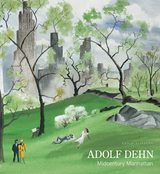
Adolf Dehn (1895–1968), American painter in multimedia and acclaimed master lithographer, left his Minnesota hometown after formal training at the Minneapolis Art Institute to study at the Art Students League in New York. He toured Europe in the early 1920s, quickly acclimating to the continental lifestyle and adeptly depicting its nuances and idiosyncrasies with prolific lithographs and sketches. His critical and satirical renderings of the political movements, social conventions, and governmental policies in post-World War I Europe during "Le Crazy Years" gave the Midwestern artist ample material for his growing body of work.
Sailing back to the United States in 1929, Dehn survived the Great Depression with commercial artwork and contributions to popular magazines such as The New Yorker, Vogue, and Vanity Fair. His clever drawings that reflected the Jazz Age's culture and fashionable society made him a favorite of Frank Crowninshield, Vanity Fair's renowned editor.
During this time, while Dehn captured the heyday of Manhattan's burlesque theaters, lively Harlem nightclubs, impressive skyline, and busy harbor, he was continuously drawn to Central Park—his predilection for the city's magnificent green space was a sustaining source of inspiration and subject matter. Adolf Dehn: Midcentury Manhattan candidly examines the life and work of this exceptional, adventurous, and intrepid artist as he moved skillfully and capably between lithography, ink-wash drawings, gouache, casein painting, and watercolors. Combining numerous vintage photographs with newly discovered, Manhattan-inspired prints and drawings from the collections of, among others, the Whitney Museum of American Art, MoMA, and The Metropolitan Mesuem of Art, Adolf Dehn: Midcentury Manhattan traces how Dehn's art reflected the spirit, pulse, and uniquely American tonalities of The City of Dreams.

Violence in the modernist mode, an ostensible intrusion of raw bodily harm into the artwork, aspires to transcend its own textuality, and yet, as An Aesthetics of Injury establishes, the wound paradoxically remains the essence of inscription. Fleishman thus shows how the wound, once the modernist emblem par excellence of an immediate aesthetic experience, comes to be implicated in a postmodern understanding of reality reduced to ceaseless mediation. In so doing, he demonstrates how what we think of as the most real object, the human body, becomes indistinguishable from its “nonreal” function as text. At stake in this tautological textual model is the heritage of narrative thought: both the narratological workings of these texts (how they tell stories) and the underlying epistemology exposed (whether these narrativists still believe in narrative at all).
With fresh and revealing readings of canonical authors and filmmakers seldom treated alongside one another, An Aesthetics of Injury is important reading for scholars working on literary or cinematic modernism and the postmodern, philosophy, narratology, body culture studies, queer and gender studies, trauma studies, and cultural theory.

Volume III, initially published in 1981, teems with characters, many of whom are based on historical figures. It commences in May of 1940, as the narrator’s parents flee Nazi forces in Eastern Europe and reunite with their son in Sweden. While in Stockholm, the narrator and other Communist activists living in exile struggle to build structures in the German underground. The story then follows Communist resistance fighter Charlotte Bischoff as she is smuggled to Bremen on a freighter. In Berlin, she contacts the narrator’s friends and joins the Red Orchestra resistance group. Soon, the Gestapo cracks the underground group’s code, arrests a number of its members, and takes them to Plötzensee Prison, where most of them are executed. Featuring the narrator’s meditations on paintings, sculpture, and literature throughout, The Aesthetics of Resistance demonstrates the affinity between political resistance and art. Ultimately, Weiss argues that we must look to art for new models of political action and social understanding.
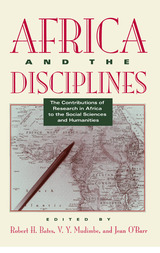
African Studies, contrary to some accounts, is not a separate continent in the world of American higher education. Its intellectual borders touch those of economics, literature, history, philosophy, and art; its history is the story of the world, both ancient and modern. This is the clear conclusion of Africa and the Disciplines, a book that addresses the question: Why should Africa be studied in the American university?
This question was put to distinguished scholars in the social sciences and humanities, prominent Africanists who are also leaders in their various disciplines. Their responses make a strong and enlightening case for the importance of research on Africa to the academy.
Paul Collier's essay, for example, shows how studies of African economies have clarified our understanding of the small open economies, and contributed to the theory of repressed inflation and to a number of areas in microeconomics as well. Art historian Suzanne Blier uses the terms and concepts that her discipline has applied to Africa to analyze the habits of mind and social practice of her own field. Christopher L. Miller describes the confounding and enriching impact of Africa on European and American literary theory. Political scientist Richard Sklar outlines Africa's contributions to the study of political modernization, pluralism, and rational choice. These essays, together with others from scholars in history, anthropology, philosophy, and comparative literature, attest to the influence of African research throughout the curriculum.
For many, knowledge from Africa seems distant and exotic. These powerful essays suggest the contrary: that such knowledge has shaped the way in which scholars in various disciplines understand their worlds. Eloquent testimony to Africa's necessary place in the mainstream of American education, this book should alter the academy's understanding of the significance of African research, its definition of core and periphery in human knowledge.
"These essays are at once exceptionally thoughtful and remarkably comprehensive. Not only do they offer an unusually interesting overview of African studies; they are also striking for the depth and freshness of their insights. This is the sort of volume from which both seasoned regional experts and students stand to learn an enormous amount."—John Comaroff, University of Chicago
"These essays provide an important perspective on the evolution of African studies and offer insights into what Africa can mean for the different humanistic and social science disciplines. Many show in ingenious and subtle ways the enormous potential that the study of Africa has for confounding the main tenets of established fields. One could only hope that the strictures expressed here would be taken to heart in the scholarly world."—Robert L. Tignor, Princeton University

Against the backdrop of the rising interest in African stories in mainstream media, African Animation looks at a more than century-old animation practice that remains largely unknown. Carefully organized, this book offers a comprehensive treatment that canvases animation from all over the continent, analyzing its history, socio-political contexts, artistic and technological development, visual cultures, and economic market conditions. African animation also contributes to the broader landscape of animation studies: how does our view of the history of animation change when we add an African perspective to the otherwise dominating perspectives of Hollywood, Japanese, and Korean animation? What does animation look and feel like in other parts of the world? African animation has always been there; this book helps us pay attention to it. This is a must-read for those interested in African animation, including artists, industry insiders, and fans.
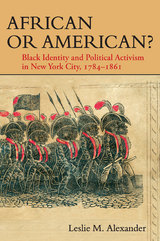
During the early national and antebellum eras, black leaders in New York City confronted the tenuous nature of Northern emancipation. Despite the hope of freedom, black New Yorkers faced a series of sociopolitical issues including the persistence of Southern slavery, the threat of forced removal, racial violence, and the denial of American citizenship. Even efforts to create community space within the urban landscape, such as the African Burial Ground and Seneca Village, were eventually demolished to make way for the city's rapid development. In this illuminating history, Leslie M. Alexander chronicles the growth and development of black activism in New York from the formation of the first black organization, the African Society, in 1784 to the eve of the Civil War in 1861. In this critical period, black activists sought to formulate an effective response to their unequal freedom. Examining black newspapers, speeches, and organizational records, this study documents the creation of mutual relief, religious, and political associations, which black men and women infused with African cultural traditions and values.
As Alexander reveals, conflicts over early black political strategy foreshadowed critical ideological struggles that would bedevil the black leadership for generations to come. Initially, black leaders advocated racial uplift through a sense of communalism and connection to their African heritage. Yet by the antebellum era, black activists struggled to reconcile their African identity with a growing desire to gain American citizenship. Ultimately, this battle resulted in competing agendas; while some leaders argued that the black community should dedicate themselves to moral improvement and American citizenship, others began to consider emigrating to Africa or Haiti. In the end, the black leadership resolved to assert an American identity and to expand their mission for full equality and citizenship in the United States. This decision marked a crucial turning point in black political strategy, for it signaled a new phase in the quest for racial advancement and fostered the creation of a nascent Black Nationalism.
Contributors are Joan C. Bristol, Nancy E. van Deusen, Leo J. Garofalo, Herbert S. Klein, Charles Beatty-Medina, Karen Y. Morrison, Rachel Sarah O'Toole, Frank "Trey" Proctor III, and Michele Reid-Vazquez.

By bringing instances of Afro-Asian traffic in the realms of politics, economics, and culture to the foreground, this collection maps an alternative global circuit. The issue examines the non-Eurocentric form of cosmopolitanism that emerged from creative encounters of racialized people in Jazz Age Paris, the Harlem Renaissance, and colonial Shanghai. It reconceptualizes the Indian Ocean as a crucial site for Afro-Asian cross-pollination and investigates the cinematic culture of kung fu as a global discourse of Afro-Asian anti-imperialism.
Contributors. Brent Edwards, Andrew F. Jones, Yukiko Koshiro, Bill Mullen, Vijay Prashad, William Schaefer, Nikhil Pal Singh, Françoise Vergès, Daniel Widener

Looking back at a lifetime of rich experience from Wisconsin’s driftless hills
We all dream of finding the place we can be most ourselves, the landscape that seems to have been crafted just for us. The poet Paul Zimmer has found his: a farm in the driftless hills of southwestern Wisconsin, a region of rolling land and crooked rivers, "driftless" because here the great glaciers of the Patrician ice sheet split widely, leaving behind a heart-shaped area untouched by crushing ice. After the Fire is the story of Zimmer’s journey from his boyhood in the factory town of Canton, Ohio, and his days as a soldier during atomic tests in the Nevada desert, to his many years in the book business as a writer and publisher, and the rural tranquillity of his present life.
Zimmer juxtaposes timeless rustic subjects (tending the land, country people and their ways, the ever-changing beauty of his natural surroundings) with flashbacks to key moments: his first and only boxing match, hearing Count Basie play and discovering his lifelong love of jazz, his return to the France of his ancestors, his painful departure from the publishing world after forty years. These stories are full of humor and pathos, keen insights and poignant meditations, but the real center of the book is the abiding beauty of the driftless hills, the silence and peace that is the source of and reward for Zimmer’s hard-won wisdom. Above all, it is a meditation on the ways that nature provides deep meaning and solace, and a consideration of the importance of finding the right place.
Swallowtail butterflies frolic on the wind. Vireos and rock wrens sing their hearts out by the recovering creek. Spiders and other predators chase their next meal. Through it all, John Alcock observes, records, and delights in what he sees. In a once-burnt area, life resurges. Plants whose seeds and roots withstood an intense fire become habitat for the returning creatures of the wild. After the Wildfire describes the remarkable recovery of wildlife in the Mazatzal Mountains in central Arizona.
It is the rare observer who has the dedication to revisit the site of a wildfire, especially over many years and seasons. But naturalist John Alcock returned again and again to the Mazatzals, where the disastrous Willow fire of 2004 burned 187 square miles. Documenting the fire’s aftermath over a decade, Alcock thrills at the renewal of the once-blackened region. Walking the South Fork of Deer Creek in all seasons as the years passed, he was rewarded by the sight of exuberant plant life that in turn fostered an equally satisfying return of animals ranging from small insects to large mammals.
Alcock clearly explains the response of chaparral plants to fire and the creatures that reinhabit these plants as they come back from a ferocious blaze: the great spreadwing damselfly, the western meadowlark, the elk, and birds and bugs of rich and colorful varieties. This book is at once a journey of biological discovery and a celebration of the ability of living things to reoccupy a devastated location. Alcock encourages others to engage the natural world—even one that has burnt to the ground.
Marcus Bullock and Peter Y. Paik, in bringing this collection together, show we have reached a moment in history when it is imperative to question prevailing intellectual models. The interconnectedness of the world's economies, the contributors argue, can exacerbate existing antagonisms or create new ones. With essays by Ihab Hassan, Paul Brodwin, and Helen Fehervary, among others, Aftermaths engages not only with important academic topics but also with the leading political issues of the day.
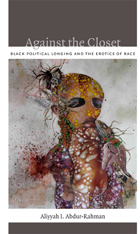
Abdur-Rahman brings black feminist, psychoanalytic, critical race, and poststructuralist theories to bear on literary genres from slave narratives to science fiction. Analyzing works by African American writers, including Frederick Douglass, Pauline Hopkins, Harriet Jacobs, James Baldwin, and Octavia Butler, she shows how literary representations of transgressive sexuality expressed the longings of African Americans for individual and collective freedom. Abdur-Rahman contends that those representations were fundamental to the development of African American forms of literary expression and modes of political intervention and cultural self-fashioning.

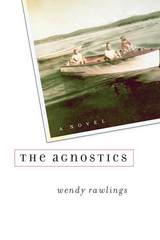
“Who knows if there’s a God? There’s us, now, and caterpillars and other insects and mulch. So thinks Stephen Wirth as he watches his marriage collapse. Between bouts of alcoholism and attempts to restore a fleet of decrepit boats, Stephen does his best to help his daughters cope with their mother having fallen in love with another woman. But growing up and making sense of the world is something the girls must do on their own, just as for their mother there is no easy way around building a new life. Set on Long Island, The Agnostics follows the Wirths through several decades as they struggle to redefine themselves and their idea of family.
Painting with a fine and delicate brush, Wendy Rawlings reveals her characters’ lives as a series of discrete moments, illuminating the intimate story of one American middle-class family.

An AIDS videomaker herself, Juhasz writes from the standpoint of an AIDS activist and blends feminist film critique with her own experience. She offers a detailed description of alternative AIDS video, including her own work on the Women’s AIDS Video Enterprise (WAVE). Along with WAVE, Juhasz discusses amateur video tapes of ACT UP demonstrations, safer sex videos produced by Gay Men’s Health Crisis, public access programming, and PBS documentaries, as well as network television productions.
From its close-up look at camcorder AIDS activism to its critical account of mainstream representations, AIDS TV offers a better understanding of the media, politics, identity, and community in the face of AIDS. It will challenge and encourage those who hope to change the course of this crisis both in the ‘real world’ and in the world of representation.

What actually took place in the private laboratory of a mid-seventeenth century alchemist? How did he direct his quest after the secrets of Nature? What instruments and theoretical principles did he employ?
Using, as their guide, the previously misunderstood interactions between Robert Boyle, widely known as "the father of chemistry," and George Starkey, an alchemist and the most prominent American scientific writer before Benjamin Franklin as their guide, Newman and Principe reveal the hitherto hidden laboratory operations of a famous alchemist and argue that many of the principles and practices characteristic of modern chemistry derive from alchemy. By analyzing Starkey's extraordinary laboratory notebooks, the authors show how this American "chymist" translated the wildly figurative writings of traditional alchemy into quantitative, carefully reasoned laboratory practice—and then encoded his own work in allegorical, secretive treatises under the name of Eirenaeus Philalethes. The intriguing "mystic" Joan Baptista Van Helmont—a favorite of Starkey, Boyle, and even of Lavoisier—emerges from this study as a surprisingly central figure in seventeenth-century "chymistry." A common emphasis on quantification, material production, and analysis/synthesis, the authors argue, illustrates a continuity of goals and practices from late medieval alchemy down to and beyond the Chemical Revolution.
For anyone who wants to understand how alchemy was actually practiced during the Scientific Revolution and what it contributed to the development of modern chemistry, Alchemy Tried in the Fire will be a veritable philosopher's stone.
This book is the first companion to the film in any language. It recounts the film’s plot and turbulent production history, and it also offers a close analysis of the artistic vision of its director, Aleksandr Askoldov, and the ways that viewers can trace in the film not only his complex aesthetics, but also the personal crises he endured in the years leading up to the film. The result is an indispensable companion to an unforgettable film.
This companion to Russian Ark addresses all key aspects of the film, beginning with a comprehensive synopsis, an in-depth analysis, and an account of the production history. Birgit Beumers goes on from there to discuss the work that went into the now-legendary Steadicam shot—which required two thousand actors and three orchestras—and she also offers an account of the film’s critical and public reception, showing how it helped to establish director Aleksandr Sokurov as perhaps the leading filmmaker in Russia today.
Alfonso Reyes, the great humanist and man of letters of contemporary Spanish America, began his literary career just before the outbreak of the Mexican Revolution of 1910. He spearheaded the radical shift in Mexico's cultural and philosophical orientation as a leading member of the famous "Athenaeum Generation."
The crucial years of his literary formation, however, were those he spent in Spain (1914-1924). He arrived in Madrid unknown and unsure of his future. When he left, he had achieved both professional maturity and wide acclaim as a writer. This book has, as its basis, the remarkable correspondence between Reyes and some of the leading spirits of the Spanish intellectual world, covering not only his years in Spain but also later exchanges of letters.
Although Reyes always made it clear that he was a Mexican and a Spanish American, he became a full-fledged member of the closed aristocracy of Spanish literature. It was the most brilliant period in Spain's cultural history since the Golden Age, and it is richly represented here by Reyes' association with five of its most important figures: Miguel de Unamuno and Ramón del Valle-Inclán were of the great "Generation of 98"; among the younger writers were José Ortega y Gasset, essayist and philosopher; the Nobel poet Juan Ramón Jiménez; and Ramón Gómez de la Serna, a precursor of surrealism.
Alfonso Reyes maintained lifelong friendships with these men, and their exchanges of letters are of a dual significance. They reveal how the years in Spain allowed Reyes to pursue his vocation independently, thereby prompting him to seek universal values. Coincidentally, they provide a unique glimpse into the inner world of those friends—and their dreams of a new Spain.

According to 2016 Pew Research Center survey data, Millennials are more likely to have visited a public library in the past year than any other adult demographic. But despite being core library users, millennials and other younger generations are often underrepresented on library boards and library advocacy groups, including Friends groups and Foundations. But you can change that, with the help of this planner’s hands-on worksheets, brainstorming activities, checklists, and expert advice. Using this toolkit from United for Libraries you will
- understand generational differences and commonalities through statistics and analysis of Baby Boomers, Generation X, Millennials and Generation Z/post-Millennials;
- learn how to navigate the challenges of fundraising with the “debt generations” by persuasively answering the question “what’s in it for me?”;
- master the ABCs of recruitment and retention, tailoring them to fit your library;
- craft several customized pitches, giving you confidence no matter the situation or audience;
- discover how to cement buy-in from two key groups, current organization members and your new recruits, thereby ensuring acceptance and enthusiasm all around;
- work towards defining and managing diversity for your advocacy group; and
- use tried and true methods for successful onboarding of volunteers, including a Board Member Orientation Checklist and guidance on mentoring.
Using this resource, libraries of all kinds will be empowered to grow and strengthen their recruitment, retention, and training of Trustees, Friends, and Foundation members.
All Thoughts Are Equal is both an introduction to the work of French philosopher François Laruelle and an exercise in nonhuman thinking. For Laruelle, standard forms of philosophy continue to dominate our models of what counts as exemplary thought and knowledge. By contrast, what Laruelle calls his “non-standard” approach attempts to bring democracy into thought, because all forms of thinking—including the nonhuman—are equal.
John Ó Maoilearca examines how philosophy might appear when viewed with non-philosophical and nonhuman eyes. He does so by refusing to explain Laruelle through orthodox philosophy, opting instead to follow the structure of a film (Lars von Trier’s documentary The Five Obstructions) as an example of the non-standard method. Von Trier’s film is a meditation on the creative limits set by film, both technologically and aesthetically, and how these limits can push our experience of film—and of ourselves—beyond what is normally deemed “the perfect human.”
All Thoughts Are Equal adopts film’s constraints in its own experiment by showing how Laruelle’s radically new style of philosophy is best presented through our most nonhuman form of thought—that found in cinema.
Of all his creations, the radiant poems in Alliance and Condemnation offer the best imaginable introduction to his extraordinary life and work.

Aloha Compadre: Latinxs in Hawaiʻi is the first book to examine the collective history and contemporary experiences of the Latinx population of Hawaiʻi. This study reveals that contrary to popular discourse, Latinx migration to Hawaiʻi is not a recent event. In the national memory of the United States, for example, the Latinx population of Hawaiʻi is often portrayed as recent arrivals and not as long-term historical communities with a presence that precedes the formation of statehood itself. Historically speaking, Latinxs have been voyaging to the Hawaiian Islands for over one hundred and ninety years. From the early 1830s to the present, they continue to help shape Hawaiʻi’s history, yet their contributions are often overlooked. Latinxs have been a part of the cultural landscape of Hawaiʻi prior to annexation, territorial status, and statehood in 1959. Aloha Compadre also explores the expanding boundaries of Latinx migration beyond the western hemisphere and into Oceania.
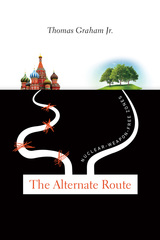
The classic road toward nuclear disarmament appears to be closed for the foreseeable future, but there may be another route. In the last fifty years, well-conceived regional treaties have been developed in Latin America, the South Pacific, Africa, Southeast Asia, and Central Asia. These arrangements have developed for many and varied political and security reasons, but now virtually all of the Southern Hemisphere and important parts of the Northern Hemisphere are legally nuclear-weapon-free. These regional nuclear weapon disarmament treaties are formally respected by the five states recognized under the Non-Proliferation Treaty (NPT) as nuclear weapon states: the United States, the United Kingdom, Russia, France, and China—often referred to collectively as the P-5 states.
Variations of these regional treaties might eventually be negotiated in the Middle East, Northeast Asia, and South Asia, setting aside the P-5 states until the very end of the process. With regional agreements in place around the globe, negotiation among the P-5 states would be all that stands between the world community and the banishment of nuclear weapons, verifiably and effectively worldwide. By the time this point is reached, Russia and the United States might be able to cooperate.
Essential reading for policy advisors, foreign service professionals, and scholars in political science, The Alternate Route examines the possibilities of nuclear-weapon-free zones as a pathway to worldwide nuclear disarmament.
The idea of “alternative modernities” holds that modernity always unfolds within specific cultures or civilizations and that different starting points of the transition to modernity lead to different outcomes. Without abandoning the Western discourse on the subject, the contributors to this volume write from the standpoint that modernity is in truth a richly mulitiplicitous concept. Believing that the language and lessons of Western modernity must be submitted to comparative study of its global receptions, they focus on such sites as China, Russia, India, Trinidad, and Mexico. Other essays treat more theoretical aspects of modernity, such as its self-understanding and the potential reconcilability of cosmopolitanism and diversity.
Contributors. Homi Bhabha, William Cunningham Bissell, Dipesh Chakrabarty, Dilip Parameshwar Gaonkar, Michael Hanchard, Beatriz Jaguaribe, Leo Ou-fan Lee, Claudio Lomnitz, Thomas McCarthy, Tejaswini Niranjana, Elizabeth A. Povinelli, Shahzia Sikander, Charles Taylor, Andrew Wachtel
A group of highly distinguished scholars takes up important issues, theories, and methods stemming from the nascent body of research on comparative archaeology to showcase and apply important theories of households, power, and how the development of complex societies can be extended and refined. Drawing on the archaeological, ethnohistorical, and ethnographic records, the chapters in this volume contain critical investigations on the role of collective action, economics, and corporate cognitive codes in structuring complex societies.
Alternative Pathways to Complexity is an important addition to theoretical development and empirical research on Mesoamerica, the Old World, and cross-cultural studies. The theoretical implications addressed in the chapters will have broad appeal for scholars grappling with alternative pathways to complexity in other regions as well as those addressing diverse cross-cultural research.
Contributors: Sarah B. Barber, Cynthia L. Bedell, Christopher S. Beekman, Frances F. Berdan, Tim Earle, Carol R. Ember, Gary M. Feinman, Arthur A. Joyce, Stephen A. Kowalewski, Lisa J. LeCount, Linda M. Nicholas, Peter N. Peregrine, Peter Robertshaw, Barbara L. Stark, T. L. Thurston, Deborah Winslow, Rita Wright
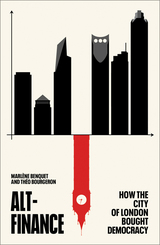
Powerful financial forces have supported the neoliberal project since the 1980s to advance their interests, but there are now signs that these forces have a new face and a new strategy.
The majority of the British finance sector threw its support behind Britain leaving the European Union, a flagship institution of neoliberalism. Beyond this counterintuitive move, what was really happening and why? Alt-Finance examines a new authoritarian turn in financialised democracies, focusing on the City of London, revealing a dangerous alternative political project in the making.
In a clash with traditional finance, the new behemoths of financial capital - hedge funds, private equity firms, and real estate funds - have started to cohere around a set of political beliefs, promoting libertarian, authoritarian, climate-denying, and Eurosceptic views. Protecting investments, suppressing social dissent, and reducing state interference is at the core of their mission for a new world order.
By following the money, the authors provide indisputable evidence of these worrying developments. Through a clear analysis of the international dealings of this new authoritarian-libertarian regime, not just in Britain but in the US and Brazil, we can understand how our world is being shaped against our will by struggles between dominant groups.
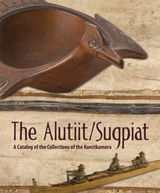
This beautifully photographed book catalogs the collection of nearly five hundred Alutiiq cultural items held by the Peter the Great Museum of Anthropology and Ethnography, or the Kunstkamera, in St. Petersburg, Russia. Gathered between 1780 and 1867, many of the artifacts are composed of fur, feathers, gut, hair, and other delicate materials, which prevent their transport for display or study.

Born between 1568 and 1580, Alva Ixtlilxochitl was a direct descendant of Ixtlilxochitl I and Ixtlilxochitl II, who had been rulers of Texcoco, one of the major city-states in pre-Conquest Mesoamerica. After a distinguished education and introduction into the life of the empire of New Spain in Mexico, Ixtlilxochitl was employed by the viceroy to write histories of the indigenous peoples in Mexico. Engaging with this history and delving deep into the resultant archives of this life's work, Amber Brian addresses the question of how knowledge and history came to be crafted in this era.
Brian takes the reader through not only the history of the archives itself, but explores how its inheritors played as crucial a role in shaping this indigenous history as the author. The archive helped inspire an emerging nationalism at a crucial juncture in Latin American history, as Creoles and indigenous peoples appropriated the history to give rise to a belief in Mexican exceptionalism. This belief, ultimately, shaped the modern state and impacted the course of history in the Americas. Without the work of Ixtlilxochitl, that history would look very different today.
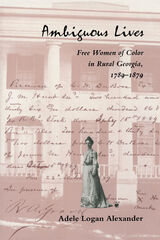
1992 Myers Center Outstanding Book on Human Rights
Historians have produced scores of studies on white men, extraordinary white women, and even the often anonymous mass of enslaved Black people in the United States. But in this innovative work, Adele Logan Alexander chronicles there heretofore undocumented dilemmas of one of nineteenth-century America’s most marginalized groups—free women of color in the rural South.
Ambiguous Lives focuses on the women of Alexander’s own family as representative of this subcaste of the African-American community. Their forbears, in fact, included Africans, Native Americans, and whites. Neither black nor white, affluent nor impoverished, enslaved nor truly free, these women of color lived and died in a shadowy realm situated somewhere between the legal, social, and economic extremes of empowered whites and subjugated blacks. Yet, as Alexander persuasively argues, these lives are worthy of attention precisely because of these ambiguities—because the intricacies, gradations, and subtleties of their anomalous experience became part of the tangled skein of American history and exemplify our country’s endless diversity, complexity, and self-contradictions.
Written as a “reclamation” of a long-ignored substratum of our society, Ambiguous Lives is more than the story of one family—it is a well-researched and fascinating profile of America, its race and gender relations, and its complex cultural weave.


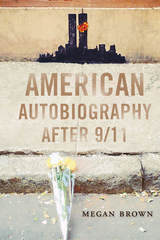
This lively and theoretically grounded book analyzes twenty-first-century memoirs from Three Cups of Tea to Fun Home, emphasizing the ways in which they reinforce and circulate ideologies, becoming guides or models for living. Brown expands her inquiry beyond books to the autobiographical narratives in reality television and political speeches. She offers a persuasive explanation for the memoir boom: the genre as a response to an era of uncertainty and struggle.
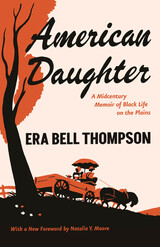
A portrait of Black life in the Great Plains, written by a key figure in the Chicago Renaissance and decades-long editor of Ebony.
Era Bell Thompson grew up on the plains of North Dakota, where she and her family were some of the only Black people amid an overwhelmingly white population. American Daughter, originally published in 1946, recounts her childhood in the rural West, her college years in Iowa, and the social and racial revelations she experienced upon arriving in Chicago, where she first encountered a large Black community.
Her memories defy contemporary assumptions. She was a popular high school student, even if she was forced to disarm ignorant questions from her peers. She describes her father’s work for the governor, her family’s interactions with diverse Midwestern immigrant communities, the natural beauty of the landscape, and the collaborative spirit necessary to survive the harsh weather conditions in North Dakota. As an adult in Chicago, she discovered lifestyles and attitudes that were entirely unfamiliar after her childhood in predominantly white spaces. While Thompson endured discrimination in rural and urban settings alike, she relied on her trademark humor to defuse tensions and bridge differences. Her memoir similarly radiates optimism, curiosity, and wit.
Long out of print, this new edition includes a foreword by the Chicago-based journalist Natalie Y. Moore, who not only contextualizes the memoir for contemporary readers but also explores Thompson’s life after American Daughter, including her trailblazing career as an editor for Ebony magazine.
Is theater really dead? Does the theater, as its champions insist, really provide a more intimate experience than film? If so, how have changes in cinematic techniques and technologies altered the relationship between stage and film? What are the inherent limitations of representing three-dimensional spaces in a two-dimensional one, and vice versa?
American Drama in the Age of Film examines the strengths and weaknesses of both the dramatic and cinematic arts to confront the standard arguments in the film-versus-theater debate. Using widely known adaptations of ten major plays, Brietzke seeks to highlight the inherent powers of each medium and draw conclusions not just about how they differ, but how they ought to differ as well. He contrasts both stage and film productions of, among other works, David Mamet’s Glengarry Glen Ross, Sam Shepard’s True West, Edward Albee’s Who’s Afraid of Virginia Woolf, Margaret Edson’s Wit, Tony Kushner’s Angels in America, Tennessee Williams’s Cat on a Hot Tin Roof, Arthur Miller’s Death of a Salesman, and August Wilson’s The Piano Lesson. In reading the dual productions of these works, Brietzke finds that cinema has indeed stolen much of theater’s former thunder, by making drama more intimate, and visceral than most live events.
But theater is still vital and matters greatly, Brietzke argues, though for reasons that run counter to many of the virtues traditionally attributed to it as an art form, such as intimacy and spontaneity. Brietzke seeks to revitalize perceptions of theater by challenging those common pieties and offering a new critical paradigm, one that champions spectacle and simultaneity as the most, not least, important elements of drama.
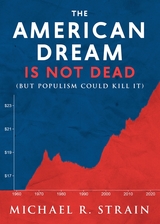
Populists on both sides of the political aisle routinely announce that the American Dream is dead. According to them, the game has been rigged by elites, workers can’t get ahead, wages have been stagnant for decades, and the middle class is dying.
Michael R. Strain, director of economic policy studies at the American Enterprise Institute, disputes this rhetoric as wrong and dangerous. In this succinctly argued volume, he shows that, on measures of economic opportunity and quality of life, there has never been a better time to be alive in America. He backs his argument with overwhelming—and underreported—data to show how the facts favor realistic optimism.
He warns, however, that the false prophets of populism pose a serious danger to our current and future prosperity. Their policies would leave workers worse off. And their erroneous claim that the American Dream is dead could discourage people from taking advantage of real opportunities to better their lives. If enough people start to believe the Dream is dead, they could, in effect, kill it. To prevent this self-fulfilling prophecy, Strain’s book is urgent reading for anyone feeling the pull of the populists.
E. J. Dionne and Henry Olsen provide spirited responses to Strain’s argument.
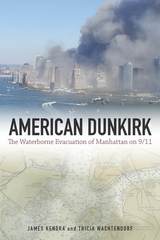
When the terrorist attacks struck New York City on September 11, 2001, boat operators and waterfront workers quickly realized that they had the skills, the equipment, and the opportunity to take definite, immediate action in responding to the most significant destructive event in the United States in decades. For many of them, they were “doing what needed to be done.”
American Dunkirk shows how people, many of whom were volunteers, mobilized rescue efforts in various improvised and spontaneous ways on that fateful date. Disaster experts James Kendra and Tricia Wachtendorf examine the efforts through fieldwork and interviews with many of the participants to understand the evacuation and its larger implications for the entire practice of disaster management.
The authors ultimately explore how people—as individuals, groups, and formal organizations—pull together to respond to and recover from startling, destructive events. American Dunkirk asks, What can these people and lessons teach us about not only surviving but thriving in the face of calamity?
American Examples: New Conversations about Religion, Volume Three, is the third in a series of annual anthologies produced by the American Examples workshop hosted by the Department of Religious Studies at the University of Alabama. In the latest volume from this innovative academic project, ten topically and methodologically diverse scholars vividly reimagine the meaning and applications of American religious history. These ten chapters use case studies from America, broadly conceived, to ask trenchant theoretical questions that are of interest to scholars and students within and beyond the subfield of American religious history.
Visit americanexamples.ua.edu for more information on upcoming workshop dates and future projects.
American Hotel takes us behind the glittering image to reveal the full extent of the Waldorf’s contribution toward shaping twentieth-century life and culture. Historian David Freeland examines the Waldorf from the opening of its first location in 1893 through its rise to a place of influence on the local, national, and international stage. Along the way, he explores how the hotel’s mission to provide hospitality to a diverse range of guests was put to the test by events such as Prohibition, the anticommunist Red Scare, and civil rights struggles.
Alongside famous guests like Frank Sinatra, Martin Luther King, Richard Nixon, and Eleanor Roosevelt, readers will meet the lesser-known men and women who made the Waldorf a leader in the hotel industry and a key setting for international events. American Hotel chronicles how institutions such as the Waldorf-Astoria played an essential role in New York’s growth as a world capital.
READERS
Browse our collection.
PUBLISHERS
See BiblioVault's publisher services.
STUDENT SERVICES
Files for college accessibility offices.
RECENTLY PUBLISHED


UChicago Accessibility Resources
home | accessibility | search | about | contact us
BiblioVault ® 2001 - 2026
The University of Chicago Press