
 A SCHOLARLY BOOK REPOSITORY
147 start with A start with A
David Mulroy’s translation of Antigone faithfully reproduces the literal meaning of Sophocles’ words while also reflecting his verbal pyrotechnics. Using fluid iambic pentameters for the spoken passages and rhyming stanzas for the songs, it is true to the letter and the spirit of the great Greek original.
Winner, Friends of the Dallas Public Library Award from the Texas Institute of Letters, 2003
Antiphon was a fifth-century Athenian intellectual (ca. 480-411 BCE) who created the profession of speechwriting while serving as an influential and highly sought-out adviser to litigants in the Athenian courts. Three of his speeches are preserved, together with three sets of Tetralogies (four hypothetical paired speeches), whose authenticity is sometimes doubted. Fragments also survive of intellectual treatises on subjects including justice, law, and nature (physis), which are often attributed to a separate Antiphon the Sophist. Were these two Antiphons really one and the same individual, endowed with a wide-ranging mind ready to tackle most of the diverse intellectual interests of his day?
Through an analysis of all these writings, this book convincingly argues that they were composed by a single individual, Antiphon the Athenian. Michael Gagarin sets close readings of individual works within a wider discussion of the fifth-century Athenian intellectual climate and the philosophical ferment known as the sophistic movement. This enables him to demonstrate the overall coherence of Antiphon's interests and writings and to show how he was a pivotal figure between the sophists and the Attic orators of the fourth century. In addition, Gagarin's argument allows us to reassess the work of the sophists as a whole, so that they can now be seen as primarily interested in logos (speech, argument) and as precursors of fourth-century rhetoric, rather than in their usual role as foils for Plato.

Oratory and philosophy from a Latin novelist.
Apuleius, one of the great stylists of Latin literature, was born ca. AD 125 in Madauros to a politically prominent family and received an elite education in the provincial capital Carthage and at Athens, where he began a lifelong allegiance to Platonic philosophy. In the later 150s, he married Pudentilla of Oea, a wealthy widow, and seems to have enjoyed a distinguished public career in Africa and perhaps as an advocate in Rome.
Although Apuleius is best known for his picaresque novel Metamorphoses or The Golden Ass (LCL 44, 453), he also wrote and declaimed on a wide variety of subjects. This edition contains the other surviving works of Apuleius that are considered genuine. Apologia is a speech delivered probably in 158/59 in which Apuleius defends himself against in-laws who had accused him of having used sinister means, including magic, to induce Pudentilla to marry him. The Florida is a collection of twenty-three excerpts from speeches by Apuleius, probably all of them delivered in Africa; the title refers either to their florid style or to their resemblance to an anthology, perhaps both. De Deo Socratis (On Socrates’ God) takes the form of a speech addressed to a cultured, nonspecialist Latin-speaking audience that locates Socrates’ invisible guide and protector (daimonion) within the more general concept of daimones as forces intermediary between gods and humans.
The Loeb Classical Library edition of Apuleius is in three volumes.
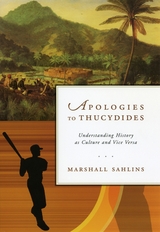
Sahlins begins by confronting Thucydides' account of the Peloponnesian War with an analogous "Polynesian War," the fight for the domination of the Fiji Islands (1843-55) between a great sea power (like Athens) and a great land power (like Sparta). Sahlins draws parallels between the conflicts with an eye to their respective systems of power and sovereignty as well as to Thucydides' alternation between individual (Pericles, Themistocles) and collective (the Athenians, the Spartans) actors in the making of history. Characteristic of most histories ever written, this alternation between the agency of "Great Men" and collective entities leads Sahlins to a series of incisive analyses ranging in subject matter from Bobby Thomson's "shot heard round the world" for the 1951 Giants to the history-making of Napoleon and certain divine kings to the brouhaha over Elián Gonzalez. Finally, again departing from Thucydides, Sahlins considers the relationship between cultural order and historical contingency through the recounting of a certain royal assassination that changed the course of Fijian history, a story of fratricide and war worthy of Shakespeare.
In this most convincing presentation yet of his influential theory of culture, Sahlins experiments with techniques for mixing rich narrative with cultural explication in the hope of doing justice at once to the actions of persons and the customs of people. And he demonstrates the necessity of taking culture into account in the creation of history—with apologies to Thucydides, who too often did not.

Austere apologetics.
Q. Septimus Florens Tertullianus (ca. AD 150–222) was born a soldier’s son at Carthage, educated in Greek and Roman literature, philosophy, and medicine, and later studied law to became a pleader, remaining a clever and often tortuous arguer. At Rome he became a learned and militant Christian. After visiting churches in Greece (and Asia Minor?) he returned to Carthage and in his writings there founded a Christian Latin language and literature, toiling to fuse enthusiasm with reason; to unite the demands of the Bible with the practice of the Church; and to continue to vindicate the Church’s possession of the true doctrine in the face of unbelievers, Jews, Gnostics, and others. In some of his many works he defended Christianity, in others he attacked heretical people and beliefs; in others he dealt with morals. In this volume are his Apologeticus and De Spectaculis.
Of Minucius, an early Christian writer of unknown date, we have only Octavius, a vigorous and readable debate between an unbeliever and a Christian friend of Minucius, the lawyer Octavius Ianuarius. Minucius himself acts as presiding judge. Octavius wins the argument. The whole work presents a picture of social and religious conditions in Rome, apparently about the end of the second century.

The Roman poet Statius called the via Appia “the Queen of Roads,” and for nearly a thousand years that description held true, as countless travelers trod its path from the center of Rome to the heel of Italy. Today, the road is all but gone, destroyed by time, neglect, and the incursions of modernity; to travel the Appian Way today is to be a seeker, and to walk in the footsteps of ghosts.
Our guide to those ghosts—and the layers of history they represent—is Robert A. Kaster. In The Appian Way, he brings a lifetime of studying Roman literature and history to his adventures along the ancient highway. A footsore Roman soldier pushing the imperial power south; craftsmen and farmers bringing their goods to the towns that lined the road; pious pilgrims headed to Jerusalem, using stage-by-stage directions we can still follow—all come to life once more as Kaster walks (and drives—and suffers car trouble) on what’s left of the Appian Way. Other voices help him tell the story: Cicero, Goethe, Hawthorne, Dickens, James, and even Monty Python offer commentary, insight, and curmudgeonly grumbles, their voices blending like the ages of the road to create a telescopic, perhaps kaleidoscopic, view of present and past.
To stand on the remnants of the Via Appia today is to stand in the pathway of history. With The Appian Way, Kaster invites us to close our eyes and walk with him back in time, to the campaigns of Garibaldi, the revolt of Spartacus, and the glory days of Imperial Rome. No traveler will want to miss this fascinating journey.

Fabretti's treatise, De aquis et aquaeductibus veteris Romae dissertationes tres, is cited as a matter of course by all later scholars working in the area of Roman topography. Its findings--while updated and supplemented by more recent archaeological efforts--have never been fully superseded. Yet despite its enormous importance and impact on scholarly efforts, the De aquis has never yet been translated from the original Latin. Aqueduct Hunting in the Seventeenth Century provides a full translation of and commentary on Fabretti's writings, making them accessible to a broad audience and carefully assessing their scholarly contributions.
Harry B. Evans offers his reader an introduction to Fabretti and his scholarly world. A complete translation and a commentary that focuses primarily on the topographical problems and Fabretti's contribution to our understanding of them are also provided. Evans also assesses the contributions and corrections of later archaeologists and topographers and places the De aquis in the history of aqueduct studies.
Evans demonstrates that Fabretti's conclusions, while far from definitive, are indeed significant and merit wider attention than they have received to date. This book will appeal to classicists and classical archaeologists, ancient historians, and readers interested in the history of technology, archaeology, and Rome and Italy in the seventeenth century.
Harry B. Evans is Professor of Classics, Fordham University.
This introduction to major topics in the field of Arabic sociolinguistics examines key issues in diglossia, code-switching, gendered discourse, language variation and change, and language policies. It introduces and evaluates various theoretical approaches and models, and it illustrates the usefulness and limitations of these approaches to Arabic with empirical data. Reem Bassiouney explores how current sociolinguistic theories can be applied to Arabic and, conversely, what the study of Arabic can contribute to our understanding of the function of language in society.
Graduate students of Arabic language and linguistics as well as students of sociolinguistics with no knowledge of Arabic will find this volume to be an indispensable resource.

The Archaeology of the Olympics presents a stirring reevaluation of the Olympic Games (and related festivals) as they actually were, not as the ancient Greeks wished—and we still wish—they might have been. Historians, archaeologists, and classicists examine the evidence to ask such questions as, How did the athletes train? What did they eat? Can we trace the roots of the games as far back as the Bronze Age of Crete and Mycenae? Or even to Anatolia, where similar athletic activities occurred? Were the ancient games really so free of political overtones as modern Olympic rhetoric urges us to believe?
scholarship on the earliest true writing system in human
history. Invented by the Babylonians at the end of the
fourth millennium B.C., this script, called proto-cuneiform,
survives in the form of clay tablets that have until now
posed formidable barriers to interpretation. Many tablets,
excavated in fragments from ancient dump sites, lack a clear
context. In addition, the purpose of the earliest tablets
was not to record language but to monitor the administration
of local economies by means of a numerical system.
Using the latest philological research and new methods
of computer analysis, the authors have for the first time
deciphered much of the numerical information. In
reconstructing both the social context and the function of
the notation, they consider how the development of our
earliest written records affected patterns of thought, the
concept of number, and the administration of household
economies. Complete with computer-generated graphics keyed
to the discussion and reproductions of all documents referred
to in the text, Archaic Bookkeeping will interest
specialists in Near Eastern civilizations, ancient history,
the history of science and mathematics, and cognitive
psychology.

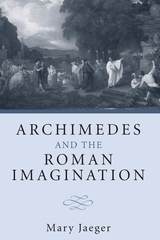
The great mathematician Archimedes, a Sicilian Greek whose machines defended Syracuse against the Romans during the Second Punic War, was killed by a Roman after the city fell, yet it is largely Roman sources, and Greek texts aimed at Roman audiences, that preserve the stories about him. Archimedes' story, Mary Jaeger argues, thus becomes a locus where writers explore the intersection of Greek and Roman culture, and as such it plays an important role in Roman self-definition. Jaeger uses the biography of Archimedes as a hermeneutic tool, providing insight into the construction of the traditional historical narrative about the Roman conquest of the Greek world and the Greek cultural invasion of Rome.
By breaking down the narrative of Archimedes' life and examining how the various anecdotes that comprise it are embedded in their contexts, the book offers fresh readings of passages from both well-known and less-studied authors, including Polybius, Cicero, Livy, Vitruvius, Plutarch, Silius Italicus, Valerius Maximus, Johannes Tzetzes, and Petrarch.
---Helen King, Times Literary Supplement
"An absolutely wonderful book on a truly original and important topic. As Jaeger explores neglected texts that together tell an important story about the Romans' views of empire and their relationship to Greek cultural accomplishments, so she has written an important new chapter in the history of science. A genuine pleasure to read, from first page to last."
---Andrew Feldherr, Associate Professor of Classics, Princeton University
"This elegantly written and convincingly argued project analyzes Archimedes as a vehicle for reception of the Classics, as a figure for loss and recovery of cultural memory, and as a metaphorical representation of the development of Roman identity. Jaeger's fastening on the still relatively obscure figure of the greatest ancient mathematician as a way of understanding cultural liminality in the ancient world is nothing short of a stroke of genius."
---Christina S. Kraus, Professor and Chair of Classics, Yale University
"Archimedes and the Roman Imagination forms a useful addition to our understanding of Roman culture as well as of the reception of science in antiquity. It will make a genuine contribution to the discipline, not only in terms of its original interpretative claims but also as a fascinating example of how we may follow the cultural reception of historical figures."
---Reviel Netz, Professor of Classics, Stanford University
Cover art: Benjamin West. Cicero Discovering the Tomb of Archimedes. Yale University Art Gallery. John Hill Morgan, B.A. 1893, LL.B. 1898, M.A. (Hon.) 1929, Fund.
Employing the idea of networks to effectively describe the interconnectedness of design, materials, technology, religion, and politics, the contributors to this volume establish the need to understand this important region holistically and on its own terms. Taking a close look at major buildings and monuments—while considering technique, design, and decoration as elements of a vigorous web—this volume offers important insights about the area’s significance in the history of Hellenistic architecture, including lasting innovations in architectural illusion, Ionic entablature, and groundbreaking uses of marble and plaster. From the North Aegean, such principles and tactics were transmitted to the rest of the Hellenistic world, influencing Roman architecture and, from there, Western architectural history.
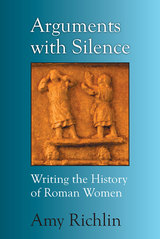
Women in ancient Rome challenge the historian. Widely represented in literature and art, they rarely speak for themselves. Amy Richlin, among the foremost pioneers in ancient studies, gives voice to these women through scholarship that scours sources from high art to gutter invective.
In Arguments with Silence, Richlin presents a linked selection of her essays on Roman women’s history, originally published between 1981 and 2001 as the field of “women in antiquity” took shape, and here substantially rewritten and updated. The new introduction to the volume lays out the historical methodologies these essays developed, places this process in its own historical setting, and reviews work on Roman women since 2001, along with persistent silences. Individual chapter introductions locate each piece in the social context of Second Wave feminism in Classics and the academy, explaining why each mattered as an intervention then and still does now.
Inhabiting these pages are the women whose lives were shaped by great art, dirty jokes, slavery, and the definition of adultery as a wife’s crime; Julia, Augustus’ daughter, who died, as her daughter would, exiled to a desert island; women wearing makeup, safeguarding babies with amulets, practicing their religion at home and in public ceremonies; the satirist Sulpicia, flaunting her sexuality; and the praefica, leading the lament for the dead.
Amy Richlin is one of a small handful of modern thinkers in a position to consider these questions, and this guided journey with her brings surprise, delight, and entertainment, as well as a fresh look at important questions.
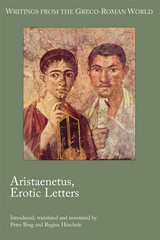
The first complete English translation of Aristaenetus in nearly three centuries
Through allusion and adaption of earlier authors, Aristaenetus recounts tales that are the stuff of comedy, erotic poetry, and ancient novel. Here we read of lovers who use every trope of erotic literature to praise their beloveds in over-the-top speeches. Aristaenetus amazes us with tales of paramours hatching complicated schemes to achieve their desires, while wily go-betweens help smooth their way. He presents us with accounts of unfaithful spouses who barely avoid capture in the midst of hair-raising and amusing infidelities. This sixth century collection is perfect for anyone interested in classical and postclassical literature.
Features:
- English translation and Greek text on facing pages
- Introduction with history of the text
- Discussion of intertextual connections with Greco-Roman authors
This is the first substantial commentary on Clouds since Dover’s 1968 edition. Intended for intermediate Greek students at undergraduate and graduate levels, the commentary pays careful attention to the basic characteristics of ancient Greek syntax, as well as to how Greek words are formed and can be analyzed. It offers robust staging notes, information about daily life in late 5th-century Athens, and constant reference to the rhetorical and dramatic strategies of the text. Full support is offered for those interested in the metrical structure of the songs, but in a way that allows instructors to leave such issues aside, should they choose to do so. The first and second appendices offer a basic means of entry into the rich but complex world of the comic fragments. An English-language bibliography is provided. The edition will interest professional classicists of all sorts seeking an accessible introduction to one of Aristophanes’ greatest plays, to philosophers concerned with Socrates and the sophistic movement, and to theater professionals who wish to stage the play.
Explore richly embellished Armenian tales of biblical heroes
This fifth book of Michael E. Stone's English translations of stories from medieval Armenian manuscripts illustrates how authors transmitted and transformed accounts of biblical heroes. Texts focus on important figures such as Adam, Noah, Abraham, Solomon, Daniel and Susanna, and more. This collection reflects not only the richness of Armenian creativity stimulated by piety and learning but also Michael E. Stone's career-long search for reworkings of biblical traditions, stories, and persons in the Armenian tradition.
Features:
- A rich tradition of biblical exegesis and commentary, much of it in genres of the older apocryphal and pseudepigraphical literature
- Reflections on the roots of Armenian texts in ancient Judaism and earliest Christianity
- Texts, translations, and a critical apparatus
During the first centuries of the Roman Empire, Greek intellectuals wrote a great many texts modeled on the dialect and literature of Classical Athens, some 500 years prior. Among the most successful of these literary figures were sophists, whose highly influential display oratory has been the prevailing focus of scholarship on Roman Greece over the past fifty years. Often overlooked are the period’s historians, who spurned sophistic oral performance in favor of written accounts. One such author is Arrian of Nicomedia.
Daniel W. Leon examines the works of Arrian to show how the era's historians responded to their sophistic peers’ claims of authority and played a crucial role in theorizing the past at a time when knowledge of history was central to defining Greek cultural identity. Best known for his history of Alexander the Great, Arrian articulated a methodical approach to the study of the past and a notion of historical progress that established a continuous line of human activity leading to his present and imparting moral and political lessons. Using Arrian as a case study in Greek historiography, Leon demonstrates how the genre functioned during the Imperial Period and what it brings to the study of the Roman world in the second century.
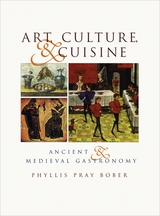
Bober draws on archaeology and art history to examine prehistoric eating customs in ancient Turkey; traditions of the great civilizations of Egypt, Mesopotamia, Greece, and Rome; and rituals of the Middle Ages. Both elegant and entertaining, Art, Culture, and Cuisine reveals cuisine and dining's place at the heart of cultural, religious, and social activities that have shaped Western sensibilities.

THIS EDITION HAS BEEN REPLACED BY A NEWER EDITION..
From the awesome grandeur of the great pyramids to the delicacy of a face etched on an amulet, the spellbinding power of the art of ancient Egypt persists to this day. This beautifully illustrated book conducts us through the splendors of this world, great and small, and into the mysteries of its fascination in its day as well as in our own. What did art, and the architecture that housed it, mean to the ancient Egyptians? Why did they invest such vast wealth and effort in its production? These are the puzzles Gay Robins explores as she examines the objects of Egyptian art--the tombs and wall paintings, the sculpture and stelae, the coffins, funerary papyri, and amulets--from its first flowering in the Early Dynastic period to its final resurgence in the time of the Ptolemies.
Spanning three thousand years, her book offers a thorough and delightfully readable introduction to the art of ancient Egypt even as it provides insight into questions that have long perplexed experts and amateurs alike. With remarkable sensitivity to the complex ways in which historical, religious, and social changes are related to changes in Egyptian art, she brings out the power and significance of the image in Egyptian belief and life. Her attention to the later period, including Ptolemaic art, shows for the first time how Egyptian art is a continuous phenomenon, changing to meet the needs of different times, right down to the eclipse of ancient Egyptian culture. In its scope, its detail, and its eloquent reproduction of over 250 objects from the British Museum and other collections in Europe, the United States, and Egypt, this volume is without parallel as a guide to the art of ancient Egypt.

From the awesome grandeur of the Great Pyramids to the delicacy of a face etched on an amulet, the spellbinding power of ancient Egyptian art persists to this day. Spanning three thousand years, this beautifully illustrated history offers a thorough and delightfully readable introduction to the artwork even as it provides insight into questions that have long engaged experts and amateurs alike. In its scope, its detail, and its eloquent reproduction of over 250 objects, Gay Robins’s classic book is without parallel as a guide to the art of ancient Egypt.
This eagerly awaited new edition includes many new color photographs and a fully revised and updated bibliography.

With The Art of Living in Avant-Garde Paris, Rachel Silveri takes a fresh look at the desire to unify art and life, an ambition long regarded as foundational to the European historical avant-gardes. She reveals how many early twentieth-century artists saw their own everyday lives—their bodies, identities, and relationships—as a type of creative material and a central component to their avant-garde practice. These artists abandoned traditional forms of artmaking and venues of art viewing, instead aspiring to integrate art with everyday life, creating an “art of living.”
Considering Tristan Tzara’s performances of Dadaist identity, Sonia Delaunay’s simultaneous fashions and self-branding, and the collective endeavor to open and operate the Surrealist Research Bureau, Silveri offers a new narrative about how the artists of interwar Paris developed experiential life practices that resisted dominant forms of “lifestyle” and normative discourses surrounding gender, ethnicity, and office work. This book argues that ethical questions of “How should I live?” and “How should I relate to others?” were as important to the avant-garde as politics, and that aspirations to change the world played out in daily practices of self-making.
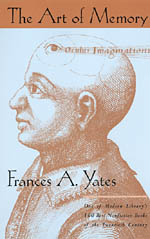
In this classic study of how people learned to retain vast stores of knowledge before the invention of the printed page, Frances A. Yates traces the art of memory from its treatment by Greek orators, through its Gothic transformations in the Middle Ages, to the occult forms it took in the Renaissance, and finally to its use in the seventeenth century. This book, the first to relate the art of memory to the history of culture as a whole, was revolutionary when it first appeared and continues to mesmerize readers with its lucid and revelatory insights.
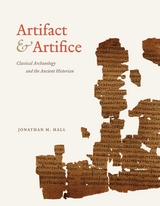

The Ascension of Authorship traces the history of the idea of the author in the ancient world, beginning with the attribution practices of Second Temple and Rabbinic Judaism. Jed Wyrick explores the testimony of Josephus on the succession of prophetic scribes and their superiority to Greek historiographers, and interprets the formation of the biblical canon in this light.
The Ascension of Authorship also examines the Greek scholarly methodology that questioned traditional connections between names and texts, a methodology perfected by Hellenistic grammarians and inherited by early Christian scholars. Wyrick argues that the fusion of Jewish and Hellenistic approaches toward attribution helped lead to St. Augustine’s reinvention of the writer of scripture as an author whose texts were governed by both divine will and human intent.

In the third century BCE, Ashoka ruled an empire encompassing much of modern-day India, Pakistan, Afghanistan, and Bangladesh. During his reign, Buddhism proliferated across the South Asian subcontinent, and future generations of Asians came to see him as the ideal Buddhist king. Disentangling the threads of Ashoka’s life from the knot of legend that surrounds it, Nayanjot Lahiri presents a vivid biography of this extraordinary Indian emperor and deepens our understanding of a legacy that extends beyond the bounds of Ashoka’s lifetime and dominion.
At the center of Lahiri’s account is the complex personality of the Maurya dynasty’s third emperor—a strikingly contemplative monarch, at once ambitious and humane, who introduced a unique style of benevolent governance. Ashoka’s edicts, carved into rock faces and stone pillars, reveal an eloquent ruler who, unusually for the time, wished to communicate directly with his people. The voice he projected was personal, speaking candidly about the watershed events in his life and expressing his regrets as well as his wishes to his subjects.
Ashoka’s humanity is conveyed most powerfully in his tale of the Battle of Kalinga. Against all conventions of statecraft, he depicts his victory as a tragedy rather than a triumph—a shattering experience that led him to embrace the Buddha’s teachings. Ashoka in Ancient India breathes new life into a towering figure of the ancient world, one who, in the words of Jawaharlal Nehru, “was greater than any king or emperor.”

Aspects of History and Epic in Ancient Iran focuses on the content of one of the most important inscriptions of the Ancient Near East: the Bisotun inscription of the Achaemenid king Darius I (6th century BCE), which in essence reports on a suspicious fratricide and subsequent coup d’état. Moreover, the study shows how the inscription’s narrative would decisively influence the Iranian epic, epigraphic, and historiographical traditions well into the Sasanian and early Islamic periods.
Intriguingly, our assessment of the impact of the Bisotun narrative on later literary traditions—in particular, the inscription of the Sasanian king Narseh at Paikuli (3rd–4th centuries CE)—necessarily relies on the reception of the oral rendition of the Bisotun story captured by Greek historians. As Rahim Shayegan argues, this oral tradition had an immeasurable impact upon the historiographical writings and epic compositions of later Iranian empires. It would have otherwise remained unknown to modern scholars, had it not been partially preserved and recorded by Hellanicus of Lesbos, Herodotus, Ctesias, and other Greek authors. The elucidation of Bisotun’s thematic composition therefore not only allows us to solve an ancient murder but also to reevaluate pre-Thucydidean Greek historiography as one of the most important repositories of Iranian epic themes.


Poetry of the sky and stars.
Marcus Manilius, who lived in the reigns of Augustus and Tiberius, is the author of the earliest treatise on astrology we possess. His Astronomica, a Latin didactic poem in five books, begins with an account of celestial phenomena, and then proceeds to treat of the signs of the zodiac and the twelve temples; there follow instructions for calculating the horoscoping degree, and details of chronocrators, decans, injurious degrees, zodiacal geography, paranatellonta, and other technical matters. Besides exhibiting great virtuosity in rendering mathematical tables and diagrams in verse form, the poet writes with some passion about his Stoic beliefs and shows much wit and humor in his character sketches of persons born under particular stars. Perhaps taking a lead from Virgil in his Georgics, Manilius abandons the proportions of his last book to narrate the story of Perseus and Andromeda at considerable length.
In spite of its undoubted elegance, the Astronomica is a difficult work, and this edition provides in addition to the first English prose translation a full guide to the poem, with copious explanatory notes and illustrative figures.
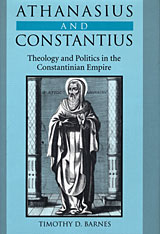
As the high-ranking Bishop of Alexandria from 328 to 373, Athanasius came into conflict with no fewer than four Roman emperors—Constantine himself, his son Constantius, Julian the Apostate, and the “Arian” Valens. In this new reconstruction of Athanasius’s career, Timothy D. Barnes analyzes the nature and extent of the Bishop’s power, especially as it intersected with the policies of these emperors.
Repeatedly condemned and deposed by church councils, the Bishop persistently resurfaced as a player to contend with in ecclesiastic and imperial politics. Barnes’s work reveals that Athanasius’s writings, though a significant source for this period, are riddled with deliberate misinterpretations, which historians through the ages have uncritically accepted.
Untangling longstanding misconceptions, Barnes reveals the Bishop’s true role in the struggles within Christianity, and in the relations between the Roman emperor and the Church at a critical juncture.
This volume collects Harold B. Mattingly's most important essays on the question, and offers them in updated form together with a new introduction and notes, and a concordance of inscriptions. A preface by Mortimer Chambers helps place the volume amid the decades- long controversy about events in and around Athens, and describes the scientific technique that has proven Mattingly's argument.
In the process of establishing a sounder methodology for investigating this crucial period of Greek--and Western--history, Mattingly in these groundbreaking essays turns a beacon of light on many aspects of Greek and Athenian society and history.
Revered as the birthplace of Western thought and democracy, Athens is much more than an open-air museum filled with crumbling monuments to ancient glory. Athens takes readers on a journey from the classical city-state to today’s contemporary capital, revealing a world-famous metropolis that has been resurrected and redefined time and again.
Although the Acropolis remains the city’s anchor, Athens’ vibrant culture extends far beyond the Greek city’s antique boundaries. James H. S. McGregor points out how the cityscape preserves signs of the many actors who have crossed its historical stage. Alexander the Great incorporated Athens into his empire, as did the Romans. Byzantine Christians repurposed Greek temples, the Parthenon included, into churches. From the thirteenth to fifteenth centuries, the city’s language changed from French to Spanish to Italian, as Crusaders and adventurers from different parts of Western Europe took turns sacking and administering the city. An Islamic Athens took root following the Ottoman conquest of 1456 and remained in place for nearly four hundred years, until Greek patriots finally won independence in a blood-drenched revolution.
Since then, Athenians have endured many hardships, from Nazi occupation and military coups to famine and economic crisis. Yet, as McGregor shows, the history of Athens is closer to a heroic epic than a Greek tragedy. Richly supplemented with maps and illustrations, Athens paints a portrait of one of the world’s great cities, designed for travelers as well as armchair students of urban history.
On a summer night in 415 BCE, unknown persons systematically mutilated most of the domestic “herms”—guardian statues of the god Hermes—in Athens. The reaction was immediate and extreme: the Athenians feared a terrifying conspiracy was underway against the city and its large fleet—and possibly against democracy itself. The city established a board of investigators, which led to informants, accusations, and flight by many of the accused. Ultimately, dozens were exiled or executed, their property confiscated.
This dramatic period offers the opportunity to observe the city in crisis. Sequential events allow us to see the workings of the major institutions of the city (assembly, council, law courts, and theater, as well as public and private religion). Remarkably, the primary sources for these tumultuous months name conspirators and informants from a very wide range of status-groups: citizens, women, slaves, and free residents. Thus the incident provides a particularly effective entry-point into a full multifaceted view of the way Athens worked in the late fifth century.
Designed for classroom use, Athens 415 is no potted history, but rather a source-based presentation of ancient urban life ideal for the study of a people and their institutions and beliefs. Original texts—all translated by poet Robert B. Hardy—are presented along with thoughtful discussion and analyses by Clara Shaw Hardy in an engaging narrative that draws students into Athens’ crisis.
Thousands of Greek painted vases have emerged from excavations of tombs, sanctuaries, and settlements throughout Etruria, from southern coastal centers to northern communities in the Po Valley. Using documented archaeological assemblages, especially from tombs in southern Etruria, Bundrick challenges the widely held assumption that Etruscans were hellenized through Greek imports. She marshals evidence to show that Etruscan consumers purposefully selected figured pottery that harmonized with their own local needs and customs, so much so that the vases are better described as etruscanized. Athenian ceramic workers, she contends, learned from traders which shapes and imagery sold best to the Etruscans and employed a variety of strategies to maximize artistry, output, and profit.

The conquests of Alexander the Great transformed the Greek world into a complex of monarchies and vying powers, a vast sphere in which the Greek city-states struggled to survive. This is the compelling story of one city that despite long periods of subjugation persisted as a vital social entity throughout the Hellenistic age.
Christian Habicht narrates the history of Athens from its subjugation by the Macedonians in 338 B.C. to the battle of Actium in 31 B.C., when Octavian's defeat of Mark Antony paved the way for Roman dominion over the Hellenistic world. For nearly three centuries Athens strove unsuccessfully for sovereignty; its foreign policies were shaped by the dictates first of the Macedonian monarchy and later of the Roman republic. Yet the city never relinquished control of internal affairs, and citizen participation in its government remained strong. Habicht lucidly chronicles the democracy's setbacks and recoveries over these years as it formed and suffered the consequences of various alliances. He sketches its continuing role as a leader in intellectual life and the arts, as Menander and other Athenian playwrights saw their work produced throughout the Greek world; and the city's famous schools of philosophy, now including those of Zeno and Epicurus, remained a stellar attraction for students from around the Mediterranean. Habicht has long been in the forefront of research on Hellenistic Athens; in this authoritative yet eminently readable history he distills that research for all readers interested in the ancient Mediterranean world.
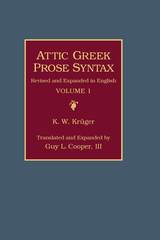
The language of classical Greek literature has been extensively studied since the Renaissance, and the most generally admired approach to Greek grammar and syntax has long been K. W. Krüger's Griechische Sprachlehre. In this translation Guy L. Cooper III accepts Krüger's simple and transparent organization, but greatly expands the substance of the earlier work by increasing the total number of citations from the original texts. Research since 1875, especially the contributions of Basil Lanneau Gildersleeve, is incorporated so as to create a reference work, in English, which covers the full range of this complex subject.
Krüger's original paragraph numbering has been maintained so that references in previously published works can be followed directly in the new work. However, every paragraph and chapter has been revised and expanded, opening up new subheadings within Krüger's format. The English has moved away from Krüger's laconic style to a more flowing, readable presentation, without jargon and unexplained technical language. A complete index of passages cited and the impressive number of citations make the work a running syntactic commentary on the whole range of Attic prose literature. The net result is a new comprehensive reference work, an essential reference for libraries and personal collections alike.
Guy L. Cooper III is Professor Emeritus of Classics, University of North Carolina at Asheville.
Volume 2
cloth ISBN 0-472-10844-1
Set of Volumes 1 & 2
cloth ISBN 0-472-10844-1
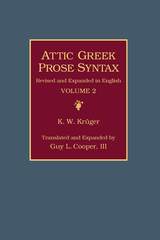
The language of classical Greek literature has been extensively studied since the Renaissance, and the most generally admired approach to Greek grammar and syntax has long been K. W. Krüger's Griechische Sprachlehre. In this translation Guy L. Cooper III accepts Krüger's simple and transparent organization, but greatly expands the substance of the earlier work by increasing the total number of citations from the original texts. Research since 1875, especially the contributions of Basil Lanneau Gildersleeve, is incorporated so as to create a reference work, in English, which covers the full range of this complex subject.
Krüger's original paragraph numbering has been maintained so that references in previously published works can be followed directly in the new work. However, every paragraph and chapter has been revised and expanded, opening up new subheadings within Krüger's format. The English has moved away from Krüger's laconic style to a more flowing, readable presentation, without jargon and unexplained technical language. A complete index of passages cited and the impressive number of citations make the work a running syntactic commentary on the whole range of Attic prose literature. The net result is a new comprehensive reference work, an essential reference for libraries and personal collections alike.
Guy L. Cooper III is Professor Emeritus of Classics, University of North Carolina at Asheville.

Refined midnight oil.
Aulus Gellius (ca. AD 123–170) is known almost wholly from his Noctes Atticae, “Attic Nights,” so called because it was begun during the nights of an Attic winter. The work collects in twenty books (of Book VIII only the index is extant) interesting notes covering philosophy, history, biography, all sorts of antiquities, points of law, literary criticism, and lexicographic matters, explanations of old words, and questions of grammar. The work is valuable because of its many excerpts from other authors whose works are lost, and because of its evidence for people’s manners and occupations. At least some of the dramatic settings may be genuine occasions.
The Loeb Classical Library edition of Attic Nights is in three volumes.

Refined midnight oil.
Aulus Gellius (ca. AD 123–170) is known almost wholly from his Noctes Atticae, “Attic Nights,” so called because it was begun during the nights of an Attic winter. The work collects in twenty books (of Book VIII only the index is extant) interesting notes covering philosophy, history, biography, all sorts of antiquities, points of law, literary criticism, and lexicographic matters, explanations of old words, and questions of grammar. The work is valuable because of its many excerpts from other authors whose works are lost, and because of its evidence for people’s manners and occupations. At least some of the dramatic settings may be genuine occasions.
The Loeb Classical Library edition of Attic Nights is in three volumes.

Refined midnight oil.
Aulus Gellius (ca. AD 123–170) is known almost wholly from his Noctes Atticae, “Attic Nights,” so called because it was begun during the nights of an Attic winter. The work collects in twenty books (of Book VIII only the index is extant) interesting notes covering philosophy, history, biography, all sorts of antiquities, points of law, literary criticism, and lexicographic matters, explanations of old words, and questions of grammar. The work is valuable because of its many excerpts from other authors whose works are lost, and because of its evidence for people’s manners and occupations. At least some of the dramatic settings may be genuine occasions.
The Loeb Classical Library edition of Attic Nights is in three volumes.

An exploration of the darker corners of ancient Rome to spotlight the strange sorcery of anonymous literature.
From Banksy to Elena Ferrante to the unattributed parchments of ancient Rome, art without clear authorship fascinates and even offends us. Classical scholarship tends to treat this anonymity as a problem or game—a defect to be repaired or mystery to be solved. Author Unknown is the first book to consider anonymity as a site of literary interest rather than a gap that needs filling. We can tether each work to an identity, or we can stand back and ask how the absence of a name affects the meaning and experience of literature.
Tom Geue turns to antiquity to show what the suppression or loss of a name can do for literature. Anonymity supported the illusion of Augustus’s sprawling puppet mastery (Res Gestae), controlled and destroyed the victims of a curse (Ovid’s Ibis), and created out of whole cloth a poetic persona and career (Phaedrus’s Fables). To assume these texts are missing something is to dismiss a source of their power and presume that ancient authors were as hungry for fame as today’s.
In this original look at Latin literature, Geue asks us to work with anonymity rather than against it and to appreciate the continuing power of anonymity in our own time.

Pagans’ advocate.
A professing pagan in an aggressively Christian empire, a friend of the emperor Julian and acquaintance of St. Basil, a potent spokesman for private and political causes—Libanius can tell us much about the tumultuous world of the fourth century.
Born in Antioch to a wealthy family steeped in the culture and religious traditions of Hellenism, Libanius rose to fame as a teacher of the classics in a period of rapid social change. In his lifetime Libanius was an acknowledged master of the art of letter writing. Today his letters—about 1550 of which survive—offer an enthralling self-portrait of this combative pagan publicist and a vivid picture of the culture and political intrigues of the eastern empire. A. F. Norman selects one eighth of the extant letters, which come from two periods in Libanius’ life, AD 355–365 and 388–393, letters written to Julian, churchmen, civil officials, scholars, and his many influential friends. The Letters are complemented, in this two-volume edition, by Libanius’ Autobiography (Oration 1), a revealing narrative that begins as a scholar’s account and ends as an old man’s private journal.
Also available in the Loeb Classical Library is a two-volume edition of Libanius’ Orations.

Pagans’ advocate.
A professing pagan in an aggressively Christian empire, a friend of the emperor Julian and acquaintance of St. Basil, a potent spokesman for private and political causes—Libanius can tell us much about the tumultuous world of the fourth century.
Born in Antioch to a wealthy family steeped in the culture and religious traditions of Hellenism, Libanius rose to fame as a teacher of the classics in a period of rapid social change. In his lifetime Libanius was an acknowledged master of the art of letter writing. Today his letters—about 1550 of which survive—offer an enthralling self-portrait of this combative pagan publicist and a vivid picture of the culture and political intrigues of the eastern empire. A. F. Norman selects one eighth of the extant letters, which come from two periods in Libanius’ life, AD 355–365 and 388–393, letters written to Julian, churchmen, civil officials, scholars, and his many influential friends. The Letters are complemented, in this two-volume edition, by Libanius’ Autobiography (Oration 1), a revealing narrative that begins as a scholar’s account and ends as an old man’s private journal.
Also available in the Loeb Classical Library is a two-volume edition of Libanius’ Orations.
READERS
Browse our collection.
PUBLISHERS
See BiblioVault's publisher services.
STUDENT SERVICES
Files for college accessibility offices.
RECENTLY PUBLISHED




UChicago Accessibility Resources
home | accessibility | search | about | contact us
BiblioVault ® 2001 - 2025
The University of Chicago Press