
 A SCHOLARLY BOOK REPOSITORY
21 start with B start with B
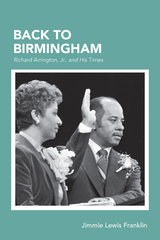
During the 1960s, Birmingham, Alabama was the central battleground in the struggle for human rights in the American South. As one of the most segregated cities in the United States, the city of Birmingham became infamous for its suppression of civil rights and for official and vigilante violence against its African American citizens, most notoriously the use of explosives in the Sixteenth Street Baptist Church bombing and the bombing of the home of Reverend Fred Shuttlesworth.
In October of 1979, Birmingham elected its first Black mayor, Richard Arrington Jr. He was born in the rural town of Livingston, Alabama. His family moved to Birmingham when he was a child. A man of quiet demeanor, he was nevertheless destined to bring to fruition many of the fundamental changes that the Civil Rights Movement had demanded. This is his story. Not a conventional political or Civil Rights history, Back to Birmingham is the story of a man who demonstrated faith in his region and people. The work illuminates Arrington's sense of place, a quality that enables a person to claim sentimentally a portion of the natural and human environment. Franklin passionately underscores the importance of the attachment of Southern Blacks to their land and place.
Back to Birmingham will appeal to both the general reader and the serious student of American society. The book endeavors to bridge the gap between popular and scholarly history. It is guided by the assumption that Americans of whatever description can find satisfaction in comprehending social change and that they are buoyed by the individual triumph of those who beat the odds.
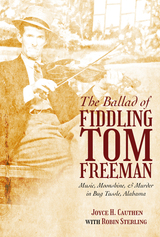
A raw, firsthand account of feuds, fiddling, moonshining, and survival in a small Alabama town, told by its most colorful chronicler and shaped through careful historical insight.
The Ballad of Fiddling Tom Freeman is a riveting portrait of a forgotten America, drawn from the handwritten memoirs of a bootlegger, fiddler, and chronicler of life in Bug Tussle, Alabama, in the first half of the twentieth century. Today, rural voices are often drowned out by polished narratives, but this book resurrects the unfiltered perspective of a man who lived through—and candidly documented—the chaos and violence in his home place as he shared stories of the large close-knit families who lived there.
Freeman’s storytelling is as wild and tangled as the lives he describes, and author Joyce H. Cauthen, with the assistance of historical researcher Robin Sterling, brings clarity and context to his tales without sanding down their rough edges. The result is a vivid, bottom-up history of a place where lawlessness and loyalty often walked hand in hand.
The Ballad of Fiddling Tom Freeman stands out as a testament to the power of personal narrative. Not just a story about one man, it’s a window into a community shaped by hardship, music, and survival, told in a voice that refuses to be forgotten. This book is essential reading for historians, folklorists, musicians, and anyone drawn to the untamed stories of America’s backroads and backwoods.
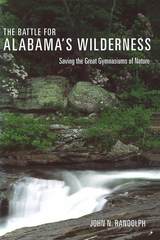
Traces the development of Alabama's environmental movement from its beginnings with the establishment of The Alabama Conservancy in the late 1960s and early '70s to the preservation efforts of present-day activist groups
The grassroots effort to preserve Alabama's Wilderness Areas spanned thirty years, from 1967 to 1997. The first battle, to establish the Sipsey Wilderness in the Bankhead National Forest, was the catalyst for reform of national policy regarding public land preserves in the eastern United States. It, and the later campaigns—to establish the Cheaha Wilderness, to enlarge the Sipsey, and to create the Dugger Mountain Wilderness—are classic tales of citizen activists overcoming the quagmire of federal bureaucracy and the intransigence of hostile politicians. Early political opposition to proposed designation or expansion of wilderness areas in Alabama was based on the belief that limiting development of these lands would negatively impact the state's powerful timber industry. In response to such opposition, serious environmental activism was born in Alabama.
Using newspaper reports, Congressional testimony, interviews, and his own recollections, John Randolph traces the development of Alabama's environmental movement from its beginnings with the establishment of The Alabama Conservancy in the late 1960s and early '70s to the preservation efforts of present-day activist groups, such as the Alabama Environmental Council, the Cahaba River Society, and the Alabama Wilderness Alliance.
The Battle for Alabama's Wilderness permits all of the players—pro and con—to speak for themselves, but the heroes—people like Mary Burks, Blanche Dean, Joab Thomas, and Pete Conroy—embody the vision, hope, and persistence required of those who succeed in their preservation efforts. Randolph's account is a testament to the power of grassroots citizen groups who are committed to a common cause and inspired by a shared ideal.

Traces the little-known story of the bitter contest for the fate of the University of Alabama after the Civil War.
In The Battle for the University of Alabama, William Warren Rogers Jr. gives a fascinating account of the fierce struggle over the nature of the University of Alabama after the Civil War. Union forces reduced the campus to ruins as the war ended, and the university did not reopen until 1869. In the interregnum, powerful forces shifted the trajectory of the school. Alabama Republicans authored an egalitarian state constitution that delivered oversight of the university to the Republican Party. That set the stage for turmoil and confrontation. This book tells the story of that conflict.
In the next few years, Democrats charged Republicans with turning the university into a “radical” institution. They alleged that a handful of unqualified individuals had gained faculty positions because of their political allegiance, which resulted in the university’s academic desecration. Professors were bitterly denounced in the state newspaper press and quite personally in Tuscaloosa. Administration of the university became part of the fratricidal political debate in the state. Political violence and questions concerning race, specifically the possible integration of the university, illuminated the controversies of the Reconstruction years. Many of these questions resonate even today.
This authoritative account sets events at the University of Alabama against the backdrop of what occurred at other state universities in the Reconstruction South. The University of North Carolina experienced controversy similar to Alabama’s. At the University of Georgia, however, calm prevailed. This story of the incendiary events at Alabama’s flagship university charts new ground and provides a revelatory look into the extraordinary partisanship that characterized the South after the Civil War.
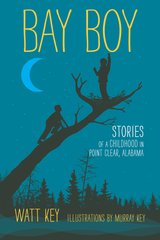
Bay Boy is a collection of essays by award-winning young adult author Watt Key, chronicling his boyhood in Point Clear, Alabama. During his childhood, Point Clear was not the tony enclave of today with its spas, art galleries, and multimillion dollar waterfront properties. Rather, it was a sleepy resort community, practically deserted in the winter, with a considerable population of working-class residents.
As Key notes in his introduction, “Life in Point Clear is really about being outside. . . . I have never found a place so perfectly suited to exercise a young boy’s imagination.” Key and his brother filled their days collecting driftwood to make forts, scooting around the bay in a sturdy Stauter boat, and making art and writing stories when it rained.
In a tone that is simple and direct, punctuated by truly hilarious moments. Key writes about Gulf Coast traditions including Mardi Gras, shrimping, fishing, dove hunting, jubilees, camping out, and bracing for hurricanes. These stories are full of colorful characters— Nasty Bill Dickson, a curmudgeonly tow-truck driver; I’llNeeda, a middle-aged homeless woman encamped in a shack across the road; and the Ghost of Zundel’s Wharf, “the restless soul of a long-dead construction worker.” The stories are illustrated by charming and evocative artwork by the author’s brother Murray Key.

A civil rights attorney’s unflinching memoir about the fight against segregation and systemic racism through landmark legal battles in Alabama
Be Not Afraid: A Southern Journey Through Law, Liberty, and Civil Rights is a timely and unflinching memoir from civil rights attorney Jack Drake, who has spent decades on the front lines of Alabama’s legal battles for racial justice. Raised in a segregated community in Gardendale, Alabama, Drake came of age during the civil rights movement and became a pivotal figure in cases that reshaped the state’s legal and moral landscape.
Drake helped reform Alabama’s grossly inadequate mental health system and supported voting rights efforts throughout Alabama. His career underscores the crucial role private attorneys and grassroots advocates played in enforcing civil rights laws long after their passage.
Through vivid recollections of courtroom battles, civil rights alliances, and personal transformation, Be Not Afraid offers an intimate view into the persistence and courage required to challenge systemic injustice. At a time when debates over equity and democracy remain pressing, Drake’s story is both a powerful reflection on the past and a call to action for the present. It speaks to the enduring importance of legal advocacy and community solidarity in the fight for a more just society, making it essential reading for those engaged in civil rights history, law, or social change.
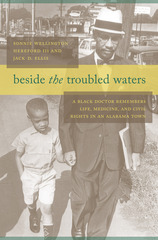
A memoir by an African American physician in Alabama whose story in many ways typifies the lives and careers of black doctors in the south during the segregationist era
Beside the Troubled Waters is a memoir by an African American physician in Alabama whose story in many ways typifies the lives and careers of black doctors in the south during the segregationist era while also illustrating the diversity of the black experience in the medical profession. Based on interviews conducted with Hereford over ten years, the account includes his childhood and youth as the son of a black sharecropper and Primitive Baptist minister in Madison County, Alabama, during the Depression; his education at Huntsville’s all-black CouncillSchool and medical training at MeharryMedicalCollege in Nashville; his medical practice in Huntsville’s black community beginning in 1956; his efforts to overcome the racism he met in the white medical community; his participation in the civil rights movement in Huntsville; and his later problems with the Medicaid program and state medical authorities, which eventually led to the loss of his license.
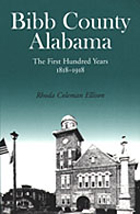
This model county history chronicles one hundred years in the life of a representative Deep South county
The history of Bibb County between 1818 and 1918 is in many ways representative of the experience of central Alabama during that period. Bibb County shares physical characteristics with the areas both to its north and to its south. In its northern section is a mineral district and in its southern valleys fertile farming country; therefore, its citizens have sometimes allied themselves with the hill counties and sometimes with their Black Belt neighbors.
Both sections of the county developed in step with the surrounding counties. Bibb's foundries were established during the same time and by the same iron masters as Shelby County, and its coal mines in the same decade as Jefferson County. Its farmers planted the same crops and faced the same problems as those in Perry, Autauga, and Tuscaloosa counties. Like Tuscaloosa, Bibb endeavored to promote river transportation for both its industrial and its agricultural products.
This carefully documented history is based on a variety of original sources, from personal letters to government records. It is generously illustrated with early maps and with old pictures of Bibb landmarks, many of which have now vanished.
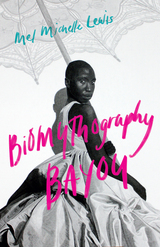
Biomythography Bayou is more than just a book of memoir; it is a ritual for conjuring queer embodied knowledges and decolonial perspectives. Blending a rich gumbo of genres—from ingredients such as praise songs, folk tales, recipes, incantations, and invocations—it also includes a multimedia component, with “bayou tableau” images and audio recording links. Inspired by such writers as Audre Lorde, Zora Neale Hurston, and Octavia Butler, Mel Michelle Lewis draws from the well of her ancestors in order to chart a course toward healing Afrofutures. Showcasing the nature, folklore, dialect, foodways, music, and art of the Gulf’s coastal communities, Lewis finds poetic ways to celebrate their power and wisdom.
Taking a multidimensional approach, Cowett places Newfield's early life in the context of his Hungarian childhood and also relates Newfield’s career to those of fellow Hebrew Union College graduates and to national Reform Jewish history. The reader is made aware constantly of changing conditions in Birmingham, in Alabama, and in the south and how those changes affected Newfield’s congregants. Cowett illuminates Newfield’s efforts to help Jews maintain a sense of religious identity in a predominately Southern and Christian environment.
Based upon essential sources including interviews, newspapers, and manuscript collections in Alabama and at the American Jewish Archives in Cincinnati, Cowett shows Newfield’s struggle to support social welfare efforts in Alabama during the Progressive Era. He recognized the need for Jews to develop bonds with other American ethnic groups. Cowett portrays him as a mediator between not only Jew and Christian but also black and white, labor and capital, liberal and conservative—in short, within the full spectrum of political and social exchange in an industrial city of the New South.
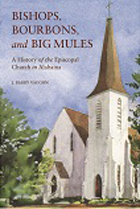
Tells the story of how the Episcopal Church gained influence over Alabama’s cultural, political, and economic arenas despite being a denominational minority in the state
The consensus of southern historians is that, since the Second Great Awakening, evangelicalism has dominated the South. This is certainly true when one considers the extent to which southern culture is dominated by evangelical rhetoric and ideas. However, in Alabama one non-evangelical group has played a significant role in shaping the state’s history. J. Barry Vaughn explains that, although the Episcopal Church has always been a small fraction (around 1 percent) of Alabama’s population, an inordinately high proportion, close to 10 percent, of Alabama’s significant leaders have belonged to this denomination. Many of these leaders came to the Episcopal Church from other denominations because they were attracted to the church’s wide degree of doctrinal latitude and laissez-faire attitude toward human frailty.
Vaughn argues that the church was able to attract many of the state’s governors, congressmen, and legislators by positioning itself as the church of conservative political elites in the state--the planters before the Civil War, the “Bourbons” after the Civil War, and the “Big Mules” during industrialization. He begins this narrative by explaining how Anglicanism came to Alabama and then highlights how Episcopal bishops and congregation members alike took active roles in key historic movements including the Civil War, Reconstruction, and the Civil Rights Movement. Bishops, Bourbons, and Big Mules closes with Vaughn’s own predictions about the fate of the Episcopal Church in twenty-first-century Alabama.
The study of education in Alabama is especially important in understanding black education throughout the United States since the most famous black school, Booker T. Washington's Tuskegee Institute, is located in Alabama and began as a state teachers’ training school. A history of black education in Alabama provides a test case of the frequently assumed dominance of Booker T. Washington and his plan of "industrial'' or vocational training in black education.
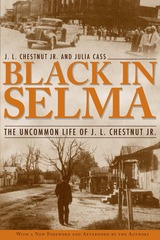
One man’s fight for justice. One town’s reckoning with history.
Born in Selma in 1930, J. L. Chestnut left home to study law at Howard University in Washington, DC. Returning to Selma, Chestnut was the town’s first and only African American attorney in the late 1950s. As the turbulent struggle for civil rights spread across the South, Chestnut became an active and ardent promoter of social and legal equality in his hometown. A key player on the local and state fronts, Chestnut accrued deep insights into the racial tensions in his community and deftly opened paths toward a more equitable future.
Though intimately involved in many events that took place in Selma, Chestnut was nevertheless often identified in history books simply as “a local attorney.” Black in Selma reveals his powerful yet little-known story.
In the 2014 film Selma, director Ava DuVernay takes audiences to the climactic confrontation between civil rights advocates and the state’s security forces of March 1965. Readers looking for a deeper understanding of the events that preceded that epic moment, as well as how racial integration unfolded in Selma in the decades that followed, will find Chestnut’s story and memories both a vital primary source and an inspiration.
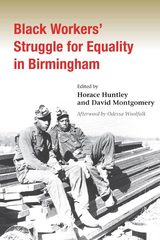
Horace Huntley and David Montgomery curate a collection of annotated oral interviews of black workers who served on the front lines of the Civil Rights Movement in Birmingham, Alabama. As the interviewees recount their struggles against discrimination, they show how collective action--whether through unions, the Movement, or networks of workplace activists--sought to gain access to better jobs, municipal services, housing, and less restrictive voter registration.
Powerful and honest, Black Workers' Struggle for Equality in Birmingham draws on work by the Birmingham Civil Rights Institute to offer readers vivid eyewitness accounts of American history in the making.
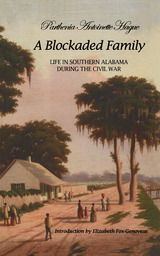
Parthenia Hague experienced the Civil War while employed as a schoolteacher on a plantation near Eufaula, Alabama. This book recounts how a frightened and war-weary household dealt with privations during the blockade imposed on the South by the federal navy. The memoir of Parthenia Hague is a detailed look at the ingenious industry and self-sufficiency employed by anxious citizens as the northern army closed in.

Bonapartists in the Borderlands debunks the standard account of the Vine and Olive Colony, which stresses the failure of aristocratic, luxury-loving French to tame the wilderness. Rafe Blaufarb recounts how Napoleonic exiles and French refugees from Europe and the Caribbean joined forces with Latin American insurgents, Gulf pirates, and international adventurers to seek their fortune in the Gulf borderlands. The US Congress welcomed the French and granted them a capacious tract of rich Black Belt land near Demopolis, Alabama, on the condition that they would establish a Mediterranean-style Vine and Olive colony.
Blaufard shows that it was not a lack of grit that caused the enterprise to fail. Rather, the Napoleonic officers involved in the colony sold their land shares to speculators to finance an even more perilous adventure—invading the Texas borderlands contested by Spain and the US. Their departure left the Vine and Olive colony in the hands of French refugees from the Haitian slave revolt. They soon abandoned vine cultivation and fused with the neighboring communities of Anglo-American slaveholding cotton planters and speculators.
Rafe Blaufarb examines the underlying motivations and aims that inspired this endeavor and details the nitty-gritty politics, economics, and backroom bargaining that resulted in the settlement. He employs a wide variety of local, national, and international resources: from documents held by the Alabama State Archives, Marengo County court records, and French-language newspapers published in America to material from the War Ministry Archives at Vincennes, the Diplomatic Archives at the Quai d’Orasy, and the French National Archives.
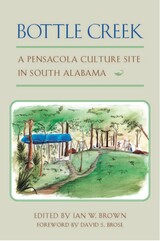
The first comprehensive study and analysis of the most important Mississippian mound site on the north-central Gulf coast
Consisting of 18 earthen mounds and numerous additional habitation areas dating to A.D. 1250-1550, the Bottle Creek site was first professionally investigated in 1932 when David L. DeJarnette of the Alabama Museum of Natural History began work there to determine if the site had a cultural relationship with Moundville, connected to the north by a river system. Although partially mapped in the 1880s, Bottle Creek's location in the vast Mobile-Tensaw Delta of Baldwin County completely surrounded by swamp made it inaccessible and protected it from most of the plunder experienced by similar sites in the Southeast.
This volume builds on earlier investigations to present extensive recent data from major excavations conducted from 1991 to 1994 and supported in part by an NEH grant. Ten anthropologists examine various aspects of the site, including mound architecture, prehistoric diet, pottery classification, vessel forms, textiles used to make pottery impressions, a microlithic stone tool industry, water travel, the persistence of mound use into historic times, and the position of Bottle Creek in the protohistoric world.
The site is concluded to be the best remaining example of Pensacola culture, an archaeological variant of the widespread Mississippian tradition identified by a shell-tempered pottery complex and by its geographic association with the north-central coast of the Gulf of Mexico. Occupied for three centuries by a thriving native culture, Bottle Creek is an important remnant of North American peoples and as such is designated a National Historic Landmark. This published compilation of the research data should establish a base for future scholarly investigation and interpretation.
A Dan Josselyn Memorial Publication
Analyzes and describes the state government of Alabama during the Bourbon Period as it operated under the Democratic and Conservative party
Hailed as the definitive study of the subject when it appeared in 1951, Bourbon Democracy in Alabama analyzes and describes the state government of Alabama during the Bourbon Period as it operated under the Democratic and Conservative party. For this edition, the author has prepared a new foreword in which he surveys recent scholarship. The term Bourbon originated during the Reconstruction Era and was used by the Radicals to label their Democratic opponents as anti-progressive and ultraconservative. The term has been adopted generally to describe the period following the overthrow of Radical Reconstruction.
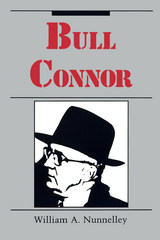
Nunnelley’s biography covers Connor’s early life as a sportscaster, his years as a nearly pathological police chief, and his reign as president of a corrupt public service commission.While providing the first published biographical study of Connor, Bull also traces the evolution of the civil rights movement in Birmingham. The book amplifies traditional one-dimensional accounts through the use of such primary sources a s Connor FBI files gained from a Freedom of Information request, Connor papers discovered in an old fire station about to be demolished, files from a law firm which represented Connor, interviews, and newspaper files. Connor’s racist image remains intact, but a more complete portrait of the controversial commissioner emerges.
Eugene “Bull” Connor gained infamy during the spring of 1963 as the heavy-handed Birmingham police commissioner who turned power hoses and police dogs on the black demonstrators led by Martin Luther King, Jr. Bull Connor and Birmingham symbolized hard-line Southern racism. Connor’s actions received national and international media coverage, which dramatized the plight of black people in segregated areas, giving the civil rights movement much-needed attention. After viewing television reports of the fire-hose and police-dogs episode, President John Kennedy said, “The civil rights movement should thank God for Bull Connor. He helped is as much as Abraham Lincoln.”
Bull Connor was an unlikely catalyst for the civil rights movement. Rather than forestalling integration, his response to the 1963 demonstrations hastened the demise of the dual society of which he became a symbol. Within weeks of King’s much-publicized Birmingham campaign, Congress took the first steps toward enacting the most sweeping civil rights legislation in American history. Birmingham was a turning point in the civil rights struggle, and Connor was the movement’s perfect adversary.

Capture Every Stage of Alabama’s Butterfly Wonder.
Butterflies of Alabama is a full-color, richly illustrated guide to the 84 known species of “true” butterflies (Papilionoidea) found within the state’s borders. For more than 14 years, the authors have made a close study of these showy, winged stars of the insect world, pursuing them in a great variety of habitats, rearing them, and photographing their remarkable life cycle stages—egg, larva (caterpillar), pupa (chrysalid or “cocoon”), and adult.
Each species account is accompanied by color photographs of live subjects in their natural habitats. Close-ups reveal fascinating details of camouflage, mimicry, coloration, and warning devices. The engaging text explains the highly evolved relationships between butterflies and the plants upon which they depend as well as the specialized adaptations that enable their survival within specific environmental niches. Included are range maps, flight times, caterpillar host plants, adult nectar sources, and identification tips—abundant information to tantalize budding as well as experienced butterfly watchers. In addition, pertinent conservation issues are addressed and appendices provide an annotated checklist of the state’s butterflies, a list of accidentals and strays, information on butterfly organizations, and recommended further reading.
With its non-technical language, simple format, and beautiful images, Butterflies of Alabama is accessible and appealing to anyone who appreciates Alabama’s amazing natural wealth.
Publication is supported in part by the Citizens of the City of Selma, Alabama's Butterfly Capital.

“There are four buses that leave Mobile daily for Moss Bayou. No matter what time the trains get in from New Orleans or Birmingham, you still have to wait around half the day for one of theses buses if you want to get to Moss Bayou. And a good many people do, for Moss Bayou is a lovely, easygoing resort town, located as it where Magnolia River runs into the bay with worlds of giant live oaks and sandy roads that wind forever under the trailing Spanish moss.”
So begins Robert Bell’s novel that is most of all about a love affair with a place—the legendary eastern shore of Mobile Bay. Published in 1959, the story centers on young Peter Abbott who is about to reach his 21st birthday while visiting the bay area. Peter is drawn into a search for the mythical Butterfly Tree, and finds fulfillment and an end to innocence. In his introduction, Thomas Rountree helps set the stage for a step back in time, and a slowing of pace, as we seek the timeless magic of a special locale that happens to be in Alabama, and in each of us.
READERS
Browse our collection.
PUBLISHERS
See BiblioVault's publisher services.
STUDENT SERVICES
Files for college accessibility offices.
RECENTLY PUBLISHED






UChicago Accessibility Resources
home | accessibility | search | about | contact us
BiblioVault ® 2001 - 2026
The University of Chicago Press