
 A SCHOLARLY BOOK REPOSITORY
13 start with B start with B
Chinese American Librarians Association Best Book Award (Honorary Mention, Adult Non-fiction category)
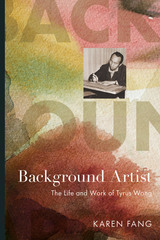
You might not know the name Tyrus Wong, but you probably know some of the images he created, including scenes from the beloved Disney classic Bambi. Yet when he came to this country as a child, Tyrus was an illegal immigrant locked up in an offshore detention center. How did he go on to a long and prosperous career drawing animation cels, storyboards, and greeting cards that shaped the American imagination?
Background Artist shares the inspiring story of Tyrus Wong’s remarkable 106-year life and showcases his wide array of creative work, from the paintings and fine art prints he made working for Roosevelt’s Works Progress Administration to the unique handmade kites he designed and flew on the Santa Monica beach. It tells how he came to the United States as a ten-year-old boy in 1920, at a time when the Chinese Exclusion Act barred him from legal citizenship. Yet it also shows how Wong found American communities that welcomed him and nurtured his artistic talent. Covering everything from his work as a studio sketch artist for Warner Bros. to the best-selling Christmas cards he designed for Hallmark and other greeting card companies, this book celebrates a multitalented Asian American artist and pioneer.

Of the conceptual artists who began their careers in the 1960s and 1970s—Bruce Nauman, Chris Burden, Vito Acconci, and Mel Bochner among them—Barry Le Va may be the most elusive. As this first study of his work reveals, his rigorously planned art was instigated to mask its creator’s intentions and methods, presenting itself as an “aftermath” of modernism’s claim to permanency and civil society’s preferred mode of monumentalism.
For Michael Maizels, Le Va’s work constitutes a particularly productive subject of inquiry because it clearly articulates the interconnection between the avant-garde’s distrust of autonomous art objects, two decades of social unrest, the emergence of information theory, and lingering notions of scientific objectivity. Barry Le Va: The Aesthetic Aftermath explores how Le Va used such materials as shattered glass, spent bullets, sound recordings, scattered flour, and meat cleavers embedded in a floor to challenge the interlocking assumptions behind blind faith in lasting beauty, just government, and perfectible knowledge. Taking inspiration from popular crime novels as well as contemporary art theory, Le Va charged his viewers to attempt, like detectives at a crime scene, to decipher an order underlying the apparent chaos.
Le Va’s installations were designed to erode not simply the presumed autonomy of the art object but also the economic and political authority of the art establishment. In his concluding chapter, Maizels looks at the more fixed work of the past two decades in which Le Va turned to architectural themes and cast concrete to probe the limits of dynamism and the idea of permanence.
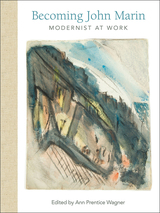
John Marin was a major figure among the cutting-edge circle of American modernist artists who showed his work in Alfred Stieglitz’s New York galleries from 1909 until 1950. A new collection of the artist’s work at the Arkansas Arts Center, given by Marin’s daughter-in-law, forms the basis of this first book of essays and images to concentrate on Marin’s drawings in the context of Marin’s life, his watercolors, and his etchings.
We follow Marin to his most famous subject matter: New York City and the coast of Maine. Foundational drawings and an unfinished watercolor of the towering Woolworth Building, still under construction when they were made in 1912, begin the story of a renowned group of watercolors first exhibited in 1913 at Alfred Stieglitz’s 291 Gallery and then at the ground-breaking 1913 Armory Show. Other images take us to lesser-known locales, such as the Ramapo Mountains in New York and New Jersey where Marin often painted when he couldn’t get to Maine. More obscure aspects of the artist’s career explored in this collection include portraits of friends and family, charming drawings of animals, and circus scenes.
Becoming John Marin invites readers to look over this important artist’s shoulder as he created and honed the sketches he would interpret into completed watercolors and etchings, illustrating the evolution of his style and methods as he transformed from intuitive draftsman to innovative modernist watercolorist and etcher.
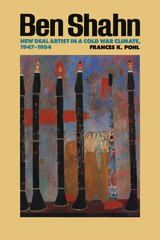
In the first, most intense years of the Cold War (1947–1954), New Deal liberals often found themselves in great disfavor. Ben Shahn's experience presents something of a paradox, however, since his paintings appealed in different ways to both liberals and conservatives. Blacklisted by CBS during the McCarthy era and yet, ironically, incorporated into presidential "campaigns of truth" aimed at improving the U.S. image abroad, Ben Shahn is a pivotal figure, revealing the complexities and contradictions inherent in this highly polarized moment in American history.
In this pathbreaking study, Frances Pohl traces the political and artistic struggles Ben Shahn became embroiled in as he tried to remain a socially concerned artist during the early Cold War period. She shows how he rejected the argument, voiced by many Abstract Expressionists, that art and politics should not mix, yet at the same time searched for a way to depict, in universal and allegorical terms, the broad human condition rather than simply specific instances of injustice. Perhaps most important, she makes critical connections between U.S. social and political history and the art it provoked, thus illuminating both the later career of Ben Shahn and the Cold War era in American cultural history.

Contributors. Stephen Barker, Ed Cohen, Tom Cohen, Claire Colebrook, Arne De Boever, Benoît Dillet, Alexander R. Galloway, Mark B. N. Hansen, Jason R. LaRivière, Gerald Moore, Daniel Ross, Bernard Stiegler
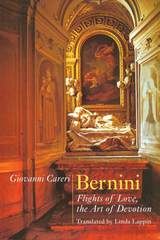
In the Fonseca Chapel, the Albertoni Chapel, and the church of Sant' Andrea al Quirinale, all in Rome, Careri identifies three types of ensemble and links each to a particular spiritual journey. Using contemporary theories in anthropology, film, and reception aesthetics, he shows how Bernini's formal mechanisms established an emotional dynamic between the beholder and a specific arrangement of forms. As an inquiry into the ways art in a certain historical context transformed and was transformed by its audience, Bernini: Flights of Love, the Art of Devotion is also a penetrating investigation into the aesthetic principles of multimedia composition.


Blanche Lazzell went from Maidsville, West Virginia, to the leading edge of twentieth-century American art. A member of the prominent art communities of Paris and Provincetown, MA during the '20s and '30s, Lazzell was always on the fringe of important developments in the modern art world. Her studies in Paris led her to adopt the techniques of modernism as well as other emerging styles. Among her groundbreaking works were some of the first examples of abstraction in America. Blanche Lazzell: The Life and Work of an American Modernist is a significant contribution to the history of twentieth-century American art.
Know primarily as a Provincetown printmaker, Lazzell’s full life and career are presented here, generously accompanied by color reproductions of her work, showing the breadth of her accomplishment in painting, printmaking, and hooked rugs. Lazzell's true contribution to American art history was never fully appreciated during her lifetime. A renewed interest in the artist has developed over the past fifteen years, due mostly to the critical appreciation of her color wood block prints. She is worth remembering not only for her own work, but also for her role as a translator of the achievements of the European modernists for her colleagues in America. In Blanche Lazzell: The Life and Work of an American Modernist, nine essays and hundreds of full-color illustrations bring this incredibly talented and influential artist's work to life.
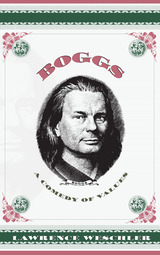
"Lawrence Weschler, who evidently admires [Boggs]-something not difficult to do-has written what may be the most extraordinary biography imaginable: "weird," to use a favourite Boggs word. It does something towards changing our entire outlook on money and its uses. And the reader is left with an uneasy feeling that anything in this world can be created by drawing it." —Ruth Rendell, Daily Telegraph
"As ideal a subject matter as money is for Boggs' genius, Boggs is as ideal a topic for Weschler's considerable talents. . . . A writer any less lucid than Weschler would smudge the lines, making of Boggs a counterculture caricature or a high-art huckster. And a writer any less confident would knock the balance, making academic mud pies of Boggs' enlightened chaos." —Jonathon Keats, San Francisco Chronicle Book Review
"[A] witty and engaging chronicle. . . . Weschler's fascinating account of the artist as agent provocateur demonstrates both the significance of Boggs's art and his determination to continue his unusual critique of the idea of money." —Henry Wessells, Washington Post Book World
"[A] witty, excellently written account of a bizarre and fascinating snippet of modern life." —Paul Ormerod, Times Higher Education Supplement
"The book, like the artist, challenges people to pause and consider the extent to which the economic bedrock of everyday life is in part a confusing welter of artistic abstractions. It's a work that is at once informative, entertaining, and provocative-a reading experience, one might say, of rather good value." —Toby Lester, Atlantic Monthly
"[A] fascinating tale, especially in these days of fluctuating currency rates, the euro, and inexplicable Net-stock valuations." —Paul Lukas, Fortune
Lawrence Weschler, a recipient of the prestigious Lannan Literary Award for 1998, is the author of numerous books, including Calamities of Exile: Three Nonfiction Novellas, and Mr. Wilson's Cabinet of Wonder, which was a finalist for both the Pulitzer Prize and the National Book Critics Circle Award.

Brightening Glance offers a stunningly self-revealing portrait of the struggles and sacrifices, joys and excitement inherent in a modern painter’s life, and captures the evergreen allure of New York’s art world between 1970 and 2010. In stripped down, elegant prose, Lipsky summons a New York that no longer exists and ponders why we love (and hate) the art world. Ultimately, it’s a story of a contemporary woman, a mother, and a painter, who dares a career in a field where only a handful of women have succeeded.
READERS
Browse our collection.
PUBLISHERS
See BiblioVault's publisher services.
STUDENT SERVICES
Files for college accessibility offices.
RECENTLY PUBLISHED



UChicago Accessibility Resources
home | accessibility | search | about | contact us
BiblioVault ® 2001 - 2025
The University of Chicago Press