
 A SCHOLARLY BOOK REPOSITORY
2150 start with C start with C

Careful reading of contemporary texts reveals a decades-long process as tumultuous and unsteady as the political events they echoed, one in which multiple and competing strategies for reconceiving the nature of masculinity were tested, employed, discarded, and adopted in a complex public-private discourse. The eventual reconstitution of a definition of Roman manhood was not easily agreed upon. Masculinity in both the Republic and the Empire are well-studied subjects, but by shining a light on the precise moment of transition Racette-Campbell unveils the complexity, contours, and nuances of the Augustan crisis of masculinity.
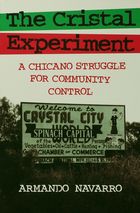
Amidst the turbulence and militancy of the 1960s and early 1970s, the Mexicano population of the dusty agricultural town of Crystal City, Texas (Cristal in Spanish), staged two electoral revolts, each time winning control of the city council and school board. The landmark city council victory in 1963 was a first for Mexican Americans in South Texas, and Cristal—the “spinach capital of the world”—became for a time the political capital of the Chicano Movement.
In The Cristal Experiment, Armando Navarro presents the most comprehensive examination to date of the rise of the Chicano political movement in Cristal, its successes and conflicts (both internal and external), and its eventual decline. He looks particularly at the larger and more successful “Second Revolt” in 1970 and its aftermath up to 1981, examining the political, economic, educational, and social changes for Mexicanos that resulted. Drawing upon nearly 100 interviews, a wealth of secondary materials, and his own experiences as a political organizer in the Chicano Movement, Navarro offers a shrewd and insightful analysis not only of the events in Cristal, but also of the workings of local politics generally, the politics of community control, and the factors inherent in the American political system that lead to the self-destruction of political movements. As both a political scientist and an organizer, he outlines important lessons to be learned from what happened in Cristal and to the Chicano Movement.
This study revolves around the career of Kobayashi Hideo (1902–1983), one of the seminal figures in the history of modern Japanese literary criticism, whose interpretive vision was forged amidst the cultural and ideological crises that dominated intellectual discourse between the 1920s and the 1940s.
Kobayashi sought in criticism a vehicle through which to rhetorically restore to the artistic work an aura of concreteness that precluded interpretation and instead inspired awe, to somehow recover a literary experience unmediated by intellectual machinations. In adhering firmly to this worldview for the duration of World War II, Kobayashi came to assume a complex stance toward the wartime regime. Although his interweaving of aesthetics and ideology exhibited elements of both resistance and complicity, his critical ethos served ultimately to undergird his wartime fascist stance by encouraging acquiescence to authority, championing patriotism, and calling for more vigorous thought control.
Treating Kobayashi’s influential works and the historical context in which they are rooted, James Dorsey traces the emergence of a modern critical consciousness in conversation with such concerns as the nature of materiality in capitalist culture, the relationship of narrative to subjectivity, and the nostalgia for beauty in a time of war.
This bibliographic guide directs the reader to a prize selection of the best modern, analytical studies of every play, anonymous play, masque, pageant, and "entertainment" written by more than two dozen contemporaries of Shakespeare in the years between 1580 and 1642. Together with Shakespeare's plays, these works comprise the most illustrious body of drama in the English language.
Frederick Aldama’s The Cinema of Robert Rodriguez (2014) was the first full-scale study of one of the most prolific and significant Latino directors making films today. In this companion volume, Aldama enlists a corps of experts to analyze a majority of Rodriguez’s feature films, from his first break-out success El Mariachi in 1992 to Machete in 2010. The essays explore the formal and thematic features present in his films from the perspectives of industry (context, convention, and distribution), the film blueprint (auditory and visual ingredients), and consumption (ideal and real audiences). The authors illuminate the manifold ways in which Rodriguez’s films operate internally (plot, character, and event) and externally (audience perception, thought, and feeling).
The volume is divided into three parts: “Matters of Mind and Media” includes essays that use psychoanalytic and cognitive psychology to shed light on how Rodriguez’s films complicate Latino identity, as well as how they succeed in remaking audiences’ preconceptions of the world. “Narrative Theory, Cognitive Science, and Sin City: A Case Study” offers tools and models of analysis for the study of Rodriguez’s film re-creation of a comic book (on which Frank Miller was credited as codirector). “Aesthetic and Ontological Border Crossings and Borderlands” considers how Rodriguez’s films innovatively critique fixed notions of Latino identity and experience, as well as open eyes to racial injustices. As a whole, the volume demonstrates how Rodriguez’s career offers critical insights into the filmmaking industry, the creative process, and the consuming and reception of contemporary film.
This beautifully written and deeply personal book is an informative and fascinating read that will be of interest to anyone interested in Critical Media and Communication Studies and the Political Economy of Communication.
Young people will bear the brunt of the impacts of present and emerging crises occurring at all scales, from the national to the global. This volume brings together scholars and activists from various backgrounds to analyze youth interactions with law and politics, focusing specifically on the US legal landscape. It uses the lens of youth geographies to consider how legal and political systems shape our spaces, and provides leading-edge perspectives through case studies of child labor, compulsory education, asylum claims, criminalization of youth, youth activism, and more.
Of special interest in this volume is the tension between young people as both objects of law and policy and creative agents of change. Despite being directly affected by law and policy, young people are denied access to many legally sanctioned paths to shape them. Yet youth find ways to work within and mold the social, political, and legal spheres and set the stage for alternative futures.

Cultural and natural heritage are central to ideas of what Europe and “the European project’” are. Heritage studies were prevalent in the emergence of nation-states in the eighteenth and nineteenth centuries, where they were used to justify differences over which border conflicts were fought. Later, the idea of a “common European heritage” provided a rationale for the development of the European Union. Now, the emergence of “new” populist nationalisms shows how the imagined past continues to play a role in cultural and social governance, while a series of interlinked social and ecological crises are changing the ways that heritage operates, with new discourses and ontologies emerging to reconfigure heritage for the circumstances of the present and the uncertainties of the future.
Aileen Moreton-Robinson’s introductory essay provides a context for the emerging discipline. The volume is organized into three sections: the first includes essays that interrogate the embedded nature of Indigenous studies within academic institutions; the second explores the epistemology of the discipline; and the third section is devoted to understanding the locales of critical inquiry and practice.
Each essay places and contemplates critical Indigenous studies within the context of First World nations, which continue to occupy Indigenous lands in the twenty-first century. The contributors include Aboriginal, Metis, Maori, Kanaka Maoli, Filipino-Pohnpeian, and Native American scholars working and writing through a shared legacy born of British and later U.S. imperialism. In these countries, critical Indigenous studies is flourishing and transitioning into a discipline, a knowledge/power domain where distinct work is produced, taught, researched, and disseminated by Indigenous scholars.
View the Table of Contents here.
Contributors:
Hokulani K. Aikau
Chris Andersen
Larissa Behrendt
Vicente M. Diaz
Noelani Goodyear Kaopua
Daniel Heath Justice
Brendan Hokowhitu
Aileen Moreton-Robinson
Jean M. O'Brien
Noenoe Silva
Kim Tallbear
Robert Warrior
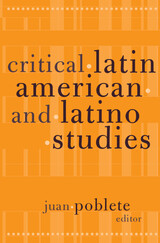
Situates these dynamic disciplines within debates around globalization
This book brings together some of the most prominent scholars working across the spectrum of Latin American and Latino studies to explore their changing intellectual undertaking in relation to global processes of change. Critical Latin American and Latino Studies identifies the challenges and possibilities of more politically engaged and theoretically critical modes of scholarly practice.
One objective is to provide a brief critical history of the study of various Latin American cultures—Latino, Chicano, Puerto Rican, among others. But these essays also serve to assess the roles of ethnic and area studies in light of changing scholarly trends, from emphases on gender and sexuality to a focus on postcoloniality and globalization. The result is an important contribution to current debates on the conditions of contemporary knowledge production. Contributors: Tomás Almaguer, San Francisco State U; Frances R. Aparicio, U of Illinois, Chicago; John Beverley, U of Pittsburgh; Angie Chabram-Dernersesian, U of California, Davis; Román de la Campa, SUNY, Stony Brook; Juan Flores, Hunter College and CUNY; Walter D. Mignolo, Duke U; Giorgio Perissinotto, U of California, Santa Barbara; Kirsten Silva Gruesz, U of California, Santa Cruz; Stefano Varese, U of California, Davis; George Yúdice, NYU; Juan Zevallos Aguilar, Villanova U.
The articles in this collection build on recent work in the larger arena of disability studies and address such subjects as the hegemony of the concept of normalcy, the idea of the able body, and the constitutive place of disability in ethics, liberalism, and capitalism. The Critical Limits of Embodiment examines the commonsense foundations of disability studies, which tend to universalize Western norms and assumptions in which the normal is foregrounded and the able body forms the basis for the universal liberal subject. The broad geographic scope of these essays constitutes one of their greatest contributions to the field. In order to query the body-related universalisms of Western thought, the issue seeks to be self-conscious about cultural locations.
The volume examines the figure of the disabled in the cultural imaginaries of a variety of historical, cultural, and disciplinary contexts including literature, anthropology, philosophy, and art history.
Contributors. Renu Addlakha, Carol A. Breckenridge, Veena Das, Faye Ginsburg, Wu Hung, Eva Kittay, Celeste Langan, David Mitchell, Rayna Rapp, Susan Schweik, Sharon Snyder, Candace Vogler, Hank Vogler
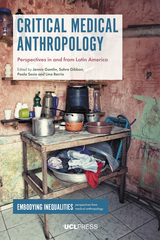
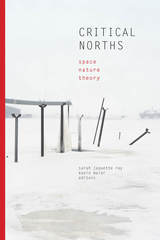
This book brings together scholars from a range of disciplines to ask key questions about the North and how we’ve conceived it—and how conceiving of it in those terms has caused us to fail the region’s human and nonhuman life. Engaging questions of space, place, indigeneity, identity, nature, the environment, justice, narrative, history, and more, it offers a crucial starting point for an essential rethinking of both the idea and the reality of the North.

A key participant in the major debates in Latin American studies—beginning with the “boom” period of the 1960s and continuing through debates on ideology and discourse, Marxism, mass culture, and postmodernism—Franco is recognized for her feminist critique of Latin American writing. While her principal books are all readily available, Franco’s several dozen articles are dispersed in a variety of periodicals in Latin America, Europe, and the United States. Although many of these essays are considered pioneering and classic, they have never before been collected in a single work. In this volume, Mary Louise Pratt and Kathleen Newman have organized the essays into four interrelated sections: feminism and the critique of authoritarianism, mass and popular culture, Latin American literature from the “boom” onward, and the cultural history of Mexico. As a group, these writings demonstrate Franco’s ability to reflect on and judge with equal seriousness all spheres of expression, whether subway graffiti, a fashion manual, or an avant-garde haiku. A bona fide fan of popular and mass media, Franco never allows her critiques to dissolve into the puritanical or reductive; instead, she finds ways to present and debate complex theoretical questions in direct and accessible language.
This volume will draw an extensive readership in Latin American, cultural, and women’s studies.

In Massachusetts, the Latino population increased by 475 percent between 1980 and 2017, marking a dramatic growth. This diverse ethnic community of Puerto Ricans, Dominicans, Salvadoreans, Colombians, Brazilians, and more also contains a wide range of cultures, immigration and migration experiences, languages, and socio-political backgrounds. However, there are numerous commonalities involving education. Recent research at the Mauricio Gastón Institute for Latino Community Development and Policy reveals that Latino students in Massachusetts are more likely to attend public schools, in communities with significant academic achievement and opportunity gaps as well as other challenges, from food scarcity to higher rates of unemployment. At the same time, the state-wide shift to standards-based education has had a disproportionately negative impact on Latino students, who already feel the effects of politically motivated anti-immigrant policies and laws that limit bilingual education.
This collection of essays, from those working inside the classroom as well as researchers taking a broader look at policy, addresses the array of issues facing Latino students in Massachusetts. These perspectives paint a complex picture of the educational experience for Latinos, and offer expert suggestions for improving classrooms, school environments, and ultimate educational outcomes for an important growing demographic in the Commonwealth.
In addition to editors Lorna Rivera and Melissa Colón, this volume’s contributors include Almudena G. Abeyta, Nasteho Ali, Cristina Araujo Brinkerhoff, Michael Berardino, Alex Briesacher, Thomas Conroy, Judenie Dabel, Liya Escalera, Luis Enrique Esquivel, Deyja Enriquez, Isahiah Erilus, Nyal Fuentes, Jazmin Rubi Flete Gomez, Manuel Frau-Ramos, Kimberly A. S. Howard, Patricia Krueger-Henney, Steven Lue, Mary Jo Marion, Timothy E. Murphy, Cecilia Nardi, Laurie Occhipinti, Alexandra Oliver-Davila, Chong Myung Park, Angelica Rodriquez, Marta T. Rosa, Diana Santiago, Melissa Sargent, Ester Shapiro, V. Scott H. Solberg, Fabián Torres-Ardila, Ashley Torres Carrasquillo, Paul Trunfio, Carmen N. Veloria, and Heilam Xie.
This edition contains treatment of all the topics covered in the first edition, along with provocative and probing questions for discussion and detailed suggestions for additional reading, all of which set this fine volume apart from the field. In addition, this edition contains five new substantive units -- crime, critical race practice, intergroup tensions and alliances, gay/lesbian issues, and transcending the black-white binary paradigm of race. In each of these areas, groundbreaking scholarship by the movement's founding figures as well as the brightest new stars provides immediate entre to current trends and developments in critical civil rights thought.
The contributions, from a stellar roster of established and emerging scholars, address new topics, such as intersectionality and black men on the "down low." Essays also confront much-discussed issues of discrimination, workplace dynamics, affirmative action, and sexual politics. Also new to this volume are updated section introductions, author notes, questions for discussion, and reading lists for each unit. The volume also covers the spread of the movement to other disciplines such as education.
Offering a comprehensive and stimulating snapshot of current race jurisprudence and thought, this new edition of Critical Race Theory is essential for those interested in law, the multiculturalism movement, political science, education, and critical thought.
Contributors. Douglas Booth, Peter Brosius, Robin Canniford, Krista Comer, Kevin Dawson, Clifton Evers, Chris Gibson, Dina Gilio-Whitaker, Dexter Zavalza Hough-Snee, Scott Laderman, Kristin Lawler, lisahunter, Colleen McGloin, Patrick Moser, Tara Ruttenberg, Cori Schumacher, Alexander Sotelo Eastman, Glen Thompson, Isaiah Helekunihi Walker, Andrew Warren, Belinda Wheaton
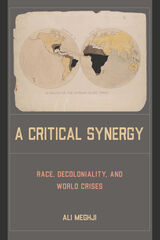
The differences between decolonial thought and CRT, Meghji insists, does not necessarily imply one approach is stronger. Rather, he asserts, they often provide alternative but not incompatible viewpoints of the same social problem. Meghji presents case studies of capitalism, the COVID-19 pandemic, climate crisis, and twenty-first-century far-right populism to show that with both theories, we can understand more, as insights may be lost by using only one.
Meghji is not calling for a universal theoretical synthesis in A Critical Synergy, but rather a practice that can help open sociology and social science to the tradition of pluriversality much more broadly.
Written by a distinguished group of scholars, the essays compiled in this volume take stock of African studies today and look toward a future beyond its fraught intellectual and political past. Each essay discusses one of our most critical terms for talking about Africa, exploring the trajectory of its development while pushing its boundaries. Editors Gaurav Desai and Adeline Masquelier balance the choice of twenty-five terms between the expected and the unexpected, calling for nothing short of a new mapping of the scholarly field. The result is an essential reference that will challenge assumptions, stimulate lively debate, and make the past, present, and future of African Studies accessible to students and teachers alike.
So write women’s studies pioneer Catharine R. Stimpson and anthropologist Gilbert Herdt in their introduction to Critical Terms for the Study of Gender, laying out the wide-ranging nature of this interdisciplinary and rapidly changing field. The sixth in the series of “Critical Terms” books, this volume provides an indispensable introduction to the study of gender through an exploration of key terms that are a part of everyday discourse in this vital subject.
Following Stimpson and Herdt’s careful account of the evolution of gender studies and its relation to women’s and sexuality studies, the twenty-one essays here cast an appropriately broad net, spanning the study of gender and sexuality across the humanities and social sciences. Written by a distinguished group of scholars, each essay presents students with a history of a given term—from bodies to utopia—and explains the conceptual baggage it carries and the kinds of critical work it can be made to do. The contributors offer incisive discussions of topics ranging from desire, identity, justice, and kinship to love, race, and religion that suggest new directions for the understanding of gender studies. The result is an essential reference addressed to students studying gender in very different disciplinary contexts.
Critical Theory of Communication offers a vital set of new insights on how communication operates in the age of information, digital media and social media, arguing that we need to transcend the communication theory of Habermas by establishing a dialectical and cultural-materialist critical theory of communication.
It is the first title in a major new book series 'Critical Digital and Social Media Studies' published by the University of Westminster Press.
*How was whiteness invented, and why?
*How has the category whiteness changed over time?
*Why did some immigrant groups, such as the Irish and Jews, start out as nonwhite and later became white?
*Can some individual people be both white and nonwhite at different times, and what does it mean to "pass for white"?
*At what point does pride in being white cross the line into white power or white supremacy?
*What can whites concerned over racial inequity or white privilege do about it?
Science and pseudoscience are presented side by side to demonstrate how our views on whiteness often reflect preconception, not fact. For example, most scientists hold that race is not a valid scientific category -- genetic differences between races are insignificant compared to those within them. Yet, the "one drop" rule, whereby those with any nonwhite heritage are classified as nonwhite, persists even today. As the bell curve controversy shows, race concepts die hard, especially when power and prestige lie behind them.
A sweeping portrait of the emerging field of whiteness studies, Critical White Studies presents, for the first time, the best work from sociology, law, history, cultural studies, and literature. Delgado and Stefancic expressly offer critical white studies as the next step in critical race theory. In focusing on whiteness, not only do they ask nonwhites to investigate more closely for what it means for others to be white, but also they invite whites to examine themselves more searchingly and to "look behind the mirror."
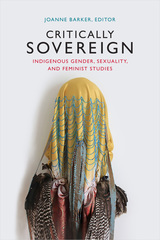
Contributors. Jodi A. Byrd, Joanne Barker, Jennifer Nez Denetdale, Mishuana Goeman, J. Kēhaulani Kauanui, Melissa K. Nelson, Jessica Bissett Perea, Mark Rifkin
"A profound meditation on relations obtaining among writing, political consciousness, and criticism—this last taken in its most general sense. It is written with passion and grace; it is shot through with learning, intimate knowledge of the critical tradition, and a deep (though by no means uncritical) understanding of the work (as well as social significance) of Kenneth Burke."—Hayden White
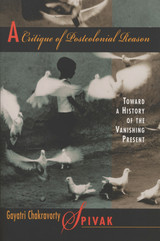
Are the “culture wars” over? When did they begin? What is their relationship to gender struggle and the dynamics of class? In her first full treatment of postcolonial studies, a field that she helped define, Gayatri Chakravorty Spivak, one of the world’s foremost literary theorists, poses these questions from within the postcolonial enclave.
“We cannot merely continue to act out the part of Caliban,” Spivak writes; and her book is an attempt to understand and describe a more responsible role for the postcolonial critic. A Critique of Postcolonial Reason tracks the figure of the “native informant” through various cultural practices—philosophy, history, literature—to suggest that it emerges as the metropolitan hybrid. The book addresses feminists, philosophers, critics, and interventionist intellectuals, as they unite and divide. It ranges from Kant’s analytic of the sublime to child labor in Bangladesh. Throughout, the notion of a Third World interloper as the pure victim of a colonialist oppressor emerges as sharply suspect: the mud we sling at certain seemingly overbearing ancestors such as Marx and Kant may be the very ground we stand on.
A major critical work, Spivak’s book redefines and repositions the postcolonial critic, leading her through transnational cultural studies into considerations of globality.

It introduces a theoretical framework that engages with important themes including the crisis-ridden structural transformation of the media industry, media economics in the age of digital communications, media concentration, science communication and open access publishing, media technologies, the role of advertising in capitalism, and the contradictions of alternative media in capitalism.
The critique uses a novel device in that the same set of ethnographic “facts” are looked at through different theories. This reveals a good deal about the different theories. By the same token, of course, this critique goes into the question of what a “fact” of “kinship” might be and how to recognize one either at home or in the field.
Schneider’s critique also uses history to raise cogent questions about how kinship has been studied. But it is not as 20/20 hindsight that history is used. Due respect is paid to the climate of the time, as well as the climatic changes and the ways in which these helped to create the emperor’s clothes. Right, wrong, or indifferent, Schneider’s study of how the emperor “kinship” was dressed and then redressed as the winds of change threatened disarray, proves challenging to the theories by which anthropology lives, as well as to the specifically privileged domain of “kinship.” The implications of this study for a wide range of problems within theoretical anthropology are striking.

Drawing on archival research and oral testimonies, Nikolina .idek explores how intergenerational memory shaped identity across time. She shows how the community preserved its origins while adapting to new realities, ultimately transforming into “planetary Croats” who use social media and transnational networks to connect with Croatia and the global diaspora.
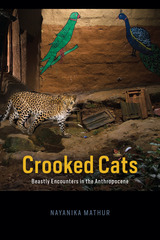
There are many theories on why and how a big cat comes to prey on humans, with the ecological collapse emerging as a central explanatory factor. Yet, uncertainty over the precise cause of crookedness persists. Crooked Cats explores in vivid detail the many lived complexities that arise from this absence of certain knowledge to offer startling new insights into both the governance of nonhuman animals and their intimate entanglements with humans. Through creative ethnographic storytelling, Crooked Cats illuminates the Anthropocene in three critical ways: as method, as a way of reframing human-nonhuman relations on the planet, and as a political tool indicating the urgency of academic engagement. Weaving together “beastly tales” spun from encounters with big cats, Mathur deepens our understanding of the causes, consequences, and conceptualization of the climate crisis.
In vivid, inventive, and engaging prose, Pandian weaves together ethnographic encounters, archival investigations, and elements drawn from Tamil poetry, prose, and popular cinema. Tacking deftly between ploughed soils and plundered orchards, schoolroom lessons and stationhouse registers, household hearths and riverine dams, he reveals moral life in the postcolonial present as a palimpsest of traces inherited from multiple pasts. Pursuing these legacies through the fragmentary play of desire, dream, slander, and counsel, Pandian calls attention not only to the moral potential of ordinary existence, but also to the inescapable force of accident, chance, and failure in the making of ethical lives. Rarely are the moral coordinates of modern power sketched with such intimacy and delicacy.
This study portrays individuals, organizations, and events that contributed to the development of the world movement for women's rights between 1848 and 1948.
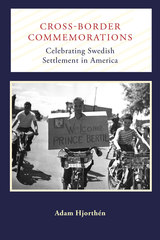
Focusing on two celebrations of Swedish settlement in America—the 1938 New Sweden Tercentenary and the 1948 Swedish Pioneer Centennial—Hjorthén examines a wide variety of sources to demonstrate how cultural leaders, politicians, and businessmen used these events to promote international relations between the United States and Sweden during times of great geopolitical transformation. Cross-Border Commemorations argues that scholarship on public commemoration should expand beyond national borders and engage the shared and contested meanings of history across local, national, and transnational contexts.

International migration presents the human face of globalization, with consequences that make headlines throughout the world. The Cross-Border Connection addresses a paradox at the core of this phenomenon: emigrants departing one society become immigrants in another, tying those two societies together in a variety of ways. In nontechnical language, Roger Waldinger explains how interconnections between place of origin and destination are built and maintained and why they eventually fall apart.
“When are immigrants ‘us’? When are they ‘them’? Waldinger implores readers to reframe the debate from a before-after dichotomy to a new transnational approach, revealing migrants to be here, there, and in-between at all stages of their migration tenure…The book’s real strength is in the elegance of the author’s argument, supported by evidence that transnationalism itself is not static but an ongoing dialectic.”
—R. A. Harper, Choice
“The Cross-Border Connection is to be commended for putting substance into the black box of transnationalism, offering scholars a dynamic model to account for the ebb and flow of transnationalism in the real world and yielding testable propositions about the circumstances under which cross-border connections can be expected to expand or contract.”
—Douglas S. Massey, American Journal of Sociology
In writing Black Boy, the centerpiece of the Chicago Renaissance, Wright was inspired by Theodore Dreiser. Because the European and African cultural visions that Wright, Ralph Ellison, Alice Walker, and Toni Morrison acquired were buttressed by the universal humanism that is common to all cultures, this ideology is shown to transcend the problems of society. Fascinated by Eastern thought and art, Wright, Walker, Sonia Sanchez, and James Emanuel wrote highly accomplished poetry and prose. Like Ezra Pound, Wright was drawn to classic haiku, as reflected in the 4,000 haiku he wrote at the end of his life. As W. B. Yeats’s symbolism was influenced by his cross-cultural visions of noh theatre and Irish folklore, so is James Emanuel’s jazz haiku energized by his cross-cultural rhythms of Japanese poetry and African American music.
The book demonstrates some of the most visible cultural exchanges in modern and postmodern African American literature. Such a study can be extended to other contemporary African American writers whose works also thrive on their cross-cultural visions, such as Amiri Baraka, Ishmael Reed, Charles Johnson, and haiku poet Lenard Moore.
This intriguing book, original published in 1981, considers the Quechans as a case history of the frequent discrepancy between benevolently phrased national intention and exploitative local action. The story of their changing life is traced through the anti-poverty programs of the 1960s and '70s—showing how the implementation of these programs was affected by features of community life that had evolved over preceding decades—and culminates in the Quechans’ forging a self-sustaining though fragile economy despite their status as Federal wards.
This book is more than a product of archival research. Author Robert Bee attended Quechan public gatherings, canvassed the community, and conducted intensive interviews over a thirteen-year period to attain an intimate understanding of this people’s perseverance in the face of age-old frustration. In presenting their story, Bee focuses on the behavior and actions of individuals thrust into key decision-making roles to provide more than just abstract analysis. What emerges is not only a unique ethnohistorical approach to economic development, but a model history of a modern tribe.
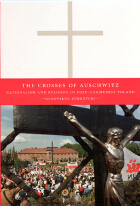
In the summer and fall of 1998, ultranationalist Polish Catholics erected hundreds of crosses outside Auschwitz, setting off a fierce debate that pitted Catholics and Jews against one another. While this controversy had ramifications that extended well beyond Poland’s borders, Geneviève Zubrzycki sees it as a particularly crucial moment in the development of post-Communist Poland’s statehood and its changing relationship to Catholicism.
In The Crosses of Auschwitz, Zubrzycki skillfully demonstrates how this episode crystallized latent social conflicts regarding the significance of Catholicism in defining “Polishness” and the role of anti-Semitism in the construction of a new Polish identity. Since the fall of Communism, the binding that has held Polish identity and Catholicism together has begun to erode, creating unease among ultranationalists. Within their construction of Polish identity also exists pride in the Polish people’s long history of suffering. For the ultranationalists, then, the crosses at Auschwitz were not only symbols of their ethno-Catholic vision, but also an attempt to lay claim to what they perceived was a Jewish monopoly over martyrdom.
This gripping account of the emotional and aesthetic aspects of the scene of the crosses at Auschwitz offers profound insights into what Polishness is today and what it may become.
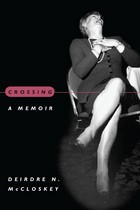
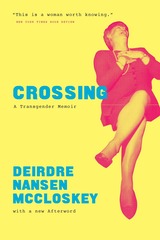
“I visited womanhood and stayed. It was not for the pleasures, though I discovered many I had not imagined, and many pains too. But calculating pleasures and pains was not the point. The point was who I am.”
Once a golden boy of conservative economics and a child of 1950s privilege, Deirdre McCloskey (formerly Donald) had wanted to change genders from the age of eleven. But it was a different time, one hostile to any sort of straying from the path—against gays, socialists, women with professions, men without hats, and so on—and certainly against gender transition. Finally, in 1995, at the age of fifty-three, it was time for McCloskey to cross the gender line.
Crossing is the story of McCloskey’s dramatic and poignant transformation from Donald to Dee to Deirdre. She chronicles the physical procedures and emotional evolution required and the legal and cultural roadblocks she faced in her journey to womanhood. By turns searing and humorous, this is the unflinching, unforgettable story of her transformation—what she lost, what she gained, and the women who lifted her up along the way.
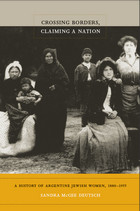
Drawing on extensive archival research and original oral histories, Deutsch tells the stories of individual women, relating their sentiments and experiences as both insiders and outsiders to state formation, transnationalism, and cultural, political, ethnic, and gender borders in Argentine history. As agricultural pioneers and film stars, human rights activists and teachers, mothers and doctors, Argentine Jewish women led wide-ranging and multifaceted lives. Their community involvement—including building libraries and secular schools, and opposing global fascism in the 1930s and 1940s—directly contributed to the cultural and political lifeblood of a changing Argentina. Despite their marginalization as members of an ethnic minority and as women, Argentine Jewish women formed communal bonds, carved out their own place in society, and ultimately shaped Argentina’s changing pluralistic culture through their creativity and work.
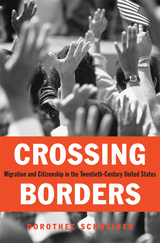
Aspiring immigrants to the United States make many separate border crossings in their quest to become Americans—in their home towns, ports of departure, U.S. border stations, and in American neighborhoods, courthouses, and schools. In a book of remarkable breadth, Dorothee Schneider covers both the immigrants’ experience of their passage from an old society to a new one and American policymakers’ debates over admission to the United States and citizenship. Bringing together the separate histories of Irish, English, German, Italian, Jewish, Chinese, Japanese, and Mexican immigrants, the book opens up a fresh view of immigrant aspirations and government responses.
Ingenuity and courage emerge repeatedly from these stories, as immigrants adapted their particular resources, especially social networks, to make migration and citizenship successful on their own terms. While officials argued over immigrants’ fitness for admission and citizenship, immigrant communities forced the government to alter the meaning of race, class, and gender as criteria for admission. Women in particular made a long transition from dependence on men to shapers of their own destinies.
Schneider aims to relate the immigrant experience as a totality across many borders. By including immigrant voices as well as U.S. policies and laws, she provides a truly transnational history that offers valuable perspectives on current debates over immigration.
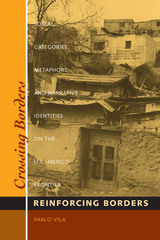
Along the U.S.-Mexico frontier, where border crossings are a daily occurrence for many people, reinforcing borders is also a common activity. Not only does the U.S. Border Patrol strive to "hold the line" against illegal immigrants, but many residents on both sides of the border seek to define and bound themselves apart from groups they perceive as "others."
This pathfinding ethnography charts the social categories, metaphors, and narratives that inhabitants of El Paso and Ciudad Juárez use to define their group identity and distinguish themselves from "others." Pablo Vila draws on over 200 group interviews with more than 900 area residents to describe how Mexican nationals, Mexican immigrants, Mexican Americans, African Americans, and Anglos make sense of themselves and perceive their differences from others.
This research uncovers the regionalism by which many northern Mexicans construct their sense of identity, the nationalism that often divides Mexican Americans from Mexican nationals, and the role of ethnicity in setting boundaries among Anglos, Mexicans, and African Americans. Vila also looks at how gender, age, religion, and class intertwine with these factors. He concludes with fascinating excerpts from re-interviews with several informants, who modified their views of other groups when confronted by the author with the narrative character of their identities.


Conventional urban environmental reform has made modern city life possible, but it has done little to limit the despoliation of distant places. Nevertheless, the successes of urban environmental reform remind us of what is possible.
John Fairfield concludes with a case study of Phoenix, Arizona to demonstrate this dysfunctional relationship between city and country while developing a sympathetic critique of the Green New Deal. He suggests how we might bridge the “great divide” as we face the daunting challenges the twenty-first century is pressing upon us.
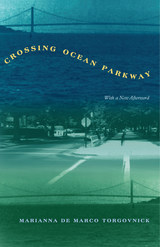
Included are autobiographical moments interwoven with engrossing interpretations of American cultural icons from Dr. Dolittle to Lionel Trilling, The Godfather to Camille Paglia. Her experiences allow her to probe the cultural tensions in America caused by competing ideas of individuality and community, upward mobility and ethnic loyalty, acquisitiveness and spirituality.
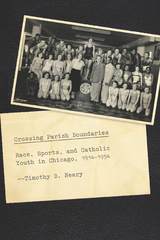
In this book, Timothy B. Neary reveals the history of Bishop Bernard Sheil’s Catholic Youth Organization (CYO), which brought together thousands of young people of all races and religions from Chicago’s racially segregated neighborhoods to take part in sports and educational programming. Tens of thousands of boys and girls participated in basketball, track and field, and the most popular sport of all, boxing, which regularly filled Chicago Stadium with roaring crowds. The history of Bishop Sheil and the CYO shows a cosmopolitan version of American Catholicism, one that is usually overshadowed by accounts of white ethnic Catholics aggressively resisting the racial integration of their working-class neighborhoods. By telling the story of Catholic-sponsored interracial cooperation within Chicago, Crossing Parish Boundaries complicates our understanding of northern urban race relations in the mid-twentieth century.
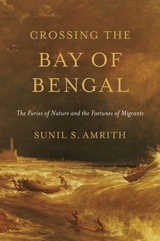
The Indian Ocean was global long before the Atlantic, and today the countries bordering the Bay of Bengal—India, Bangladesh, Burma, Sri Lanka, Thailand, and Malaysia—are home to one in four people on Earth. Crossing the Bay of Bengal places this region at the heart of world history for the first time. Integrating human and environmental history, and mining a wealth of sources, Sunil Amrith gives a revelatory and stirring new account of the Bay and those who have inhabited it.
For centuries the Bay of Bengal served as a maritime highway between India and China, and then as a battleground for European empires, all while being shaped by the monsoons and by human migration. Imperial powers in the nineteenth century, abetted by the force of capital and the power of steam, reconfigured the Bay in their quest for coffee, rice, and rubber. Millions of Indian migrants crossed the sea, bound by debt or spurred by drought, and filled with ambition. Booming port cities like Singapore and Penang became the most culturally diverse societies of their time. By the 1930s, however, economic, political, and environmental pressures began to erode the Bay’s centuries-old patterns of interconnection.
Today, rising waters leave the Bay of Bengal’s shores especially vulnerable to climate change, at the same time that its location makes it central to struggles over Asia’s future. Amrith’s evocative and compelling narrative of the region’s pasts offers insights critical to understanding and confronting the many challenges facing Asia in the decades ahead.
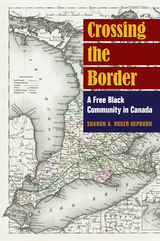
How formerly enslaved people found freedom and built community in Ontario
In 1849, the Reverend William King and fifteen once-enslaved people he had inherited founded the Canadian settlement of Buxton on Ontario land set aside for sale to Blacks. Though initially opposed by some neighboring whites, Buxton grew into a 700-person agricultural community that supported three schools, four churches, a hotel, a lumber mill, and a post office.
Sharon A. Roger Hepburn tells the story of the settlers from Buxton’s founding of through its first decades of existence. Buxton welcomed Black men, woman, and children from all backgrounds to live in a rural setting that offered benefits of urban life like social contact and collective security. Hepburn’s focus on social history takes readers inside the lives of the people who built Buxton and the hundreds of settlers drawn to the community by the chance to shape new lives in a country that had long represented freedom from enslavement.
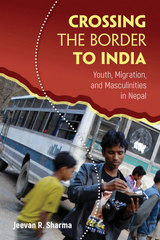
Given the limited economic opportunities in rural Nepal, the desire of young men of all income and education levels, castes and ethnicities to migrate has never been higher. Crossing the Border to India provides an ethnography of male labor migration from the western hills of Nepal to Indian cities. Jeevan Sharma shows how a migrant’s livelihood and gender, as well as structural violence impacts his perceptions, experiences, and aspirations.
Based on long-term fieldwork, Sharma captures the actual experiences of crossing the border. He shows that Nepali migration to India does not just allow young men from poorer backgrounds to “save there and eat here,” but also offers a strategy to escape the more regimented social order of the village. Additionally, migrants may benefit from the opportunities offered by the “open-border” between India and Nepal to attain independence and experience a distant world. However, Nepali migrants are subjected to high levels of ill treatment. Thus, while the idea of freedom remains extremely important in Nepali men’s migration decisions, their actual experience is often met with unfreedom and suffering.
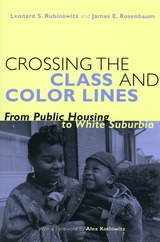
"This book's history of Chicago public housing should be required reading for anyone interested in social policy in the United States."—Jens Ludwig, Social Service Review
"[The authors'] work is rightly cited as one of the important precedents in the field. . . . This is a remarkable, unassailable accomplishment and this book is an important record of their scholarly contribution."—John M. Goering, Ethnic and Racial Studies
Winner of the 2017 Aidoo-Snyder Book Prize
Winner of the 2016 American Historical Association’s Wesley-Logan Prize in African diaspora
Finalist for the 2016 Fage and Oliver Prize from the African Studies Association of the UK
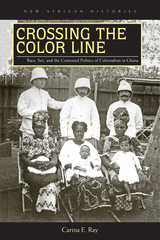
Interracial sex mattered to the British colonial state in West Africa. In Crossing the Color Line, Carina E. Ray goes beyond this fact to reveal how Ghanaians shaped and defined these powerfully charged relations. The interplay between African and European perspectives and practices, argues Ray, transformed these relationships into key sites for consolidating colonial rule and for contesting its hierarchies of power. With rigorous methodology and innovative analyses, Ray brings Ghana and Britain into a single analytic frame to show how intimate relations between black men and white women in the metropole became deeply entangled with those between black women and white men in the colony in ways that were profoundly consequential.
Based on rich archival evidence and original interviews, the book moves across different registers, shifting from the micropolitics of individual disciplinary cases brought against colonial officers who “kept” local women to transatlantic networks of family, empire, and anticolonial resistance. In this way, Ray cuts to the heart of how interracial sex became a source of colonial anxiety and nationalist agitation during the first half of the twentieth century.
Attempts to answer difficult questions about battle tactics employed by the United States Army
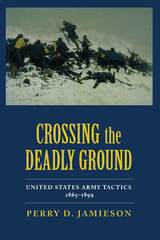
Weapons improved rapidly after the Civil War, raising difficult questions about the battle tactics employed by the United States Army. The most fundamental problem was the dominance of the tactical defensive, when defenders protected by fieldworks could deliver deadly fire from rifles and artillery against attackers advancing in close-ordered lines. The vulnerability of these offensive forces as they crossed the so-called "deadly ground" in front of defensive positions was even greater with the improvement of armaments after the Civil War.
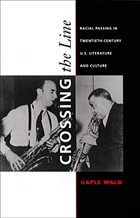
Wald begins her reading of twentieth-century passing narratives by analyzing works by African American writers James Weldon Johnson, Jessie Fauset, and Nella Larsen, showing how they use the “passing plot” to explore the negotiation of identity, agency, and freedom within the context of their protagonists' restricted choices. She then examines the 1946 autobiography Really the Blues, which details the transformation of Milton Mesirow, middle-class son of Russian-Jewish immigrants, into Mezz Mezzrow, jazz musician and self-described “voluntary Negro.” Turning to the 1949 films Pinky and
Lost Boundaries, which imagine African American citizenship within class-specific protocols of race and gender, she interrogates the complicated representation of racial passing in a visual medium. Her investigation of “post-passing” testimonials in postwar African American magazines, which strove to foster black consumerism while constructing “positive” images of black achievement and affluence in the postwar years, focuses on neglected texts within the archives of black popular culture. Finally, after a look at liberal contradictions of John Howard Griffin’s 1961 auto-ethnography Black Like Me, Wald concludes with an epilogue that considers the idea of passing in the context of the recent discourse of “color blindness.”
Wald’s analysis of the moral, political, and theoretical dimensions of racial passing makes Crossing the Line important reading as we approach the twenty-first century. Her engaging and dynamic book will be of particular interest to scholars of American studies, African American studies, cultural studies, and literary criticism.
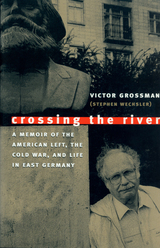
A child of the Depression, Grossman witnessed firsthand the dislocations wrought by the collapse of the U.S. economy during the 1930s. Widespread unemployment and poverty, CIO sit-down strikes, and the fight to save Republican Spain from fascism-all made an indelible impression as he grew up in an environment that nurtured a commitment to left-wing causes. He continued his involvement with communist activities as a student at Harvard in the late 1940s and after graduation, when he took jobs in two factories in Buffalo, New York, and tried to organize their workers.
Fleeing McCarthyite America and potential prosecution, Grossman worked in the GDR with other Western defectors and eventually became, as he notes, the "only person in the world to attend Harvard and Karl Marx universities." Later, he was able to establish himself as a freelance journalist, lecturer, and author. Traveling throughout East Germany, he evaluated the failures as well as the successes of the GDR's "socialist experiment." He also recorded his experiences, observations, and judgments of life in East Berlin after reunification, which failed to bring about the post-Communist paradise so many had expected.
Written with humor as well as candor, Crossing the River provides a rare look at the Cold War from the other side of the ideological divide.
Mark Solomon, a distinguished historian of the American left, provides a historical afterword that places Grossman's experiences in a larger Cold War context.
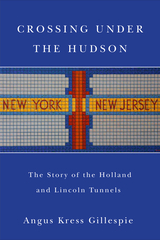
Crossing Under the Hudson takes a fresh look at the planning and construction of two key links in the transportation infrastructure of New York and New Jersey--the Holland and Lincoln Tunnels. Writing in an accessible style that incorporates historical accounts with a lively and entertaining approach, Angus Kress Gillespie explores these two monumental works of civil engineering and the public who embraced them. He describes and analyzes the building of the tunnels, introduces readers to the people who worked there--then and now--and places the structures into a meaningful cultural context with the music, art, literature, and motion pictures that these tunnels, engineering marvels of their day, have inspired over the years.
Today, when new concerns about global terrorism may trump bouts of simple tunnel tension, Gillespie's Crossing Under the Hudson continues to cast a light at the end of the Holland and Lincoln Tunnels.
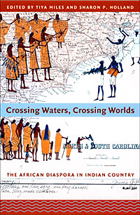
Essays range from a close reading of the 1838 memoirs of a black and Native freewoman to an analysis of how Afro-Native intermarriage has impacted the identities and federal government classifications of certain New England Indian tribes. One contributor explores the aftermath of black slavery in the Choctaw and Chickasaw nations, highlighting issues of culture and citizenship. Another scrutinizes the controversy that followed the 1998 selection of a Miss Navajo Nation who had an African American father. A historian examines the status of Afro-Indians in colonial Mexico, and an ethnographer reflects on oral histories gathered from Afro-Choctaws. Crossing Waters, Crossing Worlds includes evocative readings of several of Toni Morrison’s novels, interpretations of plays by African American and First Nations playwrights, an original short story by Roberta J. Hill, and an interview with the Creek poet and musician Joy Harjo. The Native American scholar Robert Warrior develops a theoretical model for comparative work through an analysis of black and Native intellectual production. In his afterword, he reflects on the importance of the critical project advanced by this volume.
Contributors. Jennifer D. Brody, Tamara Buffalo, David A. Y. O. Chang, Robert Keith Collins, Roberta J. Hill, Sharon P. Holland, ku'ualoha ho’omnawanui, Deborah E. Kanter, Virginia Kennedy, Barbara Krauthamer, Tiffany M. McKinney, Melinda Micco, Tiya Miles, Celia E. Naylor, Eugene B. Redmond, Wendy S. Walters, Robert Warrior
2023 Honorable Mention, Isis Duarte Book Prize, Haiti/ Dominican Republic section (LASA)
2023 Winner, Gordon K. and Sybil Lewis Book Award, Caribbean Studies Association
An innovative study of the artistic representations of undocumented migration within the Hispanophone Caribbean
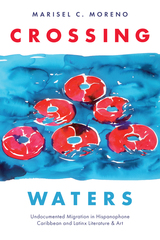
Debates over the undocumented migration of Latin Americans invariably focus on the southern US border, but most migrants never cross that arbitrary line. Instead, many travel, via water, among the Caribbean islands. The first study to examine literary and artistic representations of undocumented migration within the Hispanophone Caribbean, Crossing Waters relates a journey that remains silenced and largely unknown.
Analyzing works by novelists, short-story writers, poets, and visual artists replete with references to drowning and echoes of the Middle Passage, Marisel Moreno shines a spotlight on the plight that these migrants face. In some cases, Puerto Rico takes on a new role as a stepping-stone to the continental United States and the society migrants will join there. Meanwhile the land border between Haiti and the Dominican Republic, the only terrestrial border in the Hispanophone Caribbean, emerges as a complex space within this cartography of borders. And while the Border Patrol occupies US headlines, the Coast Guard occupies the nightmares of refugees.
An untold story filled with beauty, possibility, and sorrow, Crossing Waters encourages us to rethink the geography and experience of undocumented migration and the role that the Caribbean archipelago plays as a border zone.
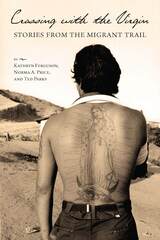
Crossing With the Virgin collects stories heard from migrants about these treacherous treks—firsthand accounts told to volunteers for the Samaritans, a humanitarian group that seeks to prevent such unnecessary deaths by providing these travelers with medical aid, water, and food. Other books have dealt with border crossing; this is the first to share stories of immigrant suffering at its worst told by migrants encountered on desert trails.
The Samaritans write about their encounters to show what takes place on a daily basis along the border: confrontations with Border Patrol agents at checkpoints reminiscent of wartime; children who die in their parents’ desperate bid to reunite families; migrants terrorized by bandits; and hovering ghost-like above nearly every crossing, the ever-present threat of death.
These thirty-nine stories are about the migrants, but they also tell how each individual author became involved with this work. As such, they offer not only a window into the migrants’ plight but also a look at the challenges faced by volunteers in sometimes compromising situations—and at their own humanizing process.
Crossing With the Virgin raises important questions about underlying assumptions and basic operations of border enforcement, helping readers see past political positions to view migrants as human beings. It will touch your heart as surely as it reassures you that there are people who still care about their fellow man.
One day in the dentist's office journalist Walt Harrington heard a casual racist joke that left him enraged. Married to a black woman, Harrington is the father of two biracial children. His experience in the dentist's office made him realize not only that the joke was about his own children but also that he really knew very little about what it was like to be a black person in America.
After this rude awakening, Harrington set off on a twenty- five-thousand-mile journey through black America, talking with scores of black and white people along the way, including an old sharecropper, a city police chief, a jazz trumpeter, a convicted murderer, a welfare mother, and a corporate mogul. In Crossings, winner of the Gustavus Myers Award for the Study of Human Rights, he relates what he learned as he listened.

A creative dialogue between a queer artist and a queer academic reminiscing about and thinking with their cruising experiences, Crossings takes queer sex practices and cultures seriously as ways of knowing and world-making. The result is an erotic hybrid form hovering between scholarship and avant-garde experimentation, between critical manifesto and sex memoir. Here, the voices of each author, merged together in one, invite the reader to inhabit the erotic spacetime between self and other, the familiar and the strange, desire and pleasure, climax and release. That is, the spaces and temporalities of cruising itself.

In the United States immigration is both history and destiny. It is the driving force behind a most significant social transformation taking place in American society at the end of our millennium. Arguably few other social phenomena are likely to impact the future character of American culture and society as much as the ongoing wave of “new immigration.”
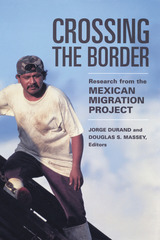
Who are the new immigrants? What do they want? How are they changing American society? This cross-disciplinary book brings together twelve essays by the leading scholars of the most significant aspect of the new immigration: Mexican immigration to the United States. Crossings theorizes aspects of recent Mexican immigration that are new and that demarcate this wave of immigration from earlier experiences in this century.
In Crossings, Sylvia Molloy embarks on an evocative exploration of the intricate and profound experience of living between languages, cultures, and geographies. A pioneering Argentine writer, fluent in Spanish, English, and French, Molloy inhabited all three languages, shuttling back, forth, and between, aware that each place and each language bring forth a different self.
The short entries that make up “Varied Imagination” and “Living Between Languages”—the two collections gathered in this volume for the first time—revolve around an interrelated set of questions. What makes “home”? Does language make or destabilize a sense of home? How does speaking a language or switching between languages perform one’s place in the world? These vignettes capture the realization that the most seemingly natural things in life—such as home, language, and identity—depend entirely on performance. Each act, each word communicates something, means something, does something to their specific audience; another audience might react quite differently. Molloy wrote, rewrote, edited, and reworked to find the right mix to express the estar entre or “between” that was her life.
In this compelling volume, Molloy’s reflections on the fluidity of identity and the transient nature of home resonate deeply, prompting readers to contemplate the profound connections between language, place, memory, and lived experience.
Experts in statistical analysis of aggregate data, Christopher H. Achen and W. Philips Shively contend that cross-level inference makes unusually strong demands on substantive knowledge, so that no one method, such as Goodman's ecological regression, will fit all situations. Criticizing Goodman's model and some recent attempts to replace it, the authors argue for a range of alternate techniques, including estensions of cross-tabular, regression analysis, and unobservable variable estimators.
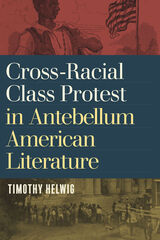
Timothy Helwig analyzes the shared strategies of class protest in popular and canonical texts from a range of antebellum white and black American authors, including George Lippard, Ned Buntline, Harry Hazel, Frederick Douglass, William Wells Brown, and Frank J. Webb. This pathbreaking study offers original perspectives on racial representations in antebellum American print culture and provides a new understanding of black and white authors' strivings for socioeconomic justice across racial lines in the years leading up to the Civil War.
But what is Critical Race Theory? How did it develop? Where does it stand now? Where should it go in the future? In this volume, thirty-one CRT scholars present their views on the ideas and methods of CRT, its role in academia and in the culture at large, and its past, present, and future.
Critical race theorists assert that both the procedures and the substance of American law are structured to maintain white privilege. The neutrality and objectivity of the law are not just unattainable ideals; they are harmful actions that obscure the law's role in protecting white supremacy. This notion—so obvious to some, so unthinkable to others—has stimulated and divided legal thinking in this country and, increasingly, abroad.
The essays in Crossroads, Directions, and a New Critical Race Theory—all original—address this notion in a variety of helpful and exciting ways. They use analysis, personal experience, historical narrative, and many other techniques to explain the importance of looking critically at how race permeates our national consciousness.
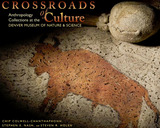
The book presents 123 full-color images to highlight the museum's cultural treasures. Selected for their individual beauty, historic value, and cultural meaning, these objects connect different places, times, and people. From the mammoth hunters of the Plains to the first American pioneer settlers to the flourishing Hispanic and Asian diasporas in downtown Denver, the Rocky Mountain region has been home to a breathtaking array of cultures. Many objects tell this story of the Rocky Mountains' fascinating and complex past, whereas others serve to bring enigmatic corners of the globe to modern-day Denver.
Crossroads of Culture serves as a behind-the-scenes tour of the museum's anthropology collections. All the royalties from this publication will benefit the collections of the Denver Museum of Nature & Science's Department of Anthropology.
As bandidos or gigolos, drug users or unwed mothers, Latinos continue to figure in the public consciousness primarily as undesirables. Despite decades of effort by Spanish-speaking Americans to improve their image in the United States, Mexican Americans and other resident Latinos are still largely perceived by other Americans as poverty-stricken immigrants and second-class citizens. Accordingly, the great majority of Latino citizens receive substandard educations, equipping them for substandard jobs in substandard living environments.
The lives of Mexican Americans and other Latinos, Portales contends, can best be illuminated by looking at the history of Chicanos and particularly Chicano literature, which dramatizes the impact of education and the media on Latinos. Like Irish literature, Chicano literature has sought to articulate and to establish itself as a postcolonial voice that has struggles for national attention. Through psychological and sociopolitical representations, Chicano writers have variously used anger, indifference, fear, accommodation, and other conflicting emotions and attitudes to express how it feels to be seen as an immigrant or a foreigner in one's own country.
Portales looks at four Chicano literary works -- Americo Paredes' George Washington Gomez, Anthony Quinn's The Original Sin, Sandra Cisnero's House on Mango Street, and Ana Castillo's Massacre of the Dreamers -- to focus attention on social issues that impede the progress of Latinos. By doing so, he hopes to engage both Latino and non-Latino Americans in an overdue dialogue about the power of education and the media to form perceptions that can either empower or repress Latino citizens.
A scholar of law and religion uncovers a surprising origin story behind the idea of the separation of powers.
The separation of powers is a bedrock of modern constitutionalism, but striking antecedents were developed centuries earlier, by Jewish scholars and rabbis of antiquity. Attending carefully to their seminal works and the historical milieu, David Flatto shows how a foundation of democratic rule was contemplated and justified long before liberal democracy was born.
During the formative Second Temple and early rabbinic eras (the fourth century BCE to the third century CE), Jewish thinkers had to confront the nature of legal authority from the standpoint of the disempowered. Jews struggled against the idea that a legal authority stemming from God could reside in the hands of an imperious ruler (even a hypothetical Judaic monarch). Instead scholars and rabbis argued that such authority lay with independent courts and the law itself. Over time, they proposed various permutations of this ideal. Many of these envisioned distinct juridical and political powers, with a supreme law demarcating the respective jurisdictions of each sphere. Flatto explores key Second Temple and rabbinic writings—the Qumran scrolls; the philosophy and history of Philo and Josephus; the Mishnah, Tosefta, Midrash, and Talmud—to uncover these transformative notions of governance.
The Crown and the Courts argues that by proclaiming the supremacy of law in the absence of power, postbiblical thinkers emphasized the centrality of law in the people’s covenant with God, helping to revitalize Jewish life and establish allegiance to legal order. These scholars proved not only creative but also prescient. Their profound ideas about the autonomy of law reverberate to this day.

This volume examines the Crow-Omaha problem from a variety of perspectives—historical, linguistic, formalist, structuralist, culturalist, evolutionary, and phylogenetic. It focuses on the regions where Crow-Omaha systems occur: Native North America, Amazonia, West Africa, Northeast and East Africa, aboriginal Australia, northeast India, and the Tibeto-Burman area. The international roster of authors includes leading experts in their fields.
The book offers a state-of-the-art assessment of Crow-Omaha kinship and carries forward the work of the landmark volume Transformations of Kinship, published in 1998. Intended for students and scholars alike, it is composed of brief, accessible chapters that respect the complexity of the ideas while presenting them clearly. The work serves as both a new benchmark in the explanation of kinship systems and an introduction to kinship studies for a new generation of students.
Series Note: Formerly titled Amerind Studies in Archaeology, this series has recently been expanded and retitled Amerind Studies in Anthropology to incorporate a high quality and number of anthropology titles coming in to the series in addition to those in archaeology.
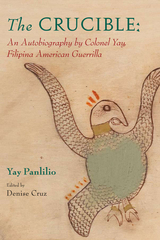
On December 8, 1941, as the Pacific War reached the Philippines, Yay Panlilio, a Filipina-Irish American, faced a question with no easy answer: How could she contribute to the war?
In this 1950 memoir, The Crucible: An Autobiography by Colonel Yay, Filipina American Guerrilla, Panlilio narrates her experience as a journalist, triple agent, leader in the Philippine resistance against the Japanese, and lover of the guerrilla general Marcos V. Augustin. From the war-torn streets of Japanese-occupied Manila, to battlegrounds in the countryside, and the rural farmlands of central California, Panlilio blends wry commentary, rigorous journalistic detail, and popular romance.
Weaving together appearances by Douglas MacArthur and Carlos Romulo with dangerous espionage networks, this work provides an insightful perspective on the war. The Crucible invites readers to see new intersections in Filipina/o, Asian American, and American literature studies, and Denise Cruz's introduction imparts key biographical, historical, and cultural contexts to that purpose.
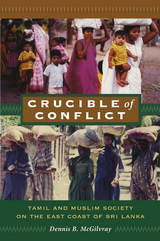
McGilvray explores the densely populated farming and fishing settlements in this coastal zone, focusing on the Tamil and Muslim inhabitants of an agricultural town in the Ampara District. Drawing on fieldwork conducted over more than thirty years as well as on Tamil and Dutch historical sources, he describes the regional dominance of a non-Brahmin matrilineal caste of thirteenth-century Kerala origin. The Muslims, who acquired dowry lands and matrilineal family patterns through local intermarriages, have in the twentieth century emerged from Hindu caste domination and are now the Tamil Hindus’ political and economic equals. Crucible of Conflict offers a uniquely detailed account of Muslim kinship and community organization in eastern Sri Lanka, as well as a comparison of Tamil and Muslim practices and institutions. McGilvray concludes with an analysis of the interethnic tensions and communal violence that have intensified in recent years.
In 1954, the Supreme Court delivered the landmark decision of Brown v. Board of Education—establishing the right to attend a desegregated school as a national constitutional right—but the decision contained fundamental ambiguities. The Supreme Court has never offered a clear definition of what desegregation means or laid out a framework for evaluating competing interpretations. In The Crucible of Desegregation, R. Shep Melnick examines the evolution of federal school desegregation policy from 1954 through the termination of desegregation orders in the first decades of the twenty-first century, combining legal analysis with a focus on institutional relations, particularly the interactions between federal judges and administrators. Melnick argues that years of ambiguous, inconsistent, and meandering Court decisions left lower court judges adrift, forced to apply contradictory Supreme Court precedents in a wide variety of highly charged political and educational contexts. As a result, desegregation policy has been a patchwork, with lower court judges playing a crucial role and with little opportunity to analyze what worked and what didn’t. The Crucible of Desegregation reveals persistent patterns and disagreements that continue to roil education policy.

Examines the patchwork evolution of school desegregation policy.
In 1954, the Supreme Court delivered the landmark decision of Brown v. Board of Education—establishing the right to attend a desegregated school as a national constitutional right—but the decision contained fundamental ambiguities. The Supreme Court has never offered a clear definition of what desegregation means or laid out a framework for evaluating competing interpretations. In The Crucible of Desegregation, R. Shep Melnick examines the evolution of federal school desegregation policy from 1954 through the termination of desegregation orders in the first decades of the twenty-first century, combining legal analysis with a focus on institutional relations, particularly the interactions between federal judges and administrators. Melnick argues that years of ambiguous, inconsistent, and meandering Court decisions left lower court judges adrift, forced to apply contradictory Supreme Court precedents in a wide variety of highly charged political and educational contexts. As a result, desegregation policy has been a patchwork, with lower court judges playing a crucial role and with little opportunity to analyze what worked and what didn’t. The Crucible of Desegregation reveals persistent patterns and disagreements that continue to roil education policy.
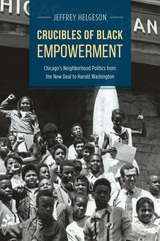
In Crucibles of Black Empowerment, Jeffrey Helgeson recounts the rise of African American political power and activism from the 1930s onward, revealing how it was achieved through community building. His book tells stories of the housewives who organized their neighbors, building tradesmen who used connections with federal officials to create opportunities in a deeply discriminatory employment sector, and the social workers, personnel managers, and journalists who carved out positions in the white-collar workforce. Looking closely at black liberal politics at the neighborhood level in Chicago, Helgeson explains how black Chicagoans built the networks that eventually would overthrow the city’s seemingly invincible political machine.
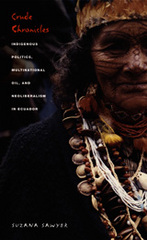
Through her rich ethnography of indigenous marches, demonstrations, occupations, and negotiations, Sawyer tracks the growing sophistication of indigenous politics as Indians subverted, re-deployed, and, at times, capitulated to the dictates and desires of a transnational neoliberal logic. At the same time, she follows the multiple maneuvers and discourses that the multinational corporation and the Ecuadorian state used to circumscribe and contain indigenous opposition. Ultimately, Sawyer reveals that indigenous struggles over land and oil operations in Ecuador were as much about reconfiguring national and transnational inequality—that is, rupturing the silence around racial injustice, exacting spaces of accountability, and rewriting narratives of national belonging—as they were about the material use and extraction of rain-forest resources.

In the post-Vietnam era, the prison population has increased tenfold and the death penalty has enjoyed a renaissance. Few subjects in contemporary US society provoke as much controversy as punishment. In this context, Cruel and Unusual aims to offer the first comprehensive exploration of the history of punishment as it has been mediated in American culture.
Grounding his analysis in Marxist theory, psychoanalysis and Foucault’s influential work on discipline, Brian Jarvis examines a range of cultural texts, from seventeenth century execution sermons to twenty-first century prison films, to uncover the politics, economics and erotics of punishment.
This wide-ranging and interdisciplinary survey constructs a genealogy of cruelty through close reading of novels by Hawthorne and Melville, fictional accounts of the Rosenberg execution by Coover and Doctorow, slave narratives and prison writings by African Americans and the critically neglected genre of American prison films.
In the process, Cruel and Unusual unmasks a fundamental conflict between legends of liberty in the Land of the Free and the secret, silenced histories of sadomasochistic desire, punishment for profit and social control.
Carefully exploring different cases of the attempt to rehabilitate child sex offenders, Borneman details a secular ritual process aimed not only at preventing future acts of molestation but also at fundamentally transforming the offender, who is ultimately charged with creating an almost entirely new self. Acknowledging the powerful repulsion felt by a public that is often extremely skeptical about the success of rehabilitation, he challenges readers to confront the contemporary contexts and conundrums that lie at the heart of regulating intimacy between children and adults.
Franco draws on human-rights documents, memoirs, testimonials, novels, and films, as well as photographs and art works, to explore not only cruel acts but the discriminatory thinking that made them possible, their long-term effects, the precariousness of memory, and the pathos of survival.
Why are immigrants from Mexico and Latin America such an affectively charged population for political conservatives?
More than a decade before the election of Donald Trump, vitriolic and dehumanizing rhetoric against migrants was already part of the national conversation. Situating the contemporary debate on immigration within America’s history of indigenous dispossession, chattel slavery, the Mexican-American War, and Jim Crow, Cristina Beltrán reveals white supremacy to be white democracy—a participatory practice of racial violence, domination, and exclusion that gave white citizens the right to both wield and exceed the law. Still, Beltrán sees cause for hope in growing movements for migrant and racial justice.
Forerunners is a thought-in-process series of breakthrough digital works. Written between fresh ideas and finished books, Forerunners draws on scholarly work initiated in notable blogs, social media, conference plenaries, journal articles, and the synergy of academic exchange. This is gray literature publishing: where intense thinking, change, and speculation take place in scholarship.
READERS
Browse our collection.
PUBLISHERS
See BiblioVault's publisher services.
STUDENT SERVICES
Files for college accessibility offices.
RECENTLY PUBLISHED



UChicago Accessibility Resources
home | accessibility | search | about | contact us
BiblioVault ® 2001 - 2025
The University of Chicago Press