
 A SCHOLARLY BOOK REPOSITORY
1112 books about Military and 105
1112 books about Military
105 start with C start with C
105 start with C start with C
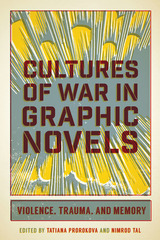
Cultures of War in Graphic Novels
Violence, Trauma, and Memory
Prorokova, Tatiana
Rutgers University Press, 2018
First runner-up for the 2019 Ray and Pat Browne Award for the Best Edited Collection in Popular and American Culture
Cultures of War in Graphic Novels examines the representation of small-scale and often less acknowledged conflicts from around the world and throughout history. The contributors look at an array of graphic novels about conflicts such as the Boxer Rebellion (1899-1901), the Irish struggle for national independence (1916-1998), the Falkland War (1982), the Bosnian War (1992-1995), the Rwandan genocide (1994), the Israel-Lebanon War (2006), and the War on Terror (2001-). The book explores the multi-layered relation between the graphic novel as a popular medium and war as a pivotal recurring experience in human history. The focus on largely overlooked small-scale conflicts contributes not only to advance our understanding of graphic novels about war and the cultural aspects of war as reflected in graphic novels, but also our sense of the early twenty-first century, in which popular media and limited conflicts have become closely interrelated.
Cultures of War in Graphic Novels examines the representation of small-scale and often less acknowledged conflicts from around the world and throughout history. The contributors look at an array of graphic novels about conflicts such as the Boxer Rebellion (1899-1901), the Irish struggle for national independence (1916-1998), the Falkland War (1982), the Bosnian War (1992-1995), the Rwandan genocide (1994), the Israel-Lebanon War (2006), and the War on Terror (2001-). The book explores the multi-layered relation between the graphic novel as a popular medium and war as a pivotal recurring experience in human history. The focus on largely overlooked small-scale conflicts contributes not only to advance our understanding of graphic novels about war and the cultural aspects of war as reflected in graphic novels, but also our sense of the early twenty-first century, in which popular media and limited conflicts have become closely interrelated.
[more]
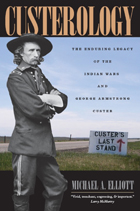
Custerology
The Enduring Legacy of the Indian Wars and George Armstrong Custer
Michael A. Elliott
University of Chicago Press, 2007
On a hot summer day in 1876, George Armstrong Custer led the Seventh Cavalry to the most famous defeat in U.S. military history. Outnumbered and exhausted, the Seventh Cavalry lost more than half of its 400 men, and every soldier under Custer’s direct command was killed.
It’s easy to understand why this tremendous defeat shocked the American public at the time. But with Custerology, Michael A. Elliott tackles the far more complicated question of why the battle still haunts the American imagination today. Weaving vivid historical accounts of Custer at Little Bighorn with contemporary commemorations that range from battle reenactments to the unfinished Crazy Horse memorial, Elliott reveals a Custer and a West whose legacies are still vigorously contested. He takes readers to each of the important places of Custer’s life, from his Civil War home in Michigan to the site of his famous demise, and introduces us to Native American activists, Park Service rangers, and devoted history buffs along the way. Elliott shows how Custer and the Indian Wars continue to be both a powerful symbol of America’s bloody past and a crucial key to understanding the nation’s multicultural present.
“[Elliott] is an approachable guide as he takes readers to battlefields where Custer fought American Indians . . . to the Michigan town of Monroe that Custer called home after he moved there at age 10 . . . to the Black Hills of South Dakota where Custer led an expedition that gave birth to a gold rush."—Steve Weinberg, Atlanta Journal-Constitution
“By ‘Custerology,’ Elliott means the historical interpretation and commemoration of Custer and the Indian Wars in which he fought not only by those who honor Custer but by those who celebrate the Native American resistance that defeated him. The purpose of this book is to show how Custer and the Little Bighorn can be and have been commemorated for such contradictory purposes.”—Library Journal
“Michael Elliott’s Custerology is vivid, trenchant, engrossing, and important. The American soldier George Armstrong Custer has been the subject of very nearly incessant debate for almost a century and a half, and the debate is multicultural, multinational, and multimedia. Mr. Elliott's book provides by far the best overview, and no one interested in the long-haired soldier whom the Indians called Son of the Morning Star can afford to miss it.”—Larry McMurtry
[more]
Custer's Last Stand
The Unfinished Manuscript
Norman Maclean
University of Chicago Press, 2008
In his eighty-seven years, Norman Maclean played many parts: fisherman, logger, firefighter, scholar, teacher. But it was a role he took up late in life, that of writer, that won him enduring fame and critical acclaim—as well as the devotion of readers worldwide. When he died in 1990, Maclean left behind an earlier unfinished project, on a topic that had held his attention for decades: General Custer and the Battle of the Little Bighorn. The portions of that writing that remain reveal a deep interest not only in the battle itself but also its afterlife—how historical events influence popular culture and how retellings revise the past. Summarizing the events from the various perspectives of the Americans, the Sioux, and the Cheyenne, Maclean explains why the battle lives on in our imagination. Custer’s “last stand” provides all the elements—the characters, the plot, and the backdrop—of the perfect dramatic tragedy. And the way we retell history, argues Maclean, is intimately tied to how we choose to memorialize defeat.
[more]

CW-21 Interceptor
Edwin Hoogschagen
Amsterdam University Press, 2023
The CW-21 was designed during the late 1930s. It combined light weight construction with a powerful engine, which resulted in an excellent rate of climb and manoeuvrability, allowing the fighter to quickly reach the height of attacking enemy aircraft, and attack them. The prototype was sent to China as a demonstration copy and an order for three aircraft, plus a further 32 as kits, followed. These would be assembled locally. Only the three production machines arrived in the chaos of war and would never see actual combat. A second modified variant was ordered by the Dutch government and 24 were delivered to the Netherlands Indies. The CW-21s were outnumbered and outgunned when the Japanese launched their attack on the Netherlands Indies. Despite the poor outlook, the pilots flying them put up a good fight...
[more]
Cyberwars in the Middle East
Ahmed Al-Rawi
Rutgers University Press, 2021
Cyberwars in the Middle East argues that hacking is a form of online political disruption whose influence flows vertically in two directions (top-bottom or bottom-up) or horizontally. These hacking activities are performed along three political dimensions: international, regional, and local. Author Ahmed Al-Rawi argues that political hacking is an aggressive and militant form of public communication employed by tech-savvy individuals, regardless of their affiliations, in order to influence politics and policies. Kenneth Waltz’s structural realism theory is linked to this argument as it provides a relevant framework to explain why nation-states employ cyber tools against each other.
On the one hand, nation-states as well as their affiliated hacking groups like cyber warriors employ hacking as offensive and defensive tools in connection to the cyber activity or inactivity of other nation-states, such as the role of Russian Trolls disseminating disinformation on social media during the US 2016 presidential election. This is regarded as a horizontal flow of political disruption. Sometimes, nation-states, like the UAE, Saudi Arabia, and Bahrain, use hacking and surveillance tactics as a vertical flow (top-bottom) form of online political disruption by targeting their own citizens due to their oppositional or activists’ political views. On the other hand, regular hackers who are often politically independent practice a form of bottom-top political disruption to address issues related to the internal politics of their respective nation-states such as the case of a number of Iraqi, Saudi, and Algerian hackers. In some cases, other hackers target ordinary citizens to express opposition to their political or ideological views which is regarded as a horizontal form of online political disruption. This book is the first of its kind to shine a light on many ways that governments and hackers are perpetrating cyber attacks in the Middle East and beyond, and to show the ripple effect of these attacks.
On the one hand, nation-states as well as their affiliated hacking groups like cyber warriors employ hacking as offensive and defensive tools in connection to the cyber activity or inactivity of other nation-states, such as the role of Russian Trolls disseminating disinformation on social media during the US 2016 presidential election. This is regarded as a horizontal flow of political disruption. Sometimes, nation-states, like the UAE, Saudi Arabia, and Bahrain, use hacking and surveillance tactics as a vertical flow (top-bottom) form of online political disruption by targeting their own citizens due to their oppositional or activists’ political views. On the other hand, regular hackers who are often politically independent practice a form of bottom-top political disruption to address issues related to the internal politics of their respective nation-states such as the case of a number of Iraqi, Saudi, and Algerian hackers. In some cases, other hackers target ordinary citizens to express opposition to their political or ideological views which is regarded as a horizontal form of online political disruption. This book is the first of its kind to shine a light on many ways that governments and hackers are perpetrating cyber attacks in the Middle East and beyond, and to show the ripple effect of these attacks.
[more]
READERS
Browse our collection.
PUBLISHERS
See BiblioVault's publisher services.
STUDENT SERVICES
Files for college accessibility offices.
RECENTLY PUBLISHED





UChicago Accessibility Resources
home | accessibility | search | about | contact us
BiblioVault ® 2001 - 2026
The University of Chicago Press