
 A SCHOLARLY BOOK REPOSITORY
14 start with E start with E
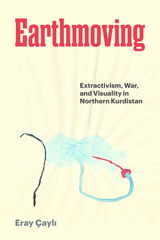
Focuses on contemporary art and media to examine the role of visuals in environmental violence and war in Northern Kurdistan.
Extractivism—exploiting the earth for resources—has long driven racial capitalism and colonialism. And yet, how does extractivism operate in a world where ecological and humanitarian sensibilities are unprecedentedly widespread? Eray Çaylı argues it does so by mobilizing these sensibilities in new ways. Extractivism is no longer only about moving the earth—displacing peoples, fossils, minerals, and waters—but also leaving those who witness this violent displacement sentimentally moved.
Earthmoving conceptualizes this duality. Derived from Çaylı’s years-long work in Northern Kurdistan, home to the world’s largest stateless nation—rendered stateless by colonial policies since the nineteenth century—Earthmoving focuses on the 2010s, a decade that began with peace talks between Turkey and the Kurdish liberation movement but ended with war. The decade saw extractivism intensify in the region and images of its harm proliferate across art and media. Together with contemporary artists, Çaylı shows that images challenge extractivism both by making its harm visible and by fostering self-reflexive and reciprocal collaboration that breaks with its valuation of the colonized and the racialized only in quantifiable and marketable terms.

Part I, "Disaster and Recovery," contains previously unpublished studies of major historical catastrophes, among them the Black Death of the fourteenth century, the Civil War in Russia that followed the Bolshevik revolution, and the mass bombing of Germany and of Japan during World War II. Accompanying the historical studies are several analytical papers that interpret the disaster experience.
The essays in Part II, "Cooperation and Conflict," represent innovative theoretical analyses based on a common theme—that cooperation and conflict are alternative strategies whereby individuals, groups, and different forms of social organization struggle with one another for evolutionary survival. Ultimately, these essays indicate, the political economy of the human species is an instance of Darwin's "economy of nature."
Winner, Crader Family Book Prize in American Values, Department of History and Crader Family Endowment for American Values, Southeast Missouri State University
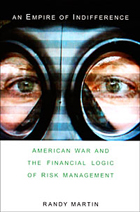
Drawing on theorists including Michel Foucault, Giorgio Agamben, Michael Hardt, Antonio Negri, and Achille Mbembe, Martin illuminates a frightening financial logic that must be understood in order to be countered. Martin maintains that finance divides the world between those able to avail themselves of wealth opportunities through risk taking (investors) and those who cannot do so, who are considered “at risk.” He contends that modern-day American imperialism differs from previous models of imperialism, in which the occupiers engaged with the occupied to “civilize” them, siphon off wealth, or both. American imperialism, by contrast, is an empire of indifference: a massive flight from engagement. The United States urges an embrace of risk and self-management on the occupied and then ignores or dispossesses those who cannot make the grade.

This history of administrative thought and practice in colonial Kenya looks at the ways in which white people tried to engineer social change.
It asks four questions:
- Why was Kenya’s welfare operation so idiosyncratic and spartan compared with that of other British colonies?
- Why did a transformation from social welfare to community development produce further neglect of the very poor?
- Why was there no equivalent to the French tradition of community medicine?
- If there was a transformatory element of colonial rule that sought to address poverty, where and why did it fall down?
The answers offer revealing insight into the dynamics of rule in the late colonial period in Kenya.
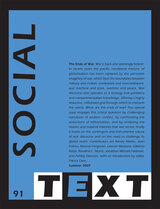
The contributors to this special issue—drawing on cultural studies, anthropology, economics, psychoanalysis, gender studies, postcolonial studies, and war literature—target the blind spots in current debates about war. One essay examines the financing of war, challenging the myth that our military-industrial complex generates economic bounty. Another contributor addresses strategies of high-tech urban warfare now being developed by the U.S. military and warns of the historical limits of colonial policing techniques that build on practices of surveillance. Other essays discuss the eroticization of “consent” embodied in the practice of torture at Abu Ghraib; the paradoxes of paramilitary policing and popular resistance along the militarized Mexico-U.S. border; and the continuities between the permanent war economy that emerged in the United States during World War II and the current disastrous confluence of militarism, global outsourcing, and economic depletion.
Contributors. Ashley Dawson, Patrick Deer, Jonathan Michael Feldman, Kennan Ferguson, Jean Franco, Randy Martin, Leerom Medovoi, Rosalind C. Morris, Gilberto Rosas
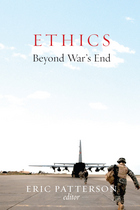
The wars in Afghanistan and Iraq have focused new attention on a perennial problem: how to end wars well. What ethical considerations should guide war’s settlement and its aftermath? In cases of protracted conflicts, recurring war, failed or failing states, or genocide and war crimes, is there a framework for establishing an enduring peace that is pragmatic and moral?
Ethics Beyond War’s End provides answers to these questions from the just war tradition. Just war thinking engages the difficult decisions of going to war and how war is fought. But from this point forward just war theory must also take into account what happens after war ends, and the critical issues that follow: establishing an enduring order, employing political forms of justice, and cultivating collective forms of conciliation. Top thinkers in the field—including Michael Walzer, Jean Bethke Elshtain, James Turner Johnson, and Brian Orend—offer powerful contributions to our understanding of the vital issues associated with late- and post conflict in tough, real-world scenarios that range from the US Civil War to contemporary quagmires in Afghanistan, the Middle East, and the Congo.
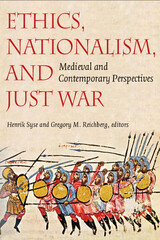

How do we frame decisions to use or abstain from military force? Who should do the killing? Do we need new paradigms to guide the use of force? And what does “victory” mean in contemporary conflict?
In many ways, these are timeless questions. But they should be revisited in light of changing circumstances in the twenty-first century. The post–Cold War, post-9/11 world is one of contested and fragmented sovereignty: contested because the norm of territorial integrity has shed some of its absolute nature, fragmented because some states do not control all of their territory and cannot defeat violent groups operating within their borders. Humanitarian intervention, preventive war, and just war are all framing mechanisms aimed at convincing domestic and international audiences to go to war—or not, as well as to decide who is justified in legally and ethically killing. The international group of scholars assembled in this book critically examine these frameworks to ask if they are flawed, and if so, how they can be improved. Finally, the volume contemplates what all the killing and dying is for if victory ultimately proves elusive.

Extinction Song begins with a tender depiction of early parenthood, as the speaker cradles his newborn son while imagining a dystopian climate future. The poems open into a broader consideration of overlapping and interrelated systems, from the confines of received knowledge to the closed circuit of ideology to the circularity of pollutive environmental cycles. Attentive to the levels of sound and of visual architecture, these poems highlight both destruction and unseen possibilities. By turns meditative and probing, and sometimes slyly funny, Extinction Song unwinds the perils and the joys of our precarious climate future.
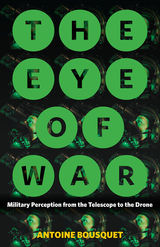
How perceptual technologies have shaped the history of war from the Renaissance to the present
From ubiquitous surveillance to drone strikes that put “warheads onto foreheads,” we live in a world of globalized, individualized targeting. The perils are great. In The Eye of War, Antoine Bousquet provides both a sweeping historical overview of military perception technologies and a disquieting lens on a world that is, increasingly, one in which anything or anyone that can be perceived can be destroyed—in which to see is to destroy.
Arguing that modern-day global targeting is dissolving the conventionally bounded spaces of armed conflict, Bousquet shows that over several centuries, a logistical order of militarized perception has come into ascendancy, bringing perception and annihilation into ever-closer alignment. The efforts deployed to evade this deadly visibility have correspondingly intensified, yielding practices of radical concealment that presage a wholesale disappearance of the customary space of the battlefield. Beginning with the Renaissance’s fateful discovery of linear perspective, The Eye of War discloses the entanglement of the sciences and techniques of perception, representation, and localization in the modern era amid the perpetual quest for military superiority. In a survey that ranges from the telescope, aerial photograph, and gridded map to radar, digital imaging, and the geographic information system, Bousquet shows how successive technological systems have profoundly shaped the history of warfare and the experience of soldiering.
A work of grand historical sweep and remarkable analytical power, The Eye of War explores the implications of militarized perception for the character of war in the twenty-first century and the place of human subjects within its increasingly technical armature.
READERS
Browse our collection.
PUBLISHERS
See BiblioVault's publisher services.
STUDENT SERVICES
Files for college accessibility offices.
RECENTLY PUBLISHED


UChicago Accessibility Resources
home | accessibility | search | about | contact us
BiblioVault ® 2001 - 2026
The University of Chicago Press