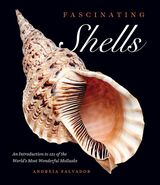
front cover of Fascinating Shells
Fascinating Shells
An Introduction to 121 of the World’s Most Wonderful Mollusks
Andreia Salvador
University of Chicago Press, 2022
A New Scientist Best Book of the Year

Beautiful photographs of stunning shells from London's Natural History Museum, home to one of the most significant and comprehensive collections in the world.


Collected and treasured for their beauty, used in religious rituals, or even traded as currency, shells have fascinated humans for millennia. Ancient and enchanting, dazzling in form and variety, these beautiful objects come from mollusks, one of the most diverse groups in the animal kingdom, including snails, oysters, cuttlefish, and chitons. Soft-bodied, these creatures rely on shells for protection from enemies and their environments, from snowy mountains to arid deserts, in deep-sea hydrothermal vents and the jungles of the tropics, on rocky shores, and in coral reefs.

In this book, mollusk expert Andreia Salvador profiles some of the world’s most beautiful and quirky shells, each selected from the more than eight million specimens held in the collection at London’s Natural History Museum. We lock eyes with the hundred-eyed cowry, named after "the all-seeing one," the giant Argus Panoptes of Greek mythology. We see how shells' appearances translate into defense strategies, as with the zigzag nerite, which varies its patterning to deceive and confuse predators. And we meet shell inhabitants, such as the amber snail, which eats earthworms by sucking them up like spaghetti. Reproduced in full color and striking detail, these shells have much to reveal about the history of collecting, the science of taxonomy, and the human desire to understand the natural world.
[more]

logo for Central European University Press
Fears and Symbols
An Introduction to the Study of Western Civilization
Elemér Hankiss
Central European University Press, 2001

This is a serious scholarly work that is, at the same time, somewhat unorthodox. On the one hand, it elaborates a systematic theory of civilization. It surveys the major theories of civilization and develops a new hypothesis, according to which existential fear has been a major factor in the generation of human culture. The author argues that in order to mitigate this fear and anxiety, human beings and communities have surrounded themselves not only with the walls of their houses and cities, with tools and weapons, laws and institutions, but also with protective spheres of symbols: myths and religions, values and belief systems, ideas and scientific theories, moral and practical rules of behavior, and a multitude of everyday rituals and trivialities. In a word, with the brilliant construct: civilization.


It is, on the other hand, an unorthodox book in that it studies an unusually wide range of examples and shows that the struggle for safety and freedom, for a meaningful life and human dignity, is present not only in the great symbolic systems of humankind but also in the most trivial of everyday activities and aspects of human existence; in tragedies as well as jokes, in the sacred as well as the profane, in the symbolism of medieval cathedrals as well as in that of contemporary shopping malls, in the great drama of Sin and Salvation as well as in the trivial mythology of perfumes. Ultimately, our trivialities are not trivial at all. 
[more]

front cover of Field Guide to Wisconsin Sedges
Field Guide to Wisconsin Sedges
An Introduction to the Genus Carex (Cyperaceae)
Andrew L. Hipp; Illustrations by Rachel D. Davis; Maps and Appendices by Merel R. Black and Theodore S. Cochrane
University of Wisconsin Press, 2008
Sedges are among the world’s most diverse and ecologically important plant families, with almost two hundred species in Wisconsin alone. These grass-like plants, found mostly in wetlands, are increasingly popular with landscapers and home gardeners. Learning to identify sedges is challenging, however, and the available technical guides to the sedge family can be overwhelming to a nonspecialist. Field Guide to Wisconsin Sedges is a beautifully illustrated introduction to the largest sedge genus, Carex, which alone makes up about 7 percent of the flora of the upper Midwest.
            Written primarily for naturalists, wild plant enthusiasts, and native landscapers, this book is unique in its accessible format and illustrations. With this book, readers can learn to recognize key structures needed to identify approximately 150 Carex species found in Wisconsin. Author Andrew Hipp shows how to identify many of the major groupings of sedges that are used in guides to the genus throughout the world.
           Field Guide to Wisconsin Sedges includes information on habitat and range drawn from Hipp’s extensive field experience and inspection of thousands of herbarium sheets. Primarily an identification guide, the book is also a valuable source of habitat information for landscapers, gardeners, and restorationists.

Features:
• Keys to all Wisconsin Carex species, arranged by section
• Distribution maps for all species
• Species descriptions and detailed habitat information for more than 50 common species
• Color illustrations of whole plants or details for more than 70 species
• Appendix summarizing dominant Carex species by Wisconsin habitat
• A glossary of terms
• Water-resistant paperback cover
 
[more]

front cover of Florentine Codex
Florentine Codex
Introduction and Indices: Introductory Book
Bernardino de Sahagun
University of Utah Press, 1982

Two of the world’s leading scholars of the Aztec language and culture have translated Sahagún’s monumental and encyclopedic study of native life in Mexico at the time of the Spanish Conquest. This immense undertaking is the first complete translation into any language of Sahagún’s Nahuatl text, and represents one of the most distinguished contributions in the fields of anthropology, ethnography, and linguistics.

Written between 1540 and 1585, the Florentine Codex (so named because the manuscript has been part of the Laurentian Library’s collections since at least 1791) is the most authoritative statement we have of the Aztecs’ lifeways and traditionsa rich and intimate yet panoramic view of a doomed people.

The Florentine Codex is divided by subject area into twelve books and includes over 2,000 illustrations drawn by Nahua artists in the sixteenth century.

This introduction to the Florentine Codex contains the original prologues to each volume written by Bernadino de Sahagun, which detail his intentions and personal experiences in compiling the Codex. Authors Dibble and Anderson dig into Sahagun’s past in “Sahagun’s Historia” and “Sahagun: Career and Character,” and discuss dating the Codex in “The Watermarks in the Florentine Codex.” This volume also includes indices of subject matter, persons and deities, and places for all twelve books.
[more]

front cover of Folk Groups And Folklore Genres
Folk Groups And Folklore Genres
An Introduction
edited by Elliott Oring
Utah State University Press, 1986
Oring's introductory folklore text consists of a series of essays by leading scholars that give the student a solid sense of major folklore topics and interpretive techniques. This book has met the need for good instructional material for decades- covering a period of tremendous growth in folklore programs and introductory courses in colleges and universities around the world.
[more]

front cover of Folklore and Folklife
Folklore and Folklife
An Introduction
Richard M. Dorson
University of Chicago Press, 1982
"This introduction to the study of folklore and folklife contains an inspiring and spirited mixture of essays, theoretical contributions, practical instructions, and pure encyclopedia articles. It is a very well put together book, written by eighteen researchers who have something to say. One can see here that it is competent educators who have come forward and are narrating. . . . All in all it is a very use-oriented handbook with attractive typography and layout."—Iorn Pio, Journal of American Folklore
[more]

front cover of Foucault's Askesis
Foucault's Askesis
An Introduction to the Philosophical Life
Edward McGushin
Northwestern University Press, 2007
In his renowned courses at the Collège de France from 1982 to 1984, Michel Foucault devoted his lectures to meticulous readings and interpretations of the works of Plato, Epictetus, Seneca, and Marcus Aurelius, among others. In this his aim was not, Edward F. McGushin contends, to develop a new knowledge of the history of philosophy; rather, it was to let himself be transformed by the very activity of thinking. Thus, this work shows us Foucault in the last phase of his life in the act of becoming a philosopher. Here we see how his encounter with ancient philosophy allowed him to experience the practice of philosophy as, to paraphrase Nietzsche, a way of becoming who one is: the work of self-formation that the Greeks called askēsis.

Through a detailed study of Foucault's last courses, McGushin demonstrates that this new way of practicing philosophical askēsis evokes Foucault's ethical resistance to modern relations of power and knowledge. In order to understand Foucault's later project, then, it is necessary to see it within the context of his earlier work. If his earlier projects represented an attempt to bring to light the relations of power and knowledge that narrowed and limited freedom, then this last project represents his effort to take back that freedom by redefining it in terms of care of the self. Foucault always stressed that modern power functions by producing individual subjects. This book shows how his excavation of ancient philosophical practices gave him the tools to counter this function-with a practice of self-formation, an askēsis.
[more]

front cover of The Fragments of Parmenides
The Fragments of Parmenides
A Critical Text With Introduction and Translation, the Ancient Testimonia and a Commentary
A. H, Coxon
Parmenides Publishing, 2009
 Edited with New Translation by Richard McKirahan

With a New Preface by Malcolm Schofield
This book is a revised and expanded version of A.H. Coxon's full critical edition of the extant remains of Parmenides of Elea—the fifth-century B.C. philosopher by many considered "one of the greatest and most astonishing thinkers of all times." (Karl Popper) Coxon's presentation of the complete ancient evidence for Parmenides and his comprehensive examination of the fragments, unsurpassed to this day, have proven invaluable to our understanding of the Eleatic since the book's first publication in 1986. This edition, edited by Richard McKirahan and with a new preface by Malcolm Schofield, is released on the 100th anniversary of Coxon's birth. 
 
This new edition for the first time includes English translations of the testimonia and of any Ancient Greek throughout the book, as well as an English/Greek glossary by Richard McKirahan, and revisions by the late author himself. The text consists of Coxon's collations of the relevant folios of manuscripts of Sextus Empiricus, Proclus and Simplicius and includes all extant fragments, a commentary, the testimonia, a complete list of sources, linguistic parallels from both earlier and later authors, and the fullest critical apparatus that has appeared since Diels’ Poetarum Philosophorum Fragmenta (1901). The collection of testimonia includes the philosophical discussions of Parmenides by Plato, Aristotle and the Neoplatonists, most of which had been omitted by Diels. The introduction discusses the history of the text, the language and form of the poem, Parmenides’ use and understanding of the verb ‘to be’, his place in the history of earlier and later philosophy and the biographical tradition. In the commentary Coxon deals in detail with both the language and the subject matter of the poem and pays full attention to Parmenides’ account of the physical world. The appendix relates later Eleatic arguments to those of Parmenides. 
[more]

front cover of Freedom and History and Other Essays
Freedom and History and Other Essays
An Introduction to the Thought of Richard McKeon
Richard McKeon
University of Chicago Press, 1990
This volume of essays is an important introduction to the thought of one of the twentieth century's most significant yet underappreciated philosophers, Richard McKeon. The originator of philosophical pluralism, McKeon made extraordinary contributions to philosophy, to international relations, and to theory-formation in the communication arts, aesthetics, the organization of knowledge, and the practical sciences. This collection, which includes a philosophical autobiography as well as the out-of-print title essay "Freedom and History" and a previously unpublished essay on "Philosophic Semantics and Philosophic Inquiry," is a testimony to the range and systematic power of McKeon's thinking for the social sciences and the humanities.
[more]

front cover of From Human Dignity to Natural Law
From Human Dignity to Natural Law
An Introduction
Richard Berquist
Catholic University of America Press, 2019
From Human Dignity to Natural Law shows how the whole of the natural law, as understood in the Aristotelian Thomistic tradition, is contained implicitly in human dignity. Human dignity means existing for one’s own good (the common good as well as one’s individual good), and not as a mere means to an alien good. But what is the true human good? This question is answered with a careful analysis of Aristotle’s definition of happiness. The natural law can then be understood as the precepts that guide us in achieving happiness. To show that human dignity is a reality in the nature of things and not a mere human invention, it is necessary to show that human beings exist by nature for the achievement of the properly human good in which happiness is found. This implies finality in nature. Since contemporary natural science does not recognize final causality, the book explains why living things, as least, must exist for a purpose and why the scientific method, as currently understood, is not able to deal with this question. These reflections will also enable us to respond to a common criticism of natural law theory: that it attempts to derive statements of what ought to be from statements about what is. After defining the natural law and relating it to human or positive law, Richard Berquist considers Aquinas’s formulation of the first principle of the natural law. It then discusses the love commandments to love God above all things and to love one’s neighbor as oneself as the first precepts of the natural law. Subsequent chapters are devoted to clarifying and defending natural law precepts concerned with the life issues, with sexual morality and marriage, and with fundamental natural rights. From Human Dignity to Natural Law concludes with a discussion of alternatives to the natural law.
[more]


Send via email Share on Facebook Share on Twitter