
 A SCHOLARLY BOOK REPOSITORY
109 start with G start with G
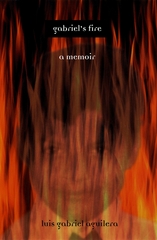
Aguilera's memoir is not just an account of race relations and street life in the inner city, nor of the plight of the immigrant and the dilemma of class identity for a "minority" family. Gabriel's Fire also movingly recounts the peculiarly daunting and inspiring moments of a particular age, riddled with confusion, desires, and duties and recorded by an exceptionally observant and articulate young man. Aguilera writes that he "grew into" the English language when he was eleven or twelve, and his recollections reflect his newfound delight with words—the conversations, arguments, taunts, song lyrics, and casual interchanges of his youth are rendered here with an immediacy and directness rare in contemporary memoirs.
Both a picture of American culture of the 1980s and 1990s and a coming-of-age story, Gabriel's Fire counters mainstream and mass-mediated images of the inner city, Hispanic culture, and troubled youth. In its honesty and energy, it is a poignant and compelling story of one man's formative years.
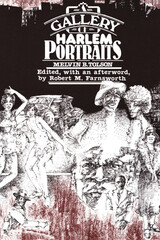
Tolson eventually attempted to incorporate the technical achievements of T.S. Eliot and the New Criticism into a complex modern poetry which would accurately represent the extraordinary tensions, paradoxes, and sophistication, both highbrow and lowbrow, of modern Harlem. As a consequence his position in literary history is problematical. The publication of this earliest of his manuscripts will help clarify Tolson's achievement and surprise many of his readers with its readily accessible, warmly human poetic portraiture.
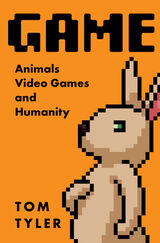
A playful reflection on animals and video games, and what each can teach us about the other
Video games conjure new worlds for those who play them, human or otherwise: they’ve been played by cats, orangutans, pigs, and penguins, and they let gamers experience life from the perspective of a pet dog, a predator or a prey animal, or even a pathogen. In Game, author Tom Tyler provides the first sustained consideration of video games and animals and demonstrates how thinking about animals and games together can prompt fresh thinking about both.
Game comprises thirteen short essays, each of which examines a particular video game, franchise, aspect of gameplay, or production in which animals are featured, allowing us to reflect on conventional understandings of humans, animals, and the relationships between them. Tyler contemplates the significance of animals who insert themselves into video games, as protagonists, opponents, and brute resources, but also as ciphers, subjects, and subversive guides to new ways of thinking. These animals encourage us to reconsider how we understand games, contesting established ideas about winning and losing, difficulty settings, accessibility, playing badly, virtuality, vitality and vulnerability, and much more.
Written in a playful style, Game draws from a dizzying array of sources, from children’s television, sitcoms, and regional newspapers to medieval fables, Shakespearean tragedy, and Edwardian comedy; from primatology, entomology, and hunting and fishing manuals to theological tracts and philosophical treatises. By examining video games through the lens of animals and animality, Tyler leads us to a greater humility regarding the nature and status of the human creature, and a greater sensitivity in dealings with other animals.

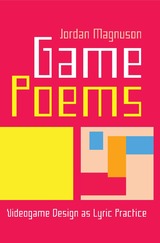
Scholars, critics, and creators describe certain videogames as being “poetic,” yet what that means or why it matters is rarely discussed. In Game Poems: Videogame Design as Lyric Practice, independent game designer Jordan Magnuson explores the convergences between game making and lyric poetry and makes the surprising proposition that videogames can operate as a kind of poetry apart from any reliance on linguistic signs or symbols.
This rigorous and accessible short book first examines characteristics of lyric poetry and explores how certain videogames can be appreciated more fully when read in light of the lyric tradition—that is, when read as “game poems.” Magnuson then lays groundwork for those wishing to make game poems in practice, providing practical tips and pointers along with tools and resources. Rather than propose a monolithic framework or draw a sharp line between videogame poems and poets and their nonpoetic counterparts, Game Poems brings to light new insights for videogames and for poetry by promoting creative dialogue between disparate fields. The result is a lively account of poetic game-making praxis.
“Everyone who loves the true power of games will benefit from the treasure trove of insights in Game Poems.” — Jesse Schell, author of The Art of Game Design
“Magnuson shines a sensitive and incisive light on small, often moving, videogames.” — D. Fox Harrell, Ph.D., Professor of Digital Media, Computing, and Artificial Intelligence, MIT
“[Game Poems] tells a new story about games— that games can be lyrical, beautiful, emotionally challenging—to inspire creators and critics alike.” —Noah Wardrip-Fruin, author of How Pac-Man Eats
“Even as the news swells with impending doom for creativity, writing, and text itself, this literate and crafty book pursues poetry not through implacable algorithms but in concrete and personal play. It should be an indispensable guide for anyone who aims to maintain the true, human promise of technical poetics.”—Stuart Moulthrop, coauthor of Twining: Critical and Creative Approaches to Hypertext Narratives
“For far too long videogames have flourished – and commanded both capital and attention – in a kind of counterculture that they seem to have created as if ex nihilo for themselves and their players. But we are these players, and their culture has always been integrated with all of our own. In this evenhanded artist-scholar’s ars poetica Jordan Magnuson respects the material cultural specificity of videogames while regarding them through the ‘lens of poetry’ in order to discover – and help create – a practice and an art of Game Poems within the wider field. Magnuson formally, int(erv)entionally embraces this art as lyrically poetic.”—John Cayley, Brown University
“In Game Poems, Magnuson listens carefully to videogames, and hears them speak to questions of art, language, and meaning that connect our written past to our software future. Read this book and you will hear it too.”—Frank Lantz, Director, NYU Game Center
“Jordan Magnuson has created a work that ties together the worlds of poetry and videogames in a deep and enlightening way. For those of us who care about the potential of poetic games, Jordan greatly improves the language of how we talk about them and expands our ability to see what this unique form can become. This is one of my favorite books on game design and I apologize in advance to those whom I will end up cornering and not being able to stop talking to about it.”—Benjamin Ellinger, Game Design Program Director, DigiPen Institute of Technology
“A groundbreaking and accessible book that helps us think about games as poems. With patient tenacity, Magnuson teases out what he felt for years as he engaged in his own practice of making videogames. His mission to help us apply a ‘lyric reading’ to games so that our engagement with, and appreciation of, games can be enhanced feels deeply personal. Drawing from a wide range of games and computational media scholars, poetry scholars, game creators, and poets, Magnuson provides a rigorous, balanced, and unique interdisciplinary contribution. A must-read for videogame scholars, practicing game makers, and anyone interested in the potential of ‘game poems.’”—Susana Ruiz, University of California, Santa Cruz
“This book tenaciously wrenches videogame hermeneutics from the insatiable maws of rhetoric and narratology—to the cheers of poets everywhere. In elucidating the lyric characteristics of the "game poem," Magnuson demonstrates not just that poetry is a useful lens for understanding videogames, but also that videogames can be a useful lens for understanding poetry. A rewarding text for scholars, game designers, poets, and anyone in between.”—Allison Parrish, Interactive Telecommunications Program and Interactive Media Arts, NYU
“A concise, passionate articulation - and defense! - of an artistic space between poems and videogames. If game scholars wish to prove that they are not engaged merely in an apologetics for violent pornography, they need only to teach this book.”—Chris Bateman, author of Imaginary Games and 21st Century Game Design
“I feel I've found a kindred spirit in Jordan Magnuson and his practical recommendations for creating distilled, compelling, personal videogames – throw out the conventions of game design one at a time? Yes, please! The revelation for me in this book, however, is the heat and power of the language of poets and poetry brought close to videogame design. There's much in here worth pursuing to kindle the fires of new and exciting videogame poems, and Jordan is a capable and delightfully humble guide.”—Pippin Barr, author of How to Play a Video Game and The Stuff Games Are Made Of
“With Game Poems, Jordan Magnuson lays to rest any last vestige of the notion that the implicit limits of games are as ‘entertainment products’. By taking games seriously as successors of the lyric poetry tradition, he opens up new avenues for how game designers can think about what they do, how critical game theorists can approach their many-faceted object of study, and how players can more fully engage with videogames.”—Soraya Murray, author of On Video Games
“Game Poems shines an important light on a neglected area of videogame theory and provides unique guidance for those interested in exploring the poetic potential of videogames.”—Jenova Chen, designer of Flow, Flower, Journey, and Sky: Children of the Light
“Popular frameworks for video game scholarship consistently fail to account for the most avant-garde and affective works of interactive art. With Game Poems, Jordan Magnuson provides not only a lens to understand these diverse and important titles but also a guide to constructing the next generation of personal and incisive games. With numerous examples from decades of experimental games, including Magnuson's own minimalist and insightful work, this book is an excellent introduction to the form for neophytes as well as finally providing words to describe a movement that many experienced game poets previously understood only intuitively.”—Gregory Avery-Weir, creator of The Majesty of Colors and Looming
“Jordan Magnuson is one of a surprisingly small group of artists who see in the technology of videogames a versatile medium capable of expressing much more than conventional games.”—Michaël Samyn, co-founder, Tale of Tales; co-creator of Sunset, The Graveyard, and The Path
“So much has been written about what games are, and yet there’s always a new way of thinking about them. In Jordan Magnuson’s Game Poems we discover that games are also a lyrical form of art; that games can be understood as poetry, and that the making games as poetry creates new modes of artistic expression. Jordan Magnuson’s book is a fascinating exploration of games as poetry, and the poetry of play.”—Miguel Sicart, author of Play Matters, Beyond Choices: The Design of Ethical Gameplay, and Playing Software
“In Game Poems, I found a new perspective on the kind of videogames that are dearest to me: short, personal, poetic games. By looking at games through the lens of lyric poetry, Jordan Magnuson puts into focus the workings of that mysterious hodgepodge of audio, visuals, and interactivity: the language of videogames. Both experienced and novice game makers will find approachable, practical advice on the craft of videogames. And anyone who plays short games will find new ways of appreciating and talking about them. I know I will be returning to it for inspiration when making my own small games!”—Adam Le Doux, creator of Bitsy
“As a creator and researcher, Jordan Magnuson has been able to demonstrate through the utmost visual simplicity, by enhancing basic geometric forms, the empathetic capacity of the videogame medium. Game Poems explores this idea and the reconfiguration of the videogame beyond its ludic component, highlighting the artistic and poetic potential of games.”—Antonio César Moreno Cantano, University Complutense of Madrid
“Poems ask us to slow down, pay attention, and take the time to appreciate our experiences. Emerging from Magnuson's need to find ways to talk about his own creative practice, this book is all about discovering ways to do this with videogames. Magnuson explores what it means to view videogames as poetry, and provides insight, as a practitioner, on how to make game poems that enable and encourage this type of reflection. Drawing on a wide range of sources, from literature and philosophy to game studies and game design, this book covers a lot of material, but always remains grounded in concrete examples and solid theory. The book ends with a call to “go make some game poems!” After reading the book, I was keen to do exactly that. I urge you to do the same!”—Alex Mitchell, National University of Singapore
“To many, poetry is a dying – or dead – art form. Few people sit down at night to open their favorite poet’s chapbook with the latest streaming service at hand or their favorite videogame console sitting nearby. Spectacle seems to be the cultural norm, and this can be no more evident than in videogames: when the latest and greatest offers 60+ hours of spine-tingling excitement, why would someone want to launch a smaller-form game about expressions such as love, death, loneliness, or even God? But, as Jordan Magnuson, in his new book Games Poems, shows, poems have always been an integral piece of forming human culture. Poems have the ability to get right to the heart of the matter and, in fact, pierce the heart of the reader. Poems can be a form of cultural resistance, and even launch revolutions. Magnuson’s book highlights what it means to use the medium of game design as poetry. Magnuson presents several examples of the intricacies of poetry in general, as well as work that fuses the ideals of poetry with game design. Magnuson succinctly examines how the imagination, rhythm, intensity, style – and brevity – of poetry can enlighten the game design process in order to form possibility spaces within videogames that are pointed and powerful.”—Tim Samoff, Games and Interactive Media Program Director, Azusa Pacific University
Video and computer games in their cultural contexts.
As the popularity of computer games has exploded over the past decade, both scholars and game industry professionals have recognized the necessity of treating games less as frivolous entertainment and more as artifacts of culture worthy of political, social, economic, rhetorical, and aesthetic analysis. Ken McAllister notes in his introduction to Game Work that, even though games are essentially impractical, they are nevertheless important mediating agents for the broad exercise of socio-political power.
In considering how the languages, images, gestures, and sounds of video games influence those who play them, McAllister highlights the ways in which ideology is coded into games. Computer games, he argues, have transformative effects on the consciousness of players, like poetry, fiction, journalism, and film, but the implications of these transformations are not always clear. Games can work to maintain the status quo or celebrate liberation or tolerate enslavement, and they can conjure feelings of hope or despair, assent or dissent, clarity or confusion. Overall, by making and managing meanings, computer games—and the work they involve and the industry they spring from—are also negotiating power.
This book sets out a method for "recollecting" some of the diverse and copious influences on computer games and the industry they have spawned. Specifically written for use in computer game theory classes, advanced media studies, and communications courses, Game Work will also be welcome by computer gamers and designers.
Ken S. McAllister is Assistant Professor of Rhetoric, Composition, and the Teaching of English at the University of Arizona and Co-Director of the Learning Games Initiative, a research collective that studies, teaches with, and builds computer games.

From flight simulators and first-person shooters to MMPOG and innovative strategy games like 2008’s Spore, computer games owe their development to computer simulation and imaging produced by and for the military during the Cold War. To understand their place in contemporary culture, Patrick Crogan argues, we must first understand the military logics that created and continue to inform them. Gameplay Mode situates computer games and gaming within the contemporary technocultural moment, connecting them to developments in the conceptualization of pure war since the Second World War and the evolution of simulation as both a technological achievement and a sociopolitical tool.
Crogan begins by locating the origins of computer games in the development of cybernetic weapons systems in the 1940s, the U.S. Air Force’s attempt to use computer simulation to protect the country against nuclear attack, and the U.S. military’s development of the SIMNET simulated battlefield network in the late 1980s. He then examines specific game modes and genres in detail, from the creation of virtual space in fight simulation games and the co-option of narrative forms in gameplay to the continuities between online gaming sociality and real-world communities and the potential of experimental or artgame projects like September 12th: A Toy World and Painstation, to critique conventional computer games.
Drawing on critical theoretical perspectives on computer-based technoculture, Crogan reveals the profound extent to which today’s computer games—and the wider culture they increasingly influence—are informed by the technoscientific program they inherited from the military-industrial complex. But, Crogan concludes, games can play with, as well as play out, their underlying logic, offering the potential for computer gaming to anticipate a different, more peaceful and hopeful future.
In the first decade of the twenty-first century, video games are an integral part of global media culture, rivaling Hollywood in revenue and influence. No longer confined to a subculture of adolescent males, video games today are played by adults around the world. At the same time, video games have become major sites of corporate exploitation and military recruitment.
In Games of Empire, Nick Dyer-Witheford and Greig de Peuter offer a radical political critique of such video games and virtual environments as Second Life, World of Warcraft, and Grand Theft Auto, analyzing them as the exemplary media of Empire, the twenty-first-century hypercapitalist complex theorized by Michael Hardt and Antonio Negri. The authors trace the ascent of virtual gaming, assess its impact on creators and players alike, and delineate the relationships between games and reality, body and avatar, screen and street.
Games of Empire forcefully connects video games to real-world concerns about globalization, militarism, and exploitation, from the horrors of African mines and Indian e-waste sites that underlie the entire industry, the role of labor in commercial game development, and the synergy between military simulation software and the battlefields of Iraq and Afghanistan exemplified by Full Spectrum Warrior to the substantial virtual economies surrounding World of Warcraft, the urban neoliberalism made playable in Grand Theft Auto, and the emergence of an alternative game culture through activist games and open-source game development.
Rejecting both moral panic and glib enthusiasm, Games of Empire demonstrates how virtual games crystallize the cultural, political, and economic forces of global capital, while also providing a means of resisting them.
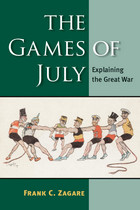
"Frank C. Zagare combines a deep command of historical scholarship and the sophisticated skills of an applied game theorist to develop and test a theory of why deterrence failed, catastrophically, in July 1914. . . . Zagare concludes with sage advice on how to avoid even more cataclysmic breakdowns in a nuclear world."
---Steven J. Brams, New York University
"Zagare's deft study of the origins of the First World War using his perfect deterrence theory uncovers new insights into that signal event and shows the value of formal theory applied to historical events. A must-read for those interested in security studies."
---James D. Morrow, University of Michigan
"Through an exemplary combination of formal theory, careful qualitative analysis, and lucid prose, The Games of July delivers important and interesting answers to key questions concerning the international political causes of World War I. Its well-formed narratives and its sustained engagement with leading works in IR and diplomatic history . . . make it a rewarding read for security scholars in general and a useful teaching tool for international security courses."
---Timothy W. Crawford, Boston College
Taking advantage of recent advances in game theory and the latest historiography, Frank C. Zagare offers a new, provocative interpretation of the events that led to the outbreak of World War I. He analyzes key events from Bismarck's surprising decision in 1879 to enter into a strategic alliance with Austria-Hungary to the escalation that culminated in a full-scale global war. Zagare concludes that, while the war was most certainly unintended, it was in no sense accidental or inevitable.
The Games of July serves not only as an analytical narrative but also as a work of theoretical assessment. Standard realist and liberal explanations of the Great War are evaluated along with a collection of game-theoretic models known as perfect deterrence theory.
Frank C. Zagare is UB Distinguished Professor of Political Science at the State University of New York at Buffalo.
Cover illustration: Satirical Italian postcard from World War I. Used with permission from The University of North Carolina at Chapel Hill Libraries.
Video games have long been seen as the exclusive territory of young, heterosexual white males. In a media landscape dominated by such gamers, players who do not fit this mold, including women, people of color, and LGBT people, are often brutalized in forums and in public channels in online play. Discussion of representation of such groups in games has frequently been limited and cursory. In contrast, Gaming at the Edge builds on feminist, queer, and postcolonial theories of identity and draws on qualitative audience research methods to make sense of how representation comes to matter.
In Gaming at the Edge, Adrienne Shaw argues that video game players experience race, gender, and sexuality concurrently. She asks: How do players identify with characters? How do they separate identification and interactivity? What is the role of fantasy in representation? What is the importance of understanding market logic? In addressing these questions Shaw reveals how representation comes to matter to participants and offers a perceptive consideration of the high stakes in politics of representation debates.
Putting forth a framework for talking about representation, difference, and diversity in an era in which user-generated content, individualized media consumption, and the blurring of producer/consumer roles has lessened the utility of traditional models of media representation analysis, Shaw finds new insight on the edge of media consumption with the invisible, marginalized gamers who are surprising in both their numbers and their influence in mainstream gamer culture.

In Gaming, Alexander Galloway instead considers the video game as a distinct cultural form that demands a new and unique interpretive framework. Drawing on a wide range of disciplines, particularly critical theory and media studies, he analyzes video games as something to be played rather than as texts to be read, and traces in five concise chapters how the “algorithmic culture” created by video games intersects with theories of visuality, realism, allegory, and the avant-garde. If photographs are images and films are moving images, then, Galloway asserts, video games are best defined as actions.
Using examples from more than fifty video games, Galloway constructs a classification system of action in video games, incorporating standard elements of gameplay as well as software crashes, network lags, and the use of cheats and game hacks. In subsequent chapters, he explores the overlap between the conventions of film and video games, the political and cultural implications of gaming practices, the visual environment of video games, and the status of games as an emerging cultural form.
Together, these essays offer a new conception of gaming and, more broadly, of electronic culture as a whole, one that celebrates and does not lament the qualities of the digital age.
Alexander R. Galloway is assistant professor of culture and communication at New York University and author of Protocol: How Control Exists after Decentralization.

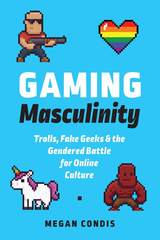
In 2016, a female videogame programmer and a female journalist were harassed viciously by anonymous male online users in what became known as GamerGate. Male gamers threatened to rape and kill both women, and the news soon made international headlines, exposing the level of abuse that many women and minorities face when participating in the predominantly male online culture.
Gaming Masculinity explains how the term “gamer” has been constructed in the popular imagination by a core group of male online users in an attempt to shore up an embattled form of geeky masculinity. This latest form of toxicity comes at a moment of upheaval in gaming culture, as women, people of color, and LGBTQ individuals demand broader access and representation online. Paying close attention to the online practices of trolling and making memes, author Megan Condis demonstrates that, despite the supposedly disembodied nature of life online, performances of masculinity are still afforded privileged status in gamer culture. Even worse, she finds that these competing discourses are not just relegated to the gaming world but are creating rifts within the culture at large, as witnessed by the direct links between the GamerGate movement and the recent rise of the alt-right during the last presidential election.
Condis asks what this moment can teach us about the performative, collaborative, and sometimes combative ways that American culture enacts race, gender, and sexuality. She concludes by encouraging designers and those who work in the tech industry to think about how their work might have, purposefully or not, been developed in ways that are marked by gender.

Traces how Chinese migrants challenged racialization and disenfranchisement by establishing Chinese restaurants during the Gilded Age.
In Gastrodiplomacy, Heather Ruth Lee dives deep into not just the history of Chinese restaurants in early twentieth-century New York City but the delicate, inchoate, and constantly evolving dynamics among their owners, workers, and their predominantly white clientele. Lee argues that the stylistic and capitalist choices made by restaurateurs (“gastrodiplomats”) had outsized political effects on paternalistic white diners (“gastroliberals”) who patronized their establishments, particularly when it came to racial relations in cities that were growing and diversifying. Lee is not starry-eyed—satisfying white tongues and stomachs didn’t lead to an urban utopia of peace, harmony, and brotherhood—but she shows the great and subtle influences of Chinese migrants on American urban space, culture, and metropolitan identity in a defining time.
In Lee’s capable and compelling telling, the Chinese restaurant becomes a distinctive locus for the negotiation of political power, cultural influence, urban identity, and more. Gastrodiplomacy reveals much about burgeoning and increasingly cosmopolitan American cities, as well as about their dynamic relationships with the fluidities of the American character.


Fifty-six hikes are described that fit, in a graded fashion, the physical capabilities of most older hikers. While the majority of hikes listed are in the Denver / Boulder area and the nearby foothills, the authors have detailed several routes in Rocky Mountain National Park, Aspen, and Vail that will entice more ambitious readers up into the high Colorado Rockies.
The Geezers' Guide to Colorado Hikes includes an overview of the physiology of altitude and aging, a summary of altitude-related medical problems, notes on hike preparation and what to pack, and 56 recommended hikes with: Degree of difficulty ratings, distances, e stimated round-trip time for the older hiker, starting altitude and elevation gain figures, driving direction, trail descriptions, and maps.

Born in colonial Havana to an aristocratic Creole family, the future countess of Merlin left Cuba for Spain at an early age. Later, her marriage to the French count Antoine Christophe Merlin and the invasion of French Napoleonic troops precipitated another move to France, where she became one of the belle dames of Paris and began her literary career. She returned only once to Cuba after the death of her husband in 1840, a journey that produced Viaje a la Habana. Upon her return to Paris, Merlin expanded this into La Havane, an ambitious three-volume account of the political, social, and economic organization of the island.
From the viewpoint of feminist and psychoanalytical theory, Gender and Nationalism in Colonial Cuba brilliantly explores the many ways in which issues of gender have contributed to Merlin's virtual absence from the canons of literature and from the discourses on Cuban national identity. Merlin's double identity as both Cuban and French is symbolic of the Cuban exiled condition, a fact taken up by contemporary exiled Cuban writers who see the countess as an alter-ego.
Mendez Rodenas seeks to restore Merlin as the first woman writer in Cuban literary history to articulate a sense of national identity, as well as being Cuba's first female historian. She focuses on Merlin's travel writings because they examine such issues as slavery, independence, nationhood, the role of women, education, and local literature. Together her writings construct an alternative, gendered history of nineteenth-century Cuba that must be acknowledged as both functional and authentic.
By situating Merlin at the intersection of the discourses of gender and nationalism, Mendez Rodenas reveals not only her pioneering role but also the need to expand current critical categories to account for the specificity of the Latin American literary tradition. In the process of restoring Merlin to her appropriate place in the canon of Latin American literature, she broadens our understanding of colonial Cuban history and expands our knowledge of the ways in which travel writing can influence a country's national literature .
This book provides semiotically focused analyses and interpretations of video game music, focusing specifically on the musical representation of three demographic diversity traits. Adopting a narratologist orientation to supplement existing ludological scholarship, these analyses apply music semiotics to crucial modern-day issues such as the representation of gender, race, and religion in video games.
An original and welcome contribution to the field, it considers musical meaning in relation to the aspects of gender, race, and religion. This book will help readers develop language and context in which to consider video game music in terms of society and representation and will encourage future research in these critical areas. Containing twenty-five detailed analytical case studies of musical representation in video game music, the book sets out theoretical and conceptual frameworks beneficial for interpreting musical meaning from video game soundtracks. Though players and commentators may be tempted to view a game’s soundtrack as mere background music, this research demonstrates video game music’s social relevance as a major factor impacting players’ cultural attitudes, values, and beliefs.
Part I explores immersion, interactivity, and interpretation in video game music, proposing a theory of interpretative interactivity to account for players’ semiotic agency in dialogue with their ludic agency. Part II explores musical gender representation in a trajectory from conventional gender construction, alternative femininities and masculinities, and the potential for nonbinary representational possibilities. Part III explores the musical representation of nationality, culture, and race, proposing the concept of racialized fantasy and applying frameworks from race scholarship to connect media representations of race to real-world racial justice movements. Part IV examines religion, introducing the concept of sonic iconography to connect theological meanings to the use of sacred music in video game music.
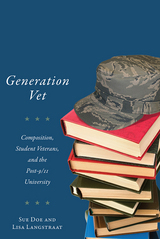
Institutions of higher education are experiencing the largest influx of enrolled veterans since World War II, and these student veterans are transforming post-secondary classroom dynamics. While many campus divisions like admissions and student services are actively moving to accommodate the rise in this demographic, little research about this population and their educational needs is available, and academic departments have been slower to adjust. In Generation Vet, fifteen chapters offer well-researched, pedagogically savvy recommendations for curricular and programmatic responses to student veterans for English and writing studies departments.
In work with veterans in writing-intensive courses and community contexts, questions of citizenship, disability, activism, community-campus relationships, and retention come to the fore. Moreover, writing-intensive courses can be sites of significant cultural exchanges—even clashes—as veterans bring military values, rhetorical traditions, and communication styles that may challenge the values, beliefs, and assumptions of traditional college students and faculty.
This classroom-oriented text addresses a wide range of issues concerning veterans, pedagogy, rhetoric, and writing program administration. Written by diverse scholar-teachers and written in diverse genres, the essays in this collection promise to enhance our understanding of student veterans, composition pedagogy and administration, and the post-9/11 university.
Generational Politics in the United States is the first comprehensive book that examines the concept of generations from a political science perspective. It defines what a generation is and how to sort out the differences between life cycle, cohort, and aging effect. The book then brings together chapters from an array of political science scholars that examine the role of generations in American politics and how it relates to other variables such as age, race, gender, and socioeconomic status. It discusses how politics in the United States are impacted by changes in generations, including how the passing of the Baby Boom generation and rise of the Millennials and Gen Z will change American politics. By examining the differences in political attitudes, engagement, and impact of recent generations, Generational Politics in the United States suggests how generational change will impact American politics in the future.

Genre Migrations argues that authors Jhumpa Lahiri, Valeria Luiselli, Ling Ma, Claudia Rankine, and Gary Shteyngart address immigration in both their content and innovative literary form. These authors highlight the relationship between immigrant identities and others, exposing borders—and genres—as porous and malleable constructs. Through their revisionist aesthetics and rhetorical engagements, these writers challenge the logic of globalization and xenophobia and condemn blind adherence to the limiting conventions of genres and life.

The very question of “what do Jews think about the goyim” has fascinated Jews and Gentiles, anti-Semites and philo-Semites alike. Much has been written about immigrant Jews in nineteenth- and twentieth-century New York City, but Gil Ribak’s critical look at the origins of Jewish liberalism in America provides a more complicated and nuanced picture of the Americanization process.
Gentile New York examines these newcomers’ evolving feelings toward non-Jews through four critical decades in the American Jewish experience. Ribak considers how they perceived Gentiles in general as well as such different groups as “Yankees” (a common term for WASPs in many Yiddish sources), Germans, Irish, Italians, Poles, and African Americans. As they discovered the complexity of America’s racial relations, the immigrants found themselves at odds with “white” American values or behavior and were drawn instead into cooperative relationships with other minorities. Sparked with many previously unknown anecdotes, quotations, and events, Ribak’s research relies on an impressive number of memoirs, autobiographies, novels, newspapers, and journals culled from both sides of the Atlantic.
@font-face { font-family: "Palatino";}@font-face { font-family: "?????? Pro W3";}p.MsoNormal, li.MsoNormal, div.MsoNormal { margin: 0in 0in 0.0001pt; font-size: 12pt; font-family: "Times New Roman"; }p.FreeForm, li.FreeForm, div.FreeForm { margin: 0in 0in 0.0001pt; font-size: 12pt; font-family: "Times New Roman"; color: black; }div.Section1 { page: Section1; }
In the 1880s, the well-connected young Englishman William B. Close and his three brothers, having bought thousands of acres of northwest Iowa prairie, conceived the idea of enticing sons of Britain’s upper classes to pursue the life of the landed gentry on these fertile acres. “Yesterday a wilderness, today an empire”: their bizarre experiment, which created a colony for people “of the better class” who were not in line to inherit land but whose fathers would set them up in farming, flourished in Le Mars, Iowa (and later in Pipestone, Minnesota), with over five hundred youths having a go at farming. In Gentlemen on the Prairie, Curtis Harnack tells the remarkable story of this quite unusual chapter in the settling of the Midwest.
Many of these immigrants had no interest in American citizenship but enjoyed or endured the challenging adventure of remaining part of the empire while stranded on the plains. They didn’t mix socially with other Le Mars area residents but enjoyed such sports as horse racing, fox hunts, polo, and an annual derby followed by a glittering grand ball. Their pubs were named the House of Lords, the House of Commons, and Windsor Castle; the Prairie Club was a replica of a London gentlemen’s club, an opera house attracted traveling shows, and their principal hotel was Albion House. In St. George’s Episcopal Church, prayers were offered for the well-being of Queen Victoria.
Problems soon surfaced, however, even for these well-heeled aristocrats. The chief problem was farm labor; there was no native population to exploit, and immigrant workers soon bought their own land. Although sisters might visit the colonists and sometimes marry one of them, appropriate female companionship was scarce. The climate was brutal in its extremes, and many colonists soon sold their acres at a profit and moved to countries affiliated with Britain. When the financial depression in the early 1890s lowered land values and made agriculture less profitable, the colony collapsed. Harnack skillfully draws upon the founder’s “Prairie Journal,” company ledgers, and other records to create an engaging, engrossing story of this quixotic pioneering experiment.
Geopolitical Economy examines the significance and nature of free trade agreements (FTAs), the primary policy tool through which modern nations seek access to international markets and promote economic growth. The book focuses specifically on how South Korea, the world’s leader in the number and significance of FTAs as well as the world’s sixth largest export economy, uses FTAs.
Jonathan Krieckhaus argues that geopolitics—the struggle between powerful nations over specific geographic regions around the globe—influenced FTA strategy and economic policy in South Korea and beyond. This perspective illustrates the security approach to FTAs, but adds that the geographic specificity of security concerns deeply shape FTA policy.
Geopolitical Economy also looks at Korean FTAs through the lens of development strategy. South Korea is singularly successful in garnering FTAs with all three players in the global economy: the United States, the European Union, and China. This unprecedented success was built on a strong commitment from three consecutive Korean presidential administrations, each operating within a favorable state-society context that enjoyed the existence of a centralized and effective trade bureaucracy.
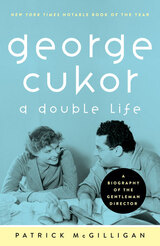
One of the highest-paid studio contract directors of his time, George Cukor was nominated five times for an Academy Award as Best Director. In publicity and mystique he was dubbed the “women’s director” for guiding the most sensitive leading ladies to immortal performances, including Greta Garbo, Ingrid Bergman, Judy Garland, and—in ten films, among them The Philadelphia Story and Adam’s Rib—his lifelong friend and collaborator Katharine Hepburn. But behind the “women’s director” label lurked the open secret that set Cukor apart from a generally macho fraternity of directors: he was a homosexual, a rarity among the top echelon. Patrick McGilligan’s biography reveals how Cukor persevered within a system fraught with bigotry while becoming one of Hollywood’s consummate filmmakers.
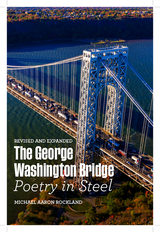
Since opening in 1931, the George Washington Bridge, linking New York and New Jersey, has become the busiest bridge in the world, with 103 million vehicles crossing it in 2016. Many people also consider it the most beautiful bridge in the world, yet remarkably little has been written about this majestic structure.
Intimate and engaging, this revised and expanded edition of Michael Rockland's rich narrative presents perspectives on the GWB, as it is often called, that span history, architecture, engineering, transportation, design, the arts, politics, and even post-9/11 mentalities. This new edition brings new insight since its initial publication in 2008, including a new chapter on the infamous “Bridgegate” Chris Christie-era scandal of 2013, when members of the governor's administration shut down access to the bridge, causing a major traffic jam and scandal and subsequently helping undermine Christie’s candidacy for the US presidency.
Stunning photos, from when the bridge was built in the late 1920s through the present, are a powerful complement to the bridge's history. Rockland covers the competition between the GWB and the Brooklyn Bridge that parallels the rivalry between New Jersey and New York City. Readers will learn about the Swiss immigrant Othmar Ammann, an unsung hero who designed and built the GWB, and how a lack of funding during the Depression dictated the iconic, uncovered steel beams of its towers, which we admire today. There are chapters discussing accidents on the bridge, such as an airplane crash landing in the westbound lanes and the sad story of suicides off its span; the appearance of the bridge in media and the arts; and Rockland's personal adventures on the bridge, including scaling its massive towers on a cable.
Movies, television shows, songs, novels, countless images, and even PlayStation 2 games have aided the GWB in becoming a part of the global popular culture. This tribute will captivate residents living in the shadow of the GWB, the millions who walk, jog, bike, skate, or drive across it, as well as tourists and those who will visit it someday.
.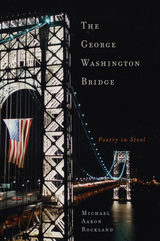
Intimate and engaging, Michael Rockland's rich narrative presents perspectives on the GWB, as it is often called, that span history, architecture, engineering, transportation, design, the arts, politics, and even post-9/11 mentality. Stunning archival photos, from the late 1920s when the bridge was built through the present, are a powerful complement to the bridge's history. Rockland covers the competition between the GWB and the Brooklyn Bridge that parallels the rivalry between New Jersey and New York City. Readers will learn about the Swiss immigrant Othmar Ammann, an unsung hero who designed and built the GWB, and how a lack of funding during the Depression dictated the iconic, uncovered steel beams of its towers, which we admire today. There are chapters discussing accidents on the bridge, such as an airplane crash landing in the westbound lanes and the sad story of suicides off its span; the appearance of the bridge in media and the arts; and Rockland's personal adventures on the bridge, including scaling its massive towers on a cable.
Movies, television shows, songs, novels, countless images, and even PlayStation 2 games have aided the GWB in becoming a part of the global popular culture. This tribute will captivate residents living in the shadow of the GWB, the millions who walk, jog, bike, skate, or drive across it, as well as tourists and those who will visit it some day.
- First major book on the George Washington Bridge
- Full of amazing facts about the GWB that will surprise even bridge historians
- Includes over 30 spectacular illustrations, ranging from archival photographs of the building of the bridge to those that show it draped in an enormous flag after 9/11
- Includes personal accounts of the author's adventures on the bridge
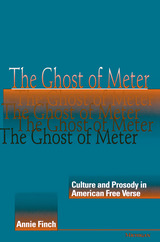
The Ghost of Meter: Culture and Prosody in American Free Verse provides a new strategy for interpreting the ways in which metrical patterns contribute to the meaning of poems. Annie Finch puts forth the theory of "the metrical code," a way of tracing the changing cultural connotations of metered verse, especially iambic pentameter. By applying the code to specific poems, the author is able to analyze a writer's relation to literary history and to trace the evolution of modern and contemporary poetries from the forms that precede them.
Poet, translator, and critic Annie Finch is director of the Stonecoast low-residency MFA program at the University of Southern Maine. She is co-editor, with Kathrine Varnes, of An Exaltation of Forms: Contemporary Poets Celebrate the Diversity of Their Art, and author of Calendars. She is the winner of the eleventh annual Robert Fitzgerald Prosody Award for scholars who have made a lasting contribution to the art and science of versification.
Author bio:
Annie Finch, poet, editor, and critic, has published twenty books of poetry and poetics including Spells: New and Selected Poems, The Body of Poetry: Essays on Women, Form, and the Poetic Self, An Exaltation of Forms: Contemporary Poets Celebrate the Diversity of Their Art, A Poet's Craft: A Comprehensive Guide to Making and Sharing Your Poetry, and The Ghost of Meter: Culture and Prosody in American Free Verse. Based in New York, Dr. Finch travels widely to teach and perform her poetry and is the founder of PoetryWitchCommunity.org, where she teaches poetry, meter, and more. She is the winner of the eleventh annual Robert Fitzgerald Prosody Award for scholars who have made a lasting contribution to the art and science of versification.
An interpretive history of Asian American independent media since the 1960s
Asian American filmmakers and video artists have created a substantial, diverse, and challenging body of work that reimagines the cultural and political representation of Asian Americans. Yet much of this work remains unknown.
For Glen M. Mimura, Asian American cinema is the spectral, ghostly return of the international film movement known as Third Cinema. Tracing contemporary Asian American cinema as a continuation of Third Cinema’s radical enterprise of making marginalized subjects visible in the First World, Ghostlife of Third Cinema examines such potent issues as diasporic identity, historical memory, and queer sexuality through sophisticated readings of a wide range of film and video projects, including Trinh T. Minh-ha’s experimental documentary Surname Viet Given Name Nam; avant-garde works by Japanese American filmmakers Rea Tajiri, Lise Yasui, and Janice Tanaka; and queer videos exploring the intersection of race, nation, and sexuality by Pablo Bautista, Ming-Yuen Ma, and Nguyen Tan Hoang. In Ghostlife of Third Cinema, Mimura confronts the ongoing erasure of Asian American independent media andilluminates its cultural and political significance today.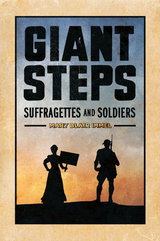
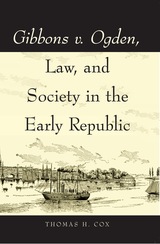
Gibbons v. Ogden, Law, and Society in the Early Republic examines a landmark decision in American jurisprudence, the first Supreme Court case to deal with the thorny legal issue of interstate commerce.
Decided in 1824, Gibbons v. Ogden arose out of litigation between owners of rival steamboat lines over passenger and freight routes between the neighboring states of New York and New Jersey. But what began as a local dispute over the right to ferry the paying public from the New Jersey shore to New York City soon found its way into John Marshall’s court and constitutional history. The case is consistently ranked as one of the twenty most significant Supreme Court decisions and is still taught in constitutional law courses, cited in state and federal cases, and quoted in articles on constitutional, business, and technological history.
Gibbons v. Ogden initially attracted enormous public attention because it involved the development of a new and sensational form of technology. To early Americans, steamboats were floating symbols of progress—cheaper and quicker transportation that could bring goods to market and refinement to the backcountry. A product of the rough-and-tumble world of nascent capitalism and legal innovation, the case became a landmark decision that established the supremacy of federal regulation of interstate trade, curtailed states’ rights, and promoted a national market economy. The case has been invoked by prohibitionists, New Dealers, civil rights activists, and social conservatives alike in debates over federal regulation of issues ranging from labor standards to gun control. This lively study fills in the social and political context in which the case was decided—the colorful and fascinating personalities, the entrepreneurial spirit of the early republic, and the technological breakthroughs that brought modernity to the masses.
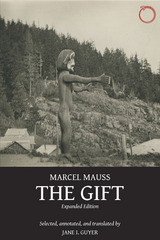
Included alongside the “Essay on the Gift” are Mauss’ memorial accounts of the work of Émile Durkheim and his colleagues who were lost during World War I, as well as his scholarly reviews of influential contemporaries such as Franz Boas, J. G. Frazer, Bronislaw Malinowski, and others. Read in the context of these additional pieces, the “Essay on the Gift” is revealed as a complementary whole, a gesture of both personal and political generosity: Mauss’ honor for his fallen colleagues; his aspiration for modern society’s recuperation of the gift as a mode of repair; and his own careful, yet critical, reading of his intellectual milieu. The result sets the scene for a whole new generation of readers to study this essay alongside pieces that exhibit the erudition, political commitment, and generous collegial exchange that first nourished the essay into life.

A poetic collage of voices, genres, and time-spaces. A display of power over language and rhythm. A postmodern performance of naked figures hanging in the nebulae of a militarized universe. A new millennium cubist manifesto against decrepit political machines. A mystic song in search of birth and love. In this new collection of poems, Juan Felipe Herrera's natural talent for capturing the raw dimensions of reality merges with his wild imagination and technical prowess.
Things, names, places, histories, herstories, desires, wills, minds, and their effects and progeny are re-mixed, re-mastered, and re-cast into a new narrative theater. Characters in a constant and stubborn rush, appearance, disappearance, and flow—with, against, and for each other—create the fire and give birth to the hallucinatory spotted and leaf-eating, long-necked child. Exciting and original, cutting-edge and risk-taking, Giraffe on Fire is a breathtaking addition to a respected body of work by a poet not afraid to speak out about how poetry reflects the raw beauty and truth of life.

Finalist for 2016 Richard Wall Memorial Award from the Theatre Library Association
Long-listed for the 2017 Best Photography Book Award from the Kraszna-Krausz Foundation
Marlene Dietrich, Greta Garbo, and Katharine Hepburn all made lasting impressions with the cinematic cross-dressing they performed onscreen. What few modern viewers realize, however, is that these seemingly daring performances of the 1930s actually came at the tail end of a long wave of gender-bending films that included more than 400 movies featuring women dressed as men.
Laura Horak spent a decade scouring film archives worldwide, looking at American films made between 1908 and 1934, and what she discovered could revolutionize our understanding of gender roles in the early twentieth century. Questioning the assumption that cross-dressing women were automatically viewed as transgressive, she finds that these figures were popularly regarded as wholesome and regularly appeared onscreen in the 1910s, thus lending greater respectability to the fledgling film industry. Horak also explores how and why this perception of cross-dressed women began to change in the 1920s and early 1930s, examining how cinema played a pivotal part in the representation of lesbian identity.
Girls Will Be Boys excavates a rich history of gender-bending film roles, enabling readers to appreciate the wide array of masculinities that these actresses performed—from sentimental boyhood to rugged virility to gentlemanly refinement. Taking us on a guided tour through a treasure-trove of vintage images, Girls Will Be Boys helps us view the histories of gender, sexuality, and film through fresh eyes.

In Git Along, Little Dogies, White draws on old friendships and his exhaustive files to bring readers the untold story of cowboy and western song. Wonderful anecdotes stand beside White's trademark attention to detail as he painstakingly establishes the time, place, and circumstance behind each song's origin and places the music within the evolution of popular song. He also looks at how radio and recording affected the genre and shows how the music crisscrossed with pop music but also with folk and the traditional Anglo-Irish tradition.
From "Whoopee Ti Yi Yo" to "Ten Thousand Cattle Straying," Git Along, Little Dogies ventures from cow camps to saloons to big-city radio studios as it lassos a vivid piece of American music history.
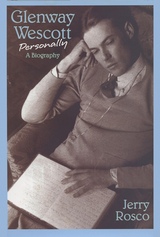
As a writer, Glenway Wescott (1901–1987) left behind several novels, including The Grandmothers and The Pilgrim Hawk, noted for their remarkable lyricism. As a literary figure, Wescott also became a symbol of his times. Born on a Wisconsin farm in 1901, he associated as a young writer with Hemingway, Stein, and Fitzgerald in 1920s Paris and subsequently was a central figure in New York’s artistic and gay communities. Though he couldn’t finish a novel after the age of forty-five, he was just as famous as an arts impresario, as a diarist, and for the company he kept: W. H. Auden, Christopher Isherwood, Marianne Moore, Somerset Maugham, E. M. Forster, Joseph Campbell, and scores of other luminaries.
In Glenway Wescott Personally, Jerry Rosco chronicles Wescott’s long and colorful life, his early fame and later struggles to write, the uniquely privileged and sometimes tortured world of artistic creation. Rosco sensitively and insightfully reveals Wescott’s private life, his long relationship with Museum of Modern Art curator Monroe Wheeler, his work with sex researcher Alfred Kinsey that led to breakthrough findings on homosexuality, and his kinship with such influential artists as Jean Cocteau, George Platt-Lynes, and Paul Cadmus.
For a post-human hitchhiker, human life–with its anxiety, aging, illness, and constant need for problem-solving–may look unviable. Yet, for humans, the life struggle is softened by human touch, human emotion, and human cooperation.
The Global Encyclopaedia of Informality, Volume 3 continues the journey of the two previous volumes into the world’s open secrets, unwritten rules, and hidden practices. It focuses on issues of emotional ambivalence and pressures of the digital age. The informal practices presented in this volume demonstrate the urgency of alleviating tensions between continuity and all-too-rapid change and the need to tackle the central problem of modern societies—uncertainty.
The volume takes the reader on a biographical journey through elusive, taken-for-granted, or banal ways of getting things done from over seventy countries and world regions. It offers an innovative understanding of the significance of fringes and challenges the assumption that informality is associated exclusively with poverty, underdevelopment, the Global South, oppressive regimes, or the former socialist countries of Eastern Europe and Central Asia. It also maps the patterns of informality around the globe, identifies specific informal practices in a context-sensitive way, and documents their ambivalent impact on people engaged in problem-solving, on societies in which these problems arise, and on humanity overall.

A far-reaching approach that considers the truly global picture and recognizes the contributions of many disciplines—including the natural sciences, the social sciences, and increasingly, the humanities—Global Environmental History focuses not only on the material world but also on humans’ ideas about the planet and their place on it. Taking as his starting point the major phases of human technological evolution of the last 12,000 years, Simmons considers how these changes have affected the natural world and goes on to assess the response to conditions such as climate change. By putting today’s environmental preoccupations into a long-term perspective, Simmons reveals the history of some current anxieties.
A timely examination of the interrelation of history and nature, Simmons’s book will be welcomed by any concerned reader interested in the origins of the modern environmental crisis.



"Karl Marx aspired to a world in which our animal needs would be satisfied and our human needs could be addressed. It is a realistic possibility now, as William Robinson outlines—or the alternative that is taking shape before our eyes: a 'global police state' controlled by narrowly concentrated capital with 'surplus humanity' left to survive somehow on its own. The choice is in our hands."
—Noam Chomsky, author of Who Rules the World?
As the world becomes ever more unequal, people become ever more “disposable.” Today, governments systematically exclude sections of their populations from society through heavy-handed policing. But it doesn't always go to plan.
William I. Robinson exposes the nature and dynamics of this out-of-control system, arguing for the urgency of creating a movement capable of overthrowing it. The global police state uses a variety of ingenious methods of control, including mass incarceration, police violence, US-led wars, the persecution of immigrants and refugees, and the repression of environmental activists.
He writes in his Introduction, “I offer a ‘big picture” of the emerging global police state in a short book that is eminently readable. The pages to follow may startle many readers and make them angry. I trust the work will serve as a warning of the dystopic future that is upon us. More importantly, by exposing the nature and dynamic of this out-of-control system, I hope it will contribute to the struggles to bring about an alternative future based on human freedom and liberation.”
Movements have emerged to combat the increasing militarization, surveillance and social cleansing; however, many of them appeal to a moral sense of social justice rather than addressing its root: global capitalism.
Using shocking data which reveals how far capitalism has become a system of repression, Robinson argues that the emerging megacities of the world are becoming the battlegrounds where the excluded and the oppressed face off against the global police state.
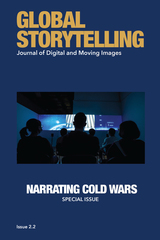
Special Issue Editors: Kenneth Paul Tan & Dorothy Lau
Letter from the Editor - YING ZHU
Cold War and New Cold War Narratives: Special Issue Editor’s Introduction - KENNETH PAUL TAN
Research Articles
Notes on Cold War Historiography - LOUIS MENAND
Tales from the Hot Cold War - MARTHA BAYLES
Bomb Archive: The Marshall Islands as Cold War Film Set - ILONA JURKONYTĖ
Das unsichtbare Visier—A 1970s Cold War Intelligence TV Series as a Fantasy of International and Intranational Empowerment; or, How East Germany Saved the World and West Germans Too - TARIK CYRIL AMAR
To Whom Have We Been Talking? Naeem Mohaiemen’s Fabulation of a People-to-Come - NOIT BANAI
The Man without a Country: British Imperial Nostalgia in Ferry to Hong Kong (1959) - KENNY K. K. NG
Imagining Cooperation: Cold War Aesthetics for a Hot Planet - MARINA KANETI
Book Reviews
Through Space and Time - Review of The Odyssey of Communism: Visual Narratives, Memory and Culture edited by Michaela Praisler and Oana-Celia Gheorghiu, Cambridge Scholars Publishing, 2021 - ISABEL GALWEY
Review of Hollywood in China: Behind the Scenes of the World’s Largest Movie Market by Ying Zhu, New Press, 2022 - YONGLI LI
The Cautionary Tale of Painting War Remembrance in China as a New Nationalism - Review of China’s Good War: How World War II Is Shaping a New Nationalism by Rana Mitter, Belknap Press, 2020 - FUWEI ZUO
Tracking American Political Currents - Review of White Identity Politics by Ashley Jardina, Cambridge University Press, 2019, and Fox Populism: Branding Conservatism as Working Class by Reece Peck, Cambridge University Press, 2019 - DAVID GURNEY
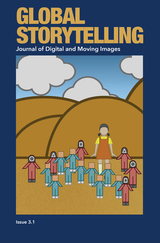
Special Issue Editors Tze-lan Sang, Lina Qu, and Ying Zhu
IN THIS ISSUE
Tze-lan Sang, Lina Qu, and Ying Zhu - East Asian Serial Dramas in the Era of Global Streaming Services: Special Issue Editors’ Introduction
Research Articles
Ying Zhu - The Therapeutic and the Transgressive: Chinese Fansub Straddling between Hollywood IP Laws and Chinese State Censorship
David Humphrey - Japanese Dramas and the Streaming Success Story that Wasn’t: How Industry Practices and IP Shape Japan’s Access to Global Streaming
Yucong Hao - Transmedia Adaptation, Sonic Affect, and Multisensory Participation in Contemporary Chinese Danmei Radio Drama
Eunice Ying Ci Lim - The Nostalgic Negotiation of Post-TV Legibility in Mom, Don’t Do That!
Winnie Yanjing Wu - How Pachinko Mirrors Migrant Life: Rethinking the Temporal, Spatial, and Linguistic Dimensions of Migration
Drama Reviews
Mei Mingxue Nan - Squid Game: The Hall of Screens in the Age of Platform Cosmopolitanism
Shuwen Yang - Review of Light the Night
Short Essay
Sheng-mei Ma - Three Bad Kids, One Loving Killer: Red China Noir in Blakean Symmetry
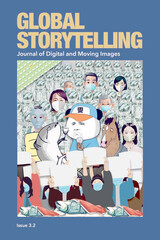
Haiqing Yu. COVID-19, Satirical Activism, and Chinese Youth Culture: An Introduction
Research Articles
Ying Zhu and Junqi Peng. From Diaosi to Sang to Tangping: The Chinese DST Youth Subculture Online
Shaohua Guo. Moments of "Madness": Cynicism in Times of COVID
Howard Choy. Laughter in the Time of Coronavirus: Epidemic Humor and Satire in Chinese Women's Digital Diaries
Shaoyu Tang. Political In Between: Streaming Stand-Up Comedy and Feminist Reckoning in Contemporary Mainland China
Jingxue Zhang and Charlie Yi Zhang. The Power of Citation: Feminist Counter-Appropriation of State Discourses in Post-Reform China
Book Reviews
Ethan Tussey. Revised Research Methodology for the Age of Media Industries Speculation - Review of Specworld: Folds, Faults, and Fractures in Embedded Creator Industries by John Thornton Caldwell, University of California Press, 2023
Michael Keane. Precarious Creativity and the State in New Era China - Review of Chinese Creator Economies: Labor and Bilateral Creative Workers by Jian Lin, New York University Press, 2023


Global Storytelling: Journal of Digital and Moving Images, housed at the Academy of Film and published by Michigan Publishing, is an open access, peer-reviewed international and interdisciplinary journal for intellectual debates concerning the politics, economics, culture, media, and technology of the moving image.
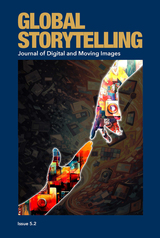
Global Storytelling: Journal of Digital and Moving Images, housed at the Academy of Film and published by Michigan Publishing, is an open access, peer-reviewed international and interdisciplinary journal for intellectual debates concerning the politics, economics, culture, media, and technology of the moving image.

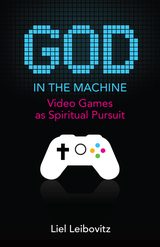
Yet video games remain relatively unexplored by both scholars and pundits alike. Few have advanced beyond outmoded and futile attempts to tie gameplay to violent behavior. With this rumor now thoroughly and repeatedly disproven, it is time to delve deeper. Just as the Museum of Modern Art in Manhattan recently acquired fourteen games as part of its permanent collection, so too must we seek to add a serious consideration of virtual worlds to the pantheon of philosophical inquiry.
In God in the Machine, author Liel Leibovitz leads a fascinating tour of the emerging virtual landscape and its many dazzling vistas from which we are offered new vantage points on age-old theological and philosophical questions. Free will vs. determinism, the importance of ritual, transcendence through mastery, notions of the self, justice and sin, life, death, and resurrection all come into play in the video games that some critics so quickly write off as mind-numbing wastes of time. When one looks closely at how these games are designed, their inherent logic, and their cognitive effects on players, it becomes clear that playing these games creates a state of awareness vastly different from when we watch television or read a book. Indeed, the gameplay is a far more dynamic process that draws on various faculties of mind and body to evoke sensations that might more commonly be associated with religious experience. Getting swept away in an engaging game can be a profoundly spiritual activity. It is not to think, but rather to be, a logic that sustained our ancestors for millennia as they looked heavenward for answers.
As more and more of us look “screenward,” it is crucial to investigate these games for their vast potential as fine instruments of moral training. Anyone seeking a concise and well-reasoned introduction to the subject would do well to start with God in the Machine. By illuminating both where video game storytelling is now and where it currently butts up against certain inherent limitations, Liebovitz intriguingly implies how the field and, in turn, our experiences might continue to evolve and advance in the coming years.

In the fast changing culture of antebellum New York, writers of every stripe celebrated "the City" as a stage for the daily urban encounter between the familiar and the inexplicable. Probing into these richly varied texts, Hans Bergmann uncovers the innovations in writing that accompanied the new market society— the penny newspapers' grandiose boastings, the poetic catalogues of Walt Whitman, the sentimental realism of charity workers, the sensationalism of slum visitors, and the complex urban encounters of Herman Melville's fiction.
The period in which New York, the city itself, became firmly established as a subject invented a literary form that attempts to capture the variety of the teeming city and the flaneur, the walking observer. But Bergmann does not simply lead a parade of images and themes; he explores the ways in which these observers understood what was happening around them and to them, always attentive to class struggle and race and gender issues.
God in the Street shows how the penny press and Whitman's New York poetry create a new mass culture hero who interprets and dignifies the city's confusions. New York writers, both serious and sensationalist, meditate upon street encounters with tricksters and confidence-men and explore the meanings of encounters. Melville's "Bartleby, the Scrinever" underlines the unrelenting isolation and inability to control the interpreter. Bergmann reinterprets Melville's The Confidence Man as an example of how a complex literary form arises directly from its own historical materials and is itself socially symbolic. Bergmann sees Melville as special because he recognizes his inability to make sense of the surface of chaotic images and encounters. In mid-century New York City, Melville believes God is in the street, unavailable and unrecognizable, rather than omnipresent and guiding.
Building upon the scholarship of an earlier volume, Dionysus Reborn, Spariosu her continues to draw on Dionysus—the “God of many names,” of both poetic play and sacred power—as a mythical embodiment of the two sides of the classical Greek mentality. Combining philosophical reflection with close textual analysis, the author examines the divided nature of the Hellenic mentality in such primary canonic texts as the Iliad, the Odyssey, the Theogony, Works and Days, the most well-known of the Presocratic fragments, Euripides’ Bacchae, Aristophanes’ The Frogs, Plato’s Republic and Laws, and Aristotle’s Poetics and Politics.
Spariosu’s model illuminates the many of the most enduring questions in contemporary humanistic study and addresses modern questions about the nature of the interrelation of poetry, ethics, and politics.
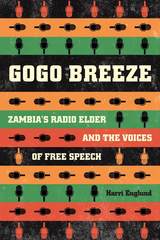
Harri Englund provides a masterfully detailed study of this popular radio personality that addresses broad questions of free speech in Zambia and beyond. By drawing on ethnographic insights into political communication, Englund presents multivocal morality as an alternative to dominant Euro-American perspectives, displacing the simplistic notion of voice as individual personal property—an idea common in both policy and activist rhetoric. Instead, Englund focuses on the creativity and polyphony of Zambian radio while raising important questions about hierarchy, elderhood, and ethics in the public sphere.
A lively, engaging portrait of an extraordinary personality, Gogo Breeze will interest Africanists, scholars of radio and mass media, and anyone interested in the history and future of free speech.
This collection focuses on the introduction of phenomenology to the United States by the community of scholars who taught and studied at the New School for Social Research from 1954 through 1973. During those years, Dorion Cairns, Alfred Schutz, and Aron Gurwitsch—all former students of Edmund Husserl—came together in the department of philosophy to establish the first locus of phenomenology scholarship in the country. This founding trio was soon joined by three other prominent scholars in the field: Werner Marx, Thomas M. Seebohm, and J. N. Mohanty. The Husserlian phenomenology that they brought to the New School has subsequently spread through the Anglophone world as the tradition of Continental philosophy.
The first part of this volume includes original works by each of these six influential teachers of phenomenology, introduced either by one of their students or, in the case of Seebohm and Mohanty, by the thinkers themselves. The second part comprises contributions from twelve leading scholars of phenomenology who trained at the New School during this period. The result is a powerful document tracing the lineage and development of phenomenology in the North American context, written by members of the first two generations of scholars who shaped the field.
Contributors: Michael Barber, Lester Embree, Jorge García-Gómez, Fred Kersten, Thomas M. T. Luckmann, William McKenna, J. N. Mohanty, Giuseppina C. Moneta, Thomas Nenon, George Psathas, Osborne P. Wiggins, Matthew M. Seebohm, and Richard M. Zaner.
The family arrives as Harlem staggers under the flu pandemic that follows the First World War. DeLilah Mosby and her daughter, Selma, meet difficulties with backbone and resolve to make a home for themselves in the city, and Selma has a baby, Chloe. As the Great Depression creeps across the world at the close of the twenties, however, the farsighted see hard times coming.
The panic of the early thirties is embodied in the kidnapping and murder of the infant son of the nation’s dashing young aviator, Charles Lindbergh. A transfixed public follows the manhunt in the press and on the radio. Then Chloe goes missing—but her disappearance does not draw the same attention. Wry and perceptive Weldon Haynie Thomas, the city’s first “colored” policeman, takes the case.
The urgent investigation tests Thomas’s abilities to draw out the secrets Harlem harbors, untangling the color-coded connections and relationships that keep company with greed, ghosts, and grief. With nuanced characters, lush historical detail, and a lyrical voice, Gone Missing in Harlem affirms the restoring powers of home and family.
After the 2016 U.S. Presidential election, a large cohort of women emerged to run for office. Their efforts changed the landscape of candidates and representation. However, women are still far less likely than men to seek elective office, and face biases and obstacles in campaigns. (Women running for Congress make twice as many phone calls as men to raise the same contributions.)
The editors and contributors to Good Reasons to Run, a mix of scholars and practitioners, examine the reasons why women run—and do not run—for political office. They focus on the opportunities, policies, and structures that promote women’s candidacies. How do nonprofits help recruit and finance women as candidates? And what role does money play in women’s campaigns?
The essays in Good Reasons to Run ask not just who wants to run, but how to activate and encourage such ambition among a larger population of potential female candidates while also increasing the diversity of women running for office.

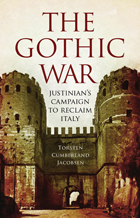
“Jacobsen brings to the story an intimate knowledge of Italy. The battles took place on terrain Jacobsen knows well. . . Recommended.”—Choice
“Jacobsen provides an operational history of Justinian’s campaign. Throughout he traces the military strategies and tactical intrigues of leaders such as the Roman general Belisarius and the Goth leader Totila.”—Publishers Weekly
“Jacobsen knows the sites he writes about, he has read Procopius diligently . . . and his military reconstruction can be faulted only in attributing to both sides rather better command and control than the ancient armies could generally manage. . . . Jacobsen has offered wargamers a tool they will appreciate.”—The Classical Review
A period of stability in the early sixth century A.D. gave the Eastern Roman emperor Justinian an opportunity to recapture parts of the Western Empire which had been lost to invading barbarians in the preceding centuries. The climactic conflict over Italy between 535 and 554—the Gothic War—decided the political future of Europe, holding in its balance the possibility that the Roman Empire might rise again. While large portions of the original territory of the ancient Roman Empire were recaptured, the Eastern Empire was incapable of retaining much of its hard-won advances, and soon the empire once again retracted. As a result of the Gothic War, Italy was invaded by the Lombards who began their important kingdom, the Franks began transforming Gaul into France, and without any major force remaining in North Africa, that territory was quickly overrun by the first wave of Muslim expansion in the ensuing century. Written as a general overview of this critical period, The Gothic War: Justinian’s Campaign to Reclaim Italy opens with a history of the conflict with Persia and the great Roman general Belisarius’s successful conquest of the Vandals in North Africa. After an account of the Ostrogothic tribe and their history, the campaigns of the long war for Italy are described in detail, including the three sieges of Rome, which turned the great city from a bustling metropolis into a desolate ruin. In addition to Belisarius, the Gothic War featured many of history’s most colorful antagonists, including Rome’s Narses the Eunuch, and the Goths’ ruthless and brilliant tactician, Totila. Two appendices provide information about the armies of the Romans and Ostrogoths, including their organization, weapons, and tactics, all of which changed over the course of the war.
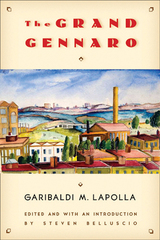
The Grand Gennaro, a riveting saga set at the turn of the last century in Italian American Harlem, reflects on how youthful acts of cruelty and desperation follow many to the grave. A classic in the truest sense, this operatic narrative is alive once again, addressing the question: How does one become an "American"?
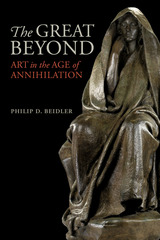
Essays mapping how modern art confronts mortality in an age of war and annihilation.
While much about modernism remains up for debate, there can be no dispute about the connection between modernist art and death. The long modern moment was and is an age of war, genocide, and annihilation. Two world wars killed perhaps as many as 100 million people, through combat, famine, holocaust, and ghastly attacks on civilians. The ongoing COVID-19 pandemic is the fifth global pandemic since 1918, with more than a half-million American deaths and counting.
It can hardly come as a surprise, then, that many of the touchstones of modernism reflect on death and devastation. In Philip D. Beidler’s exploration of the modernist canon, he illuminates how these singular voices looked extinction in the eye and tried to reckon with our finitude—and their own. The Great Beyond: Art in the Age of Annihilation catalogs through lively prose an eclectic selection of artists, writers, and thinkers. In 16 essays, Beidler takes nuanced and surprising approaches to well-studied figures—the haunting sculpture by Saint-Gaudens commissioned by Henry Adams for his late wife; Luchino Visconti’s adaptation of Mann’s Death in Venice; and the author’s own long fascination with Beckett’s Waiting for Godot.
The threads and recurring motifs that emerge through Beidler’s analysis bridge the different media, genres, and timeframes of the works under consideration. Protomodernists Crane and Twain connect with near-contemporary voices like Sebald and Morrison. Robert MacFarlane’s 21st-century nonfiction about what lies underneath the earth echoes the Furerbunker and the poetry of Gertrud Kolmar. Learned but lively, somber but not grim, The Great Beyond is not a comfortable read, but it is in a way comforting. In tracing how his subjects confronted nothingness, be it personal or global, Beidler draws a brilliant map of how we see the end of the road.
This study examines these questions in relation to the German immigrant community in New York City between 1880-1930, and seeks to understand how German-American New Yorkers assimilated into the larger American society in the early twentieth century.
By the turn of the twentieth century, New York City was one of the largest German-speaking cities in the world and was home to the largest German community in the United States. This community was socio-economically diverse and increasingly geographically dispersed, as upwardly mobile second and third generation German Americans began moving out of the Lower East Side, the location of America’s first Kleindeutschland (Little Germany), uptown to Yorkville and other neighborhoods. New York’s German American community was already in transition, geographically, socio-economically, and culturally, when the anti-German/One Hundred Percent Americanism of World War I erupted in 1917.
This book examines the structure of New York City’s German community in terms of its maturity, geographic dispersal from the Lower East Side to other neighborhoods, and its ultimate assimilation to the point of invisibility in the 1920s. It argues that when confronted with the anti-German feelings of World War I, German immigrants and German Americans hid their culture – especially their language and their institutions – behind closed doors and sought to make themselves invisible while still existing as a German community.
But becoming invisible did not mean being absorbed into an Anglo-American English-speaking culture and society. Instead, German Americans adopted visible behaviors of a new, more pluralistic American culture that they themselves had helped to create, although by no means dominated. Just as the meaning of “German” changed in this period, so did the meaning of “American” change as well, due to nearly 100 years of German immigration.
On the night of October 8, 1871, a whirlwind of fire swept through northeastern Wisconsin, destroying the bustling frontier town of Peshtigo. Trees, buildings, and people burst into flames. Metal melted. Sand turned into glass. People thought the end of the world had come. When the “tornado of fire” was over, 2,500 people were dead, and Peshtigo was nothing but a smoking ruin. It was the deadliest wildfire in U.S. history.
The Great Peshtigo Fire: Stories and Science from America’s Deadliest Firestorm explores the history, science, and legacy of the 1871 Peshtigo Fire at a fourth-grade reading level. Readers will learn about the history of settlement, agriculture, and forestry in 19th-century Wisconsin. This illuminating text covers a diverse range of topics that will enrich the reader’s understanding of the Peshtigo Fire, including the building and land-use practices of the time that made the area ripe for such a fire, the weather patterns that fostered widespread fires throughout the upper Midwest in the summer and fall of 1871, and exciting first-person accounts that vividly bring the `victims’ stories to life. Connections made between the Peshtigo Fire and the history of fire prevention in the United States encourage critical thinking about issues that remain controversial to this day, such as planned burns and housing development restrictions near forested areas. The Great Peshtigo Fire: Stories and Science from America’s Deadliest Firestorm will inform and captivate its readers as it journeys through the horrifying history of the Peshtigo Fire.
Early descriptions of the Great Plains often focus on a vast, grassy expanse that was either burnt or burning. The scene continued to burn until the land was plowed under or grazed away and broken by innumerable roads and towns. Yet, where the original landscape has persisted, so has fire, and where people have sought to restore something of that original setting, they have had to reinstate fire. This has required the persistence or creation of a fire culture, which in turn inspired schools of science and art that make the Great Plains today a regional hearth for American fire.
Volume 5 of To the Last Smoke introduces a region that once lay at the geographic heart of American fire, and today promises to reclaim something of that heritage. After all these years, the Great Plains continue to bear witness to how fires can shape contemporary life, and vice versa. In this collection of essays, Stephen J. Pyne explores how this once most regularly and widely burned province of North America, composed of various subregions and peoples, has been shaped by the flames contained within it and what fire, both tame and feral, might mean for the future of its landscapes.
Included in this volume:
- How wildland and rural fire have changed from the 19th century to the 21st century
- How fire is managed in the nation’s historic tallgrass prairies, from Texas to South Dakota, from Illinois to Nebraska
- How fire connects with other themes of Great Plains life and culture
- How and why Texas has returned to the national narrative of landscape fire
Herbert Marcuse examined the subjective and material conditions of radical social change and developed the "Great Refusal," a radical concept of "the protest against that which is." The editors and contributors to the exciting new volume The Great Refusal provide an analysis of contemporary social movements around the world with particular reference to Marcuse's revolutionary concept. The book also engages-and puts Marcuse in critical dialogue with-major theorists including Slavoj Žižek and Michel Foucault, among others.
The chapters in this book analyze different elements and locations of the contemporary wave of struggle, drawing on the work and vision of Marcuse in order to reveal, with a historical perspective, the present moment of resistance. Essays seek to understand recent uprisings-such as the Zapatistas in Mexico, the Arab Spring, and the Occupy movement-in the context of Marcuse's powerful conceptual apparatus.
The Great Refusal also charts contemporary social movements against global warming, mass incarceration, police brutality, white supremacy, militarization, technological development, and more, to provide insights that advance our understanding of resistance today.
Contributors include: Kevin B. Anderson, Stanley Aronowitz, Joan Braune, Jenny Chan, Angela Y. Davis, Arnold L. Farr, Andrew Feenberg, Michael Forman, Christian Fuchs, Stefan Gandler, Christian Garland, Toorjo Ghose, Imaculada Kangussu, George Katsiaficas, Douglas Kellner, Sarah Lynn Kleeb, Filip Kovacevic, Lauren Langman, Heather Love, Peter Marcuse, Martin J. Beck Matuštík, Russell Rockwell, AK Thompson, Marcelo Vieta, and the editors.

Instead of a comprehensive history of the battlefield, this book captures the homefront experience: the political debates over war policy, the worry over loved ones fighting overseas, the countless everyday sacrifices, and the impact of a wartime hysteria that drove dissent underground. It also includes the voices of soldiers from Wisconsin’s famed 32nd Division, through extensively quoted letters and newspaper accounts. Immerse yourself in the Wisconsin experience during World War I—a conflict that demonstrated America’s great capacity for sacrifice and generosity, but also for prejudice, intolerance, and injustice.

In this lively story of sports, politics, and the talented, hilarious, and charming characters associated with the Brooklyn Dodgers, Bob McGee chronicles the ballpark's vibrant history from the drawing board to the wrecking ball, beginning with Charley Ebbets and the heralded opening in 1913, on through the eras that followed. McGee weaves a story about how Ebbets Field's architectural details, notable flaws, and striking facade brought Brooklyn and its team together in ways that allowed each to define the other.
Drawing on original interviews and letters, as well as published and archival sources, The Greatest Ballpark Ever explores the struggle of Charley Ebbets to build Ebbets Field, the days of Wilbert Robinson's early pennant winners, the eras of the Daffiness Boys, Larry MacPhail, and Branch Rickey, the tumultuous field leadership of Leo the Lip, the fiery triumph of Jackie Robinson, the golden days of the Boys of Summer, and Walter O'Malley's ignominious departure.
With humor and passion, The Greatest Ballpark Ever lets readers relive a day in the raucous ballpark with its quirky angles and its bent right-field wall, with the characters and events that have become part of the nation's folklore.
Joy Y. Zhang and Michael Barr explain how environmental problems are transforming Chinese society through new developments such as the struggle for clean air, low-carbon conspiracy theories, new forms of public fund raising and the international tactics of grassroots NGOs. In doing so, they challenge static understandings of state-society relations in China.
Green Politics in China is an illuminating and detailed investigation which provides crucial insights into how China is both changing internally and emerging as a powerful player in global environmental politics.

The Green Revolution was devised to increase agricultural production worldwide, particularly in the developing world. Agriculturalists employed anhydrous ammonia and other fertilizing agents, mechanical tilling, hybridized seeds, pesticides, herbicides, and a multitude of other techniques to increase yields and feed a mushrooming human population that would otherwise suffer starvation as the world’s food supply dwindled.
In The Green Revolution in the Global South: Science, Politics, and Unintended Consequences, R. Douglas Hurt demonstrates that the Green Revolution did not turn out as neatly as scientists predicted. When its methods and products were imported to places like Indonesia and Nigeria, or even replicated indigenously, the result was a tumultuous impact on a society’s functioning. A range of factors—including cultural practices, ethnic and religious barriers, cost and availability of new technologies, climate, rainfall and aridity, soil quality, the scale of landholdings, political policies and opportunism, the rise of industrial farms, civil unrest, indigenous diseases, and corruption—entered into the Green Revolution calculus, producing a series of unintended consequences that varied from place to place. As the Green Revolution played out over time, these consequences rippled throughout societies, affecting environments, economies, political structures, and countless human lives.
Analyzing change over time, almost decade by decade, Hurt shows that the Green Revolution was driven by the state as well as science. Rather than acknowledge the vast problems with the Green Revolution or explore other models, Hurt argues, scientists and political leaders doubled down and repeated the same missteps in the name of humanity and food security. In tracing the permutations of modern science’s impact on international agricultural systems, Hurt documents how, beyond increasing yields, the Green Revolution affected social orders, politics, and lifestyles in every place its methods were applied—usually far more than once.
Illuminates how borough residents, urban planners, and politicians used environmental policy to cement a racially restrictive landscape.
Though it was once home to the world’s largest landfill, today Staten Island boasts thousands of acres of parklands, dozens of public-private conservation arrangements, and four ecological zoning districts. In this book, Patrick D. Nugent details the political forces that gave rise to this wealth of greenery in a famously dense city. He demonstrates how postwar economic and political trajectories intersected in the 1960s with the rising consciousness of environmentalism to create a distinctive laboratory in Staten Island, where white communities and politicians heeded the rising call for the preservation of green space—but often as a tool to maintain racial segregation. Ecological zoning, public-private park management, conservation easement, environmental litigation, and other strategies created a lush, discriminatory landscape. Nugent refers to these policies as greenlining.
The Greenlining of Staten Island shows that the political and environmental history of Staten Island is key to understanding how environmentalism has been used to reinforce racial discrimination, not just in New York City, but nationwide. By the mid-1970s, conservationists had embraced urban planning that preserved low-density housing districts and bolstered the sprawling and segregated landscape that took shape in metropolitan America over the coming decades. In exploring the gap between the modern environmental movement’s ambitious goals and its tangible outcomes, Nugent excavates important lessons for contemporary city dwellers debating zoning reform and planning for climate change’s impending effects.

A leading writer on cultural history, Banes draws a vibrant portrait of the artists and performers who gave the 1963 Village its exhilarating force, the avant-garde whose interweaving of public and private life, work and play, art and ordinary experience, began a wholesale reworking of the social and cultural fabric of America. Among these young artists were many who went on to become acknowledged masters in their fields, including Andy Warhol, John Cage, Yoko Ono, Yvonne Rainer, Lanford Wilson, Sam Shepard, Brian de Palma, Harvey Keitel, Kate Millet, and Claes Oldenburg. In live performance--Off-Off Broadway theater, Happenings, Fluxus, and dance--as well as in Pop Art and underground film, we see this generation of artists laying the groundwork for the explosion of the counterculture in the late 1960s and the emergence of postmodernism in the 1970s. Exploring themes of community, freedom, equality, the body, and the absolute, Banes shows us how the Sixties artists, though shaped by a culture of hope and optimism, helped to galvanize a culture of criticism and change. As 1963 came to define the Sixties, so this vivid account of the year will redefine a crucial generation in recent American history.
The first monograph to trace artist and activist Gregg Bordowitz’s visual practice.
For over four decades, Gregg Bordowitz has been a force in contemporary art, recognized for his work as an AIDS activist and an artist working in video, conceptual art, and institutional critique. During the 1980s, Bordowitz made vital contributions in the early years of ACT UP (AIDS Coalition to Unleash Power) in New York, where he cofounded video collectives including Testing the Limits and DIVA (Damn Interfering Video Activists). His collaborative activist work formed the foundation of his art practice—a sprawling, diverse, and deeply human endeavor that has explored his gay and Jewish identities within the context of the ongoing AIDS crisis.
Despite his expansive artistic production, activism, and influence, there has yet to be a full monographic exploration of Bordowitz’s work. This landmark volume serves as the first publication dedicated exclusively to his visual work, offering a comprehensive portrait of an artist in constant motion. I Wanna Be Well—named after the 1977 Ramones song—traces the emergence of his visual art practice. Developed in close collaboration with Bordowitz and a team of art historians, curators, scholars, poets, and artists who have worked with him over the years, this book reveals Bordowitz’s practice as an evolving investigation of how to live, teach, and make art through sustained acts of care, critique, and remembrance. Lavishly illustrated with color throughout, the essays, interviews, poetry, and other writings gathered here present a rich look at Bordowitz’s life and career.

Surprisingly, the "girl problem"?a crisis caused by the transition from a sheltered, family-centered Victorian childhood to modern adolescence where self-control and a strong democratic spirit were required of reliable citizens?was also solved by way of traditionally masculine, adventurous, outdoor activities, as practiced by the Girl Scouts, the Camp Fire Girls, and many other similar organizations.
Susan A. Miller explores these girls' organizations that sprung up in the first half of the twentieth century from a socio-historical perspective, showing how the notions of uniform identity, civic duty, "primitive domesticity," and fitness shaped the formation of the modern girl.

Guest Appearances and Other Travels in Time and Space introduces us to many of those whom Rose has met along the way, a cast of characters as colorful as it is diverse. It includes his music-loving mother; his tour guides in China, Germany, and Israel; Indochinese refugees he followed to the United States; the notorious murderer, Nathan Leopold; the simple tailor, Mr. David; and three writers for whom Rose has a special affinity: Philip Roth, John Updike, and Paul Theroux.
Peter Rose gives us an entirely pleasurable and insightful look into the life of an American scholar actively involved in contemporary issues as he takes readers along on his field trips and guest appearances.

READERS
Browse our collection.
PUBLISHERS
See BiblioVault's publisher services.
STUDENT SERVICES
Files for college accessibility offices.
RECENTLY PUBLISHED



UChicago Accessibility Resources
home | accessibility | search | about | contact us
BiblioVault ® 2001 - 2026
The University of Chicago Press