
 A SCHOLARLY BOOK REPOSITORY
21 start with H start with H
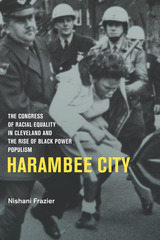
BLACK POWER!
It was a phrase that consumed the American imagination in the 1960s and 70s and inspired a new agenda for black freedom. Dynamic and transformational, the black power movement embodied more than media stereotypes of gun-toting, dashiki-wearing black radicals; the movement opened new paths to equality through political and economic empowerment.
In Harambee City, Nishani Frazier chronicles the rise and fall of black power within the Congress of Racial Equality (CORE) by exploring the powerful influence of the Cleveland CORE chapter. Frazier explores the ways that black Clevelanders began to espouse black power ideals including black institution building, self-help, and self-defense. These ideals challenged CORE’s philosophy of interracial brotherhood and nonviolent direct action, spawning ideological ambiguities in the Cleveland chapter. Later, as Cleveland CORE members rose to national prominence in the organization, they advocated an open embrace of black power and encouraged national CORE to develop a notion of black community uplift that emphasized economic populism over political engagement. Not surprisingly, these new empowerment strategies found acceptance in Cleveland.
By providing an understanding of the tensions between black power and the mainstream civil rights movement as they manifested themselves as both local and national forces, Harambee City sheds new light on how CORE became one of the most dynamic civil rights organizations in the black power era.
These twelve previously unpublished essays explore the international phenomenon of hate crime, examining the socio-psychological dynamics of these crimes and the settings in which they occur, the relationships between offenders and their victims, the emotional states of the participants, and the legal and law enforcement responses to these crimes.
The essays address religious, racial, ethnic, and sexual crimes in the United States, Latin America, Africa, Europe, and the Middle East. The essayists provide historical reviews of the problems and the ways local authorities understand and cope with the dilemmas as well as prognoses about the persistence of hate crime and the measures that can be taken to control and contain it.
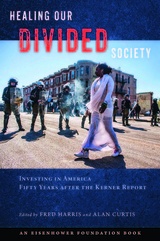
In 1968, the Kerner Commission concluded that America was heading toward “two societies, one black, one white—separate and unequal.” Today, America’s communities are experiencing increasing racial tensions and inequality, working-class resentment over the unfulfilled American Dream, white supremacy violence, toxic inaction in Washington, and the decline of the nation’s example around the world.
In Healing Our Divided Society, Fred Harris, the last surviving member of the Kerner Commission, along with Eisenhower Foundation CEO Alan Curtis, re-examine fifty years later the work still necessary towards the goals set forth in The Kerner Report. This timely volume unites the interests of minorities and white working- and middle-class Americans to propose a strategy to reduce poverty, inequality, and racial injustice. Reflecting on America’s urban climate today, this new report sets forth evidence-based policies concerning employment, education, housing, neighborhood development, and criminal justice based on what has been proven to work—and not work.
Contributors include: Oscar Perry Abello, Elijah Anderson, Anil N.F. Aranha, Jared Bernstein, Henry G. Cisneros, Elliott Currie, Linda Darling-Hammond, Martha F. Davis, E. J. Dionne, Jr., Marian Wright Edelman, Delbert S. Elliott, Carol Emig, Jeff Faux, Ron Grzywinski, Michael P. Jeffries, Lamar K. Johnson, Celinda Lake, Marilyn Melkonian, Gary Orfield, Diane Ravitch, Laurie Robinson, Herbert C. Smitherman, Jr., Joseph Stiglitz, Dorothy Stoneman, Kevin Washburn, Valerie Wilson, Gary Younge, Julian E. Zelizer, and the editors

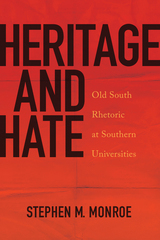
The US South is a rhetorical landscape that pulsates with division, a place where words and symbols rooted in a deeply problematic past litter the ground and contaminate the soil. Stephen M. Monroe’s provocative study focuses on predominantly white southern universities where Old South rhetoric still reverberates, where rebel flags cast a shadow over attempts at racial harmony, school cheers to reinforce racial barriers, and student yearbooks to create and protect
an oppressive culture of exclusion. Across the region, in college towns like Oxford, Mississippi; Athens, Georgia; and Tuscaloosa, Alabama—communities remain locked in a difficult, recursive, and inherently rhetorical struggle that wrestles with this troubling legacy.
Words, images, and symbols are not merely passive artifacts of southern history, Monroe argues, but formative agents that influence human behavior and shape historical events. Drawing on research from many disciplines, including rhetoric, southern studies, history, sociology, and African American studies, Monroe develops the concept of confederate rhetoric: the collection of Old South words and symbols that have been and remain central to the identity conflicts of the South. He charts examples of such rhetoric at work in southern universities from Reconstruction to the present day.
Tracing the long life and legacy of Old South words and symbols at southern universities, this book provides close and nuanced analysis of the rhetorical conflicts that have resulted at places like the University of Mississippi and the University of Missouri. Some conflicts erupted during the civil rights movement, when the first African American students sought admission to all-white southern universities and colleges, and others are brewing now, as African
Americans (and their progressive white peers) begin to cement genuine agency and voice in these communities. Tensions have been, and remain, high.
Ultimately, Monroe offers hope and optimism, contending that if words and symbols can be used to damage and divide, then words and symbols can also be used to heal and unify. Racist rhetoric can be replaced by antiracist rhetoric. The old South can become new. While resisting naïve or facile arguments, Heritage and Hate ultimately finds the promise of progress within the tremendous power of language.

Often depicted as the nation’s iconic legal immigrant, unauthorized European migrants are often overlooked by scholars, policymakers, and the media. This volume tells the stories of European migrants who adopted irregular migration strategies to enter and remain in the United States throughout the twentieth century. Contributors explore facets of this history with essays on migration patterns from Russia, Italy, Ireland, the Ottoman Empire, and Poland. They also offer important arguments about the treatment of unauthorized European migrants by states and societies on both sides of the Atlantic and how the reception of undocumented immigrants has been and continues to be impacted by the dynamics of racial, class, and gender constructions in the United States and abroad. As the contributors show, the reception accorded unauthorized European migrants frequently obscured and even normalized their irregular migration strategies, easing their access to American citizenship.
Revealing and insightful, Hidden Histories of Unauthorized Migrations from Europe to the United States sheds new light our intertwined notions of race, legality, and immigration.
Contributors: Danielle Battisti, Ashley Johnson Bavery, Mary Patrice Erdmans, Polina Ermoshkina, Torsten Feys, Carly Goodman, S. Deborah Kang, E. Kyle Romero, Randa Tawil, and Joanna Wojdon

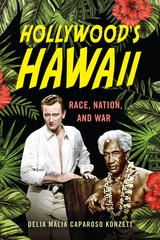
Delia Malia Caparoso Konzett highlights films that mirror the cultural and political climate of the country over more than a century—from the era of U.S. imperialism on through Jim Crow racial segregation, the attack on Pearl Harbor and WWII, the civil rights movement, the contemporary articulation of consumer and leisure culture, as well as the buildup of the modern military industrial complex. Focusing on important cultural questions pertaining to race, nationhood, and war, Konzett offers a unique view of Hollywood film history produced about the national periphery for mainland U.S. audiences. Hollywood’s Hawaii presents a history of cinema that examines Hawaii and the Pacific and its representations in film in the context of colonialism, war, Orientalism, occupation, military buildup, and entertainment.
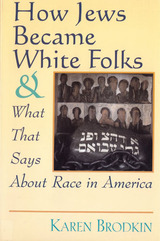
The history of Jews in the United States is one of racial change that provides useful insights on race in America. Prevailing classifications have sometimes assigned Jews to the white race and at other times have created an off-white racial designation for them. Those changes in racial assignment have shaped the ways American Jews of different eras have constructed their ethnoracial identities. Brodkin illustrates these changes through an analysis of her own family's multi-generational experience. She shows how Jews experience a kind of double vision that comes from racial middleness: on the one hand, marginality with regard to whiteness; on the other, whiteness and belonging with regard to blackness.
Class and gender are key elements of race-making in American history. Brodkin suggests that this country's racial assignment of individuals and groupsconstitutes an institutionalized system of occupational and residential segregation, is a key element in misguided public policy, and serves as a pernicious foundational principle in the construction of nationhood. Alternatives available to non-white and alien "others" have been either to whiten or to be consigned to an inferior underclass unworthy of full citizenship. The American ethnoracial map-who is assigned to each of these poles-is continually changing, although the binary of black and white is not. As a result, the structure within which Americans form their ethnoracial, gender, and class identities is distressingly stable. Brodkin questions the means by which Americans construct their political identities and what is required to weaken the hold of this governing myth.

Human Relations in Interracial Housing was first published in 1955. Minnesota Archive Editions uses digital technology to make long-unavailable books once again accessible, and are published unaltered from the original University of Minnesota Press editions.
No phase of this country's domestic or foreign relations holds greater potential power for harmony or conflict than our racial attitudes. Yet there is probably no area of social relations in which we have had fewer facts and more assumptions on which to base our thinking and our efforts at constructive action. This sociopsychological study adds considerably to our knowledge of actual racial attitudes in the United States and some of the factors that affect them.
The study examines the racial attitudes of people living in public, interracial housing projects in four cities: Philadelphia, Pittsburgh, Hartford, and Springfield, Massachusetts. Based on interviews with more than 1000 white and Negro residents, it sought information that would help answer such questions as these: What is the effect of Negro-white residential proximity on race relations? Does living nearby reduce or intensify any already existing prejudices? What is the nature of the contacts that develop among members of the two races?
The findings show in great detail the effects of residential proximity and suggest the underlying reasons for the role that such proximity plays. They reveal, further, the effects of the contact experience itself and the perception of the social climate in the community regarding such contact.
The research forms an important sequel to the investigation reported in the book, Interracial Housing, by Deutsch and Collins, confirming some of the basic findings in the earlier study as well as providing new insights.
Psychologists, sociologists, social workers, housing officials, and community leaders will find solid evidence here on a subject that has been sparsely documented up to now.
HumAnimal explores the experience of dehumanization as the privation of speech. Taking up the figure of silence as the space between human and animal, it traces the potential for an alternate political and ethical way of life beyond law. Employing the resources offered by deconstruction as well as an ontological critique of biopower, Kalpana Rahita Seshadri suggests that humAnimal, as the site of impropriety opened by racism and manifested by silence, can be political and hazardous to power.
Through the lens of such works as Coetzee’s Foe, Chesnutt’s “The Dumb Witness,” Dr. Itard’s “wild child,” and aerialist Philippe Petit’s Man on Wire, Seshadri lucidly brings Derrida’s concept of the trace and his theory of sovereignty into conversation with Agamben’s investigation of the analytics of power. The task is twofold: on the one hand, to question the logocentric presumption that determines the separation between human and animal, and on the other to examine the conflation of this separation as an instrument of power in the practice of racism. Thus HumAnimal details the differences and intersections between Derrida and Agamben in their respective approaches to power, claiming that to think simultaneously within the registers of deconstruction (which conceives of power as a symptom of the metaphysics of presence) and biopolitics (which conceives of power as the operation of difference) entails a specification of the political and ethical consequences that attends the two perspectives.
When considered as the potential of language to refuse the law of signification and semantics, silence can neutralize the exercise of power through language, and Seshadri’s inquiry discloses a counterpower that does not so much oppose or destroy the politics of the subject but rather neutralizes it and renders it ineffective.
When is a war not a war? When it is undertaken in the name of democracy, against the forces of racism, sexism, and religious and political persecution? This is the new world of warfare that Neda Atanasoski observes in Humanitarian Violence, different in name from the old imperialism but not so different in kind. In particular, she considers U.S. militarism—humanitarian militarism—during the Vietnam War, the Soviet-Afghan War, and the 1990s wars of secession in the former Yugoslavia.
What this book brings to light—through novels, travel narratives, photojournalism, films, news media, and political rhetoric—is in fact a system of postsocialist imperialism based on humanitarian ethics. In the fiction of the United States as a multicultural haven, which morally underwrites the nation’s equally brutal waging of war and making of peace, parts of the world are subject to the violence of U.S. power because they are portrayed to be homogeneous and racially, religiously, and sexually intolerant—and thus permanently in need of reform. The entangled notions of humanity and atrocity that follow from such mediations of war and crisis have refigured conceptions of racial and religious freedom in the post–Cold War era. The resulting cultural narratives, Atanasoski suggests, tend to racialize ideological differences—whereas previous forms of imperialism racialized bodies. In place of the European racial imperialism, U.S. settler colonialism, and pre–civil rights racial constructions that associated racial difference with a devaluing of nonwhite bodies, Humanitarian Violence identifies an emerging discourse of race that focuses on ideological and cultural differences and makes postsocialist and Islamic nations the potential targets of U.S. disciplining violence.
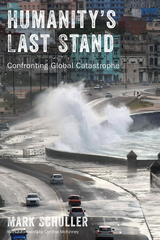
Humanity’s Last Stand dares to ask these big questions, exploring the interconnections between climate change, global capitalism, xenophobia, and white supremacy. As it unearths how capitalism was born from plantation slavery and the slaughter of Indigenous people, it also invites us to imagine life after capitalism. The book teaches its readers how to cultivate an anthropological imagination, a mindset that remains attentive to local differences even as it identifies global patterns of inequality and racism.
Surveying the struggles of disenfranchised peoples around the globe from frontline communities affected by climate change, to #BlackLivesMatter activists, to Indigenous water protectors, to migrant communities facing increasing hostility, anthropologist Mark Schuller argues that we must develop radical empathy in order to move beyond simply identifying as “allies” and start acting as “accomplices.” Bringing together the insights of anthropologists and activists from many cultures, this timely study shows us how to stand together and work toward a more inclusive vision of humanity before it’s too late.
More information and instructor resources (https://humanityslaststand.org)
READERS
Browse our collection.
PUBLISHERS
See BiblioVault's publisher services.
STUDENT SERVICES
Files for college accessibility offices.
RECENTLY PUBLISHED






UChicago Accessibility Resources
home | accessibility | search | about | contact us
BiblioVault ® 2001 - 2026
The University of Chicago Press