
 A SCHOLARLY BOOK REPOSITORY
21 start with H start with H
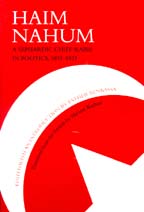

From Acadians to Zoroastrians-Asians, American Indians, East Indians, West Indians, Europeans, Latin Americans, Afro-Americans, and Mexican Americans—the Harvard Encyclopedia of American Ethnic Groups provides the first comprehensive and systematic review of the many peoples of this country. It should excite all Americans about their nation.
Informative and entertaining, this volume is an indispensable reference work for home, library and office. It establishes a foundation for the burgeoning field of ethnic studies; it will satisfy and stimulate the popular interest in ancestry and heritage. It is a guide to the history, culture, and distinctive characteristics of the more than 100 ethnic groups who live in the United States.
Each ethnic group is described in detail. The origins, history and present situation of the familiar as well as the virtually unknown are presented succinctly and objectively. Not only the immigrants and refugees who came voluntarily but also those already in the New World when the first Europeans arrived, those whose ancestors came involuntarily as slaves, and those who became part of the American population as a result of conquest or purchase and subsequent annexation figure in these pages. The English and the Estonians, the Germans and the Gypsies, the Swedes and the Serbs are interestingly juxtaposed. Even entries about relatively well-known groups offer new material and fresh interpretations. The articles on less well-known groups are the product of intensive research in primary sources; many provide the first scholarly discussion to appear in English. One hundred and twenty American and European contributors have been involved in this effort, writing either on individual groups or on broad themes relating to many.
The group entries are at the heart of the book, but it contains, in addition, a series of thematic essays that illuminate the key facets of ethnicity. Some of these are comparative; some philosophical; some historical; others focus on current policy issues or relate ethnicity to major subjects such as education, religion, and literature. American identity and Americanization, immigration policy and experience, and prejudice and discrimination in U.S. history are discussed at length. Several essays probe the complex interplay between assimilation and pluralism—perhaps the central theme in American history—and the complications of race and religion.
Numerous cross-references and brief identifications will aid the reader with unfamiliar terms and alternative group names. Eighty-seven maps, especially commissioned, show where different groups have originated. Annotated bibliographies contain suggestions for further reading and research. Appendix I, on methods of estimating the size of groups, leads the reader through a maze of conflicting statistics. Appendix II reproduces, in facsimile, hard-to-locate census and immigration materials, beginning with the first published report on the nativities of the population in 1850.
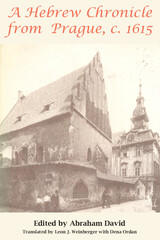
"This slender anonymous work, spanning 1389 to 1611, presents the priorities and concerns of a Jewish community straddling the late medieval and early modern periods. Ample footnotes and explanations provide the lay reader with sufficient background to understand the references to historical events and figures, to ideologies and to institutions. A comprehensive introduction presents the realities of Prague and Bohemia, as well as offering a helpful discussion of the chronicle and other contemporary Jewish accounts."
—Conservative Jewish Quarterly
"In about 1615 an anonymous Jew from Prague composed a short Hebrew chronicle to recount 'the expulsions, miracles, and other occurrences befalling [the Jews] in Prague and the other lands of our long exile.' Abraham David discovered the manuscript [and] added glosses, historical notes, and an introduction. . . . The chronicle, with its brief annual entries, is not a continuous narrative, but does give a feeling of immediacy, like a newspaper."
—Polin: Studies in Polish Jewry
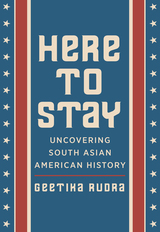
In Here to Stay, Geetika Rudra, a second-generation Indian immigrant and American history buff, takes readers on a journey across the country to unearth the little-known histories of earlier generations of South Asian Americans. She visits storied sites such as Oregon’s “Hindoo Alley,” home to many lumber workers at the turn of the century, and Angel Island, California’s immigration hub. She also introduces readers to such inspiring figures as Bhagat Singh Thind, an immigrant who had enlisted in the U.S. Army to serve his adopted country in World War I, but who was later denied citizenship and took his case all the way to the U.S. Supreme Court. In turns both serious and joyful, this book vividly reveals how South Asians have always been a vital part of the American tapestry.
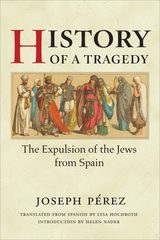
Few events in the history of Spain have provoked as much controversy as the expulsion of the Jews in 1492. Conflicts within the Catholic Church, suspicions within the newly unified Spain, and the claims of Spanish merchants combined to make the Spain of Ferdinand and Isabella intolerant and inquisitorial. Yet the roots of Spanish anti-Semitism went deeper. In this concise survey of the expulsion of the Sephardic Jews, Joseph Pérez studies the evolution of the Jewish community in Spain from the time of the Visigoths to the reign of the Catholic kings. He explores the Jewish community’s role in creating and sustaining the vibrant cultural, political, and economic world of medieval Spain, and how growing religious intolerance, a pervasive resentment of the “others,” and a string of escalating encroachments culminated in expulsion.

The book consists of five parts: introduction; history of the Holocaust; representations of the Holocaust in literature, film, and the arts; other genocides; and ethics. The curriculum, shaped with feedback from those who teach Holocaust studies, consists mainly of primary documents and their analysis. Each section includes a general introduction to a body of knowledge that reflects current research and detailed introductions to particular documents. Throughout the book, there are provocative discussion questions and suggestions for further reading and other resources. Each section features "links" to other parts to encourage interdisciplinary reflection. The final section on ethics addresses the difficult questions raised by genocide.
The Holocaust and Other Genocides is designed as a model for flexible, innovative teaching about this complex subject. It is also a sophisticated, interdisciplinary effort to create the conditions for discussing and understanding the genocides of the twentieth century.

In The Holocaust Odyssey, Rebecca Fromer leads us through the experiences of Danny Bennahmias, a Greek Jew of Italian citizenship whose forced labor as a Sonderkommando at Auschwitz included the disentangling of hundreds of thousands of gassed men, women, and children. The book is the result of a diligent collaboration. As it unfolds, it becomes a poignant reminder of the manner in which enslaved Jews and others were forced to destroy their families and fellow prisoners. It is a story of human decency, the spark of which remains against all odds.
This pathbreaking collection builds on recent examinations of identity in the postcolonial states of South and Southeast Asia by investigating the ways in which domestic workers and their employers come to know and depict one another and themselves through their interactions inside and outside of the home. This setting provides a particularly apt arena for examining the daily negotiations of power and hegemony.
Contributors to the volume, all anthropologists, provide rich ethnographic analyses that avoid a narrow focus on either workers or employers. Rather, they examine systems of power through specific topics that range from the notion of "nurture for sale" to the roles of morality and humor in the negotiation of hierarchy and the dilemmas faced by foreign employers who find themselves in life-and-death dependence on their servants.
With its provocative theoretical and ethnographic contributions to current debates, this collection will be of interest to scholars in Asian studies, women's studies, anthropology, sociology, and cultural studies.
Kathleen M. Adams is Associate Professor of Anthropology, Loyola University of Chicago. Sara Dickey is Associate Professor of Anthropology, Bowdoin College.
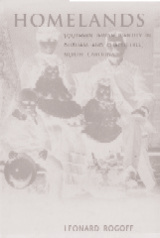
Exploring how Southern Jews forged identity, community, and belonging in the evolving landscape of the New South.
Homelands is a case study of a unique ethnic group in North America—small-town southern Jews. Both Jews and southerners, Leonard Rogoff points out, have long struggled with questions of identity and whether to retain their differences or try to assimilate into the national culture. Rogoff shows how, as immigrant Jews became small-town southerners, they constantly renegotiated their identities and reinvented their histories.
The Durham-Chapel Hill Jewish community was formed during the 1880s and 1890s, when the South was recovering from the Reconstruction era and Jews were experiencing ever-growing immigration as well as challenging the religious traditionalism of the previous 4,000 years. Durham and Chapel Hill Jews, recent arrivals from the traditional societies of eastern Europe, assimilated and secularized as they lessened their differences with other Americans. Some Jews assimilated through intermarriage and conversion, but the trajectory of the community as a whole was toward retaining their religious and ethnic differences while attempting to integrate with their neighbors.
The Durham-Chapel Hill area is uniquely suited to the study of the southern Jewish experience, Rogoff maintains, because the region is exemplary of two major trends: the national population movement southward and the rise of Jews into the professions. The Jewish peddler and storekeeper of the 1880s and the doctor and professor of the 1990s, Rogoff says, are representative figures of both Jewish upward mobility and southern progress.
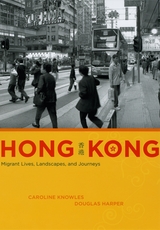
In 1997 the United Kingdom returned control of Hong Kong to China, ending the city’s status as one of the last remnants of the British Empire and initiating a new phase for it as both a modern city and a hub for global migrations. Hong Kong is a tour of the city’s postcolonial urban landscape, innovatively told through fieldwork and photography.
Caroline Knowles and Douglas Harper’s point of entry into Hong Kong is the unusual position of the British expatriates who chose to remain in the city after the transition. Now a relatively insignificant presence, British migrants in Hong Kong have become intimately connected with another small minority group there: immigrants from Southeast Asia. The lives, journeys, and stories of these two groups bring to life a place where the past continues to resonate for all its residents, even as the city hurtles forward into a future marked by transience and transition. By skillfully blending ethnographic and visual approaches, Hong Kong offers a fascinating guide to a city that is at once unique in its recent history and exemplary of our globalized present.
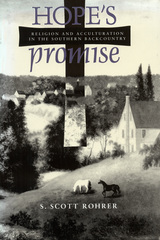
In Hope's Promise, Scott Rohrer dissects the internal workings of the ecumenical Moravian movement at Wachovia—how this disparate group of pilgrims hailing from many countries (Germany, Ireland, Scandinavia, England) and different denominations (Lutheran, Reformed, Methodist, Anglican) yielded their ethnicities as they became, above all, a people of faith. By examining the "open" farm congregations of Hope, Friedberg, and Friedland, Rohrer offers a sensitive portrayal of their evangelical life and the momentous cultural changes it wrought: the organization of tight-knit congregations bound by "heart religion;" the theology of the new birth; the shape of religious discipline; the sacrament of communion; and the role of music. Drawing on courthouse documents and church records, Rohrer carefully demonstrates how various groups began to take on traits of the others. He also illustrates how evangelical values propelled interaction with the outside world—at the meetinghouse and the frontier store, for example—and fostered even more collective and accelerated change.
As the Moravians became ever more "American" and "southern," the polyglot of ethnicities that was Wachovia would, under the unifying banner of evangelicalism, meld into one of the most sophisticated religious communities in early America.
Explore how American conditions and Jewish circumstances collided in the nineteenth and early twentieth centuries
In this new book award-winning author Hasia R. Diner explores the issues behind why European Jews overwhelmingly chose to move to the United States between the 1820s and 1920s. Unlike books that tend to romanticize American freedom as the force behind this period of migration or that tend to focus on Jewish contributions to America or that concentrate on how Jewish traditions of literacy and self-help made it possible for them to succeed, Diner instead focuses on aspects of American life and history that made it the preferred destination for 90 percent of European Jews.
Features:
- Examination of the realities of race, immigration, color, money, economic development, politics, and religion in America
- Exploration of an America agenda that sought out white immigrants to help stoke economic development and that valued religion as a force for morality
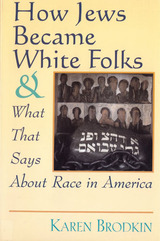
The history of Jews in the United States is one of racial change that provides useful insights on race in America. Prevailing classifications have sometimes assigned Jews to the white race and at other times have created an off-white racial designation for them. Those changes in racial assignment have shaped the ways American Jews of different eras have constructed their ethnoracial identities. Brodkin illustrates these changes through an analysis of her own family's multi-generational experience. She shows how Jews experience a kind of double vision that comes from racial middleness: on the one hand, marginality with regard to whiteness; on the other, whiteness and belonging with regard to blackness.
Class and gender are key elements of race-making in American history. Brodkin suggests that this country's racial assignment of individuals and groupsconstitutes an institutionalized system of occupational and residential segregation, is a key element in misguided public policy, and serves as a pernicious foundational principle in the construction of nationhood. Alternatives available to non-white and alien "others" have been either to whiten or to be consigned to an inferior underclass unworthy of full citizenship. The American ethnoracial map-who is assigned to each of these poles-is continually changing, although the binary of black and white is not. As a result, the structure within which Americans form their ethnoracial, gender, and class identities is distressingly stable. Brodkin questions the means by which Americans construct their political identities and what is required to weaken the hold of this governing myth.

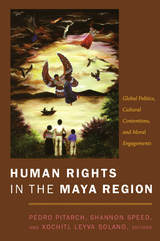
The collection includes a reflection on the effects of truth-finding and documenting particular human rights abuses, a look at how Catholic social teaching validates the human rights claims advanced by indigenous members of a diocese in Chiapas, and several analyses of the limitations of human rights frameworks. A Mayan intellectual seeks to bring Mayan culture into dialogue with western feminist notions of women’s rights, while another contributor critiques the translation of the United Nations Declaration of Human Rights into Tzeltal, an indigenous language in Chiapas. Taken together, the essays reveal a broad array of rights-related practices and interpretations among the Mayan population, demonstrating that global-local-state interactions are complex and diverse even within a geographically limited area. So too are the goals of indigenous groups, which vary from social reconstruction and healing following years of violence to the creation of an indigenous autonomy that challenges the tenets of neoliberalism.
Contributors: Robert M. Carmack, Stener Ekern, Christine Kovic, Xochitl Leyva Solano, Julián López García, Irma Otzoy, Pedro Pitarch, Álvaro Reyes, Victoria Sanford, Rachel Sieder, Shannon Speed, Rodolfo Stavenhagen, David Stoll, Richard Ashby Wilson
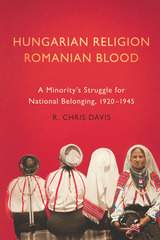
Davis's highly illuminating example is the case of the little-known Moldavian Csangos, a Hungarian- and Romanian-speaking community of Roman Catholics in eastern Romania. During World War II, some in the Romanian government wanted to expel them. The Hungarian government saw them as Hungarians and wanted to settle them on lands confiscated from other groups. Resisting deportation, the clergy of the Csangos enlisted Romania's leading racial anthropologist, collected blood samples, and rewrote a millennium of history to claim Romanian origins and national belonging—thus escaping the discrimination and violence that devastated so many of Europe's Jews, Roma, Slavs, and other minorities. In telling their story, Davis offers fresh insight to debates about ethnic allegiances, the roles of science and religion in shaping identity, and minority politics past and present.
READERS
Browse our collection.
PUBLISHERS
See BiblioVault's publisher services.
STUDENT SERVICES
Files for college accessibility offices.
RECENTLY PUBLISHED




UChicago Accessibility Resources
home | accessibility | search | about | contact us
BiblioVault ® 2001 - 2025
The University of Chicago Press