
 A SCHOLARLY BOOK REPOSITORY
108 books about Radar and 8
start with I
108 books about Radar and 8
108 books about Radar
8 start with I start with I
8 start with I start with I
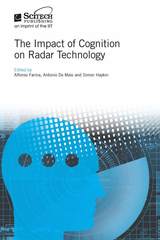
The Impact of Cognition on Radar Technology
Alfonso Farina
The Institution of Engineering and Technology, 2018
Cognitive dynamic systems are inspired by the computational capability of the brain and the viewpoint that cognition is a supreme form of computation. The key idea behind this new paradigm is to mimic the human brain as well as that of other mammals with echolocation capabilities which continuously learn and react to stimulations according to four basic processes: perception-action cycle, memory, attention, and intelligence.
[more]

Interactions of Wind Turbines with Aviation Radio and Radar Systems
Alan Collinson
The Institution of Engineering and Technology, 2024
Wind farms and wind turbines are strong reflectors of radio waves, which can affect radar and radio systems used by civil and military aviation. The speeds of turbine blades and aircraft are comparable, and it can be difficult to discriminate between them using existing radar systems. Wind turbines may also affect communications, navigation and instrument landing systems. This situation is a brake to wind farm development slowing or stopping exploitation of many giga watts of wind capacity in many countries. Therefore, developing approaches and technologies for the mitigation of the impacts of wind farms on aviation systems is of great importance. These technologies have the potential to increase renewable energy generation and promote energy independence but, and this is critically important, they must do so without compromising safety or national defense.
[more]
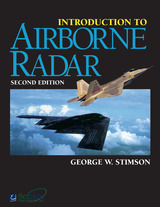
Introduction to Airborne Radar
Geroge W. Stimson
The Institution of Engineering and Technology, 1998
Introduction to Airborne Radar is the revision of the classic book privately published by Hughes Aircraft Company in 1983. Lavishly produced in full color, the book was quite unlike any commercially published radar book produced by the major technical publishers. The combination of clear, understandable writing and the unparalleled illustrations established the text-reference as a 'must-have' for engineers, technicians, pilots, and even sales and marketing people within the radar and aerospace industry. The book was authored by veteran Hughes engineer and Technical Manager George W. Stimson, a publications specialist. Individual chapters were thoroughly reviewed by the appropriate experts within the Hughes Radar Systems Group. The book was initially available 1983-1987 only to those within the Hughes family: employees and customers, primarily the military. Restriction was lifted in 1987. Hughes went through three printings and 40,000 copies 1983-1993, mostly by word-of-mouth testimonials and demand. Upon retirement from Hughes, George Stimson successfully negotiated for the rights to the book and made an agreement with SciTech Publishing to do a major revision of the text to update it. The resulting Second Edition has been overwhelmingly positive and a best-seller. Second Edition The revision is extensive: thirteen entirely new chapters cover the technological advances over the fifteen years since publication, two chapters considered obsolete have been deleted entirely, three chapters are extensively rewritten and updated, two chapters have been given new sections, and fourteen chapters have been given minor tweaks, corrections, and polishing. The book has grown from 32 chapters to 44 chapters in 584 efficiently-designed pages. Efforts have been made to bring more even-handed coverage to radars developed outside of Hughes Aircraft, while older and less important Hughes radars have been deleted or abbreviated. Chapter 44 catalogs many of the cutting edge radars in functioning aircraft and near-service aircraft in early stages of production. The book's appeal is to a diverse audience: from military pilots and radar officers eager to gain a sound technical understanding of the complex systems that their lives depend upon, on up through technicians, marketing, and sales people, to the radar system design specialists, who may 'know all that stuff' but who deeply admire the expression and thus use the book to teach others who have questions. The market encompasses companies directly involved in the radar business and those on the periphery, college professors of engineering and physics themselves, along with students in aviation, aeronautics, and electromagnetics and radar courses. The cross-disciplinary and multi-level demand for the book shows that the book should not be pigeon-holed as just a radar book for electrical engineers. Virtually anybody with a knowledge of high school algebra, trigonometry, and physics will be able to read and absorb most of the material.
[more]
Introduction to Radar Target Recognition
P. Tait
The Institution of Engineering and Technology, 2006
This book text provides an overview of the radar target recognition process and covers the key techniques being developed for operational systems. It is based on the fundamental scientific principles of high resolution radar, and explains how the underlying techniques can be used in real systems, taking into account the characteristics of practical radar system designs and component limitations. It also addresses operational aspects, such as how high resolution modes would fit in with other functions such as detection and tracking.
[more]
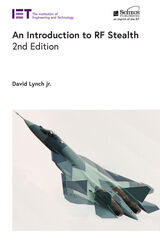
An Introduction to RF Stealth
David Lynch Jr.
The Institution of Engineering and Technology, 2021
This expanded, revised and updated new edition of Introduction to RF Stealth covers two major topics: Low Observables and Low Probability of Intercept (LO and LPI) of radars and data links, collectively sometimes called Stealth. Each chapter includes examples, student exercises and references. Worked simulations are available that illustrate the techniques described.
[more]

Introduction to RF Stealth
David L. Lynch Jr.
The Institution of Engineering and Technology, 2004
This is the only book focused on the complete aspects of RF Stealth design. It is the first book to present and explain first order methods for the design of active and passive stealth properties. Everything from Electronic Order of Battle to key component design is covered.
[more]
Introduction to Sensors for Ranging and Imaging
Graham Brooker
The Institution of Engineering and Technology, 2009
This is a comprehensive textbook and reference that provides a solid background in active sensing technology. Beginning with a historical overview and an introductory section on signal generation, filtering and modulation, it follows with a section on radiometry (infrared and microwave) as a background to the active sensing process. The core of the book is concerned with active sensing, starting with the basics of time-of-flight sensors (operational principles, components), and goes through the derivation of the radar range equation, and the detection of echo signals, both fundamental to the understanding of radar, sonar and lidar imaging. Several chapters cover signal propagation of both electromagnetic and acoustic energy, target characteristics, stealth and clutter. The remainder of the book involves the basics of the range measurement process, active imaging with an emphasis on noise and linear frequency modulation techniques, Doppler processing, and target tracking.
[more]
Inverse Synthetic Aperture Radar Imaging
Principles, algorithms and applications
Victor C. Chen
The Institution of Engineering and Technology, 2014
Based on the authors' 20 years' research work on Inverse Synthetic Aperture Radar (ISAR) imaging of moving targets and non-cooperative target recognition, this book provides readers with knowledge of various algorithms of ISAR imaging of targets and implementation with MATLAB. It introduces basic principles of radar backscattering, radar imaging, and signal analysis. It describes the characteristics of radar returns from targets, how to produce well-focused ISAR images of moving targets, and what features that can extracted from ISAR images. Also introduced are several important algorithms for ISAR image formation, ISAR image auto-focusing, and applications of ISAR imaging to air targets, sea vessels and ground moving targets. Examples of ISAR imaging of ground moving targets, air targets, and sea vessels are discussed in detail.
[more]
READERS
Browse our collection.
PUBLISHERS
See BiblioVault's publisher services.
STUDENT SERVICES
Files for college accessibility offices.
RECENTLY PUBLISHED







UChicago Accessibility Resources
home | accessibility | search | about | contact us
BiblioVault ® 2001 - 2026
The University of Chicago Press