
 A SCHOLARLY BOOK REPOSITORY
11 start with I start with I


From well-known battlefields, such as Manassas, Fredericksburg, and Appomattox, to lesser-known sites, such as Sinking Spring Cemetery and Rude’s Hill, Sedore leads readers on a vivid journey through Virginia’s Confederate history. Tablets, monoliths, courthouses, cemeteries, town squares, battlefields, and more are cataloged in detail and accompanied by photographs and meticulous commentary. Each entry contains descriptions, fascinating historical information, and location, providing a complete portrait of each site.
Much more than a visual tapestry or a tourist’s handbook, An Illustrated Guide to Virginia’s Confederate Monuments draws on scholarly and field research to reveal these sites as public efforts to reconcile mourning with Southern postwar ideologies. Sedore analyzes in depth the nature of these attempts to publicly explain Virginia’s sense of grief after the war, delving deep into the psychology of a traumatized area. From commemorations of famous generals to memories of unknown soldiers, the dead speak from the pages of this sweeping companion to history.
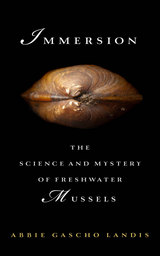
"Eloquent treatise...Landis's book is as much call to action as paean to mesmerizing molluscs." —Nature
"Rich, accurate, and moving." —New Scientist
"A lyrical love letter to the imperiled freshwater mussel." —Science
Abbie Gascho Landis first fell for freshwater mussels while submerged in an Alabama creek, her pregnant belly squeezed into a wetsuit. After an hour of fruitless scanning, a mussel materialized from the rocks—a little spectaclecase, herself pregnant, filtering the river water through a delicate body while her gills bulged with offspring. In that moment of connection, Landis became a mussel groupie, obsessed with learning more about the creatures’ hidden lives. She isn’t the only fanatic; the shy mollusks, so vital to the health of rivers around the world, have a way of inspiring unusual devotion.
In Immersion, Landis brings readers to a hotbed of mussel diversity, the American Southeast, to seek mussels where they eat, procreate, and, too often, perish. Accompanied often by her husband, a mussel scientist, and her young children, she learned to see mussels on the creekbed, to tell a spectaclecase from a pigtoe, and to worry what vanishing mussels—70 percent of North American species are imperiled—will mean for humans and wildlife alike. In Immersion, Landis shares this journey, traveling from perilous river surveys to dry streambeds and into laboratories where endangered mussels are raised one precious life at a time.
Mussels have much to teach us about the health of our watersheds if we step into the creek and take a closer look at their lives. In the tradition of writers like Terry Tempest Williams and Sy Montgomery, Landis gracefully chronicles these untold stories with a veterinarian’s careful eye and the curiosity of a naturalist. In turns joyful and sobering, Immersion is an invitation to see rivers from a mussel’s perspective, a celebration of the wild lives visible to those who learn to search.
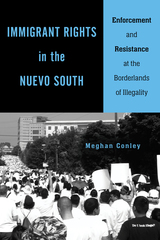
Every day, undocumented immigrants are rendered vulnerable through policies and practices that illegalize them. Moreover, they are socially constructed into dangerous criminals and taxpayer burdens who are undeserving of rights, dignity, and respect. Meghan Conley’s timely book, Immigrant Rights in the Nuevo South, seeks to expose and challenge these dehumanizing ideas and practices byexamining the connections between repression and resistance for unauthorized immigrants in communities across the American Southeast.
Conley uses on-the-ground interviews to describe fear and resistance from the perspective of those most affected by it. She shows how, for example, the Illegal Immigration Reform and Enforcement Act in Georgia prompted marches and an action that became “a day of non-compliance.” Likewise, an “enforcement lottery” that created unpredictable threats of arrest and deportation in the region mobilized immigrants to organize and demonstrate. However, as immigrant rights activists mobilize in opposition to the criminalization of undocumented people, they may unintentionally embrace stories of who deserves to be in the United States and who does not. Immigrant Rights in the Nuevo South explores these paradoxes while offering keen observations about the nature and power of Latinx resistance.

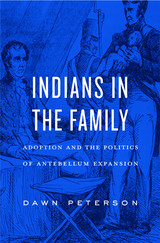
During his invasion of Creek Indian territory in 1813, future U.S. president Andrew Jackson discovered a Creek infant orphaned by his troops. Moved by an “unusual sympathy,” Jackson sent the child to be adopted into his Tennessee plantation household. Through the stories of nearly a dozen white adopters, adopted Indian children, and their Native parents, Dawn Peterson opens a window onto the forgotten history of adoption in early nineteenth-century America. Indians in the Family shows the important role that adoption played in efforts to subdue Native peoples in the name of nation-building.
As the United States aggressively expanded into Indian territories between 1790 and 1830, government officials stressed the importance of assimilating Native peoples into what they styled the United States’ “national family.” White households who adopted Indians—especially slaveholding Southern planters influenced by leaders such as Jackson—saw themselves as part of this expansionist project. They hoped to inculcate in their young charges U.S. attitudes toward private property, patriarchal family, and racial hierarchy.
U.S. whites were not the only ones driving this process. Choctaw, Creek, and Chickasaw families sought to place their sons in white households, to be educated in the ways of U.S. governance and political economy. But there were unintended consequences for all concerned. As adults, these adopted Indians used their educations to thwart U.S. federal claims to their homelands, setting the stage for the political struggles that would culminate in the Indian Removal Act of 1830.
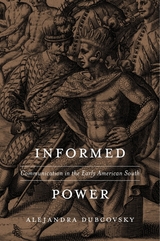
Informed Power maps the intricate, intersecting channels of information exchange in the early American South, exploring how people in the colonial world came into possession of vital knowledge in a region that lacked a regular mail system or a printing press until the 1730s.
Challenging the notion of early colonial America as an uninformed backwater, Alejandra Dubcovsky uncovers the ingenious ways its inhabitants acquired timely news through largely oral networks. Information circulated through the region via spies, scouts, traders, missionaries, and other ad hoc couriers—and by encounters of sheer chance with hunting parties, shipwrecked sailors, captured soldiers, or fugitive slaves. For many, content was often inseparable from the paths taken and the alliances involved in acquiring it. The different and innovative ways that Indians, Africans, and Europeans struggled to make sense of their world created communication networks that linked together peoples who otherwise shared no consensus of the physical and political boundaries shaping their lives.
Exchanging information was not simply about having the most up-to-date news or the quickest messenger. It was a way of establishing and maintaining relationships, of articulating values and enforcing priorities—a process inextricably tied to the region’s social and geopolitical realities. At the heart of Dubcovsky’s study are important lessons about the nexus of information and power in the early American South.
This is the first volume comprehensively to explore the dynamics of political interest groups in the twelve southern states – the types of group, lobbyists and lobbying tactics, state regulation of lobbying activity, and the power they exert in the individual states. The authors bring a new dimension to the study of southern politics, which traditionally has emphasized electoral politics and the politics of race, and their work underscores the pivotal, and at times controlling, role played by interest groups.
This eagerly anticipated second volume of short stories is offered by nationally acclaimed writer Mary Ward Brown, often referred to as the “first lady” of Alabama letters
With the 11 stories in this long-awaited collection, Mary Ward Brown once again offers her devoted fans a palette of new literary pleasures. The hallmarks of her style, so finely wrought in the award-winning Tongues of Flame (1986)—the fully realized characters, her deep sensitivity, a defining sense of place and time—are back in all their richness to involve and enchant the reader.
All but one of the stories are set in Alabama. They deal with dramatic turning points in the lives of characters who happen to be southerners, many jaxtaposed between Old South sensibility and manners and New South modernity and expectations. Among these is a new widow who is not consoled by well-meaning, proselytizing Christians; a middle-aged waitress in love with the town “catch”; a bedridden belle dependent upon her black nurse; a “special” young man in a newspaper shop; a young faculty wife who attempts generosity with a lower-class neighbor; and a lawyer caught in the dilemma of race issues. Through their diverse voices, Brown proves herself a graceful and gifted storyteller who writes with an authoritative pen, inventing and inhabiting the worlds of her set of characters with insight, compassion, and wit.
Most of the stories in It Wasn't All Dancing have appeared previously in prominent national magazines and literary journals, including the Atlantic Monthly, Grand Street, and Threepenny Review. This fine collection should appeal to a wide audience among writers, literature scholars, and general readers alike.
READERS
Browse our collection.
PUBLISHERS
See BiblioVault's publisher services.
STUDENT SERVICES
Files for college accessibility offices.
RECENTLY PUBLISHED



UChicago Accessibility Resources
home | accessibility | search | about | contact us
BiblioVault ® 2001 - 2025
The University of Chicago Press