
 A SCHOLARLY BOOK REPOSITORY
6 start with J start with J

An unsparing indictment of an international system of terror that is fully countenanced by the West, Jallad presents close-up, detailed accounts of incidents of state terror and targeted violence throughout South Asia. Khalil, a reporter who himself endured torture at the hands of agents in Bangladesh, and whose remarkable story was featured in the New York Times, draws on countless hours of on-the-ground reporting and a broad network of activists and human rights advocates to build an undeniable portrait of the domination and repression that lies at the very core of statecraft in South Asia. Shielded by their protectors in the developed world, the perpetrators of these abuses deploy them strategically to silence dissent and crush opposition.
A brave, essential work of reporting and investigation, Jallad brings these horrific acts to prominence in order to make it impossible for Western governments to continue turning a blind eye to the human rights violations of their erstwhile allies.
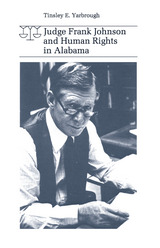
Where courage meets the gavel: One judge’s relentless fight for justice and human rights in Alabama.
Judge Frank M. Johnson, Jr., Chief Judge of the United States District Court for the Middle District of Alabama until his elevation to the Court of Appeals for the Fifth Circuit in 1979, was perhaps President Dwight D. Eisenhower’s most significant appointment to a lower court. His selection to the bench in 1955 followed by only a few months the Supreme Court’s historic decision in Brown vs. Board of Education.
During Judge Johnson’s tenure, his court invalidated segregation and other forms of racial discrimination in Alabama’s transportation facilities, voter registration processes, school and colleges, administrative agencies, system of jury selection, prisons, mental institutions, political parties, and government grant programs. In fact, most of the state’s major racial crises were resolved in his courtroom. However, his impact on human rights policy in Alabama was not confined to a racial context. Among other significant developments, the Middle District Court ordered reapportionment of the state’s governing bodies and invalidated its grossly inequitable property tax systems.
Judge Johnson’s decisions made him one of the most widely respected and controversial trial judges in the country. Until recently, however, his name was anathema to many white Alabamians, and he and his family were subject to ostracism, threats, violence, and verbal abuse.
Yarbrough examines Judge Johnson’s life through the end of the Wallace era and the Judge’s appointment to the Fifth Circuit Court. More broadly, the book is a history of modern human rights reform in Alabama, cast in the biographical idiom. For, in a real sense, the history of the reform and of Judge Johnson’s judicial career have been synonymous.
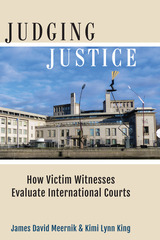
In order to understand the meaning of justice, James David Meernik and Kimi Lynn King studied the perspective of witnesses who have testified before the International Criminal Tribunal for the Former Yugoslavia (ICTY). Using a unique survey, Meernik and King look at the identity of the victims and their perception of the fairness of ICTY. Because of the need to justify the practical and emotional difficulties involved in testifying before an international tribunal, witnesses look not just to the institution to judge its effectiveness, but also to their own contribution, by testifying effectively. The central elements of the theory Meernik and King develop—identity, fairness, and experience—transcend specific conflicts and specific countries and are of importance to people everywhere.
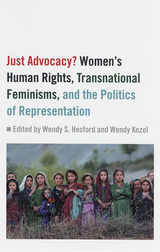
In humanitarian and political debates about the topic, women and children are frequently considered first. Since the 1990s, human rights have become the most legitimate and legitimizing juridical and cultural claim made on a woman's behalf. But what are the consequences of equating women's rights with human rights? As the eleven essays in this volume show, the impact is often contradictory.
Bringing together some of the most respected scholars in the field, including Inderpal Grewal, Leela Fernandes, Leigh Gilmore, Susan Koshy, Patrice McDermott, and Sidonie Smith, Just Advocacy? sheds light on the often overlooked ways that women and children are further subjugated when political or humanitarian groups represent them solely as victims and portray the individuals that are helping them as paternal saviors.
Drawn from a variety of disciplinary perspectives in the humanities, arts, and social sciences, Just Advocacy? promises to advance a more nuanced and politically responsible understanding of human rights for both scholars and activists.
-Sister Helen Prejean
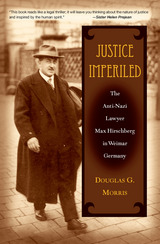
Justice Imperiled is the story of the brilliant lawyer Max Hirschberg, one of Germany's most courageous defenders of justice in the face of Hitler's rise to power.
Hirschberg lived an extraordinary life at a defining moment in German and European history. By the time he fled Nazi Germany in 1934, he had argued a series of cases in Munich's courtrooms that shed light on the history of political justice in pre-Nazi Germany and, by extension, the miscarriage of justice in all Western democracies.
Hirschberg was a rare figure: he fought for cases that reflected the new democracy rather than the old monarchy, that valued equality rather than hierarchy, and that showed respect for workers as well as aristocrats.
Throughout the Weimar period Hirschberg squared off in court against Munich's conservatives, reactionaries, and Nazis-twice facing Hitler himself. As he litigated politically charged disputes, he also began fighting to reverse the criminal convictions of innocent defendants and to study what mistaken verdicts teach us about the criminal justice system as a whole.
In a unique blend of biography and courtroom drama, Justice Imperiled captures the excitement of Hirschberg's actual cases and presents legal battles that still rage, in different circumstances, to this day.
READERS
Browse our collection.
PUBLISHERS
See BiblioVault's publisher services.
STUDENT SERVICES
Files for college accessibility offices.
RECENTLY PUBLISHED



UChicago Accessibility Resources
home | accessibility | search | about | contact us
BiblioVault ® 2001 - 2026
The University of Chicago Press