front cover of Labor Markets and Firm Benefit Policies in Japan and the United States
Labor Markets and Firm Benefit Policies in Japan and the United States
Edited by Seiritsu Ogura, Toshiaki Tachibanaki, and David A. Wise
University of Chicago Press, 2003
This volume, the fourth to result from a remarkably productive collaboration between the National Bureau of Economic Research and the Japan Center for Economic Research, presents a selection of thirteen high-caliber papers addressing issues in the employment practices, labor markets, and health, benefit, and pension policies of the United States and Japan.

After an opening chapter assessing the recent ascendance of the U.S. economy, papers diverge to tackle a range of specific issues. Focusing less on international comparison than on the assembly of high-quality research, contributors hone in on a variety of individual topics. Chapters delve into issues of youth employment, participatory employment, information sharing, fringe benefits, and drug coverage in Japan, as well as the dynamics of medical savings accounts, private insurance coverage, and benefit options in the U.S.

Like previous volumes stemming from NBER/JCER collaboration, this book represents a valuable mass of empirical data on some of the most notable employment and benefits issues in each nation, information that will both anchor and provoke scholarly analysis of these topics well into the future.

[more]

front cover of Law in Everyday Japan
Law in Everyday Japan
Sex, Sumo, Suicide, and Statutes
Mark D. West
University of Chicago Press, 2005
Lawsuits are rare events in most people's lives. High-stakes cases are even less commonplace. Why is it, then, that scholarship about the Japanese legal system has focused almost exclusively on epic court battles, large-scale social issues, and corporate governance? Mark D. West's Law in Everyday Japan fills a void in our understanding of the relationship between law and social life in Japan by shifting the focus to cases more representative of everyday Japanese life.

Compiling case studies based on seven fascinating themes—karaoke-based noise complaints, sumo wrestling, love hotels, post-Kobe earthquake condominium reconstruction, lost-and-found outcomes, working hours, and debt-induced suicide—Law in Everyday Japan offers a vibrant portrait of the way law intermingles with social norms, historically ingrained ideas, and cultural mores in Japan. Each example is informed by extensive fieldwork. West interviews all of the participants-from judges and lawyers to defendants, plaintiffs, and their families-to uncover an everyday Japan where law matters, albeit in very surprising ways.

[more]

front cover of The Limits of Okinawa
The Limits of Okinawa
Japanese Capitalism, Living Labor, and Theorizations of Community
Wendy Matsumura
Duke University Press, 2015
Since its incorporation into the Japanese nation-state in 1879, Okinawa has been seen by both Okinawans and Japanese as an exotic “South,” both spatially and temporally distinct from modern Japan. In The Limits of Okinawa, Wendy Matsumura traces the emergence of this sense of Okinawan difference, showing how local and mainland capitalists, intellectuals, and politicians attempted to resolve clashes with labor by appealing to the idea of a unified Okinawan community. Their numerous confrontations with small producers and cultivators who refused to be exploited for the sake of this ideal produced and reproduced “Okinawa” as an organic, transhistorical entity. Informed by recent Marxist attempts to expand the understanding of the capitalist mode of production to include the production of subjectivity, Matsumura provides a new understanding of Okinawa's place in Japanese and world history, and it establishes a new locus for considering the relationships between empire, capital, nation, and identity.
[more]

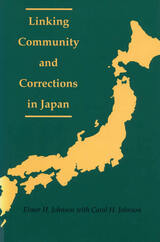
front cover of Linking Community and Corrections in Japan
Linking Community and Corrections in Japan
Elmer H. Johnson with Carol H. Jonnson
Southern Illinois University Press, 2000

Completing Elmer H. Johnson’s impressive three-volume examination of corrections in Japan, Linking Community and Corrections in Japan (written with the assistance of Carol H. Johnson) focuses on the Rehabilitation Bureau’s responsibilities regarding probation, parole, and aftercare as well as the Correction Bureau’s role in Japan’s version of community-oriented corrections. Johnson first outlines the tasks of the Rehabilitation Bureau, then turns to historical and contemporary views of community and corrections. In discussions of the probation and parole system for both adults and juveniles, he describes in detail the Japanese version of supervision and the return of prisoners to the community. One strength of this study is Johnson’s impartiality. As an investigator, he functions as a "friend of the court," an adviser who is free to conduct an objective pursuit of the fundamental strengths and shortcomings of the Japanese prison system. He also follows the Foucauldian dictum: "With the prisons there would be no sense of limiting oneself to discourses about prisons; just as important are the discourses which arise within the prison, the decisions and regulations which are among its constituent elements, its means of functioning, along with its strategies."
[more]

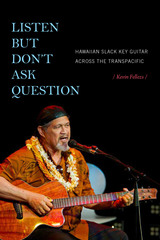
front cover of Listen but Don't Ask Question
Listen but Don't Ask Question
Hawaiian Slack Key Guitar across the TransPacific
Kevin Fellezs
Duke University Press, 2019
Performed on an acoustic steel-string guitar with open tunings and a finger-picking technique, Hawaiian slack key guitar music emerged in the mid-nineteenth century. Though performed on a non-Hawaiian instrument, it is widely considered to be an authentic Hawaiian tradition grounded in Hawaiian aesthetics and cultural values. In Listen But Don’t Ask Question Kevin Fellezs listens to Kanaka Maoli (Native Hawaiian) and non-Hawaiian slack key guitarists in Hawai‘i, California, and Japan, attentive to the ways in which notions of Kanaka Maoli belonging and authenticity are negotiated and articulated in all three locations. In Hawai‘i, slack key guitar functions as a sign of Kanaka Maoli cultural renewal, resilience, and resistance in the face of appropriation and occupation, while in Japan it nurtures a merged Japanese-Hawaiian artistic and cultural sensibility. For diasporic Hawaiians in California, it provides a way to claim Hawaiian identity. By demonstrating how slack key guitar is a site for the articulation of Hawaiian values, Fellezs illuminates how slack key guitarists are reconfiguring notions of Hawaiian belonging, aesthetics, and politics throughout the transPacific. 
[more]

front cover of Listening to the Voices of the Dead
Listening to the Voices of the Dead
The 3-11 Tohoku Disaster Speaks
Isomae Jun'ichi
University of Michigan Press, 2024
Listening to the Voices of the Dead is an account of the author’s search for the disquieted voices of the dead in the wake of the March 11, 2011, Tōhoku Disaster and his attempt to translate those voices for the living. Isomae Jun’ichi considers the disaster a challenge for outside observers to overcome, especially for practitioners of religion and religious studies. He chronicles the care and devotion for the dead shown by ordinary people, people displaced from their homes and loved ones. Drawing upon religious studies, Japanese history, postcolonial studies, and his own experiences during the disaster, Isomae uncovers historical symptoms brought to the surface by the traumas of disaster. Only by listening to the disquieted voices of the dead, translating them, and responding to them can we regain our true selves as well as offer peace to the spirits of the victims. While Listening to the Voices of the Dead focuses on a specific event in Japanese history and memory, it captures a broadening critique at the heart of many movements responding to how increasing globalization impacts our sense of place and community.
[more]

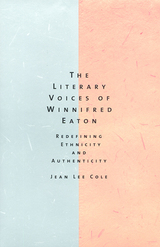
front cover of The Literary Voices of Winnifred Eaton
The Literary Voices of Winnifred Eaton
Redefining Ethnicity and Authenticity
Cole, Jean Lee
Rutgers University Press, 2002
Winnifred Eaton, better known under her Japanese-sounding pseudonym, Onoto Watanna, published over a dozen novels and hundreds of short stories, articles, and screenplays during the first half of the twentieth century. However, by the time of her death in 1954, most of her books were out of print.

Eaton attempted to disguise her Chinese heritage by writing under a hypothetically Japanese pen name. In legal documents, she usually claimed a "white" racial identity. In her fiction, Eaton portrayed Japanese, Chinese, Irish, and American characters, relying on the accepted stereotypes of the day. Jean Lee Cole shows that the many voices Eaton adopted show her deep preoccupations with "American" identity as a whole. The author attempts to reconcile all of these "voices," examining how Eaton survived in a climate hostile to minority writers in the early twentieth century, and how her seemingly anomalous works conjoin Asian American and American literary history.

[more]

logo for University of North Texas Press
Living in the Shadow of a Hell Ship
The Survival Story of U.S. Marine George Burlage, a WWII Prisoner-of-War of the Japanese
Georgianne Burlage
University of North Texas Press, 2020

front cover of Lords of the Sea
Lords of the Sea
Pirates, Violence, and Commerce in Late Medieval Japan
Peter D. Shapinsky
University of Michigan Press, 2014
Lords of the Sea revises our understanding of the epic political, economic, and cultural transformations of Japan’s late medieval period (ca. 1300–1600) by shifting the conventional land-based analytical framework to one centered on the perspectives of seafarers who, though usually dismissed as "pirates," thought of themselves as sea lords.
Over the course of these centuries, Japan’s sea lords became maritime magnates who wielded increasing amounts of political and economic authority by developing autonomous maritime domains that operated outside the auspices of state authority. They played key roles in the operation of networks linking Japan to the rest of the world, and their protection businesses, shipping organizations, and sea tenure practices spread their influence across the waves to the continent, shaping commercial and diplomatic relations with Korea and China. Japan's land-based authorities during this time not only came to accept the autonomy of "pirates" but also competed to sponsor sea-lord bands who could administer littoral estates, fight sea battles, protect shipping, and carry trade. In turn, prominent sea-lord families expanded their dominion by shifting their locus of service among several patrons and by appropriating land-based rhetorics of lordship, which forced authorities to recognize them as legitimate lords over sea-based domains.
By the end of the late medieval period, the ambitions, tactics, and technologies of sea-lord mercenary bands proved integral to the naval dimensions of Japan’s sixteenth-century military revolution. Sea lords translated their late medieval autonomy into positions of influence in early modern Japan and helped make control of the seas part of the ideological foundations of the state.
[more]

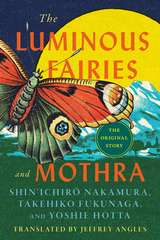
front cover of The Luminous Fairies and Mothra
The Luminous Fairies and Mothra
Takehiko Fukunaga
University of Minnesota Press, 2026

The original story that hatched Mothra, one of the most beloved monsters in the “kaijuverse”—available in English for the first time

Mystical and benevolent, the colossal lepidopteran Mothra has been one of the most beloved kaiju since 1961, when The Luminous Fairies and Mothra was originally published in Japanese. Commissioned by Tōhō Studios from three of Japan’s most prominent postwar literary writers (Shin’ichirō Nakamura, Takehiko Fukunaga, and Yoshie Hotta), the novella formed the basis for the now-classic monster film Mothra, with a protagonist second only to Godzilla in number of film appearances by a kaiju. Finally available in its first official English translation, The Luminous Fairies and Mothra will captivate ardent, longtime fans of the films as well as newcomers.

Written just months after the largest political demonstrations Japan had ever seen, The Luminous Fairies and Mothra reflects the rebellious spirit of the time. In this original story, explorers visit a South Pacific island and capture a group of fairies, inciting the fury of the goddess Mothra, who sets out for Japan on a mission of rescue and revenge. Expressing a powerful social stance about Japan’s need to chart its own foreign policy during the Cold War, the novella’s political message was ultimately toned down in the Tōhō Studios film. Through this translation, Anglophone audiences will discover Mothra as a figure of protest fiction intricately reflecting the complex geopolitical situation in early 1960s Japan.

The Luminous Fairies and Mothra is translated into lively prose by Jeffrey Angles, who also wrote an extensive afterword about the novella’s cultural context, the unusual story of its composition, and the development of the 1961 film. Following Angles’s best-selling translation of the original Godzilla novellas, this new work will once again delight kaiju fans everywhere.

Retail e-book files for this title are screen-reader friendly with images accompanied by short alt text and/or extended descriptions.

[more]


Send via email Share on Facebook Share on Twitter