
 A SCHOLARLY BOOK REPOSITORY

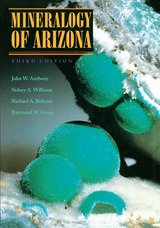
For nearly 20 years, Mineralogy of Arizona has been respected as the definitive reference on Arizona minerals. Now completely revised and greatly expanded with breathtaking new color photographs, the third edition covers 232 minerals discovered in Arizona since the first edition, including 28 first identified in the state.
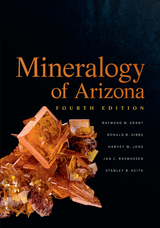
Completely revised and expanded, this fourth edition covers the 986 minerals found in Arizona, showcased with breathtaking new color photographs throughout the book. The new edition includes more than 200 new species not reported in the third edition and previously unknown in Arizona.
Chapters in this fourth edition of Mineralogy of Arizona cover gemstones and lapidary materials, fluorescent minerals, and an impressive catalog of mineral species. The authors also discuss mineral districts, including information about the geology, mineralogy, and age of mineral occurrences throughout the state. The book includes detailed maps of each county, showing the boundaries and characteristics of the mineral districts present in the state.
Arizona’s rich mineral history is well illustrated by the more than 300 color photographs of minerals, gemstones, and fluorescent minerals that help the reader identify and understand the rich and diverse mineralogy of Arizona. Anyone interested in the mineralogy and geology of the state will find this the most up-to-date compilation of the minerals known to occur in Arizona.

Nevada has an extraordinary diversity of minerals, some of them unique to the state and some the focus of human exploitation for millennia. Minerals of Nevada is the first synoptic catalog of Nevada minerals, listing every mineral found in the state along with the places where they occur. The book includes the geologic history of the state, the history of mining in Nevada, descriptions of significant mineral deposits and mining districts, maps, and an album of striking color photographs of rare and important minerals.
The inhabitants of the department of Antioquía in north-central Colombia have played a unique role in that country’s economic history. During the colonial period Antioqueño placer miners supplied a substantial portion of New Granada’s gold exports. Their nineteenth-century descendants pioneered investments in lode mining, colonization, international commerce, banking, stock raising, tobacco, and coffee. In the twentieth century, Antioqueños initiated the industrialization of the regional capital, Medellín.
Many theories have been set forth to account for the special energy and initiative of Antioqueños. They range from ethnic and psychological interpretations (Antioqueños are descended from Jews or Basques; they are driven to succeed because of status deprivation) to historical explanations that emphasize their geographic isolation, mining heritage, or the coffee-export economy. In Miners, Merchants, and Farmers in Colonial Colombia, Ann Twinam critiques these theories and sets forth her own revisionist interpretation of Antioqueño enterprise. Rather than emphasize the alien or deviant in Antioqueño psychology or culture, Twinam re-creates the region’s late colonial economic and social structure and attributes the origins of Antioqueño enterprise to a particular mix of human and natural resources that directed the region’s development toward capital accumulation and reinvestment.
Although the existing limitations of their colonial environment may have forced Antioqueños along enterprising pathways initially, the continuation of Antioqueño investments to the present day suggests that their adaptation to a specific economic reality became a way of life transcending the historical conditions that created it.

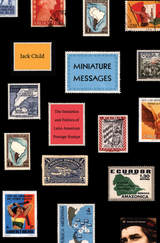
Child combines history and political science with philatelic research of nearly forty thousand Latin American stamps. He focuses on Argentina and the Southern Cone, highlighting stamps representing the consolidation of the Argentine republic and those produced under its Peronist regime. He compares Chilean stamps issued by the leftist government of Salvador Allende and by Augusto Pinochet’s dictatorship. Considering postage stamps produced under other dictatorial regimes, he examines stamps from the Dominican Republic, Guatemala, Nicaragua, and Paraguay. Child studies how international conflicts have been depicted on the stamps of Argentina, Chile, and Peru, and he pays particular attention to the role of South American and British stamps in establishing claims to the Malvinas/Falkland Islands and to Antarctica. He also covers the cultural and political history of stamps in Bolivia, Brazil, Colombia, Cuba, Grenada, Mexico, Uruguay, Venezuela and elsewhere. In Miniature Messages, Child finds the political history of modern Latin America in its “tiny posters.”

Written in the style of Theodor Adorno's Minima Moralia, Jackson's work shows how general ideas are always anchored in particular social events and critical concerns. Emphasizing the intersubjective encounter over objective descriptions of the whole historical and contemporary situation of a given people, he illustrates the power and originality of existential anthropology through a series of vignettes from his fieldwork in Sierra Leone and Australia. An award-winning poet, novelist, and anthropologist, Jackson offers a timely critique of conventions that dull our sense of the links between academic study and lived experience.

In the seven stories and novella of Minimal Damage, veterans search for dignity in a civilian life that has no need for men who were soldiers. Finding themselves psychically scarred, in crisis, on the fringes of society, or in battle with their memories, these men are living "like warts on America's ass." The characters range from the enigmatic Mr. K, who runs a reality television show and once led an escape from a Korean pow camp, to the doomed Billy Debecki, who regains his dignity in the last minutes of his life by remembering that he once willingly risked his life to save an enemy soldier. In one story, a man who was never a soldier finds a path toward reconciliation with his brother, a former Marine. In another, a man recalls becoming a soldier by watching the humanity of a fellow recruit disintegrate in basic training. In the novella "Snake Boy," a homeless Vietnam vet is kidnapped by a snake-handling evangelist. In proper, upstanding lives and lost, drifting ones, the depth of damage is never immediately apparent for these men. In war, chance, luck, and arbitrary timing conspire to determine a soldier's fate. As civilians, the same uncontrollable forces influence who finds a place in society and who is doomed to keep searching. With emotion, humor, and clarity, Barnes creates characters who show us what it is to live with the trauma of having experienced combat. The fractured souls and lives of these men remind us that the damage doesn't remain on the battlefield. Western Literature Series.


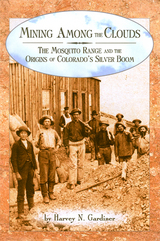
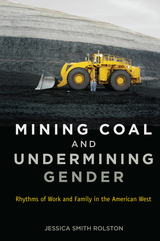
Though mining is an infamously masculine industry, women make up 20 percent of all production crews in Wyoming’s Powder River Basin—the largest coal-producing region in the United States. How do these women fit into a working culture supposedly hostile to females? This is what anthropologist Jessica Smith Rolston, herself a onetime mine worker and the daughter of a miner, set out to discover. Her answers, based on years of participant-observation in four mines and extensive interviews with miners, managers, engineers, and the families of mine employees, offer a rich and surprising view of the working “families” that miners construct. In this picture, gender roles are not nearly as straightforward—or as straitened—as stereotypes suggest.
Gender is far from the primary concern of coworkers in crews. Far more important, Rolston finds, is protecting the safety of the entire crew and finding a way to treat each other well despite the stresses of their jobs. These miners share the burden of rotating shift work—continually switching between twelve-hour day and night shifts—which deprives them of the daily rhythms of a typical home, from morning breakfasts to bedtime stories. Rolston identifies the mine workers’ response to these shared challenges as a new sort of constructed kinship that both challenges and reproduces gender roles in their everyday working and family lives.
Crews’ expectations for coworkers to treat one another like family and to adopt an “agricultural” work ethic tend to minimize gender differences. And yet, these differences remain tenacious in the equation of masculinity with technical expertise, and of femininity with household responsibilities. For Rolston, such lingering areas of inequality highlight the importance of structural constraints that flout a common impulse among men and women to neutralize the significance of gender, at home and in the workplace.
At a time when the Appalachian region continues to dominate discussion of mining culture, this book provides a very different and unexpected view—of how miners live and work together, and of how their lives and work reconfigure ideas of gender and kinship.
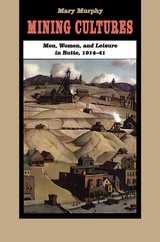
Butte, Montana, long deserved its reputation as a wide-open town. Mining Cultures shows how the fabled Montana city evolved from a male-dominated mining enclave to a community in which men and women participated on a more equal basis as leisure patterns changed and consumer culture grew. Mary Murphy looks at how women worked and spent their leisure time in a city dominated by the quintessential example of "men's work": mining. Bringing Butte to life, she adds in-depth research on church weeklies, high school yearbooks, holiday rituals, movie plots, and news of local fashion to archival material and interviews.
A richly illustrated jaunt through western history, Mining Cultures is the never-told chronicle of how women transformed the richest hill on earth.
Mining Encounters paints a broad picture, looking at resource extraction in numerous locations at different stages of development—covering coal, natural gas, gold, and cement mining in North, West, and South Africa, as well as in India, Kazakhstan, and Australia. The chapters answer key questions: How does mining transform the physical landscape? What are the value systems underlying the world’s mining industries? And how does the process of extracting resources determine which stakeholders become dominant and which marginalized?
Uncovering the tensions, negotiations, and disparities among different actors in the extractive industries, Mining Encounters will make a vital contribution to policy debates moving forward.

The continent of Africa is rich in minerals needed by Western economies, but rather than forming the basis for economic growth the mining industry contributes very little to African development
Investigating the impact of the 2003 Extractive Industries Review on a number of African countries, the contributors find that a key dimension of the problem lies in the regulatory frameworks imposed on the African countries by the IMF and World Bank. They aim to convince academics, governments and industry that regulation needs to be reformed to create a mining industry favourable to social and economic development and environmental protection.
The book takes a multidisciplinary approach and provides a historical perspective of each country, making it ideal for students of development studies and development organisations.
Examining 150 years of mining and mineral technology exhibits at the Smithsonian
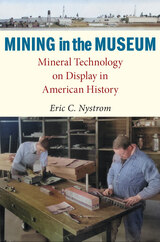
Buried deep underground or cut into remote landscapes, mines are often dirty, dark, and dangerous places, located far from the everyday urban spaces that most Americans call home. Yet mining is foundational to the making of the United States, supplying the raw materials that built its infrastructure, powered its industries, and shaped its scientific institutions, even as the work itself has remained physically removed, technically complex, and culturally overlooked. Mining in the Museum reveals how Americans have encountered this vital industry not at the distant mine face, but in museum galleries. Tracing more than 150 years of mining and mineral technology exhibits at the Smithsonian Institution in Washington, DC, Eric C. Nystrom shows how curators transformed ore, instruments, models, and machinery into stories about progress, innovation, and national development, and how those interpretive choices shaped what the nation remembers—and forgets—about mining.
Using mining collections as a lens into institutional change, Nystrom offers a new history of the Smithsonian and its United States National Museum, examining how curators, administrators, and policymakers debated what museums were for, which kinds of knowledge they should produce, and what objects deserved display. He follows the shifting fortunes of mineral and mining exhibits across world’s fairs, scientific surveys, and changing exhibition philosophies, showing how display strategies evolved alongside professional science and public education. As mining’s place in the national imagination changed, so too did its presence in the federal museum, moving from a central scientific and technological showcase to a subject increasingly preserved by regional and local institutions closer to mining communities themselves. Grounded in extensive archival research, Mining in the Museum illuminates the evolving relationship among technology, public history, and the politics of display, demonstrating how museums help define which industries, and which kinds of work, become part of the American story.
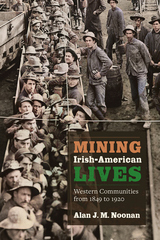
Historian Alan J. M. Noonan uses a range of previously overlooked sources, including collections of emigrant letters, hospital logbooks, private detective reports, and internment records, to tell the stories of Irish men and women who emigrated to mining towns to search for opportunity. Noonan details the periods, the places, and the experiences over multiple generations in the late nineteenth and early twentieth centuries. He carefully examines their encounters with nativists, other ethnic groups, and mining companies to highlight the contested emergence of a hyphenated Irish-American identity.
Unearthing personal details along with the histories of different communities, the book investigates Irish immigrants and Irish-Americans through the prism of their own experiences, significantly enriching the history of the period.
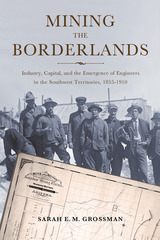
At the dawn of the twentieth century, the US-Mexico border was home to some of the largest and most technologically advanced industrial copper mines. This despite being geographically, culturally, and financially far-removed from traditional urban centers of power. Mining the Borderlands argues that this was only possible because of the emergence of mining engineers—a distinct technocratic class of professionals who connected capital, labor, and expertise.
Mining engineers moved easily between remote mining camps and the upscale parlors of east coast investors. Working as labor managers and technical experts, they were involved in the daily negotiations, which brought private US capital to the southwestern border. The success of the massive capital-intensive mining ventures in the region depended on their ability to construct different networks, serving as intermediaries to groups that rarely coincided.
Grossman argues that this didn’t just lead to bigger and more efficient mines, but served as part of the ongoing project of American territorial and economic expansion. By integrating the history of technical expertise into the history of the transnational mining industry, this in-depth look at borderlands mining explains how American economic hegemony was established in a border region peripheral to the federal governments of both Washington, D.C. and Mexico City.
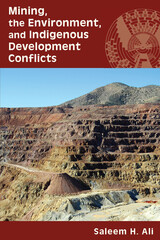
This book gets to the heart of resource conflicts and environmental impact assessment by asking why indigenous communities support environmental causes in some cases of mining development but not in others. Saleem Ali examines environmental conflicts between mining companies and indigenous communities and with rare objectivity offers a comparative study of the factors leading to those conflicts.
Mining, the Environment, and Indigenous Development Conflicts presents four cases from the United States and Canada: the Navajos and Hopis with Peabody Coal in Arizona; the Chippewas with the Crandon Mine proposal in Wisconsin; the Chipewyan Inuits, Déné and Cree with Cameco in Saskatchewan; and the Innu and Inuits with Inco in Labrador. These cases exemplify different historical relationships with government and industry and provide an instance of high and low levels of Native resistance in each country. Through these cases, Ali analyzes why and under what circumstances tribes agree to negotiated mining agreements on their lands, and why some negotiations are successful and others not.
Ali challenges conventional theories of conflict based on economic or environmental cost-benefit analysis, which do not fully capture the dynamics of resistance. He proposes that the underlying issue has less to do with environmental concerns than with sovereignty, which often complicates relationships between tribes and environmental organizations. Activist groups, he observes, fail to understand such tribal concerns and often have problems working with tribes on issues where they may presume a common environmental interest.
This book goes beyond popular perceptions of environmentalism to provide a detailed picture of how and when the concerns of industry, society, and tribal governments may converge and when they conflict. As demands for domestic energy exploration increase, it offers clear guidance for such endeavors when native lands are involved.
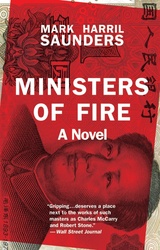
Kabul, Afghanistan, 1979: CIA station chief Lucius Burling, an idealistic but flawed product of his nation’s intelligence establishment, barely survives the assassination of the American ambassador. Burling’s reaction to the murder, and his desire to understand its larger meaning, propel him on a journey of intrigue and betrayal that will reach its ultimate end in the streets of Shanghai, months after 9/11. A Chinese dissident physicist may (or may not) be planning to sell his country’s nuclear secrets, and in his story Burling, now living quietly as consul, recognizes the fingerprints of a covert operation, one without the obvious sanction of the Agency. The dissident’s escape draws the violent attention of the Chinese internal security service, and as Burling is drawn inexorably into their path, he must face the ghosts of his past misadventures and a present world of global trafficking, fragile alliances, and the human need for connection above all.
Reminiscent of the best work of Graham Greene and John le Carré, Ministers of Fire extends the spy thriller into new historical, political, and emotional territory.


In A Ministry of Presence, Winnifred Fallers Sullivan explores how chaplaincy works in the United States—and in particular how it sits uneasily at the intersection of law and religion, spiritual care, and government regulation. Responsible for ministering to the wandering souls of the globalized economy, the chaplain works with a clientele often unmarked by a specific religious identity, and does so on behalf of a secular institution, like a hospital. Sullivan's examination of the sometimes heroic but often deeply ambiguous work yields fascinating insights into contemporary spiritual life, the politics of religious freedom, and the never-ending negotiation of religion's place in American institutional life.

Like Dylan Thomas’ Under Milk Wood and Sherwood Anderson’s Winesburg, Ohio, Brian Doyle’s stunning fiction debut brings a town to life through the jumbled lives and braided stories of its people.
In a small town on the Oregon coast there are love affairs and almost-love-affairs, mystery and hilarity, bears and tears, brawls and boats, a garrulous logger and a silent doctor, rain and pain, Irish immigrants and Salish stories, mud and laughter. There’s a Department of Public Works that gives haircuts and counts insects, a policeman addicted to Puccini, a philosophizing crow, beer and berries. An expedition is mounted, a crime committed, and there’s an unbelievably huge picnic on the football field. Babies are born. A car is cut in half with a saw. A river confesses what it’s thinking…
It’s the tale of a town, written in a distinct and lyrical voice, and readers will close the book more than a little sad to leave the village of Neawanaka, on the wet coast of Oregon, beneath the hills that used to boast the biggest trees in the history of the world.
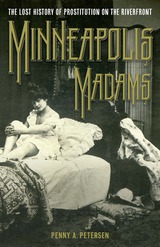
Sex, money, and politics—no, it’s not a thriller novel. Minneapolis Madams is the surprising and riveting account of the Minneapolis red-light district and the powerful madams who ran it. Penny Petersen brings to life this nearly forgotten chapter of Minneapolis history, tracing the story of how these “houses of ill fame” rose to prominence in the late nineteenth century and then were finally shut down in the early twentieth century.
In their heyday Minneapolis brothels were not only open for business but constituted a substantial economic and political force in the city. Women of independent means, madams built custom bordellos to suit their tastes and exerted influence over leading figures and politicians. Petersen digs deep into city archives, period newspapers, and other primary sources to illuminate the Minneapolis sex trade and its opponents, bringing into focus the ideologies and economic concerns that shaped the lives of prostitutes, the men who used their services, and the social-purity reformers who sought to eradicate their trade altogether. Usually written off as deviants, madams were actually crucial components of a larger system of social control and regulation. These entrepreneurial women bought real estate, hired well-known architects and interior decorators to design their bordellos, and played an important part in the politics of the developing city.
Petersen argues that we cannot understand Minneapolis unless we can grasp the scope and significance of its sex trade. She also provides intriguing glimpses into racial interactions within the vice economy, investigating an African American madam who possibly married into one of the city’s most prestigious families. Fascinating and rigorously researched, Minneapolis Madams is a true detective story and a key resource for anyone interested in the history of women, sexuality, and urban life in Minneapolis.
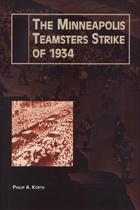
The 1934 Minneapolis Teamsters Strike proved to be a pivotal event in twentieth-century American labor history. The Minneapolis Teamsters challenged the muscle of big business, as well as the authority of local, state, and federal government, and in the process they changed the very nature of labor relations in the United States. In The Minneapolis Teamsters Strike of 1934, Philip Korth's description of events surrounding this landmark labor action are filtered through the recollections of the people who were there. Korth blends historical record with the words of actual participants to draw a thorough and compelling portrait of a labor strike and its consequences. Philip Korth's study illustrates the organizational strategies that made the Minneapolis strike a success, as well as how opposition and public perception defined emerging labor relations practices and public policy. At the same time, the author provides an in-depth examination of the conflict through interviews with witnesses and participants in this pivotal event in labor history.


The Minnesota Commission of Administration and Finance, 1925-1939 was first published in 1964. Minnesota Archive Editions uses digital technology to make long-unavailable books once again accessible, and are published unaltered from the original University of Minnesota Press editions.
Minnesota Farmer-Laborism was first published in 1979. Minnesota Archive Editions uses digital technology to make long-unavailable books once again accessible, and are published unaltered from the original University of Minnesota Press editions.
Minnesota's Farmer-Labor party, a coalition of reformers and radicals ,farmers and unionists, flourished in the state during the years between world wars. Unlike most third parties, it gained political power and for a time virtually displaced the near-moribund Democratic party, vying successfully with Republicans for congressional and state offices. In this book, Millard L. Gieske provides the first detailed history of the Farmer-Labor movement from its inception late in World War I down to its merger with the state Democratic party in 1944.
Gieske finds the origins of the Farmer-Labor party in the Populist and Progressive movements, its specific forebears in the farmers' cooperative movement and the Nonpartisan League. Radical union members in Minneapolis, St. Paul, and the Iron Range, dissatisfied with the conservative program of the American Federation of Labor, gave the party an additional economic base. Most Farmer-Labor adherents shared the belief that the political and economic systems were un-responsive and that the two parties were either unwilling to reform them or incapable of doing so.
Down the years, the Farmer-Labor movement was subject to mercurial shifts in its strength and effectiveness. Gieske's narrative covers the party's squabbles and near collapse in the late 1920s and its resurgence in the 1930s during the Great Depression. He emphasizes the divergent and often conflicting elements that made up the party, traces its tortuous relation with Communists, and notes that significance of foreign policy issues in a movement concerned for the most part with domestic economic issues.
The Farmer-Labor party attracted some of the state's most vivid political figures, whom Gieske skillfully portrays -- Henrik Shipstead, Floyd B. Olson, Elmer Benson, and others. Primarily the story of a specific party, the book also examines the role of the third-party movement in a two-party system. Minnesota Farmer-Laborism is based largely on primary sources and will be a valuable work not only for political historians but also for readers who are interested in Minnesota history or in radical political movements.
Minnesota History was first published in 1931. Minnesota Archive Editions uses digital technology to make long-unavailable books once again accessible, and are published unaltered from the original University of Minnesota Press editions.
Minnesota History was first published in 1960. Minnesota Archive Editions uses digital technology to make long-unavailable books once again accessible, and are published unaltered from the original University of Minnesota Press editions.
Anyone interested in Minnesota history, whether as a teacher, as a student, or as a general reader, will find this an invaluable guide to reading and study. The book contains an outline of the state's history, questions and suggestions for the student, and lists of reading material for each of the 42 topical sections into which the outline is divided.
The outline covers the entire history of the state from the time of the Indians, before the French and British explorations, to the present. The reading references include accounts written from the seventeenth through the twentieth centuries. The aim in preparing the reading lists was to include any article or book bearing upon the Minnesota story which met the qualifications of good historical writing and fair accessibility. Materials of particular interest or importance to the topic under consideration are so designated, and there are liberal annotations to help the reader in his choice of readings. References which are particularly appropriate for young readers are also specially designated. A number of maps are provided for additional guidance.
This is a complete revision of a book long out of print, Minnesota History: A Study Outline by Theodore C. Blegen.

Only in Minnesota can you snap a Polaroid of a fifty-five-foot-tall grinning green man with a size seventy-eight shoe or marvel at the spunk of a Swede who dedicated his life to spinning a gigantic ball of twine. The world’s largest hockey stick, as well as the biggest pelican, prairie chicken, turkey, fish, otter, fox, and loon also make Minnesota their home. Where else can you ponder the mysterious "miracle meat" of Spam in a museum dedicated to pork products or have your head examined by the phrenology machines at the Museum of Questionable Medical Devices?
Minnesota Marvels is a tour of the inspired, bizarre, brilliant, scandalous, and funny sites around the state. Look up in wonder at the several Paul Bunyan statues, including the original (Bemidji), the tallest (Akeley), and the largest talking version (Brainerd). Ease on down the road to visit the first home of the heel-tapping native of Grand Rapids, Judy Garland, or walk the "main street" of Sauk Centre immortalized by native son Sinclair Lewis. See the birthplaces of Charles Lindbergh, the Mayo brothers, the Greyhound bus, the snowmobile, and the ice-cream sandwich.
Minnesota is also the home of such attractions as the Minneapolis Sculpture Garden and the world’s largest aerial lift bridge in Duluth, and architectural wonders such as Frank Lloyd Wright’s modernist gas station in Cloquet and Frank Gehry’s arresting Weisman Art Museum. Stunning mansions with histories of ghost sightings, the hangouts and lairs of infamous gangsters, and old-fashioned breweries dot the state.
Conveniently organized by town name and illustrated throughout, Minnesota Marvels is the perfect light-hearted guide for entertaining road trips all over the state.
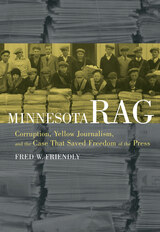
The fascinating behind-the-scenes story of this landmark First Amendment case
Minnesota Rag takes the reader on an exhilarating tour of the seamy underside of a dark period in Minnesota’s past, one rife with crooked public officials, vengeful gangsters, and yellow journalists. Featuring notorious characters such as Jay M. Near, racist and antilabor publisher of Minneapolis’s Saturday Press, pioneering newsman Fred W. Friendly weaves the tale of a court case that molded our understanding of freedom of the press and set a precedent for the publication of the Pentagon Papers.






Based on four years of travel and research, Minnesota’s Best Breweries and Brewpubs is a welcome addition to Robin Shepard’s series of guides to the best of the Midwest’s beer industries. From large-scale breweries such as Cold Spring, to chains like Granite City, to individual brewpubs like Fitger’s Brewhouse, Shepard provides commentary for more than thirty beer makers and three-hundred Minnesota beers. Accessible enough for people at all stages in their journeys to discover great-tasting beer, the information-packed guidebook also features a list of helpful books and websites, as well as information on Minnesota’s beer tastings and festivals.
For each brewery and brewpub site you’ll find:
• a description and brief history, plus many “don’t miss” features
• a description of beers on tap and a list of seasonal and specialty beers
• a space for the brewmaster’s autograph
• notes on the pub food, with recommendations
• suggestions of nearby sights and activities
• general directions to the location
• Shepard’s personal ratings of the experience, plus room to add your own.
Minnesota's Endangered Flora and Fauna was first published in 1988. Minnesota Archive Editions uses digital technology to make long-unavailable books once again accessible, and are published unaltered from the original University of Minnesota Press editions.
"Extinction of species, the silent crisis of our time, diminishes our world...and a commitment to the preservation of species diversity is fundamental to an optimistic view of the future of our own species," says Harrison B. Tordoff in his forward to this comprehensive reference book. Minnesota's Endangered Flora and Fauna is the result of a legislative mandate -- the 1981 amendment to the State Endangered Species Act -- which called upon the state's Department of Natural Resources and an expert advisory committee to prepare a list of plants and animals in jeopardy.
Covered in the book are some 300 species, ranging from mosses and lichens to jumping spiders, and including vascular plants, birds, mammals, reptiles, and amphibians, fish, butterflies, mollusks, and tiger beetles. A chapter is devoted to each of these floral and faunal groups, with individual status accounts provided for all species. Each account includes the designation endangered, threatened,or special concern,the reasons for that choice, and related information on habitat and distribution. Endangered and threatened species are illustrated; state distribution maps are provided for all species, as well as information on national range. In their substantial introduction, the editors describe the historical background of this project; the components of Minnesota's Endangered Species Program -- one of the most comprehensive and respected in the nation; and the state's natural environment -- its diverse landforms and vegetation.
An up-to-date and expanded version of the information contained in Minnesota's Endangered Flora and Fauna is available online through the Minnesota DNR's Rare Species Guide at www.mndnr.gov/rsg.
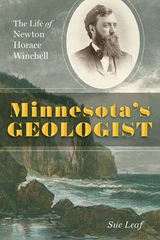
Winner of the 2021 Minnesota Book Award for Minnesota Nonfiction
The story of the scientist who first mapped Minnesota’s geology, set against the backdrop of early scientific inquiry in the state
At twenty, Newton Horace Winchell declared, “I know nothing about rocks.” At twenty-five, he decided to make them his life’s work. As a young geologist tasked with heading the Minnesota Geological and Natural History Survey, Winchell (1839–1914) charted the prehistory of the region, its era of inland seas, its volcanic activity, and its several ice ages—laying the foundation for the monumental five-volume Geology of Minnesota. Tracing Winchell’s remarkable path from impoverished fifteen-year-old schoolteacher to a leading light of an emerging scientific field, Minnesota’s Geologist also recreates the heady early days of scientific inquiry in Minnesota, a time when one man’s determination and passion for learning could unlock the secrets of the state’s distant past and present landscape.
Traveling by horse and cart, by sailboat and birchbark canoe, Winchell and his group surveyed rock outcrops, river valleys, basalt formations on Lake Superior, and the vast Red River Valley. He studied petrology at the Sorbonne in Paris, bringing cutting-edge knowledge to bear on the volcanic rocks of the Arrowhead region. As a founder of the American Geological Society and founding editor of American Geologist, the first journal for professional geologists, Winchell was the driving force behind scientific endeavor in early state history, serving as mentor to many young scientists and presiding over a household—the Winchell House, located on the University of Minnesota’s present-day mall—that was a nexus of intellectual ferment. His life story, told here for the first time, draws an intimate picture of this influential scientist, set against a backdrop of Minnesota’s geological complexity and splendor.
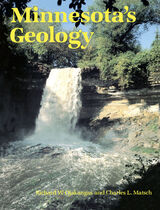
The classic book on the state’s unique geology, now back in print!
Have you ever wondered how the Mississippi River was formed? Or why shark teeth have been found in the Iron Range of the Upper Midwest? Towering mountain ranges, explosive volcanoes, expansive glaciers, and long-extinct forms of both land and sea life were important parts of Minnesota’s ancient history. Today the evidence of this remarkable heritage is revealed in the state’s rocky outcroppings, stony soils, and thousands of lakes.
Minnesota’s Geology provides a history of the past 3.5 billion years in the area’s development. In accessible language, Minnesota-based geologists Richard W. Ojakangas and Charles L. Matsch tell the story of the state’s past and offer a guide for those who want to read geological history firsthand from the rocks and landscapes of today. The book’s four sections give a short introduction to geology and Minnesota’s place in geologic history; a historic timeline; a look at the metallic minerals, nonmetals, and water present today; and a geologic picture of today’s Minnesota arranged in five geographical regions. This book is both a wonderful source of information for rock hounds and the perfect backpacking companion for tourists and outdoor enthusiasts. Lavishly illustrated with color and black-and-white photographs, as well as extensive graphs and maps, Minnesota’s Geology will inform and delight for years to come."This is certainly one of the finest books about the geology of any state in the United States. It is written at a level that should satisfy the visitor, the student, and even most professionals." American Scientist"A stunning guide . . . Minnesota’s Geology will be as valuable to the rock hound or student as it is to a trained geologist." Duluth News-Tribune"Minnesota’s Geology sets a standard of excellence for books about the geology of a region. . . . an unusually well-written and well-balanced book." Science Books and FilmsRichard W. Ojakangas and Charles L. Matsch are professors in the Department of Geological Sciences at the University of Minnesota, Duluth.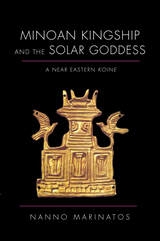
Ancient Minoan culture has been typically viewed as an ancestor of classical Greek civilization, but this book shows that Minoan Crete was on the periphery of a powerfully dynamic cultural interchange with its neighbors. Rather than viewing Crete as the autochthonous ancestor of Greece's glory, Nanno Marinatos considers ancient Crete in the context of its powerful competitors to the east and south.
Analyzing the symbols of the Minoan theocratic system and their similarities to those of Syria, Anatolia, and Egypt, Marinatos unlocks many Minoan visual riddles and establishes what she calls a "cultural koine," or standard set of cultural assumptions, that circulated throughout the Near East and the eastern Mediterranean at the time Minoan civilization reached its peak. With more than one hundred and fifty illustrations, Minoan Kingship and the Solar Goddess delivers a comprehensive reading of Minoan art as a system of thought.
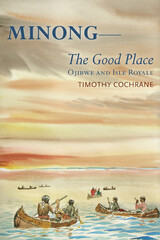
Minong (the Ojibwe name for Isle Royale) is the search for the history of the Ojibwe people's relationship with this unique island in the midst of Lake Superior. Cochrane uses a variety of sources: Ojibwe oral narratives, recently rediscovered Jesuit records and diaries, reports of the Hudson's Bay post at Fort William, newspaper accounts, and numerous records from archives in the United States and Canada, to understand this relationship to a place. What emerges is a richly detailed account of Ojibwe activities on Minong—and their slow waning in the latter third of the nineteenth century.
Piece by piece, Cochrane has assembled a narrative of a people, an island, and a way of life that transcends borders, governments, documentation, and tidy categories. His account reveals an authentic 'history': the missing details, contradictions, deviations from the conventions of historical narrative—the living entity at the intersection of documentation by those long dead and the narratives of those still living in the area. Significantly, it also documents how non-natives symbolically and legally appropriated Isle Royale by presenting it to fellow non-natives as an island that was uninhabited and unused.


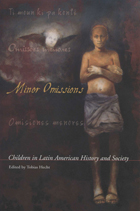
Latin American history—the stuff of wars, elections, conquests, inventions, colonization, and all those other events and processes attributed to adults—has also been lived and partially forged by children. Taking a fresh look at Latin American and Caribbean society over the course of more than half a millennium, this book explores how the omission of children from the region's historiography may in fact be no small matter.
Children currently make up one-third of the population of Latin America and the Caribbean, and over the centuries they have worked, played, worshipped, committed crimes, and fought and suffered in wars. Regarded as more promising converts to the Christian faith than adults, children were vital in European efforts to invent loyal subjects during the colonial era. In the contemporary economies of Latin America and the Caribbean—where 23 percent of people live on a dollar per day or less—the labor of children may spell the difference between survival and starvation for millions of households.
Minor Omissions brings together scholars of history, anthropology, religion, and art history as well as a talented young author who has lived in the streets of a Brazilian city since the age of nine. The book closes with the prophetic dystopian tale "The Children's Rebellion" by the noted Uruguayan writer Cristina Peri Rossi.
Through a blend of personal narrative, cultural and literary analysis, and discussions about teaching, Minor Re/Visions: Asian American Literacy Narratives as a Rhetoric of Citizenship shows how people of color use reading and writing to develop and articulate notions of citizenship. Morris Young begins with a narration of his own literacy experiences to illustrate the complicated relationship among literacy, race, and citizenship and to reveal the tensions that exist between competing beliefs and uses of literacy among those who are part of dominant American culture and those who are positioned as minorities.
Influenced by the literacy narratives of other writers of color, Young theorizes an Asian American rhetoric by examining the rhetorical construction of American citizenship in works such as Richard Rodriguez’s Hunger of Memory, Victor Villanueva’s Bootstraps: From an American Academic of Color, Carlos Bulosan’s America Is in the Heart, and Maxine Hong Kingston’s “Song for a Barbarian Reed Pipe” from Woman Warrior. These narratives, Young shows, tell stories of transformation through education, the acquisition of literacy, and cultural assimilation and resistance. They also offer an important revision to the American story by inserting the minor and creating a tension amid dominant discourses about literacy, race, and citizenship. Through a consideration of the literacy narratives of Hawai`i, Young also provides a context for reading literacy narratives as responses to racism, linguistic discrimination, and attempts at “othering” in a particular region.
As we are faced with dominant discourses that construct race and citizenship in problematic ways and as official institutions become even more powerful and prevalent in silencing minor voices, Minor Re/Visions reveals the critical need for revising minority and dominant discourses. Young’s observations and conclusions have important implications for the ways rhetoricians and compositionists read, teach, and assign literacy narratives.
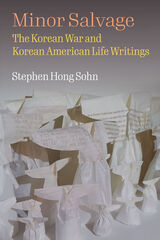

Based in a broad range of fields—including literature, history, African studies, Asian American studies, Asian studies, French and francophone studies, and Latin American studies—the contributors complicate ideas of minority cultural formations and challenge the notion that transnationalism is necessarily a homogenizing force. They cover topics as diverse as competing versions of Chinese womanhood; American rockabilly music in Japan; the trope of mestizaje in Chicano art and culture; dub poetry radio broadcasts in Jamaica; creole theater in Mauritius; and race relations in Salvador, Brazil. Together, they point toward a new theoretical vocabulary, one capacious enough to capture the almost infinitely complex experiences of minority groups and positions in a transnational world.
Contributors. Moradewun Adejunmobi, Ali Behdad, Michael Bourdaghs, Suzanne Gearhart, Susan Koshy, Françoise Lionnet, Seiji M. Lippit, Elizabeth Marchant, Kathleen McHugh, David Palumbo-Liu, Rafael Pérez-Torres, Jenny Sharpe, Shu-mei Shih , Tyler Stovall

In Minor Troubles, Erin J. Rand investigates a series of controversies about youth sexuality and queerness from the early twenty-first century: adult concerns about teen sexting, the bullying and suicides of queer kids, trans youths’ access to gender-segregated bathrooms at school, and sex education. In the public deliberation and mediation of each of these controversies, the imagined qualities of childhood—innocence, vulnerability, nonsexuality, and, crucially, whiteness—are deployed by adults to justify the protection of children. However, these rhetorical figurations of childhood often produce material precarities for actual young people, especially youth of color and queer, trans, and gender-nonconforming youth.
Rand foregrounds the fundamental role of racialization in forming ideas about childhood, arguing that the image of innocent white childhood depends upon the dehumanization of racialized youth. Moreover, the rhetorical process of figuration produces vulnerability and constrains agency for real young people and creates cultural ideas about childhood that come to justify policies, discipline behaviors, regulate identities, control knowledges, and determine interventions that shape children’s lives, bodies, and experiences.
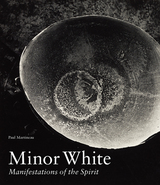
Controversial, misunderstood, and sometimes overlooked, Minor White (1908–1976) is one of the great photographers of the twentieth century, whose ideas exerted a powerful influence on a generation of photographers and still resonate today. His photographic career began in 1938 in Portland, Oregon, with assignments for the WPA (Works Progress Administration). After serving in World War II and studying art history at Columbia University, White’s focus shifted toward the metaphorical. He began creating images charged with symbolism and a critical aspect called equivalency, referring to the invisible spiritual energy present in a photograph made visible to the viewer.
This book brings together White’s key biographical information—his evolution as a photographer, teacher of photography, and editor of Aperture, as well as particularly insightful quotations from his journals, which he kept for more than forty years. The result is an engaging narrative that weaves through the main threads of White’s life, his growth as an artist, as well as his spiritual search and ongoing struggle with his own sexuality and self-doubt. He sought comfort in a variety of religious practices that influenced his continually metamorphosing artistic philosophy.
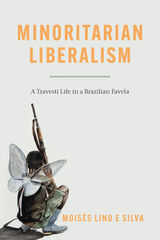
Normative liberalism has promoted the freedom of privileged subjects, those entitled to rights—usually white, adult, heteronormative, and bourgeois—at the expense of marginalized groups, such as Black people, children, LGBTQ people, and slum dwellers. In this visceral ethnography of Rocinha, the largest favela in Rio de Janeiro, Brazil, Moisés Lino e Silva explores what happens when liberalism is challenged by people whose lives are impaired by normative understandings of liberty. He calls such marginalized visions of freedom “minoritarian liberalism,” a concept that stands in for overlapping, alternative modes of freedom—be they queer, favela, or peasant.
Lino e Silva introduces readers to a broad collective of favela residents, most intimately accompanying Natasha Kellem, a charismatic self-declared travesti (a term used in Latin America to indicate a specific form of female gender construction opposite to the sex assigned at birth). While many of those the author meets consider themselves “queer,” others are treated as “abnormal” simply because they live in favelas. Through these interconnected experiences, Lino e Silva not only pushes at the boundaries of anthropological inquiry, but also offers ethnographic evidence of non-normative routes to freedom for those seeking liberties against the backdrop of capitalist exploitation, transphobia, racism, and other patterns of domination.
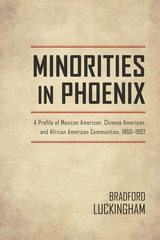
Settled in the mid-nineteenth century by Anglo and Mexican pioneers, Phoenix emerged as an Anglo-dominated society that presented formidable obstacles to minorities seeking access to jobs, education, housing, and public services. It was not until World War II and the subsequent economic boom and civil rights era that opportunities began to open up. Drawing on a variety of sources, from newspaper files to statistical data to oral accounts, Luckingham profiles the general history of each community, revealing the problems it has faced and the progress it has made. His overview of the public life of these three ethnic groups shows not only how they survived, but how they contributed to the evolution of one of America's fastest-growing cities.

Drawing from the personal stories of members of these two minority communities regarding their struggle with displacement, discrimination, and cultural assimilation, as well as comprehensive historical analysis, this book examines how historical traumas, national policies, and sociopolitical dynamics have influenced contemporary minority memory and identity formation. By incorporating interviews with community leaders, civil society representatives, and state officials, this book offers a rich, multifaceted perspective on the processes of memory and identity formation that underscores the broader implications of these processes for international relations in the region and minority rights. Gül M. Gür pulls together theories of nationalism, collective memory, and narrative practice to highlight the unique process of minority memory work and its role in sustaining minority identity and their advocacy efforts.
Challenging conventional assumptions that the majority party dominates the legislature, Jennifer Hayes Clark investigates precisely the ways in which—and under what conditions—members of the minority party successfully pursue their interests. For this study, Clark collects fine-grained data from both the U.S. Congress and state legislatures to get a close look at three key points in the legislative process: committee assignments, bill cosponsorship, and roll-call votes. She finds that minority party members are not systematically excluded throughout the policymaking process. Indeed, their capacity to shape legislative decision-making is enhanced when party polarization is low, when institutional prerogatives are broadly dispersed rather than centralized, and when staff resources are limited. Under these conditions, bipartisanship bill cosponsorship and voting coalitions are also more prevalent.
With the sharp increase of partisan polarization in state legislatures and in Congress, it is essential to understand how and when a minority party can effectively represent constituents.
This book examines the role of minority party status on politicians’ engagement in electoral politics. Jacob Smith argues that politicians are more likely to be engaged in electoral politics when they expect their party to be in the majority in Congress after the next election and less likely when they anticipate their party will be in the minority. This effect is particularly likely to hold true in recent decades where parties disagree on a substantial number of issues. Politicians whose party will be in the majority have a clear incentive to engage in electoral politics because their preferred policies have a credible chance of passing if they are in the majority. In contrast, it is generally difficult for minority party lawmakers to get a hearing on—much less advance—their preferred policies, particularly when institutional rules inside Congress favor the majority party. Instead, minority party lawmakers spend most of their time fighting losing battles against policy proposals from the majority party. Minority Party Misery examines the consequences of the powerlessness that politicians feel from continually losing battles to the majority party in Congress. Its findings have important consequences for democratic governance, as highly qualified minority party politicians may choose to leave office due to their dismal circumstances rather than continue to serve until their party eventually reenters the majority.
Posing questions about gender, cultural politics, and identity, Schein examines how non-Miao people help to create Miao ethnicity by depicting them as both feminized keepers of Chinese tradition and as exotic others against which dominant groups can assert their own modernity. In representing and consuming aspects of their own culture, Miao distance themselves from the idea that they are less than modern. Thus, Schein explains, everyday practices, village rituals, journalistic encounters, and tourism events are not just moments of cultural production but also performances of modernity through which others are made primitive. Schein finds that these moments frequently highlight internal differences among the Miao and demonstrates how not only minorities but more generally peasants and women offer a valuable key to understanding China as it renegotiates its place in the global order.
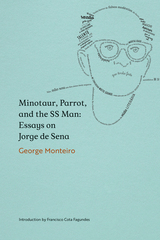

An evocative collection by Slovak poet Eva Luka, The Minotaur’s Daughter seamlessly melds the human and natural worlds, weaving motifs of mythology, nature, and personal freedom into a tapestry of vivid imagery and profound emotion. The poems traverse settings from Japan to mythic landscapes, exploring the complexities of sexuality, desire, and transition.
Central to Luka’s work is the theme of resistance—against societal pressures and psychic harm. Her poetic voice defies artistic conformity, merging human and animal identities to challenge gender norms and explore mutable identities. Through this innovative fusion, her poems capture both the terror and beauty of existence, drawing parallels to Rilke's metaphysical explorations while grounding her work in the pantheistic and protoplasmic. Journeying through darkness and light, The Minotaur’s Daughter reveals an unwavering commitment to artistic and personal truth, establishing Luka as a formidable voice of resistance in contemporary European poetry.
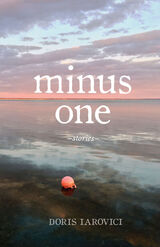
Woven through this slim and powerful volume are astute observations on how pain and grief can be inherited from one generation to the next. With tenderness and honesty, Doris Iarovici explores the plunging depths of the human experience, lingering on moments of familial warmth and joy but never shying away from conflict and tension. These stories reveal glimmers of hope and possibility, even in our darkest times.
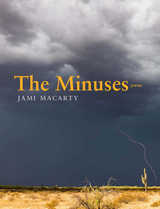
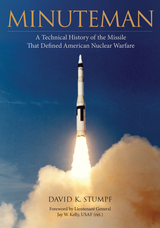
Minuteman offers a fascinating look at the technological breakthroughs necessary to field this weapon system that has served as a powerful component of the strategic nuclear triad for more than half a century. With exacting detail, Stumpf examines the construction of launch and launch control facilities; innovations in solid propellant, lightweight inertial guidance systems, and lightweight reentry vehicle development; and key flight tests and operational flight programs—all while situating the Minuteman program in the context of world events. In doing so, the author reveals how the historic missile has adapted to changing defense strategies—from counterforce to mutually assured destruction to sufficiency.
"Disturbing and often enthralling."—New York Times Book Review
"Extraordinarily moving. . . . Weschler writes brilliantly."—Newsday
"Implausible, intricate and dazzling."—Times Literary Supplement
"As Weschler's interviewees told their tales, I paced agitatedly, choked back tears. . . . Weschler narrates these two episodes with skill and tact. . . . An inspiring book."—George Scialabba, Los Angeles Weekly

Poetically delving into the spectacle and incredulity of a real-life religious controversy
In the early 1990s, a small town in the Philippines became the epicenter of religious controversy when a teenager claimed to be visited by the Virgin Mary. News of these visions, broadcast over national media, would prompt over a million to flock to the town, hoping to catch a glimpse of the teenager and witness inexplicable events: a statue of the Virgin weeping blood, the sun dancing and throbbing into various fantastic colors, or a bevy of doves appearing overhead during Mass.
Miracle Fever, chronicling the life of this town, is a poetry sequence revolving around these apparitions. Documentary in its scrutiny and distortion of real-life events, novelistic in its plot trajectory, and lyric in its imagistic intensity, Miracle Fever offers a fabulist model of reality, built through poems delivered in the form of dramaticules, timelines, and photo captions. These fugitive presences, bearing out and unsettling the complex ethics of representation that the sequence cleaves to, foreground the element of spectacle surrounding the apparitions and bring new light to the ever-shifting antecedents bound by shared history.

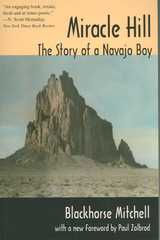
In Miracle Hill, Blackhorse Mitchell presents the unforgettable account of a boy’s struggle to learn—which would be for him a miracle—in the face of handicaps most people would call insurmountable. Under the guidance of a teacher determined to help him pursue that miracle, he records his life from birth to the dawn of manhood: herding family sheep, living at a boarding school, encountering whites for the first time, journeying home, and finally enrolling in the Institute of American Indian Arts in Santa Fe, where his talent was encouraged.
Miracle Hill is written in a distinctively personal style, without strict adherence to orthodox grammar that would have robbed Mitchell of his true voice. Filled with unforgettable characters and brimming with insights into Navajo ways and family relationships, it is a book that crosses cultural barriers and speaks to the miracle-seeker in us all.

In her second full-length poetry collection, Miracle Marks, activist Purvi Shah charts women’s status through pointed explorations of Hindu iconography and philosophy and powerful critiques of American racism. In these searing, revelatory poems, Shah reminds us that surviving birth as an infant girl and living as a woman is miraculous—as such, every girl is a miracle mark. And because education is often denied to girls, writing by women is a miracle.
In Miracle Marks, Shah probes belonging, devotion, and social inequity, delving into what it means to be a woman, and what it means to be. Through sound energy and white space, these poems chart multiple realities, including the miracles of women’s labors and survivals. This collection spurs dialogue across audiences and communities and lights a way for brown girls and women who relish in spirit, intellect, politics, and justice.

Miracle of ’48: Harry Truman’s Major Campaign Speeches and Selected Whistle-stopsis the first published collection of the public addresses Harry Truman made as he crisscrossed the United States from New York City to Los Angeles to Independence, Missouri in 1948. Edited by veteran political journalist Steve Neal, and complemented by a foreword from presidential historian Robert V. Remini, this volume captures the infectious spirit and determination of Truman’s message to the American people.
In an era when policy issues were paramount and televised debates were a thing of the future, Truman boldly stated his case directly to the American people, and they responded. “Senator Barkley and I will win this election and make these Republicans like it,” he declared in his acceptance speech at the Democratic National Convention in Philadelphia. “Don’t you forget that. We will do that because they are wrong and we are right.”
From the start of his “non-political” western tour in Crestline, Ohio, through his victory celebration in his hometown of Independence, the plainspoken Truman waged the good fight against all odds, never mixing his words or apologizing for his aggressively honest tactics. In blaming the GOP for a decline in farm prices, he alleged that the 80th Congress had “stuck a pitchfork in the farmer’s backs.” Truman is now regarded as among our greatest presidents and the populist message of his ’48 campaign is still as compelling and relevant today as it was over half a century ago.
“The political history of the United States reveals many unusual developments,” General Dwight D. Eisenhower wrote Truman after the 1948 election, “but certainly at no point does it record a greater accomplishment than yours, that can be traced so clearly to the stark courage and fighting heart of one man.”

“A naturally gripping adventure tale.”—Publishers Weekly
“Powerful and intensely focused.”—Booklist
“Tracy's satisfying narrative constitutes the first modern account. A finely detailed maritime history.”—Kirkus Reviews
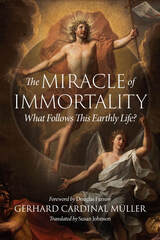
In 1825, the Kent, an East Indiaman, set sail from England for India with a crew and nearly 600 men, women, and children on board. North of Spain, the ship was slammed by a ferocious gale, and while a sailor was inspecting the hold for damage, his lantern ignited a cask of spirits. A fire quickly erupted, and even with the desperate expedient of opening hatches and flooding the ship, the fire burned out of control. As night wore on, the ship became an inferno, with the flames moving toward stores of gunpowder. At this point, everyone on board knew that they would perish, and they began preparing for their ghastly deaths. Despite the raging tempest a sailor climbed one last time to the top of the Kent’s mainmast and—miraculously—a sail was sighted on the horizon. It was the Cambria, a small brig on its way to Mexico. The Cambriaspied the burning Kentand through determination and dogged seamanship in towering seas, the little brig closed the doomed vessel. Launching their boats, the Kent’s and Cambria’s crews were able to transfer nearly all of the children, women, and men to the brig and pull away before the Kent exploded. Dangerously overloaded, the Cambriamade the Cornish coast three days later.
In The Miracle of the Kent: A Tale of Courage, Faith, and Fire, award-winning historian Nicholas Tracy reconstructs this extraordinary tale through records left by the participants, revealing how those aboard the Kent faced their deaths, and their reactions to being offered a second chance. The story of the Kentis both a page-turning adventure and an inspirational homage to the capacity of the human spirit.
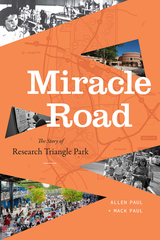
Research Triangle Park in North Carolina (RTP) emerged under the unique circumstances of a poor Southern state that needed to find a way to offset the declining industries of tobacco, furniture, and textiles in the 1950s. Through the sustained commitment of nearby universities, business leaders, and local and state officials, state leaders established the largest science and research park in the United States in an area that was nothing but “possums and pines.” Miracle Road tells this story through the eyes of those at the center of it, like the local black leaders who convinced white officials to desegregate public schools with the justification that it would make the area more appealing to tech companies, or how a chance meeting between the governor and a Danish executive led to North Carolina becoming an epicenter for weight loss drugmakers decades later. Allen Paul and Mack Paul organize the story around major periods in RTP’s growth, showing how RTP came to define the region and the state by the 1990s as well as the major setbacks it encountered in the early 2000s. Breaking down the strategies that led to RTP’s success, like creating new institutions in targeted tech areas to spur activity and factoring quality of life into the regional planning of the area, Miracle Road demonstrates how the story of Research Triangle Park is a fascinating and important case study of urban development in the twenty-first century.

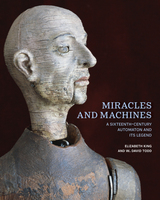
This volume tells the singular story of an uncanny, rare object at the cusp of art and science: a 450-year-old automaton known as “the monk.” The walking, gesticulating figure of a friar, in the collection of the Smithsonian Institution’s National Museum of American History, is among the earliest extant ancestors of the self-propelled robot. According to legend connected to the court of Philip II of Spain, the monk represents a portrait of Diego de Alcalá, a humble Franciscan lay brother whose holy corpse was said to be agent to the miraculous cure of Spain’s crown prince as he lay dying in 1562.
In tracking the origins of the monk and its legend, the authors visited archives, libraries, and museums across the United States and Europe, probing the paradox of a mechanical object performing an apparently spiritual act. They identified seven kindred automata from the same period, which, they argue, form a paradigmatic class of walking “prime movers,” unprecedented in their combination of visual and functional realism. While most of the literature on automata focuses on the Enlightenment, this enthralling narrative journeys back to the late Renaissance, when clockwork machinery was entirely new, foretelling the evolution of artificial life to come.

Religious history and, in particular, the history of the cult of saints and their miracles has recently become one of the most popular fields of historical investigation. Together with continuing interest in the related ecclesiastic motivations and the well organized craft of hagiography, this new interest might be explained by the marvellously rich details of thousands of witness accounts testifying to the miraculous help they received from the saint in times of desparate need. These accounts provide an unparalleled insight into the history of everyday life and into the various hardships, illnesses, hopes dreams and anxieties during the late medieval and early modern period.
Only two records exist on the history of the medieval Hungarian kingdom- the thirteenth century canonization trial of St. Margaret of Hungary and the miracle collections promoting the canonization of St. John of Capistran, the victorious Crusader at Belgrade in 1456, who died thereafter in Ilok (a city located on the periphery of western Christianity in Croatia). Based on a careful study of the widely scattered manuscripts on Capistranean miracles and with the help of a microscopic philological analysis, the author has managed to reconstruct, for the first time, one of the most complex miracle collections in the history of medieval hagiography.
Covering the recording of the first miracle series by the urban notaries of Ilok, the local hagiographer of Ilok Franciscans (John Geszti), the vicar general of the Hungarian province (Stephen Varsányi), and a number of subsequent editions and amplifications of this material recycling into the canonization campaign of St. John of Capistran and the miracles he himself recorded, The Miracles of St. John of Capistran, is an outstanding debut by a representative of a new generation of Central European medievalists.


A study of the Christ of Ixmiquilpan, a historically beloved religious icon from sixteenth-century Mexico, and its evolving cultural importance.
The life-sized crucifix known as the Christ of Ixmiquilpan (also the Señor de Santa Teresa) was one of the most important artworks in colonial Mexico. The statue began as an ordinary devotional image, but in 1621 devotees witnessed it undergo a miraculous renovation that gave it a supernatural beauty. Over the next two and half centuries, its perceived power increased until it was surpassed in importance only by the Virgin of Guadalupe. Despite its historical significance, the Christ of Ixmiquilpan’s history has yet to be fully told.
Derek Burdette brings the miraculous crucifix out of the shadows and explores its instrumental role in shaping the devotional culture of New Spain. Following the arc of the statue’s life, he chronicles the story of the statue’s creation, miraculous renovation, and subsequent veneration at the heart of Mexico City. He also reveals how colonial politics were woven into the statue’s life from the very start. Reconstructing the history of a key artwork, Miraculous Celebrity sheds new light on the intersection of art, faith, and politics in the Spanish colonial world.

READERS
Browse our collection.
PUBLISHERS
See BiblioVault's publisher services.
STUDENT SERVICES
Files for college accessibility offices.
RECENTLY PUBLISHED





UChicago Accessibility Resources
home | accessibility | search | about | contact us
BiblioVault ® 2001 - 2026
The University of Chicago Press