
 A SCHOLARLY BOOK REPOSITORY
20 start with M start with M

Beautifully designed and sturdily bound for rugged field use, Mammals of Alabama is the first and only exhaustive guidebook to Alabama’s diverse and fascinating mammalian fauna.
European and American naturalists visited the territory that would become Alabama as early as the late eighteenth century and marveled at the breadth and variety of its flora and fauna. Yet until today scientists, scholars, and nature enthusiasts had no systematic guide to the state’s mammals. Mammals of Alabama fills the gap.
Naturally occurring in the state are nine orders, twenty-two families, fifty-one genera, and seventy-two species of living mammals. Best and Dusi offer an engaging entry for each as well as additional species that have become extinct through natural processes or human extirpation.
Illustrated with maps and photos, each entry includes:
• Identification notes • Dental formula
• Size and weight • Distribution
• Ecology • Life History
• Behavior • Parasites and Diseases
• Conservation Status • Notes and References
Ideal for backyards, hikes, libraries, and classrooms, Mammals of Alabama includes hundreds of professional, close-up color specimen photographs of both living animals in their natural habitats and skull plates, making identification of animals easy.
Best also offers fascinating and fun facts about Alabama mammals that will delight nature lovers of all ages, such as the surprising and excellent tree-climbing skills of the gray fox, the use in the past of mole skins to apply cosmetics, and the litters of identical quadruplets common to the nine-banded armadillo.
Published in cooperation with the Alabama Wildlife Federation
With a new foreword by Lynton Keith Caldwell
In Managing the Environmental Crisis William R. Mangun and Daniel H. Henning provide a balanced and comprehensive guide to the management of complex environmental and natural resource policy issues. Taking into account new developments, trends, and issues that have arisen in recent years, the authors begin with the recognition, often overlooked, that it is not the environment that needs to be managed but human action relating to the environment.
The authors review issues associated with a range of environmental policy concerns, including energy considerations, renewable and non renewable resource management, pollution control, wilderness management, and urban and regional policy. The history of these issues, recent actions pertaining to their management, difficulties associated with their continued presence, and the consequences of a failure to address these concerns are explored. Though focused on specific political issues, Mangun and Henning direct their attention to two large-scale trends—globalization and the political polarization of the environmental movement. At the level of the decision-making process, the incorporation of values—specifically addressed from multicultural and cross-disciplinary perspectives—is also discussed. International in scope, the book provides descriptions of the roles of both governmental and nongovernmental organizations in the formulations and implementation of national and global environmental policy.
This thoroughly revised second edition discusses various successes in the arenas of environmental cooperation and management strategy while pointing to the new challenges that have emerged in the last decade.
Historian Erik Reardon argues that to protect these fish, New England's farmer-fishermen pushed for conservation measures to limit commercial fishing and industrial uses of the river. Beginning in the colonial period and continuing to the mid-nineteenth century, they advocated for fishing regulations to promote sustainable returns, compelled local millers to open their dams during seasonal fish runs, and defeated corporate proposals to erect large-scale dams. As environmentalists work to restore rivers in New England and beyond in the present day, Managing the River Commons offers important lessons about historical conservation efforts that can help guide current campaigns to remove dams and allow anadromous fish to reclaim these waters.

The Mangle in Practice opens with a fresh introduction to the mangle by Pickering. Several contributors then present empirical studies that demonstrate the mangle’s applicability to topics as diverse as pig farming, Chinese medicine, economic theory, and domestic-violence policing. Other contributors offer examples of the mangle in action: real-world practices that implement a self-consciously “mangle-ish” stance in environmental management and software development. Further essays discuss the mangle as philosophy and social theory. As Pickering argues in the preface, the mangle points to a shift in interpretive sensibilities that makes visible a world of de-centered becoming. This volume demonstrates the viability, coherence, and promise of such a shift, not only in science and technology studies, but in the social sciences and humanities more generally.
Contributors: Lisa Asplen, Dawn Coppin, Adrian Franklin, Keith Guzik, Casper Bruun Jensen,Yiannis Koutalos, Brian Marick, Randi Markussen, Andrew Pickering, Volker Scheid, Esther-Mirjam Sent, Carol Steiner, Maxim Waldstein
The authors provide a concise yet thorough introduction to the economic theory of environmental policy and natural resource management. They begin with an overview of environmental economics before exploring topics including cost-benefit analysis, market failures and successes, and economic growth and sustainability. Readers of the first edition will notice new analysis of cost estimation as well as specific market instruments, including municipal water pricing and waste disposal. Particular attention is paid to behavioral economics and cap-and-trade programs for carbon.
Throughout, Markets and the Environment is written in an accessible, student-friendly style. It includes study questions for each chapter, as well as clear figures and relatable text boxes. The authors have long understood the need for a book to bridge the gap between short articles on environmental economics and tomes filled with complex algebra. Markets and the Environment makes clear how economics influences policy, the world around us, and our own lives.

In A Matter of Life and Death, anthropologist Marc Boglioli puts a human face on a group widely regarded as morally suspect, one that currently stands in the crossfire of America's so-called culture wars. Drawing on extensive ethnographic fieldwork in Addison County, Vermont, which took him from hunting camps and sporting goods stores to local bars and kitchen tables, Boglioli focuses on how contemporary hunters, women as well as men, understand their relationship to their prey. He shows how hunters' attitudes toward animals flow directly from the rural lifeways they have continued to maintain in the face of encroaching urban sensibilities. The result is a rare glimpse into a culture that experiences wild animals in a way that is at once violent, consumptive, and respectful, and that regards hunting as an enduring link to a vanishing past. It is a book that will challenge readers—hunters, non-hunters, and anti-hunters alike—to reconsider what constitutes a morally appropriate relationship with the non-human residents of this planet.

Pressures of population growth, rapid urbanization, industrialization, and stress on natural resources provide new challenges to the Asian Development Bank as it strives to set forth environmental issues as an important element of sustainable economic development in the Asian and Pacific region. While the Bank can provide policy and technical guidance, the governments themselves must take the lead in providing the resources and policies needed to address effectively the rapidly changing environmental condition. How we measure the effectiveness of governmental performance in meeting the environmental challenge in Asia and the Pacific is the subject of this book.
By drawing on experiences in six Asian and Pacific countries, the authors have developed a series of methodological tools to assist others in assessing the environmental quality of air, water, soil, and biological diversity in developing countries. These tools can then be used to determine the financial resources needed to achieve the quality of life characteristic of a sustainable development path.

Contributors. Christopher Ali, Patrick Bresnihan, Patrick Brodie, Darin Barney, Jenna Burrell, Jordan B. Kinder, Burç Köstem, Cindy Lin, Emily Ng, Lisa Parks, Anne Pasek, Esther Peeren, Nicole Starosielski, Ishita Tiwary, Hunter Vaughan, Ayesha Vemuri, Megan Wiessner, Assatu Wisseh

We all remember the famous tagline: better living through chemistry. But in recent years, that promise has been distorted, as serious health effects have been traced to the chemicals in everyday products. When a plastic baby bottle can interfere with brain and reproductive development, you know something is missing.
John Warner is working to fill in the pieces. Starting out as a musician, Warner never thought he would enter the sciences, let alone become a world-renowned chemist. Yet through extraordinary professional and personal experiences, he not only learned to create safe, environmentally-friendly chemicals, but discovered what was broken in the system. From an educational approach that teaches chemistry through rote instruction rather than creative exploration, to business models that short-shrift R&D, society at large is not fostering the development of benign chemicals.
The Missing Elements proposes a path forward, arguing for straightforward changes in education, business, government, philanthropy, and personal behavior that would support the universal adoption of green chemistry. The scale of reform is substantial, but so is the possibility when we restore chemistry’s promise.
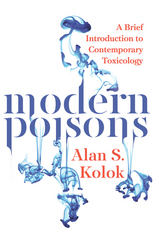
This accessible book explains basic principles in plain language while illuminating the most important issues in contemporary toxicology. Kolok begins by exploring age-old precepts of the field such as the dose-response relationship and the concept, first introduced by Ambroise Paré in the sixteenth century, that a chemical’s particular action depends on its inherent chemical nature. The author goes on to show exactly how chemicals enter the body and elicit their toxic effect, as well as the body’s methods of defense.
With the fundamentals established, Kolok digs into advances in toxicology, tracing the field’s development from World War II to the present day. The book examines both technical discoveries and their impacts on public policy. Highlights include studies of endocrine-disrupting chemicals in toiletries and prescriptions, the emerging science on prions, and our growing understanding of epigenetics.
Readers learn not only how toxic exposure affects people and wildlife, but about the long-term social and environmental consequences of our chemicals. Whether studying toxicology itself, public health, or environmental science, readers will develop a core understanding of—and curiosity about—this fast-changing field.

Money Trees is an interdisciplinary history of the crucial decades that shaped the modern American conception of the value of the forest. It begins with early 20th century environmental changes in the Douglas Fir forests of the Pacific Northwest, which led to increasing divisiveness and controversy among foresters. Brock balances this regional story with a national view of the intellectual and political currents that governed forest management, marshaling archival evidence from industry, government, and scientific sources.
An important contribution to environmental scholarship, Money Trees offers a nuanced vision of forestry’s history and its past relationship to both wilderness activism and scientific ecology. With fresh perspectives on well-known environmental figures such as Bob Marshall and Gifford Pinchot, it will add to the conversation among scholars in environmental history, history of science, and the history of the American West. It will be welcomed as a key resource across the spectrum of environmental studies, and by anyone interested in natural resources, land management, the role of science in environmentalism, and the modern wilderness movement.
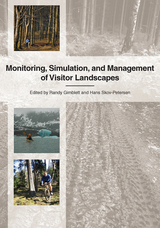
Conventional methods used in the planning and management of human-landscape interactions fall far short of the needs of today’s land management professionals. Monitoring, Simulation, and Management of Visitor Landscapes presents a growing body of applied research that provides decision makers with tools to maintain the ecological integrity of public places by evaluating the impacts of humans in various landscapes across space and time. This timely volume, available in both print and electronic editions, presents the latest research in this field, specifically focusing on the intersection of research and applied techniques. The contributors examine environmental management from around the world, including river traffic analysis in Melbourne, Australia; wilderness solitude and land use in the backcountry recreation areas of North America; the spatial modeling of visitor behavior at recreational areas near Vienna, Austria; the application of visibility studies and data from automatic visitor counters to simulation models in Denmark; and the integration of recreation and biodiversity in high-use environments in the Netherlands. This invaluable reference will help land managers and policy makers construct strategies for evaluating interactions between humans and the environment and expand the model of land management to include social and geographic, as well as environmental, factors.
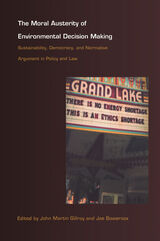
The contributors search for these assumptions and principles in short arguments and debates over the role of science, social justice, instrumental value, and intrinsic value in contemporary environmental policy. In their discussion of moral alternatives to enrich environmental decision making and in their search for a less austere and more robust role for normative discourse in practical policy making, they analyze a series of original case studies that deal with environmental sustainability and natural resources policy including pollution, land use, environmental law, globalism, and public lands. The unique structure of the book—which features the core contributors responding in a discourse format to the central chapters’ essays and debates—helps to highlight the role personal and public values play in democratic decision making generally and in the field of environmental politics specifically.
Contributors. Joe Bowersox, David Brower, Susan Buck, Celia Campbell-Mohn, John Martin Gillroy, Joel Kassiola, Jan Laitos, William Lowry, Bryan Norton, Robert Paehlke, Barry G. Rabe, Mark Sagoff, Anna K. Schwab, Bob Pepperman Taylor, Jonathan Wiener
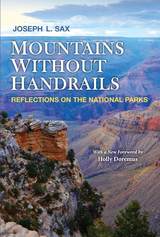
Beloved by academic and general readers alike, Mountains Without Handrails, Joseph L. Sax’s thought-provoking treatise on America’s national parks, remains as relevant today as when first published in 1980. Focusing on the long-standing and bitter battles over recreational use of our parklands, Sax proposes a novel scheme for the protection and management of America's national parks. Drawing upon still controversial disputes—Yosemite National Park, the Colorado River in the Grand Canyon, and the Disney plan for California's Mineral King Valley—Sax boldly unites the rich and diverse tradition of nature writing into a coherent thesis that speaks directly to the dilemma of the parks.
In a new foreword, environmental law scholar Holly Doremus articulates this book’s enduring importance and reflects on what Sax, her former teacher, might have thought about the encroachment of technology into natural spaces, the impact of social media, and growing threats from climate change. At this moment of great uncertainty for the national parks, Mountains Without Handrails should be read (and re-read) by anyone with a stake in America’s natural spaces.

Focusing on the long-standing and bitter battles over recreational use of our national parklands, Joseph L. Sax proposes a novel scheme for the protection and management of America's national parks. Drawing upon the most controversial disputes of recent years---Yosemite National Park, the Colorado River in the Grand Canyon, and the Disney plan for California's Mineral King Valley---Sax boldly unites the rich and diverse tradition of nature writing into a coherent thesis that speaks directly to the dilemma of the parks.
READERS
Browse our collection.
PUBLISHERS
See BiblioVault's publisher services.
STUDENT SERVICES
Files for college accessibility offices.
RECENTLY PUBLISHED





UChicago Accessibility Resources
home | accessibility | search | about | contact us
BiblioVault ® 2001 - 2026
The University of Chicago Press