
 A SCHOLARLY BOOK REPOSITORY
53 start with M start with M

On the 150th anniversary of the death of the English historian and politician Thomas Babington Macaulay, Robert Sullivan offers a portrait of a Victorian life that probes the cost of power, the practice of empire, and the impact of ideas.
His Macaulay is a Janus-faced master of the universe: a prominent spokesman for abolishing slavery in the British Empire who cared little for the cause, a forceful advocate for reforming Whig politics but a Machiavellian realist, a soaring parliamentary orator who avoided debate, a self-declared Christian, yet a skeptic and a secularizer of English history and culture, and a stern public moralist who was in love with his two youngest sisters.
Perhaps best known in the West for his classic History of England, Macaulay left his most permanent mark on South Asia, where his penal code remains the law. His father ensured that ancient Greek and Latin literature shaped Macaulay’s mind, but he crippled his heir emotionally. Self-defense taught Macaulay that power, calculation, and duplicity rule politics and human relations. In Macaulay’s writings, Sullivan unearths a sinister vision of progress that prophesied twentieth-century genocide. That the reverent portrait fashioned by Macaulay’s distinguished extended family eclipsed his insistent rhetoric about race, subjugation, and civilizing slaughter testifies to the grip of moral obliviousness.
Devoting his huge talents to gaining power—above all for England and its empire—made Macaulay’s life a tragedy. Sullivan offers an unsurpassed study of an afflicted genius and a thoughtful meditation on the modern ethics of power.
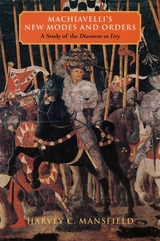
Mansfield's aim is to discern Machiavelli's intention in writing the book: he argues that Machiavelli wanted to introduce new modes and orders in political philosophy in order to make himself the founder of modern politics. Mansfield maintains that Machiavelli deliberately concealed part of his intentions so that only the most perceptive reader could see beneath the surface of the text and understand the whole of his book. Previously out of print, Mansfield's penetrating study brings to light the hidden thoughts lurking in the details of the Discourses on Livy to inform and challenge its readers at every step along the way.
A wealth of historical writing dealing with the Maghrib (Morocco, Algeria, Tunisia, and Libya) has been published during the roughly forty years since European colonial control ended in the region. This book provides a "state of the field" survey of this postcolonial Maghribi historiography.
The book contains thirteen essays by leading Maghribi and North American scholars. The first section surveys the Maghrib as a whole; the second focuses on individual countries of the Maghrib; and the third explores theoretical issues and case studies. Cutting across chronological categories, the book encompasses historiographical writing dealing with all eras, from the ancient Maghrib to the contemporary period.
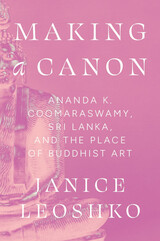
An early interpreter of Buddhist art to the West, Ananda Kentish Coomaraswamy laid the foundation of what would become the South Asian visual canon, particularly through his efforts to understand how Buddhist art emerged and developed. In Making a Canon, Janice Leoshko examines how Coomaraswamy’s experience as the director of a mineralogical survey in Sri Lanka shaped his understanding of South Asian art and religion. Along the way, she reveals how Coomaraswamy’s distinctive repetition of Sri Lankan visual images in his work influenced the direction of South Asia’s canon formation and left a lasting impression on our understanding of Buddhist art.

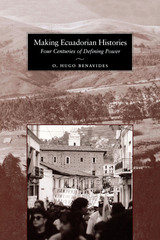
In Ecuador, as in all countries, archaeology and history play fundamental roles in defining national identity. Connecting with the prehistoric and historic pasts gives the modern state legitimacy and power. But the state is not the only actor that lays claim to the country's archaeological patrimony, nor is its official history the only version of the story. Indigenous peoples are increasingly drawing on the past to claim their rights and standing in the modern Ecuadorian state, while the press tries to present a "neutral" version of history that will satisfy its various publics.
This pathfinding book investigates how archaeological knowledge is used for both maintaining and contesting nation-building and state-hegemony in Ecuador. Specifically, Hugo Benavides analyzes how the pre-Hispanic site of Cochasquí has become a source of competing narratives of Native American, Spanish, and Ecuadorian occupations, which serve the differing needs of the nation-state and different national populations at large. He also analyzes the Indian movement itself and the recent controversy over the final resting place for the traditional monolith of San Biritute. Offering a more nuanced view of the production of history than previous studies, Benavides demonstrates how both official and resistance narratives are constantly reproduced and embodied within the nation-state's dominant discourses.

---Zeev Maoz, Professor of Political Science at the University of California, Davis, and Distinguished Fellow at the Interdisciplinary Center, Herzliya
---William B. Quandt, University of Virginia
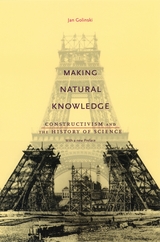
Viewing scientific knowledge as a product of human culture, Jan Golinski challenges the traditional trajectory of the history of science as steady and autonomous progress. In exploring topics such as the social identity of the scientist, the significance of places where science is practiced, and the roles played by language, instruments, and images, Making Natural Knowledge sheds new light on the relations between science and other cultural domains.
"A standard introduction to historically minded scholars interested in the constructivist programme. In fact, it has been called the 'constructivist's bible' in many a conference corridor."—Matthew Eddy, British Journal for the History of Science
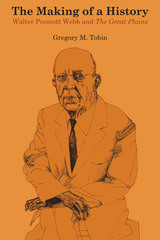
Walter Prescott Webb became one of the best known interpreters of the American West following the publication of The Great Plains in 1931. That book remained one of the outstanding studies of the region for decades and attracted considerable attention over the years for its unusual emphasis on the impact of geographic factors on the process of settlement. Using manuscript sources, some of which had not previously been available, Gregory M. Tobin has traced the elements that went into the planning and writing of The Great Plains and that account for its distinctive approach to the writing of a regional history.
Tobin emphasizes two aspects of Webb's life that molded the historian's outlook: his early family life and community connections in West Texas and his admiration for the ideas of scholar Lindley Miller Keasbey. Webb reacted strongly against the assumption that the only cultural values of any real worth emanated from the urban and sophisticated East; he was determined to write the history of his own people in a way that would reveal the scale of their anonymous contribution to American civilization. By reverting to Keasbey's stress on the relationship between natural environment and social institutions, Webb broadened his study to take in what he believed to be a distinct geographic environment. The result was The Great Plains, an assertion of individual and regional identity by a man with a personal stake in establishing the image of a distinctive Plains civilization.
Although The Making of a History is not a full biography of Walter Prescott Webb, it is the first biographically oriented study of a man regarded as one of the twentieth century's major western historians. It places his development within the framework of his intellectual and social setting and, in a sense, subjects his career to the same type of scrutiny that he advocated as the basis of the study of evolving cultures.

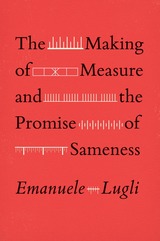
Measurement is all around us—from the circumference of a pizza to the square footage of an apartment, from the length of a newborn baby to the number of miles between neighboring towns. Whether inches or miles, centimeters or kilometers, measures of distance stand at the very foundation of everything we do, so much so that we take them for granted. Yet, this has not always been the case.
This book reaches back to medieval Italy to speak of a time when measurements were displayed in the open, showing how such a deceptively simple innovation triggered a chain of cultural transformations whose consequences are visible today on a global scale. Drawing from literary works and frescoes, architectural surveys, and legal compilations, Emanuele Lugli offers a history of material practices widely overlooked by historians. He argues that the public display of measurements in Italy’s newly formed city republics not only laid the foundation for now centuries-old practices of making, but also helped to legitimize local governments and shore up church power, buttressing fantasies of exactitude and certainty that linger to this day.
This ambitious, truly interdisciplinary book explains how measurements, rather than being mere descriptors of the real, themselves work as powerful molds of ideas, affecting our notions of what we consider similar, accurate, and truthful.

This book encompasses a range of influential thinkers and historians from the period of the Second and Third Internationals down to the heyday of the New Left. Among the individuals it covers are William Morris, Mikhail Lifshits, Frederick Antal, Francis Klingender, Max Raphael, Meyer Schapiro, Walter Benjamin, Henri Lefebvre, and Arnold Hauser. It also includes three essays addressing the heritage of the New Left. In the spirit of Marxism itself, the authors interpret the achievements and limitations of Marxist art history in relation to the historical and political circumstances of its production and provide an indispensable and lucid introduction to contemporary radical practices in the field.
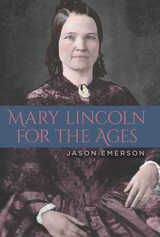
Mary Lincoln for the Ages first articulates how reliance on limited sources has greatly restricted our understanding of the subject, evaluating their flaws and benefits and pointing out the shallowness of using the same texts to study her life. Emerson then presents more than four hundred bibliographical entries of nonfiction books and pamphlets, scholarly and popular articles, journalism, literature, and juvenilia. More than just listings of titles and publication dates, each entry includes Emerson’s deft analysis of these additional works on Mary Lincoln that should be used—but rarely have been—to better understand who she was during her life and why we see her as we do. The volume also includes rarely used illustrations, including some that have never before appeared in print.
A roadmap for a firmer, more complete grasp of Mary Lincoln’s place in the historical record, this is the first and only extensive, analytical bibliography of the subject. In highlighting hundreds of overlooked sources, Emerson changes the paradigm of Mary Lincoln’s legacy.
Ben-Yehuda describes how, after nearly 1800 years, the long, complex, and unsubstantiated narrative of Josephus Flavius was edited and augmented in the twentieth century to form a simple and powerful myth of heroism. He looks at the ways this new mythical narrative of Masada was created, promoted, and maintained by pre-state Jewish underground organizations, the Israeli army, archaeological teams, mass media, youth movements, textbooks, the tourist industry, and the arts. He discusses the various organizations and movements that created “the Masada experience” (usually a ritual trek through the Judean desert followed by a climb to the fortress and a dramatic reading of the Masada story), and how it changed over decades from a Zionist pilgrimage to a tourist destination.
Placing the story in a larger historical, sociological, and psychological context, Ben-Yehuda draws upon theories of collective memory and mythmaking to analyze Masada’s crucial role in the nation-building process of modern Israel and the formation of a new Jewish identity. An expert on deviance and social control, Ben-Yehuda looks in particular at how and why a military failure and an enigmatic, troubling case of mass suicide (in conflict with Judaism’s teachings) were reconstructed and fabricated as a heroic tale.
Meanings of Antiquity is the first dedicated study of how the oldest Japanese myths, recorded in the eighth-century texts Kojiki and Nihon shoki, changed in meaning and significance between 800 and 1800 CE. Generations of Japanese scholars and students have turned to these two texts and their creation myths to understand what it means to be Japanese and where Japan fits into the world order.
As the shape and scale of the world explained by these myths changed, these myths evolved in turn. Over the course of the millennium covered in this study, Japan transforms from the center of a proud empire to a millet seed at the edge of the Buddhist world, from the last vestige of China’s glorious Zhou Dynasty to an archipelago on a spherical globe. Analyzing historical records, poetry, fiction, religious writings, military epics, political treatises, and textual commentary, Matthieu Felt identifies the geographical, cosmological, epistemological, and semiotic changes that led to new adaptations of Japanese myths. Felt demonstrates that the meanings of Japanese antiquity and of Japan’s most ancient texts were—and are—a work in progress, a collective effort of writers and thinkers over the past 1,300 years.

Throughout the Middle Ages, Christians wrote about Islam and the life of Muhammad. These stories, ranging from the humorous to the vitriolic, both informed and warned audiences about what was regarded as a schismatic form of Christianity. Medieval Latin Lives of Muhammad covers nearly five centuries of Christian writings on the prophet, including accounts from the farthest-flung reaches of medieval Europe, the Iberian Peninsula, and the Byzantine Empire. Over time, authors portrayed Muhammad in many guises, among them: Theophanes’s influential ninth-century chronicle describing the prophet as the heretical leader of a Jewish conspiracy; Embrico of Mainz’s eleventh-century depiction of Muhammad as a former slave who is manipulated by a magician into performing unholy deeds; and Walter of Compiègne’s twelfth-century presentation of the founder of Islam as a likable but tricky serf ambitiously seeking upward social mobility.
The prose, verse, and epistolary texts in Medieval Latin Lives of Muhammad help trace the persistence of old clichés as well as the evolution of new attitudes toward Islam and its prophet in Western culture. This volume brings together a highly varied and fascinating set of Latin narratives and polemics never before translated into English.

This book examines the transformations in medieval studies—and the humanities more broadly—enabled by decades of digitization and advances in computational methods. Centring on the Paris Bible, a widely copied thirteenth- and fourteenth-century manuscript genre, we demonstrate how automated transcription produces scribal data at a scale once inaccessible, and how automation can support new approaches to localizing, dating, and contextualizing manuscripts. We argue that bringing machine learning and artificial intelligence to medieval studies not only requires re-centring expert human intelligence within computational systems, but also raises the question of the infrastructures needed for equitable, collaborative scholarship across the field. The book models how medieval studies might rethink interpretation, highlighting both the promise and risks of computational methods in manuscript research.
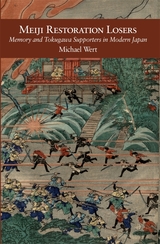
This book is about the “losers” of the Meiji Restoration and the supporters who promoted their legacy. Although the violence of the Meiji Restoration is typically downplayed, the trauma was real, and those who felt marginalized from the mainstream throughout modern Japan looked to these losers as models of action.
Using a wide range of sources, from essays by former Tokugawa supporters like Fukuzawa Yukichi to postwar film and “lost decade” manga, Michael Wert traces the shifting portrayals of Restoration losers. By highlighting the overlooked sites of memory such as legends about buried gold, the awarding of posthumous court rank, or fighting over a disembodied head, Wert illustrates how the process of commemoration and rehabilitation allows individuals a voice in the formation of national history. He argues that the commingling of local memory activists and nationally-known politicians, academics, writers, and treasure hunters formed interconnecting memory landscapes that promoted local figures as potential heroes in modern Japan.
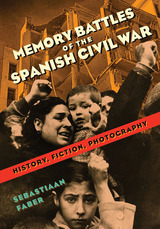
Faber traces the curious trajectories of iconic Spanish Civil War photographs by Robert Capa, Gerda Taro, and David Seymour; critically reads a dozen recent Spanish novels and essays; interrogates basic scholarly assumptions about history, memory, and literature; and interviews nine scholars, activists, and documentarians who in the past decade and a half have helped redefine Spain's relationship to its past. In this book Faber argues that recent political developments in Spain--from the grassroots call for the recovery of historical memory to the indignados movement and the foundation of Podemos--provide an opportunity for scholars in the humanities to engage in a more activist, public, and democratic practice.

This account of historical politics in Ukraine, framed in a broader European context, shows how social, political, and cultural groups have used and misused the past from the final years of the Soviet Union to 2020. Georgiy Kasianov details practices relating to history and memory by a variety of actors, including state institutions, non-governmental organizations, political parties, historians, and local governments. He identifies the main political purposes of these practices in the construction of nation and identity, struggles for power, warfare, and international relations.
Kasianov considers the Ukrainian case in the context of a global increase in the politics of history and memory, with particular emphasis on a distinctive East-European variety. He pays special attention to the use and abuse of history in relations between Ukraine, Russia, and Poland.
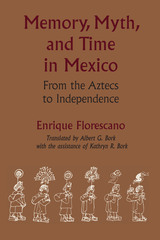
In Memory, Myth, and Time in Mexico, noted Mexican scholar Enrique Florescano’s Memoria mexicana becomes available for the first time in English. A collection of essays tracing the many memories of the past created by different individuals and groups in Mexico, the book addresses the problem of memory and changing ideas of time in the way Mexicans conceive of their history. Original in perspective and broad in scope, ranging from the Aztec concept of the world and history to the ideas of independence, this book should appeal to a wide readership.
When exploring the links between America and postcolonialism, scholars tend to think either in terms of contemporary multiculturalism, or of imperialism since 1898. This narrow view has left more than the two prior centuries of colonizing literary and political culture unexamined.
Messy Beginnings challenges the idea of early America’s immunity from issues of imperialism, that its history is not as “clean” as European colonialism. By addressing the literature ranging from the diaries of American women missionaries in the Middle East to the work of Benjamin Franklin and Nathaniel Hawthorne, and through appraisals of key postcolonial theorists such as Edward Said, Gayatri Spivak, and Homi Bhabha, the contributors to this volume explore the applicability of their models to early American culture.
Messy Beginnings argues against the simple concept that the colonization of what became the United States was a confrontation between European culture and the “other.” Contributors examine the formation of America through the messy or unstable negotiations of the idea of “nation.”
The essays forcefully show that the development of “Americanness” was a raced and classed phenomenon, achieved through a complex series of violent encounters, legal maneuvers, and political compromises. The complexity of early American colonization, where there was not one coherent “nation” to conquer, contradicts the simple label of imperialism used in other lands. The unique approach of Messy Beginnings will reshape both pre-conceived notions of postcolonialism, and how postcolonialists think about the development of the American nation.


Throughout the twentieth century, the post-revolutionary Mexican State had used mestizaje as a symbol of national unity and social integration. By the end of the millennium, however, Mexico had gone from a PRI-dominated, economically protectionist nation to a more democratic, economically globalizing one. More importantly, the homogenizing, mestizophile national identity that pervaded Mexico throughout the past century had given way to official admission of Mexico's ethnic and linguistic diversity--or 'pluriculture' according to President Salinas's 1992 constitutional revision.
This book is the first interdisciplinary study of literary, cinematic, and graphic images of Mexican national identity in the 1980s and '90s. Discussing, in depth, writings, films, and cartoons from a vast array of contemporary sources, Carrie C. Chorba creates a social history of this important shift.

Writing studies has been dominated throughout its history by grand narratives of the discipline, but in this volume Bruce McComiskey begins to explore microhistory as a way to understand, enrich, and complicate how the field relates to its past. Microhistory investigates the dialectical interaction of social history and cultural history, enabling historians to examine uncommon sites, objects, and agents of historical significance overlooked by social history and restricted to local effects by cultural history. This approach to historical scholarship is ideally suited for exploring the complexities of a discipline like composition.
Through an introduction and eleven chapters, McComiskey and his contributors—including major figures in the historical research of writing studies, such as Louise Wetherbee Phelps, Kelly Ritter, and Neal Lerner—develop focused narratives of particular significant moments or themes in disciplinary history. They introduce microhistorical methodologies and illustrate their application and value for composition historians, contributing to the complexity and adding momentum to the emerging trend within writing studies toward a richer reading of the field’s past and future. Scholars and historians of both composition and rhetoric will appreciate the fresh perspectives on institutional and disciplinary histories and larger issues of rhetorical agency and engagement enacted in writing classrooms that are found in Microhistories of Composition.
Other contributors include Cheryl E. Ball, Suzanne Bordelon, Jacob Craig, Matt Davis, Douglas Eyman, Brian Gogan, David Gold, Christine Martorana, Bruce McComiskey, Josh Mehler, Annie S. Mendenhall, Kendra Mitchell, Antony N. Ricks, David Stock, Kathleen Blake Yancey, Bret Zawilski, and James T. Zebroski.
In the first of the book's three parts, Lassner examines what he calls the stratigraphy of the text--he makes sense of the unusual organization of medieval Islamic narrative. The second section investigates issues such as work on city planning and on the creation of imperial centers. The last portion studies the interplay between Jewish and Muslim memory and the trading of themes and ideas between the cultures.
Shorter studies in the volume have been revised, and the author weaves new and complementary essays around them. Earlier work has been transformed and made more available to the general public. The style is accessible, and technical and arcane usages have been kept to a minimum. Throughout there are flashes of the author's wry humor.
Jacob Lassner is Philip M. and Ethel Klutsnick Professor of Jewish Civilization, Northwestern University, and Professor of Middle East History, Tel Aviv University.
Reviews of this book:
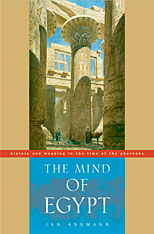
Magnificent' Assmann asks what meaning Egyptians obtained from their own constructions of their history. How did they incorporate the legacy of the past into the present. Using three approaches - archeological, mythic, and epigraphic or iconographic - Assmann takes us a chronological journey, starting with the formation of the unified state in about 3100 BC and going through the three great kingdoms. He ends in the late period with the final whimpers of Egyptian civilization. Assmann has looked closely into the mirror of the ancient intangible with telling effect. Every student of early civilization has something to learn from these pages, which will help cure us of intellectual myopia.
--Brian Fagan, The Los Angeles Times
Reviews of this book:
Assmann is attempting something far more ambitious than all the conventional books on Egypt. What he attempts to do is pen a psychological portrait of Egyptian culture. He asks questions that are normally avoided by ancient historians: What motivated the culture? How did it view the relationship between the individual and the universe surrounding him or her? What explanations did it provide for worldly events and reversals of fortune? The result is impressive. The Mind of Egypt marks the culmination of years of questioning about the past and the ways it can be conceptualized. Jan Assmann is close in some ways to being the Beethoven of Egyptology. The Mind of Egypt is a singular book that will provoke debate for a generation to come. It is essential reading for those who wish to call themselves Egyptologists, and it is an important intellectual contribution to the whole question of what constitutes history and historiography.
--John Ray, The American Scholar
Reviews of this book:
[This book's] aim--to examine the mainsprings of Egyptian civilisation and thereby to provide a 'psychological' portrait of Egyptian culture--is truly fascinating.
--History Today

Religious history and, in particular, the history of the cult of saints and their miracles has recently become one of the most popular fields of historical investigation. Together with continuing interest in the related ecclesiastic motivations and the well organized craft of hagiography, this new interest might be explained by the marvellously rich details of thousands of witness accounts testifying to the miraculous help they received from the saint in times of desparate need. These accounts provide an unparalleled insight into the history of everyday life and into the various hardships, illnesses, hopes dreams and anxieties during the late medieval and early modern period.
Only two records exist on the history of the medieval Hungarian kingdom- the thirteenth century canonization trial of St. Margaret of Hungary and the miracle collections promoting the canonization of St. John of Capistran, the victorious Crusader at Belgrade in 1456, who died thereafter in Ilok (a city located on the periphery of western Christianity in Croatia). Based on a careful study of the widely scattered manuscripts on Capistranean miracles and with the help of a microscopic philological analysis, the author has managed to reconstruct, for the first time, one of the most complex miracle collections in the history of medieval hagiography.
Covering the recording of the first miracle series by the urban notaries of Ilok, the local hagiographer of Ilok Franciscans (John Geszti), the vicar general of the Hungarian province (Stephen Varsányi), and a number of subsequent editions and amplifications of this material recycling into the canonization campaign of St. John of Capistran and the miracles he himself recorded, The Miracles of St. John of Capistran, is an outstanding debut by a representative of a new generation of Central European medievalists.
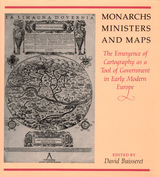
consolidate their power realized that better knowledge of
their lands would strengthen their control over them. By
1550, the cartographer's art had already become an important
instrument for bringing territories under the control of
centralized government; increasing governmental reliance on
maps stimulated the refinement of cartographic techniques
throughout the following century.
This volume, a detailed survey of the political uses of
cartography between 1400 and 1700 in Italy, France, England,
Poland, Austria, and Spain, answers these questions: When
did monarchs and ministers begin to perceive that maps could
be useful in government? For what purposes were maps
commissioned? How accurate and useful were they? How did
cartographic knowledge strengthen the hand of government?
The chapters offer new insights into the development of
cartography and its role in European history.
Contributors to the volume are John Marino, Peter
Barber, David Buisseret, Geoffrey Parker, James Vann, and
Michael J. Mikòs.
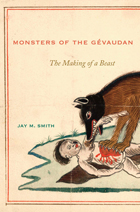
In a brilliant, original rendition, Monsters of the Gévaudan revisits a spellbinding French tale that has captivated imaginations for over two hundred years, and offers the definitive explanation of the strange events that underlie this timeless story.
In 1764 a peasant girl was killed and partially eaten while tending a flock of sheep. Eventually, over a hundred victims fell prey to a mysterious creature, or creatures, whose cunning and deadly efficiency terrorized the region and mesmerized Europe. The fearsome aggressor quickly took on mythic status, and the beast of the Gévaudan passed into French folklore.
What species was this killer, why did it decapitate so many of its victims, and why did it prefer the flesh of women and children? Why did contemporaries assume that the beast was anything but a wolf, or a pack of wolves, as authorities eventually claimed, and why is the tale so often ignored in histories of the ancien régime? Smith finds the answer to these last two questions in an accident of timing. The beast was bound to be perceived as strange and anomalous because its ravages coincided with the emergence of modernity itself.
Expertly situated within the social, intellectual, cultural, and political currents of French life in the 1760s, Monsters of the Gévaudan will engage a wide range of readers with both its recasting of the beast narrative and its compelling insights into the allure of the monstrous in historical memory.
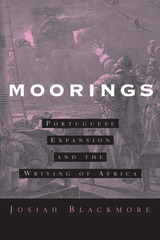
How Africa was perceived in the early modern imaginary
In this first book to study Portuguese texts about Africa, Moorings brings an important but little-known body of European writings to bear on contemporary colonial thought. Images of Africa as monstrous, dangerous, and lush were created in early Portuguese imperial writings and dominated its representation in European literature. Moorings establishes these key works in their proper place: foundational to Western imperial discourse.
Attentive to history as well as the nuances of language, Josiah Blackmore leads readers from the formation of the “Moor” in medieval Iberia to the construction of a full colonial imaginary, as found in the works of two writers: the royal chronicler Gomes Eanes de Zurara and the epic poet Luís de Camões. Blackmore’s original work helps to explain how concepts and myths—such as the “otherness” of Africa and Africans—originated, functioned, and were perpetuated.Delving into the Portuguese imperial experience, Moorings enriches our understanding of historical and literary imagination during a significant period of Western expansion.
The editors argue that the Spanish record is incomplete, and only the Hopi perspective can balance the story. The Spanish documentary record (and by extension the documentary record of any European or Euro-American colonial power) is biased and distorted, according to the editors, who assert there are enormous silences about Hopi responses to Spanish missionization and colonization. The only hope of correcting those weaknesses is to record and analyze Hopi oral traditions, which have been passed down from generation to generation, and give voice to Hopi values and Hopi social memories of what was a traumatic period in their past.
Spanish abuses during missionization—which the editors address specifically and directly as the sexual exploitation of Hopi women, suppression of Hopi ceremonies, and forced labor of Hopis—drove Hopis to the breaking point, inspiring a Hopi revitalization that led them to participate in the Pueblo Revolt. Those abuses, the revolt, and the resistance that followed remain as open wounds in Hopi society today.
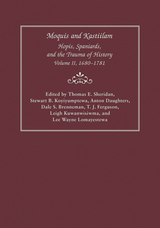
The second in a two-volume series, Moquis and Kastiilam, Volume II, 1680–1781 continues the story of the encounter between the Hopis, who the Spaniards called Moquis, and the Spaniards, who the Hopis called Kastiilam, from the Pueblo Revolt in 1680 through the Spanish expeditions in search of a land route to Alta California until about 1781. By comparing and contrasting Spanish documents with Hopi oral traditions, the editors present a balanced presentation of a shared past. Translations of sixteenth-, seventeenth-, and eighteenth-century documents written by Spanish explorers, colonial officials, and Franciscan missionaries tell the perspectives of the European visitors, and oral traditions recounted by Hopi elders reveal the Indigenous experience.
The editors argue that only the Hopi perspective can balance the story recounted in the Spanish documentary record, which is biased, distorted, and incomplete (as is the documentary record of any European or Euro-American colonial power). The only hope of correcting those weaknesses and the enormous silences about the Hopi responses to Spanish missionization and colonization is to record and analyze Hopi oral traditions, which have been passed down from generation to generation since 1540, and to give voice to Hopi values and social memories of what was a traumatic period in their past.
Volume I documented Spanish abuses during missionization, which the editors address specifically and directly as the sexual exploitation of Hopi women, suppression of Hopi ceremonies, and forced labor of Hopi men and women. These abuses drove Hopis to the breaking point, inspiring a Hopi revitalization that led them to participate in the Pueblo Revolt and to rebuff all subsequent efforts to reestablish Franciscan missions and Spanish control. Volume II portrays the Hopi struggle to remain independent at its most effective—a mixture of diplomacy, negotiation, evasion, and armed resistance. Nonetheless, the abuses of Franciscan missionaries, the bloodshed of the Pueblo Revolt, and the subsequent destruction of the Hopi community of Awat’ovi on Antelope Mesa remain historical traumas that still wound Hopi society today.
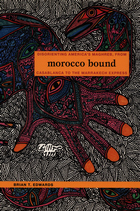
Edwards reads a broad range of texts to recuperate the disorienting possibilities for rethinking American empire. Examining work by William Burroughs, Jane Bowles, Ernie Pyle, A. J. Liebling, Jane Kramer, Alfred Hitchcock, Clifford Geertz, James Michener, Ornette Coleman, General George S. Patton, and others, he puts American texts in conversation with an archive of Maghrebi responses. Whether considering Warner Brothers’ marketing of the movie Casablanca in 1942, journalistic representations of Tangier as a city of excess and queerness, Paul Bowles’s collaboration with the Moroccan artist Mohammed Mrabet, the hippie communities in and around Marrakech in the 1960s and early 1970s, or the writings of young American anthropologists working nearby at the same time, Edwards illuminates the circulation of American texts, their relationship to Maghrebi history, and the ways they might be read so as to reimagine the role of American culture in the world.

Standing at the very foundation of monotheism, and so of Western culture, Moses is a figure not of history, but of memory. As such, he is the quintessential subject for the innovative historiography Jan Assmann both defines and practices in this work, the study of historical memory--a study, in this case, of the ways in which factual and fictional events and characters are stored in religious beliefs and transformed in their philosophical justification, literary reinterpretation, philological restitution (or falsification), and psychoanalytic demystification.
To account for the complexities of the foundational event through which monotheism was established, Moses the Egyptian goes back to the short-lived monotheistic revolution of the Egyptian king Akhenaten (1360-1340 B.C.E.). Assmann traces the monotheism of Moses to this source, then shows how his followers denied the Egyptians any part in the origin of their beliefs and condemned them as polytheistic idolaters. Thus began the cycle in which every "counter-religion," by establishing itself as truth, denounced all others as false. Assmann reconstructs this cycle as a pattern of historical abuse, and tracks its permutations from ancient sources, including the Bible, through Renaissance debates over the basis of religion to Sigmund Freud's Moses and Monotheism. One of the great Egyptologists of our time, and an exceptional scholar of history and literature, Assmann is uniquely equipped for this undertaking--an exemplary case study of the vicissitudes of historical memory that is also a compelling lesson in the fluidity of cultural identity and beliefs.

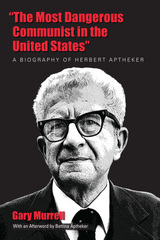
When J. Edgar Hoover declared Herbert Aptheker “the most dangerous Communist in the United States,” the notorious FBI director misconstrued his true significance. In this first book-length biography of Aptheker (1915–2003), Gary Murrell provides a balanced yet unflinching assessment of the controversial figure who was at once a leading historian of African America, radical political activist, literary executor of W. E. B. Du Bois, and lifelong member of the American Communist Party. Although blacklisted at U.S. universities, Aptheker published dozens of books, including the groundbreaking American Negro Slave Revolts (1943) and the monumental seven-volume Documentary History of the Negro People (1951–1994). He also edited four volumes of the correspondence and unpublished writings of Du Bois, an achievement that Eric Foner, writing in the New York Times Book Review, called “a milestone in the coming of age of Afro-American history.”
As Murrell shows, Aptheker the historian was inseparable from Aptheker the leading Communist Party intellectual, polemicist, and agitator. During the 1960s, his ability to rouse and inspire both black and white student radicals made him one of the few Old Leftists accepted by the New Left. Aptheker had joined the CPUSA during its heyday in the 1930s, convinced that only through the party's leadership could fascism be defeated and true liberation be achieved: he ended his affiliation five decades later in 1991 after the collapse of socialism in the Soviet Union and Eastern Europe.
In an afterword, Bettina Aptheker adds to Murrell's narrative by illuminating her mother Fay's vital contributions to her father's work and by affirming the particularly devastating challenges of life in a family dedicated to radical political and social change.
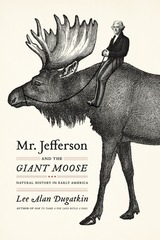
In the years after the Revolutionary War, the fledgling republic of America was viewed by many Europeans as a degenerate backwater, populated by subspecies weak and feeble. Chief among these naysayers was the French Count and world-renowned naturalist Georges-Louis Leclerc de Buffon, who wrote that the flora and fauna of America (humans included) were inferior to European specimens.
Thomas Jefferson—author of the Declaration of Independence, U.S. president, and ardent naturalist—spent years countering the French conception of American degeneracy. His Notes on Virginia systematically and scientifically dismantled Buffon’s case through a series of tables and equally compelling writing on the nature of his home state. But the book did little to counter the arrogance of the French and hardly satisfied Jefferson’s quest to demonstrate that his young nation was every bit the equal of a well-established Europe. Enter the giant moose.
The American moose, which Jefferson claimed was so enormous a European reindeer could walk under it, became the cornerstone of his defense. Convinced that the sight of such a magnificent beast would cause Buffon to revise his claims, Jefferson had the remains of a seven-foot ungulate shipped first class from New Hampshire to Paris. Unfortunately, Buffon died before he could make any revisions to his Histoire Naturelle, but the legend of the moose makes for a fascinating tale about Jefferson’s passion to prove that American nature deserved prestige.
In Mr. Jefferson and the Giant Moose, Lee Alan Dugatkin vividly recreates the origin and evolution of the debates about natural history in America and, in so doing, returns the prize moose to its rightful place in American history.

A Times Literary Supplement Best Book of the Year
From “one of the most thoughtful ancient historians in Britain over more than half a century” (Mary Beard) comes a powerful look at how the modern world has understood the ancient Greeks and why their legacy still matters today.
“This majestic book by Oswyn Murray has been long and eagerly awaited . . . and its quality and scope exceed expectations.” —Edith Hall, BBC History Magazine
The study of ancient Greece has been central to Western conceptions of history since the Renaissance. The Muse of History traces the shifting patterns of this preoccupation, as successive generations reinterpreted the Greeks in light of their contemporary worlds. Thus, in the eighteenth century, the conflict between Athens and Sparta became a touchstone in the development of republicanism, and in the nineteenth, Athens came to represent the democratic ideal. Amid the twentieth century’s ideological conflicts, Greek suffering inspired defenses against nationalism, Nazism, communism, and capitalism.
Oswyn Murray draws powerful conclusions from the ever-changing narrative of ancient Greece, in the process illuminating grand theories of human society articulated by the likes of Hegel, Burckhardt, Nietzsche, and Braudel. Along the way, The Muse of History offers behind-the-scenes glimpses of figures who shaped the study of ancient Greece. We sit in on a class with Arnaldo Momigliano; meet Moses Finley after his arrival in England; eavesdrop on Paul Veyne, Jean-Pierre Vernant, and Pierre Vidal-Naquet; and rediscover Michel Foucault.
A thrilling work of historiography, The Muse of History reminds us that the meaning of the past is always made in and for the present.
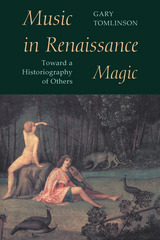
In Music in Renaissance Magic, Gary Tomlinson describes some of these connections and offers a fresh view of the development of early modern thought in Italy. Raising issues essential to postmodern historiography—issues of cultural distance and our relationship to the others who inhabit our constructions of the past —Tomlinson provides a rich store of ideas for students of early modern culture, for musicologists, and for historians of philosophy, science, and religion.
"A scholarly step toward a goal that many composers have aimed for: to rescue the idea of New Age Music—that music can promote spiritual well-being—from the New Ageists who have reduced it to a level of sonic wallpaper."—Kyle Gann, Village Voice
"An exemplary piece of musical and intellectual history, of interest to all students of the Renaissance as well as musicologists. . . . The author deserves congratulations for introducing this new approach to the study of Renaissance music."—Peter Burke, NOTES
"Gary Tomlinson's Music in Renaissance Magic: Toward a Historiography of Others examines the 'otherness' of magical cosmology. . . . [A] passionate, eloquently melancholy, and important book."—Anne Lake Prescott, Studies in English Literature

After careful re-reading and analysis of original Old Burmese and other primary sources, the author discovered that four out of the five events considered to be the most important in the history of early Burma, and believed to have been historically accurate, are actually late-nineteenth and twentieth-century inventions of colonial historians caught in their own intellectual and political world.
Only one of these is a genuine indigenous Burmese myth, but it too has been embellished by modern historians.
The author discusses each of these five myths and concludes with an assessment of the current situation in Burma in the context of the new myths springing up today, thereby bringing the thirteenth century into the twentieth.

In Mythistory, Joseph Mali revives this oldest controversy in historiography. Contesting the conventional opposition between myth and history, Mali advocates instead for a historiography that reconciles the two and recognizes the crucial role that myth plays in the construction of personal and communal identities. The task of historiography, he argues, is to illuminate, not eliminate, these fictions by showing how they have passed into and shaped historical reality. Drawing on the works of modern theorists and artists of myth such as Nietzsche and Wittgenstein, Joyce and Eliot, Mali redefines modern historiography and relates it to the older notion and tradition of "mythistory."
Tracing the origins and transformations of this historiographical tradition from the ancient world to the modern, Mali shows how Livy and Machiavelli sought to recover true history from uncertain myth-and how Vico and Michelet then reversed this pattern of inquiry, seeking instead to recover a deeper and truer myth from uncertain history. In the heart of Mythistory, Mali turns his attention to four thinkers who rediscovered myth in and for modern cultural history: Jacob Burckhardt, Aby Warburg, Ernst Kantorowicz, and Walter Benjamin. His elaboration of the different biographical and historiographical routes by which all four sought to account for the persistence and significance of myth in Western civilization opens up new perspectives for an alternative intellectual history of modernity-one that may better explain the proliferation of mythic imageries of redemption in our secular, all too secular, times.
READERS
Browse our collection.
PUBLISHERS
See BiblioVault's publisher services.
STUDENT SERVICES
Files for college accessibility offices.
RECENTLY PUBLISHED




UChicago Accessibility Resources
home | accessibility | search | about | contact us
BiblioVault ® 2001 - 2025
The University of Chicago Press