
 A SCHOLARLY BOOK REPOSITORY
278 start with N start with N
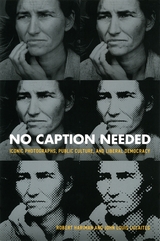
In No Caption Needed, Robert Hariman and John Louis Lucaites provide the definitive study of the iconic photograph as a dynamic form of public art. Their critical analyses of nine individual icons explore the photographs themselves and their subsequent circulation through an astonishing array of media, including stamps, posters, billboards, editorial cartoons, TV shows, Web pages, tattoos, and more. Iconic images are revealed as models of visual eloquence, signposts for collective memory, means of persuasion across the political spectrum, and a crucial resource for critical reflection.
Arguing against the conventional belief that visual images short-circuit rational deliberation and radical critique, Hariman and Lucaites make a bold case for the value of visual imagery in a liberal-democratic society. No Caption Needed is a compelling demonstration of photojournalism’s vital contribution to public life.
Imagine, staring into the sun, then,
how the clouds spread out and open like wallets
over a few corrugated roofs.
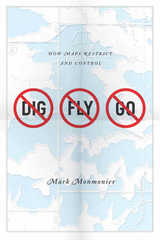
Some maps help us find our way; others restrict where we go and what we do. These maps control behavior, regulating activities from flying to fishing, prohibiting students from one part of town from being schooled on the other, and banishing certain individuals and industries to the periphery. This restrictive cartography has boomed in recent decades as governments seek regulate activities as diverse as hiking, building a residence, opening a store, locating a chemical plant, or painting your house anything but regulation colors. It is this aspect of mapping—its power to prohibit—that celebrated geographer Mark Monmonier tackles in No Dig, No Fly, No Go.
Rooted in ancient Egypt’s need to reestablish property boundaries following the annual retreat of the Nile’s floodwaters, restrictive mapping has been indispensable in settling the American West, claiming slices of Antarctica, protecting fragile ocean fisheries, and keeping sex offenders away from playgrounds. But it has also been used for opprobrium: during one of the darkest moments in American history, cartographic exclusion orders helped send thousands of Japanese Americans to remote detention camps. Tracing the power of prohibitive mapping at multiple levels—from regional to international—and multiple dimensions—from property to cyberspace—Monmonier demonstrates how much boundaries influence our experience—from homeownership and voting to taxation and airline travel. A worthy successor to his critically acclaimed How to Lie with Maps, the book is replete with all of the hallmarks of a Monmonier classic, including the wry observations and witty humor.
In the end, Monmonier looks far beyond the lines on the page to observe that mapped boundaries, however persuasive their appearance, are not always as permanent and impermeable as their cartographic lines might suggest. Written for anyone who votes, owns a home, or aspires to be an informed citizen, No Dig, No Fly. No Go will change the way we look at maps forever.
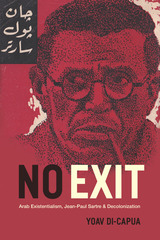
By closely following the remarkable career of Arab existentialism, Yoav Di-Capua reconstructs the cosmopolitan milieu of the generation that tried to articulate a political and philosophical vision for an egalitarian postcolonial world. He tells this story by touring a fascinating selection of Arabic and Hebrew archives, including unpublished diaries and interviews. Tragically, the warm and hopeful relationships forged between Arab intellectuals, Sartre, Simone de Beauvoir, and others ended when, on the eve of the 1967 war, Sartre failed to embrace the Palestinian cause. Today, when the prospect of global ethical engagement seems to be slipping ever farther out of reach, No Exit provides a timely, humanistic account of the intellectual hopes, struggles, and victories that shaped the Arab experience of decolonization and a delightfully wide-ranging excavation of existentialism’s non-Western history.

In No Longer Outsiders, Minta provides a comprehensive account of the effectiveness of minority civil rights organizations and their legislative allies. He finds that the organizations’ legislative priorities are consistent with black and Latino preferences for stronger enforcement of civil rights policy and immigration reform. Although these groups focus mainly on civil rights for blacks and immigration issues for Latinos, their policy agendas extend into other significant areas. Minta concludes with an examination of how diversity in Congress helps groups gain greater influence and policy success despite many limits placed upon them.
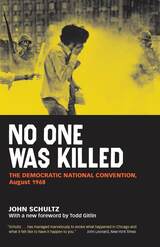
While other writers contemplated the events of the 1968 Chicago riots from the safety of their hotel rooms, John Schultz was in the city streets, being threatened by police, choking on tear gas, and listening to all the rage, fear, and confusion around him. The result, No One Was Killed, is his account of the contradictions and chaos of convention week, the adrenalin, the sense of drama and history, and how the mainstream press was getting it all wrong.
"A more valuable factual record of events than the city’s white paper, the Walker Report, and Theodore B. White’s Making of a President combined."—Book Week
"As a reporter making distinctions between Yippie, hippie, New Leftist, McCarthyite, police, and National Guard, Schultz is perceptive; he excels in describing such diverse personalities as Julian Bond and Eugene McCarthy."—Library Journal
"High on my short list of true, lasting, inspired evocations of those whacked-out days when the country was fighting a phantasmagorical war (with real corpses), and police under orders were beating up demonstrators who looked at them funny."—Todd Gitlin, from the foreword
"Carefully separating stereotype from reality, Carrington investigates family in the gay and lesbian community. Relying upon interviews and observation, the author analyzes the loves and routings of 52 diverse lesbian, gay, and bisexual couples in the Bay area. . . . [He] closes the work with a discussion of the raging same-sex marriage debate and posits an enlightened solution to this dilemma." —Library Journal
First published in 1981, T. J. Jackson Lears’s No Place of Grace is a landmark book in American studies and American history, acclaimed for both its rigorous research and the deft fluidity of its prose. A study of responses to the emergent culture of corporate capitalism at the turn of the twentieth century, No Place of Grace charts the development of contemporary consumer society through the embrace of antimodernism—the effort among middle- and upper-class Americans to recapture feelings of authentic experience. Rather than offer true resistance to the increasingly corporatized bureaucracy of the time, however, antimodernism helped accommodate Americans to the new order—it was therapeutic rather than oppositional, a striking forerunner to today’s self-help culture. And yet antimodernism contributed a new dynamic as well, “an eloquent edge of protest,” as Lears puts it, which is evident even today in anticonsumerism, sustainable living, and other practices. This new edition, with a lively and discerning foreword by Jennifer Ratner-Rosenhagen, celebrates the fortieth anniversary of this singular work of history.
"It's an understatement to call No Place of Grace a brilliant book. . . . It's the first clear sign I've seen that my generation, after marching through the '60s and jogging through the '70s might be pausing to examine what we've learned, and to teach it."—Walter Kendrick, Village Voice
"One can justly make the claim that No Place of Grace restores and reinterprets a crucial part of American history. Lears's method is impeccable."—Ann Douglas, The Nation
In these poems, Peter Balakian wrestles with national and global cultural and political realities, including challenges for the human species amid planetary transmutation and the impact of mass violence on the self and culture. At the collection’s heart is “No Sign,” another in Balakian’s series of long-form poems, following “A-Train/Ziggurat/Elegy” and “Ozone Journal,” which appeared in his previous two collections. In this dialogical multi-sectioned poem, an estranged couple encounters each other, after years, on the cliffs of the New Jersey Palisades. The dialogue that ensues reveals the evolution of a kaleidoscopic memory spanning decades, reflecting on the geological history of Earth and the climate crisis, the film Hiroshima Mon Amour, the Vietnam War, a visionary encounter with the George Washington Bridge, and the enduring power of love..
Whether meditating on the sensuality of fruits and vegetables, the COVID-19 pandemic, the trauma and memory of the Armenian genocide, James Baldwin in France, or Arshile Gorky in New York City, Balakian’s layered, elliptical language, wired phrases, and shifting tempos engage both life’s harshness and beauty and define his inventive and distinctive style.
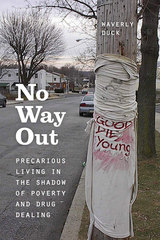
Duck’s short stay in Bristol Hill quickly transformed into a long-term study—one that forms the core of No Way Out. This landmark book challenges the common misconception of urban ghettoes as chaotic places where drug dealing, street crime, and random violence make daily life dangerous for their residents. Through close observations of daily life in these neighborhoods, Duck shows how the prevailing social order ensures that residents can go about their lives in relative safety, despite the risks that are embedded in living amid the drug trade. In a neighborhood plagued by failing schools, chronic unemployment, punitive law enforcement, and high rates of incarceration, residents are knit together by long-term ties of kinship and friendship, and they base their actions on a profound sense of community fairness and accountability. Duck presents powerful case studies of individuals whose difficulties flow not from their values, or a lack thereof, but rather from the multiple obstacles they encounter on a daily basis.
No Way Out explores how ordinary people make sense of their lives within severe constraints and how they choose among unrewarding prospects, rather than freely acting upon their own values. What emerges is an important and revelatory new perspective on the culture of the urban poor.
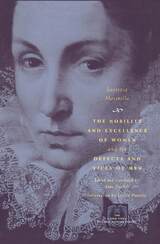
Marinella's masterpiece, The Nobility and Excellence of Women, and the Defects and Vices of Men was first published in 1600, composed at a furious pace in answer to Giusepe Passi's diatribe about women's alleged defects. This polemic displays Marinella's vast knowledge of the Italian poetic tradition and demonstrates her ability to argue against authors of the misogynist tradition from Boccaccio to Torquato Tasso. Trying to effect real social change, Marinella argued that morally, intellectually, and in many other ways, women are superior to men.
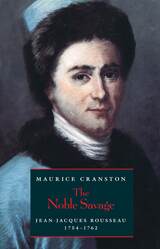
"Luckily for us, Maurice Cranston's The Noble Savage: Jean-Jacques Rousseau, 1754-1762 has managed to craft a highly detailed account of eight key years of Rousseau's life in such a way that we can both understand and even, on occasion, sympathize."—Olivier Bernier, Wall Street Journal
Maurice Cranston (1920-1993), a distinguished scholar and recipient of the James Tait Black Memorial Prize for his biography of John Locke, was professor of political science at the London School of Economics. His numerous books include The Romantic Movement and Philosophers and Pamphleteers, and translations of Rousseau's The Social Contract and Discourse on the Origins of Inequality.

Richard Stark's Parker novels are the hardest of hard-boiled, classic crime novels where the heists are huge, the body counts are high, and the bad guys usually win.
The Parker novels have been a huge influence on countless writers and filmmakers, including Quentin Tarantino, Stephen King, George Pelecanos, Colson Whitehead, Lucy Sante, John Banville, and many more. Their stripped-down language and hard-as-nails amorality create an unforgettable world where the next score could be the big one, but your next mistake could also be your last. There's nothing else like them.
Nobody Runs Forever opens with a job at a poker game that sours into a necktie party. When Parker goes in on a messy scam—stealing an armored car—with someone he barely knows, as usual the amateurs get in the way of the job. From a nervous ex-con and his well-intentioned sister to a bank manager's two-timing wife and a beautiful, relentless cop, too many people have their hands too close to Parker's pie. Even when he sees the job turning bad, he can’t let go of the score—and there just might be nowhere left to run . . .
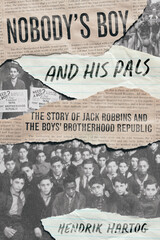
In 1914, social reformer Jack Robbins and a group of adolescent boys in Chicago founded the Boys’ Brotherhood Republic, an unconventional and unusual institution. During a moral panic about delinquent boys, Robbins did not seek to rehabilitate and/or punish wayward youths. Instead, the boys governed themselves, democratically and with compassion for one another, and lived by their mantra “So long as there are boys in trouble, we too are in trouble.” For nearly thirty years, Robbins was their “supervisor,” and the will he drafted in the late 1950s suggests that he continued to care about forgotten boys, even as the political and legal contexts that shaped children’s lives changed dramatically.
Nobody’s Boy and His Pals is a lively investigation that challenges our ideas about the history of American childhood and the law. Scouring the archives for traces of the elusive Jack Robbins, Hendrik Hartog examines the legal histories of Progressive reform, childhood, criminality, repression, and free speech. The curiosity of Robbins’s story is compounded by the legal challenges to his will, which wound up establishing the extent to which last wishes must conform to dominant social values. Filled with persistent mysteries and surprising connections, Nobody’s Boy and His Pals illuminates themes of childhood and adolescence, race and ethnicity, sexuality, wealth and poverty, and civil liberties, across the American Century.
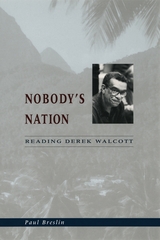
According to Breslin, Walcott's work is centrally concerned with the West Indies' imputed absence from history and lack of cohesive national identity or cultural tradition. Walcott sees this lack not as impoverishment but as an open space for creation. In his poems and plays, West Indian history becomes a realm of necessity, something to be confronted, contested, and remade through literature. What is most vexed and inspired in Walcott's work can be traced to this quixotic struggle.
Linking extensive archival research and new interviews with Walcott himself to detailed critical readings of major works, Nobody's Nation will take its place as the definitive study of the poet.
“Nobody who has not taken one can imagine the beauty of a walk through Rome by full moon,” wrote Goethe in 1787. Sadly, the imagination is all we have today: in Rome, as in every other modern city, moonlight has been banished, replaced by the twenty-four-hour glow of streetlights in a world that never sleeps. Moonlight, for most of us, is no more.
So James Attlee set out to find it. Nocturne is the record of that journey, a traveler’s tale that takes readers on a dazzling nighttime trek that ranges across continents, from prehistory to the present, and through both the physical world and the realms of art and literature. Attlee attends a Buddhist full-moon ceremony in Japan, meets a moon jellyfish on a beach in Northern France, takes a moonlit hike in the Arizona desert, and experiences a lunar eclipse on New Year’s Eve atop the snowbound Welsh hills. Each locale is illuminated not just by the moonlight he seeks, but by the culture and history that define it. We learn about Mussolini’s pathological fear of moonlight; trace the connections between Caspar David Friedrich, Rudolf Hess, and the Apollo space mission; and meet the inventors of the Moonlight Collector in the American desert, who aim to cure all kinds of ailments with concentrated lunar rays. Svevo and Blake, Whistler and Hokusai, Li Po and Marinetti are all enlisted, as foils, friends, or fellow travelers, on Attlee’s journey.
Pulled by the moon like the tide, Attlee is firmly in a tradition of wandering pilgrims that stretches from Basho to Sebald; like them, he presents our familiar world anew.
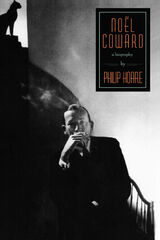
"Philip Hoare's careful research and lucid presentation in his Noël Coward: A Biography adds depth to the picture."-New York Times Book Review
"A fascinating, in-depth biography."—Library Journal
"Hoare has profiled vividly and in-depth a complex legend who had a talent for creating and recreating both himself and his works."—Publishers Weekly
"In the thicket of books about the life and work of Coward, Philip Hoare's stands out as the most well-documented and objective."—Los Angeles Times
"[Hoare's] book, like its subject, strives for effortless sophistication, and succeeds."—Newsday
"Hoare's retelling of Coward's story [is] the most vivid, insightful, and fascinating so far."—John Lahr, The New Yorker

In Noise, Alex Preda explores the world of the people who trade even when by all measures they would be better off not trading. Based on firsthand observations, interviews with traders and brokers, and on international direct trading experience, Preda’s fascinating ethnography investigates how ordinary people take up financial trading, how they form communities of their own behind their computer screens, and how electronic finance encourages them to trade more and more frequently. Along the way, Preda finds the answer to the paradox of amateur trading—the traders aren’t so much seeking monetary rewards in the financial markets, rather the trading itself helps them to fulfill their own personal goals and aspirations.
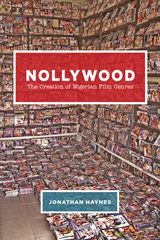
Haynes describes the major Nigerian film genres and how they relate to Nigerian society—its values, desires, anxieties, and social tensions—as the country and its movies have developed together over the turbulent past two decades. As he shows, Nollywood is a form of popular culture; it produces a flood of stories, repeating the ones that mean the most to its broad audience. He interprets these generic stories and the cast of mythic figures within them: the long-suffering wives, the business tricksters, the Bible-wielding pastors, the kings in their traditional regalia, the glamorous young professionals, the emigrants stranded in New York or London, and all the rest. Based on more than twenty years of research, Haynes’s survey of Nollywood’s history and genres is unprecedented in scope, while his book also vividly describes landmark films, leading directors, and the complex character of this major branch of world cinema.
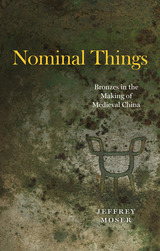
This book opens in eleventh-century China, where scholars were the first in world history to systematically illustrate and document ancient artifacts. As Jeffrey Moser argues, the visual, technical, and conceptual mechanisms they developed to record these objects laid the foundations for methods of visualizing knowledge that scholars throughout early modern East Asia would use to make sense of the world around them.
Of the artifacts these scholars studied, the most celebrated were bronze ritual vessels that had been cast nearly two thousand years earlier. While working to make sense of the relationship between the bronzes’ complex shapes and their inscribed glyphs, they came to realize that the objects were “nominal things”—objects inscribed with names that identified their own categories and uses. Eleventh-century scholars knew the meaning of these glyphs from hallowed Confucian writings that had been passed down through centuries, but they found shocking disconnects between the names and the bronzes on which they were inscribed. Nominal Things traces the process by which a distinctive system of empiricism was nurtured by discrepancies between the complex materiality of the bronzes and their inscriptions. By revealing the connections between the new empiricism and older ways of knowing, the book explains how scholars refashioned the words of the Confucian classics into material reality.

In this important treatise, ecologists and evolutionary biologists John Damuth and Lev R. Ginzburg identify a specific evolutionary process in biology, which they call nonadaptive selection. The idea is simple, but the implications are profound. Nonadaptive selection, as they use the term, is selection among biological entities (as is natural selection) but is based on the fitness effects of structural properties intrinsic to the entities under selection rather than on interactions between traits and a local shared environment. In other words, features of systems that evolve by nonadaptive selection do not adapt to local environmental conditions; rather, this selective process increases the long-term stability of the focal systems independent of local conditions.
Nonadaptive selection may be of particular value in explaining broad, persistent patterns in multispecies biological units where adaptive evolution may be weak or poorly defined. Examples include Damuth’s Law, the equivalence of energy use among animal species across a wide range of body sizes; the ratio-dependent, or Arditi-Ginzburg, predation conjecture; the consistency of allometric scaling powers; the shortness of trophic chains; and the prevalence of certain types of three-species trophic structures across ecosystems. Damuth and Ginzburg see nonadaptive selection underlying patterns of ecological allometries, community structure, and species interactions, with some implications for macroevolution. Moreover, they find a surprising relationship between these nonadaptive processes and biological laws. They do not advocate the reorientation of any existing research programs but present nonadaptive selection as an additional conceptual framework that may be useful to add to ecology and evolution.


Every day, Americans surrender their private information to entities claiming to have their best interests in mind. This trade-off has long been taken for granted, but the extent of its nefariousness has recently become much clearer. As None of Your Damn Business reveals, the problem is not so much that data will be used in ways we don’t want, but rather how willing we have been to have our information used, abused, and sold right back to us. In this startling book, Lawrence Cappello targets moments from the past 130 years of US history when privacy was central to battles over journalistic freedom, national security, surveillance, big data, and reproductive rights. As he makes dismayingly clear, Americans have had numerous opportunities to protect the public good while simultaneously safeguarding our information, and we’ve squandered them every time. None of Your Damn Business is a rich and provocative survey of an alarming topic that grows only more relevant with each fresh outrage of trust betrayed.
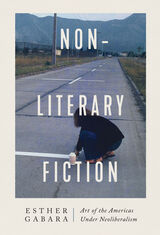
With Non-literary Fiction, Esther Gabara examines how contemporary art produced across the Americas has reacted to the rising tide of neoliberal regimes, focusing on the crucial role of fiction in daily politics. Gabara argues that these fictions depart from familiar literary narrative structures and emerge in the new mediums and practices that have revolutionized contemporary art. Each chapter details how fiction is created through visual art forms—in performance and body art, posters, mail art, found objects, and installations. For Gabara, these fictions comprise a type of art that asks viewers to collaborate in the creation of the work and helps them to withstand the brutal restrictions imposed by dominant neoliberal regimes.
During repressive regimes of the 1960s and 1970s and free trade agreements of the 1990s, artists and critics consistently said no to economic privatization, political deregulation, and reactionary social logic as they rejected inherited notions of visual, literary, and political representation. Through close analyses of artworks and writings by leading figures of these two generations, including Indigenous thinkers, Gabara shows how negation allows for the creation of fiction outside textual forms of literature.
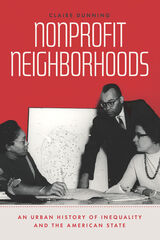
Nonprofits serving a range of municipal and cultural needs are now so ubiquitous in US cities, it can be difficult to envision a time when they were more limited in number, size, and influence. Turning back the clock, however, uncovers both an illuminating story of how the nonprofit sector became such a dominant force in American society, as well as a troubling one of why this growth occurred alongside persistent poverty and widening inequality. Claire Dunning’s book connects these two stories in histories of race, democracy, and capitalism, revealing how the federal government funded and deputized nonprofits to help individuals in need, and in so doing avoided addressing the structural inequities that necessitated such action in the first place.
Nonprofit Neighborhoods begins after World War II, when suburbanization, segregation, and deindustrialization inaugurated an era of urban policymaking that applied private solutions to public problems. Dunning introduces readers to the activists, corporate executives, and politicians who advocated addressing poverty and racial exclusion through local organizations, while also raising provocative questions about the politics and possibilities of social change. The lessons of Nonprofit Neighborhoods exceed the bounds of Boston, where the story unfolds, providing a timely history of the shift from urban crisis to urban renaissance for anyone concerned about American inequality—past, present, or future.
Scharfstein begins with essays on the nature of philosophy itself, moving from an autobiographical account of the trials of being a comparativist to philosophy’s function in the outside world to the fear of death in Kant and Hume. From there he explores an impressive array of art: from China and Japan to India and the West; from an essay on sadistic and masochistic body art to one on the epistemology of the deaf and the blind. He then returns to philosophy, writing on Machiavelli and political ruthlessness, then on the ineffable, and closes with a review of Walter Kaufmann’s multivolume look at the essence of humanity, Discovering the Mind. Altogether, these essays are a testament to adventurous thought, the kind that leaps to the furthest reaches of the possible.
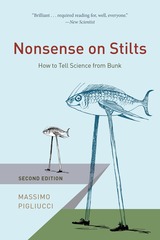
In this era of fake news and alternative facts, there is more bunk than ever. But why do people believe in it? And what causes them to embrace such pseudoscientific beliefs and practices? In this fully revised second edition, noted skeptic Massimo Pigliucci sets out to separate the fact from the fantasy in an entertaining exploration of the nature of science, the borderlands of fringe science, and—borrowing a famous phrase from philosopher Jeremy Bentham—the nonsense on stilts. Presenting case studies on a number of controversial topics, Pigliucci cuts through the ambiguity surrounding science to look more closely at how science is conducted, how it is disseminated, how it is interpreted, and what it means to our society. The result is in many ways a “taxonomy of bunk” that explores the intersection of science and culture at large.
No one—neither the public intellectuals in the culture wars between defenders and detractors of science nor the believers of pseudoscience themselves—is spared Pigliucci’s incisive analysis in this timely reminder of the need to maintain a line between expertise and assumption. Broad in scope and implication, Nonsense on Stilts is a captivating guide for the intelligent citizen who wishes to make up her own mind while navigating the perilous debates that will shape the future of our planet.
Recent polls suggest that fewer than 40 percent of Americans believe in Darwin’s theory of evolution, despite it being one of science’s best-established findings. More and more parents are refusing to vaccinate their children for fear it causes autism, though this link can been consistently disproved. And about 40 percent of Americans believe that the threat of global warming is exaggerated, despite near consensus in the scientific community that manmade climate change is real.
Why do people believe bunk? And what causes them to embrace such pseudoscientific beliefs and practices? Noted skeptic Massimo Pigliucci sets out to separate the fact from the fantasy in this entertaining exploration of the nature of science, the borderlands of fringe science, and—borrowing a famous phrase from philosopher Jeremy Bentham—the nonsense on stilts. Presenting case studies on a number of controversial topics, Pigliucci cuts through the ambiguity surrounding science to look more closely at how science is conducted, how it is disseminated, how it is interpreted, and what it means to our society. The result is in many ways a “taxonomy of bunk” that explores the intersection of science and culture at large.
No one—not the public intellectuals in the culture wars between defenders and detractors of science nor the believers of pseudoscience themselves—is spared Pigliucci’s incisive analysis. In the end, Nonsense on Stilts is a timely reminder of the need to maintain a line between expertise and assumption. Broad in scope and implication, it is also ultimately a captivating guide for the intelligent citizen who wishes to make up her own mind while navigating the perilous debates that will affect the future of our planet.
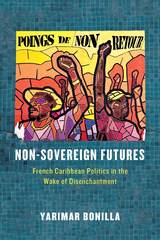
Through a deep ethnography of Guadeloupean labor activism, Bonilla examines how Caribbean political actors navigate the conflicting norms and desires produced by the modernist project of postcolonial sovereignty. Exploring the political and historical imaginaries of activist communities, she examines their attempts to forge new visions for the future by reconfiguring narratives of the past, especially the histories of colonialism and slavery. Drawing from nearly a decade of ethnographic research, she shows that political participation—even in failed movements—has social impacts beyond simple material or economic gains. Ultimately, she uses the cases of Guadeloupe and the Caribbean at large to offer a more sophisticated conception of the possibilities of sovereignty in the postcolonial era.
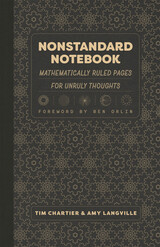
A standard notebook displays page after page of horizontal lines. But what if we break the pattern? What if the ruled pages grew unruly? In this Nonstandard Notebook, lines twist, fragment, curve, and crisscross in beautiful formations. Each sheet is a distinctive work of imagination, asking us to draw, doodle, and journal in the same spirit.
Page after page, as we journey from lines to parabolas to waves, deep questions arise—about form, art, and mathematics. How do we harness the infinite? Why do patterns permeate nature? What are the limitations and possibilities of human vision? Nonstandard Notebook explores these questions and more through its provocative and inspirational images, each displayed with the mathematics that generated it. We see how straight lines can form fractal crenellations, how circles can disrupt and unify, and how waves and scaling can form complex landscapes (or even famous faces). Created by mathematicians, educators, and math popularizers Tim Chartier and Amy Langville, and with a foreword from Ben Orlin (bestselling author of Math with Bad Drawings), Nonstandard Notebook shows that rules—both the rules of mathematics and the rules of a notebook—do not mark the end of creativity, but the beginning.
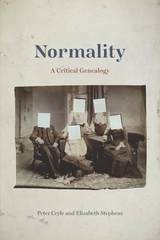
In Normality, Peter Cryle and Elizabeth Stephens offer an intellectual and cultural history of what it means to be normal. They explore the history of how communities settle on any one definition of the norm, along the way analyzing a fascinating series of case studies in fields as remote as anatomy, statistics, criminal anthropology, sociology, and eugenics. Cryle and Stephens argue that since the idea of normality is so central to contemporary disability, gender, race, and sexuality studies, scholars in these fields must first have a better understanding of the context for normality. This pioneering book moves beyond binaries to explore for the first time what it does—and doesn’t—mean to be normal.
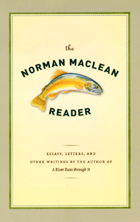
In his eighty-seven years, Norman Maclean played many parts: fisherman, logger, firefighter, scholar, teacher. But it was a role he took up late in life, that of writer, that won him enduring fame and critical acclaim—as well as the devotion of readers worldwide. Though the 1976 collection A River Runs Through It and Other Stories was the only book Maclean published in his lifetime, it was an unexpected success, and the moving family tragedy of the title novella—based largely on Maclean’s memories of his childhood home in Montana—has proved to be one of the most enduring American stories ever written.
The Norman Maclean Reader is a wonderful addition to Maclean’s celebrated oeuvre. Bringing together previously unpublished materials with incidental writings and selections from his more famous works, the Reader will serve as the perfect introduction for readers new to Maclean, while offering longtime fans new insight into his life and career.
In this evocative collection, Maclean as both a writer and a man becomes evident. Perceptive, intimate essays deal with his career as a teacher and a literary scholar, as well as the wealth of family stories for which Maclean is famous. Complete with a generous selection of letters, as well as excerpts from a 1986 interview, The Norman Maclean Reader provides a fully fleshed-out portrait of this much admired author, showing us a writer fully aware of the nuances of his craft, and a man as at home in the academic environment of the University of Chicago as in the quiet mountains of his beloved Montana.
Various and moving, the works collected in The Norman Maclean Reader serve as both a summation and a celebration, giving readers a chance once again to hear one of American literature’s most distinctive voices.
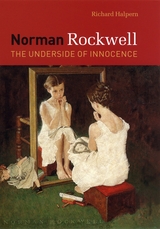
Norman Rockwell’s scenes of everyday small-town life are among the most indelible images in all of twentieth-century art. While opinions of Rockwell vary from uncritical admiration to sneering contempt, those who love him and those who dismiss him do agree on one thing: his art embodies a distinctively American style of innocence.
In this sure-to-be controversial book, Richard Halpern argues that this sense of innocence arises from our reluctance—and also Rockwell’s—to acknowledge the often disturbing dimensions of his works. Rockwell’s paintings frequently teem with perverse acts of voyeurism and desire but contrive to keep these acts invisible—or rather, hidden in plain sight, available for unacknowledged pleasure but easily denied by the viewer.
Rockwell emerges in this book, then, as a deviously brilliant artist, a remorseless diagnostician of the innocence in which we bathe ourselves, and a continuing, unexpected influence on contemporary artists. Far from a banal painter of the ordinary, Halpern argues, Rockwell is someone we have not yet dared to see for the complex creature he is: a wholesome pervert, a knowing innocent, and a kitschy genius.
Provocative but judicious, witty but deeply informed, Norman Rockwell is a book rich in suggestive propositions and eye-opening details—one that will change forever the way we think about this American icon and his works.
A prominent member of a new generation of Latin American writers, Paz Soldán stands in defiant opposition to the magical realism of the past century, instead grounding his work in political, economic, and historical realities. Norte is no exception; it is a tale of displacement and the very human costs of immigration. Shocking with its violence even as it thrills with its language, confounding rather than cowering under the cliché of the murderous, drug-dealing immigrant, Norte is a disquieting, imperative work—an undeniable reflection of our fragmented modern world.
Drawing from all twelve of his books, and including one poem collected posthumously, North in the World offers award-winning English translations of Jacobsen's poems, accompanied by the original Norwegian texts. The translator, the American poet Roger Greenwald, worked with Jacobsen himself to correct errors that had crept into the Norwegian texts over the years. An in-depth introduction by Greenwald highlights the main features of Jacobsen's poetry, and extensive endnotes, as well as indexes to titles and first lines in both languages, enhance the usefulness of the book for general readers and scholars alike. The result is the definitive bilingual edition of Jacobsen's marvelous poetry.
"For a searching examination of the North Star Legend we are indebted to Leon F. Litwack. . . ."—C. Vann Woodward, The American Scholar

Traversed by thousands of trains and millions of riders, the Northeast Corridor might be America’s most famous railway, but its influence goes far beyond the right-of-way. David Alff welcomes readers aboard to see how nineteenth-century train tracks did more than connect Boston to Washington, DC. They transformed hundreds of miles of Atlantic shoreline into a political capital, a global financial hub, and home to fifty million people. The Northeast Corridor reveals how freight trains, commuter rail, and Amtrak influenced—and in turn were shaped by—centuries of American industrial expansion, metropolitan growth, downtown decline, and revitalization.
Paying as much attention to Canton, Trenton, New Rochelle, and Providence as to New York City, Philadelphia, and Baltimore, Alff provides narrative thrills for history buffs, train enthusiasts, and adventurers alike. What’s more, he offers a glimpse into the future of the corridor. New infrastructural plans—supported by President Joe Biden, famously Amtrak’s biggest fan—envision ever-faster trains zipping along technologically advanced rails. Yet those tracks will literally sit atop a history that links the life of Frederick Douglass, who fled to freedom by boarding a train in Baltimore, to the Frederick Douglass Tunnel, which is expected to be the newest link in the corridor by 2032.
Trains have long made the places that make America, and they still do.

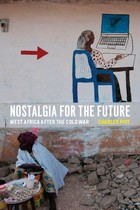
Since the end of the cold war, Africa has seen a dramatic rise in new political and religious phenomena, including an eviscerated privatized state, neoliberal NGOs, Pentecostalism, a resurgence in accusations of witchcraft, a culture of scamming and fraud, and, in some countries, a nearly universal wish to emigrate. Drawing on fieldwork in Togo, Charles Piot suggests that a new biopolitics after state sovereignty is remaking the face of one of the world’s poorest regions.
In a country where playing the U.S. Department of State’s green card lottery is a national pastime and the preponderance of cybercafés and Western Union branches signals a widespread desire to connect to the rest of the world, Nostalgia for the Future makes clear that the cultural and political terrain that underlies postcolonial theory has shifted. In order to map out this new terrain, Piot enters into critical dialogue with a host of important theorists, including Agamben, Hardt and Negri, Deleuze, and Mbembe. The result is a deft interweaving of rich observations of Togolese life with profound insights into the new, globalized world in which that life takes place.
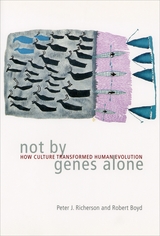
Not by Genes Alone offers a radical interpretation of human evolution, arguing that our ecological dominance and our singular social systems stem from a psychology uniquely adapted to create complex culture. Richerson and Boyd illustrate here that culture is neither superorganic nor the handmaiden of the genes. Rather, it is essential to human adaptation, as much a part of human biology as bipedal locomotion. Drawing on work in the fields of anthropology, political science, sociology, and economics—and building their case with such fascinating examples as kayaks, corporations, clever knots, and yams that require twelve men to carry them—Richerson and Boyd convincingly demonstrate that culture and biology are inextricably linked, and they show us how to think about their interaction in a way that yields a richer understanding of human nature.
In abandoning the nature-versus-nurture debate as fundamentally misconceived, Not by Genes Alone is a truly original and groundbreaking theory of the role of culture in evolution and a book to be reckoned with for generations to come.
“I continue to be surprised by the number of educated people (many of them biologists) who think that offering explanations for human behavior in terms of culture somehow disproves the suggestion that human behavior can be explained in Darwinian evolutionary terms. Fortunately, we now have a book to which they may be directed for enlightenment . . . . It is a book full of good sense and the kinds of intellectual rigor and clarity of writing that we have come to expect from the Boyd/Richerson stable.”—Robin Dunbar, Nature
“Not by Genes Alone is a valuable and very readable synthesis of a still embryonic but very important subject straddling the sciences and humanities.”—E. O. Wilson, Harvard University
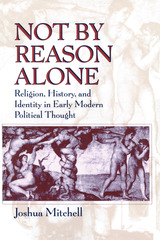
This erudite and ambitious work crosses disciplinary boundaries to expose unsuspected connections between political theory, religion, and history. In doing so, it offers a view of modern political thought undistorted by conventional distinctions between the ancient and the modern, and between the religious and the political.
"Original. . . . A delight to read a political philosopher who takes the theologies of Hobbes and Locke seriously." —J. M. Porter, Canadian Journal of History
"Mitchell's argument both illuminates and fascinates. . . . An arresting, even stunning, contribution to our study of modern political thought."—William R. Stevenson, Jr., Christian Scholar's Review
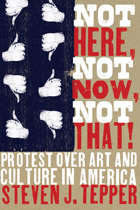
In the late 1990s Angels in America,Tony Kushner’s epic play about homosexuality and AIDS in the Reagan era, toured the country, inspiring protests in a handful of cities while others received it warmly. Why do people fight over some works of art but not others? Not Here, Not Now, Not That! examines a wide range of controversies over films, books, paintings, sculptures, clothing, music, and television in dozens of cities across the country to find out what turns personal offense into public protest.
What Steven J. Tepper discovers is that these protests are always deeply rooted in local concerns. Furthermore, they are essential to the process of working out our differences in a civil society. To explore the local nature of public protests in detail, Tepper analyzes cases in seventy-one cities, including an in-depth look at Atlanta in the late 1990s, finding that debates there over memorials, public artworks, books, and parades served as a way for Atlantans to develop a vision of the future at a time of rapid growth and change.
Eschewing simplistic narratives that reduce public protests to political maneuvering, Not Here, Not Now, Not That! at last provides the social context necessary to fully understand this fascinating phenomenon.
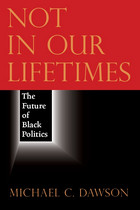
For all the talk about a new postracial America, the fundamental realities of American racism—and the problems facing black political movements—have not changed. Michael C. Dawson lays out a nuanced analysis of the persistence of racial inequality and structural disadvantages, and the ways that whites and blacks continue to see the same problems—the disastrous response to Katrina being a prime example—through completely different, race-inflected lenses. In fact, argues Dawson, the new era heralded by Barack Obama’s election is more racially complicated, as the widening class gap among African Americans and the hot-button issue of immigration have the potential to create new fissures for conservative and race-based exploitation. Through a thoughtful analysis of the rise of the Tea Party and the largely successful “blackening” of President Obama, Dawson ultimately argues that black politics remains weak—and that achieving the dream of racial and economic equality will require the sort of coalition-building and reaching across racial divides that have always marked successful political movements.
Polemical but astute, passionate but pragmatic, Not in Our Lifetimes forces us to rethink easy assumptions about racial progress—and begin the hard work of creating real, lasting change.

The late twentieth century has seen a fantastic expansion of personal, sexual, and domestic liberties in the United States. In Not Just Roommates, Elizabeth H. Pleck explores the rise of cohabitation, and the changing social norms that have allowed cohabitation to become the chosen lifestyle of more than fifteen million Americans.
Despite this growing social acceptance, Pleck contends that when it comes to the law, cohabitors have been, and continue to be, treated as second-class citizens, subjected to discriminatory laws, limited privacy, a lack of political representation, and little hope for change. Because cohabitation is not a sexual identity, Pleck argues, cohabitors face the legal discrimination of a population with no group identity, no civil rights movement, no legal defense organizations, and, often, no consciousness of being discriminated against. Through in-depth research in written sources and interviews, Pleck shines a light on the emergence of cohabitation in American culture, its complex history, and its unpleasant realities in the present day.
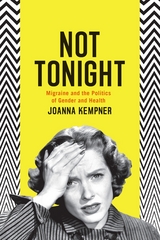
In Not Tonight, Joanna Kempner argues that this general dismissal of migraine can be traced back to the gendered social values embedded in the way we talk about, understand, and make policies for people in pain. Because the symptoms that accompany headache disorders—like head pain, visual auras, and sensitivity to sound—lack an objective marker of distress that can confirm their existence, doctors rely on the perceived moral character of their patients to gauge how serious their complaints are. Kempner shows how this problem plays out in the history of migraine, from nineteenth-century formulations of migraine as a disorder of upper-class intellectual men and hysterical women to the influential concept of “migraine personality” in the 1940s, in which women with migraine were described as uptight neurotics who withheld sex, to contemporary depictions of people with highly sensitive “migraine brains.” Not Tonight casts new light on how cultural beliefs about gender, pain, and the distinction between mind and body influence not only whose suffering we legitimate, but which remedies are marketed, how medicine is practiced, and how knowledge about disease is produced.
Winner of the Healthy Teen Network’s Carol Mendez Cassell Award for Excellence in Sexuality Education and the American Sociological Association's Children and Youth Section's 2012 Distinguished Scholarly Research Award
For American parents, teenage sex is something to be feared and forbidden: most would never consider allowing their children to have sex at home, and sex is a frequent source of family conflict. In the Netherlands, where teenage pregnancies are far less frequent than in the United States, parents aim above all for family cohesiveness, often permitting young couples to sleep together and providing them with contraceptives. Drawing on extensive interviews with parents and teens, Not Under My Roof offers an unprecedented, intimate account of the different ways that girls and boys in both countries negotiate love, lust, and growing up.
Tracing the roots of the parents’ divergent attitudes, Amy T. Schalet reveals how they grow out of their respective conceptions of the self, relationships, gender, autonomy, and authority. She provides a probing analysis of the way family culture shapes not just sex but also alcohol consumption and parent-teen relationships. Avoiding caricatures of permissive Europeans and puritanical Americans, Schalet shows that the Dutch require self-control from teens and parents, while Americans guide their children toward autonomous adulthood at the expense of the family bond.
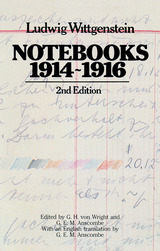
"When the first edition of this collection of remarks appeared in 1961 we were provided with a glimpse of the workings of Wittgenstein's mind during the period when the seminal ideas of the Tractatus Logico-Philosophicus were being worked out. This second edition provided the occasion to be struck anew by the breadth, rigor, and above all the restlessness of that mind."—T. Michael McNulty, S. J., The Modern Schoolman
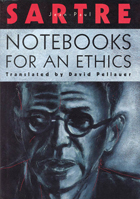
In the famous conclusion to Being and Nothingness, Sartre announced that he would devote his next philosophical work to moral problems. Although he worked on this project in the late 1940s, Sartre never completed it to his satisfaction, and it remained unpublished until after his death in 1980. Presented here for the first time in English, the Notebooks reveal Sartre at his most productive, crafting a masterpiece of philosophical reflection that can easily stand alongside his other great works.
Sartre grapples anew here with such central issues as "authenticity" and the relation of alienation and freedom to moral values. Exploring fundamental modes of relating to the Other—among them violence, entreaty, demand, appeal, refusal, and revolt—he articulates the necessary transition from individualism to historical consciousness. This work thus forms an important bridge between the early existentialist Sartre and the later Marxist social thinker of the Critique of Dialectical Reason. The Notebooks themselves are complemented here by two additional essays, one on "the good and subjectivity," the other on the oppression of blacks in the United States.
With publication of David Pellauer's lucid translation, English-speaking readers will be able to appreciate this important contribution to moral philosophy and the history of ethics.
Jean-Paul Sartre (1906-1980) was offered, but declined, the Nobel Prize for literature in 1964. His many works of fiction, drama, and philosophy include the monumental study of Flaubert, The Family Idiot, and The Freud Scenario, both published in translation by the University of Chicago Press.
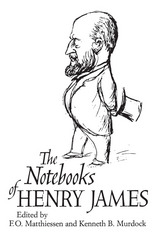
"The Notebooks take us into his study, and here we can observe him, at last, in the very act of creation at his writing table."—Leon Edel, Atlantic Monthly
"A document of prime importance."—Edmund Wilson, New Yorker
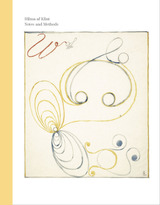
Hilma af Klint studied at the Royal Swedish Academy in Stockholm where she was part of the first generation of female students. Up until the beginning of the century, she painted mainly landscapes and detailed botanical studies. Her work from this period was that of a young artist of her time who meticulously observed the world around her. But, like many of her contemporaries, af Klint was also interested in the invisible relationships that shape our world, believing strongly in a spiritual dimension. She joined the Theosophical Society, and, with four fellow female members who together called themselves “The Five,” began to study mediumship. Between 1906 and 1915, purportedly guided by a higher power, af Klint created 193 individual works that, in both scale and scope of imagery, are like no other art created at that time. Botanically inspired images and mystical symbols, diagrams, words, and geometric series, all form part of af Klint’s abstract language. These abstract techniques would not be seen again until years later.
Notes and Methods presents facsimile reproductions of a wide array of af Klint’s early notebooks accompanied by the first English translation of af Klint’s extensive writings. It contains the rarely seen “Blue Notebooks,” hand-painted and annotated catalogues af Klint created of her most famous series “Paintings for the Temple,” and a dictionary compiled by af Klint of the words and letters found in her work. This extraordinary collection is edited by and copublished with Christine Burgin, and features an introduction by Iris Müller-Westermann. It will stand as an important and timely contribution to the legacy of Hilma af Klint.
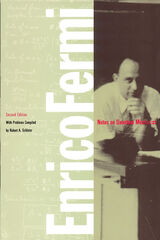
At the close of each lecture, Fermi created a single problem for his students. These challenging exercises were not included in Fermi's notes but were preserved in the notes of his students. This second edition includes a set of these assigned problems as compiled by one of his former students, Robert A. Schluter.
Enrico Fermi was awarded the Nobel Prize for Physics in 1938.
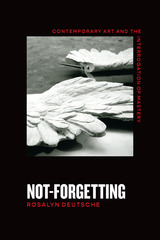
Amid times of emboldened cruelty and perpetual war, Rosalyn Deutsche links contemporary art to three practices that counter the prevailing destructiveness: psychoanalytic feminism, radical democracy, and war resistance. Deutsche considers how art joins these radical practices to challenge desires for mastery and dominion, which are encapsulated in the Eurocentric conception of the human that goes under the name “Man” and is driven by deadly inclinations that Deutsche calls masculinist. The masculinist subject—as an individual or a group—universalizes itself, claims to speak on behalf of humanity, and meets differences with conquest.
Analyzing artworks by Christopher D’Arcangelo, Robert Filliou, Hans Haacke, Mary Kelly, Silvia Kolbowski, Barbara Kruger, Louise Lawler, Martha Rosler, James Welling, and Krzysztof Wodiczko, Deutsche illuminates the diverse ways in which they expose, question, and trouble the visual fantasies that express masculinist desire. Undermining the mastering subject, these artworks invite viewers to question the positions they assume in relation to others. Together, the essays in Not-Forgetting, written between 1999 and 2020, argue that this art offers a unique contribution to building a less cruel and violent society.
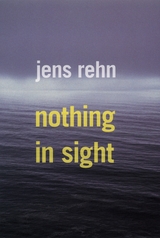
In a terse, almost clinically exact style, Nothing in Sight distills the brutal essence of what it is to die alone. Much more than a story of war, this short novel presents the memories, dreams, and hallucinations of two soldiers as they drift toward death. With nothing in sight on the horizon, Jens Rehn directs our view inward, into the minds of both men as they question the meaning of life, the existence of God, and the possibility of enduring human relationships. As the drama unfolds, each man recalls fragments of his past through the delirium of thirst and pain. The American soldier, his arm severed, dies first of gangrene. The German dies in agony a week later. Their life raft sinks into the vastness of the ocean.
Reissued two years ago in Germany, Nothing in Sight was hailed by critics there as a singular achievement. The work is presented here in a crystalline English translation for the first time, given new life for generations of readers to come.
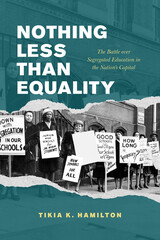
The landmark Brown v. Board of Education case, which barred racial segregation in American public schools, wasn’t the only path for Black parents, teachers, and activists who sought equality of educational opportunity. Some believed that the solution to inequality lay in pressing the federal government to live up to the Jim Crow doctrine of “separate but equal” by providing more resources to Black schools. And for a time, this seemed true in Washington, DC, where Black activists leveraged their status as residents of the nation’s capital to advocate on behalf of Black education. However, disappointments with the “separate but equal” strategy and a sea change in activism led to an embrace of integration.
In Nothing Less Than Equality, Tikia K. Hamilton reveals the rich and complex history of educational activism in Washington prior to Brown v. Board of Education, illuminating complex dynamics that provide a counterpoint and backdrop to the landmark Supreme Court case. Hamilton thoroughly examines the multipronged strategies employed by parents, teachers, attorneys, and activists to democratize education, demonstrating that there was no linear path to Brown.
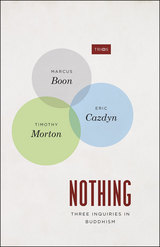
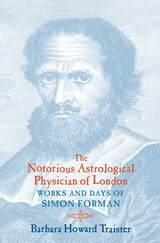
Although he received no formal medical education, Forman built a thriving practice. His success rankled the College of Physicians of London, who hounded Forman with fines and jail terms for nearly two decades. In addition to detailing case histories of his medical practice—the first such records known from London—as well as his run-ins with the College, Forman's manuscripts cover a wide variety of other matters, from astrology and alchemy to gardening and the theater. His autobiographical writings are among the earliest English examples of their genre and display an abiding passion for reworking his personal history in the best possible light, even though they show little evidence that Forman ever intended to publish them.
Fantastic as many of Forman's manuscripts are, it is their more mundane aspects that make them such a priceless record of what daily life was like for ordinary inhabitants of Shakespeare's London. Forman's descriptions of the stench of a privy, the paralyzed limbs of a child, a lost bitch dog with a velvet collar all offer tantalizing glimpses of a world that seems at once very far away and intimately familiar. Anyone who wants to reclaim that world will enjoy this book.
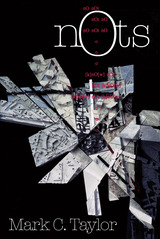
In the first section of this book, Taylor discusses the question of the "not" in the religious thought of Anselm, Hegel, Derrida, and Nishitani. In the second part, he analyzes artistic efforts "to figure not" in the work of artists Arakawa and Madeline Gins, architect Daniel Libeskind, pop artist David Sallee, and pop icon Madonna. The final section consists of a deeply personal and scientifically informed chapter that discusses the workings of negativity in immunology and illness.
Taylor's essays work toward a sense of the not as unnameable as it is irrepressible—an "unthinkable third" that falls between being and nonbeing. Bringing together concerns that span Taylor's early investigations of Hegel and Kierkegaard and recent studies of art and architecture, Nots is an important contribution by one of the most original and distinctive voices now writing on the American scene.
Religion and Postmodernism series
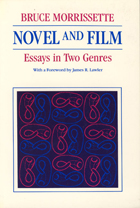
The influential essays collected in Novel and Film display a wide range of critical and analytic approaches to the narrative aspects of the two genres. For all the variety of their subjects, from constructional forms such as interior duplication and game play to intertextual parallels with mathematics and topology, these essays together define a unified critical perspective, one that has brought fresh precision to the analysis of narrative techniques and that continues to raise questions of prime importance to contemporary fiction. Included is a complete bibliography of Morrissette's scholarly works.

Allison Carruth’s Novel Ecologies shows how the tech industry has taken up the wilderness mythologies that shaped one strain of American environmentalism over the last century. Calling this twenty-first-century environmental imagination Nature Remade, Carruth describes a distinctly West Coast framework that is at once nostalgic and futuristic. Through three case studies (synthetic wildlife, the digital cloud, and space colonization), the book shows Nature Remade to be a quasi-religious belief in venture capitalism and big tech. This paradigm thus imagines a future in which species, ecosystems, and entire planets are re-generated and re-created through engineering.
Novel Ecologies challenges the conviction that climate change and other environmental crises must be met with ever larger-scale forms of technological intervention. Against the new worlds conjured by Google, Meta, Open AI, Amazon, SpaceX, and a host of lesser-known start-ups, Carruth marshals writers and artists who imagine provisionally hopeful environmental futures while refusing to forget the histories that have made the world what it is. On this track of the book, Carruth discusses the works of Octavia Butler, Becky Chambers, Jennifer Egan, Ruth Ozeki, Craig Santos Perez, Tracy K. Smith, Jeff VanderMeer, Saya Woolfalk, and many more. Their novels, poems, installation artworks, and expressive media offer a speculative world built on livable communities rather than engineered lifeforms.
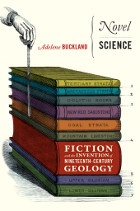
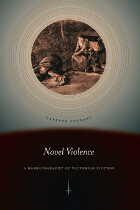
Victorian novels, Garrett Stewart argues, hurtle forward in prose as violent as the brutal human existence they chronicle. In Novel Violence, he explains how such language assaults the norms of written expression and how, in doing so, it counteracts the narratives it simultaneously propels.
Immersing himself in the troubling plots of Charles Dickens, Anne Brontë, George Eliot, and Thomas Hardy, Stewart uses his brilliant new method of narratography to trace the microplots of language as they unfold syllable by syllable. By pinpointing where these linguistic narratives collide with the stories that give them context, he makes a powerful case for the centrality of verbal conflict to the experience of reading Victorian novels. He also maps his finely wrought argument on the spectrum of influential theories of the novel—including those of Georg Lukács and Ian Watt—and tests it against Edgar Allan Poe’s antinovelistic techniques. In the process, Stewart shifts critical focus toward the grain of narrative and away from more abstract analyses of structure or cultural context, revealing how novels achieve their semantic and psychic effects and unearthing, in prose, something akin to poetry.

Twenty-first-century fiction and theory have taken a decidedly weird turn. They both show a marked interest in the nonhuman and in the preternatural moods that the nonhuman often evokes. Writers of fiction and criticism are avidly experimenting with strange, even alien perspectives and protagonists. Kate Marshall’s Novels by Aliens explores this development broadly while focusing on problems of genre fiction. She identifies three key generic hybrids that harness a longing for the nonhuman: the old weird, an alternative tradition within naturalism and modernism for the twenty-first century’s cowboys and aliens; cosmic realism, the reach for words legible only from space in otherwise terrestrial narratives; and pseudoscience fiction, which imagines speculative futures beyond human life on earth. Offering sharp and surprising insights about a breathtaking range of authors, from Edgar Rice Burroughs to Kazuo Ishiguro, Willa Cather to Maggie Nelson, Novels by Aliens tells the story of how genre became mood in the twenty-first century.
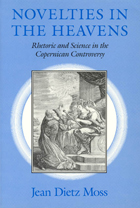
Moss describes the nature of dialectical and rhetorical discourse in the period of the Copernican debate to shed new light on the argumentative strategies used by the participants. Against the background of Ptolemy's Almagest, she analyzes the gradual increase of rhetoric beginning with Copernicus's De Revolutionibus and Galileo's Siderius nuncius, through Galileo's debates with the Jesuits Scheiner and Grassi, to the most persuasive work of all, Galileo's Dialogue. The arguments of the Dominicans Bruno and Campanella, the testimony of Johannes Kepler, and the pleas of Scriptural exegetes and the speculations of John Wilkins furnish a counterpoint to the writings of Galileo, the centerpiece of this study.
The author places the controversy within its historical frame, creating a coherent narrative movement. She illuminates the reactions of key ecclesiastical and academic figures figures and the general public to the issues.
Blending history and rhetorical analysis, this first study to look at rhetoric as defined by sixteenth- and seventeenth-century participants is an original contribution to our understanding of the use of persuasion as an instrument of scientific debate.
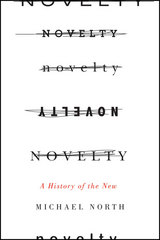
In Novelty, Michael North takes us on a dazzling tour of more than two millennia of thinking about the problem of the new, from the puzzles of the pre-Socratics all the way up to the art world of the 1960s and ’70s. The terms of the debate, North shows, were established before Plato, and have changed very little since: novelty, philosophers argued, could only arise from either recurrence or recombination. The former, found in nature’s cycles of renewal, and the latter, seen most clearly in the workings of language, between them have accounted for nearly all the ways in which novelty has been conceived in Western history, taking in reformation, renaissance, invention, revolution, and even evolution. As he pursues this idea through centuries and across disciplines, North exhibits astonishing range, drawing on figures as diverse as Charles Darwin and Robert Smithson, Thomas Kuhn and Ezra Pound, Norbert Wiener and Andy Warhol, all of whom offer different ways of grappling with the idea of originality.
Novelty, North demonstrates, remains a central problem of contemporary science and literature—an ever-receding target that, in its complexity and evasiveness, continues to inspire and propel the modern. A heady, ambitious intellectual feast, Novelty is rich with insight, a masterpiece of perceptive synthesis.
“Professor Booth’s earnestness is graced by wit, irony, and generous humor.”—Louis Coxe, New Republic
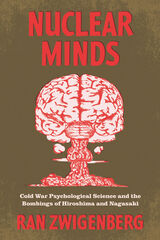
In 1945, researchers on a mission to Hiroshima with the United States Strategic Bombing Survey canvassed survivors of the nuclear attack. This marked the beginning of global efforts—by psychiatrists, psychologists, and other social scientists—to tackle the complex ways in which human minds were affected by the advent of the nuclear age. A trans-Pacific research network emerged that produced massive amounts of data about the dropping of the bomb and subsequent nuclear tests in and around the Pacific rim.
Ran Zwigenberg traces these efforts and the ways they were interpreted differently across communities of researchers and victims. He explores how the bomb’s psychological impact on survivors was understood before we had the concept of post-traumatic stress disorder. In fact, psychological and psychiatric research on Hiroshima and Nagasaki rarely referred to trauma or similar categories. Instead, institutional and political constraints—most notably the psychological sciences’ entanglement with Cold War science—led researchers to concentrate on short-term damage and somatic reactions or even, in some cases, on denial of victims’ suffering. As a result, very few doctors tried to ameliorate suffering.
But, Zwigenberg argues, it was not only that doctors “failed” to issue the right diagnosis; the victims’ experiences also did not necessarily conform to our contemporary expectations. As he shows, the category of trauma should not be used uncritically in a non-Western context. Consequently, this book sets out, first, to understand the historical, cultural, and scientific constraints in which researchers and victims were acting and, second, to explore how suffering was understood in different cultural contexts before PTSD was a category of analysis.

"The compilers of this publication may be warmly congratulated. . . . The scope of this course is amazing: within 240 pages it ranges from the general properties of atomic nuclei and nuclear forces to mesons and cosmic rays, and includes an account of fission and elementary pile theory. . . . The course addresses itself to experimenters rather than to specialists in nuclear theory, although the latter will also greatly profit from its study on account of the sound emphasis laid everywhere on the experimental approach to problems. . . . There is a copious supply of problems."—Proceedings of the Physical Society
"Only a relatively few students are privileged to attend Professor Fermi's brilliant lectures at the University of Chicago; it is therefore a distinct contribution to the followers of nuclear science that his lecture material has been systematically organized in a publication and made available to a much wider audience."—Nucelonics
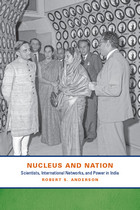
In 1974 India joined the elite roster of nuclear world powers when it exploded its first nuclear bomb. But the technological progress that facilitated that feat was set in motion many decades before, as India sought both independence from the British and respect from the larger world. Over the course of the twentieth century, India metamorphosed from a marginal place to a serious hub of technological and scientific innovation. It is this tale of transformation that Robert S. Anderson recounts in Nucleus and Nation.
Tracing the long institutional and individual preparations for India’s first nuclear test and its consequences, Anderson begins with the careers of India’s renowned scientists—Meghnad Saha, Shanti Bhatnagar, Homi Bhabha, and their patron Jawaharlal Nehru—in the first half of the twentieth century before focusing on the evolution of the large and complex scientific community—especially Vikram Sarabhi—in the later part of the era. By contextualizing Indian debates over nuclear power within the larger conversation about modernization and industrialization, Anderson hones in on the thorny issue of the integration of science into the framework and self-reliant ideals of Indian nationalism. In this way, Nucleus and Nation is more than a history of nuclear science and engineering and the Indian Atomic Energy Commission; it is a unique perspective on the history of Indian nationhood and the politics of its scientific community.
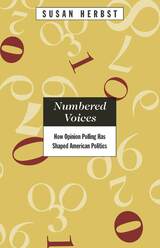
Exploring the history of public opinion in the United States from the mid-nineteenth century to the present day, Herbst shows how numbers served both instrumental and symbolic functions, not only conveying neutral information but creating a basis authority. Addressing how the quantification of public opinion has affected contemporary politics and the democratic process, Herbst asks difficult but fundamental questions about the workings of American politics.
"An original and thought-provoking analysis of why we have polls, what they accomplish, and how they affect the current political scene. Herbst's scholarship is impeccable, her writing is clear and crisp, and her findings are original. . . . Every reader will benefit by carefully weighing the issues she raises and the conclusions she draws."—Doris A. Graber, Political Science Quarterly
"An intelligent, theoretically rich, and historically broad account of public opinion over several millennia. . . . The historical accounts are interesting and her interpretations are thought-provoking."—Paul Brace, Journal of American History
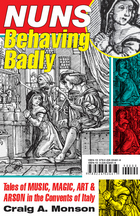
Witchcraft. Arson. Going AWOL. Some nuns in sixteenth- and seventeenth-century Italy strayed far from the paradigms of monastic life. Cloistered in convents, subjected to stifling hierarchy, repressed, and occasionally persecuted by their male superiors, these women circumvented authority in sometimes extraordinary ways. But tales of their transgressions have long been buried in the Vatican Secret Archive. That is, until now.
In Nuns Behaving Badly, Craig A. Monson resurrects forgotten tales and restores to life the long-silent voices of these cloistered heroines. Here we meet nuns who dared speak out about physical assault and sexual impropriety (some real, some imagined). Others were only guilty of misjudgment or defacing valuable artwork that offended their sensibilities. But what unites the women and their stories is the challenges they faced: these were women trying to find their way within the Catholicism of their day and through the strict limits it imposed on them. Monson introduces us to women who were occasionally desperate to flee cloistered life, as when an entire community conspired to torch their convent and be set free. But more often, he shows us nuns just trying to live their lives. When they were crossed—by powerful priests who claimed to know what was best for them—bad behavior could escalate from mere troublemaking to open confrontation.
In resurrecting these long-forgotten tales and trials, Monson also draws attention to the predicament of modern religious women, whose “misbehavior”—seeking ordination as priests or refusing to give up their endowments to pay for priestly wrongdoing in their own archdioceses—continues even today. The nuns of early modern Italy, Monson shows, set the standard for religious transgression in their own age—and beyond.

In Nut Country, Edward H. Miller tells the story of that transformation, showing how a group of influential far-right businessmen, religious leaders, and political operatives developed a potent mix of hardline anticommunism, biblical literalism, and racism to generate a violent populism—and widespread power. Though those figures were seen as extreme in Texas and elsewhere, mainstream Republicans nonetheless found themselves forced to make alliances, or tack to the right on topics like segregation. As racial resentment came to fuel the national Republican party’s divisive but effective “Southern Strategy,” the power of the extreme conservatives rooted in Texas only grew.
Drawing direct lines from Dallas to DC, Miller's captivating history offers a fresh understanding of the rise of the new Republican Party and the apocalyptic language, conspiracy theories, and ideological rigidity that remain potent features of our politics today.
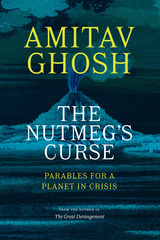
A powerful work of history, essay, testimony, and polemic, Amitav Ghosh’s new book traces our contemporary planetary crisis back to the discovery of the New World and the sea route to the Indian Ocean. The Nutmeg’s Curse argues that the dynamics of climate change today are rooted in a centuries-old geopolitical order constructed by Western colonialism. At the center of Ghosh’s narrative is the now-ubiquitous spice nutmeg. The history of the nutmeg is one of conquest and exploitation—of both human life and the natural environment. In Ghosh’s hands, the story of the nutmeg becomes a parable for our environmental crisis, revealing the ways human history has always been entangled with earthly materials such as spices, tea, sugarcane, opium, and fossil fuels. Our crisis, he shows, is ultimately the result of a mechanistic view of the earth, where nature exists only as a resource for humans to use for our own ends, rather than a force of its own, full of agency and meaning.
Writing against the backdrop of the global pandemic and the Black Lives Matter protests, Ghosh frames these historical stories in a way that connects our shared colonial histories with the deep inequality we see around us today. By interweaving discussions on everything from the global history of the oil trade to the migrant crisis and the animist spirituality of Indigenous communities around the world, The Nutmeg’s Curse offers a sharp critique of Western society and speaks to the profoundly remarkable ways in which human history is shaped by non-human forces.
READERS
Browse our collection.
PUBLISHERS
See BiblioVault's publisher services.
STUDENT SERVICES
Files for college accessibility offices.
RECENTLY PUBLISHED



UChicago Accessibility Resources
home | accessibility | search | about | contact us
BiblioVault ® 2001 - 2025
The University of Chicago Press