
 A SCHOLARLY BOOK REPOSITORY
25 start with O start with O

These retellings raise fresh questions about the relationship between home and the identities we expect to find rooted there and stress the elusiveness of a satisfying homecoming. They remind us that the Odyssey’s happy ending is itself qualified by the hero’s unsettled future, the violence of his return, and the independent desires of his friends and family members. At the same time, they highlight new obstacles to homecoming posed by the modern world with its political and economic upheavals, newly configured family relations and gender roles, and diminished confidence in the stability of identity. The authors discussed include Charlotte Yonge, James Joyce, Virginia Woolf, Rebecca West, George Seferis, Yannis Ritsos, Gwendolyn Brooks, Charles Frazier, W. B. Sebald, Marilynne Robinson, and Zachary Mason.
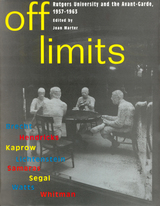
Off Limits is the first examination of the Rutgers group, artists who came together on the Rutgers University, New Brunswick campus during the 1950s and revolutionized art practices and pedagogy. Based on interviews with artists, critics, and dealers from the period, the book connects the initiation of major trends such as Happenings, Pop Art, and Fluxus to the faculty, students, art curriculum, and events at the university. It is the first book to look not only at the work of individual artists, but to consider how interactions between these artists influenced their groundbreaking work.
Rutgers was clearly the place to be for experimental artists during the late 1950s and early 1960s. Allan Kaprow’s first Happening was presented at Rutgers. Roy Lichtenstein’s first Pop paintings, George Segal’s earliest figurative tableaux, Lucas Samaras’s radical exploration of media, and proto-Fluxus events by Robert Watts and George Brecht all took place on and around the campus. The innovative group rejected Abstract Expressionism for art based on the immediate experience of urban and industrial life, creating startling new artforms which remain startling and provocative.
Led by the theoretical writings and art practice of Kaprow, the group created a New Art—art beyond the limits of the conventional and predictable, even beyond accepted notions of progressive trends. Lichtenstein recalls in an interview, “Kaprow showed us that art didn’t have to look like art.” Along with Lichtenstein, Kaprow, Segal, and Watts taught at Rutgers and challenged one another to take art “Off Limits” — beyond the limits of the conventional, the predictable — even beyond the progressive, as defined by Abstract Expressionist gesturalism. Their art incorporated the gritty environs, the technological, the everyday, making art radical, outrageous, disturbing, and humorous.
WINNER, Certificate of Excellence in “Scholarly Publications” from the Illinois State Historical Society’s 2025 Best of Illinois History Awards!
Honorable Mention, 2025 Society of Midland Authors Award in History!
The challenge to preserve Chicagoland’s unique haven
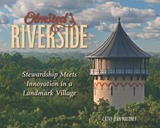
Just outside the bustling metropolis of Chicago lies the unlikely green oasis of Riverside, Illinois, a small village that has continued to directly influence American landscapes and suburbs since the 1870s. Once farmland, the location provided a blank canvas for preeminent designers Fredrick Law Olmsted and Calvert Vaux’s manifestation of a truly democratic society. Olmsted’s Riverside details the village’s historical significance, harmony with nature, and its nearly 150-year impact on American suburbs today.
Cathy Jean Maloney explores how Riverside’s layout and design presaged today’s urban planning goals of walkability, green space, public transportation access, sustainability, and resiliency. Houses in Riverside are set back from the road, sidewalks meander along gently curving roads, and public green spaces abound. Maloney shows how Riverside’s leaders and residents struggled with stewardship of Olmsted’s ideals by balancing competing interests in suburban development and Chicago sprawl from the 1870s to the 2020s. She details in chronological chapters how the village adapted to tragedies such as the Great Fire of 1871 and the Panic of 1873, as well as advancements in transportation, local civic life, urban policy, and environmental thought, all while staying true to the framework inherited from Olmsted and Vaux.
Olmsted’s Riverside provides engaging examples of how citizen involvement can protect a community’s ideals. This richly illustrated volume combines landscape architecture, regional history, and urban design to show how audacious civic planning and thoughtful conservation can provide a model for future American suburbs.
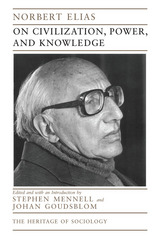
This volume is a carefully chosen collection of Elias's most important writings and includes many of his most brilliant ideas. The development of Elias's thinking during the course of his long career is traced along with a discussion of how his work relates to other major sociologists and how the various selections are interconnected. The result is a consistent and stimulating look at one of sociology's founding thinkers.
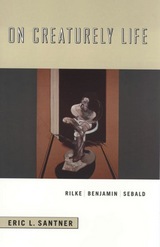
Santner traces this theme of creaturely life from its poetic and philosophical beginnings in the first half of the twentieth century to the writings of the enigmatic German novelist W. G. Sebald. Sebald’s entire oeuvre, Santner argues, can be seen as an archive of creaturely life. For Sebald, the work on such an archive was inseparable from his understanding of what it means to engage ethically with another person’s history and pain, an engagement that transforms us from indifferent individuals into neighbors.
An indispensable book for students of Sebald, On Creaturely Life is also a significant contribution to critical theory.
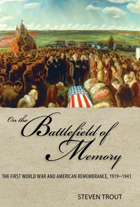
This work is a detailed study of how Americans in the 1920s and 1930s interpreted and remembered the First World War. Steven Trout asserts that from the beginning American memory of the war was fractured and unsettled, more a matter of competing sets of collective memories—each set with its own spokespeople— than a unified body of myth. The members of the American Legion remembered the war as a time of assimilation and national harmony. However, African Americans and radicalized whites recalled a very different war. And so did many of the nation’s writers, filmmakers, and painters.
Trout studies a wide range of cultural products for their implications concerning the legacy of the war: John Dos Passos’s novels Three Soldiers and 1919, Willa Cather’s One of Ours, William March’s Company K, and Laurence Stallings’s Plumes; paintings by Harvey Dunn, Horace Pippin, and John Steuart Curry; portrayals of the war in The American Legion Weekly and The American Legion Monthly; war memorials and public monuments like the Tomb of the Unknown Soldier; and commemorative products such as the twelve-inch tall Spirit of the American Doughboy statue.
Trout argues that American memory of World War I was not only confused and contradictory during the ‘20s and ‘30s, but confused and contradictory in ways that accommodated affirmative interpretations of modern warfare and military service. Somewhat in the face of conventional wisdom, Trout shows that World War I did not destroy the glamour of war for all, or even most, Americans and enhanced it for many.

In this and in her previous book, The Sarah Siddons Audio Files, Pascoe’s engaging narrative innovates a new scholarly form involving immersive research practice to attempt a cross-cultural version of reader-response criticism. On the Bullet Train with Emily Brontë will appeal to scholars in the fields of 19th-century British literature, adaptation studies, and Japanese literary history.

The 1830s is an overlooked period in American naval history and is usually overshadowed by the more dramatic War of 1812 and the Civil War. Nevertheless, the personnel, operations, technologies, policies, and vision of the Navy of that era, which was emerging from the “Age of Sail,” are important components of its evolution, setting it on the long path to its status as a global maritime power. On Wide Seas: The US Navy in the Jacksonian Era details the ways in which the US Navy transformed from an antiquated arm of the nation’s military infrastructure into a more dynamic and effective force that was soon to play a pivotal role in a number of national and international conflicts.
By Andrew Jackson’s inauguration in 1829, the Navy had engaged with two major powers, defended American shipping, conducted antipiracy operations, and provided a substantive, long-term overseas presence. The Navy began to transform during Jackson’s administration due in part to the policies of the administration and to the emerging officer corps, which sought to professionalize its own ranks, modernize the platforms on which it sailed, and define its own role within national affairs and in the broader global maritime commons. Jackson had built his reputation as a soldier, but he quickly recognized as president the necessity for a navy that could foster his policies. To expand American commerce, he needed a navy that could defend shipping as well as conduct punitive raids or deterrence missions.
Jackson developed a clear, concise naval strategy that policymakers and officers alike could seize and execute. He also provided a vision for the Navy, interceded to resolve naval disciplinary challenges, and directed naval operations. Also, given Jackson’s own politics, junior officers were emboldened by the populist era to challenge traditional, conservative thinking. They carried out a collective vision that coincided with the national literary movement that recognized America’s future would rely upon the Navy.
Chuck Tryon offers a compelling introduction to a world in which movies have become digital files. He navigates the complexities of digital delivery to show how new modes of access—online streaming services like YouTube or Netflix, digital downloads at iTunes, the popular Redbox DVD kiosks in grocery stores, and movie theaters offering digital projection of such 3-D movies as Avatar—are redefining how audiences obtain and consume motion picture entertainment. Tryon also tracks the reinvention of independent movies and film festivals by enterprising artists who have built their own fundraising and distribution models online.
Unique in its focus on the effects of digital technologies on movie distribution, On-Demand Culture offers a corrective to address the rapid changes in the film industry now that movies are available at the click of a button.
In O'Neill's Shakespeare , Normand Berlin explores the relationship of William Shakespeare and Eugene O'Neill through detailed, often surprising, intertextual readings of the two great playwrights' work. "Of course, it would have been impossible for O'Neill not to have been influenced by Shakespeare," acknowledges Berlin. But this is an influence of an unusual and extraordinary sort, "a family romance" that transcends their obvious differences—a romance that "takes in all O'Neill's life and art."
In the first book-length study of this crucial literary and dramatic relationship, Berlin probes far beyond the usual listing of allusions and references. This is the exploration of an "essential, basic, even natural" connection, in which Shakespeare is shown to have fundamentally shaped O'Neill's creative imagination. Following O'Neill's career chronologically, Berlin divides his study into two parts. The "first career" (culminating in Mourning Becomes Electra) is explored through recurring themes that evoke Shakespeare: the sea, black and white, and the family. O'Neill's "second career" (from Ah! Wilderness until the last plays) is examined through Shakespearean genre classifications: comedy, history, tragedy, and tragicomedy. Though always grounded in close textual readings, Berlin's analysis spirals outward to encompass O'Neill's artistic and psychological development and touches on the questions of tradition, transcendence, and human nature inevitably raised when such literary connections across history are drawn.
O'Neill's Shakespeare is more than a reminder that Shakespeare continues to haunt Western culture; it is a careful and fascinating analysis of a particular legacy in American drama. The book has insights to offer to specialists in Shakespeare and O'Neill, and to any reader interested in the transmission of ideas through Western culture. Berlin's study of the unconscious and conscious uses of Shakespeare by O'Neill provide a valuable new understanding of O'Neill's artistry. It is also an eloquent, thoughtful account that blends the transcendence of Shakespeare's influence with the particular ways in which every era must refashion Shakespeare so that "the past becomes the present."
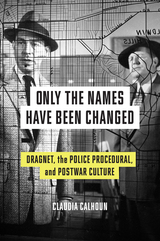
2022 Peter C. Rollins Book Award, Northeast Texas Popular Culture and American Culture Associations (NEPCA)
In the postwar era, the police procedural series Dragnet informed Americans on the workings of the criminal justice system and instructed them in their responsibilities as citizens.
Among shifting politics, tastes, and technology in television history, one genre has been remarkably persistent: the cop show. Claudia Calhoun returns to Dragnet, the pioneering police procedural and an early transmedia franchise, appearing on radio in 1949, on TV and in film in the 1950s, and in later revivals. More than a popular entertainment, Dragnet was a signifier of America’s postwar confidence in government institutions—and a publicity vehicle for the Los Angeles Police Department.
Only the Names Have Been Changed shows how Dragnet’s “realistic” storytelling resonated across postwar culture. Calhoun traces Dragnet’s “semi-documentary” predecessors, and shows how Jack Webb, Dragnet’s creator, worked directly with the LAPD as he produced a series that would likewise inspire public trust by presenting day-to-day procedural justice, rather than shootouts and wild capers. Yet this realism also set aside the seething racial tensions of Los Angeles as it was. Dragnet emerges as a foundational text, one that taught audiences to see police as everyday heroes not only on TV but also in daily life, a lesson that has come under scrutiny as Americans increasingly seek to redefine the relationship between policing and public safety.
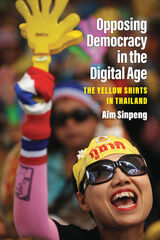
Opposing Democracy in the Digital Age is about why ordinary people in a democratizing state oppose democracy and how they leverage both traditional and social media to do so. Aim Sinpeng focuses on the people behind popular, large-scale antidemocratic movements that helped bring down democracy in 2006 and 2014 in Thailand. The yellow shirts (PAD—People’s Alliance for Democracy) that are the focus of the book are antidemocratic movements grown out of democratic periods in Thailand, but became the catalyst for the country’s democratic breakdown. Why, when, and how supporters of these movements mobilize offline and online to bring down democracy are some of the key questions that Sinpeng answers. While the book primarily uses a qualitative methodological approach, it also uses several quantitative tools to analyze social media data in the later chapters. This is one of few studies in the field of regime transition that focuses on antidemocratic mobilization and takes the role of social media seriously.
Lessie B. Branch confronts the tension between black Americans' economic realities and the hope many felt for the future, looking at survey data alongside the rhetoric of leading black figures, including President Obama. This disparity has caused a dangerous resistance to social activism, as discourses of optimism privilege individual success over the need for collective action. Branch sees the emergence of the Black Lives Matter movement as a constructive change in this dynamic. As Americans continue to grapple with complicated questions of race and progress in classrooms, in the media, and in legislatures, this short, provocative book will inform and enrich these important discussions.
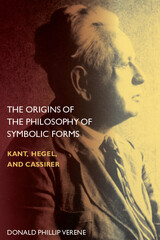
Verene takes as his departure point that Cassirer never wishes to argue Kant over Hegel. Instead he takes from each what he needs, realizing that philosophical idealism itself did not stop with Kant but developed to Hegel, and that much of what remains problematic in Kantian philosophy finds particular solutions in Hegel’s philosophy. Cassirer never replaces transcendental reflection with dialectical speculation, but he does transfer dialectic from a logic of illusion, that is, the form of thinking beyond experience as Kant conceives it in the Critique of Pure Reason, to a logic of consciousness as Hegel employs it in the Phenomenology of Spirit. Cassirer rejects Kant’s thing-in-itself but he also rejects Hegel’s Absolute as well as Hegel’s conception of Aufhebung. Kant and Hegel remain the two main characters on his stage, but they are accompanied by a large secondary cast, with Goethe in the foreground. Cassirer not only contributes to Goethe scholarship, but in Goethe he finds crucial language to communicate his assertions. Verene introduces us to the originality of Cassirer’s philosophy so that we may find access to the riches it contains.
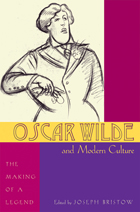
Oscar Wilde and Modern Culture: The Making of a Legend explores the meteoric rise, sudden fall, and legendary resurgence of an immensely influential writer’s reputation from his hectic 1881 American lecture tour to recent Hollywood adaptations of his dramas. Always renowned—if not notorious—for his fashionable persona, Wilde courted celebrity at an early age. Later, he came to prominence as one of the most talented essayists and fiction writers of his time.
In the years leading up to his two-year imprisonment, Wilde stood among the foremost dramatists in London. But after he was sent down for committing acts of “gross indecency” it seemed likely that social embarrassment would inflict irreparable damage to his legacy. As this volume shows, Wilde died in comparative obscurity. Little could he have realized that in five years his name would come back into popular circulation thanks to the success of Richard Strauss’s opera Salome and Robert Ross’s edition of De Profundi. With each succeeding decade, the twentieth century continued to honor Wilde’s name by keeping his plays in repertory, producing dramas about his life, adapting his works for film, and devising countless biographical and critical studies of his writings.
This volume reveals why, more than a hundred years after his demise, Wilde’s value in the academic world, the auction house, and the entertainment industry stands higher than that of any modern writer.
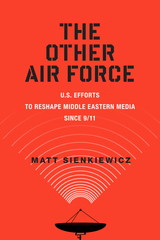
As it seeks to win the hearts and minds of citizens in the Muslim world, the United States has poured millions of dollars into local television and radio programming, hoping to generate pro-American currents on Middle Eastern airwaves. However, as this fascinating new book shows, the Middle Eastern media producers who rely on these funds are hardly puppets on an American string, but instead contribute their own political and creative agendas while working within U.S. restrictions.
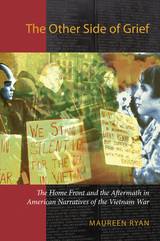
The lingering aftereffects of the Vietnam War resonate to this day throughout American society: in foreign policy, in attitudes about the military and war generally, and in the contemporary lives of members of the so-called baby boom generation who came of age during the 1960s and early 1970s. While the best-known personal accounts of the war tend to center on the experience of combat, Maureen Ryan's The Other Side of Grief examines the often overlooked narratives—novels, short stories, memoirs, and films—that document the war's impact on the home front.
In analyzing the accounts of Vietnam veterans, women as well as men, Ryan focuses on the process of readjustment, on how the war continued to insinuate itself into their lives, their families, and their communities long after they returned home. She looks at the writings of women whose husbands, lovers, brothers, and sons served in Vietnam and whose own lives were transformed as a result. She also appraises the experiences of the POWs who came to be embraced as the war's only heroes; the ordeal of Vietnamese refugees who fled their “American War” to new lives in the United States; and the influential movement created by those who committed themselves to protesting the war.
The end result of Ryan's investigations is a cogent synthesis of the vast narrative literature generated by the Vietnam War and its aftermath. Together those stories powerfully demonstrate how deeply the legacies of the war penetrated American culture and continue to reverberate still.
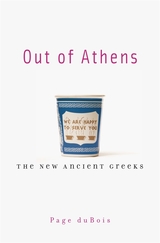
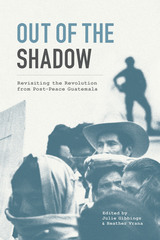
Guatemala’s “Ten Years of Spring” (1944–1954) began when citizens overthrew a military dictatorship and ushered in a remarkable period of social reform. This decade of progressive policies ended abruptly when a coup d’état, backed by the United States at the urging of the United Fruit Company, deposed a democratically elected president and set the stage for a period of systematic human rights abuses that endured for generations. Presenting the research of diverse anthropologists and historians, Out of the Shadow offers a new examination of this pivotal chapter in Latin American history.
Marshaling information on regions that have been neglected by other scholars, such as coastlines dominated by people of African descent, the contributors describe an era when Guatemalan peasants, Maya and non-Maya alike, embraced change, became landowners themselves, diversified agricultural production, and fully engaged in electoral democracy. Yet this volume also sheds light on the period’s atrocities, such as the US Public Health Service’s medical experimentation on Guatemalans between 1946 and 1948. Rethinking institutional memories of the Cold War, the book concludes by considering the process of translating memory into possibility among present-day urban activists.
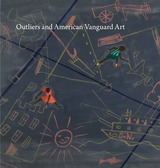
The art works in Outliers and American Vanguard Art come from three distinct periods when the intersections between mainstream and outlier artists were most dynamic and productive, ushering in exhibitions of art based on various degrees of co-existence, inclusion, and assimilation. Works by such diverse artists as Charles Sheeler, Christina Ramberg, and Matt Mullican are set in conversation with a range of works by such self-taught artists as Horace Pippin, Janet Sobel, and Henry Darger. Cooke also examines a recent increase of radically expressive work that challenges what it means to be an outlier today. She reveals how these distinctions have been freighted with a particularly American point of view as she investigates our assumptions about creativity, artistic practice, and the role of the artist in contemporary culture.
Outliers and American Vanguard Art is the most comprehensive show ever to examine outliers in dialogue with their established peers. It is sure to inspire vigorous conversation about how artists and the work they make are represented.
Boyd's thoughtful approach to imitation in Latin poetry brings into prominence the formative role played by Virgil in shaping Ovid's "poetic memory," even in the Amores. The detailed examination of Ovidian extended similes shows how the poet exploits the literary past precisely in order to free himself from generic restraint and to expand the narrow horizons of elegy. Boyd argues that this paradox is the essence of Ovidian poetics.
Ovid's Literary Loves is an imaginative approach to imitation in Latin poetry and makes a significant contribution to current discussions of the subject. This is one of the first contemporary scholarly monographs on the Amores, and it will find a large and welcoming audience of Latinists at all levels of study.
Barbara Weiden Boyd is Associate Professor of Classics, Bowdoin College, Brunswick, Maine.
READERS
Browse our collection.
PUBLISHERS
See BiblioVault's publisher services.
STUDENT SERVICES
Files for college accessibility offices.
RECENTLY PUBLISHED



UChicago Accessibility Resources
home | accessibility | search | about | contact us
BiblioVault ® 2001 - 2025
The University of Chicago Press