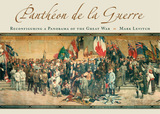
front cover of Panthéon De La Guerre
Panthéon De La Guerre
Reconfiguring a Panorama of the Great War
Mark Levitch
University of Missouri Press, 2006
In its day it was, quite simply, the world’s largest painting.
            The Panthéon de la Guerre was a cyclorama the size of a football field, featuring 5,000 full-length portraits of prominent figures from World War I—a painting that blatantly sought to arouse patriotic fervor in its viewers. This book traces that work’s shifting fortunes during its unlikely journey from Great War Paris to cold war Kansas City and examines the continuing journeys of its fragments in the world’s art markets.
Mark Levitch has written the first history and analysis of the Panthéon, capturing its social life in a story full of surprising twists and turns and as epic as the painting itself. Created in Paris as an artist-generated propaganda project while the war raged, the Panthéonwas celebrated there as a solemn and nostalgic work after the war, then was promoted as a circuslike spectacle on a postwar tour of the United States when it was “updated” to appeal to Americans’ more celebratory view of the conflict. Consigned to storage and all but forgotten after World War II, the Panthéon was eventually procured for Kansas City’s Liberty Memorial in 1956, where less than 7 percent of the work was reconfigured into a smaller U.S.-centric mural—some of the unused fragments eventually surfacing in Paris flea markets and on eBay.
Levitch looks at the Panthéon as both painting and artifact, combining cultural history, art history, and material culture studies to trace the changing reception of traditional art in the new age of mechanical media. He assesses the changing values attached to the Panthéon and argues that the panorama’s status and frequent reshaping have both informed and been informed by the experience and memory of the First World War in France and the United States—and also reflects on how it has promoted a politically and culturally conservative agenda.
            Brimming with facts and insights that will amaze anyone who has known the painting in any of its incarnations, Levitch’s handsomely illustrated book provides a unique lens through which to view a conflict and its commemoration. And as people continue to place importance on commemorative projects, it is a powerful reminder of how ephemeral such grand undertakings can be.
[more]

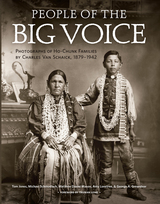
front cover of People of the Big Voice
People of the Big Voice
Photographs of Ho-Chunk Families by Charles Van Schaick, 1879-1942
Tom Jones
Wisconsin Historical Society Press, 2011

People of the Big Voice tells the visual history of Ho-Chunk families at the turn of the twentieth century and beyond as depicted through the lens of Black River Falls, Wisconsin studio photographer, Charles Van Schaick. The family relationships between those who “sat for the photographer” are clearly visible in these images—sisters, friends, families, young couples—who appear and reappear to fill in a chronicle spanning from 1879 to 1942. Also included are candid shots of Ho-Chunk on the streets of Black River Falls, outside family dwellings, and at powwows. As author and Ho-Chunk tribal member Amy Lonetree writes, “A significant number of the images were taken just a few short years after the darkest, most devastating period for the Ho-Chunk. Invasion, diseases, warfare, forced assimilation, loss of land, and repeated forced removals from our beloved homelands left the Ho-Chunk people in a fight for their culture and their lives.”
The book includes three introductory essays (a biographical essay by Matthew Daniel Mason, a critical essay by Amy Lonetree, and a reflection by Tom Jones) and 300-plus duotone photographs and captions in gallery style. Unique to the project are the identifications in the captions, which were researched over many years with the help of tribal members and genealogists, and include both English and Ho-Chunk names.
[more]

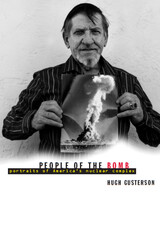
front cover of People Of The Bomb
People Of The Bomb
Portraits of America’s Nuclear Complex
Hugh Gusterson
University of Minnesota Press, 2004

How the American military-industrial complex has invaded our consciousness to create consent for its programs

“We have had the bomb on our minds since 1945. It was first our weaponry and then our diplomacy, and now it’s our economy. How can we suppose that something so monstrously powerful would not, after forty years, compose our identity?” —E. L. Doctorow

This book tells the story of how—like it or not, know it or not—we have become “the people of the bomb.” Integrating fifteen years of field research at weapons laboratories across the United States with discussion of popular movies, political speeches, media coverage of war, and the arcane literature of defense intellectuals, Hugh Gusterson shows how the military-industrial complex has built consent for its programs and, in the process, taken the public “nuclear.”People of the Bomb mixes empathic and vivid portraits of individual weapons scientists with hard-hitting scrutiny of defense intellectuals’s inability to foresee the end of the Cold War, government rhetoric on missile defense, official double standards about nuclear proliferation, and pork barrel politics in the nuclear weapons complex. Overall, the book assembles a disturbing picture of the ways in which the military-industrial complex has transformed our public culture and personal psychology in the half century since we entered the nuclear age.

[more]

front cover of Photo-Attractions
Photo-Attractions
An Indian Dancer, an American Photographer, and a German Camera
Ajay Sinha
Rutgers University Press, 2022
In Spring 1938, an Indian dancer named Ram Gopal and an American writer-photographer named Carl Van Vechten came together for a photoshoot in New York City. Ram Gopal was a pioneer of classical Indian dance and Van Vechten was reputed as a prominent white patron of the African-American movement called the Harlem Renaissance. Photo-Attractions describes the interpersonal desires and expectations of the two men that took shape when the dancer took pose in exotic costumes in front of Van Vechten’s Leica camera. The spectacular images provide a rare and compelling record of an underrepresented history of transcultural exchanges during the interwar years of early-20th century, made briefly visible through photography.
 
Art historian Ajay Sinha uses these hitherto unpublished photographs and archival research to raise provocative and important questions about photographic technology, colonial histories, race, sexuality and transcultural desires. Challenging the assumption that Gopal was merely objectified by Van Vechten’s Orientalist gaze, he explores the ways in which the Indian dancer co-authored the photos. In Sinha’s reading, Van Vechten’s New York studio becomes a promiscuous contact zone between world cultures, where a “photo-erotic” triangle is formed between the American photographer, Indian dancer, and German camera.
 
A groundbreaking study of global modernity, Photo-Attractions brings scholarship on American photography, literature, race and sexual economies into conversation with work on South Asian visual culture, dance, and gender. In these remarkable historical documents, it locates the pleasure taken in cultural difference that still resonates today.
[more]

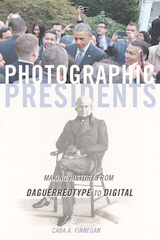
front cover of Photographic Presidents
Photographic Presidents
Making History from Daguerreotype to Digital
Cara A. Finnegan
University of Illinois Press, 2021
Defining the Chief Executive via flash powder and selfie sticks

Lincoln’s somber portraits. Lyndon Johnson’s swearing in. George W. Bush’s reaction to learning about the 9/11 attacks. Photography plays an indelible role in how we remember and define American presidents. Throughout history, presidents have actively participated in all aspects of photography, not only by sitting for photos but by taking and consuming them. Cara A. Finnegan ventures from a newly-discovered daguerreotype of John Quincy Adams to Barack Obama’s selfies to tell the stories of how presidents have participated in the medium’s transformative moments. As she shows, technological developments not only changed photography, but introduced new visual values that influence how we judge an image. At the same time, presidential photographs—as representations of leaders who symbolized the nation—sparked public debate on these values and their implications.

An original journey through political history, Photographic Presidents reveals the intertwined evolution of an American institution and a medium that continues to define it.
[more]

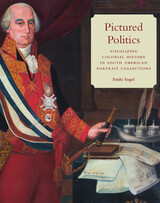
front cover of Pictured Politics
Pictured Politics
Visualizing Colonial History in South American Portrait Collections
By Emily Engel
University of Texas Press, 2020

The Spanish colonial period in South America saw artists develop the subgenre of official portraiture, or portraits of key individuals in the continent’s viceregal governments. Although these portraits appeared to illustrate a narrative of imperial splendor and absolutist governance, they instead became a visual record of the local history that emerged during the colonial occupation.

Using the official portrait collections accumulated between 1542 and 1830 in Lima, Buenos Aires, and Bogotá as a lens, Pictured Politics explores how official portraiture originated and evolved to become an essential component in the construction of Ibero-American political relationships. Through the surviving portraits and archival evidence—including political treatises, travel accounts, and early periodicals—Emily Engel demonstrates that these official portraits not only belie a singular interpretation as tools of imperial domination but also visualize the continent's multilayered history of colonial occupation. The first stand alone analysis of South American portraiture, Pictured Politics brings to light the historical relevance of political portraits in crafting the history of South American colonialism.
[more]

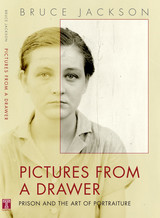
front cover of Pictures from a Drawer
Pictures from a Drawer
Prison and the Art of Portraiture
Bruce Jackson
Temple University Press, 2009
For more than forty years, Bruce Jackson has been documenting—in books, photographs, audio recording and film—inmates' lives in American prisons. In November 1975, he acquired a collection of old ID photos while he was visiting the Cummins Unit, a state prison farm in Arkansas. They are published together for the first time in this remarkable book. The 121 images that appear here were likely taken between 1915-1940. As Jackson describes in an absorbing introduction, the function of these photos was not portraiture— their function was to "fold a person into the controlled space of a dossier." Here, freed from their prison "jackets" and printed at sizes far larger than their originals, these one-time ID photos have now become portraits. Jackson's restoration transforms what were small bureaucratic artifacts into moving images of real men and women. Pictures from a Drawer also contains an extraordinary description of everyday life at Cummins prison in the 1950s, written originally by hand and presented to Jackson in 1973 by its author, a longtime inmate.
[more]

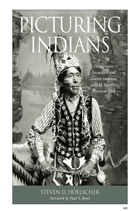
front cover of Picturing Indians
Picturing Indians
Photographic Encounters and Tourist Fantasies in H. H. Bennett's Wisconsin Dells
Steven D. Hoelscher
University of Wisconsin Press, 2008
Today a tourist mecca, the area now known as the Wisconsin Dells was once wilderness—and a gathering place for the region’s Native peoples, the Ho-Chunk, who for centuries migrated to this part of the Wisconsin River for both sustenance and spiritual renewal. By the late 1800s their numbers had dwindled through displacement or forcible removal, and it was this smaller band that caught the attention of photographer Henry Hamilton Bennett. Having built his reputation on his photographs of the Dells’ steep gorges and fantastic rock formations, H. H. Bennett now turned his camera upon the Ho-Chunk themselves, and thus began the many-layered relationship unfolded by Steven D. Hoelscher in Picturing Indians: Photographic Encounters and Tourist Fantasies in H. H. Bennett’s Wisconsin Dells.
            The interactions between Indian and white man, photographer and photographed, suggested a relationship in which commercial motives and friendly feelings mixed, though not necessarily in equal measure. The Ho-Chunk resourcefully sought new ways to survive in the increasingly tourist-driven economy of the Dells. Bennett, struggling to keep his photography business alive, capitalized on America’s comfortably nostalgic image of Native peoples as a vanishing race, no longer threatening and now safe for white consumption.
            Hoelscher traces these developments through letters, diaries, financial records, guidebooks, and periodicals of the day. He places Bennett within the context of contemporary artists and photographers of American Indians and examines the receptions of this legacy by the Ho-Chunk today. In the final chapter, he juxtaposes Bennett’s depictions of Native Americans with the work of present-day Ho-Chunk photographer Tom Jones, who documents the lives of his own people with a subtlety and depth foreshadowed, a century ago, in the flickers of irony, injury, humor, and pride conveyed by his Ho-Chunk ancestors as they posed before the lens of a white photographer.


Winner, Book Award of Merit, Wisconsin Historical Society, Best Books for General Audiences, selected by the American Association of School Librarians, and Best Books for Regional Interests, selected by the Public Library Association
[more]

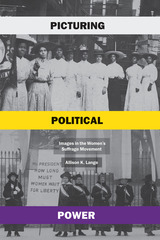
front cover of Picturing Political Power
Picturing Political Power
Images in the Women’s Suffrage Movement
Allison K. Lange
University of Chicago Press, 2020
Lange's examination of the fights that led to the ratification of the Nineteenth Amendment in 1920 reveals the power of images to change history.

For as long as women have battled for equitable political representation in America, those battles have been defined by images—whether illustrations, engravings, photographs, or colorful chromolithograph posters. Some of these pictures have been flattering, many have been condescending, and others downright incendiary. They have drawn upon prevailing cultural ideas of women’s perceived roles and abilities and often have been circulated with pointedly political objectives.

Picturing Political Power offers perhaps the most comprehensive analysis yet of the connection between images, gender, and power. In this examination of the fights that led to the ratification of the Nineteenth Amendment in 1920, Allison K. Lange explores how suffragists pioneered one of the first extensive visual campaigns in modern American history. She shows how pictures, from early engravings and photographs to colorful posters, proved central to suffragists’ efforts to change expectations for women, fighting back against the accepted norms of their times. In seeking to transform notions of womanhood and win the right to vote, white suffragists emphasized the compatibility of voting and motherhood, while Sojourner Truth and other leading suffragists of color employed pictures to secure respect and authority. Picturing Political Power demonstrates the centrality of visual politics to American women’s campaigns throughout the nineteenth and early twentieth centuries, revealing the power of images to change history.
[more]

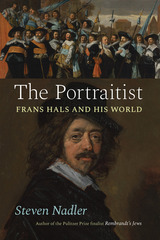
front cover of The Portraitist
The Portraitist
Frans Hals and His World
Steven Nadler
University of Chicago Press, 2022
A biography of the great portraitist Frans Hals that takes the reader into the turbulent world of the Dutch Golden Age. 
 
 
Frans Hals was one of the greatest portrait painters in history, and his style transformed ideas and expectations about what portraiture can do and what a painting should look like.
 
Hals was a member of the great trifecta of Dutch Baroque painters alongside Rembrandt and Vermeer, and he was the portraitist of choice for entrepreneurs, merchants, professionals, theologians, intellectuals, militiamen, and even his fellow artists in the Dutch Golden Age. His works, with their visible brush strokes and bold execution, lacked the fine detail and smooth finish common among his peers, and some dismissed his works as sloppy and unfinished. But for others, they were fresh and exciting, filled with a sense of the sitter’s animated presence captured with energy and immediacy.
 
Steven Nadler gives us the first full-length biography of Hals in many years and offers a view into seventeenth-century Haarlem and this culturally rich era of the Dutch Republic. He tells the story not only of Hals’s life, but also of the artistic, social, political, and religious worlds in which he lived and worked.
 
[more]

front cover of Portraits
Portraits
A Gallery of Intellectuals
Edward Shils
University of Chicago Press, 1997
In these vivid portraits of prominent twentieth-century intellectuals, Edward Shils couples the sensitivity of a biographer with the profound knowledge of a highly respected scholar. Ranging as widely across various disciplines as Shils himself did, the essays gathered here share a distaste for faddists who "run with the intellectual mob" and a deep respect for intellectuals who maintain their integrity under great pressure.

Highlights include an affectionate treatment of Leo Szilard, the physicist whose involvement with the development of the atomic bomb led him to work ceaselessly to address its social consequences; a discussion of the educational philosophy of Robert Maynard Hutchins, the University of Chicago's fifth and most controversial president; an appreciative account of the Polish emigré Leopold Labedz's well-informed and outspoken resistance to Communism; and an essay about the extraordinary Indian writer Nirad Chaudhuri.

Many of these essays have appeared in The American Scholar, edited by Joseph Epstein, who introduces this volume with his own portrait of Edward Shils.

"Though professionally a sociologist, Edward Shils was a man of wide cosmopolitan culture and experience, greatly concerned with the public problems of his time: in particular with those created by the rise of new and dangerous ideologies, the frightening possibilities of science, and the apparent abrogation of public responsibility by many Western intellectuals."—Hugh Trevor-Roper

The late Edward Shils was a member of the University of Chicago's Committee on Social Thought for forty-five years and a fellow of Peterhouse, Cambridge University. His many books include The Calling of Sociology and The Intellectuals and the Powers, both published by the University of Chicago Press.
[more]

front cover of Portraits in a Nutshell
Portraits in a Nutshell
The Art and History of Coquilla Nut Snuff Boxes and Bottles
Donna S. Sanzone
Brandeis University Press, 2025
A gorgeously illustrated look at snuff boxes and bottles carved from the Brazilian coquilla nut reveals a larger history of commerce, cultural exchange, and power in the Atlantic world.
 
Portraits in a Nutshell showcases intricately carved snuff boxes and bottles sculpted from the Brazilian coquilla nut between the seventeenth and mid-nineteenth centuries. Both utilitarian and decorative, these bottles and boxes were produced and used by diverse people of wide-ranging geographic origin, racial background, and social standing. As a result, coquilla nut snuff boxes present a rich material archive of the Atlantic world and the central role of Indigenous and Black histories within it.
 
Despite being just three or four inches long, these coquilla nut snuff boxes encapsulate an early modern history of transoceanic movement and creativity. The carvings depict animals and fantastical creatures, scenes of religious and courtly life, portraits of political and military leaders, abolitionists and activists, and people at the margins of colonial society. These images are available to the public and to scholars for the first time in this book and will be of interest to antique collectors, art historians, social historians, and anyone interested in the unusual and the curious.
 
Over 250 detailed photographs of snuff bottles and boxes from the unique and wide-ranging collection of David Badger not only illustrate the exceptional skill of their creators but also tell the story of millions of Africans transported to Brazil during centuries of the transatlantic slave trade. The text demonstrates the interconnectedness of the Atlantic world, the movements of peoples and ideas, and the commercial exchange of goods and cultural and material objects in Africa, Brazil, the Caribbean, and North America. In this beautiful book, these objects reveal a story never before told.
 
With a preface by Matthew Francis Rarey, associate professor of African and Black Atlantic art history at Oberlin College, and an introduction by Gwendolyn DuBois Shaw, professor of art history at the University of Pennsylvania and director of the Arthur Ross Gallery.
[more]

front cover of Portraits of a Few of the People I’ve Made Cry
Portraits of a Few of the People I’ve Made Cry
Stories
Christine Sneed
University of Massachusetts Press, 2010
The ten stories in this striking debut collection examine the perils of love and what it means to live during an era when people will offer themselves, almost unthinkingly, to strangers. Risks and repercussions are never fully weighed. People leap and almost always land on rocky ground. May-December romances flourish in these stories, as do self-doubt and, in many cases, serious regret. Mysterious, dangerous benefactors, dead and living artists, movie stars and college professors, plagiarists, and distinguished foreign novelists are among the many different characters. No one is blameless, but villains are difficult to single out--everyone seemingly bears responsibility for his or her desires and for the outcome of difficult choices so often made hopefully and naively.
[more]

front cover of Portraits of a Generation
Portraits of a Generation
Early Pentecostal Leaders
James Goff
University of Arkansas Press, 2002

A spirit of religious revival blazed across the United States just after 1900. With a focus on Holy Spirit power, early adherents stirred an enthusiastic response, first at a Bible school in Topeka and then in a small mission on Asuza Street in Los Angeles. Almost immediately, the movement spread to Houston, Chicago, and then northeastern urban centers. By the early 1910s the fervor had reached most parts of the United States, Canada, and northern Mexico, and eventually the converts called themselves pentecostals. Today there are pentecostals all over the world. From the beginning the movement was unusually diverse: women and African Americans were active in many of the early fellowships, and although some groups were segregated, some were interracial. Everytwhere, ordinary people passionately devoted themselves to salvation, Holy Ghost baptism evidenced by speaking in tongues, divine healing, and anticipation of the Lord’s imminent return.

This movement saw itself as leaderless, depending on individual conversion and a radical equality of souls — or, as early devotees would say, on the Holy Spirit. But a closer look reveals a host of forceful, clear-eyed leaders. This volume offers twenty biographical portraits of the first-generation pioneers who wove the different strands of Holy Spirit revivalism into a coherent and dramatically successful movement.
[more]

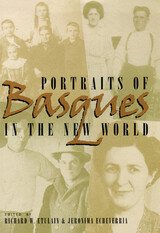
front cover of Portraits of Basques in the New World
Portraits of Basques in the New World
Richard W. Etulain
University of Nevada Press, 1999

A collection of new essays on notable historic and contemporary Basques of America's Far West that offers a perceptive and lively examination of the lives of one of the West's most resilient and successful ethnic minorities. It is essential reading for anyone interested in the Basque people or those interested in the process of immigration and assimilation: these profiles illustrate how America's Basque immigrants have achieved success in mainstream society while retaining strong ties to their ancient Old World culture.
[more]

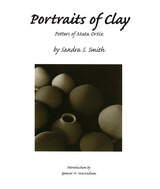
front cover of Portraits of Clay
Portraits of Clay
Potters of Mata Ortíz
Sandra S. Smith
University of Arizona Press, 1998
Not long ago, pottery was a lost art in Chihuahua, Mexico. But in the 1970s, near the ruins of Casas Grandes, an art revolution was born. Inspired by ancient pottery fragments from a tradition that had disappeared before the arrival of the first Europeans, a self-taught woodcutter-turned-artist reinvented an entire ceramic technology. Today Casas Grandes pottery, made by hand from local clays and mineral colors by a handful of artists, claims high prices and sets the standard for contemporary pottery. Photographer Sandra Smith traveled to Mata Ortíz to photograph the potters and to record their reflections on their work. Her portraits document their techniques—collecting and preparing the clay, forming by hand, sanding, and painting. They also capture intimate moments between artists and their art. For anyone who has ever admired Casas Grandes pottery, Portraits of Clay is a beautiful introduction to the potters and their work.
[more]

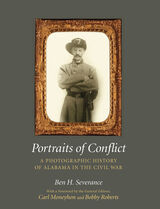
front cover of Portraits of Conflict
Portraits of Conflict
A Photographic History of Alabama in the Civil War
Ben H. Severance
University of Arkansas Press, 2012
Portraits of Conflict: A Photographic History of Alabama in the Civil War is the tenth volume in this acclaimed series showing the human side of the country's great national conflict. Over 230 photographs of soldiers and civilians from Alabama, many never seen before, are accompanied by their personal stories and woven into the larger narrative of the war both on the battlefield and the home front. Alabama is unusual among the Rebel states in that, while its people saw little fighting inside its boundaries, nearly one hundred thousand Alabamians served with Confederate units throughout the South. This volume chronicles their experiences in almost every battle east of the Mississippi River--especially at Sharpsburg, Chancellorsville, and Gettysburg under the legendary Robert E. Lee; at Murfreesboro and Chickamauga as part of the ill-fated Army of Tennessee; and at the famous siege of Vicksburg. Ultimately Union soldiers did invade the state, and Alabamians defended their homeland against enemy cavalry raiders at Selma and against Federal warships in the fight for Mobile Bay. The volume also includes accounts of some of Alabama's leading politicians as well as several of its more ordinary citizens. This new volume contains the same quality of photography and storytelling that has attracted Civil War enthusiasts since the first volume was published in 1987, making it another welcome addition to the series Civil War History called "a sensibly priced, beautifully produced photographic history."
[more]

logo for University of Arkansas Press
Portraits of Conflict
A Photographic History of Louisiana in the Civil War
Carl H. Moneyhon
University of Arkansas Press, 1990

front cover of Portraits of Conflict
Portraits of Conflict
A Photographic History of Missouri in the Civil War
William Garrett Piston
University of Arkansas Press, 2009
A deeply divided border state, heir to the “Bleeding Kansas” era, Missouri became the third most fought-over state in the war, following Virginia and Tennessee. Rich in resources and manpower, critical politically to both the Union and the Confederacy, it was the scene of conventional battles, river warfare, and cavalry raids. It saw the first combat by organized units of Native Americans and African Americans. It was also marked by guerrilla warfare of unparalleled viciousness. This volume, the ninth in the series, includes hundreds of photographs, many of them never before published. The authors provide text and commentary, organizing the photographs into chapters covering the origins of the war, its conventional and guerrilla phases, the war on the rivers, medicine (Sweeny’s medical knowledge adds a great deal to this chapter and expands our knowledge of its practice in the west), the experiences of Missourians who served out of state, and the process of reunion in the postwar years.
[more]

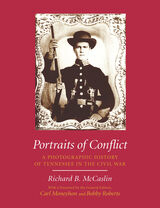
front cover of Portraits of Conflict
Portraits of Conflict
Tennessee: A Photographic History of Tennessee in the Civil War
Richard B. McCaslin
University of Arkansas Press, 2007
It’s one thing to understand that over twenty-thousand Confederate and Union soldiers died at the Battle of Murfreesboro. It’s quite another to study an ambrotype portrait of twenty-year-old private Frank B. Crosthwait, dressed in his Sunday best, looking somberly at the camera. In a tragically short time, he’ll be found on the battlefield, mortally wounded, still clutching the knotted pieces of handkerchief he used in a hopeless attempt to stop the bleeding from his injuries. Private Crosthwait’s image is one of more than 250 portraits—many never before published—to be found in the much anticipated Portraits of Conflict: A Photographic History of Tennessee in the Civil War. The eighth in the distinguished Portraits of Conflict series, this volume joins the personal and the public to provide a uniquely rich portrayal of Tennesseans—in uniforms both blue and gray—who fought and lost their lives in the Civil War. Here is the story of a widow working as a Union spy to support herself and her children. Of a father emerging from his house to find his Confederate soldier son dying at his feet. Of a nine-year-old boy who attached himself to a Union regiment after his mother died. Their stories and faces, joined with personal remembrances from recovered letters and diaries and ample historical information on secession, famous battles, surrender, and Reconstruction, make this new Portraits of Conflict a Civil War treasure.
[more]

front cover of Portraits of Justice
Portraits of Justice
The Wisconsin Supreme Court's First 150 Years
Trina E. Gray
Wisconsin Historical Society Press, 2003
First published in 1998 to commemorate the sesquicentennial of Wisconsin statehood, this book has been updated to mark the Wisconsin Supreme Court's 150th anniversary and the 125th anniversary of the State Bar of Wisconsin, both celebrated in 2003. It contains profiles of all those who have served as Wisconsin Supreme Court justices and a new introduction by Chief Justice Abrahamson summarizing the court's history and its vision for the future. This book is an excellent reference for students, attorneys, and all interested in the state's legal history.
[more]

front cover of Portraits of Medieval and Renaissance Living
Portraits of Medieval and Renaissance Living
Essays in Memory of David Herlihy
Samuel K. Cohn, Jr. and Steven A. Epstein, Editors
University of Michigan Press, 1996
This volume--a collection of essays dedicated to one of this century's most distinguished medieval historians, David Herlihy--introduces the general reader to the new social history of the Middle Ages and the Renaissance. The essays address three themes: sex and the family, power and patronage in local history, and society in town and countryside. The authors use current research to illustrate how Herlihy's ideas continue to shape work about the lives of powerful and ordinary people in this long and important period of Western history.
Portraits of Medieval and Renaissance Living opens with Herlihy's final summary of his views on family history, followed by a reminiscence by his most important collaborator, Christiane Klapisch-Zuber. The first group of essays takes us inside specific familial settings, using recent methods in anthropological, legal, and women's studies to uncover new dimensions of medieval and Renaissance family life. A second group of studies focuses on the question of authority in medieval society and advances new theses about politics and society in Florence and other local settings. The final group of authors considers the special circumstances of town and countryside in Italy, England, and Spain and draws insightful generalizations across territorial and national boundaries.
Like Herlihy's own work, these essays present innovative and challenging hypotheses about significant problems in the history of medieval and Renaissance Europe. Important new material on Florence, family history, religion, the Inquisition, and taxation is presented for the first time, but the essays are not simply technical exercises focused on small or isolated pieces of research. Thus the volume will go beyond the interest of specialists in medieval and Renaissance social history and will attract a wide audience of students and scholars.
Samuel K. Cohn, Jr., is Professor of History, Brandeis University. Steven Epstein is Professor of History, University of Colorado.
[more]

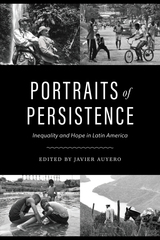
front cover of Portraits of Persistence
Portraits of Persistence
Inequality and Hope in Latin America
Javier Auyero
University of Texas Press, 2024

Profiles of triumph and hardship amid massive inequality in Latin America.

Each chapter of Portraits of Persistence, a project of the University of Texas Urban Ethnography Lab, offers an intimate portrait of one or two individual lives. The subjects are a diverse group of individuals from across the continent: grassroots activists and political brokers, private security entrepreneurs, female drug dealers, shantytown dwellers, and rural farmers, as well as migrants finding routes into and out of the region. Through these accounts, the writers explore issues that are common throughout today's world: precarious work situations, gender oppression, housing displacement, experiences navigating the bureaucracy for asylum seekers, state violence, environmental devastation, and access to good and affordable health care. Carefully situating these experiences within the sociohistorical context of their specific local regions or countries, editor Javier Auyero and his colleagues consider how people make sense of the paths their lives have taken, the triumphs and hardships they have experienced, and the aspirations they hold for the future. Ultimately, these twelve compelling profiles offer unique and personal windows into the region’s complex and multilayered reality.
[more]

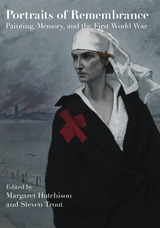
front cover of Portraits of Remembrance
Portraits of Remembrance
Painting, Memory, and the First World War
Edited by Margaret Hutchison and Steven Trout
University of Alabama Press, 2020
Interdisciplinary collection of essays on fine art painting as it relates to the First World War and commemoration of the conflict
 
Although photography and moving pictures achieved ubiquity during the First World War as technological means of recording history, the far more traditional medium of paint­ing played a vital role in the visual culture of combatant nations. The public’s appetite for the kind of up-close frontline action that snapshots and film footage could not yet pro­vide resulted in a robust market for drawn or painted battle scenes.
 
Painting also figured significantly in the formation of collective war memory after the armistice. Paintings became sites of memory in two ways: first, many governments and communities invested in freestanding pan­oramas or cycloramas that depicted the war or featured murals as components of even larger commemorative projects, and second, certain paintings, whether created by official artists or simply by those moved to do so, emerged over time as visual touchstones in the public’s understanding of the war.
 
Portraits of Remembrance: Painting, Memory, and the First World War examines the relationship between war painting and collective memory in Australia, Austria, Belgium, Canada, Croatia, France, Germany, Great Britain, New Zealand, Russia, Serbia, Turkey, and the United States. The paintings discussed vary tremendously, ranging from public murals and panoramas to works on a far more intimate scale, including modernist masterpieces and crowd-pleasing expressions of sentimentality or spiritualism. Contribu­tors raise a host of topics in connection with the volume’s overarching focus on memory, including national identity, constructions of gender, historical accuracy, issues of aesthetic taste, and connections between painting and literature, as well as other cultural forms.
 
[more]

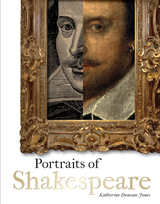
front cover of Portraits of Shakespeare
Portraits of Shakespeare
Katherine Duncan-Jones
Bodleian Library Publishing, 2015
Most of us can recall with clarity a favorite scene from Shakespeare. But call to mind the playwright’s appearance and there are many depictions to choose from with few widely accepted. Shakespeare himself left no description of his appearance nor can any evidence be found that he commissioned a portrait.

With Portraits of Shakespeare, Katherine Duncan-Jones poses a series of questions about the mysterious physical appearance of the brilliant writer of plays, poems, and sonnets: Why is it so difficult to find images of Shakespeare that were made during his lifetime? Which images are most likely to have been made by those close to the writer? And why do newly discovered images emerge with such startling regularity? With an eye toward answering these questions, the book begins with a broad analysis of the tradition of the “author portrait” before, during, and after Shakespeare’s lifetime. Duncan-Jones provides a detailed critique of three of the most widely accepted portraits: the engraving facing the First Folio’s title page; the sculptured stone bust that adorns Shakespeare’s funerary monument at Holy Trinity Church, Stratford-upon-Avon; and the “Chandos portrait,” an early seventeenth-century painting on canvas which is widely recognized as the best image. Through a painstaking historical analysis of the painting’s early history and provenance, Duncan-Jones arrives at a plausible new identification of both the artist and the artist’s personal connections with Shakespeare. Finally, taking the book into the present, she considers the afterlife of all three images in memorials, advertising, and in graphic art—all evidence of a continuing desire to put a face to one of literature’s most famous names.
[more]

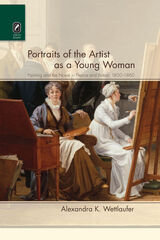
front cover of Portraits of the Artist as a Young Woman
Portraits of the Artist as a Young Woman
Painting and the Novel in France and Britain, 1800–1860
Alexandra K. Wettlaufer
The Ohio State University Press, 2011
As women entered the field of cultural production in unprecedented numbers in nineteenth-century France and Britain, they gradually forged a place for themselves, however tenuous, in artistic movements and exhibitions, in academies and salons, and finally in the public imagination. Portraits of the Artist as a Young Woman: Painting and the Novel in France and Britain, 1800–1860 focuses on a decisive period in that process of professional self-invention and maps out the concrete and symbolic roles played by women painters, real and fictional, in the construction of female artistic identity in the aesthetic and the public spheres. Alexandra K. Wettlaufer examines the diverse and complex ways canonical and non-canonical women painters and novelists—including Anne Brontë, Sydney Owenson, Margaret Gillies, Marceline Desbordes-Valmore, George Sand, and Hortense Haudebourt-Lescot—figured and brought forth the radical image of a female subject representing the world.
 
Wettlaufer brings to light a rich and nearly forgotten culture of women’s artistic production, allowing us to understand the nineteenth-century in more complex and nuanced ways across the borders of gender, genre, and nation. In her close readings of paintings by women and novels about women painting, she charts the political and cultural resonances of this artistic self-representation, tracing its evolution through themes of “The Studio” (Part I), “Cosmopolitan Visions” (Part II), and “The Portrait” (Part III). By pairing painting and literature in a single study that also considers works from two distinct but closely related cultures, Portraits of the Artist as a Young Woman locates the interpretation of these works in the dialogic context in which they were created and consumed, highlighting aesthetic and political intersections between nineteenth-century British and French art, literature, and feminism that are too often elided by the disciplinary boundaries of scholarship.
[more]

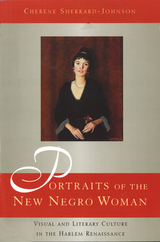
front cover of Portraits of the New Negro Woman
Portraits of the New Negro Woman
Visual and Literary Culture in the Harlem Renaissance
Cherene M. Sherrard-Johnson
Rutgers University Press, 2007

Of all the images to arise from the Harlem Renaissance, the most thought-provoking were those of the mulatta. For some writers, artists, and filmmakers, these images provided an alternative to the stereotypes of black womanhood and a challenge to the color line. For others, they represented key aspects of modernity and race coding central to the New Negro Movement. Due to the mulatta’s frequent ability to pass for white, she represented a variety of contradictory meanings that often transcended racial, class, and gender boundaries.

In this engaging narrative, Cherene Sherrard-Johnson uses the writings of Nella Larsen and Jessie Fauset as well as the work of artists like Archibald Motley and William H. Johnson to illuminate the centrality of the mulatta by examining a variety of competing arguments about race in the Harlem Renaissance and beyond.
[more]

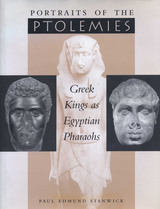
front cover of Portraits of the Ptolemies
Portraits of the Ptolemies
Greek Kings as Egyptian Pharaohs
By Paul Edmund Stanwick
University of Texas Press, 2003

As archaeologists recover the lost treasures of Alexandria, the modern world is marveling at the latter-day glory of ancient Egypt and the Greeks who ruled it from the ascension of Ptolemy I in 306 B.C. to the death of Cleopatra the Great in 30 B.C. The abundance and magnificence of royal sculptures from this period testify to the power of the Ptolemaic dynasty and its influence on Egyptian artistic traditions that even then were more than two thousand years old.

In this book, Paul Edmund Stanwick undertakes the first complete study of Egyptian-style portraits of the Ptolemies. Examining one hundred and fifty sculptures from the vantage points of literary evidence, archaeology, history, religion, and stylistic development, he fully explores how they meld Egyptian and Greek cultural traditions and evoke surrounding social developments and political events. To do this, he develops a "visual vocabulary" for reading royal portraiture and discusses how the portraits helped legitimate the Ptolemies and advance their ideology. Stanwick also sheds new light on the chronology of the sculptures, giving dates to many previously undated ones and showing that others belong outside the Ptolemaic period.
[more]

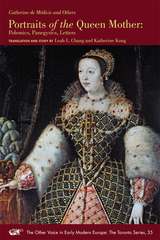
front cover of Portraits of the Queen Mother
Portraits of the Queen Mother
Polemics, Panegyrics, Letters
Catherine de Médicis and Others
Iter Press, 2014
Catherine de Médicis was portrayed in her day as foreign usurper, loving queen and queen mother, patron of the arts, and Machiavellian murderer of Protestants. Leah L. Chang and Katherine Kong assemble a diverse array of scathing polemic and lofty praise, diplomatic reports, and Catherine’s own letters, which together show how one extraordinary woman’s rule intersected with early modern conceptions of gender, maternity, and power.
[more]

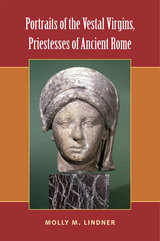
front cover of Portraits of the Vestal Virgins, Priestesses of Ancient Rome
Portraits of the Vestal Virgins, Priestesses of Ancient Rome
Molly M. Lindner
University of Michigan Press, 2015
For more than eleven hundred years, the Vestal Virgins dedicated their lives to the goddess Vesta, protector of the Roman state. Though supervised by a male priest, the Pontifex Maximus, they had privileges beyond those of most women; like Roman men, they dispensed favors and influence on behalf of their clients and relatives. In 1883, Rodolfo Lanciani, Director of Antiquities for Rome, discovered the first Vestal statues. The recovery of the Vestals’ house, and the objects contained therein, was an exciting moment in Roman archaeology. Newspapers were filled with details about the huge numbers of sculptures, inscriptions, jewelry, coins, and terracotta figures.

Molly M. Lindner examines the sculptural presentation of the Vestal Virgins and investigates what images of long-dead women tell us about their lives. She addresses why these portraits were created, and why they only began to appear in the late first or second century CE—much later than portraits of other Roman priestesses and nonimperial women. Lindner sheds light on the distinctions between a Vestal portrait and portraits of other priestesses, and considers why Vestal portraits do not copy each other’s headdresses and hairstyles. In addition to the extensive illustrations that complement the text, a catalog of all known Vestal portraits displays historical clues embedded in the hairstyles and facial features of the Vestals and other women of their day. In Portraits of the Vestal Virgins, Priestesses of Ancient Rome, Lindner has given a voice to the long-silent women of these extraordinary marble portraits.
 
[more]

front cover of Portraits of Violence
Portraits of Violence
War and the Aesthetics of Disfigurement
Suzannah Biernoff
University of Michigan Press, 2017
Portraits of Violence explores the image and idea of facial disfigurement in one of its most troubling modern formations, as a symbol and consequence of war. It opens with Nina Berman’s iconic photograph Marine Wedding, which provoked a debate about the medical, military, and psychological response to serious combat injuries. While these issues remain urgent, it is equally crucial to interrogate the representation of war and injury. The concepts of valor, heroism, patriotism, and courage assume visible form and do their cultural work when they are personified and embodied. The mutilated or disabled veteran’s body can connote the brutalizing, dehumanizing potential of modern combat.
 
Suzannah Biernoff draws on a wide variety of sources mainly from WWI but also contemporary photography and computer games. Each chapter revolves around particular images: Marine Wedding is discussed alongside Stuart Griffiths’ portraits of British veterans; Henry Tonks’ drawings of WWI facial casualties are compared to the medical photographs in the Gillies Archives; the production of portrait masks for the severely disfigured is approached through the lens of documentary film and photography; and finally the haunting image of one of Tonks’s patients reappears in BioShock, a highly successful computer game. The book simultaneously addresses a neglected area in disability studies; puts disfigurement on the agenda for art history and visual studies; and makes a timely and provocative contribution to the literature on the First World War.

[more]


Send via email Share on Facebook Share on Twitter