
 A SCHOLARLY BOOK REPOSITORY
15 start with R start with R
Reimagining transparency and secrecy in the era of digital data
When total data surveillance delimits agency and revelations of political wrongdoing fail to have consequences, is transparency the social panacea liberal democracies purport it to be? This book sets forth the provocative argument that progressive social goals would be better served by a radical form of secrecy, at least while state and corporate forces hold an asymmetrical advantage over the less powerful in data control. Clare Birchall asks: How might transparency actually serve agendas that are far from transparent? Can we imagine a secrecy that could act in the service of, rather than against, a progressive politics?
To move beyond atomizing calls for privacy and to interrupt the perennial tension between state security and the public’s right to know, Birchall adapts Édouard Glissant’s thinking to propose a digital “right to opacity.” As a crucial element of radical secrecy, she argues, this would eventually give rise to a “postsecret” society, offering an understanding and experience of the political that is free from the false choice between secrecy and transparency. She grounds her arresting story in case studies including the varied presidential styles of George W. Bush, Barack Obama, and Donald Trump; the Snowden revelations; conspiracy theories espoused or endorsed by Trump; WikiLeaks and guerrilla transparency; and the opening of the state through data portals.
Postsecrecy is the necessary condition for imagining, finally, an alternative vision of “the good,” of equality, as neither shaped by neoliberal incarnations of transparency nor undermined by secret state surveillance. Not least, postsecrecy reimagines collective resistance in the era of digital data.
The Charleston Briefings are written by authorities who provide an effective, readable overview of their topics—not an academic monograph. The intended audience is busy nonspecialist readers who want to be informed concerning important issues in our industry in an accessible and timely manner.
How is reading changing in the digital environment? How will it continue to change? Are we headed for an all- digital future? Or does print still have a place in the reading environment? Does format matter? What do readers tell us they want? This brief monograph offers librarians, publishers, vendors, and others an overview of these key issues as well as advice on how their institutions should approach the print versus digital controversy.
A theoretical framework for understanding fiction built on nodes, links, and distributed narrative systems.
The marriage of narrative and the computer dates back to the 1980s, with the hypertext experiments of luminaries such as Judy Malloy and Michael Joyce. What has been variously called "hypertext fiction," "literary hypertext," and "hyperfiction" has surely surrendered any claim to newness in the 21st century.
David Ciccoricco establishes the category of "network fiction" as distinguishable from other forms of hypertext and cybertext: network fictions are narrative texts in digitally networked environments that make use of hypertext technology in order to create emergent and recombinant narratives. Though they both pre-date and post-date the World Wide Web, they share with it an aesthetic drive that exploits the networking potential of digital composition and foregrounds notions of narrative recurrence and return.
Ciccoricco analyzes innovative developments in network fiction from first-generation writers Michael Joyce (Twilight, a symphony, 1997) and Stuart Moulthrop (Victory Garden, 1991) through Judd Morrissey’s The Jew's Daughter (2000), an acclaimed example of digital literature in its latter instantiations on the Web. Each investigation demonstrates not only what the digital environment might mean for narrative theory but also the ability of network fictions to sustain a mode of reading that might, arguably, be called "literary." The movement in the arts away from representation and toward simulation, away from the dynamics of reading and interpretation and toward the dynamics of interaction and play, has indeed led to exaggerated or alarmist claims of the endangerment of the literary arts. At the same time, some have simply doubted that the conceptual and discursive intricacy of print fiction can migrate to new media. Against these claims, Reading Network Fiction attests to the verbal complexity and conceptual depth of a body of writing created for the surface of the screen.

Breaking down the walls of the traditional newsroom, Rebuilding the News traces the evolution of news reporting as it moves from print to online. As the business models of newspapers have collapsed, author C. W. Anderson chronicles how bloggers, citizen journalists, and social networks are implicated in the massive changes confronting journalism.
Through a combination of local newsroom fieldwork, social-network analysis, and online archival research, Rebuilding the News places the current shifts in news production in socio-historical context. Focusing on the Philadelphia Inquirer, the Philadelphia Daily News, Anderson presents a gripping case study of how these papers have struggled to adapt to emerging economic, social, and technological realities.
As he explores the organizational, networked culture of journalism, Anderson lays bare questions about the future of news-oriented media and its evolving relationship with “the public” in the digital age.
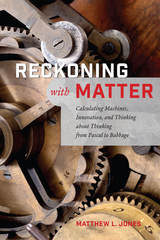
In Reckoning with Matter, Matthew L. Jones draws on the remarkably extensive and well-preserved records of the quest to explore the concrete processes involved in imagining, elaborating, testing, and building calculating machines. He explores the writings of philosophers, engineers, and craftspeople, showing how they thought about technical novelty, their distinctive areas of expertise, and ways they could coordinate their efforts. In doing so, Jones argues that the conceptions of creativity and making they exhibited are often more incisive—and more honest—than those that dominate our current legal, political, and aesthetic culture.
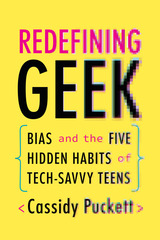
A surprising and deeply researched look at how everyone can develop tech fluency by focusing on five easily developed learning habits.
Picture a typical computer geek. Likely white, male, and someone you’d say has a “natural instinct” for technology. Yet, after six years teaching technology classes to first-generation, low-income middle school students in Oakland, California, Cassidy Puckett has seen firsthand that being good with technology is not something people are born with—it’s something they learn. In Redefining Geek, she overturns the stereotypes around the digitally savvy and identifies the habits that can help everyone cultivate their inner geek.
Drawing on observations and interviews with a diverse group of students around the country, Puckett zeroes in on five technology learning habits that enable tech-savvy teens to learn new technologies: a willingness to try and fail, management of frustration and boredom, use of models, and the abilities to use design logic and identify efficiencies. In Redefining Geek, she shows how to measure and build these habits, and she demonstrates how many teens historically marginalized in STEM are already using these habits and would benefit from recognition for their talent, access to further learning opportunities, and support in career pathways. She argues that if we can develop, recognize, and reward these technological learning habits in all kids—especially girls and historically marginalized racial and ethnic groups—we can address many educational inequities and disparities in STEM.
Revealing how being good with technology is not about natural ability but habit and persistence, Redefining Geek speaks to the ongoing conversation on equity in technology education and argues for a more inclusive technology learning experience for all students.
This book proposes a general theory of reflective logics and reflective declarative programming languages. This theory provides a conceptual foundation for judging the extent to which a computational system is reflective. Manuel Clavel presents a proof of the reflective nature of rewriting logic and provides examples of the potential for reflective programming in a number of novel computer applications. These applications are implemented in Maude, a reflective programming language and environment based on rewriting logic that can define, represent and execute a breadth of logics, languages and models of computation. A general method to easily build theorem-proving tools in Maude is also proposed and illustrated. The book goes on to promote the notion of a "universal theory" that can simulate the deductions of all representable theories within any given logic.

Failure is ordinary. From technological failures and computational obsolescence to rejected applications and challenging collaborations, failure is an unavoidable part of any scholarly endeavor. This is especially true for digital scholarship, as the everyday risk of failure is compounded by the challenges of interdisciplinary research and the fragility of digital technology.
Reframing Failure in Digital Scholarship brings together a diverse, interdisciplinary, and international group of scholars and practitioners who each offer short personal and professional reflections on the failed, broken, or challenging aspects of scholarly practice. It provides a critical perspective on the ways institutional and material conditions are intractably linked to approaches to digital research and how those conditions differ within and across national contexts.
In creating a critical, constructive, and compassionate vocabulary for failure, this book normalizes failure as an object of inquiry, asking what value exists in failure in digital scholarship and how we can create the space to fail better.
What happens to literature in an age of digital technology? Regards Croisés: Perspectives on Digital Literature provides an answer, with a collection of cutting-edge critical essays on literature gone digital. Regards Croisés is an important addition to existing research on digital literature, and will appeal to scholars of electronic writing, digital art,humanities computing, media and communication, and others interested in the field. It offers a significant advance in the field through its wide-angle perspective that globalizes digital literature and diversifies the current critical paradigms. Regards Croisés shows how digital literature connects with traditions and future directions of reading and writing communities all over the world. With contributions by authors from eight countries and three continents, the collection presents points of view on a transcontinental practice of digital literature. Regards Croisés also opens dialogues with expanded critical paradigms of digital literature, beyond earlier critical concern with the aesthetics of the screen as a space of hypertext links. Many of the essays recognize a rich history and ongoing literary practice engaged with the basic fact of the computer as a programmable device. Other essays explore the latest developments in social media and Web 2.0 as venues for digital literature. Regards Croisés shows the vibrant engagement of writers and readers with literary practice in a digital world.
Robert Gehl's timely critique, Reverse Engineering Social Media, rigorously analyzes the ideas of social media and software engineers, using these ideas to find contradictions and fissures beneath the surfaces of glossy sites such as Facebook, Google, and Twitter.
Gehl adeptly uses a mix of software studies, science and technology studies, and political economy to reveal the histories and contexts of these social media sites. Looking backward at divisions of labor and the process of user labor, he provides case studies that illustrate how binary "Like" consumer choices hide surveillance systems that rely on users to build content for site owners who make money selling user data, and that promote a culture of anxiety and immediacy over depth.
Reverse Engineering Social Media also presents ways out of this paradox, illustrating how activists, academics, and users change social media for the better by building alternatives to the dominant social media sites.

Building on current scholarly work in digital rhetoric, software studies, and technical communication, Brock connects and continues ongoing conversations among rhetoricians, technical communicators, software studies scholars, and programming practitioners to demonstrate how software code and its surrounding discourse are highly rhetorical forms of communication. He considers examples ranging from large, well-known projects like Mozilla Firefox to small-scale programs like the “FizzBuzz” test common in many programming job interviews. Undertaking specific examinations of code texts as well as the contexts surrounding their composition, Brock illuminates the variety and depth of rhetorical activity taking place in and around code, from individual differences in style to changes in large-scale organizational and community norms.
Rhetorical Code Studies holds significant implications for digital communication, multimodal composition, and the cultural analysis of software and its creation. It will interest academics and students of writing, rhetoric, and software engineering as well as technical communicators and developers of all types of software.
A timely investigation of what is at stake when AI takes legal decision-making out of human hands.
Artificial intelligence is proliferating in many professions, and the legal field is no exception. In The Rule of Law After Artificial Intelligence, Katie Szilagyi investigates the philosophical and practical implications of using AI in legal spaces, beginning with several fundamental questions: What is the law supposed to do, and from where does it derive its authority? Would law still achieve these aims if automated? How might automation affect the rule of law’s integrity and democratic institutions’ operations?
Blending legal philosophy, applied case studies, and insights from both critical legal scholarship and science and technology studies, Szilagyi argues that law and storytelling are deeply connected. Through creating and contesting the law, we make sense of the information around us and generate narratives about our collective world. These narratives are not static: legal precedent evolves, and legal deliberation on hard cases can help to resolve unclear or unprecedented social issues.
Szilagyi demonstrates that technological innovations make the rule of law vulnerable because large language models and machine learning undermine the visioning function of legal narratives, collapsing exercises of legal interpretation into mere administration. Datafication of law—built on the biased data of our cultural past—threatens longstanding legal ideals, lessens the constraints against abuses of power by private actors, and hamstrings society’s ability to reach a more egalitarian future. Szilagyi argues instead for centering narratives within the law and, in turn, rediscovering the tales the law tells us about who we are.
READERS
Browse our collection.
PUBLISHERS
See BiblioVault's publisher services.
STUDENT SERVICES
Files for college accessibility offices.
RECENTLY PUBLISHED




UChicago Accessibility Resources
home | accessibility | search | about | contact us
BiblioVault ® 2001 - 2026
The University of Chicago Press