
 A SCHOLARLY BOOK REPOSITORY
258 start with S start with S
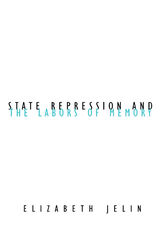
A timely exploration of the nature of memory and its political uses
Hearing the news from South America at the turn of the millennium can be like traveling in time: here are the trials of Pinochet, the searches for “the disappeared” in Argentina, the investigation of the death of former president Goulart in Brazil, the Peace Commission in Uruguay, the Archive of Terror in Paraguay, a Truth Commission in Peru. As societies struggle to come to terms with the past and with the vexing questions posed by ineradicable memories, this wise book offers guidance.
Combining a concrete sense of present urgency and a theoretical understanding of social, political, and historical realities, State Repression and the Labors of Memory fashions tools for thinking about and analyzing the presences, silences, and meanings of the past. With unflappable good judgment and fairness, Elizabeth Jelin clarifies the often muddled debates about the nature of memory, the politics of struggles over memories of historical injustice, the relation of historiography to memory, the issue of truth in testimony and traumatic remembrance, the role of women in Latin American attempts to cope with the legacies of military dictatorships, and problems of second-generation memory and its transmission and appropriation. Jelin’s work engages European and North American theory in its exploration of the various ways in which conflicts over memory shape individual and collective identities, as well as social and political cleavages. In doing so, her book exposes the enduring consequences of repression for social processes in Latin America, and at the same time enriches our general understanding of the fundamentally conflicted and contingent nature of memory.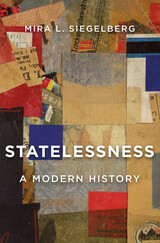
The story of how a much-contested legal category—statelessness—transformed the international legal order and redefined the relationship between states and their citizens.
Two world wars left millions stranded in Europe. The collapse of empires and the rise of independent states in the twentieth century produced an unprecedented number of people without national belonging and with nowhere to go. Mira Siegelberg’s innovative history weaves together ideas about law and politics, rights and citizenship, with the intimate plight of stateless persons, to explore how and why the problem of statelessness compelled a new understanding of the international order in the twentieth century and beyond.
In the years following the First World War, the legal category of statelessness generated novel visions of cosmopolitan political and legal organization and challenged efforts to limit the boundaries of national membership and international authority. Yet, as Siegelberg shows, the emergence of mass statelessness ultimately gave rise to the rights regime created after World War II, which empowered the territorial state as the fundamental source of protection and rights, against alternative political configurations.
Today we live with the results: more than twelve million people are stateless and millions more belong to categories of recent invention, including refugees and asylum seekers. By uncovering the ideological origins of the international agreements that define categories of citizenship and non-citizenship, Statelessness better equips us to confront current dilemmas of political organization and authority at the global level.
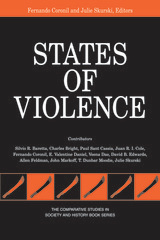
By means of a combination of detailed historical studies and imaginative reflection, this book explores the often unrecognized violent foundations of modern nations. Focusing on the relations between the state and the domestic order, it directs attention to contests over the establishment and representation of meanings and addresses the impact of state-centered categories and narratives on the organization and collective remembering of violence. The essays cover a wide range of regions, time periods, and processes, including the Middle East, South Asia, Latin America, the United States, and Europe, and span violent uprisings as well as the quotidian administration of the law. As its title suggests, States of Violence brings together the stable and the transient, the institutional and the experiential, the state sanctioned and the insurgent, inviting recognition of the multiple intersections of practices of governance and processes of feeling.
"Few scholars have managed as effectively as these to denature the place of violence in modern social life and thought. They make it abundantly plain that the frank brutality, often associated with colonial contexts, is inseparable from less acknowledged forms of "peaceful violence" that pervade much of our contemporary political life."
-Jean Comaroff, Bernard E. and Ellen C. Distinguished Service Professor, University of Chicago
Fernando Coronil, a Venezuelan citizen, is Associate Professor of Anthropology and History at the University of Michigan and Director of the Latin American and Caribbean Studies Program. His research focuses on contemporary historical transformations in Latin America and on theoretical issues concerning the state, modernity, and postcolonialism. His numerous publications include The Magical State: Nature, Money, and Modernity in Venezuela; "Beyond Occidentalism: Towards Non-Imperial Geohistorical Categories"; and the introductory essay in Cuban Counterpoint: Tobacco and Sugar, by Fernando Ortiz. He is completing a book on the coup against President Chávez of Venezuela.
Julie Skurski teaches in the Departments of Anthropology and History at the University of Michigan and is the Associate Director of the Doctoral Program in Anthropology and History. Her research concerns the intersections of national, racial, and gender relations in Latin America, with a focus on popular religiosity. Her publications include "The Ambiguities of Authenticity in Latin America: Doña Bárbara and the Construction of National Identity," in Becoming National, G. Eley and R. Suny, eds. She is currently completing Civilizing Barbarism, a book on gender, mestizaje, and the state in Venezuela.

Through a skillful combination of economic and cultural history, this book describes the impact on Moldavia and Wallachia of steam navigation on the Danube. The Danube route integrated the two principalities into a dense network of European roads and waterways. From the 1830s to the 1860s, steamboat transport transformed time and space for the areas that benefited from regular services. River traffic accelerated urban development along the Lower Danube and contributed directly to institutional modernization in one of Europe’s peripheries.
Beyond technological advances and the transportation of goods on a trans-imperial waterway, steamboat travel revolutionized human interactions, too. The book offers a fascinating insight into the social and cultural milieu of the nineteenth century, drawing on first-hand accounts of Danube cruising. Describing the story of travelers who interacted, met, and visited the places they stopped, Constantin Ardeleanu creates a transnational history of travel up and down the Danube from Vienna to Constantinople. The pleasures and sometimes the travails of the travelers unfold against a backdrop of technical and economic transformation in the crucial period of modernization.

A road trip through Steinbeck’s America—revisited, reimagined, and reinterpreted.
Steinbeck’s Uneasy America is the first collection of critical scholarship devoted to Travels with Charley in Search of America, John Steinbeck’s best-selling, late-career travel memoir. In 1960, Steinbeck was a renowned man of American letters. Many considered him America’s troubadour of ordinary people, the conscience of the country. But weakened by two small strokes and anxious that he had lost touch with America, he embarked on a cross-country road trip accompanied by his wife’s standard poodle, Charley. Two years later, he published Travels with Charley to popular acclaim and robust sales.
Throughout this narrative, Steinbeck insists that all of our perceptions are “warped” by personality, history, and society. And while this hybrid and experimental book has long been accepted as an accurate account of his journey, journalists and scholars agree that the narrative is part factual, part fiction—America as seen through Steinbeck’s particular “warp.” The work is long overdue for scholarly assessment.
Steinbeck’s Uneasy America explores three main topics. Part 1 explores genre and form to consider the degree to which the work is fiction or nonfiction. Part 2 assesses Steinbeck’s increasingly bleak assessment of America—almost a jeremiad that warns citizens of ecological excess and political apathy. Part 3 focuses on Travels with Charley as a road text, travel adventure, and literary influence.
This volume’s authors offer rich scholarly insights and a wealth of stories, facts, and anecdotes about Steinbeck and the adventures and misadventures he and Charley met on the road. Lively and groundbreaking, the collection both enlightens and enlivens discussions of Steinbeck and of the twentieth-century American book world.

From Communist Party pageants to union hall performances to benefits for the Spanish Civil War, Graff documents the passionate involvement of American dancers in the political and social controversies that raged throughout the Depression era. Dancers formed collectives and experimented with collaborative methods of composition at the same time that they were marching in May Day parades, demonstrating for workers’ rights, and protesting the rise of fascism in Europe. Graff records the explosion of choreographic activity that accompanied this lively period—when modern dance was trying to establish legitimacy and its own audience. Stepping Left restores a missing legacy to the history of American dance, a vibrant moment that was supressed in the McCarthy era and almost lost to memory. Revisiting debates among writers and dancers about the place of political content and ethnicity in new dance forms, Stepping Left is a landmark work of dance history.
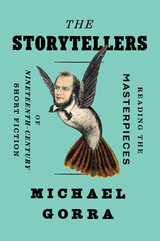
Tracing the origins of the modern short story, Michael Gorra provides the first fully realized picture of a century’s worth of great tales.
The Storytellers offers a far-reaching account of the rich tradition of short narratives that flourished in nineteenth-century Europe and America, one that both prepared for and eventually gave way to the modern short story. Tracing unexpected resemblances across languages and decades, Michael Gorra restores a wide-angle view of the form in which works usually treated as stand-alone classics reveal themselves as parts of a single, lively conversation.
What unites these tales, Gorra argues, is their blend of novelty and unity. The book’s heart lies in a series of accessible readings of great tales by Herman Melville, Nikolai Gogol, Ivan Turgenev, E. T. A. Hoffmann, Guy de Maupassant, Nathaniel Hawthorne, Arthur Conan Doyle, Sarah Orne Jewett, Charles Chesnutt, and many more. Beyond its consideration of individual works, The Storytellers examines the formal and thematic concerns that bind the century together: the use of frame tales, accounts of social marginality, and an abundance of ghosts and uncanny coincidences. Over time, Gorra shows, these qualities yielded to a cooler realism, with Anton Chekhov as the key transitional figure. His compressed studies of ordinary lives inspired the modern short story and consigned the gothic flourishes of earlier tales to genre fiction.
What do we want from a story? What makes a tale worth telling? The nineteenth-century tale sought not the grand “meaning of life” promised by the novel, Gorra shows, but sudden revelations from singular events. The Storytellers gives readers an incomparable guide to a vast body of tales that still has the power to thrill and entertain.
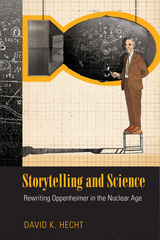
No single figure embodies Cold War science more than the renowned physicist J. Robert Oppenheimer. Although other scientists may have been more influential in establishing the institutions and policies of the nuclear age, none has loomed larger in the popular imagination than the “father of the atomic bomb.” Americans have been drawn to the story of the Manhattan Project Oppenheimer helped lead and riveted by the McCarthy-era politics that caught him in its crosshairs. Journalists and politicians, writers and artists have told Oppenheimer's story in many different ways since he first gained notoriety in 1945. In Storytelling and Science, David K. Hecht examines why they did so, and what they hoped to achieve through their stories.
From the outset, accounts of Oppenheimer's life and work were deployed for multiple ends: to trumpet or denigrate the value of science, to settle old scores or advocate new policies, to register dissent or express anxieties. In these different renditions, Oppenheimer was alternately portrayed as hero and villain, establishment figure and principled outsider, “destroyer of worlds” and humanist critic. Yet beneath the varying details of these stories, Hecht discerns important patterns in the way that audiences interpret, and often misinterpret, news about science. In the end, he argues, we find that science itself has surprisingly little to do with how its truths are assimilated by the public. Instead its meaning is shaped by narrative traditions and myths that frame how we think and write about it.
Published by the University of Delaware Press. Distributed worldwide by Rutgers University Press.

Debra Gold Hansen explores the origins of the equality-versus-difference debate by examining the Boston Female Anti-Slavery Society, which disbanded in 1840 over this very issue. After establishing a historical framework for women's lives in early nineteenth-century Boston, Hansen analyzes the membership of the Society along the lines of race, religion, and socioeconomic status. Through her findings, she concludes that many of the issues that estranged female abolitionists in antebellum Boston continue to divide women today, testifying not to the strength of the bonds between women but to the fragility of those ties.
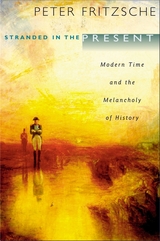
In this inventive book, Peter Fritzsche explores how Europeans and Americans saw themselves in the drama of history, how they took possession of a past thought to be slipping away, and how they generated countless stories about the sorrowful, eventful paths they chose to follow.
In the aftermath of the French Revolution, contemporaries saw themselves as occupants of an utterly new period. Increasingly disconnected from an irretrievable past, worried about an unknown and dangerous future, they described themselves as indisputably modern. To be cast in the new time of the nineteenth century was to recognize the weird shapes of historical change, to see landscapes scattered with ruins, and to mourn the remains of a bygone era.
Tracing the scars of history, writers and painters, revolutionaries and exiles, soldiers and widows, and ordinary home dwellers took a passionate, even flamboyant, interest in the past. They argued politics, wrote diaries, devoured memoirs, and collected antiques, all the time charting their private paths against the tremors of public life. These nostalgic histories take place on battlefields trampled by Napoleon, along bucolic English hedges, against the fairytale silhouettes of the Grimms' beloved Germany, and in the newly constructed parlors of America's western territories.
This eloquent book takes a surprising, completely original look at the modern age: our possessions, our heritage, and our newly considered selves.
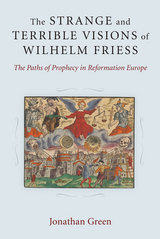
Dutch scholars have recognized that Frans Fraet was executed for printing a prognostication by Willem de Vriese, but this prognostication was thought to be lost. A few scholars of sixteenth-century German apocalypticism have briefly noted the prophecies of Wilhelm Friess but have not studied them in depth. The Strange and Terrible Visions of Wilhelm Friess is the first to connect de Vriese and Friess, as well as recognize the prophecy of Wilhelm Friess as an adaptation of a French version of theVademecum of Johannes de Rupescissa, making these pamphlets by far the most widespread source for Rupescissa’s apocalyptic thought in Reformation Germany. The book explains the connection between the first and second prophecies of Wilhelm Friess and discovers the Calvinist context of the second prophecy and its connection to Johann Fischart, one of the most important German writers of the time.
Jonathan Green provides a study of how textual history interacts with print history in early modern pamphlets and proposes a model of how early modern prophecies were created and transmitted. The Strange and Terrible Visions of Wilhelm Friess makes important contributions to the study of early modern German and Dutch literature, apocalypticism and confessionalization during the Reformation, and the history of printing in the sixteenth century.

An eye-opening reconsideration of the Cold War arms control movement, showing how scientists who presented themselves as independent-minded opponents of the arms race in fact functioned as agents of the military-industrial complex that profited from it.
Do scientists speak truth to power? During the Cold War, a group of elite American strategists and science advisors claimed to do precisely that. Styling themselves as figures of rationality and restraint, they insisted that mutual assured destruction was the natural logic of the atomic age: as long as nuclear deterrence was credible, no one would ever shoot first. This doctrine, known as “strategic stability,” became the foundation of the arms control movement, earning its promoters widespread admiration as independent thinkers and steadfast peacemakers. But in this crucial counterhistory, Benjamin Wilson shows that we have misunderstood them and their efforts. Arms controllers, he reveals, worked not to restrain the nuclear arms race but to marginalize more radical approaches to disarmament.
As Wilson makes clear, strategic stability was never the objective condition the analysts presented it as. It was a flexible, contested metaphor based on ideas from physics, economics, and cybernetics, capable of justifying a wide range of policies. Yet the advisors insisted on one upshot above all: constant military research and development and the continuous upgrading of America’s strategic arsenal. That these policies benefited the military-industrial complex is no surprise, since many arms control thinkers were creatures of the Pentagon and corporate defense contractors. Some even spoke out against missile development in public while backing lavish funding behind closed doors.
Strange Stability powerfully corrects decades of mythmaking surrounding arms control. At the same time, Wilson offers a sobering reflection on the dream of technocratic restraint. The well-placed insider who resists powerful institutions is an enticing character, but more fictional than real.

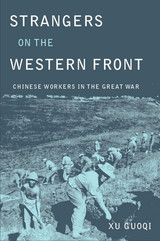
During World War I, Britain and France imported workers from their colonies to labor behind the front lines. The single largest group of support labor came not from imperial colonies, however, but from China. Xu Guoqi tells the remarkable story of the 140,000 Chinese men recruited for the Allied war effort.
These laborers, mostly illiterate peasants from north China, came voluntarily and worked in Europe longer than any other group. Xu explores China’s reasons for sending its citizens to help the British and French (and, later, the Americans), the backgrounds of the workers, their difficult transit to Europe—across the Pacific, through Canada, and over the Atlantic—and their experiences with the Allied armies. It was the first encounter with Westerners for most of these Chinese peasants, and Xu also considers the story from their perspective: how they understood this distant war, the racism and suspicion they faced, and their attempts to hold on to their culture so far from home.
In recovering this fascinating lost story, Xu highlights the Chinese contribution to World War I and illuminates the essential role these unsung laborers played in modern China’s search for a new national identity on the global stage.
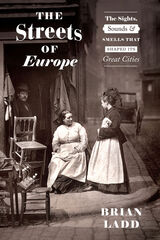
Merchants’ shouts, jostling strangers, aromas of fresh fish and flowers, plodding horses, and friendly chatter long filled the narrow, crowded streets of the European city. As they developed over many centuries, these spaces of commerce, communion, and commuting framed daily life. At its heyday in the 1800s, the European street was the place where social worlds connected and collided.
Brian Ladd recounts a rich social and cultural history of the European city street, tracing its transformation from a lively scene of trade and crowds into a thoroughfare for high-speed transportation. Looking closely at four major cities—London, Paris, Berlin, and Vienna—Ladd uncovers both the joys and the struggles of a past world. The story takes us up to the twentieth century, when the life of the street was transformed as wealthier citizens withdrew from the crowds to seek refuge in suburbs and automobiles. As demographics and technologies changed, so did the structure of cities and the design of streets, significantly shifting our relationships to them. In today’s world of high-speed transportation and impersonal marketplaces, Ladd leads us to consider how we might draw on our history to once again build streets that encourage us to linger.
By unearthing the vivid descriptions recorded by amused and outraged contemporaries, Ladd reveals the changing nature of city life, showing why streets matter and how they can contribute to public life.
Known for his best-selling military histories, Ladislas Farago also wrote a witty tribute to his homeland, Strictly from Hungary. Noting that Hungary has produced some of the world's most renowned artists, scientists, and financiers as well as its share of world-class con-artists, charlatans, and rakes, Farago sets out to explain just how one tiny country can be responsible for so much talent, both good and bad. Using stories from his days as a struggling writer in the bustling café scenes of Budapest and New York City, Farago demonstrates the Hungarian knack for remaining irrepressible and optimistic even in the face of catastrophe. Here we meet Zoltan, a fellow Bohemian who presents his astonished benefactor with a play "about nothing," a theme later made famous by another writer of Hungarian descent, Jerry Seinfeld. Farago also introduces us to "Baby Kiss," a vivacious Hungarian beauty queen, and the story of how she ended up in Fort Worth, Texas; Orkeny, a double agent for America at the height of the Cold War who "spiced up" his reports to keep everyone happy, and the author's own experience getting mustered into the supposedly non-existent Royal Hungarian Army. Farago's reminiscence validates what most Hungarians believe: that Hungary is the center of the world and that everyone has some connection to the land of the Magyars. In that spirit, Farago learns that George Washington himself was "strictly from Hungary." This edition is introduced by the author's son, who shows that the same vibrant spirit described by his father remains the hallmark of the Hungarian temperament.

Rejecting the cliché about “weak identity and underdeveloped nationalism,” Bekus argues for the co-existence of two parallel concepts of Belarusianness—the official and the alternative one—which mirrors the current state of the Belarusian people more accurately and allows for a different interpretation of the interconnection between the democratization and nationalization of Belarusian society.
The book describes how the ethno-symbolic nation of the Belarusian nationalists, based on the cultural capital of the Golden Age of the Belarusian past (17th century) competes with the “nation” institutionalized and reified by the numerous civic rituals and social practices under the auspices of the actual Belarusian state.
Comparing the two concepts not only provides understanding of the logic that dominates Belarusian society’s self-description models, but also enables us to evaluate the chances of alternative Belarusianness to win this unequal struggle over identity.

More than anyone else in his time, Struve was the master of history, journalism, economics, international relations, and practical politics. A scholar and activist, he helped found the Marxist movement in Russia, initiated Marxist Revisionism there, and launched Lenin's career, and he was the theoretician and a cofounder of the Constitutional Democratic Party.
In writing about Struve, Richard Pipes turns biography into history. He lays bare the split soul of the Russian intellectuals--their irresponsibility, unwillingness to compromise, intolerance. Struve, the liberal turned conservative, preached to his countrymen physical and spiritual freedom based on law. He was a Westerner in his championing of social reform, legality, private property, and a vigorous state and foreign policy. This long and rich tradition of liberal-conservatism is recounted against the background of a "monstrous growth of political claims on the individual that caused intellectual and moral independence increasingly to be punished with ostracism, confinement, exile, and death."

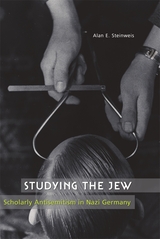
Early in his political career, Adolf Hitler declared the importance of what he called “an antisemitism of reason.” Determined not to rely solely on traditional, cruder forms of prejudice against Jews, he hoped that his exclusionary and violent policies would be legitimized by scientific scholarship. The result was a disturbing, and long-overlooked, aspect of National Socialism: Nazi Jewish Studies.
Studying the Jew investigates the careers of a few dozen German scholars who forged an interdisciplinary field, drawing upon studies in anthropology, biology, religion, history, and the social sciences to create a comprehensive portrait of the Jew—one with devastating consequences. Working within the universities and research institutions of the Third Reich, these men fabricated an elaborate empirical basis for Nazi antisemitic policies. They supported the Nazi campaign against Jews by defining them as racially alien, morally corrupt, and inherently criminal.
In a chilling story of academics who perverted their talents and distorted their research in support of persecution and genocide, Studying the Jew explores the intersection of ideology and scholarship, the state and the university, the intellectual and his motivations, to provide a new appreciation of the use and abuse of learning and the horrors perpetrated in the name of reason.
State and Capital reign over the Age of Sorrow. We face inequality, pandemics, ethnocide, climate crisis, and mass extinction. Our desire for security and power governs us as State. Our desire for possessions governs us as Capital. Our desires imprison and rule us beings as Unbeing. Yet, from Nagaland to New Zealand, Bhutan to Bolivia, a second wave of anti-colonial revolutions has begun. Arising from assemblies of humans and other-than-humans, these revolutions replace possessive individualism with non-exploitative interdependence. Naga elders, Bhutanese herders and other indigenous communities, feminists, poets, seers, yaks, cranes, vultures, and fungi haunt this pamphlet. The original Subaltern Studies narrated how Indian peasant communities destroyed the British empire. Subaltern Studies 2.0 prophesies the multi-being demos and liberates Being from Unbeing. Re-kin, Re-nomad, Re-animate, Re-wild! The Animist Revolution has come.
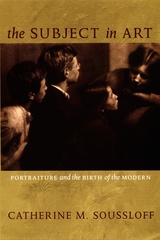
Soussloff combines a historically grounded examination of art and art historical thinking in Vienna with subsequent theories of portraiture and a careful historiography of philosophical and psychoanalytic approaches to human consciousness from Hegel to Sartre and from Freud to Lacan. She chronicles the emergence of a social theory of art among the art historians of the Vienna School, demonstrates how the Expressionist painter Oskar Kokoschka depicted the Jewish subject, and explores the development of pictorialist photography. Reflecting on the implications of the visualized, modern subject for textual and linguistic analyses of subjectivity, Soussloff concludes that the Viennese art historians, photographers, and painters will henceforth have to be recognized as precursors to such better-known theorists of the subject as Sartre, Foucault, and Lacan.
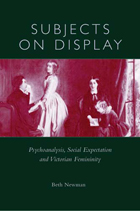
Subjects on Display explores a recurrent figure at the heart of many nineteenth-century English novels: the retiring, self-effacing woman who is conspicuous for her inconspicuousness. Beth Newman draws upon both psychoanalytic theory and recent work in social history as she argues that this paradoxical figure, who often triumphs over more dazzling, eye-catching rivals, is a response to the forces that made personal display a vexed issue for Victorian women. Chief among these is the changing socioeconomic landscape that made the ideal of the modest woman outlive its usefulness as a class signifier even as it continued to exert moral authority.
This problem cannot be grasped in its full complexity, Newman shows, without considering how the unstable social meanings of display interacted with psychical forces-specifically, the desire to be seen by others that is central to both masculine and feminine subjectivity. This desire raises an issue that feminist theorists have been reluctant to address: the importance of pleasure in being the object of the look. Their reluctance is characteristic of cultural theory, which has tended to equate subjectivity with the position of the observer rather than the observed.
Through a consideration of fiction by Charlotte Brontë, Charles Dickens, George Eliot, and Henry James, Newman shifts the inquiry toward the observed in the experience of being seen. In the process she reopens the question of the gaze and its relation to subjectivity.
Subjects on Display will appeal to scholars and students in several disciplines as it returns psychoanalysis to a central position within literary and cultural studies.
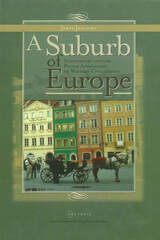
In this lively and original book, the distinguished Polish historian Jerzy Jedlicki tells the story of a century-long Polish dispute over the merits and demerits of the Western model of liberal progress and industrial civilization.
As in several countries of Europe, also in Poland, intellectuals--conservatives, liberals, and (later) socialists--quarrelled about whether such a model would suit and benefit their nation, or whether it would spell the ruin of its distinctive cultural features.
This heated debate revolved around several pairs of opposing ideas: native cultures v. cosmopolitan civilization; natural v. artificial ways of economic development; Christian morals v. capitalist laissez-faire; traditional customs v. mobile society; romanticism v. scientism, and so on. It is these various aspects of the main issue which the author analyzes and links together here. He describes how difficult and painful the process of modernization was in a nation deprived of its political independence and cultural autonomy.
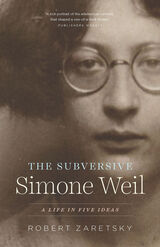
Though Weil published little during her life, after her death, thanks largely to the efforts of Albert Camus, hundreds of pages of her manuscripts were published to critical and popular acclaim. While many seekers have been attracted to Weil’s religious thought, Robert Zaretsky gives us a different Weil, exploring her insights into politics and ethics, and showing us a new side of Weil that balances her contradictions—the rigorous rationalist who also had her own brand of Catholic mysticism; the revolutionary with a soft spot for anarchism yet who believed in the hierarchy of labor; and the humanitarian who emphasized human needs and obligations over human rights. Reflecting on the relationship between thought and action in Weil’s life, The Subversive Simone Weil honors the complexity of Weil’s thought and speaks to why it matters and continues to fascinate readers today.
In this wide-ranging study, Sucheta Mazumdar offers a new answer to the fundamental question of why China, universally acknowledged as one of the most developed economies in the world through the mid-eighteenth century, paused in this development process in the nineteenth.
Focusing on cane-sugar production, domestic and international trade, technology, and the history of consumption for over a thousand years as a means of framing the larger questions, the author shows that the economy of late imperial China was not stagnant, nor was the state suppressing trade; indeed, China was integrated into the world market well before the Opium War. But clearly the trajectory of development did not transform the social organization of production or set in motion sustained economic growth.

The Sugar Hacienda of the Marqueses Del Valle was first published in 1970. Minnesota Archive Editions uses digital technology to make long-unavailable books once again accessible, and are published unaltered from the original University of Minnesota Press editions.
This is a detailed history of a Mexican sugar plantation, the first such account to be published in English. The subject of the study is the Cortes plantation, which was established on the outskirts of Cuernavaca in about 1535 by Hernan Cortes, the conqueror of New Spain and the first Marques del Valle de Oaxaca. The plantation remained the property of his heirs and descendents until the twentieth century when, like most other sugar plantations in Morelos, it ceased production.
Professor Barrett bases his account largely on the records of the Cortes plantation, a remarkably continuous series of documents for an agricultural enterprise. He deals with the records in three principal ways: as representative of the history of the sugar industry in Mexico; as representative of the history, external relationships, structure, and management of Spanish colonial plantations; and as a chapter in the history of sugar technology. He presents a detailed picture of the entire operation of the plantation. He explains how water and land rights were acquired, the latter little by little, until a goodsized plantation was formed. He describes methods of irrigation, planting cycles, weeding and harvesting schedules, and, with the aid of charts and inventories, reconstructs the plan of the mill, describes its equipment, and traces the processing of the cane into sugar. Finally, he discusses the livestock and labor needed to run the plantation and mill—oxen and mules to plow, mules to carry the sugar to market, unskilled fieldworkers, both slave and hired, and highly skilled sugarmasters. The appendixes contain much useful supplementary material. The book is illustrated with drawings, maps, and reproductions of manuscripts.

In this historical monograph on non-urban communist Albania, Artan Hoxha discusses the ambitious development project that turned a swampland into a site of sugar production after 1945. The author seeks to free the history of Albanian communism from the stereotypes that still circulate about it with stigmas of an aberration, paranoia, extreme nationalism, and xenophobia.
This micro-history of the agricultural and industrial transformation of a zone in southeastern Albania, explores a wide range of issues including modernization, development, and social, cultural, and economic policies. In addition to analyzing the collectivization of agriculture, Hoxha shows how communism affected the lives of ordinary rural people. As elsewhere in the Communist Bloc, the Albanian regime borrowed developmental projects from the past and implemented them using social mobilization and a command economy. The abundant archival resources along with interviews in the field attest to the authorities’ efforts to increase consumption and to radically transform people’s tastes. But the book argues that despite the repressive environment, people involved in the sugar project were not simply passive receivers of models from the nation's capital. The author also describes that—in defiance of Cold War bipolarity—technological requirements and social policy considerations required a degree of engagement with the broader world.
A suicide scandal in Shanghai reveals the social fault lines of democratic visions in China’s troubled Republic in the early 1920s.
On September 8, 1922, the body of Xi Shangzhen was found hanging in the Shanghai newspaper office where she worked. Although her death occurred outside of Chinese jurisdiction, her US-educated employer, Tang Jiezhi, was kidnapped by Chinese authorities and put on trial. In the unfolding scandal, novelists, filmmakers, suffragists, reformers, and even a founding member of the Chinese Communist Party seized upon the case as emblematic of deep social problems. Xi’s family claimed that Tang had pressured her to be his concubine; his conviction instead for financial fraud only stirred further controversy.
The creation of a republic ten years earlier had inspired a vision of popular sovereignty and citizenship premised upon gender equality and legal reform. After the quick suppression of the first Chinese parliament, commercial circles took up the banner of democracy in their pursuit of wealth. But, Bryna Goodman shows, the suicide of an educated “new woman” exposed the emptiness of republican democracy after a flash of speculative finance gripped the city. In the shadow of economic crisis, Tang’s trial also exposed the frailty of legal mechanisms in a political landscape fragmented by warlords and enclaves of foreign colonial rule.
The Suicide of Miss Xi opens a window onto how urban Chinese in the early twentieth century navigated China’s early passage through democratic populism, in an ill-fated moment of possibility between empire and party dictatorship. Xi Shangzhen became a symbol of the failures of the Chinese Republic as well as the broken promises of citizen’s rights, gender equality, and financial prosperity betokened by liberal democracy and capitalism.
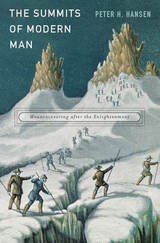
The history of mountaineering has long served as a metaphor for civilization triumphant. Once upon a time, the Alps were an inaccessible habitat of specters and dragons, until heroic men—pioneers of enlightenment—scaled their summits, classified their strata and flora, and banished the phantoms forever. A fascinating interdisciplinary study of the first ascents of the major Alpine peaks and Mount Everest, The Summits of Modern Man surveys the far-ranging significance of our encounters with the world’s most alluring and forbidding heights.
Our obsession with “who got to the top first” may have begun in 1786, the year Jacques Balmat and Michel-Gabriel Paccard climbed Mont Blanc and inaugurated an era in which Romantic notions of the sublime spurred climbers’ aspirations. In the following decades, climbing lost its revolutionary cachet as it became associated instead with bourgeois outdoor leisure. Still, the mythic stories of mountaineers, threaded through with themes of imperialism, masculinity, and ascendant Western science and culture, seized the imagination of artists and historians well into the twentieth century, providing grist for stage shows, poetry, films, and landscape paintings.
Today, we live on the threshold of a hot planet, where melting glaciers and rising sea levels create ambivalence about the conquest of nature. Long after Hillary and Tenzing’s ascent of Everest, though, the image of modern man supreme on the mountaintop retains its currency. Peter Hansen’s exploration of these persistent images indicates how difficult it is to imagine our relationship with nature in terms other than domination.
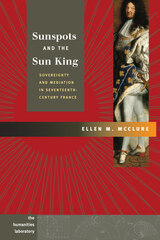
Mediation, monarchy, and Louis XIV's attempts to legitimize his reign
In order to assert his divine right, Louis XIV missed no opportunity to identify himself as God’s representative on earth. However, in Sunspots and the Sun King Ellen McClure explores the contradictions inherent in attempting to reconcile the logical and mystical aspects of divine right monarchy. McClure analyzes texts devoted to definitions of sovereignty, presents a meticulous reading of Louis XIV’s memoirs to the crown prince, and offers a novel analysis of diplomats and ambassadors as the mediators who preserved and transmitted the king’s authority. McClure asserts that these discussions, ranging from treatises to theater, expose incommensurable models of authority and representation permeating almost every aspect of seventeenth-century French culture.
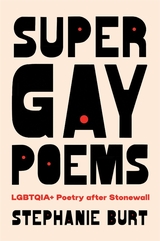
Winner of the 2025 New England Book Award for Poetry
A major poet and literary critic leads an aesthetic adventure through poems about queer experience, by writers who identify as lesbian, gay, bisexual, queer, trans, nonbinary, gender fluid, and more.
A groundbreaking anthology edited by acclaimed poet, critic, and scholar Stephanie Burt, Super Gay Poems brings together fifty-one works encompassing the wide range of queer and trans verse after the Stonewall uprising of 1969. Since that galvanizing moment, poetry has served as both a vehicle for queer liberation and a witness to its sometimes fragile, sometimes ebullient flourishing, across the world.
The poems in this anthology represent the great variety of queer and trans life itself. They include near-sonnets, iambic couplets, and rhymed quatrains; skinny dimeters and shaped poems; chatty free verse and intentionally inaccurate translations; the demotic and the rococo. Arranged in chronological order, the selections trace queer culture’s recent evolutions. Frank O’Hara, Audre Lorde, Judy Grahn, James Merrill, Thom Gunn, Jackie Kay, Adrienne Rich, Chen Chen, essa ranapiri, and The Cyborg Jillian Weise—poets widely known and poets who deserve to be—share their alienation, their euphoria, and their encounters with a protean community as it discovers new solidarities and new selves.
Each piece is paired with a concise, eye-opening essay in Burt’s trademark style, with verve and an inimitable literary ear. A treasury of aesthetic experience and insight, Super Gay Poems points protestors, political organizers, poetry lovers, and LGBTQIA+ readers toward many beautiful tomorrows.

Pedro Bassoe considers how Kyōka’s stories have been produced by a meeting of global influences—including Apuleius, The Arabian Nights, Hans Christian Andersen, the Brothers Grimm, Prosper Mérimée, Guy de Maupassant, Gerhart Hauptmann, and Jules Verne—combined with traditional Japanese genres. Bassoe develops the notion of “the scholarly fantastic” to describe how a set of realistic epistemologies reinforce the fantastic in Kyōka’s writings. Supernatural Japan offers an up-to-date introduction to Izumi Kyōka and his writing for students, scholars, or fans of Japanese fantasy literature and media.

We live in a world shaped by secularism—the separation of numinous power from political authority and religion from the political, social, and economic realms of public life. Not only has progress toward modernity often been equated with secularization, but when religion is admitted into modernity, it has been distinguished from superstition. That such ideas are continually contested does not undercut their extraordinary influence.
These divisions underpin this investigation of the role of religion in the construction of modernity and political power during the Nanjing Decade (1927–1937) of Nationalist rule in China. This book explores the modern recategorization of religious practices and people and examines how state power affected the religious lives and physical order of local communities. It also looks at how politicians conceived of their own ritual role in an era when authority was meant to derive from popular sovereignty. The claims of secular nationalism and mobilizational politics prompted the Nationalists to conceive of the world of religious association as a dangerous realm of “superstition” that would destroy the nation. This is the first “superstitious regime” of the book’s title. It also convinced them that national feeling and faith in the party-state would replace those ties—the second “superstitious regime.”
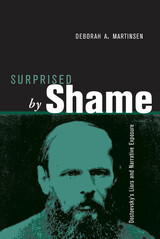
In Surprised by Shame, Deborah A. Martinsen combines shame studies and literary criticism. She begins with a discussion of shame dynamics, including the tendency of those who witness shame to feel shame themselves. Because Dostoevsky identified shame as a fundamental source of lying, Martinsen focuses on scenes when liars are exposed. She argues that by making readers witness such scandal scenes, Dostoevsky surprises them with shame, thereby collapsing the distance between readers and characters and viscerally involving them in his message of human interconnection.
Treating Dostoevsky’s liars as case studies, Surprised by Shame discusses varieties of shame and shamelessness; it also illustrates how Dostoevsky uses lying to indicate and expose subconscious processes. In addition, Martinsen demonstrates how Dostoevsky plucks shame from the realm of character trait and plot motive and embeds it in the narrative dynamics of The Idiot, Demons, and The Brothers Karamazov, thereby plunging readers into fictional experience and ethically transforming them.
By focusing on shame, this book uncovers new perspectives on Dostoevsky as writer and psychologist. By exposing how shame dynamics implicate readers in texts’ ethical actions, it enriches understanding of his tremendous influence on twentieth-century thinkers and writers. Finally, reading Dostoevsky as a prophet of shame-begotten violence reveals his universal relevance in a twenty-first century already scarred by acts of violence.
Brackney offers a new look at familiar works by authors and artists such as Claude Lanzmann, W. G. Sebald, and Paul Celan, while making surprising connections to contemporary scholars like Timothy Snyder and Donna Haraway, and events such as the Space Race. In the process, she maps out a decades-long process through which transnational conventions of mourning have emerged in Western Europe, North America, and Israel, functioning to constitute Jewish victimization as “grievable life.” Ultimately, she shows how the Holocaust has developed into a figure for the destabilization and reformulation of the category of humanity and the problem of mourning across difference.

On August 2, 1943, prisoners at the Nazi extermination camp Treblinka, located in occupied Poland, launched an uprising against their captors, during which hundreds successfully escaped while guards killed as many in the process. In this groundbreaking work, Chad S.A. Gibbs draws upon recently discovered sources and novel research methods to fundamentally reassess Jewish resistance at Treblinka—both before and during the revolt.
Using the testimonies of revolt survivors, prior escapees, those who passed through the camp, and a handful of bystander witnesses and former SS guards, Gibbs sheds new light on the events of August 2 as well as many prior acts of resistance. Critical to these new interpretations of the revolt are the actions of women prisoners, who here assume a central place in this story for the first time.
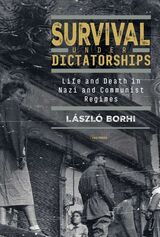
A complex array of individual responses to the abuse of power by the state is represented in this book in three horrific episodes in the history of East-Central Europe. The three events followed each other within a span of about ten years: the deportation and murder of Hungarian Jews in Nazi death and labor camps; the Arrow Cross terrorist rule in Budapest; and finally the Stalinist terror in Hungary and East-Central Europe. Through the prism of survival, László Borhi explores the relationship between the individual and power, attempting to understand the mechanism of oppression and terror produced by arbitrary, unbridled power through the experience of normal people.
Despite the obvious peculiarities of time and place, the Hungarian cases convey universal lessons about the Holocaust, Nazism, and Stalinism. In the author's conception, the National Socialist and Stalinist experiences are linked on several levels. Both regimes defended their visions of the future against social groups whom they saw as implacable enemies of those visions, and who therefore had to be destroyed for sake of social perfection. Furthermore, the social practices of National Socialism were passed on. And although Stalinism was imposed by a foreign power, some of the survival skills for coping with it were rehearsed under the previous hellish experience.

This remarkable chronicle of life and death in the Jewish Ghetto of Kovno, Lithuania, from June 1941 to January 1944, was written under conditions of extreme danger by a Ghetto inmate and secretary of the Jewish Council. After the war, in order to escape from Lithuania, the author was forced to entrust the diary to leaders of the Escape movement; eventually it made its way to his new home in Israel.
The diary incorporates Avraham Tory’s collections of official documents, Jewish Council reports, and original photographs and drawings made in the Ghetto. It depicts in grim detail the struggle for survival under Nazi domination, when—if not simply carted off and murdered in a random “action”—Jews were exploited as slave labor while being systematically starved and denied adequate housing and medical care. Through it all, Tory’s overriding purpose was to record the unimaginable events of these years and to memorialize the determination of the Jews to sustain their community life in the midst of the Nazi terror.
Of the surviving diaries originating in the principal European Ghettos of this period, Tory’s is the longest written by an adult, a dramatic and horrifying document that makes an invaluable contribution to contemporary history. Tory provides an insider’s view of the desperate efforts of Ghetto leaders to protect Jews. Martin Gilbert’s masterly introduction establishes the authenticity of the diary, presents its events against the backdrop of the war in Europe, and considers the crucial questions of collaboration and resistance.

Though the world was stunned by the horrific massacres of Tutsi by the Hutu majority in Rwanda beginning in April 1994, there has been little coverage of the reprisals that occurred after the Tutsi gained political power. During this time hundreds of thousands of Hutu were systematically hunted and killed.
Surviving the Slaughter: The Ordeal of a Rwandan Refugee in Zaire is the eyewitness account of Marie Béatrice Umutesi. She tells of life in the refugee camps in Zaire and her flight across 2000 kilometers on foot. During this forced march, far from the world’s cameras, many Hutu refugees were trampled and murdered. Others died from hunger, exhaustion, and sickness, or simply vanished, ignored by the international community and betrayed by humanitarian organizations. Amidst this brutality, day-to-day suffering, and desperate survival, Umutesi managed to organize the camps to improve the quality of life for women and children.
In this first-hand account of inexplicable brutality, day-to-day suffering, and survival, Marie Béatrice Umutesi sheds light on a backlash of violence that targeted the Hutu refugees of Rwanda after the victory of the Rwandan Patriotic Front in 1994. Umutesi’s documentation of the flight and terror of these years provides the world a veritable account of a history that is still widely unknown. After translations from its original French into three other languages, this important book is available in English for the first time. It is more than a testimony to the lives and humanity lost; it is a call for those politicians, military personnel, and humanitarian organizations responsible for the atrocious crimes—and the devastating silence—to be held accountable.
“Umutesi’s tale, told with honesty and eloquence, is a tribute to the human spirit, a searing indictment of the agents who perpetrated these horrors, and a reproach to those who turned away.”—Catharine Newbury, African Studies Review
“Restores a human dimension that has been lacking in the history of the genocide and massacres in Rwanda.”—Danielle de Lame, African Studies Review
“A vivid account of the grueling nightmare experienced by tens of thousands of Rwandan civilians whom the world had deliberately forsaken. . . . An outstanding call for justice.”—Aloys Habimama, African Studies Review
“A towering work. . . . An epic for our times, a tale to ponder for the lessons it conveys, testimony so powerful and moving that it reaches an unintended literary greatness.”—Jan Vansina, African Studies Review
“Of all the current books and films ten years after the Rwandan genocide, none is more effective than Surviving the Slaughter . . . . This book carries one along, often as if running with the refugees.”—Anne Serafin, Multicultural Review

To reclaim a sense of hope for the future, German activists in the late twentieth century engaged ordinary citizens in innovative projects that resisted alienation and disenfranchisement.
By most accounts, the twentieth century was not kind to utopian thought. The violence of two world wars, Cold War anxieties, and a widespread sense of crisis after the 1973 global oil shock appeared to doom dreams of a better world. The eventual victory of capitalism and, seemingly, liberal democracy relieved some fears but exchanged them for complacency and cynicism.
Not, however, in West Germany. Jennifer Allen showcases grassroots activism of the 1980s and 1990s that envisioned a radically different society based on community-centered politics—a society in which the democratization of culture and power ameliorated alienation and resisted the impotence of end-of-history narratives. Berlin’s History Workshop liberated research from university confines by providing opportunities for ordinary people to write and debate the story of the nation. The Green Party made the politics of direct democracy central to its program. Artists changed the way people viewed and acted in public spaces by installing objects in unexpected environments, including the Stolpersteine: paving stones, embedded in residential sidewalks, bearing the names of Nazi victims. These activists went beyond just trafficking in ideas. They forged new infrastructures, spaces, and behaviors that gave everyday people real agency in their communities. Undergirding this activism was the environmentalist concept of sustainability, which demanded that any alternative to existing society be both enduring and adaptable.
A rigorous but inspiring tale of hope in action, Sustainable Utopias makes the case that it is still worth believing in human creativity and the labor of citizenship.
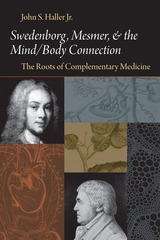
Complementary and alternative healing encompass a wide range of practices that share a common ground: the belief that our physical well-being is inextricably linked to an unseen world beyond our physical senses. Our view of that world can be traced to two key thinkers: Emanuel Swedenborg and Franz Anton Mesmer.
Who were these men, and what shaped their thought? How did their ideas capture the public imagination? How did they speak to movements as diverse as utopianism, Spiritualism, psychic healing, and homeopathy? Historian John S. Haller traces the threads of Swedenborg’s and Mesmer’s influence through the history of nineteenth-century medicine, illuminating the lasting impact these men have had on concepts of alternative healing.
Goldstein puts apparently literary projects, such as William Blake’s poetry of embryogenesis, Goethe’s journals On Morphology, and Percy Shelley’s “poetry of life,” back into conversation with the openly poetic life sciences of Erasmus Darwin, J. G. Herder, Jean-Baptiste Lamarck, and Étienne Geoffroy Saint-Hilaire. Such poetic sciences, Goldstein argues, share in reviving Lucretius’s De rerum natura to advance a view of biological life as neither self-organized nor autonomous, but rather dependent on the collaborative and symbolic processes that give it viable and recognizable form. They summon De rerum natura for a logic of life resistant to the vitalist stress on self-authorizing power and to make a monumental case for poetry’s role in the perception and communication of empirical realities. The first dedicated study of this mortal and materialist dimension of Romantic biopoetics, Sweet Science opens a through-line between Enlightenment materialisms of nature and Marx’s coming historical materialism.


Leading social scientists, empirical analysts, and policy practitioners demonstrate the various ways in which the insights of János Kornai, a renowned early analyst and critic of the command economies of Eastern European communist states, are stirring academic and policy discussions about current challenges. While dissecting the economic theories and practices in the Soviet Bloc, Kornai devised and applied concepts such as soft-budget constraints, rush versus harmonic growth, surplus versus shortage economy, non-Walrasian equilibrium, bureaucratic coordination, and the invisible power of the communist party. These concepts are commonly applied to a variety of issues in the contexts of fundamental transformation. The cases discussed in this volume include the transitional paths of post-communist economies, the pitfalls of East European market-building, economic repercussions of the dissolution of Yugoslavia, and the process of integration in the Eurozone.
In conclusion János Kornai’s thoughts on a variety of research topics as well as the value of democracy are included as he delivered at the conference celebrating his 90th birthday in 2018.
READERS
Browse our collection.
PUBLISHERS
See BiblioVault's publisher services.
STUDENT SERVICES
Files for college accessibility offices.
RECENTLY PUBLISHED



UChicago Accessibility Resources
home | accessibility | search | about | contact us
BiblioVault ® 2001 - 2026
The University of Chicago Press