
 A SCHOLARLY BOOK REPOSITORY
45 start with S start with S
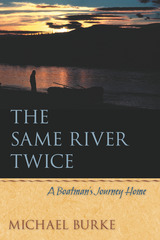
As Burke contemplates what he and Sid may have had in common, he meditates on the changing meaning of rivers, and the impossibility of fully recovering the past. In clear and graceful prose, Burke blends Sid’s colorful history with his own uncommon journey. He also reflects upon the quick currents of time and the fierce passion he shares with Sid for the life of river running in Alaska and the west. Unlike most river-running books that often describe waterways in the lower forty-eight states, The Same River Twice introduces readers to rough, austere, and unfamiliar rivers in the northern wilderness. Burke has an intimate understanding of these remote, free-flowing rivers. He effectively captures the thrill of moving water, the spirit of rivers and river canyons, and the life of river guides. This insightful memoir brings readers into a confluence of rivers, where past and present merge, revealing the power of wilderness and the truth about changing course.
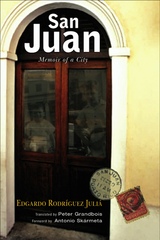
In the allusive cityscape he recreates, Rodríguez Juliá invokes the ghosts of his childhood, of San Juan's elder literati, and of characters from his own novels. On the most tangible level, the city is a place of cabarets and cockfighting clubs, flâneurs and beach bums, smoke-filled bars and honking automobiles. Poised between a colonial past and a commercial future, the San Juan he portrays feels at times perilously close to the pitfalls of modernization. Tenement houses and fading mansions yield to strip malls and Tastee Freezes; asphalt hems in jacarandas and palm trees. "In Puerto Rico," he muses, "life is not simply cruel, it is also busy erasing our tracks." Through this book—available here in English for the first time—Rodríguez Juliá resists that erasure, thoughtfully etching a palimpsest that preserves images of the city where he grew up and rejoicing in the one where he still lives.
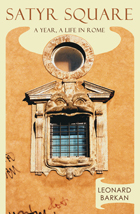
Part memoir, part literary criticism, part culinary and aesthetic travelogue, this loving reflection is a poignant, funny narrative about an American professor spending a year in Rome. A scarred veteran of academic culture wars retreating to a cradle of culture, Barkan is at first hungry, lonely, and uncertain of his intellectual mission. But soon he is appointed unofficial mascot of an eccentric community of gastronomes, becomes virtually bilingual, and falls in love. As the year progresses, he finds his voice as a writer, loses his lover, and definitively returns to America with heart, mind, and body. His memoir is the celebration of a life lived in the uncanny spaces where art and real people intersect.
Barkan’s reminiscence is not just about the Renaissance and ancient statuary, or Shakespeare and Mozart, Charles Bukowski and Paul de Man, eggplant antipasto and Brunello di Montalcino, foot fetishism and sulfur baths. At the heart of the narrative—beneath that beguiling surface of irony, humor, and misdirection—is a man of genuine ardor, struggling with what it means to be a homosexual and a Jew, trying to rediscover or reinvent his own intellectual passions. Hilarious, erudite, and lusciously rendered, Satyr Square gives us the whole of a life made up from fragments of Italy, art, food, and longing.
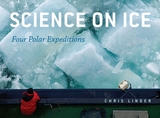
An oceanographer and award-winning photographer, Linder chronicles four polar expeditions in this richly illustrated volume: to a teeming colony of Adélie penguins, through the icy waters of the Bering Sea in spring, beneath the pack ice of the eastern Arctic Ocean, and over the lake-studded surface of the Greenland Ice Sheet. Each trip finds Linder teamed up with a prominent science journalist, and together their words and pictures reveal the day-to-day details of how science actually gets done at the poles. Breathtaking images of the stark polar landscape alternate with gritty, close-up shots of scientists working in the field, braving physical danger and brutal conditions, and working with remarkable technology designed to survive the poles—like robotic vehicles that chart undersea mountain ranges—as they gather crucial information about our planet's distant past, and the risks that climate change poses for its future.
The result is a combination travel book and paean to the hard work and dedication that underlies our knowledge of life on earth. Science on Ice takes readers to the farthest reaches of our planet; science has rarely been more exciting—or inspiring.
The author of The Desert, the book that made the American landscape accessible to the mainstream mind, was much less like his fellow environmental prophets John Muir and Henry David Thoreau than he would have had us believe. Van Dyke claimed to have wandered "alone on horseback for thousands of miles through the American Southwest and northern Mexico," as readers of The Desert—now in the millions since the book was published in 1901—were told. He did not. In The Secret Life of John C. Van Dyke, Teague and Wild unmask the desert saint with Van Dyke’s own recently discovered letters. These letters depict a privileged, patrician, and pampered member of the upper-class. His incriminating correspondence reveals that he saw most of the desert from plush railroad cars and grand hotel rooms. In the introduction, the editors clear up many misconceptions scholars currently hold about Van Dyke’s ecological principles, about his outdoorsmanship, and about his trip through the desert itself. As the centennial of the publication of The Desert approaches, this lively collection of letters helps set the record straight. The John C. Van Dyke unveiled in The Secret Life is a more varied character than we had supposed—still worthy of much admiration for his remarkable accomplishments, but still mysterious, and not the man we thought him to be.
Seven Summers is the story of a naturalist-turned-professor who flees city life each summer with her pets and power tools to pursue her lifelong dream—building a cabin in the Wyoming woods. With little money and even less experience, she learns that creating a sanctuary on her mountain meadow requires ample doses of faith, patience, and luck. This mighty task also involves a gradual and sometimes painful acquisition of flexibility and humility in the midst of great determination and naive enthusiasm.
For Corbett, homesteading is not about wresting a living from the land, but respecting and immersing herself in it—observing owls and cranes, witnessing seasons and cycles, and learning the rhythms of wind and weather in her woods and meadow. The process changes her in unexpected ways, just as it did for women homesteaders more than a century ago. The more she works with wood, the more she understands the importance of “going with the grain” in wood as well as in life. She must learn to let go, to move through loss and grief, to trust her voice, and to balance independence and dependence. Corbett also gains a better understanding of her fellow Wyomingites, a mix of ranchers, builders, gas workers, and developers, who share a love of place but often hold decidedly different values. This beautifully written memoir will appeal to readers who appreciate stories of the western landscape, independent women, or the appreciation of the natural world.
In the South Pacific, he discovers a world of sorcery and shark worship, where Christian and pagan rituals coexist and an ordinary day is marked by confrontations with America-worshiping cult leaders and militants alike. A defiantly original blend of history and memoir, anthropology and travel writing, The Shark God is ultimately a tale of personal and political transformation.
“The Shark God, a travel story as dark and twisted as one might ever wish to hear . . . reaches a superb climax with some apocalyptically page-turning scenes.”—Guardian
“A fascinating account of the drama of Melanesian life.”—Times Literary Supplement
“With exquisite writing, Montgomery lovingly captures the beauty and the horrors, the mysteries and the shams of the people and places he visits.”—Publishers Weekly
“A very real and memorable talent. . . . The endurance [Montgomery] displayed on his travels was admirable, the adventures he survived were tremendous, and the quality of his prose seems matched only by the wisdom of his observations.”—Simon Winchester, Globe and Mail (Toronto)
Western accounts of the Hajj, the ritual Muslim pilgrimage to Mecca, are rare, since access to Mecca is forbidden to non-Muslims. In the Muslim world, however, pilgrimage literature is a well-established genre, dating back to the earliest centuries of the Islamic era. A Shiʿite Pilgrimage to Mecca is taken from the original nineteenth-century Persian manuscript of the Safarnâmeh of Mirzâ Moḥammad Ḥosayn Farâhâni, a well-educated, keenly observant, Iranian Shiʿite gentleman.
This memoir holds a wealth of social and economic information about Czarist Russia, the Ottoman Empire, Egypt, Northern Iran, and Arabia. The author is a meticulous observer, recording details of distances, currencies, accommodations, modes of travel, and so on. He records the experiences encountered by pilgrims of his day: physical hardships, disease, generosity and compassion, banditry, hospitality, comradeship, and exaltation. And, without prejudice, he discusses the tensions between the Shiʿites and the Sunnites in the holy places—tensions that still exist and have erupted in bloody clashes during recent pilgrimages.
A Shiʿite Pilgrimage to Mecca will appeal to a wide audience of general readers, Middle Eastern scholars, anthropologists, and historians.

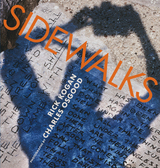
Few people know Chicago as do Rick Kogan and Charles Osgood, and their "Sidewalks" column for the Chicago Tribune Sunday Magazine is a tour of the city like no other, taking readers to the off-beat and quintessential spots that give Chicago its character—that make its inhabitants feel at home and tell its visitors that they have arrived.
Accompanied by evocative color photographs by Charles Osgood, Kogan's pieces revisit the lost places and people of Chicago, and take readers down the quiet byways and thriving thoroughfares, pointing out the characters and cornerstones, the oddities and institutions that make the city what it is. In this collection you will find an elegy for Maxwell Street, the marketplace that pulsed with city life for more than 100 years; a remembrance of a disturbing advertisement ("Are you a slave to housework?") on the side of a building on Irving Park Road; a cross marking a deadly intersection; a magical miniature golf course; as well as ballad singer Fred Holstein, the denizens of the World Gym and memories of Bensinger's pool hall, the day-camp kids of summer, bike couriers, the creatures of the beach, and much, much more. Here is Chicago, past, present, and—let's hope—future, captured in the unique archive of Sidewalks.
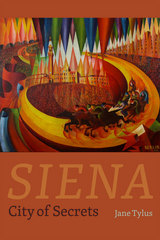
As Tylus leads us through the city, she shares her passion for Siena in novelistic prose, while never losing sight of the historical complexities that have made Siena one of the most fascinating and beautiful towns in Europe. Today, Siena can appear on the surface standoffish and old-fashioned, especially when compared to its larger, flashier cousins Rome and Florence. But first impressions wear away as we learn from Tylus that Siena was an innovator among the cities of Italy: the first to legislate the building and maintenance of its streets, the first to publicly fund its university, the first to institute a municipal bank, and even the first to ban automobile traffic from its city center.
We learn about Siena’s great artistic and architectural past, hidden behind centuries of painting and rebuilding, and about the distinctive characters of its different neighborhoods, exemplified in the Palio, the highly competitive horserace that takes place twice a year in the city’s main piazza and that serves as both a dividing and a uniting force for the Sienese. Throughout we are guided by the assured voice of a seasoned scholar with a gift for spinning a good story and an eye for the telling detail, whether we are traveling Siena’s modern highways, exploring its underground tunnels, tracking the city’s financial history, or celebrating giants of painting like Simone Martini or giants of the arena, Siena’s former Serie A soccer team.
A practical and engaging guide for tourists and armchair travelers alike, Siena is a testament to the powers of community and resilience in a place that is not quite as timeless and serene as it may at first appear.

Rediscover the spirit, stories, and landscapes of Alabama through a timeless collection of observations and historical reflections.
In Sketches of Alabama, Mary Duffee offers a richly detailed portrait of a state shaped by diverse communities, enduring traditions, and a deeply rooted cultural identity. Through a series of engaging sketches, Duffee captures the essence of Alabama’s towns, people, and everyday life, preserving moments that might otherwise be lost to time.
Blending historical insight with narrative charm, this collection explores the character of Alabama from multiple perspectives—rural and urban, past and present. Readers encounter vivid depictions of local customs, notable figures, and the evolving social fabric of the region. Duffee’s work not only chronicles the state’s development but also reflects the broader story of the American South, illuminating its complexities, resilience, and sense of place.
This collection contains typescripts of some of Mary Gordon Duffee's Iron Age columns "Sketches of Alabama," manuscripts of seven of Duffee's poems, a typed biographical sketch of Duffee, undated, and Duffee's obituary from the Birmingham Age-Herald. Ideal for students, historians, and general readers alike, Sketches of Alabama serves as both a literary work and a cultural record. Its accessible style makes it an excellent introduction to Alabama’s heritage, while its thoughtful observations reward those seeking deeper understanding of Southern history and identity.
Whether you are drawn to regional storytelling, historical narrative, or the rich traditions of the Deep South, this work offers a compelling journey into Alabama’s past—one sketch at a time.
In order to render the issue of representation, of speaking on behalf of the Palestinian ordeal in all its complexity, The Sky Is Incomplete is composed as a collage, gathering diary entries, letters, experimental passages, script, poetry, art criticism, political analysis, and other genres to convey an opaque view of the Palestine Question. Beyond representation in the sense of giving testimony or speaking on behalf of the Palestinians, however, the author’s parting point is relational: The Sky Is Incomplete is about encounters—with friends, mentors, interlocutors, lovers, children, activists, and soldiers (Israeli and Palestinian).
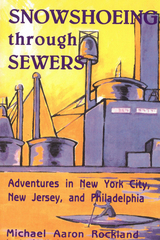
In these ten alternately poetic and comic tales of adventure in the New York/Philadelphia corridor, the most densely populated chunk of America, Rockland walks and bikes areas meant only for cars and paddles through waters capable of dissolving canoes. He hikes the length of New York's Broadway, camps in New York City, treks across Philadelphia, pedals among the tractor trailers of Route 1 in New Jersey, and paddles around Manhattan and through the dark tunnels under Trenton.
Whereas Henry David Thoreau built his cabin on Walden Pond to get out of town, for Rockland, the challenge is to head into town. As he writes, "in the late twentieth century, a weed and trash-filled city lot . . . may be a better place than the wilderness to contemplate one's relationship to nature."
The third book in Charles Bowden’s “accidental trilogy” that began with Blood Orchid and Blues for Cannibals, Some of the Dead Are Still Breathing attempts to resolve the overarching question: “How can a person live a moral life in a culture of death?” As humanity moves further into the twenty-first century, Bowden continues to interrogate our roles in creating the ravaged landscapes and accumulated death that still surround us, as well as his own childhood isolation, his lust for alcohol and women, and his waning hope for a future. We witness post-Katrina New Orleans and terrorist-bombed Bali; we encounter our shared actions with the animal world and the desirous need for consumption; we see the clash and erosion of our physical and figurative borders, the savagery of our own civilization. A man of his time and out of time, Bowden seeks acceptance and a will to endure what may lie ahead.

In this compelling biography, Charles Nicholl pieces together the shadowy story of Rimbaud's life as a trader, explorer, and gunrunner in Africa. Following his fascinating journey, Nicholl shows how Rimbaud lived out that mysterious pronouncement of his teenage years: "Je est un autre"—I is somebody else.
"Rimbaud's fear of stasis never left him. 'I should like to wander over the face of the whole world,' he told his sister, Isobelle, 'then perhaps I'd find a place that would please me a little.' The tragedy of Rimbaud's later life, superbly chronicled by Nicholl, is that he never really did."—London Guardian
"Nicholl has excavated a mosaic of semi-legendary anecdotes to show that they were an essential part of the poet's journey to become 'somebody else.' Not quite biography, not quite travel book, in the end Somebody Else transcends both genres."—Sara Wheeler, Daily Telegraph
"At the end of Somebody Else Rimbaud is more interesting and more various than before: he is not less mysterious, but he is more real."—Susannah Clapp, Observer Review
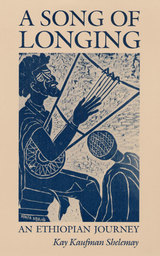
-- Library Journal
"Highly recommended to generalists in music as well as to specialists interested in Ethiopia. . . . Also makes an excellent case study text for university-level courses examining fieldwork issues and conditions."
-- Notes
"Highly recommended for both undergraduate and graduate collections in ethnomusicology, anthropology, African, and Judaic studies."
-- Choice

"To be read for enjoyment; nevertheless, the historian will find in it a wealth of information that has been shrewdly appraised, carefully sifted, and creditably related."—Catholic Historical Review
"Of interest not only to the historian but to the geographer and anthropologist."—Pacific Historical Review
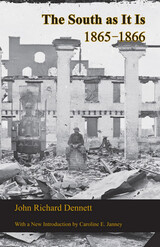
This classic report originally appeared as a series of articles in the Nation between July 8, 1865, and April 11, 1866. Dennett traveled in seven states—Virginia, North Carolina, South Carolina, Georgia, Alabama, Louisiana, and Mississippi—at the very beginning of Reconstruction. His remarkably prophetic account of the recently defeated South is a major source for the history of this transition.
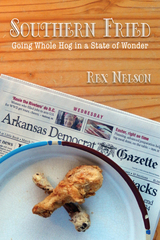
For decades, Rex Nelson has been traveling Arkansas. He learned to love the back roads, small towns, and people of the state while going on trips with his father, who sold athletic supplies to high schools. They sat in old Depression-era gyms built by the Works Progress Administration, ate in small-town cafes, and waded in streams on warm spring days.
Throughout his career as a sportswriter, political writer, senior staff member in the governor’s office, presidential appointee to the Delta Regional Authority, and now corporate communications director for Simmons Bank, Nelson has written millions of words about Arkansas and its people.
In this collection of columns from the Arkansas Democrat-Gazette, Nelson brings to life the personalities, communities, festivals, and tourist attractions that make Arkansas unique. As he says, “Arkansas is a hard place to explain to outsiders. We’re mostly Southern but also a bit Midwestern and a tad Southwestern. The Ozarks are different from the pine woods of the Gulf Coastal Plain, and the Delta is different from the Ouachitas. Invariably, though, those who take the time to get off the main roads and get to know the real Arkansas are entranced by the place.”
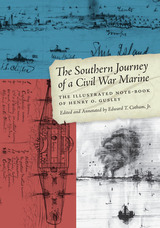
On September 28, 1863, the Galveston Tri-Weekly News caught its readers' attention with an item headlined "A Yankee Note-Book." It was the first installment of a diary confiscated from U.S. Marine Henry O. Gusley, who had been captured at the Battle of Sabine Pass. Gusley's diary proved so popular with readers that they clamored for more, causing the newspaper to run each excerpt twice until the whole diary was published. For many in Gusley's Confederate readership, his diary provided a rare glimpse into the opinions and feelings of an ordinary Yankee—an enemy whom, they quickly discovered, it would be easy to regard as a friend.
This book contains the complete text of Henry Gusley's Civil War diary, expertly annotated and introduced by Edward Cotham. One of the few journals that have survived from U.S. Marines who served along the Gulf Coast, it records some of the most important naval campaigns of the Civil War, including the spectacular Union success at New Orleans and the embarrassing defeats at Galveston and Sabine Pass. It also offers an unmatched portrait of daily life aboard ship. Accompanying the diary entries are previously unpublished drawings by Daniel Nestell, a doctor who served in the same flotilla and eventually on the same ship as Gusley, which depict many of the locales and events that Gusley describes.
Together, Gusley's diary and Nestell's drawings are like picture postcards from the Civil War—vivid, literary, often moving dispatches from one of "Uncle Sam's nephews in the Gulf."
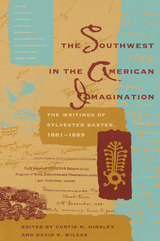
Drawing on materials housed in half a dozen institutions and now brought together for the first time, this projected seven-volume work presents a cultural history of the Hemenway Expedition and early anthropology in the American Southwest, told in the voices of its participants and interpreted by contemporary scholars. Taken as a whole, the series comprises a thorough study and presentation of the cultural, historical, literary, and archaeological significance of the expedition, with each volume posing distinct themes and problems through a set of original writings such as letters, reports, and diaries. Accompanying essays guide readers to a coherent understanding of the history of the expedition and discuss the cultural and scientific significance of these data in modern debates.
This first volume, The Southwest in the American Imagination, presents the writings of Sylvester Baxter, a journalist who became Cushing's friend and publicist in the early 1880s and who traveled to the Southwest and wrote accounts of the expedition. Included are Baxter's early writings about Cushing and the Southwest, from 1881 to 1883, which reported enthusiastically on the anthropologist's work and lifestyle at Zuñi before the expedition. Also included are published accounts of the Hemenway Expedition and its scientific promise, from 1888 to 1889, drawing on Baxter's central role in expedition affairs as secretary-treasurer of the advisory board. Series co-editor Curtis Hinsley provides an introductory essay that reviews Baxter's relationship with Cushing and his career as a journalist and civic activist in Boston, and a closing essay that inquires further into the lasting implications of the "invention of the Southwest," arguing that this aesthetic was central to the emergence and development of southwestern archaeology.
Seen a century later, the Hemenway Expedition provides unusual insights into such themes as the formation of a Southwestern identity, the roots of museum anthropology, gender relations and social reform in the late nineteenth century, and the grounding of American nationhood in prehistoric cultures. It also conveys an intellectual struggle, ongoing today, to understand cultures that are different from the dominant culture and to come to grips with questions concerning America's meaning and destiny.
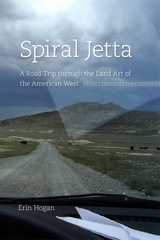
Erin Hogan hit the road in her Volkswagen Jetta and headed west from Chicago in search of the monuments of American land art: a salty coil of rocks, four hundred stainless steel poles, a gash in a mesa, four concrete tubes, and military sheds filled with cubes. Her journey took her through the states of Utah, Nevada, New Mexico, Arizona, and Texas. It also took her through the states of anxiety, drunkenness, disorientation, and heat exhaustion. Spiral Jetta is a chronicle of this journey.
A lapsed art historian and devoted urbanite, Hogan initially sought firsthand experience of the monumental earthworks of the 1970s and the 1980s—Robert Smithson’s Spiral Jetty, Nancy Holt’s Sun Tunnels, Walter De Maria’s Lightning Field, James Turrell’s Roden Crater, Michael Heizer’s Double Negative, and the contemporary art mecca of Marfa, Texas. Armed with spotty directions, no compass, and less-than-desert-appropriate clothing, she found most of what she was looking for and then some.
“I was never quite sure what Hogan was looking for when she set out . . . or indeed whether she found it. But I loved the ride. In Spiral Jetta, an unashamedly honest, slyly uproarious, ever-probing book, art doesn’t magically have the power to change lives, but it can, perhaps no less powerfully, change ways of seeing.”—Tom Vanderbilt, New York Times Book Review
“The reader emerges enlightened and even delighted. . . . Casually scrutinizing the artistic works . . . while gamely playing up her fish-out-of-water status, Hogan delivers an ingeniously engaging travelogue-cum-art history.”—Atlantic
“Smart and unexpectedly hilarious.”—Kevin Nance, Chicago Sun-Times
“One of the funniest and most entertaining road trips to be published in quite some time.”—June Sawyers, Chicago Tribune
“Hogan ruminates on how the work affects our sense of time, space, size, and scale. She is at her best when she reexamines the precepts of modernism in the changing light of New Mexico, and shows how the human body is meant to be a participant in these grand constructions.”—New Yorker
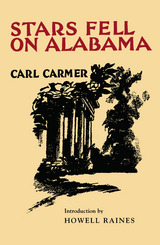
A timeless journey into the heart and folklore of Alabama.
Stars Fell on Alabama is a landmark work of Southern literature that transports readers to Alabama during the early 20th century. Written by Carl Carmer, this evocative narrative blends memoir, travel writing, and folklore to paint a rich portrait of a region steeped in tradition and complexity. Carmer captures the rhythms of rural life, the haunting beauty of the landscape, and the voices of its people—farmers, musicians, storytellers—whose tales reveal the cultural fabric of the Deep South. From ghost stories and folk songs to accounts of social customs and racial tensions, this book offers an unflinching yet affectionate look at Alabama’s heritage. Both a historical document and a literary masterpiece, Stars Fell on Alabama remains essential reading for anyone interested in Southern history, American folklore, and the enduring power of storytelling.

Through a skillful combination of economic and cultural history, this book describes the impact on Moldavia and Wallachia of steam navigation on the Danube. The Danube route integrated the two principalities into a dense network of European roads and waterways. From the 1830s to the 1860s, steamboat transport transformed time and space for the areas that benefited from regular services. River traffic accelerated urban development along the Lower Danube and contributed directly to institutional modernization in one of Europe’s peripheries.
Beyond technological advances and the transportation of goods on a trans-imperial waterway, steamboat travel revolutionized human interactions, too. The book offers a fascinating insight into the social and cultural milieu of the nineteenth century, drawing on first-hand accounts of Danube cruising. Describing the story of travelers who interacted, met, and visited the places they stopped, Constantin Ardeleanu creates a transnational history of travel up and down the Danube from Vienna to Constantinople. The pleasures and sometimes the travails of the travelers unfold against a backdrop of technical and economic transformation in the crucial period of modernization.

Steaming to the North follows the Bear from May to October 1886 as it takes its first summer cruise from San Francisco up to Point Barrow and back again. This is the first book to exhibit the photographs taken by 3rd Lt. Charles Kennedy of New Bedford, introducing rarely seen photos of the last sail-and-steam whaling ships, capturing early interactions of Natives with white whalemen and explorers, and showing lives otherwise lost to time. Essays follow the logbook of the cruise and allow readers to vividly ride alongside the crew on a history-making voyage.
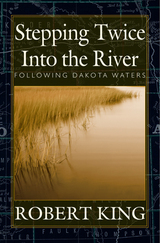
Blending travel narrative and poetic reflection, Stepping Twice Into the River takes readers on a journey through time, revealing both stability and change and offering prairie wisdom. An affectionate and shrewd observer, King illuminates the ordinary from the perspectives of history, science, and literature. In the hands of this gifted thinker and writer, local facts yield universal metaphor.
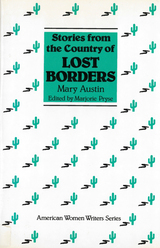
In The Land of Little Rain, Austin's attention to natural detail allows her to write prose that is geologically, biologically, and botanically accurate at the same time that it offers metaphorical insight into human emotional and spiritual experience. In Lost Borders, Austin focuses on both white and Indian women's experiences in the desert, looks for the sources of their deprivation, and finds them in the ways life betrays them, usually in the guise of men. She offers several portraits of strong women characters but ultimately identifies herself with the desert, which she personifies as a woman.
Whatever the topic, Madson’s love of nature shines through, be it coon hunting or an explanation of the incredible bird machine. His obvious affection is tempered with the recognition that not everything “natural” is a pretty sight. All of which leaves readers with a better understanding of life under the sky.
Schumacher’s history also profiles the Las Vegas where more than two million people live. He explores the neighborhoods sprawling beyond the Strip’s neon gleam and uncovers a diverse community offering much more than table games, lounge acts, and organized crime. Schumacher discusses contemporary Las Vegas, charting its course from the nation’s fastest-growing metropolis to one of the Great Recession’s most battered victims.
Sun, Sin & Suburbia will appeal to tourists looking to understand more than the glitz and glitter of Las Vegas and to newcomers who want to learn about their new hometown. It will also be an essential addition to any longtime Nevadan’s library of local history.
First published in 2012 by Stephens Press, this paperback edition is now available from the University of Nevada Press.
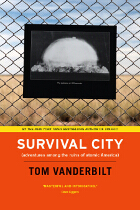
On the road to Survival City, Tom Vanderbilt maps the visible and invisible legacies of the cold war, exhuming the blueprints for the apocalypse we once envisioned and chronicling a time when we all lived at ground zero. In this road trip among ruined missile silos, atomic storage bunkers, and secret test sites, a lost battleground emerges amid the architecture of the 1950s, accompanied by Walter Cotten’s stunning photographs. Survival City looks deep into the national soul, unearthing the dreams and fears that drove us during the latter half of the twentieth century.
“A crucial and dazzling book, masterful, and for me at least, intoxicating.”—Dave Eggers
“A genuinely engaging book, perhaps because [Vanderbilt] is skillful at conveying his own sense of engagement to the reader.”—Los Angeles Times
“A retracing of Dr. Strangelove as ordinary life.”—Greil Marcus, Bookforum
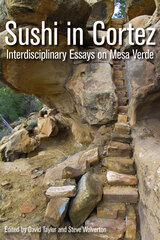
The Mesa Verde region is one of the most popular tourist destinations in the world and is an area fraught with complexities, anomalies, and layers of histories. Sushi in Cortez is a collection of essays by an interdisciplinary group of academics, artists, and cultural observers that explores this diverse landscape and heritage by combining and sharing the differing perspectives provided by various disciplines. Poetry, film, environmental philosophy, nature photography, native Pueblo perspectives, and archaeology are used to touch on the common questions people ask about the value of their work and lives as well as the value of visiting ancient sites such as Mesa Verde. The authors share personal stories about the difficulties, joys, confusions, and epiphanies they experienced as they crossed the boundaries of their professional lives, coming to understand how incomplete any single rendition of place can be. Find additional images on our website www.uofupress.com.
Take a look inside the authors’ Mesa Verde experience in this short film,“Location Fracture” by Melinda Levin.
READERS
Browse our collection.
PUBLISHERS
See BiblioVault's publisher services.
STUDENT SERVICES
Files for college accessibility offices.
RECENTLY PUBLISHED



UChicago Accessibility Resources
home | accessibility | search | about | contact us
BiblioVault ® 2001 - 2026
The University of Chicago Press