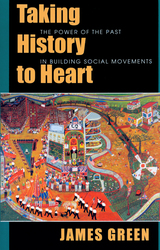
front cover of Taking History to Heart
Taking History to Heart
The Power of the Past in Building Social Movements
James Green
University of Massachusetts Press, 2000
Deftly blending autobiography and history, James Green here reflects on thirty years as an activist, educator, and historian. He recounts how he became deeply immersed in political protest and in recovering and preserving the history of progressive social movements, and how the two are linked. His book, written in an engaging and accessible style, tells powerful stories of people in struggle, framed by the personal account of his own development. As a historian, Green gives voice to generations of Americans who banded together to fight for social justice. His subjects range from the martyrs of the Haymarket tragedy to the Bread and Roses strikers of 1912, from depression-era struggles for democracy to the civil rights crusaders, from recent Rainbow Coalition campaigns to the latest union organizing drives. As an activist, Green describes how his participation in the civil rights and labor movements of our own time has transformed his life, first as a student and radical scholar in the 1960s, then as a public historian and teacher of working-class students. He also describes his efforts to break free from academic confinement and "tell movement stories in public," in an attempt to offer hope and counsel to those still fighting for equality and fairness. He concludes with a revealing look at how awareness of past social activism has contributed to the revival of the labor movement during the last ten years, an effort in which Green has been vigorously engaged.
[more]

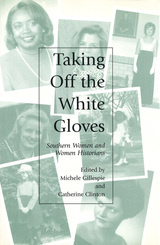
front cover of Taking Off the White Gloves
Taking Off the White Gloves
Southern Women and Women Historians
Edited & Intro by Michele Gillespie & Catherine Clinton
University of Missouri Press, 1998

When southern women remove their gloves, they speak their minds. The ten timely and provocative essays in Taking Off the White Gloves represent the collective wisdom of some of the finest scholars on women's history in the American South. On the eve of the thirtieth anniversary of the Southern Association for Women Historians, this volume brings together some of the outstanding lectures delivered by distinguished members of the association over the past fifteen years.

Spanning four centuries of women's experiences in the South, the topics featured in Taking Off the White Gloves range from Native American sexuality and European conquest to woman suffrage in the South, from black women's protest history to the status of women in the historical profession at the end of the twentieth century.

Despite diverse subject matter, these rich essays share a number of important qualities. They take an integrative approach, combining literary analysis, social history, cultural interpretation, labor history, popular culture, and oral history. Embracing the distinctiveness of the southern past and women's experiences within that past, they also recognize the inextricability of critical categories such as sexuality and gender, race and gender, and women and work. Finally, these essays emphasize the authors' commitment to the belief that the personal is political; they reveal the subtle and not so subtle ways that women transform theory into practice.

Taking Off the White Gloves invites a new understanding of the complexities that surround the history of southern women across race, class, place, and time. A model of innovative and imaginative scholarly historical writing, this book provides fertile ground for young scholars and is sure to inspire new research. This thought- provoking volume has much to offer scholars and students, as well as the general reader.
[more]

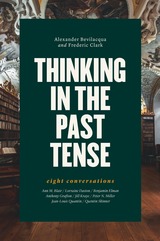
front cover of Thinking in the Past Tense
Thinking in the Past Tense
Eight Conversations
Alexander Bevilacqua and Frederic Clark
University of Chicago Press, 2019
If the vibrancy on display in Thinking in the Past Tense is any indication, the study of intellectual history is enjoying an unusually fertile period in both Europe and North America. This collection of conversations with leading scholars brims with insights from such diverse fields as the history of science, the reception of classical antiquity, book history, global philology, and the study of material culture. The eight practitioners interviewed here specialize in the study of the early modern period (c. 1400–1800), for the last forty years a crucial laboratory for testing new methods in intellectual history. The lively conversations don’t simply reveal these scholars’ depth and breadth of thought; they also disclose the kind of trade secrets that historians rarely elucidate in print. Thinking in the Past Tense offers students and professionals alike a rare tactile understanding of the practice of intellectual history. Here is a collectively drawn portrait of the historian’s craft today.
[more]

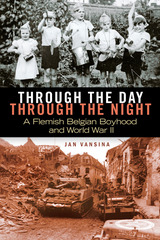
front cover of Through the Day, through the Night
Through the Day, through the Night
A Flemish Belgian Boyhood and World War II
Jan Vansina
University of Wisconsin Press, 2014
One of twelve children in a close-knit, affluent Catholic Belgian family, Jan Vansina began life in a seemingly sheltered environment. But that cocoon was soon pierced by the escalating tensions and violence that gripped Europe in the 1930s and 1940s. In this book Vansina recalls his boyhood and youth in Antwerp, Bruges, and the Flemish countryside as the country was rocked by waves of economic depression, fascism, competing nationalisms, and the occupation of first Axis and then Allied forces.
            Within the vast literature on World War II, a much smaller body of work treats the everyday experiences of civilians, particularly in smaller countries drawn into the conflict. Recalling the war in Belgium from a child’s-eye perspective, Vansina describes pangs of hunger so great as to make him crave the bitter taste of cod-liver oil. He vividly remembers the shock of seeing severely wounded men on the grounds of a field hospital, the dangers of crossing fields and swimming in ponds strafed by planes, and his family’s interactions with occupying and escaping soldiers from both sides. After the war he recalls emerging numb from the cinema where he first saw the footage of the Nazi death camps, and he describes a new phase of unrest marked by looting, vigilante justice, and the country’s efforts at reunification.
            Vansina, a historian and anthropologist best known for his insights into oral tradition and social memory, draws on his own memories and those of his siblings to reconstruct daily life in Belgium during a tumultuous era.

Best Special Interest Books, selected by the American Association of School Librarians

Best Books for General Audiences, selected by the Public Library Reviewers
[more]

logo for National University of Singapore Press
To Remain Myself
The History of Onghokham
David Reeve
National University of Singapore Press, 2022

logo for University of North Texas Press
Tracking the Texas Ranger Historians
Bruce Glasrud
University of North Texas Press, 2024

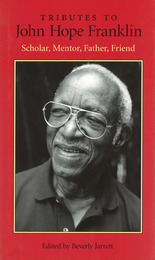
front cover of Tributes to John Hope Franklin
Tributes to John Hope Franklin
Scholar, Mentor, Father, Friend
Edited by Beverly Jarrett
University of Missouri Press, 2003
In 1947 John Hope Franklin, then a professor of history at North Carolina College for Negroes, wrote From Slavery to Freedom. Now in its eighth edition, that book, which redefined our understanding of American history, remains the preeminent record of the African American experience. With it and a dozen other books, Franklin has been established as the intellectual father of black studies.
Tributes to John Hope Franklin focuses on this esteemed scholar’s academic achievements, his humanitarian contributions, and his extraordinary legacy. This collection of comments by Franklin’s students, colleagues, family, and friends captures the man and his work for future generations. Tributes offered by Franklin’s admirers, Walter B. Hill Jr., David Levering Lewis, Alfred A. Moss Jr., Darlene Clark Hine, Loren Schweninger, Daryl Michael Scott, George M. Fredrickson, Mary Frances Berry, and many others, attest to Franklin’s commitment to his intellectual pursuits, to public service, and, most important, to his students.
Franklin’s dedication to mentoring those who sought his help, as well as providing for his family, is beyond compare. In one essay, John W. Franklin offers an inside view of growing up with John Hope and Aurelia Franklin, detailing the travels and associations that were a part of his experience as their son. Alfred Moss, coauthor of the last three editions of From Slavery to Freedom, shares special images of Franklin as mentor to a young Anglican priest.
Genna Rae McNeil shows us the quintessential teacher through the eyes of a passionate young scholar beginning her own voyage into the study of American history. George Fredrickson takes on the challenge of explaining the complexity of the work of this man who has been both a fervent proponent of racial equality and a practitioner of “detached, objective, dispassionate historical scholarship.”
Each of the pieces—by men and by women, by blacks and by whites, by several generations of participants in the twentieth century’s journey toward a better America—recalls for us what a vital role John Hope Franklin has played in that voyage. Tributes to John Hope Franklin is a joy to read and an incredible opportunity to celebrate a life and a body of historical work dedicated to achieving and sharing the wisdom that scholarly excellence provides.
[more]


Send via email Share on Facebook Share on Twitter