
 A SCHOLARLY BOOK REPOSITORY
60 start with T start with T

Yerushalmi Pesahim details the specific requirements regarding the preparation for Passover, the Passover sacrifice, and the Seder. Commenting on the many, often contradictory, prescriptions in Exodus, Leviticus, Numbers, and Deuteronomy, this tractate is an important part of a long tradition of interpretation regarding Passover.

"The texts . . . which are drawn from over two thousand years of history, are usefully divided, annotated and glossed. They enable students to explore the tradition in a new way [and] give a marvellous insight into the richness and liveliness of the Jewish religion and culture: we are given wit and pathos in addition to popular story and religious law."—Janet Trotter, Resource
Diverse approaches to biblical theology
This volume presents a collection of studies on the methodology for conceiving the theological interpretation of the Hebrew Bible among Jews and Christians as well as the treatment of key issues such as creation, the land of Israel, and divine absence. Contributors include Georg Fischer, SJ, David Frankel, Benjamin J. M. Johnson, Soo J. Kim, Wonil Kim, Jacqueline E. Lapsley, Julia M. O’Brien, Dalit Rom-Shiloni, Marvin A. Sweeney, and Andrea L. Weiss.
Features:
- Examination of metaphor, repentance, and shame in the presence of God
- Ten essays addressing the nature of biblical theology from a Jewish, Christian, or critical perspective
- Discussion of the changes that have taken place in the field of biblical theology since World War II

This follow-up to Theology of the Hebrew Bible, Volume 1: Methodological Studies, focuses on readers’ engagement with the text and their communities. Part 1 offers fresh interpretations of divine images and theological concepts drawn from various theophanies in the text. Part 2 focuses on how these insights can form new overarching structures, serving as reading strategies or foundations for alternative theologies. Part 3 emphasizes the bond between readers and their communities, highlighting the active participation of both ancient and modern readers through an analysis of past literature. Contributors, each an expert in their field, include Rachel Adelman, Samuel E. Balentine, Shelly L. Birdsong, Ginny Brewer-Boydston, Johanna Etzberger, Frances Flannery, David Frankel, Barry R. Huff, Hyun Chul Paul Kim, Barbara Leung Lai, J. Richard Middleton, Hye Kyung Park, Kris Sonek, Brent A. Strawn, David E. S. Stein, Marvin A. Sweeney, Soo Kim Sweeney, Joseph Sykora, Daniel C. Timmer, and Beat Weber. This collection of essays guides readers, including those well-versed in theology, to explore innovative and unexpected depictions of divine beings and how human characters respond to them.
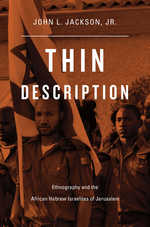
The African Hebrew Israelites of Jerusalem are often dismissed as a fringe cult for their beliefs that African Americans are descendants of the ancient Israelites and that veganism leads to immortality. But John L. Jackson questions what “fringe” means in a world where cultural practices of every stripe circulate freely on the Internet. In this poignant and sophisticated examination of the limits of ethnography, the reader is invited into the visionary, sometimes vexing world of the AHIJ. Jackson challenges what Clifford Geertz called the “thick description” of anthropological research through a multidisciplinary investigation of how the AHIJ use media and technology to define their public image in the twenty-first century.
Moving far beyond the “modest witness” of nineteenth-century scientific discourse or the “thick descriptions” of twentieth-century anthropology, Jackson insists that Geertzian thickness is an impossibility, especially in a world where the anthropologist’s subject is a self-aware subject—one who crafts his own autoethnography while critically consuming the ethnographer’s offerings. Thin Description takes as its topic a group situated along the fault lines of several diasporas—African, American, Jewish—and provides an anthropological account of how race, religion, and ethnographic representation must be understood anew in the twenty-first century lest we reenact old mistakes in the study of black humanity.
A fascination with this question prompted Jonathan Boyarin, one of America's most original thinkers in critical theory and Jewish ethnography, to offer the unexpected Jewish perspective on the vexed issue of identity politics presented here. Boyarin's essays explore the ways in which a Jewish—or, more particularly, Yiddish—idiom complicates the question of identity. Ranging from explorations of a Lower East Side synagogue to Fichte's and Derrida's contrasting notions of the relation between the Jews and the idea of Europe, from the Lubavitch Hasidim to accounts of self-making by Judith Butler and Charles Taylor, Thinking in Jewish will be indispensable reading for students of critical theory, cultural studies, and Jewish studies.
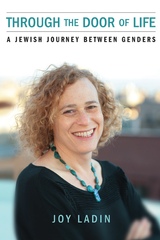
Professor Jay Ladin made headlines around the world when, after years of teaching literature at Yeshiva University, he returned to the Orthodox Jewish campus as a woman—Joy Ladin. In Through the Door of Life, Joy Ladin takes readers inside her transition as she changed genders and, in the process, created a new self.
With unsparing honesty and surprising humor, Ladin wrestles with both the practical problems of gender transition and the larger moral, spiritual, and philosophical questions that arise. Ladin recounts her struggle to reconcile the pain of her experience living as the “wrong” gender with the pain of her children in losing the father they love. We eavesdrop on her lifelong conversations with the God whom she sees both as the source of her agony and as her hope for transcending it. We look over her shoulder as she learns to walk and talk as a woman after forty-plus years of walking and talking as a man. We stare with her into the mirror as she asks herself how the new self she is creating will ever become real.
Ladin’s poignant memoir takes us from the death of living as the man she knew she wasn’t, to the shattering of family and career that accompanied her transition, to the new self, relationships, and love she finds when she opens the door of life.
2012 Finalist for the National Jewish Book Award for Biography, Autobiography, or Memoir
“Given her high-profile academic position, Ladin’s transition was a major news story in Israel and even internationally. But behind the public story was a private struggle and learning experience, and Ladin pulls no punches in telling that story. She offers a peek into how daunting it was to learn, with little support from others, how to dress as a middle-aged woman, to mu on make-up, to walk and talk like a female. She provides a front-row seat for observing how one person confronted a seemingly impossible situation and how she triumphed, however shakingly, over the many adversities, both societal and psychological, that stood in the way.”—The Gay and Lesbian Review Worldwide
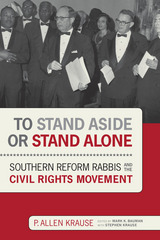
In 1966, a young rabbinical student named P. Allen Krause conducted interviews with twelve Reform rabbis from southern congregations concerning their thoughts, principles, and activities as they related to the civil rights movement. Perhaps because he was a young seminary student or more likely because the interviewees were promised an embargo of twenty-five years before the interviews would be released to the public, the rabbis were extremely candid about their opinions on and their own involvement with what was still an incendiary subject. Now, in To Stand Aside or Stand Alone: Southern Reform Rabbis and the Civil Rights Movement, their stories help elucidate a pivotal moment in time.
After a distinguished rabbinical career, Krause wrote introductions to and annotated the interviews. When Krause succumbed to cancer in 2012, Mark K. Bauman edited the manuscripts further and wrote additional introductions with the assistance of Stephen Krause, the rabbi’s son. The result is a unique volume offering insights into these rabbis’ perceptions and roles in their own words and with more depth and nuance than hitherto available. This exploration into the lives of these teachers and civic leaders is supported by important contextual information on the local communities and other rabbis, with such background information forming the basis of a demographic profile of the Reform rabbis working in the South.
The twelve rabbis whom Krause interviewed served in Alabama, Georgia, Louisiana, Mississippi, Tennessee, and Virginia, and the substance and scope of their discussions cover some of the most crucial periods in the civil rights movement. Although some have provided accounts that appeared elsewhere or have written about their experiences themselves, several new voices appear here, suggesting that more southern rabbis were active than previously thought. These men functioned within a harsh environment: rabbis’ homes, synagogues, and Jewish community centers were bombed; one rabbi, who had been beaten and threatened, carried a pistol to protect himself and his family. The views and actions of these men followed a spectrum from gradualism to activism; while several of the rabbis opposed the evils of the separate and unequal system, others made peace with it or found reasons to justify inaction. Additionally, their approaches differed from their activist colleagues in the North even more than from each other.
Within these pages, readers learn about the attitudes of the rabbis toward each other, toward their congregants, toward national Jewish organizations, and toward local leaders of black and white and Protestant and Catholic groups. Theirs are dramatic stories of frustration, cooperation, and conflict.

The central element of Jewish worship is the yearly cycle of reading the first five books of the Bible, the Five Books of Moses, called the Torah in Hebrew. Torah Today, a compilation of fifty-four essays that grew out of Pinchas Peli's Torah column in the Jerusalem Post, comments upon the weekly readings from the Torah. Written in a wonderfully clear style, each essay brings the reader closer to the rich spiritual world of Torah as it confronts the challenges of modern society. This reissue of Torah Today, with a new preface by Rabbi Harold M. Schulweis, makes this classic work available to a new generation of Bible students.
“If Hasidism begins in the life-enhancing spirituality of the Baal Shem Tov, it concludes in the tortuous, elitist and utterly fascinating career of Nahman of Bratslav (1722–1810) whose biography and teaching Arthur Green has set forth in his comprehensive, moving, and subtle study, Tormented Master.
“Arthur Green has managed to lead us through the thickets of the Bratslaver discourse with a grace and facility thus far unequaled in the English language literature on Hasidism. Tormented Master is a model of clarity and percipience, balancing awed respect and honor for its subject with a ruthless pursuit of documented truth. . . . Tormented Master is sufficiently open to the agonies of religion in general and the issues of modern religion in particular to make Nahman a thinker utterly relevant to our time.
“Nahman of Bratslav is unique in the history of Judaism, Green emphasizes, for having made the individual’s quest for intimacy with God the center of the religious way. He was a Kierkegaard before his time, believing in the utter abandon of the life of faith and the risk of paradoxicality. . . . He was, more than all others, the predecessor of Kafka, whose tales, like Nahman’s, have no explicit key and rankle, flush and irritate the spirit, compelling us—even in our failure to understand—to acknowledge their potency and challenge.”
—New York Times
The defining quality of Russian literature, for most critics, is its ethical seriousness expressed through formal originality. The Trace of Judaism addresses this characteristic through the thought of the Lithuanian-born Franco-Jewish philosopher Emmanuel Levinas. Steeped in the Russian classics from an early age, Levinas drew significantly from Dostoevsky in his ethical thought. One can profitably read Russian literature through Levinas, and vice versa.
Explore the opportunities and challenges of Septuagint studies
Recent research into the Septuagint has revealed numerous examples of modifications of the meaning of the Hebrew text in the course of its translation into Greek. This collection of essays by one of the leading scholars on the Septuagint shows how complex the translation of individual books was, provides reasons for differences between the Hebrew and Greek Bibles, and paves the way for a theology of the Septuagint. Articles introduce the field of Septuagint studies, the problem of the Letter of Aristeas, and the Hellenistic environment and the hermeneutics of Hellenistic Judaism.
Features:
- A methodological discussion of whether and how a theology of the Septuagint can be written
- Essays introducing the field of Septuagint studies and its Hellenistic environment and the hermeneutics of Hellenistic Judaism
- Fifteen English and German essays covering twenty-five years of Septuagint research
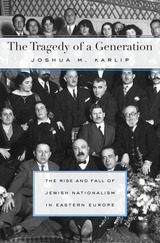
The Tragedy of a Generation is the story of the rise and fall of an ideal: an autonomous Jewish nation in Europe. It traces the origins of two influential but overlooked strains of Jewish thought—Yiddishism and Diaspora Nationalism—and documents the waning hopes and painful reassessments of their leading representatives against the rising tide of Nazism and, later, the Holocaust.
Joshua M. Karlip presents three figures—Elias Tcherikower, Yisroel Efroikin, and Zelig Kalmanovitch—seen through the lens of Imperial Russia on the brink of revolution. Leaders in the struggle for recognition of the Jewish people as a national entity, these men would prove instrumental in formulating the politics of Diaspora Nationalism, a middle path that rejected both the Zionist emphasis on Palestine and the Marxist faith in class struggle. Closely allied with this ideology was Yiddishism, a movement whose adherents envisioned the Yiddish language and culture, not religious tradition, as the unifying force of Jewish identity.
We follow Tcherikower, Efroikin, and Kalmanovitch as they navigate the tumultuous early decades of the twentieth century in pursuit of a Jewish national renaissance in Eastern Europe. Correcting the misconception of Yiddishism as a radically secular movement, Karlip uncovers surprising confluences between Judaism and the avowedly nonreligious forms of Jewish nationalism. An essential contribution to Jewish historiography, The Tragedy of a Generation is a probing and poignant chronicle of lives shaped by ideological conviction and tested to the limits by historical crisis.

A groundbreaking exploration of the Jewish marriage contract and its evolution in English translation
Translating the Ketubah offers a fresh perspective on the ketubah, the Jewish marriage contract. Traditionally composed in Aramaic, ketubot have been examined in other books within the frameworks of Jewish law and Jewish art. Here, however, Benjamin Steiner shows how translations of the ketubah into English helped Jews adapt to changing social and economic circumstances across more than two centuries.
Steiner uses ketubot to trace the intricate relationship between religious law and secular law, the changing status of women within and outside Judaism, and the complex desire of Jews to be both authentically Jewish and fully acculturated. Steiner further shows how ketubah translation aided Jews to achieve different cultural goals. It has been used to uphold rabbinic law in communities where religious affiliation was voluntary to ensure women's economic security. It has also facilitated socialization with non-Jews and addressed perceived crises within the Jewish family.
Through a nuanced analysis of ketubah translations from England and various regions of the United States from the late eighteenth century to the present, Steiner offers a detailed look at how Jews have adapted ancient tradition to meet the challenges and opportunities of different historical contexts. His work sheds new light on the rich history of American and British Jewry.
Scholar Yosef Hayim Yerushalmi (1932–2009) possessed a stunning range of erudition in all eras of Jewish history, as well as in world history, classical literature, and European culture. What Yerushalmi also brought to his craft was a brilliant literary style, honed by his own voracious reading from early youth and his formative undergraduate studies. This series of interviews paints a revealing portrait of this giant of history, bringing together exceptional material on Yerushalmi’s personal and intellectual journeys that not only attests to the astonishing breakthrough of the issues of Jewish history into “general history,” but also offers profound insight into being Jewish in today's world.
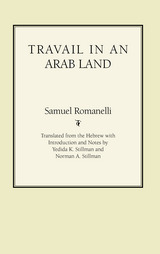
During a return voyage to Italy in 1786, he became stranded in Gibraltar for an extended time which depleted his funds, and his economic circumstances forced him to join a merchant travelling to Morocco. Through misadventure in Morocco, he lost his passport and was retained in that country for four years, the story of which forms Travail in an Arab Land, first published in 1792 in Berlin. The book is a firsthand account of the author’s adventures during the four years he was stranded in Sharifan Morocco between 1787 and 1790.

As Biro recounts these tales, we hear not only his voice and the voice of his father, but those of generations of storytellers who have used humor to teach about the truly important issues in life—the delicacy of love, the fragility of friendship, the pitfalls of self-righteousness, the costs of narrow-mindedness, and the unpredictability of life itself. Biro artfully spins each story, lingering on the details, guiding the reader to the inevitable—yet always unexpected—punchline.
Taken individually, these stories will make you laugh out loud; taken as a whole, they form an invaluable record of the sensibilities of an entire people. Biro writes: "These Jewish stories of which not a single one happened to me, and of which I did not invent a single one, do describe me, do characterize me, do explain me. They are always my own story. And yours."
READERS
Browse our collection.
PUBLISHERS
See BiblioVault's publisher services.
STUDENT SERVICES
Files for college accessibility offices.
RECENTLY PUBLISHED




UChicago Accessibility Resources
home | accessibility | search | about | contact us
BiblioVault ® 2001 - 2025
The University of Chicago Press