front cover of Waiting for the Cool Moon
Waiting for the Cool Moon
Anti-imperialist Struggles in the Heart of Japan's Empire
Wendy Matsumura
Duke University Press, 2024
In Waiting for the Cool Moon Wendy Matsumura interrogates the erasure of colonial violence at the heart of Japanese nation-state formation. She critiques Japan studies’ role in this effacement and contends that the field must engage with anti-Blackness and anti-Indigeneity as the grounds on which to understand imperialism, colonialism, fascism, and other forces that shape national consciousness. Drawing on Black radical thinkers’ critique of the erasure of the Middle Passage in universalizing theories of modernity’s imbrication with fascism, Matsumura traces the consequences of the Japanese empire’s categorization of people as human and less-than-human as manifested in the 1920s and 1930s, and the struggles of racialized and colonized people against imperialist violence. She treats the archives safeguarded by racialized, colonized women throughout the empire as traces of these struggles, including the work they performed to keep certain stories out of view. Matsumura demonstrates that tracing colonial sensibility and struggle is central to grappling with their enduring consequences for the present.
[more]

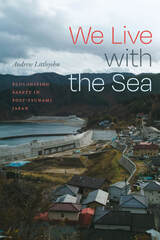
front cover of We Live with the Sea
We Live with the Sea
Ecologizing Safety in Post-Tsunami Japan
Andrew Littlejohn
Duke University Press, 2026
In We Live with the Sea, Andrew Littlejohn addresses the implementation and controversy surrounding safety infrastructures following the March 2011 tsunami in northeastern Japan. While the Japanese government proposed and enforced infrastructural transformations in the wake of the tsunami, these changes did not consider the impact on residents who built their communities and livelihoods around the coast. Focusing on the tsunami survivors who resisted government plans for increased coastal defenses, Littlejohn highlights alternative proposals offered by the local residents as well as the environmental, ecological, and more-than-human dependencies and imbrications those proposals reveal. In doing so, he argues that imposed modernist safety structures undermine the very things they claim to protect, showing how attempts to “ecologize” safety may offer more sustainable ways of thinking about security, preservation, and infrastructure.
[more]

front cover of We Refused to Die
We Refused to Die
My time as a prisoner of war in Bataan and Japan, 1942-1945
Gene S Jacobsen
University of Utah Press, 2004
Gene Jacobsen was a nineteen-year-old Idaho ranch kid when he decided to join the Army Air Corps in September 1940. By December 1941 he was supply sergeant for the Twentieth Pursuit Squadron at Clark Field in the Philippines. Five months later he was a captive of the Imperial Japanese Army, enduring the Bataan death march and subsequent horrors in the Philippines and Japan. Of the 207 officers and men who made up Jacobsen’s squadron at the beginning of the war, sixty-five survived to return to the United States. We Refused to Die recounts Jacobsen’s struggle, against all odds, to remain one of those sixty-five men.

In engaging, direct prose, Jacobsen’s three-and-a-half year experience as a prisoner of war takes the reader on a brutal and harrowing march through hatred and forgiveness, fortitude and freedom. We Refused to Die is an honest memoir that shines light on one of history’s darkest moments.
[more]

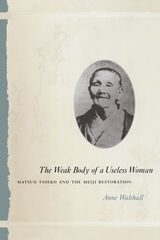
front cover of The Weak Body of a Useless Woman
The Weak Body of a Useless Woman
Matsuo Taseko and the Meiji Restoration
Anne Walthall
University of Chicago Press, 1998
In 1862, fifty-one-year-old Matsuo Taseko left her old life behind by traveling to Kyoto, the old imperial capital. Peasant, poet, and local political activist, Taseko had come to Kyoto to support the nativist campaign to restore the Japanese emperor and expel Western "barbarians." Although she played a minor role in the events that led to the Meiji Restoration of 1868, her actions were nonetheless astonishing for a woman of her day. Honored as a hero even before her death, Taseko has since been adopted as a patron saint by rightist nationalists.

In telling Taseko's story, Anne Walthall gives us not just the first full biography in English of a peasant woman of the Tokugawa period (1603-1868), but also fresh perspectives on the practices and intellectual concerns of rural entrepreneurs and their role in the Meiji Restoration. Writing about Taseko with a depth and complexity that has thus far been accorded only to men of that time, Walthall has uncovered a tale that will captivate anyone concerned with women's lives and with Japan's dramatic transition to modernity.
[more]

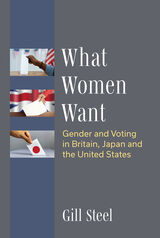
front cover of What Women Want
What Women Want
Gender and Voting in Britain, Japan and the United States
Gill Steel
University of Michigan Press, 2022

What Women Want analyzes decades of voting preferences, values, and policy preferences to debunk some of the media and academic myths about gender gaps in voting and policy preferences. Findings show that no single theory explains when differences in women’s and men’s voting preferences emerge, when they do not, or when changes—or the lack thereof—occur over time. Steel extends existing theories to create a broader framework for thinking about gender and voting behavior to provide more analytical purchase in understanding gender and its varying effects on individual voters’ preferences. She incorporates the long-term effects of party identification and class politics on political decision-making, particularly in how they influence preferences on social provision and on expectations of the state. She also points to the importance of symbolic politics
[more]

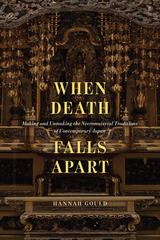
front cover of When Death Falls Apart
When Death Falls Apart
Making and Unmaking the Necromaterial Traditions of Contemporary Japan
Hannah Gould
University of Chicago Press, 2023
Through an ethnographic study inside Japan’s Buddhist goods industry, this book establishes a method for understanding change in death ritual through attention to the dynamic lifecourse of necromaterials.
 
Deep in the Fukuyama mountainside, “the grave of the graves” (o-haka no haka) houses acres of unwanted headstones—the material remains of Japan’s discarded death rites. In the past, the Japanese dead became venerated ancestors through sustained ritual offerings at graves and at butsudan, Buddhist altars installed inside the home. But in twenty-first-century Japan, this intergenerational system of care is rapidly collapsing.

In noisy carpentry studios, flashy funeral-goods showrooms, neglected cemeteries, and cramped kitchens where women prepare memorial feasts, Hannah Gould analyzes the lifecycle of butsudan, illuminating how they are made, circulate through religious and funerary economies, mediate intimate exchanges between the living and the dead, and—as the population ages, families disperse, and fewer homes have space for large lacquer cabinets—eventually fall into disuse. What happens, she asks, when a funerary technology becomes obsolete? And what will take its place? Gould examines new products better suited to urban apartments: miniature urns and sleek altars inspired by Scandinavian design, even reliquary jewelry. She visits an automated columbarium and considers new ritual practices that embrace impermanence. At an industry expo, she takes on the role of “demonstration corpse.” Throughout, Gould invites us to rethink memorialization and describes a distinct form of Japanese necrosociality, one based on material exchanges that seek to both nurture the dead and disentangle them from the world of the living.
[more]

front cover of When the Bones Speak
When the Bones Speak
The Living, the Dead, and the Sacrifice of Contemporary Okinawa
Christopher T. Nelson
Duke University Press, 2025
Haunted by the past, ordinary Okinawans struggle to live with the unbearable legacies of war, Japanese nationalism, and American imperialism. They are caught up in a web of people and practices—living and dead, visible and immaterial—that exert powerful forces often beyond their control. In When the Bones Speak, Christopher T. Nelson examines the myriad ways contemporary Okinawans experience, remember, and contest sacrifice. He attends to the voices of those who find their vocation in service to others, from shamans, fortune tellers, laborers, and artists to dead soldiers, war survivors, antiwar activists, and Christian missionaries. Nelson shows how the memories of past sacrifices, atrocities, and exploitation as well as residual trauma shape modern life in Okinawa and the possibility and hope for creative action grounded in the everyday. Offering new understandings of colonial transformation, wartime violence, and military occupation, Nelson writes from the intersection of temporalities and possibilities, where the hard finality of the past may be broken open to reveal a “not yet” that has always remained just beyond reach.
[more]

front cover of When We Say “Hiroshima”
When We Say “Hiroshima”
Selected Poems
Kurihara Sadako; Translated with an Introduction by Richard H. Minear
University of Michigan Press, 1999
Kurihara Sadako is one of the poetic giants of the nuclear age. Born in Hiroshima in 1913, she was in Hiroshima on August 6, 1945. From then till now she has addressed her poetry primarily to issues of nuclear destruction, nuclear weapons, and nuclear power. Herself a victim of the world’s first nuclear attack, she became the poetic conscience of the Hiroshima that was no more. But Kurihara turned her attention soon to more controversial issues, including Japan’s role as victimizer in World War II. Many of her poems attack the Japanese government and its policies then and now.
When We Say “Hiroshima” contains a selection of the poems Kurihara wrote between 1942 and 1989. They include meditations on death, on survival, on nuclear radiation, on Japanese politics, on American foreign policy, and on women’s issues.
[more]

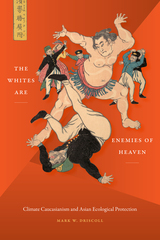
front cover of The Whites Are Enemies of Heaven
The Whites Are Enemies of Heaven
Climate Caucasianism and Asian Ecological Protection
Mark W. Driscoll
Duke University Press, 2020
In The Whites Are Enemies of Heaven Mark W. Driscoll examines nineteenth-century Western imperialism in Asia and the devastating effects of "climate caucasianism"—the white West's pursuit of rapacious extraction at the expense of natural environments and people of color conflated with them. Drawing on an array of primary sources in Chinese, Japanese, and French, Driscoll reframes the Opium Wars as "wars for drugs" and demonstrates that these wars to unleash narco- and human traffickers kickstarted the most important event of the Anthropocene: the military substitution of Qing China's world-leading carbon-neutral economy for an unsustainable Anglo-American capitalism powered by coal. Driscoll also reveals how subaltern actors, including outlaw societies and dispossessed samurai groups, became ecological protectors, defending their locales while driving decolonization in Japan and overthrowing a millennia of dynastic rule in China. Driscoll contends that the methods of these protectors resonate with contemporary Indigenous-led movements for environmental justice.
[more]

front cover of The Wild Goose
The Wild Goose
Mori Ogai; Translated with an Introduction by Burton Watson
University of Michigan Press, 1995
Mori Ōgai (1862–1922), one of the giants of modern Japanese literature, wrote The Wild Goose at the turn of the century. Set in the early 1880s, it was, for contemporary readers, a nostalgic return to a time when the nation was embarking on an era of dramatic change. Ōgai’s narrator is a middle-aged man reminiscing about an unconsummated affair, dating to his student days, between his classmate and a young woman kept by a moneylender. At a time when writers tended to depict modern, alienated male intellectuals, the characters of The Wild Goose are diverse, including not only students preparing for a privileged intellectual life and members of the plebeian classes who provide services to them, but also a pair of highly developed female characters. The author’s sympathetic and penetrating portrayal of the dilemmas and frustrations faced by women in this early period of Japan’s modernization makes the story of particular interest to readers today.
Ōgai was not only a prolific and popular writer, but also a protean figure in early modern Japan: critic, translator, physician, military officer, and eventually Japan’s Surgeon General. His rigorous and broad education included the Chinese classics as well as Dutch and German; he gained admittance to the Medical School of Tokyo Imperial University at the age of only fifteen. Once established as a military physician, he was sent to Germany for four years to study aspects of European medicine still unfamiliar to the Japanese. Upon his return, he produced his first works of fiction and translations of English and European literature. Ōgai’s writing is extolled for its unparalleled style and psychological insight, nowhere better demonstrated than in The Wild Goose.
[more]

front cover of With the Possum and the Eagle
With the Possum and the Eagle
The Memoir of a Navigator's War over Germany and Japan
Ralph Nutter
University of North Texas Press, 2005

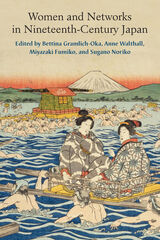
front cover of Women and Networks in Nineteenth-Century Japan
Women and Networks in Nineteenth-Century Japan
Edited by Bettina GRAMLICH-OKA, Anne WALTHALL, MIYAZAKI Fumiko, and SUGANO Noriko
University of Michigan Press, 2020
Although scholars have emphasized the importance of women’s networks for civil society in twentieth-century Japan, Women and Networks in Nineteenth-Century Japan is the first book to tackle the subject for the contentious and consequential nineteenth century. The essays traverse the divide when Japan started transforming itself from a decentralized to a centralized government, from legally imposed restrictions on movement to the breakdown of travel barriers, and from ad hoc schooling to compulsory elementary school education. As these essays suggest, such changes had a profound impact on women and their roles in networks. Rather than pursue a common methodology, the authors take diverse approaches to this topic that open up fruitful avenues for further exploration.

Most of the essays in this volume are by Japanese scholars; their inclusion here provides either an introduction to their work or the opportunity to explore their scholarship further. Because women are often invisible in historical documentation, the authors use a range of sources (such as diaries, letters, and legal documents) to reconstruct the familial, neighborhood, religious, political, work, and travel networks that women maintained, constructed, or found themselves in, sometimes against their will. In so doing, most but not all of the authors try to decenter historical narratives built on men’s activities and men’s occupational and status-based networks, and instead recover women’s activities in more localized groupings and personal associations.
[more]

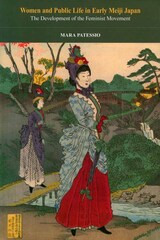
front cover of Women and Public Life in Early Meiji Japan
Women and Public Life in Early Meiji Japan
The Development of the Feminist Movement
Mara Patessio
University of Michigan Press, 2011
Women and Public Life in Early Meiji Japan focuses on women’s activities in the new public spaces of Meiji Japan. With chapters on public, private, and missionary schools for girls, their students, and teachers, on social and political groups women created, on female employment, and on women’s participation in print media, this book offers a new perspective on nineteenth- and early twentieth-century Japanese history. Women’s founding of and participation in conflicting discourses over the value of women in Meiji public life demonstrate that during this period active and vocal women were everywhere, that they did not meekly submit to the dictates of the government and intellectuals over what women could or should do, and that they were fully integrated in the production of Meiji culture.
Mara Patessio shows that the study of women is fundamental not only in order to understand fully the transformations of the Meiji period, but also to understand how later generations of women could successfully move the battle forward. Women and Public Life in Early Meiji Japan is essential reading for all students and teachers of 19th- and early 20th-century Japanese history and is of interest to scholars of women’s history more generally.
[more]

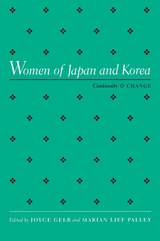
front cover of Women Of Japan & Korea
Women Of Japan & Korea
Continuity and Change
edited by Joyce Gelb and Marian Lief Palley
Temple University Press, 1994
This collection presents new research on the changing roles of women in Japan and Korea. At a time when women in these two countries are becoming more politically and socially prominent, these essays provide insight into the clashes that have arisen between tradition and change. The contributors compare similarities and differences in the two cultures, considering family life, education, health care, work, reproductive and legal rights, and political participation, including the rise of women's movements in Asia and the battle against sexism and gender stereotyping. Essays written by Japanese and Korean women, leading social scientists and practitioners, illuminate the current political, economic, and social status of women in Japan and Korea.
[more]

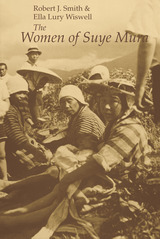
front cover of The Women of Suye Mura
The Women of Suye Mura
Robert J. Smith and Ella Lury Wiswell
University of Chicago Press, 1982
Japanese women are frequently perceived by foreigners as stereotypes. Pictured as compliant, long-suffering, and charming in a childlike way, they are said to be child-centered and restricted in their interests and actions to the domestic realm. The appear as victim, pawn, or tragic heroine: Madame Chrysanthemum, Madame Butterfly, and even the impossible Mariko of Shogun.

The Women of Suye Mura provides a rich body of information by means of which such stereotypes may be reevaluated and challenged. Based on Ella Wiswell's extensive field notes from the mid-1930s—when she and her late husband John Embree undertook a joint research project in rural Japan—this volume forms a companion to Embree's now-standard Suye Mura: A Japanese Village. Its focus on the women of the village affords a unique look at their daily lives and a detailed portrait of their world-views and social understandings at a time when the orthodoxies of the contemporary state were not yet completely accepted. Through Ella Wiswell's journal, sensitively edited by Robert Smith, we may understand some of their hopes and fears, see what amuses and angers them, and hear their comments on everything from adultery and illness to religion, magic and the origins of the imperial house.

The body of data, secured by direct observation, is unparalleled in the literature. No other account of the lives of Japanese rural women of this era remains, and in no contemporary community can their like be found. The Women of Suye Mura will thus serve as an important resource for anyone interested in the past—and present—of the Japanese woman.
[more]

front cover of Women on the Verge
Women on the Verge
Japanese Women, Western Dreams
Karen Kelsky
Duke University Press, 2001
Over the past few decades, many young Japanese women have emerged as Japan’s most enthusiastic “internationalists,” investing in study or work abroad, or in romance with Western men as opportunities to circumvent what they consider their country’s oppressive corporate and family structures. Drawing on a rich supply of autobiographical narratives, as well as literary and cultural texts, Karen Kelsky situates this phenomenon against a backdrop of profound social change in Japan andwithin an intricate network of larger global forces.

In exploring the promises, limitations, and contradictions of these “occidental longings,” Women on the Verge exposes the racial and erotic politics of transnational mobility. Kelsky shows how female cosmopolitanism recontextualizes the well-known Western male romance with the Orient: Japanese women are now the agents, narrating their own desires for the “modern” West in ways that seem to defy Japanese nationalism as well as long-standing relations of power not only between men and women but between Japan and the West. While transnational movement is not available to all Japanese women, Kelsky shows that the desire for the foreign permeates many Japanese women’s lives. She also reveals how this feminine allegiance to the West—and particularly to white men—can impose its own unanticipated hegemonies of race, sexuality, and capital.

Combining ethnography and literary analysis, and bridging anthropology and cultural studies, Women on the Verge will also appeal to students and scholars of Japan studies, feminism, and global culture.


[more]

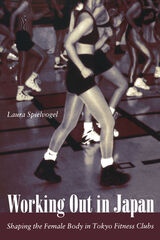
front cover of Working Out in Japan
Working Out in Japan
Shaping the Female Body in Tokyo Fitness Clubs
Laura Spielvogel
Duke University Press, 2003
Beer, ice cream, and socializing; thighs, abs, and pecs—Japanese fitness clubs combine entertainment and exercise, reflecting the Japanese concept of fitness as encompassing a zest for life as well as physical health. Through an engaging account of these clubs, Working Out in Japan reveals how beauty, bodies, health, and leisure are understood and experienced in Japan today. An aerobics instructor in two of Tokyo’s most popular fitness club chains from 1995 to 1997, Laura Spielvogel captures the diverse voices of club members, workers, and managers; women and men; young and old.
Fitness clubs have proliferated in Japanese cities over the past decade. Yet, despite the pervasive influence of a beauty industry that values thinness above all else, they have met with only mixed success . Exploring this paradox, Spielvogel focuses on the tensions and contradictions within the world of Japanese fitness clubs and on the significance of differences between Japanese and North American philosophies of mind and body. Working Out in Japan explores the ways spaces and bodies are organized and regulated within the clubs, the frustrations of female instructors who face various gender inequities, and the difficult demands that the ideal of slimness places on Japanese women. Spielvogel’s vivid investigation illuminates not only the fitness clubs themselves, but also broader cultural developments including the growth of the service industry and the changing character of work and leisure in Japan.
[more]

logo for Intellect Books
World Film Locations
Tokyo
Edited by Chris MaGee
Intellect Books, 2011

From Tokyo Story to Godzilla, You Only Live Twice to Enter the Void, World Film Locations: Tokyo presents a kaleidoscopic view of one of the world’s most exciting cities through the lens of cinema. Illustrated throughout with dynamic screen shots, this volume in Intellect’s World Film Locations series spotlights fifty key scenes from classic and contemporary films shot in Tokyo, accompanied by insightful essays that take us from the wooden streets of pre-nineteenth-century Edo to the sprawling “what-if” megalopolis of science fiction and fantasy anime. Important themes and players—among them Akira Kurosawa, Samuel Fuller, and Sofia Coppola—are individually considered. For the film scholar, or for all those who love Japanese cinema and want to learn more, World Film Locations: Tokyo will be an essential guide.
[more]

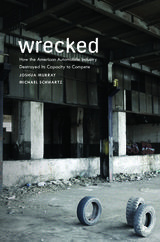
front cover of Wrecked
Wrecked
How the American Automobile Industry Destroyed Its Capacity to Compete
Joshua Murray
Russell Sage Foundation, 2019
At its peak in the 1950s and 1960s, automobile manufacturing was the largest, most profitable industry in the United States and residents of industry hubs like Detroit and Flint, Michigan had some of the highest incomes in the country. Over the last half-century, the industry has declined, and American automakers now struggle to stay profitable. How did the most prosperous industry in the richest country in the world crash and burn? In Wrecked, sociologists Joshua Murray and Michael Schwartz offer an unprecedented historical-sociological analysis of the downfall of the auto industry. Through an in-depth examination of labor relations and the production processes of automakers in the U.S. and Japan both before and after World War II, they demonstrate that the decline of the American manufacturers was the unintended consequence of their attempts to weaken the bargaining power of their unions.
 
Today Japanese and many European automakers produce higher quality cars at lower cost than their American counterparts thanks to a flexible form of production characterized by long-term sole suppliers, assembly and supply plants located near each other, and just-in-time delivery of raw materials. While this style of production was, in fact, pioneered in the U.S. prior to World War II, in the years after the war, American automakers deliberately dismantled this system. As Murray and Schwartz show, flexible production accelerated innovation but also facilitated workers’ efforts to unionize plants and carry out work stoppages. To reduce the efficacy of strikes and combat the labor militancy that flourished between the Depression and the postwar period, the industry dispersed production across the nation, began maintaining large stockpiles of inventory, and eliminated single sourcing. While this restructuring of production did ultimately reduce workers’ leverage, it also decreased production efficiency and innovation. The U.S. auto industry has struggled ever since to compete with foreign automakers, and formerly thriving motor cities have suffered the consequences of mass deindustrialization.
 
Murray and Schwartz argue that new business models that reinstate flexible production and prioritize innovation rather than cheap labor could stem the outsourcing of jobs and help revive the auto industry. By clarifying the historical relationships between production processes, organized labor, and industrial innovation, Wrecked provides new insights into the inner workings and decline of the U.S. auto industry.

 
[more]

front cover of Writing the Love of Boys
Writing the Love of Boys
Origins of Bishonen Culture in Modernist Japanese Literature
Jeffrey Angles
University of Minnesota Press, 2010
Despite its centuries-long tradition of literary and artistic depictions of love between men, around the fin de siècle Japanese culture began to portray same-sex desire as immoral. Writing the Love of Boys looks at the response to this mindset during the critical era of cultural ferment between the two world wars as a number of Japanese writers challenged the idea of love and desire between men as pathological.

Jeffrey Angles focuses on key writers, examining how they experimented with new language, genres, and ideas to find fresh ways to represent love and desire between men. He traces the personal and literary relationships between contemporaries such as the poet Murayama Kaita, the mystery writers Edogawa Ranpo and Hamao Shiro, the anthropologist Iwata Jun’ichi, and the avant-garde innovator Inagaki Taruho.

Writing the Love of Boys shows how these authors interjected the subject of male–male desire into discussions of modern art, aesthetics, and perversity. It also explores the impact of their efforts on contemporary Japanese culture, including the development of the tropes of male homoeroticism that recur so often in Japanese girls’ manga about bishonen love.
[more]


Send via email Share on Facebook Share on Twitter