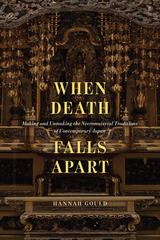
When Death Falls Apart: Making and Unmaking the Necromaterial Traditions of Contemporary Japan
University of Chicago Press, 2023
Cloth: 978-0-226-82899-2 | eISBN: 978-0-226-82900-5 | Paper: 978-0-226-82901-2
Library of Congress Classification GT3284.A2G68 2023
Dewey Decimal Classification 393.0952
Cloth: 978-0-226-82899-2 | eISBN: 978-0-226-82900-5 | Paper: 978-0-226-82901-2
Library of Congress Classification GT3284.A2G68 2023
Dewey Decimal Classification 393.0952
ABOUT THIS BOOK | AUTHOR BIOGRAPHY | REVIEWS | TOC | REQUEST ACCESSIBLE FILE
ABOUT THIS BOOK
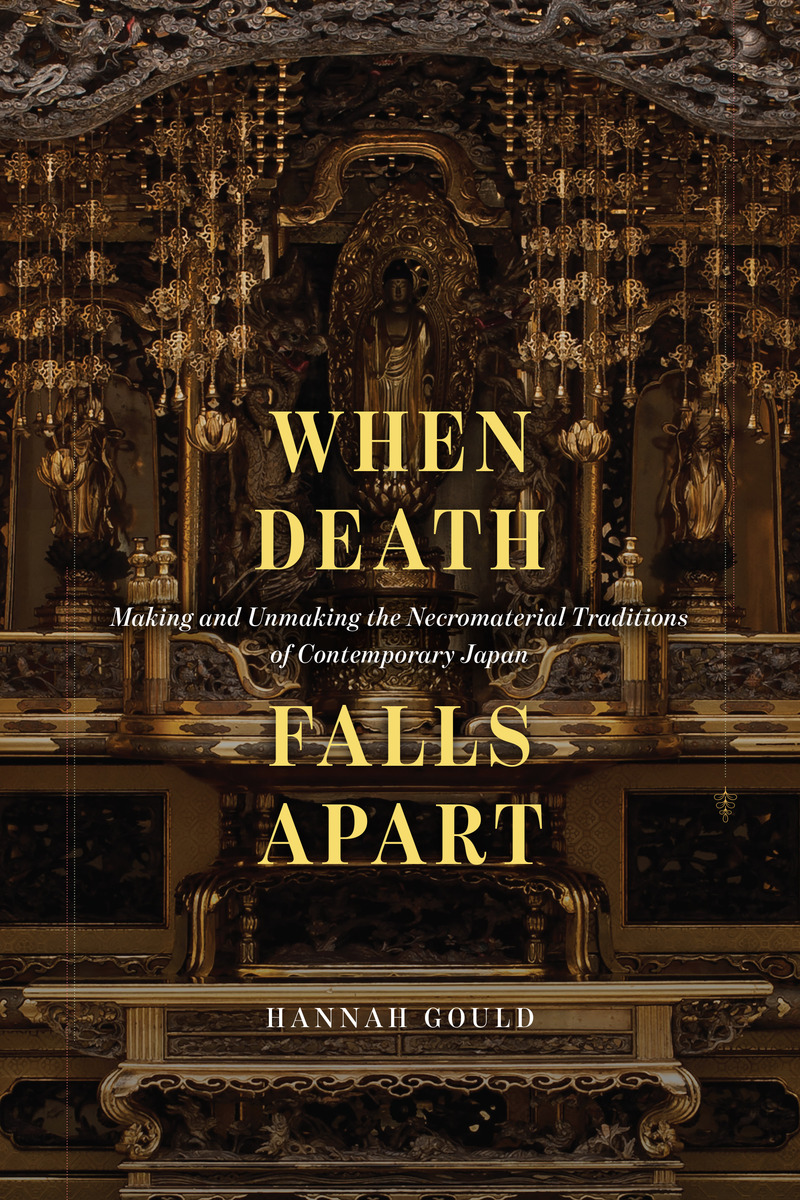
Through an ethnographic study inside Japan’s Buddhist goods industry, this book establishes a method for understanding change in death ritual through attention to the dynamic lifecourse of necromaterials.
Deep in the Fukuyama mountainside, “the grave of the graves” (o-haka no haka) houses acres of unwanted headstones—the material remains of Japan’s discarded death rites. In the past, the Japanese dead became venerated ancestors through sustained ritual offerings at graves and at butsudan, Buddhist altars installed inside the home. But in twenty-first-century Japan, this intergenerational system of care is rapidly collapsing.
In noisy carpentry studios, flashy funeral-goods showrooms, neglected cemeteries, and cramped kitchens where women prepare memorial feasts, Hannah Gould analyzes the lifecycle of butsudan, illuminating how they are made, circulate through religious and funerary economies, mediate intimate exchanges between the living and the dead, and—as the population ages, families disperse, and fewer homes have space for large lacquer cabinets—eventually fall into disuse. What happens, she asks, when a funerary technology becomes obsolete? And what will take its place? Gould examines new products better suited to urban apartments: miniature urns and sleek altars inspired by Scandinavian design, even reliquary jewelry. She visits an automated columbarium and considers new ritual practices that embrace impermanence. At an industry expo, she takes on the role of “demonstration corpse.” Throughout, Gould invites us to rethink memorialization and describes a distinct form of Japanese necrosociality, one based on material exchanges that seek to both nurture the dead and disentangle them from the world of the living.
Deep in the Fukuyama mountainside, “the grave of the graves” (o-haka no haka) houses acres of unwanted headstones—the material remains of Japan’s discarded death rites. In the past, the Japanese dead became venerated ancestors through sustained ritual offerings at graves and at butsudan, Buddhist altars installed inside the home. But in twenty-first-century Japan, this intergenerational system of care is rapidly collapsing.
In noisy carpentry studios, flashy funeral-goods showrooms, neglected cemeteries, and cramped kitchens where women prepare memorial feasts, Hannah Gould analyzes the lifecycle of butsudan, illuminating how they are made, circulate through religious and funerary economies, mediate intimate exchanges between the living and the dead, and—as the population ages, families disperse, and fewer homes have space for large lacquer cabinets—eventually fall into disuse. What happens, she asks, when a funerary technology becomes obsolete? And what will take its place? Gould examines new products better suited to urban apartments: miniature urns and sleek altars inspired by Scandinavian design, even reliquary jewelry. She visits an automated columbarium and considers new ritual practices that embrace impermanence. At an industry expo, she takes on the role of “demonstration corpse.” Throughout, Gould invites us to rethink memorialization and describes a distinct form of Japanese necrosociality, one based on material exchanges that seek to both nurture the dead and disentangle them from the world of the living.
See other books on: Asian Studies | Buddhism | Dead | Funeral rites and ceremonies | Sociology of Religion
See other titles from University of Chicago Press