
 A SCHOLARLY BOOK REPOSITORY
64 start with W start with W
Andrew Gordon goes to the core of the Japanese enterprise system, the workplace, and reveals a complex history of contest and confrontation. The Japanese model produced a dynamic economy which owed as much to coercion as to happy consensus. Managerial hegemony was achieved only after a bitter struggle that undermined the democratic potential of postwar society. The book draws on examples across Japanese industry, but focuses in depth on iron and steel. This industry was at the center of the country's economic recovery and high-speed growth, a primary site of corporate managerial strategy and important labor union initiatives.
Beginning with the Occupation reforms and their influence on the workplace, Gordon traces worker activism and protest in the 1950s and '60s, and how they gave way to management victory in the 1960s and '70s. He shows how working people had to compromise institutions of self-determination in pursuit of economic affluence. He illuminates the Japanese system with frequent references to other capitalist nations whose workplaces assumed very different shape, and looks to Japan's future, rebutting hasty predictions that Japanese industrial relations are about to be dramatically transformed in the American free-market image. Gordon argues that it is more likely that Japan will only modestly adjust the status quo that emerged through the turbulent postwar decades he chronicles here.
In an analysis of recent immigration patterns in Washington, D.C., Terry A. Repak documents the unusual predominance of women among Central American immigrants. Two thirds of the arriving immigrants in earlier decades have been women, many of them recruited by international diplomats and U.S. government employees to work as housekeepers and nannies. Repak considers the labor force participation patterns for women compared to men, the effect of immigration laws—particularly the IRCA's uneven impact on women versus men—and the profound adjustments in gender roles and identities that accompany migration.
Showing an extraordinary amount of autonomy, most of these immigrant women decided to migrate without consulting either fathers or partners, and they gained even greater independence once settled. Repak plots the career trajectories of numerous Central American immigrant women and men to illustrate the array of the women's responses, gender differences in the migration and assimilation experience, the availability of work, and the possibility for upward mobility and higher wages. Providing social, economic and political context, she looks at the conditions that set the stage for this migration, including the rapid expansion of service jobs in the 1960s and 1970s in Washington, D. C. and the political strife in such Central American countries as war-torn El Salvador, Nicaragua, and Guatemala.

Previously published by Basic Books as The Most Dangerous Man in Detroit: Walter Reuther and the Fate of American Labor
Winner of the John H. Dunning Prize in United States History
During the nineteenth century, American and foreign travelers often found New Orleans a delightful, exotic stop on their journeys. Few failed to marvel at the riverfront, the center of the city's economic activity. But historical memory overlooks the immigrants and Black migrants who served in the riverfront's army of laborers and provided the essential human power that kept the cotton, sugar, and other goods flowing. Eric Arnesen examines the diverse group of 10,000 to 15,000 cotton screwmen, longshoremen, cotton and round freight teamsters, cotton yardmen, railroad freight handlers, and Mississippi River roustabouts that formed the backbone of the Crescent City's trade and economic life.

Radio sparked the massive upsurge of organized labor during the Great Depression. The powerful new medium became an important weapon in the ideological war between labor and business. Corporations used radio to sing the praises of individualism and consumerism, while unions emphasized equal rights, industrial democracy, and social justice.
Elizabeth Fones-Wolf analyzes the battle to utilize, and control, the airwaves in radio's early era. Working chronologically, she explores the advent of local labor radio stations such as WCFL and WEVD, labor's campaigns against corporate censorship, and union experiments with early FM broadcasting. Using union archives and broadcast industry records, Fones-Wolf demonstrates radio's key role in organized labor's efforts to fight business's domination of political discourse throughout the 1930s, 1940s, and 1950s. She concludes with a look at how labor's virtual disappearance from today's media helps explain why unions have become so marginalized, and offers important historical lessons for revitalizing organized labor.
From the start, New York’s organized hotel workers experimented with and adapted how they organized and governed members and related to other labor unions. Richman follows union fortunes from early IWW activity through the Communist-led affiliates of the American Federation of Labor in the 1920s and 1930s, the shaping of breakthrough negotiating strategies, and the postwar era. As Richman shows, workers adopted a radicalism and militancy seldom associated with an AFL organization while openly negotiating the Communist Party’s power and influence within the union, until the Party’s eclipse in the 1950s.
An inspiring story of action and perseverance, We Always Had a Union profiles a foundational American labor union and offers lessons for today’s workers and organizers.
Contains the Bryant Spann Memorial Prize in Literature for 1997, an award-winning essay, "The Very Last Hurrah" by Eric Leif Davin
This collection of articles delves into the little-known community-based unionism of the 1930s. Worlds apart from bureaucratic business unions like the AFL-CIO, these organizations emerged from workers involved in many kinds of labor, from African American nutpickers in St. Louis to chemical and rubber workers in Akron, and from bootleg miners in Pennsylvania to tenant farmers in the Mississippi Delta.
The contributors draw on eyewitness interviews, first-person narratives, trade union documents, and other primary sources to describe experimental forms of worker activism during the period. This alternative unionism was democratic, deeply rooted in mutual aid among workers in different crafts and work sites, and politically independent. The key to it was a value system based on egalitarianism. The cry, "We are all leaders!" resonated among rank-and-file activists. Their struggle, though often overlooked by historians, has much to teach us about union organizing today.
Contributors: John Borsos, Eric Leif Davin, Elizabeth Faue, Rosemary Feurer, Janet Irons, Michael Kozura, Mark D. Naison, Peter Rachleff, and Stan Weir
This story explodes the popular belief that women white-collar workers tend to reject unionization and accept a passive role in the workplace. On the contrary, the women workers of Harvard University created a powerful and unique union--one that emphasizes their own values and priorities as working women and rejects unwanted aspects of traditional unionism.
The workers involved comprise Harvard's 3,600-member "support staff," which includes secretaries, library and laboratory assistants, dental hygienists, accounting clerks, and a myriad of other office workers who keep a great university functioning. Even at prestigious private universities like Harvard and Yale, these workers--mostly women--have had to put up with exploitive management policies that denied them respect and decent wages because they were women. But the women eventually rebelled, declaring that they could not live on "prestige" alone.
Encouraged by the women's movement of the early 1970's, a group of women workers (and a few men) began what would become a 15-year struggle to organize staff employees at Harvard. The women persisted in the face of patronizing and sexist attitudes of university administrators and leaders of their own national unions. Unconscionably long legal delays foiled their efforts. But they developed innovative organizing methods, which merged feminist values with demands for union representation and a means of influencing workplace decisions.
Out of adversity came an unorthodox form of unionism embodied in the Harvard Union of Clerical and Technical Workers (HUCTW). Its founding was marked by an absorbing human drama that pitted unknown workers, such as Kris Rondeau, a lab assistant who came to head the union, against famous educators such as Harvard President Derek Bok and a panoply of prestigious deans. Other characters caught up in the drama included Harvard's John T. Dunlop, the nation's foremost industrial relations scholar and former U.S. Secretary of Labor. The drama was played out in innumerable hearings before the National Labor Relations Board, in the streets of Cambridge, and on the walks of historic Harvard Yard, where union members marched and sang and employed new tactics like "ballooning," designed to communicate a message of joy and liberation rather than the traditional "hate-the-boss" hostility.
John Hoerr tells this story from the perspective of both Harvard administrators and union organizers. With unusual access to its meetings, leaders, and files, he examines the unique culture of a female-led union from the inside. Photographs add to the impact of this dramatic narrative.
postamble();
Originally published in 1969, Melvyn Dubofsky's We Shall Be All has remained the definitive archive-based history of the IWW. While much has been written on aspects of the IWW's history in the past three decades, nothing has duplicated or surpassed this authoritative work. The present volume, an abridged version of this labor history classic, makes the compelling story of the IWW accessible to a new generation of readers.
In its heyday, between 1905 and 1919, the IWW nourished a dream of a better America where poverty-–material and spiritual–-would be erased and where all people, regardless of nationality or color, would walk free and equal. More than half a century ago the Wobblies tried in their own ways to grapple with issues that still plague the nation in a more sophisticated and properous era. Their example has inspired radicals in America and abroad over the greater part of a century
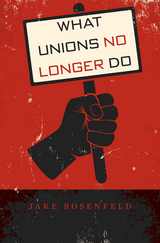
From workers’ wages to presidential elections, labor unions once exerted tremendous clout in American life. In the immediate post–World War II era, one in three workers belonged to a union. The fraction now is close to one in ten, and just one in twenty in the private sector—the lowest in a century. The only thing big about Big Labor today is the scope of its problems. While many studies have attempted to explain the causes of this decline, What Unions No Longer Do lays bare the broad repercussions of labor’s collapse for the American economy and polity.
Organized labor was not just a minor player during the “golden age” of welfare capitalism in the middle decades of the twentieth century, Jake Rosenfeld asserts. Rather, for generations it was the core institution fighting for economic and political equality in the United States. Unions leveraged their bargaining power to deliver tangible benefits to workers while shaping cultural understandings of fairness in the workplace. The labor movement helped sustain an unprecedented period of prosperity among America’s expanding, increasingly multiethnic middle class.
What Unions No Longer Do shows in detail the consequences of labor’s decline: curtailed advocacy for better working conditions, weakened support for immigrants’ economic assimilation, and ineffectiveness in addressing wage stagnation among African-Americans. In short, unions are no longer instrumental in combating inequality in our economy and our politics, and the result is a sharp decline in the prospects of American workers and their families.
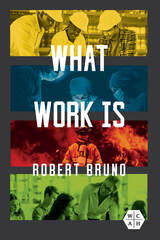
For more than twenty years, Robert Bruno has taught labor history and labor studies to union members from a wide range of occupations and demographic groups. In the class, he asked his students to finish the question “Work is—?” in six words or less. The thousands of responses he collected provide some of the rich source material behind What Work Is. Bruno draws on the thoughts and feelings experienced by workers in the present day to analyze how we might design a future of work. He breaks down perceptions of work into five categories: work and time; the space workers occupy; the impact of work on our lives; the sense of purpose that motivates workers; and the people we work for, in all senses of the term.
Far-seeing and sympathetic, What Work Is merges personal experiences with research, poetry, and other diverse sources to illuminate workers’ lives in the present and envision what work could be in the future.
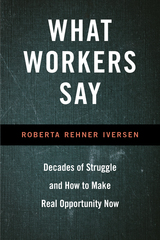
What have jobs really been like for the past 40 years and what do the workers themselves say about them? In What Workers Say, Roberta Iversen shows that for employees in labor market industries—like manufacturing, construction, printing—as well as those in service-producing jobs, like clerical work, healthcare, food service, retail, and automotive—jobs are often discriminatory, are sometimes dangerous and exploitive, and seldom utilize people’s full range of capabilities. Most importantly, they fail to provide any real opportunity for advancement.
What Workers Say takes its cue from Studs Terkel’s Working, as Iversen interviewed more than 1,200 workers to present stories about their labor market jobs since 1980. She puts a human face on the experiences of a broad range of workers indicating what their jobs were and are truly like. Iversen reveals how transformations in the political economy of waged work have shrunk or eliminated opportunity for workers, families, communities, and productivity. What Workers Say also offers an innovative proposal for compensated civil labor that could enable workers, their communities, labor market organizations, and the national infrastructure to actually flourish.
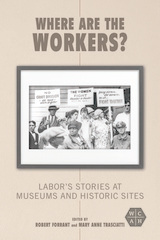
A wide-ranging blueprint for change, Where Are the Workers? shows how working-class perspectives can expand our historical memory and inform and inspire contemporary activism.
Contributors: Jim Beauchesne, Rebekah Bryer, Rebecca Bush, Conor Casey, Rachel Donaldson, Kathleen Flynn, Elijah Gaddis, Susan Grabski, Amanda Kay Gustin, Karen Lane, Rob Linné, Erik Loomis, Tom MacMillan, Lou Martin, Scott McLaughlin, Kristin O’Brassill-Kulfan, Karen Sieber, and Katrina Windon
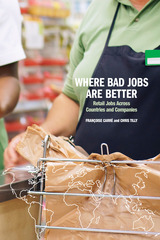
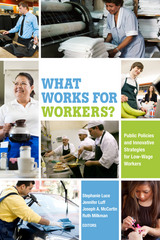
In surveying retail work across the United States, Carré and Tilly find that the majority of retail workers receive low pay and nearly half work part-time, which contributes to high turnover and low productivity. Jobs staffed predominantly by women, such as grocery store cashiers, pay even less than retail jobs in male-dominated fields, such as consumer electronics. Yet, when comparing these jobs to similar positions in Western Europe, Carré and Tilly find surprising differences. In France, though supermarket cashiers perform essentially the same work as cashiers in the United States, they receive higher pay, are mostly full-time, and experience lower turnover and higher productivity. And unlike the United States, where many retail employees are subject to unpredictable schedules, in Germany, retailers are required by law to provide their employees notice of work schedules six months in advance.
The authors show that disparities in job quality are largely the result of differing social norms and national institutions. For instance, weak labor regulations and the decline of unions in the United States have enabled retailers to cut labor costs aggressively in ways that depress wages and discourage full-time work. On the other hand, higher minimum wages, greater government regulation of work schedules, and stronger collective bargaining through unions and works councils have improved the quality of retail jobs in Europe.
As retail and service work continue to expand, American employers and policymakers will have to decide the extent to which these jobs will be good or bad. Where Bad Jobs Are Better shows how stronger rules and regulations can improve the lives of retail workers and boost the quality of low-wage jobs across the board.
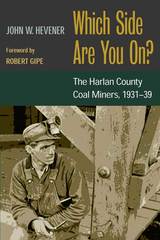
Depression-era Harlan County, Kentucky, was the site of one of the most bitter and protracted labor disputes in American history. The decade-long conflict between miners and the coal operators who adamantly resisted unionization has been immortalized in folksong by Florence Reece and Aunt Molly Jackson, contemplated in prose by Theodore Dreiser and Sherwood Anderson, and long been obscured by popular myths and legends.
John W. Hevener separates the fact from the legend in his Weatherford Award-winning investigation of Harlan's civil strife, now available for the first time in paperback. In Which Side Are You On? Hevener attributes the violence–-including the deaths of thirteen union miners–-to more than just labor conflict, viewing Harlan's troubles as sectional economic conflict stemming from the county's rapid industrialization and social disorganization in the preceding decade.
Detailing the dimensions of unionization and the balance of power spawned by New Deal labor policy after government intervention, Which Side Are You On? is the definitive analysis of Harlan's bloody decade and a seminal contribution to American labor history.
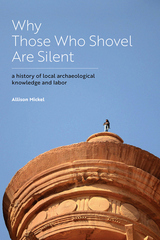
Why Those Who Shovel Are Silent is based on six years of in-depth ethnographic work with current and former site workers at two major Middle Eastern archaeological sites—Petra, Jordan, and Çatalhöyük, Turkey—combined with thorough archival research. Author Allison Mickel describes the nature of the knowledge that locally hired archaeological laborers exclusively possess about artifacts, excavation methods, and archaeological interpretation, showing that archaeological workers are experts about a wide range of topics in archaeology. At the same time, Mickel reveals a financial incentive for site workers to pretend to be less knowledgeable than they actually are, as they risk losing their jobs or demotion if they reveal their expertise.
Despite a recent proliferation of critical research examining the history and politics of archaeology, the topic of archaeological labor has not yet been substantially examined. Why Those Who Shovel Are Silent employs a range of advanced qualitative, quantitative, and visual approaches and offers recommendations for archaeologists to include more diverse expert perspectives and produce more nuanced knowledge about the past. It will appeal to archaeologists, science studies scholars, and anyone interested in challenging the concept of “unskilled” labor.

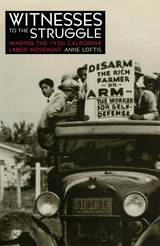
A study of the artistic and literary responses to the Depression-era labor crises of the Golden State. Anne Loftis focuses on the work and activities of John Steinbeck, Carey McWilliams, Paul Taylor, and Dorothea Lange, who brought the story of California's labor struggles to the rest of the country. The realism and documentary expression of their art grew out of their personal involvement in the problems of society, and Loftis explores the lasting influence of their work. One of Steinbeck's unintended legacies was his treatment of California farm workers as victims—the simple pawns of larger forces. In her balanced and intriguing study Loftis reveals that the workers were not victims, but rather the strong and resourceful creators of their own histories.
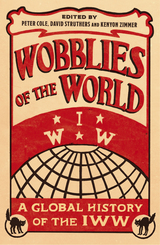
Founded in 1905, Chicago's Industrial Workers of the World (IWW) is a union unlike any other. With members affectionately called "Wobblies" and an evolutionary and internationalist philosophy and tactics, it rapidly grew across the world. Considering the history of the IWW from an international perspective for the first time, Wobblies of the World brings together a group of leading scholars to present a lively collection of accounts from thirteen diverse countries, revealing a fascinating story of anarchism, syndicalism, and socialism. Chapters include:
*”A Cosmopolitan Crowd”: Transnational Anarchists, the IWW and the American Radical Press by Kenyon Zimmer
*Living Social Dynamite: Early Twentieth-Century IWW-South Asia Connections by Tariq Khan
*IWW Internationalism and Interracial Organizing in the Southwestern United States by David M. Struthers
*Spanish Anarchists and Maritime Workers in the IWW by Bieito Alonso
*The IWW and the Dilemmas of Labor Internationalism by Wayne Thorpe
*Wobblies Down Under: The IWW in Australia by Verity Burgmann
*Ki Nga Kaimahi Maori ('To All Maori Workers'): The New Zealand IWW and the Maori by Mark Derby
*Patrick Hodgens Hickey and the IWW: A Transnational Relationship by Peter Clayworth
*Edith Frenette: A Transnational Radical Life by Heather Mayer
*Tom Barker and Revolutionary Europe by Paula de Angelis
*P. J. Welinder and “American Syndicalism” in Interwar Sweden by Johan Pries
*Tramp, Tramp, Tramp: The Songs of Joe Hill Around the World by Bucky Halker
*And much, much more!
Drawing on many important figures of the movement—Har Dayal, James Larkin, William D. "Big Bill" Haywood, Enrique Flores Magón, and more—the contributors describe how the IWW and its ideals spread, exploring the crucial role the IWW played in industries such as shipping, mining, and agriculture.
Ultimately, the book illuminates Wobblie methods of organizing, forms of expression, practices, and transnational issues, offering a fascinating alternative history of the group
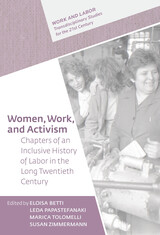
The thirteen critical and well-documented chapters of Women, Work and Activism examine women’s labor struggle from late nineteenth-century Portuguese mutual societies to Yugoslav peasant women’s work in the 1930s, and from the Catalan labor movement under the Franco dictatorship to workplace democracy in the United States. The authors portray women's labor activism in a wide variety of contexts. This includes spontaneous resistance to masculinist trade unionism, the feminist engagement of women workers, the activism of communist wives of workers, and female long-distance migration, among others. The chapters address the gendered involvement of working people in multiple and often precarious and unstable labor relations and in unpaid labor, as well as the role of the state and other institutions in shaping the history of women’s labor.
The book is an innovative contribution to both the new labor history and feminist history. It fully integrates the conceptual advances made by gender historians in the study of labor activism, driving home critiques of Eurocentric historiographies of labor to Europe while simultaneously contributing to an inclusive history of women’s labor-related activism wherever to be found. Examining women’s activism in male-dominated movements and institutions, and in women’s networks and organizations, the authors make a case for a new direction in gender history.
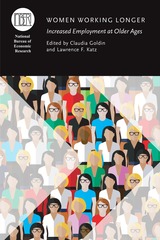
In Women Working Longer, editors Claudia Goldin and Lawrence F. Katz assemble new research that presents fresh insights on the phenomenon of working longer. Their findings suggest that education and work experience earlier in life are connected to women’s later-in-life work. Other contributors to the volume investigate additional factors that may play a role in late-life labor supply, such as marital disruption, household finances, and access to retirement benefits. A pioneering study of recent trends in older women’s labor force participation, this collection offers insights valuable to a wide array of social scientists, employers, and policy makers.
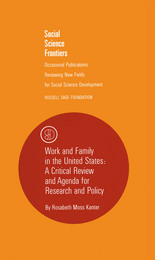
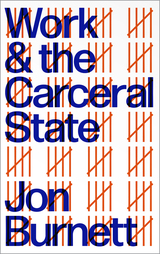
During 2019-20 in England and Wales, over 17 million hours of labor were carried out by more than 12,500 people incarcerated in prisons, while many people in immigration detention centers were also put to work. These people constitute a sub-waged, captive workforce who are frequently discarded by the state when done with.
Work and the Carceral State examines these forms of work as part of a broader exploration of the relationship between criminalization, criminal justice, immigration policy and labor, tracing their lineage through the histories of transportation and banishment, of houses of correction and prisons, to the contemporary production of work.
Criminalization has been used to enforce work and to discipline labor throughout the history of England and Wales. This book demands that we recognise the carceral state as operating at the frontier of labor control in the 21st century.
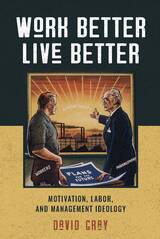
In the United States, a strong work ethic has long been upheld as a necessity, and tributes to motivation abound—from the motivational posters that line the walls of the workplace to the self-help gurus who draw in millions of viewers online. Americans are repeatedly told they can achieve financial success and personal well-being by adopting a motivated attitude toward work. But where did this obsession come from? And whose interests does it serve?
Work Better, Live Better traces the rise of motivational rhetoric in the workplace across the expanse of two world wars, the Great Depression, and the Cold War. Beginning in the early twentieth century, managers recognized that force and coercion—the traditional tools of workplace discipline—inflamed industrial tensions, so they sought more subtle means of enlisting workers' cooperation. David Gray demonstrates how this “motivational project” became a highly orchestrated affair as managers and their allies deployed films, posters, and other media, and drew on the ideas of industrial psychologists and advertising specialists to advance their quests for power at the expense of worker and union interests.
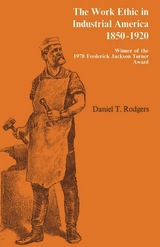
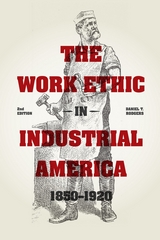
Daniel T. Rodgers masterfully explores the ways in which the eclipse of small-scale workshops by mechanized production and mass consumption triggered far-reaching shifts in perceptions of labor, leisure, and personal success. He also shows how the new work culture permeated society, including literature, politics, the emerging feminist movement, and the labor movement.
A staple of courses in the history of American labor and industrial society, Rodgers’s sharp analysis is sure to find a new audience, as twenty-first-century workers face another shift brought about by technology. The Work Ethic in Industrial America 1850–1920 is a classic with critical relevance in today’s volatile economic times.
Many workers today feel that the longstanding social contract between government, business, and labor has been broken. This book examines legal and philosophical problems that must be addressed if there is to be a new social contract that is fair to workers. Drawing on a wide variety of sources, from the popular press to technical philosophy, Edmund F. Byrne brings into focus ethical issues involved in corporate decisions to reorganize, relocate, or automate. In assessing the human costs of these decisions, he shows why, to a worker, "corporations are not reducible to their assets and liabilities any more than a government is merely its annual budget. That they are organizations, that these organizations do things, and that they are socially responsible for what they do."
In support of this assignment of responsibility, Byrne seeks to demythologize corporate hegemony by confronting a variety of intellectual "dragons" that guard the gates of the status quo. These include legal assumptions about corporate personhood and commodification, private property and eminent domain; management ideas about the autonomous employee and profit without payrolls; technocratic dreams of a dehumanized workplace: ideological belief in progress and competition; and philosophical arguments for libertarian freedom, liberal welfare, and global justice.
Because of these and other mainstream perspectives, workers today are widely perceived, in law and in common parlance, to be isolated atoms. But, Byrne emphasizes, work. including work done for a transnational corporation, is done in a community. Since corporate leaders make decisions that have an impact on people’s lives and on communities, involvement in such decisions must be not only corporate or governmental but community-based as well.

Martin Heidegger considered Jünger “the only genuine follower of Nietzsche,” singularly providing “an interpretation which took shape in the domain of that metaphysics which already determines our epoch, even against our knowledge; this metaphysics is Nietzsche's doctrine of the ‘will to power.’” In The Worker, Jünger examines some of the defining questions of that epoch: the nature of individuality, society, and the state; morality, justice, and law; and the relationships between freedom and power and between technology and nature.
This work, appearing in its entirety in English translation for the first time, is an important contribution to debates on work, technology, and politics by one of the most controversial German intellectuals of the twentieth century. Not merely of historical interest, The Worker carries a vital message for contemporary debates about world economy, political stability, and equality in our own age, one marked by unsettling parallels to the 1930s.
Drawing on more than 20 years of organizing experience, Allinson combines practical techniques with an analysis of the theory and politics of organizing and unions.
The Covid, climate, and cost of living crises all hang heavy in the air. It's more obvious than ever that we need radical social and political change. But in the vacuum left by defeated labor movements, where should we begin? For longtime workplace activist Ian Allinson, the answer is clear: organizing at work is essential to rebuild working-class power.
The premise is simple: organizing builds confidence, capacity, and collective power - and with power, we can win change. Workers Can Win is an essential, practical guide for rank-and-file workers and union activists.
The book offers insight into tried and tested methods for effective organizing. It deals with tactics and strategies and addresses some of the roots of conflict, common problems with unions, and the resistance of management to worker organizing. As a 101 guide to workplace organizing with politically radical horizons, Workers Can Win is destined to become an essential tool for workplace struggles in the years to come.
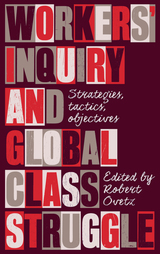
By engaging in what Karl Marx called a workers' inquiry, workers and militant co-researchers are studying their working conditions, the technical composition of capital, and how to recompose their own power in order to devise new tactics, strategies, organisational forms and objectives. These workers' inquiries, from call centre workers to teachers, and adjunct professors, are re-energising unions, bypassing unions altogether or innovating new forms of workers' organisations.
In one of the first major studies to critically assess this new cycle of global working class struggle, Robert Ovetz collects together case studies from over a dozen contributors, looking at workers' movements in China, Mexico, the US, South Africa, Turkey, Argentina, Italy, India and the UK. The book reveals how these new forms of struggle are no longer limited to single sectors of the economy or contained by state borders, but are circulating internationally and disrupting the global capitalist system as they do.


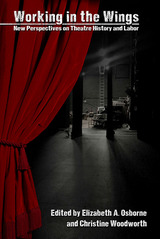
Theatre has long been an art form of subterfuge and concealment. Working in the Wings: New Perspectives on Theatre History and Labor, edited by Elizabeth A. Osborne and Christine Woodworth, brings attention to what goes on behind the scenes, challenging, and revising our understanding of work, theatre, and history.
Essays consider a range of historic moments and geographic locations—from African Americans’ performance of the cakewalk in Florida’s resort hotels during the Gilded Age to the UAW Union Theatre and striking automobile workers in post–World War II Detroit, to the struggle in the latter part of the twentieth century to finish an adaptation of Moby Dick for the stage before the memory of creator Rinde Eckert failed. Contributors incorporate methodologies and theories from fields as diverse as theatre history, work studies, legal studies, economics, and literature and draw on traditional archival materials, including performance texts and architectural structures, as well as less tangible material traces of stagecraft.
Working in the Wings looks at the ways in which workers' identities are shaped, influenced, and dictated by what they do; the traces left behind by workers whose contributions have been overwritten; the intersections between the sometimes repetitive and sometimes destructive process of creation and the end result—the play or performance; and the ways in which theatre affects the popular imagination. This collected volume draws attention to the significance of work in the theatre, encouraging a fresh examination of this important subject in the history of the theatre and beyond.
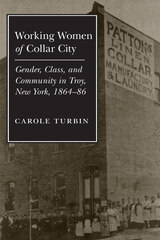
Why have some working women succeeded at organizing in spite of obstacles to labor activity? Under what circumstances were they able to form alliances with male workers?
Carole Turbin explores these and other questions by examining the case of Troy, New York. In the 1860s, Troy produced nearly all the nation's detachable shirt collars and cuffs. The city's collar laundresses were largely Irish immigrants. Their union was officially the nation's first women's labor organization, and one of the best organized. Turbin provides a new perspective on gender and shows that women's family ties are not necessarily a conservative influence but may encourage women's and men's collective action.
Runner-up in both the John H. Dunning Prize and Albert J. Beveridge Award competitions
An unheralded union battle offers new insight into identity politics.
In 1991, Columbia University’s one thousand clerical workers launched a successful campaign for justice in their workplace. This diverse union-two-thirds black and Latina, three-fourths women-was committed to creating an inclusive movement organization and to fighting for all kinds of justice. How could they address the many race and gender injustices members faced, avoid schism, and maintain the unity needed to win? Sharon Kurtz, an experienced union activist and former clerical worker herself, was welcomed into the union and pursued these questions. Using this case study and secondary studies of sister clerical unions at Yale and Harvard, she examines the challenges and potential of identity politics in labor movements.
With the Columbia strike as a point of departure, Kurtz argues that identity politics are valuable for mobilizing groups, but often exclude members and their experiences of oppression. However, Kurtz believes that identity politics should not be abandoned as a component in building movements, but should be reframed-as multi-identity politics. In the end she shows an approach to organizing with great potential impact not only for labor unions but for any social movement.
The World of the Worker illuminates workers' lives at home, on
the job, and in the voting booths. A new preface enhances this social,
cultural, and political history: an unparalleled picture of working people
during the turbulent rise and fall of the labor movement.
"A fresh and provocative look at twentieth-century American unions,
and a fine introduction to recent labor history scholarship." --
Leslie Woodcock Tentler, Washington Post Book World
"Will be welcomed by anyone with a serious interest in labor history."
-- Library Journal
"Probably the best social history of twentieth-century labor
there is." -- Kirkus Reviews
"Virtually replaces any previously existing one-volume popular history
of the labor movement." -- Ron Radosh, Democratic Left
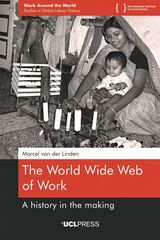
Global labor history is one of the fastest-growing fields of study worldwide today. This volume assembles a group of contributors from around the world to discuss the core concepts “capitalism” and “workers,” and to refine notions such as “coerced labor,” “household strategies,” and “labor markets.” It explores in new ways the connections between laborers in different parts of the world, arguing that both globalization and modern labor management originated in agriculture in the Global South and were only later introduced in Northern industrial settings. It reveals that nineteenth-century chattel slavery was frequently replaced by other forms of coerced labor, and it reconstructs the twentieth-century attempts of the International Labor Organisation to regulate work standards internationally. The book also pays attention to the relational inequality through which workers in wealthy countries benefit from the exploitation of those in poor countries. The final part addresses workers’ resistance and acquiescence: why collective actions often have unanticipated consequences, why and how workers sometimes organize massive flights from exploitation and oppression, and why proletarian revolutions took place in pre-industrial or industrializing countries but never in fully developed capitalist societies.
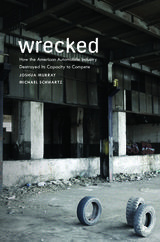
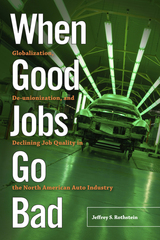
Today Japanese and many European automakers produce higher quality cars at lower cost than their American counterparts thanks to a flexible form of production characterized by long-term sole suppliers, assembly and supply plants located near each other, and just-in-time delivery of raw materials. While this style of production was, in fact, pioneered in the U.S. prior to World War II, in the years after the war, American automakers deliberately dismantled this system. As Murray and Schwartz show, flexible production accelerated innovation but also facilitated workers’ efforts to unionize plants and carry out work stoppages. To reduce the efficacy of strikes and combat the labor militancy that flourished between the Depression and the postwar period, the industry dispersed production across the nation, began maintaining large stockpiles of inventory, and eliminated single sourcing. While this restructuring of production did ultimately reduce workers’ leverage, it also decreased production efficiency and innovation. The U.S. auto industry has struggled ever since to compete with foreign automakers, and formerly thriving motor cities have suffered the consequences of mass deindustrialization.
Murray and Schwartz argue that new business models that reinstate flexible production and prioritize innovation rather than cheap labor could stem the outsourcing of jobs and help revive the auto industry. By clarifying the historical relationships between production processes, organized labor, and industrial innovation, Wrecked provides new insights into the inner workings and decline of the U.S. auto industry.
Women seeking to express concerns about childbirth or to challenge institutionalized medicine by writing online birth plans or birth stories exercise rhetorical agency in undeniably feminist ways. In Writing Childbirth: Women’s Rhetorical Agency in Labor and Online, author Kim Hensley Owens explores how women create and use everyday rhetorics in planning for, experiencing, and writing about childbirth.
Drawing on medical texts, popular advice books, and online birth plans and birth stories, as well as the results of a childbirth writing survey, Owens considers how women’s agency in childbirth is sanctioned, and how it is not. She examines how women’s rhetorical choices in writing interact with institutionalized medicine and societal norms. Writing Childbirth reveals the contradictory messages women receive about childbirth, their conflicting expectations about it, and how writing and technology contribute to and reconcile these messages and expectations.
Demonstrating the value of extending rhetorical investigations of health and medicine beyond patient-physician interactions and the discourse of physicians, Writing Childbirth offers fresh insight into feminist rhetorical agency and technology and expands our understanding of the rhetorics of health and medicine.
READERS
Browse our collection.
PUBLISHERS
See BiblioVault's publisher services.
STUDENT SERVICES
Files for college accessibility offices.
RECENTLY PUBLISHED




UChicago Accessibility Resources
home | accessibility | search | about | contact us
BiblioVault ® 2001 - 2026
The University of Chicago Press