
 A SCHOLARLY BOOK REPOSITORY
10 start with W start with W
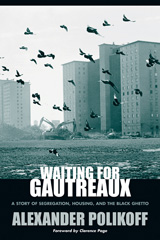
On his thirty-ninth birthday in 1966, Alexander Polikoff, a volunteer ACLU attorney and partner in a Chicago law firm, met some friends to discuss a pro bono case. Over lunch, the four talked about the Chicago Housing Authority construction program. All the new public housing, it seemed, was going into black neighborhoods. If discrimination was prohibited in public schools, wasn't it also prohibited in public housing?
And so began Gautreaux v. CHA and HUD, a case that from its rocky beginnings would roll on year after year, decade after decade, carrying Polikoff and his colleagues to the nation's Supreme Court (to face then-solicitor general Robert Bork); establishing precedents for suits against the discriminatory policies of local housing authorities, often abetted by HUD; and setting the stage for a nationwide experiment aimed at ending the concentration--and racialization--of poverty through public housing. Sometimes Kafkaesque, sometimes simply inspiring, and never less than absorbing, the story of Gautreaux, told by its principal lawyer, moves with ease through local and national civil rights history, legal details, political matters, and the personal costs--and rewards--of a commitment to fairness, equality, and justice. Both the memoir of a dedicated lawyer, and the narrative of a tenacious pursuit of equality, this story--itself a critical, still-unfolding chapter in recent American history--urges us to take an essential step in ending the racial inequality that Alexis de Toqueville prophetically named America's "most formidable evil."
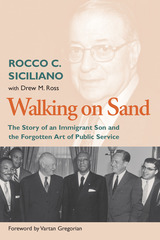
Rocco C. Siciliano broke new ground as the first Italian-American to serve in the White House as an assistant to the president, Dwight D. Eisenhower. At 31, "Ike’s Youngest" attained a prominence not suggested in his humble beginnings in Salt Lake City, Utah. But his upbringing in the Mormon-dominated community, where he balanced the heritage of his striving immigrant parents with his own aspirations for success, prepared him for a wide variety of service. This service includes leading a special weapons platoon in the 10th Mountain Division in World War II, bringing Martin Luther King Jr. to meet with President Eisenhower, and becoming a recognized business leader in California.
Siciliano used his expertise in labor, personnel management, and business to contribute substantively to the J. Paul Getty Center, the Los Angeles Philharmonic Association, the Committee for Economic Development, and the "Volcker" Commission on Public Service, among others.
The variety of Siciliano’s experiences reinvigorates our understanding of the forgotten art of public service. Walking on Sand emphasizes the role that public service can play for corporations, communities, states, and the nation. This story is a gift from the Greatest Generation to the many people who serve America today and will serve her tomorrow.
An inquiry into how we engage with the world, and how solutions to environmental challenges can be found in the heart of our emotional relationships with places
"No one with a working heart will fail to be moved by Van Gelder. With passion and intelligence, she explores the way we story places and places story all life."
---Patrick Curry, Lecturer in Religious Studies, University of Kent, and author of Ecological Ethics: An Introduction and Defending Middle-Earth
"With grace and passion Leslie Van Gelder weaves together stories of her own encounters with an amazing variety of places---riverside meadows of Oxford, racially sundered Cyprus, fly-tormented Canadian muskeg, caves stroked by Paleolithic fingertips, derelict Coney Island, grasslands through which lion cubs follow the black tip of their mother’s tail---to show us how Place and Story are the warp and weft of our being as earth-dwellers."
---Tim Robinson, Folding Landscapes, and author of Connemara: Listening to the Wind
"Travel narrative, memoir, literary criticism, and anthropology fuse in this highly original and moving exploration of place and home."
---John Elder, author of Reading the Mountains of Home and Pilgrimage to Vallombrosa
"Van Gelder offers her most deeply personal stories as microcosmic examples of universal human experience, thus creating an empathic bond with her reader that conveys power and understanding simultaneously, and stimulates the reader's imagination toward reflection upon similarly personal stories of place. Van Gelder has modeled the relationship between story and place by telling placeful stories, and so has licensed the reader to do the same. Her writing throughout is rich and metaphoric. She is a gifted storyteller and a competent scholar, a combination to be treasured."
---Joseph W. Meeker, Professor Emeritus, College of Arts/Science, Union Institute and University, and author of The Spheres of Life, The Comedy of Survival, and Minding the Earth
Weaving a Way Home is an inquiry into the complex relationship between people, place, and story. In our memories and connections to a place, we are given one of the few opportunities to have deep relationships with place---relationships that cannot be described in words. Place can embody powerful emotions for us, and Leslie Van Gelder argues that we ourselves are places---geographical points possessing unique perspectives---that can feel displaced, replaced, or immovable. While the places of the external world can be accessed through maps and a good GPS system, our emotional landscapes are best reached through the sharing of stories.
In the tradition of writers Lewis Hyde, Barry Lopez, Peter Matthiessen, Joseph Meeker, Steven Mithen, Paul Shepard, Gary Snyder, and Terry Tempest Williams, Van Gelder uses both creative nonfiction narrative and evolutionary biological theory to explore complex terrain. Following Van Gelder's own travels, the book moves from the caves of the Dordogne lit only by the small beam of a flashlight, to an acacia thicket in Mozambique, to a black fly–infested bay inappropriately named Baie de Ha Ha in the inlands of Quebec, to the green line wrapped in barbed wire separating northern and southern Cyprus, to Abu Simbel's empty stone eyes in the Egyptian desert, and finally to the high road above Pelorus Sound on the rocky coasts of New Zealand. The author takes the reader to each place to create a storied landscape and explore new intellectual terrain. Van Gelder shows us that our collections of experiences, unique to us, can only be shared through the articulation of narrative.Weaving a Way Home will appeal to those deeply interested in knowing how we forge relationships with places and how that shapes who we are.
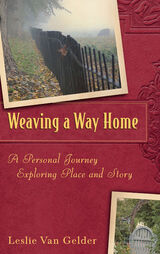
Jacket photographs: Garden gate: © iStockphoto.com/Richard Goerg. Iron fence: Christ Church Meadow in Oxford, Leslie Van Gelder.
Author photograph: Kevin Sharpe
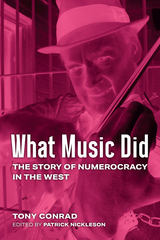
Throughout the book, readers encounter scenes from over two thousand years of history, mathematics, and music: Pythagoras using pebbles to articulate didactic number games to his disciples; Galileo fretting a hill and listening with a musician’s ear to calculate the rate of acceleration under gravity; Rameau trapping Western music in a five-limit tuning system, and what could have been if he were more adept with numbers. Even when drawing on classical sources to explore canonical figures like Saint Augustine, What Music Did offers idiosyncratic critical insights that highlight our ongoing cultural reverence when answers result in simple whole number ratios like 3:2, 4:3, or 5:4. What Music Did is Tony Conrad’s extended indictment of music’s role, from the Pythagoreans to the twentieth century, in upholding the use of number as a clandestine and circumscribed armature of power.
Denise Schmandt-Besserat opened a major new chapter in the history of literacy when she demonstrated that the cuneiform script invented in the ancient Near East in the late fourth millennium BC—the world's oldest known system of writing—derived from an archaic counting device. Her discovery, which she published in Before Writing: From Counting to Cuneiform and How Writing Came About, was widely reported in professional journals and the popular press. In 1999, American Scientist chose How Writing Came About as one of the "100 or so Books that shaped a Century of Science."
In When Writing Met Art, Schmandt-Besserat expands her history of writing into the visual realm of communication. Using examples of ancient Near Eastern writing and masterpieces of art, she shows that between 3500 and 3000 BC the conventions of writing—everything from its linear organization to its semantic use of the form, size, order, and placement of signs—spread to the making of art, resulting in artworks that presented complex visual narratives in place of the repetitive motifs found on preliterate art objects. Schmandt-Besserat then demonstrates art's reciprocal impact on the development of writing. She shows how, beginning in 2700-2600 BC, the inclusion of inscriptions on funerary and votive art objects emancipated writing from its original accounting function. To fulfill its new role, writing evolved to replicate speech; this in turn made it possible to compile, organize, and synthesize unlimited amounts of information; and to preserve and disseminate information across time and space.
Schmandt-Besserat's pioneering investigation of the interface between writing and art documents a key turning point in human history, when two of our most fundamental information media reciprocally multiplied their capacities to communicate. When writing met art, literate civilization was born.
As Anke te Heesen demonstrates, Stoy and his world in a box epitomized the Enlightenment concern with the creation and maintenance of an appropriate moral, intellectual, and social order. The box, and its images from nature, myth, and biblical history, were intended to teach children how to collect, store, and order knowledge. te Heesen compares the Academy with other aspects of Enlightenment material culture, such as commercial warehouses and natural history cabinets, to show how the kinds of collecting and ordering practices taught by the Academy shaped both the developing middle class in Germany and Enlightenment thought. The World in a Box, illustrated with a multitude of images of and from Stoy's Academy, offers a glimpse into a time when it was believed that knowledge could be contained and controlled.
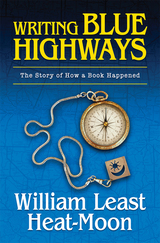
Winner, Distinguished Literary Achievement, Missouri Humanities Council, 2015
The story behind the writing of the best-selling Blue Highways is as fascinating as the epic trip itself. More than thirty years after his 14,000-mile, 38-state journey, William Least Heat-Moon reflects on the four years he spent capturing the lessons of the road trip on paper—the stops and starts in his composition process, the numerous drafts and painstaking revisions, the depressing string of rejections by publishers, the strains on his personal relationships, and many other aspects of the toil that went into writing his first book. Along the way, he traces the hard lessons learned and offers guidance to aspiring and experienced writers alike. Far from being a technical manual, Writing Blue Highways: The Story of How a Book Happenedis an adventure story of its own, a journey of “exploration into the myriad routes of heart and mind that led to the making of a book from the first sorry and now vanished paragraph to the last words that came not from a graphite pencil but from a letterpress in Tennessee.”
Readers will not find a collection of abstract formulations and rules for writing; rather, this book gracefully incorporates examples from Heat-Moon’s own experience. As he explains, “This story might be termed an inadvertent autobiography written not by the traveler who took Ghost Dancing in 1978 over the byroads of America but by a man only listening to him. That blue-roadman hasn’t been seen in more than a third of a century, and over the last many weeks as I sketched in these pages, I’ve regretted his inevitable departure.” Filtered as the struggles of the “blue-roadman” are through the awareness of someone more than thirty years older with a half dozen subsequent books to his credit, the story of how his first book “happened” is all the more resonant for readers who may not themselves be writers but who are interested in the tricky balance of intuitive creation and self-discipline required for any artistic endeavor.
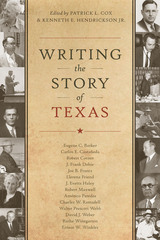
The history of the Lone Star state is a narrative dominated by larger-than-life personalities and often-contentious legends, presenting interesting challenges for historians. Perhaps for this reason, Texas has produced a cadre of revered historians who have had a significant impact on the preservation (some would argue creation) of our state’s past. An anthology of biographical essays, Writing the Story of Texas pays tribute to the scholars who shaped our understanding of Texas’s past and, ultimately, the Texan identity.
Edited by esteemed historians Patrick Cox and Kenneth Hendrickson, this collection includes insightful, cross-generational examinations of pivotal individuals who interpreted our history. On these pages, the contributors chart the progression from Eugene C. Barker’s groundbreaking research to his public confrontations with Texas political leaders and his fellow historians. They look at Walter Prescott Webb’s fundamental, innovative vision as a promoter of the past and Ruthe Winegarten’s efforts to shine the spotlight on minorities and women who made history across the state. Other essayists explore Llerena Friend delving into an ambitious study of Sam Houston, Charles Ramsdell courageously addressing delicate issues such as racism and launching his controversial examination of Reconstruction in Texas, Robert Cotner—an Ohio-born product of the Ivy League—bringing a fresh perspective to the field, and Robert Maxwell engaged in early work in environmental history.
READERS
Browse our collection.
PUBLISHERS
See BiblioVault's publisher services.
STUDENT SERVICES
Files for college accessibility offices.
RECENTLY PUBLISHED




UChicago Accessibility Resources
home | accessibility | search | about | contact us
BiblioVault ® 2001 - 2026
The University of Chicago Press