
 A SCHOLARLY BOOK REPOSITORY
19 start with W start with W
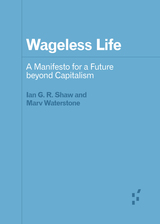
Drawing up alternate ways to “make a living” beyond capitalism
To live in this world is to be conditioned by capital. Once paired with Western democracy, unfettered capitalism has led to a shrinking economic system that squeezes out billions of people—creating a planet of surplus populations. Wageless Life is a manifesto for building a future beyond the toxic failures of late-stage capitalism. Daring to imagine new social relations, new modes of economic existence, and new collective worlds, the authors provide skills and tools for perceiving—and living in— a post-capitalist future.
Forerunners: Ideas First
Short books of thought-in-process scholarship, where intense analysis, questioning, and speculation take the lead
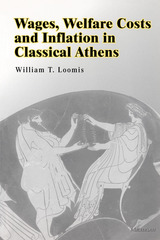
Individual chapters critically examine each surviving wage or other payment in thirteen job categories, including public office holders; soldiers and sailors; priests, oracles, and seers; overseers, architects, and other salaried construction personnel; and prostitutes and pimps. Three additional chapters then consider whether there was a "standard wage," inflation and deflation in Athens, and the implications of these conclusions for the hotly debated question about the nature of the Athenian economy.
This is the first comprehensive study of Athenian labor and welfare costs since August Böckh's Die Staatshaushaltung der Athener (1886). An updated critical study has been much needed, to take account of the greatly expanded evidence (Aristotle's Constitution of the Athenians, more than a dozen other papyrus texts and hundreds of inscriptions), and the uneven quality of the sources. This collection allows William T. Loomis to argue--contrary to prevailing scholarly opinion--that there never was a "standard wage" at Athens.
"This volume will be a significant contribution to all studies of ancient Greek civilization." --Alan L. Boegehold, Brown University
William Loomis is Visiting Professor of Classics, University of Michigan.
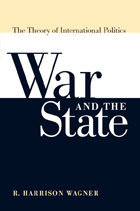
War and the State exposes the invalid arguments employed in the unproductive debate about Realism among international relations scholars, as well as the common fallacy of sharply distinguishing between conflict among states and conflict within them. As R. Harrison Wagner demonstrates, any understanding of international politics must be part of a more general study of the relationship between political order and organized violence everywhere--as it was in the intellectual tradition from which modern-day Realism was derived. War and the State draws on the insights from Wagner's distinguished career to create an elegantly crafted essay accessible to both students and scholars.
"Possibly the most important book on international relations theory since Kenneth Waltz's Theory of International Politics."
---James Fearon, Stanford University
"This is one of the best books on international relations theory I have read in a very long time. It is required reading for any student of modern IR theory. Once again, Wagner has shown himself to be one of the clearest thinkers in the field today."
---Robert Powell, Robson Professor of Political Science, University of California, Berkeley
"Painting on a vast canvas, and tackling and integrating topics such as state formation, domestic politics, and international conflict, R. Harrison Wagner's War and the State offers many brilliant insights into the nature of international relations and international conflict. War and the State compellingly highlights the importance of constructing rigorous and valid theorizing and sets a high standard for all students of international relations. The field has much to gain if scholars follow the trail blazed by Wagner in this book."
---Hein Goemans, University of Rochester
R. Harrison Wagner is Professor of Government at the University of Texas.
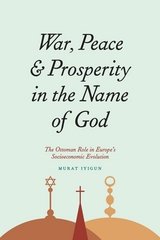
War, Peace, and Prosperity in the Name of God turns the focus on the “big three monotheisms”—Judaism, Islam, and Christianity—to consider these questions. Chronicling the relatively rapid spread of the Abrahamic religions among the Old World, Murat Iyigun shows that societies that adhered to a monotheistic belief in that era lasted longer, suggesting that monotheism brought some sociopolitical advantages. While the inherent belief in one true god meant that these religious communities had sooner or later to contend with one another, Iyigun shows that differences among them were typically strong enough to trump disagreements within. The book concludes by documenting the long-term repercussions of these dynamics for the organization of societies and their politics in Europe and the Middle East.
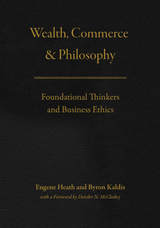
Spanning the history of western philosophy as well as looking toward classical Chinese thought and medieval Islamic philosophy, this volume provides business ethicists a unified source of clear, accurate, and compelling accounts of how the ideas of foundational thinkers—from Aristotle to Friedrich Hayek to Amartya Sen—relate to wealth, commerce, and markets. The essays illuminate perspectives that have often been ignored or forgotten, informing discussion in fresh and often unexpected ways. In doing so, the authors not only throw into relief common misunderstandings and misappropriations often endemic to business ethics but also set forth rich moments of contention as well as novel ways of approaching complex ethical problems. Ultimately, this volume provides a bedrock of moral thought that will move business ethics beyond the ever-changing opinions of headline-driven debate.

Named one of PopMatters’ Best Books of 2025! Discover a new side of the songs of Bob Dylan by exploring the virtues of rough sounds, peculiar intonation, and a raspy voice.
Folk troubadour, rock star, country crooner—for a musician who adopted so many personas, Bob Dylan always sounds like himself. While he’s written many of the most iconic and impactful lyrics of the past sixty years, Dylan’s music has also reshaped our sonic imagination with his ragged voice, wailing harmonica, and rough-hewn guitar.
Music theorist Steven Rings argues that such sonic imperfections are central to understanding Dylan’s songs and their appeal. These blemishes can invoke authenticity or persona, signal his social commitments, and betray his political shortcomings. Rings begins—where else?—with Dylan’s voice, exploring its changeability, its unmistakable features, and its ability to inhabit characters, including the female narrator of “House of the Rising Sun.” Rings then turns to Dylan as an instrumentalist, examining his infamous adoption of the electric guitar in 1965, as well as his stylistically varied acoustic playing, which borrows sounds and techniques from Black blues musicians, among other influences. Rings charts the histories audible in Dylan’s harmonica as well as piano, which has been central to his music making since his earliest days of imitating Little Richard in his hometown of Hibbing, Minnesota. Finally, Rings guides readers through one of Dylan’s most famous songs, “A Hard Rain’s a-Gonna Fall,” analyzing its musical sources as well as variations in live performances. A companion website of audio and video examples helps readers notice the nuances and idiosyncrasies inherent in Dylan’s work and, even more importantly, their effects.
A close look at an underdiscussed but essential aspect of Dylan’s oeuvre, What Did You Hear? offers a fresh understanding of a singular performer, his musical choices, and the meanings that we can hear in his imperfect sounds.
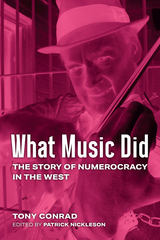
Throughout the book, readers encounter scenes from over two thousand years of history, mathematics, and music: Pythagoras using pebbles to articulate didactic number games to his disciples; Galileo fretting a hill and listening with a musician’s ear to calculate the rate of acceleration under gravity; Rameau trapping Western music in a five-limit tuning system, and what could have been if he were more adept with numbers. Even when drawing on classical sources to explore canonical figures like Saint Augustine, What Music Did offers idiosyncratic critical insights that highlight our ongoing cultural reverence when answers result in simple whole number ratios like 3:2, 4:3, or 5:4. What Music Did is Tony Conrad’s extended indictment of music’s role, from the Pythagoreans to the twentieth century, in upholding the use of number as a clandestine and circumscribed armature of power.
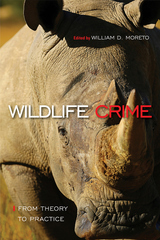
The editors and contributors to Wildlife Crime examine topical issues from extinction to trafficking in order to understand the ecological, economic, political, and social costs and consequences of these crimes. Drawing from diverse theoretical perspectives, empirical and methodological developments, and on-the-ground experiences of practitioners, this comprehensive volume looks at how conservationists and law enforcement grapple with and combat environmental crimes and the profitable market for illegal trade.
Chapters cover criminological perspectives on species poaching, unregulated fishing, the trading of ivory and rhino horns, the adoption of conservation technologies, and ranger workplaces and conditions. The book includes firsthand experiences and research from China, Indonesia, Kenya, Madagascar, Morocco, Peru, Russia, South Africa, Tanzania, and the United States. The result is a significant book about the causes of and response to wildlife crime.
Contributors include: Johan Bergenas, Avi Brisman, Craig Forsyth, Meredith Gore, Georg Jaster, Alex Killion, Kasey Kinnard, Antony C. Leberatto, Barney Long, Nerea Marteache, Gohar Petrossian, Jonah Ratsimbazafy, Gary Roloff, Viviane Seyranian, Louise Shelley, Rohit Singh, Nicole Sintov, Nigel South, Milind Tambe, Daan van Uhm, Greg Warchol, Rodger Watson, Rob White, Madelon Willemsen, and the editor.


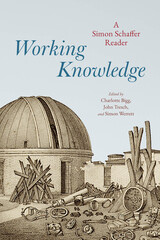
Working Knowledge is the first English-language collection of essays by Simon Schaffer, coauthor of Leviathan and the Air-Pump, a landmark text in the history of science. Though the latter may be his most famous book, Schaffer is also renowned for seminal articles on Isaac Newton and the cultures of popular spectacle, nineteenth-century physics and its practices of labor discipline and standardization, the history of anthropology and collecting, and the globe-spanning cultural interactions that have shaped modern science. Working Knowledge compiles these well-known pieces alongside newer selections, making them accessible in a single place and representing the huge scope and impact of Schaffer’s oeuvre.
The Reader divides sixteen of Schaffer’s articles across five thematic sections, which take up timely issues like the turn toward global histories of science; the intersection of science and capitalism; the interaction between bodies and machines; and the connection between science, politics, and the environment. Eight new essays by notable historians such as Adrian Johns, Lissa Roberts, and Steven Shapin bring Schaffer’s pieces into discussion with current scholarship. Illustrations and brief commentaries by Schaffer and the artist Adam Lowe, a longtime collaborator, are included throughout the volume.
Bringing together essential articles that were previously scattered across several publications, Working Knowledge is an insightful introduction to Schaffer and his ever-relevant writing.

The World Bank is a controversial organisation. It is widely viewed with suspicion, as the international economic arm of the US, in thrall to the President who is responsible for appointing the head of the Bank.
Eric Toussaint gives a highly readable account of just why the World Bank has become so powerful. In short, clear chapters he shows how the bank operates, who funds it, and what it sets out to promote.
The Bank's main purpose is to grant loans to all the newly independent states of the developing world, to help them on their journey to recovery after colonial occupation. In reality, the conditions imposed on these states -- including enforced privatisation of all public services, and enforced neo-liberal rules on trade -- mean that the Bank has become the new colonial authority in everything but name.
This is a perfect book for anyone looking for a critical introduction to the history of the Bank and its role in world affairs.
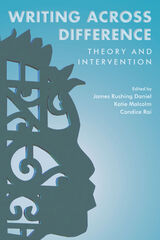
No text in composition has made such a sweeping attempt to place the multiple areas of translingualism, anti-racism, anticolonialism, interdisciplinarity, and disability into conversation or to represent the field as broadly unified around the concept of difference. The chapters in this book specifically explore how monolingual ideology is maintained in institutions and how translingual strategies can (re)include difference; how narrative-based interventions can promote writing across difference in classrooms and institutions by complicating dominant discourses; and how challenging dominant logics of class, race, ability, and disciplinarity can present opportunities for countering divisiveness.
Writing Across Difference offers writing scholars a sustained intellectual encounter with the crisis of difference and foregrounds the possibilities such an encounter offers for collective action toward a more inclusive and equitable society. It presents a variety of approaches for intervening in classrooms and institutions in the interest of focalizing, understanding, negotiating, and bridging difference. The book will be a valuable resource to those disturbed by the bigotry, violence, and fanaticism that mark our political culture and who are seeking inspiration, models, and methods for collective response.
Contributors: Anis Bawarshi, Jonathan Benda, Megan Callow, James Rushing Daniel, Cherice Escobar Jones, Laura Gonzales, Juan Guerra, Stephanie Kerschbaum, Katie Malcolm, Nadya Pittendrigh, Mya Poe, Candice Rai, Iris Ruiz, Ann Shivers-McNair, Neil Simpkins, Alison Y. L. Stephens, Sumyat Thu, Katherine Xue, Shui-yin Sharon Yam
Drawing upon previously unpublished archival materials as well as historical accounts, Gere traces the history of writing groups in America, from their origins over a century ago to their recent reappearance in the works of Macrorie, Elbow, Murray, and others.
From this historical perspective Gere examines the theoretical foundations of writing groups, challenging the traditional concept of writing as an individual performance. She offers instead a broader view of authorship that includes both individual and social dimensions, with implications not only for the teaching of composition but also for theories of rhetoric and literacy.
As new media mature, the changes they bring to writing in college are many and suggest implications not only for the tools of writing, but also for the contexts, personae, and conventions of writing. An especially visible change has been the increase of visual elements-from typographic flexibility to the easy use and manipulation of color and images. Another would be in the scenes of writing-web sites, presentation "slides," email, online conferencing and coursework, even help files, all reflect non-traditional venues that new media have brought to writing. By one logic, we must reconsider traditional views even of what counts as writing; a database, for example, could be a new form of written work.
The authors of Writing New Media bring these ideas and the changes they imply for writing instruction to the audience of rhetoric/composition scholars. Their aim is to expand the college writing teacher's understanding of new media and to help teachers prepare students to write effectively with new media beyond the classroom. Each chapter in the volume includes a lengthy discussion of rhetorical and technological background, and then follows with classroom-tested assignments from the authors' own teaching.
READERS
Browse our collection.
PUBLISHERS
See BiblioVault's publisher services.
STUDENT SERVICES
Files for college accessibility offices.
RECENTLY PUBLISHED



UChicago Accessibility Resources
home | accessibility | search | about | contact us
BiblioVault ® 2001 - 2026
The University of Chicago Press