
 A SCHOLARLY BOOK REPOSITORY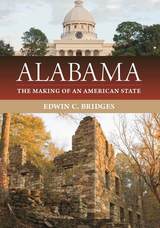
The story of Alabama—where history shaped a state and a nation.
Alabama: The Making of an American State is itself a watershed event in the long and storied history of the state of Alabama. Here, presented for the first time ever in a single, magnificently illustrated volume, Edwin C. Bridges conveys the magisterial sweep of Alabama’s rich, difficult, and remarkable history with verve, eloquence, and an unblinking eye.
From Alabama’s earliest fossil records to its settlement by Native Americans and later by European settlers and African slaves, from its territorial birth pangs and statehood through the upheavals of the Civil War and the civil rights movement, Bridges makes evident in clear, direct storytelling the unique social, political, economic, and cultural forces that have indelibly shaped this historically rich and unique American region.
Illustrated lavishly with maps, archival photographs, and archaeological artifacts, as well as art works, portraiture, and specimens of Alabama craftsmanship—many never before published—Alabama: The Making of an American State makes evident as rarely seen before Alabama’s most significant struggles, conflicts, achievements, and developments.
Drawn from decades of research and the deep archival holdings of the Alabama Department of Archives and History, this volume will be the definitive resource for decades to come for anyone seeking a broad understanding of Alabama’s evolving legacy.

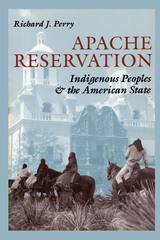
"Indian reservations" were the United States' ultimate solution to the "problem" of what to do with native peoples who already occupied the western lands that Anglo settlers wanted. In this broadly inclusive study, Richard J. Perry considers the historical development of the reservation system and its contemporary relationship to the American state, with comparisons to similar phenomena in Canada, Australia, and South Africa.
The San Carlos Apache Reservation of Arizona provides the lens through which Perry views reservation issues. One of the oldest and largest reservations, its location in a minerals- and metals-rich area has often brought it into conflict with powerful private and governmental interests. Indeed, Perry argues that the reservation system is best understood in terms of competition for resources among interest groups through time within the hegemony of the state. He asserts that full control over their resources—and hence, over their lives—would address many of the Apache's contemporary economic problems.

Why does the American federal government seem to prioritize elite capitalist interests over those of other groups? Class Politics and the Creation of the American State draws on a wide range of sources—personal letters, official government documents, private notes, and newspaper articles—to reveal that the federal government was built to give the emerging capitalist elite a way to consolidate and institutionalize their power. Challenging both liberal and conservative interpretations about what the US Constitution means, this book tells a new story about how the American state took shape.
The framers of the Constitution constructed an image of the state, enshrined in the Constitution, that presented their power as universal: a system meant to serve all Americans equally. This image helped legitimize the new order, even if the rising capitalist class stood to benefit most of all. Since the United States of the late 1780s was not yet a fully capitalist society, the state that was built opened space for less capitalistically incorporated social classes, including some artisans and yeoman farmers, to have limited representation. Class Politics and the Creation of the American State shows how the structure of the early American state worked primarily to advance capitalist interests, while incorporating other groups enough to maintain a sense of broad representation and inclusion.
In this illuminating and provocative study, Stillman provides a new understanding of the foundation of the American state.
Whether renewing a driver's license, traveling on an airplane, or just watching in fascination as a robot probes Mars, we all participate in the everyday workings of the modern administrative state. As Stillman demonstrates in this study, however, we have not, until now, fully investigated or appreciated this administrative stateÕs origins or its evolution into the entity that so affects our lives today.
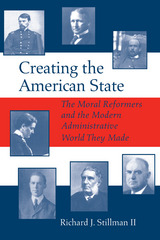
Stillman reveals that this modern enterprise emerged from a complex foundation of ideas and ideals rather than as a result of a simple, rational plan or cataclysmic event, as previously contended. In fact, he finds that the basis for our current administrative state lies in the lives of the seven individuals who, during the late 19th and early 20th centuries, invented its various elements.
Stillman also finds that although they lived at different times, these seven founders-George William Curtis, Charles Francis Adams, Jr., Emory Upton, Jane Addams, Frederick W. Taylor, Richard Childs, and Louis Brownlow-had much in common: all were products of intensely Protestant, small-town America, and all were motivated by strong moral idealism. Indeed, Stillman finds that state making in the United States has been a continuation of the Protestant goal to "protest and purify."
Some names are more recognizable than others, but all, through remarkable moral fervor and exceptional leadership skills, invented the administrative practices and procedures so familiar today.
"A wonderful, learned, and original work, full of present-day relevance. Essential reading for anyone interested in the history of higher education and its relation to professionalism and the growth of the modern state."
--Geoffrey Kabaservice, author of The Guardians: Kingman Brewster, His Circle, and the Rise of the Liberal Establishment
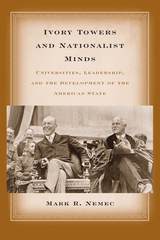
"Ivory Towers and Nationalist Minds contributes greatly to our understanding of the influence of the American university on public life, including the development of the modern American state. Nemec focuses on the universities working in concert to enhance their own influence and that of the state. This is not only a historical issue of interest-it has contemporary resonance. Institutions today compete intensely while cooperating regularly. And public universities like Michigan and California are expected, perhaps more than ever before, to contribute directly to the welfare of their states, especially in economic development."
--J. Douglas Toma, Associate Professor, Institute of Higher Education, University of Georgia
"Ivory Towers and Nationalist Minds fills an important void in the study of American political development and its relationship to the evolution of American higher education. Numerous historical case studies provide vivid evidence of how universities emerged as sources of national expertise and state-building at a critical juncture in our nation's history. Nemec demonstrates that such contributions were not historical inevitabilities, but the product of strategic actors seeking to simultaneously strengthen universities and serve a greater national purpose."
--Scott W. Allard, Brown University
Mark R. Nemec is a Vice President with Forrester Research in Cambridge, Massachusetts. He holds a BA from Yale, and both an MA in Education and a PhD in Political Science from the University of Michigan. He has served on the faculty of Davidson College and as a Senior Director of the Advisory Board Company in Washington, DC.

In the wake of the American Revolution, if you had asked a citizen whether his fledgling state would survive more than two centuries, the answer would have been far from confident. The problem, as is so often the case, was money. Left millions of dollars of debt by the war, the nascent federal government created a system of taxes on imported goods and installed custom houses at the nation’s ports, which were charged with collecting these fees. Gradually, the houses amassed enough revenue from import merchants to stabilize the new government. But, as the fragile United States was dependent on this same revenue, the merchants at the same time gained outsized influence over the daily affairs of customs houses. As the United States tried to police this commerce in the early nineteenth century, the merchants’ stranglehold on custom house governance proved to be formidable.
In National Duties, Gautham Rao makes the case that the origins of the federal government and the modern American state lie in these conflicts at government custom houses between the American Revolution and the presidency of Andrew Jackson. He argues that the contours of the government emerged from the push-and-pull between these groups, with commercial interests gradually losing power to the administrative state, which only continued to grow and lives on today.
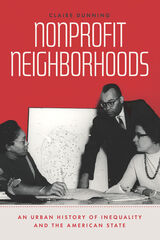
Nonprofits serving a range of municipal and cultural needs are now so ubiquitous in US cities, it can be difficult to envision a time when they were more limited in number, size, and influence. Turning back the clock, however, uncovers both an illuminating story of how the nonprofit sector became such a dominant force in American society, as well as a troubling one of why this growth occurred alongside persistent poverty and widening inequality. Claire Dunning’s book connects these two stories in histories of race, democracy, and capitalism, revealing how the federal government funded and deputized nonprofits to help individuals in need, and in so doing avoided addressing the structural inequities that necessitated such action in the first place.
Nonprofit Neighborhoods begins after World War II, when suburbanization, segregation, and deindustrialization inaugurated an era of urban policymaking that applied private solutions to public problems. Dunning introduces readers to the activists, corporate executives, and politicians who advocated addressing poverty and racial exclusion through local organizations, while also raising provocative questions about the politics and possibilities of social change. The lessons of Nonprofit Neighborhoods exceed the bounds of Boston, where the story unfolds, providing a timely history of the shift from urban crisis to urban renaissance for anyone concerned about American inequality—past, present, or future.

The sudden emergence of the Trump nation surprised nearly everyone, including journalists, pundits, political consultants, and academics. When Trump won in 2016, his ascendancy was widely viewed as a fluke. Yet time showed it was instead the rise of a movement—angry, militant, revanchist, and unabashedly authoritarian.
How did this happen? Twilight of the American State offers a sweeping exploration of how law and legal institutions helped prepare the grounds for this rebellious movement. The controversial argument is that, viewed as a legal matter, the American state is not just a liberal democracy, as most Americans believe. Rather, the American state is composed of an uneasy and unstable combination of different versions of the state—liberal democratic, administered, neoliberal, and dissociative. Each of these versions arose through its own law and legal institutions. Each emerged at different times historically. Each was prompted by deficits in the prior versions. Each has survived displacement by succeeding versions. All remain active in the contemporary moment—creating the political-legal dysfunction America confronts today.
Pierre Schlag maps out a big picture view of the tribulations of the American state. The book abjures conventional academic frameworks, sets aside prescriptions for quick fixes, dispenses with lamentations about polarization, and bypasses historical celebrations of the American Spirit.
READERS
Browse our collection.
PUBLISHERS
See BiblioVault's publisher services.
STUDENT SERVICES
Files for college accessibility offices.
RECENTLY PUBLISHED




UChicago Accessibility Resources
home | accessibility | search | about | contact us
BiblioVault ® 2001 - 2026
The University of Chicago Press