
 A SCHOLARLY BOOK REPOSITORY
In contemporary Norwegian fiction Tomas Espedal’s work stands out as uniquely personal; it can be difficult to separate the fiction from Espedal’s own experiences. In that vein, his novel Against Art is not just the story of a boy growing up to be a writer, but it is also the story of writing. Specifically, it is about the profession of writing—the routines, responsibility, and obstacles. Yet, Against Art is also about being a father, a son, and a grandson; about a family and a family’s tales, and about how preceding generations mark their successors. It is at once about choices and changes, about motion and rest, about moving to a new place, and about living.
Through a series of vivid case studies, Authors in Court charts the 300-year-long dance between authorship and copyright that has shaped each institution’s response to changing social norms of identity, privacy, and celebrity.
“A literary historian by training, Rose is completely at home in the world of law, as well as the history of photography and art. This is the work of an interdisciplinary scholar at the height of his powers. The arguments are sophisticated and the elegant text is a work of real craftsmanship. It is superb.”
—Lionel Bently, University of Cambridge
“Authors in Court is well-written, erudite, informative, and engaging throughout. As the chapters go along, we see the way that personalities inflect the supposedly impartial law; we see the role of gender in authorial self-fashioning; we see some of the fault lines which produce litigation; and we get a nice history of the evolution of the fair use doctrine. This is a book that should at least be on reserve for any IP–related course. Going forward, no one writing about any of the cases Rose discusses can afford to ignore his contribution.”
—Lewis Hyde, Kenyon College
Most scholars dismiss research into the paranormal as pseudoscience, a frivolous pursuit for the paranoid or gullible. Even historians of religion, whose work naturally attends to events beyond the realm of empirical science, have shown scant interest in the subject. But the history of psychical phenomena, Jeffrey J. Kripal contends, is an untapped source of insight into the sacred and by tracing that history through the last two centuries of Western thought we can see its potential centrality to the critical study of religion.
Kripal grounds his study in the work of four major figures in the history of paranormal research: psychical researcher Frederic Myers; writer and humorist Charles Fort; astronomer, computer scientist, and ufologist Jacques Vallee; and philosopher and sociologist Bertrand Méheust. Through incisive analyses of these thinkers, Kripal ushers the reader into a beguiling world somewhere between fact, fiction, and fraud. The cultural history of telepathy, teleportation, and UFOs; a ghostly love story; the occult dimensions of science fiction; cold war psychic espionage; galactic colonialism; and the intimate relationship between consciousness and culture all come together in Authors of the Impossible, a dazzling and profound look at how the paranormal bridges the sacred and the scientific.
Whether it is used as an icebreaker in conversation or as the subject of serious inquiry, “the weather” is one of the few subjects that everyone talks about. And though we recognize the faces that bring us the weather on television, how government meteorologists and forecasters go about their jobs is rarely scrutinized. Given recent weather-related disasters, it’s time we find out more. In Authors of the Storm, Gary Alan Fine offers an inside look at how meteorologists and forecasters predict the weather.
Based on field observation and interviews at the Storm Prediction Center in Oklahoma, the National Weather Service in Washington, D.C., and a handful of midwestern outlets, Fine finds a supremely hard-working, insular clique of professionals who often refer to themselves as a “band of brothers.” In Fine’s skilled hands, we learn their lingo, how they “read” weather conditions, how forecasts are written, and, of course, how those messages are conveyed to the public. Weather forecasts, he shows, are often shaped as much by social and cultural factors inside local offices as they are by approaching cumulus clouds. By opening up this unique world to us, Authors of the Storm offers a valuable and fascinating glimpse of a crucial profession.


A peculiar necrophilia dominates literary theory. Whether it be under the banner of “anatomy of criticism” or “death of the author,” students of literature seem fated to form a “Dead Poets’ Society.” Can literature ever create or sustain life? What is the cultural mythology of the “dead poet”? In a broad-ranging analysis of modern French and Russian writing—from poems, plays, and essays to revolutionary marches, fashion magazines, and suicide notes—Svetlana Boym reconsiders the making and unmaking of the self in writing on life.
Examining both literal and figurative deaths of poets, the author elaborates alternative strategies for reading text, life, and culture all together. Boym questions the traditional boundaries between literary theory, social psychology, anthropology, and history. She draws on and yet resists ideas advanced by Russian formalists and French and American poststructuralists to develop an authoritative critical vocabulary for the purpose of analyzing modern poetic myths. She brings poets back to life, back to their lives once again, and thereby resuscitates the dying art, the art of dying in words. The result is cultural criticism of a very high order.
The book offers spectacular example of poetic lives. First the author considers the legend of the “pure poet,” focusing on the opposite paths of Mallarmé and Rimbaud. The she investigates the myth of the “revolutionary poet,” stressing the tension between poetry and politics, particularly in the life and work of Mayakovsky. In a third section, she explores the masking image of “poetess” and its fatal entrapment of the woman poet—here, Marina Tsvetaeva. In “The Death of a Critic?” she brings the study to brilliant conclusion, revealing the ironies inherent in the work of Barthes, de Man, and Foucault, the three critics who celebrated the death of the author and yet who, in their own deaths, are subject to biographical speculation.
Editing is a tricky business. It requires analytical flair and creative panache, the patience of a saint and the vision of a writer. Transforming a manuscript into a book that edifies, inspires, and sells? That’s the job of the developmental editor, whose desk is the first stop for many manuscripts on the road to bookdom—a route ably mapped out in the pages of Developmental Editing.
Author Scott Norton has worked with a diverse range of authors, editors, and publishers, and his handbook provides an approach to developmental editing that is logical, collaborative, humorous, and realistic. He starts with the core tasks of shaping the proposal, finding the hook, and building the narrative or argument, and then turns to the hard work of executing the plan and establishing a style.
Developmental Editing includes detailed case studies featuring a variety of nonfiction books—election-year polemic, popular science, memoir, travel guide—and authors ranging from first-timer to veteran, journalist to scholar. Handy sidebars offer advice on how to become a developmental editor, create effective illustration programs, and adapt sophisticated fiction techniques (such as point of view, suspense, plotting, character, and setting) to nonfiction writing.
Norton’s book also provides freelance copyeditors with a way to earn higher fees while introducing more creativity into their work lives. It gives acquisitions, marketing, and production staff a vocabulary for diagnosing a manuscript’s flaws and techniques for transforming it into a bestseller. And perhaps most importantly, Developmental Editing equips authors with the concrete tools they need to reach their audiences.
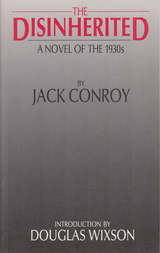
Douglas Wixson's introduction to this new edition of Conroy's classic provides biographical information on the aspects of Conroy's life that influenced his writings, explores the socialist movement of the 1930s, and examines the critical reaction to the novel, showing why The Disinherited has endured both as historical document and as fiction.
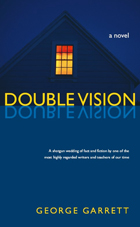
A shotgun marriage of fact and fiction by one of the most highly regarded writers and teachers of our time
A writer named George Garrett, suffering from double vision as a result of a neurological disorder, is asked to review a recent, first biography of the late Peter Taylor, a renowned writer who has been his long-time friend and neighbor in Charlottesville. Reflecting on their relationship, Garrett conceives of a character—not unlike himself—a writer in his early 70s, ill and suffering from double vision, named Frank Toomer. He gives Toomer a neighbor, a distinguished short story writer named Aubrey Carver.
As the real George Garrett and Peter Taylor are replaced by two very different and imaginary writers, the story becomes a wise and insightful exploration of American literary life, the art of biography, the comical rivalries among writers and academics, notions of success, and the knotty relationship of art to life, fact to fiction, and life to death. Double Vision is a witty tour de force and an elegy for a gifted generation of writers.
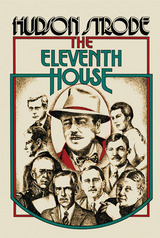
Strode starts his foreign travels in Sorrento with Dante's descendant Count Dante Serego-Alighieri as his guide. He takes a Russian cattle boat to Tunisia and lunches with the lovely Countess de Brazza. Then he embarks on a whirlwind tour of South America and writes South by Thunderbird. Later, in England, he visits Rebecca West at her country home and strikes up a warm friendship with Lady Astor. In Denmark his hostess is Isak Dinesen. In Finland he meets Jan Sibelius.
Such are the times of Hudson Strode. With his keen eye for settings, with candor, energy, and curiosity, Strode sees his famous friends closely and wholly. His is a unique account.
The Eleventh House is the story of a rewarding and fascinating life told by a man who remembers it all with affection. He tells it for the record and as great entertainment.
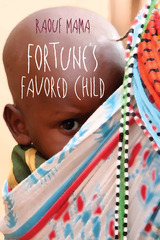
Raouf Mama is widely beloved by children and adults alike for his books and especially for his African and multicultural storytelling, which incorporates poetry, song, music, and dance.
In Fortune’s Favored Child, the master storyteller tells his own story, beginning in the West African country of Benin. Through a harrowing experience with sickness, an encounter with a clairvoyant traditional healer, and astonishing twists of fortune, the protagonist struggles to uncover his real identity, to get an education, and to make his own way in the world. His journey takes him to the shores of the United States to attend graduate school at the University of Michigan and begin a new chapter in his life.
In addition to the editors, contributors include Rebecca Rego Barry, Susann Bishop, Ben de Bruyn, Erin Hazard, Caroline Hellman, Michelle McClellan, Mara Scanlon, and Klara-Stephanie Szlezák.

Originally published in 1929, I Thought of Daisy is the first of three novels by Edmund Wilson. Written while he was still balancing his ambitions as a novelist against a successful career in literary criticism, I Thought of Daisy marries Wilson's two vocations to create an unusual and revealing work of fiction.
Here is a major new work on human infancy written by one of the country’s leading developmental psychologists and two distinguished colleagues. At its core is the long-awaited report of the authors’ six-year study of infant day care. Important in its own right, this experiment becomes the occasion for a wide-ranging discussion of cognitive and emotional processes in infancy, of the effects of early experience on later growth, and of the deep-seated cultural and historical assumptions that underlie our views of human development.
For those concerned with social policy, the book provides the best empirical assessment now available of the effects of group care on the psychological well-being of infants. It also supplies a blueprint for quality daycare that may well stand as a model for future nurseries. For those interested in the course of cognitive and emotional development, the book provides rich information about the major growth functions that characterize human infancy. It also outlines an explanation of these growth functions that links changes in emotional behavior to the maturation of underlying cognitive processes in a new and provocative way. And for everyone interested in human nature, the book of offers a controversial thesis about the discontinuity of psychological growth that challenges some of our most fundamental assumptions about the nature of individual development.
For this paperback edition, the statistical summary has been removed from the appendix to shorten the work and make it even more appealing to the general reader.

A celebrated writer returns to his hometown of Odessa, pondering a deal with the secret police, pining for a daughter living abroad, and hoping to pen one last homage to his own past. Isaac Babel, the world famous spinner of tales about Cossacks and gangsters, arrives in Odessa to be treated for asthma-and perhaps help a condemned prisoner to escape. Or is it Babel who intends to escape?
For six decades our only record of Babel's visit has been the contents of letters and postcards sent abroad to his mother and sister. In King of Odessa, Robert A. Rosenstone imagines a version of this visit and the novel Babel wrote during those weeks. Babel himself is concerned with more than literary plots as he considers an escape just as he starts an affair with an actress who may be a police spy. He also ruminates on his past-his childhood as a sickly Jewish boy, the horrifying 1905 pogrom, the famous rides with the Cossacks that inspired Red Calvary, and above all his complicated relationships with women. Throughout the novel Rosenstone captures Babel's lively wit, his exhaustion with fame and the Soviet system, and his infectious charm.
This would prove to be Babel's last visit to Odessa. Three years later, he was arrested as a spy and executed. Rosenstone, the acclaimed biographer of writer and activist John Reed, mixes historical facts and fiction with the talent of a gifted storyteller. The result is a captivating exploration of a great writer surrounded by history and on the brink of falling out of it forever.

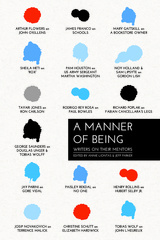
The nearly seventy short essays in A Manner of Being, by some of the best contemporary writers from around the world, pay homage to mentors—the writers, teachers, nannies, and sages—who enlighten, push, encourage, and sometimes hurt, fail, and limit their protégés. There are mentors encountered in the schoolhouse and on farms, in NYC and in MFA programs; mentors who show up exactly when needed, offering comfort, a steadying hand, a commiseration, a dose of tough love. This collection is rich with anecdotes from the heartfelt to the salacious, gems of writing advice, and guidance for how to live the writing life in a world that all too often doesn't care whether you write or not.
Each contribution is intimate and distinct—yet a common theme is that mentors model a manner of being.
Selections include:
Arthur Flowers on John O'Killens
James Franco on Harmony Korine
Mary Gaitskill on an Ann Arbor bookstore owner
Noy Holland and Sam Lipsyte on Gordon Lish
Tayari Jones on Ron Carlson
Henry Rollins on Hubert Selby Jr.
Rodrigo Rey Rosa on Paul Bowles
George Saunders on Douglas Unger and Tobias Wolff
Christine Schutt on Elizabeth Hardwick
Tobias Wolff on John L'Heureux
. . . and many more
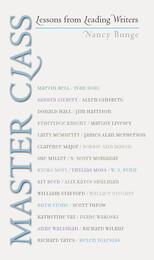
Master Class: Lessons from Leading Writers gathers more than two decades of wisdom from twenty-nine accomplished authors. It offers previously unpublished interviews along with freshly edited versions of ten interviews from Nancy Bunge's well-received previous collection, Finding the Words. The first section, Theory, incorporates interviews which document the golden age of writing programs in which authors with a strong sense of social and cultural responsibility taught as seriously as they wrote. These conversations delve into the writers' philosophies and teaching methods. The second section, Practice, presents interviews with authors who discuss how they've approached the writing of particular works. Altogether the interviews introduce authors as inspirational models and provide insightful techniques for other writers to try. One piece of advice recurs with striking consistency: to produce fresh, interesting work, aspiring writers must develop a passionate self-trust. This rule has an essential corollary: improving as a writer means constantly stretching oneself with new information and skills. Sure to interest writing and literature teachers as well as writers at every stage of development, Master Class is highly recommended for undergraduate and graduate writing courses.
Interviews with Marvin Bell, Ivan Doig, Sandra Gilbert, Allen Ginsberg, Donald Hall, Jim Harrison, Etheridge Knight, Margot Livesey, Larry McMurtry, James Alan McPherson, Clarence Major, Bobbie Ann Mason, Sue Miller, N. Scott Momaday, Kyoko Mori, Thylias Moss, W. S. Penn, Kit Reed, Alix Kates Shulman, William Stafford, Wallace Stegner, Ruth Stone, Scott Turow, Katherine Vaz, Diane Wakoski, Anne Waldman, Richard Wilbur, Richard Yates, and Helen Yglesias.
The literary genres given shape by the writers of classical antiquity are central to our own thinking about the various forms literature takes. Examining those genres, the essays collected here focus on the concept and role of the author and the emergence of authorship out of performance in Greece and Rome.
In a fruitful variety of ways the contributors to this volume address the questions: what generic rules were recognized and observed by the Greeks and Romans over the centuries; what competing schemes were there for classifying genres and accounting for literary change; and what role did authors play in maintaining and developing generic contexts? Their essays look at tragedy, epigram, hymns, rhapsodic poetry, history, comedy, bucolic poetry, prophecy, Augustan poetry, commentaries, didactic poetry, and works that "mix genres."
The contributors bring to this analysis a wide range of expertise; they are, in addition to the editors, Glenn W. Most, Joseph Day, Ian Rutherford, Deborah Boedeker, Eric Csapo, Marco Fantuzzi, Stephanie West, Alessandro Barchiesi, Ineke Sluiter, Don Fowler, and Stephen Hinds. The essays are drawn from a colloquium at Harvard's Center for Hellenic Studies.
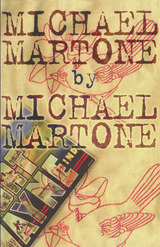
Michael Martone, by Michael Martone, continues the author's giddy exploration of the parts of books nobody ever reads. Michael Martone is its own appendix, comprising fifty “contributors notes,” each of which identifies in exorbitant biographical detail the author of the other forty-nine. Full of fanciful anecdotes and preposterous reminiscences, Martone’s self-inventions include the multiple deaths of himself and all his family members, his Kafkaesque rebirth as a giant insect, and his stints as circus performer, assembly-line worker, photographer, and movie extra.
Expect no autobiographical consistency here. A note revealing Martone's mother as the ghost-writer of all his books precedes the note beginning, “Michael Martone, an orphan . . . “ We learn of Martone’s university career and sketchy formal education, his misguided caretaking of his teacher John Barth’s lawn, and his impersonation of a poor African republic in political science class, where Martone's population is allowed to starve as his more fortunate fellow republics fight over development and natural resource trading-cards.
The author of Michael Martone, whose other names include Missy, Dolly, Peanut, Bug, Gigi-tone, Tony's boy, Patty's boy, Junior's, Mickey, Monk, Mr. Martone, and “the contributor named in this note," proves as Protean as fiction itself, continuously transforming the past with every new attribution but never identifying himself by name. It is this missing personage who, from first note to last, constitutes the unformed subject of Michael Martone.
It has long been recognized that affect (that is, the noncognitive aspect of mental activity) plays a large role in writing and in learning to write. According to Susan H. McLeod, however, the model that has been most used for empirical research on the writing process is based on cognitive psychology and does not take into account affective phenomena. Nor does the social constructionist view of the writing process acknowledge the affective realm except in a very general way. To understand the complete picture, McLeod insists, we need to explore how cognitive, affective, and social elements interact as people write.
In this book, McLeod follows a group of students through a semester of writing assignments, tracking the students’ progress and examining the affective elements relevant to their writing. To facilitate future discussion of these phenomena, McLeod also provides suggested definitions for terms in the affective domain.
In a very real sense, this book is the result of a collaboration of three Susans: Susan McLeod, who researched and wrote the book; Sue Hallett, an instructor in Washington State University’s composition program whose classes McLeod observed and who helped provide much of the data; and Susan Parker, a graduate student who observed Hallett’s class and who ran a tutorial connected to that class. To provide a narrative structure, McLeod and her two collaborators have constructed a simulated semester, conflating the year and a half of the study into one semester and creating a class that is a composite drawn from seven classrooms over three semesters.
Although philosophers have had much to say about the affective domain, Notes on the Heart is based for the most part on research from the social sciences. Discussions of pedagogy, while meant to have practical value, are suggestive rather than prescriptive. The goal is to help teachers see their practice in new way.
Teachers will be particularly interested in McLeod’s discussion of teacher affect/effect. This section examines both the issue of the "Pygmalion effect" (students becoming better because the teacher believes they are) and perhaps the more common opposite, the "golem effect" (students becoming less capable because their teachers view them that way).
Written at the peak of the late British master’s extraordinary literary career, this novel offers profound insight into the mind of a great artist whose unequaled style, ear for dialogue, and eye for irony will delight devotees and new readers alike.
The most complete translation available of these brief biographies of great European figures, written by one of the leading historians of the sixteenth century.
Portraits of Learned Men provides a fascinating synopsis of the contours, mentality, and trajectory of humanistic culture in Italy and Europe by one of the leading historians of the sixteenth century, Paolo Giovio (1483–1552). These brief biographies of 146 men of learning—from Dante, Petrarch, and Boccaccio in the fourteenth century to Erasmus, Thomas More, and Juan Luis Vives in the sixteenth—were meant to accompany accurate portrait paintings commemorating great figures in modern history. Presented together with the literary portraits in this volume, these paintings would be located in a purpose-built villa on Lake Como that would be open to the public. Giovio called this his musaeum, or home of the Muses, one of the first such institutions in European history. His museum would not only serve the traditional function of inspiring virtuous emulation but also provide a comprehensive, candid, and personal overview of the Republic of Letters as it had taken shape and flourished in Italy and Europe during the Renaissance.
This volume contains a fresh edition of the Latin text and a new, more complete translation than any now available in English.

From the antiquity of Homer to yesterday's Naked Lunch, writers have found inspiration, and readers have lost themselves, in a world of the imagination tinged and oftentimes transformed by drugs. The age-old association of literature and drugs receives its first comprehensive treatment in this far-reaching work. Drawing on history, science, biography, literary analysis, and ethnography, Marcus Boon shows that the concept of drugs is fundamentally interdisciplinary, and reveals how different sets of connections between disciplines configure each drug's unique history.
In chapters on opiates, anesthetics, cannabis, stimulants, and psychedelics, Boon traces the history of the relationship between writers and specific drugs, and between these drugs and literary and philosophical traditions. With reference to the usual suspects from De Quincey to Freud to Irvine Welsh and with revelations about others such as Milton, Voltaire, Thoreau, and Sartre, The Road of Excess provides a novel and persuasive characterization of the "effects" of each class of drug--linking narcotic addiction to Gnostic spirituality, stimulant use to writing machines, anesthesia to transcendental philosophy, and psychedelics to the problem of the imaginary itself. Creating a vast network of texts, personalities, and chemicals, the book reveals the ways in which minute shifts among these elements have resulted in "drugs" and "literature" as we conceive of them today.
Who owns your genetic information? Might it be the doctors who, in the course of removing your spleen, decode a few cells and turn them into a patented product? In 1990 the Supreme Court of California said yes, marking another milestone on the information superhighway. This extraordinary case is one of the many that James Boyle takes up in Shamans, Software, and Spleens, a timely look at the infinitely tricky problems posed by the information society. Discussing topics ranging from blackmail and insider trading to artificial intelligence (with good-humored stops in microeconomics, intellectual property, and cultural studies along the way), Boyle has produced a work that can fairly be called the first social theory of the information age.
Now more than ever, information is power, and questions about who owns it, who controls it, and who gets to use it carry powerful implications. These are the questions Boyle explores in matters as diverse as autodialers and direct advertising, electronic bulletin boards and consumer databases, ethno-botany and indigenous pharmaceuticals, the right of publicity (why Johnny Carson owns the phrase "Here's Johnny!"), and the right to privacy (does J. D. Salinger "own" the letters he's sent?). Boyle finds that our ideas about intellectual property rights rest on the notion of the Romantic author--a notion that Boyle maintains is not only outmoded but actually counterproductive, restricting debate, slowing innovation, and widening the gap between rich and poor nations. What emerges from this lively discussion is a compelling argument for relaxing the initial protection of authors' works and expanding the concept of the fair use of information. For those with an interest in the legal, ethical, and economic ramifications of the dissemination of information--in short, for every member of the information society, willing or unwilling--this book makes a case that cannot be ignored.
In 1834 Harvard dropout Richard Henry Dana Jr. sailed to California as a common seaman. His account of the voyage, Two Years Before the Mast, quickly became an American classic. But literary acclaim could not erase the young lawyer’s memory of the brutal floggings he had witnessed aboard ship or undermine the vow he had made to combat injustice. In Slavish Shore, Jeffrey Amestoy tells the story of Dana’s unflagging determination to keep that vow in the face of nineteenth-century America’s most exclusive establishment: the Boston society in which he had been born and bred.
The drama of Dana’s life arises from the unresolved tension between the Brahmin he was expected to be on shore and the man he had become at sea. Dana’s sense of justice made him a lawyer who championed sailors and slaves, and his extraordinary advocacy put him at the center of some of the most consequential cases in American history: defending fugitive slave Anthony Burns, justifying President Lincoln’s war powers before the Supreme Court, and prosecuting Confederate president Jefferson Davis for treason. Yet Dana’s own promising political career remained unfulfilled as he struggled to reconcile his rigorous conscience with his restless spirit in public controversy and private life.
The first full-length biography of Dana in more than half a century, Slavish Shore reintroduces readers to one of America’s most zealous defenders of freedom and human dignity.

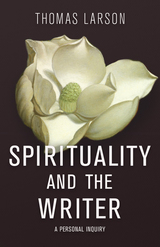
Today, the surprisingly elastic form of the memoir embraces subjects that include dying, illness, loss, relationships, and self-awareness. Writing to reveal the inner self—the pilgrimage into one’s spiritual and/or religious nature—is a primary calling. Contemporary memoirists are exploring this field with innovative storytelling, rigorous craft, and new styles of confessional authorship. Now, Thomas Larson brings his expertise as a critic, reader, and teacher to the boldly evolving and improvisatory world of spiritual literature.
In his book-length essay Spirituality and the Writer, Larson surveys the literary insights of authors old and new who have shaped religious autobiography and spiritual memoir—from Augustine to Thomas Merton, from Peter Matthiessen to Cheryl Strayed. He holds them to an exacting standard: they must render transcendent experience in the writing itself. Only when the writer’s craft prevails can the fleeting and profound personal truths of the spirit be captured. Like its predecessor, Larson’s The Memoir and the Memoirist,Spirituality and the Writer will find a home in writing classrooms and book groups, and be a resource for students, teachers, and writers who seek guidance with exploring their spiritual lives.
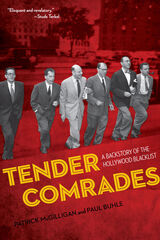
More than sixty years ago, McCarthyism silenced Hollywood. In the pages of Tender Comrades, those who were suppressed, whose lives and careers were ruined, finally have their say. A unique collection of profiles in cinematic courage, this extraordinary oral history brings to light the voices of thirty-six blacklist survivors (including two members of the Hollywood Ten), seminal directors of film noir and other genres, starring actresses and memorable supporting players, top screenwriters, and many less known to the public, who are rescued from obscurity by the stories they offer here that, beyond politics, open a rich window into moviemaking during the Golden Age of Hollywood.
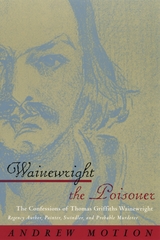
"Thomas Griffiths Wainewright is a dream subject for either novelist or biographer. . . . Andrew Motion, Britain's poet laureate, clearly felt that neither straight biography nor pure fiction would do Wainewright's complexities justice, and so he combined the two genres. The result is stunning. The central voice is that of Wainewright himself, reflecting back on his life. After each chapter Mr. Motion has added detailed notes that inform and flesh out the narrative, giving not only his own informed opinion of Wainewright's actions but also those of Wainewright's contemporaries and the scholars and writers who have studied him over the past two centuries."—Lucy Moore, Washington Times
"Brilliantly innovative, gripping, intricately researched, Motion's biography does justice to its subject at last."—John Carey, The Sunday Times
"Engaging and convincing. . . . The trajectory of this character-from neglected and resentful child to arrogant and envious London dandy to sociopathic murderer on to an enfeebled, frightened prisoner-is indelibly imagined and drawn."—Edmund White, Financial Times
"[A] fascinating look at an evil artist, a charmer still having his way with us. We can hear him being economical with the truth, telling us and himself just what he wants to hear."—Michael Olmert, New Jersey Star Ledger
"Motion crafts a fascinating tale as complex and compelling as if Wainewright himself had written it."—Michael Spinella, Booklist
"Did he kill his servant, and possibly others as well? . . . The footnotes seem to say yes, but Wainewright adamantly argues his own case. Motion's prose is flawless, and Wainewright's voice is convincing. But in the long run, it's this ambiguity that makes Wainewright the Poisoner a fascinating and memorable read."—R.V. Schelde, Sacramento News and Review
"Who could as for a better Romantic villain than Thomas Griffiths Wainewright? . . . [The book] succeeds on many levels: as an act of ventriloquism, a work of scholarship, a psychological study, as a set of sharp portraits of famous men and an engrossing read. . . ."—Polly Shulman, Newsday
"Instead of a straightforward biography, Andrew Motion gives us Wainewright's first person, fictionalized "confession."—a document as circumspect, slyly reticent, and oeaginously smooth as the man himself. Splendid."—John Banville, Literary Review
"A genuine tour de force, and on a non-fictional level, a telling portrait of a strange, intriguing and repellant man."—Brian Fallon, Irish Times
"A marvelous literary hybrid that totters with one foot in the world of nonfiction, the other in the land of make-believe. One is alternatively swept up in Motion's dizzy imaginative pastiche, or sent crashing into a dusty stack of scholarly cogitations. . . ."—Philadelphia Inquirer
"As true a portrait of a liar as its subject could wish. Rich and strange. . . ."—Glasgow Herald
Whether talking about her own writing, interpreting the works of others, or giving us a window on the world that "we in South Africa are attempting to reconstruct," Nadine Gordimer has much to tell us about the art of fiction and the art of life.
In this deeply resonant book Gordimer examines the tension for a writer between life's experiences and narrative creations. She asks first, where do characters come from--to what extent are they drawn from real life? We are touching on this question whenever we insist on the facts behind the fiction, Gordimer suggests, and here she tries to unravel the mysterious process that breathes "real" life into fiction. Exploring the writings of revolutionaries in South Africa, she shows how their struggle is contrastingly expressed in factual accounts and in lyrical poetry. Gordimer next turns to three writers linked by their search for a life that transcends their own time and place: in distinctive and telling ways, Naguib Mahfouz, Chinua Achebe, and Amos Oz defy accepted norms of loyalty to the mores and politics of their countries. Their search in Egypt, Nigeria, and Israel for a meaningful definition of home testifies to what it must be: the destination of the human spirit beyond national boundaries. Ending on a personal note, Gordimer reveals her own experience of "writing her way out of" the confines of a dying colonialism.
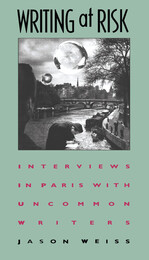
Much has been made of the image of writers in Paris—romanticized and idealized in fiction and on screen, these émigré artists in sidewalk cafés spark our imagination with unusual force. But rarely do the real-life figures speak to us directly to comment on their work, their lives, and their reasons for choosing to live and work in Paris.
In these striking interviews, E. M. Cioran, Julio Cortázar, Brion Gysin, Eugène Ionesco, Carlos Fuentes, Jean-Claude Carrière, Milan Kundera, Nathalie Sarraute, and Edmund Jabès do just this as they speak out on the risks they've taken, on their struggles and discoveries, on tradition, challenge, and their near-unanimous status as émigrés. A consummate interviewer, Jason Weiss spoke in depth with these pathbreaking artists regarding their lives, their craft, and their very special relationship to Paris. Their writings were naturally the main focus of investigation, but Weiss' concern was always to build on previous interviews, to deepen certain lines of inquiry and open new ones, to contribute fresh material to the ongoing record. The result is a series of invigorating, detailed portraits that go beyond personality, habits, and pleasures to examine some of the causes and effects in the unique relationship of place and temperament.
Writing at Risk suggests that there is more than we suspect binding writers of such disparate cultures and genres…perhaps their attitudes toward writing, perhaps their common attraction to risk. Readers will relish the immediacy of these interviews and will want to (re)discover the work of these exceptional artists.
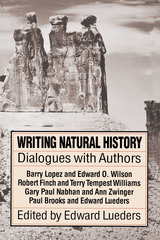
Writing Natural History is the edited record of four public dialogues held at the University of Utah in 1988 between eminent writers in the fields of natural history. In these interchanges the writers discussed their traditions, perspectives, values, purposes, techniques, and personal insights. Their conversations, like their work, link the sciences with the humanities in surprising ways, enhancing our understanding and appreciation of both. This volume maintains the vitality of the spoken dialogues and conveys a lively sense of each speaker’s concern with the processes of the natural world and our human position in it.
Half of the authors began as professionals in the natural sciences before becoming recognized for their literary skills; the other half are established writers whose works reflect their vital human affinity with and respect for nature. Writing Natural History will appeal to all readers involved in conservation, nature study, creative writing, environmental issues, the natural sciences, the outdoors, and the ecological politics of Earth.
Authors dialogues feature Barry Lopez and Edward O. Wilson, Robert Finch and Terry Tempest Williams, Gary Paul Nabhan and Ann Zwinger, Paul Brooks and Edward Lueders.
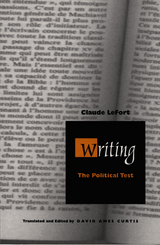
In Writing: The Political Test, France’s leading political philosopher, Claude Lefort, illuminates the process by which writers negotiate difficult path to free themselves from the ideological and contextual traps that would doom their attempts to articulate a new vision. Lefort examines writers whose works provide special insights into this problem of risk, both literary artists and political philosophers. Among them are Salman Rushdie, Sade, Tocqueville,m Machiavelli, Leo Strauss, Orwell, Kant, Robespierre, Guizot, and Pierre Clastres. In Tocqueville, for example, Lefort finds that the author’s improvisatory and open-ended expression represents the character of the democratic experience. Orwell’s work on totalitarianism shows up the totalitarian subject’s complicity in this political regime. And Rushdie is remarkable for his solid attack on relativism. With the character and fate of the political forms of modernity, democracy, and totalitarianism a central theme, Lefort concludes with some reflections on the collapse of the Soviet Union.
This intriguing and accessible exploration of literature’s political aspects and political philosophy’s literary ones will be welcomed by those who have been stymied by current efforts to bridge these two fields. Taken together, the essays in this volume also stand as an intellectual autobiography of Lefort, making it an excellent introduction to his work for less experience students of political theory or philosophy.
READERS
Browse our collection.
PUBLISHERS
See BiblioVault's publisher services.
STUDENT SERVICES
Files for college accessibility offices.
RECENTLY PUBLISHED


UChicago Accessibility Resources
home | accessibility | search | about | contact us
BiblioVault ® 2001 - 2024
The University of Chicago Press