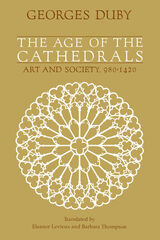
front cover of The Age of the Cathedrals
The Age of the Cathedrals
Art and Society, 980-1420
Georges Duby
University of Chicago Press, 1981
Recognizing that a work of art is the product of a particular time and place as much as it is the creation of an individual, Duby provides a sweeping survey of the changing mentalities of the Middle Ages as reflected in the art and architecture of the period.

"If Age of the Cathedrals has a fault, it is that Professor Duby knows too much, has too many new ideas and takes such a delight in setting them out. . . insights whiz to and fro like meteorites."—John Russell, New York Times Book Review
[more]

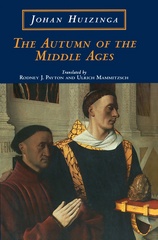
front cover of The Autumn of the Middle Ages
The Autumn of the Middle Ages
Johan Huizinga
University of Chicago Press, 1996
"Here is the first full translation into English of one of the 20th century's few undoubted classics of history." —Washington Post Book World

The Autumn of the Middle Ages is Johan Huizinga's classic portrait of life, thought, and art in fourteenth- and fifteenth-century France and the Netherlands. Few who have read this book in English realize that The Waning of the Middle Ages, the only previous translation, is vastly different from the original Dutch, and incompatible will all other European-language translations.

For Huizinga, the fourteenth- and fifteenth-century marked not the birth of a dramatically new era in history—the Renaissance—but the fullest, ripest phase of medieval life and thought. However, his work was criticized both at home and in Europe for being "old-fashioned" and "too literary" when The Waning of the Middle Ages was first published in 1919. In the 1924 translation, Fritz Hopman adapted, reduced and altered the Dutch edition—softening Huizinga's passionate arguments, dulling his nuances, and eliminating theoretical passages. He dropped many passages Huizinga had quoted in their original old French. Additionally, chapters were rearranged, all references were dropped, and mistranslations were introduced.

This translation corrects such errors, recreating the second Dutch edition which represents Huizinga's thinking at its most important stage. Everything that was dropped or rearranged has been restored. Prose quotations appear in French, with translations preprinted at the bottom of the page, mistranslations have been corrected.

"The advantages of the new translation are so many. . . . It is one of the greatest, as well as one of the most enthralling, historical classics of the twentieth century, and everyone will surely want to read it in the form that was obviously intended by the author." —Francis Haskell, New York Review of Books

"A once pathbreaking piece of historical interpretation. . . . This new translation will no doubt bring Huizinga and his pioneering work back into the discussion of historical interpretation." —Rosamond McKitterick, New York Times Book Review
[more]

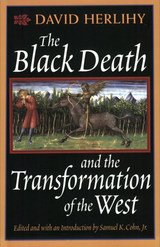
front cover of The Black Death and the Transformation of the West
The Black Death and the Transformation of the West
David Herlihy
Harvard University Press, 1997
In this small book David Herlihy makes subtle and subversive inquiries that challenge historical thinking about the Black Death. Looking beyond the view of the plague as unmitigated catastrophe, Herlihy finds evidence for its role in the advent of new population controls, the establishment of universities, the spread of Christianity, the dissemination of vernacular cultures, and even the rise of nationalism. This book, which displays a distinguished scholar's masterly synthesis of diverse materials, reveals that the Black Death can be considered the cornerstone of the transformation of Europe.
[more]

front cover of Byzantine Court Culture from 829 to 1204
Byzantine Court Culture from 829 to 1204
Henry Maguire
Harvard University Press, 1997

The imperial court in Constantinople has been central to the outsider’s vision of Byzantium. However, in spite of its fame in literature and scholarship, there have been few attempts to analyze the Byzantine court in its entirety as a phenomenon. The studies in this volume aim to provide a unified composition by presenting Byzantine courtly life in all its interconnected facets.

One important theme that unites these studies is the attention paid to describing the effects of a change in the social makeup of the court during this period and the reflection of these changes in art and architecture. These changes in social composition, mentality, and material culture of the court demonstrate that, as in so many other aspects of Byzantine civilization, the image of permanence and immutability projected by the forms of palace life was more apparent than real. As this new work shows, behind the golden facade of ceremony, rhetoric, and art, there was constant development and renewal.
[more]

front cover of City and Spectacle in Medieval Europe
City and Spectacle in Medieval Europe
Barbara Hanawalt
University of Minnesota Press, 1994

Medieval Europe is known for its sense of ceremony and drama. Knightings, tournaments, coronations, religious processions, and even private celebrations such as baptisms, weddings, and funerals were occasions for ritual, feasting, and public display. This volume is the first to take a comprehensive look at the many types of city spectacles that entertained the masses and confirmed various messages of power in late medieval Europe. Bringing together leading scholars in history, art history, and literature, this interdisciplinary collection sets new standards for the study of medieval popular culture.

Drawing examples from Spain, England, France, Italy, and the Netherlands, most of them in the fifteenth century, the authors explore the uses of ceremony as statements of political power, as pleas for divine intercession, and as expressions of popular culture. Their essays show us spectacles meant to confirm events such as victories, the signing of a city charter, or the coronation of a king. In other circumstances, the spectacle acts as a battleground where a struggle for the control of the metaphors of power is played out between factions within cities or between cities and kings. Still other ceremonies called upon divine spiritual powers in the hope that their intervention might save the urban inhabitants. We see here a public cognizant of the power of symbols to express its goals and achievements, a society reaching the height of sophistication in its manipulation of popular and elite culture for grand shows.
[more]

front cover of Constructing Medieval Sexuality
Constructing Medieval Sexuality
Karma Lochrie
University of Minnesota Press, 1997

A groundbreaking examination of sexuality in the Middle Ages.

This collection is the first to be devoted entirely to medieval sexuality informed by current theories of sexuality and gender. It brings together essays from various disciplinary perspectives-literary, theological, philosophical, medical, historical, and art historical-to consider how the Middle Ages defined, regulated, and represented sexual practices and desires.

Always considering sexuality in relation to gender, the body, and identity, the essays explore medieval sexuality as a historical construction produced by and embedded in the cultures and institutions of that period. Examining a range of medieval texts and images, the contributors explore the medieval understanding of sodomy, the historical construction of heterosexuality, the polymorphous erotics of female mysticism, and the intersections of sexuality with race, gender, and religion. This work not only offers new perspectives on the ways in which queer theory might inform our views of sexuality in medieval Europe, but also suggests that medieval constructions of sexuality may offer important contributions to both queer theory and the history of sexuality.These essays, situated in the context of current debates, linger over various definitions of medieval sexuality; they speak to each other in their differences and their similarities to further productive thinking about the sometimes conflicting and always fascinating ways in which the Middle Ages regarded sex and sexuality. Contributors: E. Jane Burns, U of North Carolina; Joan Cadden, U of California, Davis; Michael Camille, U of Chicago; Dyan Elliott, Indiana U; Louise O. Fradenburg, U of California, Santa Barbara; Mark D. Jordan, U of Notre Dame; Steven F. Kruger, CUNY.
[more]

front cover of The Edges of the Medieval World
The Edges of the Medieval World
Gerhard Jaritz
Central European University Press, 2009
In the Middles Ages, the edges of one's world could represent different meanings. On the one hand, they might have been situated in far-away regions, mainly in the east and north, that one most often only knew from hearsay and which were inhabited by strange beings: humans with their faces on their chest, without a mouth, or with dog heads. On the other hand, the edges of one's world could just mean the borders of the community where one lived and that one sometimes might not have had the possibility to cross during one's whole life.In this volume specialists from eight European countries offer their ideas about different edges of the medieval world and contribute to a discussion that has been increasing greatly in Medieval Studies in recent times.
[more]

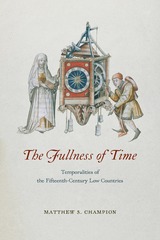
front cover of The Fullness of Time
The Fullness of Time
Temporalities of the Fifteenth-Century Low Countries
Matthew S. Champion
University of Chicago Press, 2017
The Low Countries were at the heart of innovation in Europe in the fifteenth century. Throughout this period, the flourishing cultures of the Low Countries were also wrestling with time itself. The Fullness of Time explores that struggle, and the changing conceptions of temporality that it represented and embodied showing how they continue to influence historical narratives about the emergence of modernity today.
 
The Fullness of Time asks how the passage of time in the Low Countries was ordered by the rhythms of human action, from the musical life of a cathedral to the measurement of time by clocks and calendars, the work habits of a guildsman to the devotional practices of the laity and religious orders. Through a series of transdisciplinary case studies, it explores the multiple ways that objects, texts and music might themselves be said to engage with, imply, and unsettle time, shaping and forming the lives of the inhabitants of the fifteenth-century Low Countries. Champion reframes the ways historians have traditionally told the history of time, allowing us for the first time to understand the rich and varied interplay of temporalities in the period.
 
[more]

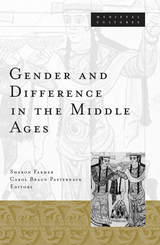
front cover of Gender and Difference in the Middle Ages
Gender and Difference in the Middle Ages
Sharon Farmer
University of Minnesota Press, 2002

Exposes complex intersections between genders and other identities in medieval cultures.

Nothing less than a rethinking of what we mean when we talk about "men" and "women" of the medieval period, this volume demonstrates how the idea of gender-in the Middle Ages no less than now-intersected in subtle and complex ways with other categories of difference. Responding to the insights of postcolonial and feminist theory, the authors show that medieval identities emerged through shifting paradigms-that fluidity, conflict, and contingency characterized not only gender, but also sexuality, social status, and religion. This view emerges through essays that delve into a wide variety of cultures and draw on a broad range of disciplinary and theoretical approaches. Scholars in the fields of history as well as literary and religious studies consider gendered hierarchies in western Christian, Jewish, Byzantine, and Islamic areas of the medieval world.

Contributors: Daniel Boyarin, U of California, Berkeley; Ruth Mazo Karras, U of Minnesota; Mathew Kuefler, San Diego State U; Martha Newman, U of Texas; Kathryn M. Ringrose, U of California, San Diego; Elizabeth Robertson, U of Colorado; Everett Rowson, U of Pennsylvania; Michael Uebel, U of Kentucky; Ulrike Wiethaus, Wake Forest U.
[more]

front cover of Getting Medieval
Getting Medieval
Sexualities and Communities, Pre- and Postmodern
Carolyn Dinshaw
Duke University Press, 1999
In Getting Medieval Carolyn Dinshaw examines communities—dissident and orthodox—in late-fourteenth and early-fifteenth-century England to create a new sense of queer history. Reaching beyond both medieval and queer studies, Dinshaw demonstrates in this challenging work how intellectual inquiry into pre-modern societies can contribute invaluably to current issues in cultural studies. In the process, she makes important connections between past and present cultures that until now have not been realized.
In her pursuit of historical analyses that embrace the heterogeneity and indeterminacy of sex and sexuality, Dinshaw examines canonical Middle English texts such as the Canterbury Tales and The Book of Margery Kempe. She examines polemics around the religious dissidents known as the Lollards as well as accounts of prostitutes in London to address questions of how particular sexual practices and identifications were normalized while others were proscribed. By exploring contemporary (mis)appropriations of medieval tropes in texts ranging from Quentin Tarantino’s Pulp Fiction to recent Congressional debates on U.S. cultural production, Dinshaw demonstrates how such modern media can serve to reinforce constrictive heteronormative values and deny the multifarious nature of history. Finally, she works with and against the theories of Michel Foucault, Homi K. Bhabha, Roland Barthes, and John Boswell to show how deconstructionist impulses as well as historical perspectives can further an understanding of community in both pre- and postmodern societies.
This long-anticipated volume will be indispensible to medieval and queer scholars and will be welcomed by a larger cultural studies audience.

[more]

logo for University of Chicago Press
Historical Anthropology of the Middle Ages
Aaron Gurevich
University of Chicago Press, 1992
Aaron Gurevich has long been considered one of the world's leading medievalists and a pioneer in the field of historical anthropology. This book brings together eleven of his most important essays—many difficult to find and some never before available in English.

Gurevich's writing, while informed by the history of mentalities as practiced by the French school of Le Goff and Duby, reflects a broader view of European culture outside France. He rejects reductionist concepts and operates with a total view of culture, using a wide range of sources—legal as well as ecclesiastical, popular as well as learned, oral and visual as well as literary.

This collection amply demonstrates this breadth of Gurevich's work and highlights his ability to synthesize historical, anthropological, and semiotic approaches to culture. Especially valuable are pieces such as Gurevich's essay Wealth and Gift-Bestowal Among the Ancient Scandinavians, about the importance of gift exchange in the medieval world. One of the first studies for this practice, this classic essay has for years been unavailable. Other pieces range from the deities and heroes of Germanic poetry to the image of the Beyond in the Middle Ages.

[more]

front cover of History of a Tragedy
History of a Tragedy
THE EXPULSION OF THE JEWS FROM SPAIN
Joseph Perez
University of Illinois Press, 2006

Few events in the history of Spain have provoked as much controversy as the expulsion of the Jews in 1492. Conflicts within the Catholic Church, suspicions within the newly unified Spain, and the claims of Spanish merchants combined to make the Spain of Ferdinand and Isabella intolerant and inquisitorial. Yet the roots of Spanish anti-Semitism went deeper.  In this concise survey of the expulsion of the Sephardic Jews, Joseph Pérez studies the evolution of the Jewish community in Spain from the time of the Visigoths to the reign of the Catholic kings. He explores the Jewish community’s role in creating and sustaining the vibrant cultural, political, and economic world of medieval Spain, and how growing religious intolerance, a pervasive resentment of the “others,” and a string of escalating encroachments culminated in expulsion.
[more]

front cover of Instrumentality
Instrumentality
On Technical Objects and Orientations in the Later Middle Ages
J. Allan Mitchell
University of Minnesota Press, 2024

From medieval to modern, exploring instrumental attitudes toward physical gadgets, diagrams, concepts, methods, and disciplines

Opening up the instrumental condition of the human for critical reflection and renewal, Instrumentality illuminates key moments in the intellectual history of the European Middle Ages. J. Allan Mitchell reveals how, in the predigital past, we can recognize many of the operative technics, analytics, and metaphorics that continue to shape human sense and cognition today.

Exploring the diverse modalities of medieval instruments, Mitchell’s case studies encompass techniques as seemingly distinct as time-keeping mechanisms, mathematical diagrams, logical syllogisms, and the literary devices of Geoffrey Chaucer and John Gower. A cultural and intellectual history, Mitchell’s work leads readers from three-dimensional objects (physical mechanisms) to two-dimensional inscriptions (maps and diagrams) and onward to overarching disciplinary norms in the early liberal and mechanical arts. Prying loose the subtle, adaptable, and generative concept of technical objects from limiting contemporary frameworks, he shows how these instruments are indispensable to the past—and the future—of the arts and culture at large.

[more]

front cover of Isolated Islands in Medieval Nature, Culture and Mind
Isolated Islands in Medieval Nature, Culture and Mind
Gerhard Jaritz
Central European University Press, 2011

The volume contains selected papers from an international workshop in 2005, at the Hungarian Academy in Rome. They aim at investigating the registers of fifteenth-century supplications to the Apostolic Penitentiary of the Holy See and to analyze the multiplicity of issues in which a context of the local needs of Western Christians and the central power of the Pope had been occurring.

The contributions make clear that local and individual factors and practice of Christian faith and religion must not be seen as separated from the global power of the Roman curia. The latter’s influence could become directly important for any individual in any local space, also … et usque ad ultimum terrae (Acts 1:8), in the utmost peripheries of the Christian world. The assistance by the Apostolic Penitentiary was indispensable in a large variety of cases. The occupation with such cases happened in the local and regional space as well as in the globalized centre of the Holy See.

[more]

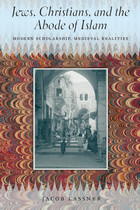
front cover of Jews, Christians, and the Abode of Islam
Jews, Christians, and the Abode of Islam
Modern Scholarship, Medieval Realities
Jacob Lassner
University of Chicago Press, 2012
In Jews, Christians, and the Abode of Islam, Jacob Lassner examines the triangular relationship that during the Middle Ages defined—and continues to define today—the political and cultural interaction among the three Abrahamic faiths. Lassner looks closely at the debates occasioned by modern Western scholarship on Islam to throw new light on the social and political status of medieval Jews and Christians in various Islamic lands from the seventh to the thirteenth century. Utilizing a vast array of primary sources, Lassner balances the rhetoric of literary and legal texts from the Middle Ages with other, newly discovered medieval sources that describe life as it was actually lived among the three faith communities. Lassner shows just what medieval Muslims meant when they spoke of tolerance, and how that abstract concept played out at different times and places in the real world of Christian and Jewish communities under Islamic rule. Finally, he considers what a more informed picture of the relationship among the Abrahamic faiths in the medieval Islamic world might mean for modern scholarship on medieval Islamic civilization and, not the least, for the highly contentious global environment of today.
[more]

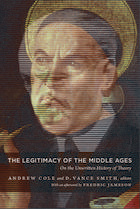
front cover of The Legitimacy of the Middle Ages
The Legitimacy of the Middle Ages
On the Unwritten History of Theory
Andrew Cole and D. Vance Smith, eds.
Duke University Press, 2010
This collection of essays argues that any valid theory of the modern should—indeed must—reckon with the medieval. Offering a much-needed correction to theorists such as Hans Blumenberg, who in his Legitimacy of the Modern Age describes the "modern age" as a complete departure from the Middle Ages, these essays forcefully show that thinkers from Adorno to Žižek have repeatedly drawn from medieval sources to theorize modernity. To forget the medieval, or to discount its continued effect on contemporary thought, is to neglect the responsibilities of periodization.

In The Legitimacy of the Middle Ages, modernists and medievalists, as well as scholars specializing in eighteenth-, nineteenth-, and twentieth-century comparative literature, offer a new history of theory and philosophy through essays on secularization and periodization, Marx’s (medieval) theory of commodity fetishism, Heidegger’s scholasticism, and Adorno’s nominalist aesthetics. One essay illustrates the workings of medieval mysticism in the writing of Freud’s most famous patient, Daniel Paul Schreber, author of Memoirs of My Nervous Illness (1903). Another looks at Michael Hardt and Antonio Negri’s Empire, a theoretical synthesis whose conscientious medievalism was the subject of much polemic in the post-9/11 era, a time in which premodernity itself was perceived as a threat to western values. The collection concludes with an afterword by Fredric Jameson, a theorist of postmodernism who has engaged with the medieval throughout his career.

Contributors: Charles D. Blanton, Andrew Cole, Kathleen Davis, Michael Hardt, Bruce Holsinger, Fredric Jameson, Ethan Knapp, Erin Labbie, Jed Rasula, D. Vance Smith, Michael Uebel
[more]

front cover of The Lettered Knight
The Lettered Knight
Knowledge and aristocratic behaviour in the twelfth and thirteenth centuries
Martin Aurell
Central European University Press, 2017
The encounter between knight and science could seem a paradox. It is nonetheless related with the intellectual Renaissance of Twelfth-Century, an essential movement for Western history. The knight is not only fighting in battles, but also moving in sophisticated courts. He is interested on Latin classics and reading, and even on his own poetry. He supports "jongleurs" and minstrels and he likes to have literary conversations with clerics, who try to reform his behaviour, which is often brutal. These lettered warriors, while improving they culture, learn how to repress their own violence and they are initiated to courtesy: selected language, measured gestures, elegance in dress, and manners at table. Their association with women, who are often learned, becomes more gallant. A mental revolution is acting among lay elites, who, in contact with clergy, use their weapons for common welfare. This new conduct is a sign of modernity.
[more]

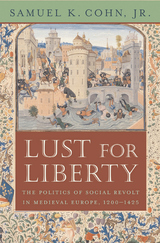
front cover of Lust for Liberty
Lust for Liberty
The Politics of Social Revolt in Medieval Europe, 1200–1425
Samuel K. Cohn Jr.
Harvard University Press, 2008

Lust for Liberty challenges long-standing views of popular medieval revolts. Comparing rebellions in northern and southern Europe over two centuries, Samuel Cohn analyzes their causes and forms, their leadership, the role of women, and the suppression or success of these revolts.

Popular revolts were remarkably common--not the last resort of desperate people. Leaders were largely workers, artisans, and peasants. Over 90 percent of the uprisings pitted ordinary people against the state and were fought over political rights--regarding citizenship, governmental offices, the barriers of ancient hierarchies--rather than rents, food prices, or working conditions. After the Black Death, the connection of the word "liberty" with revolts increased fivefold, and its meaning became more closely tied with notions of equality instead of privilege.

The book offers a new interpretation of the Black Death and the increase of and change in popular revolt from the mid-1350s to the early fifteenth century. Instead of structural explanations based on economic, demographic, and political models, this book turns to the actors themselves--peasants, artisans, and bourgeois--finding that the plagues wrought a new urgency for social and political change and a new self- and class-confidence in the efficacy of collective action.
[more]

front cover of Medieval Callings
Medieval Callings
Edited by Jacques Le Goff
University of Chicago Press, 1990
These essays by eleven internationally renowned historians present nuanced profiles of the major social and professional groups—the callings-of the Middle Ages.

The contributors focus on attitudes of medieval men and women toward their own society. Through a variety of techniques, from a reading of the Song of Roland to a reading of administrative records, they identify characteristic viewpoints of members of the fighting class, the clergy, and the peasantry. Along with vivid descriptions of what life was like for warrior knights, monks, high churchmen, criminals, lepers, shepherds, and prostitutes, this innovative approach offers a valuable new perspective on the complex social dynamics of feudal Europe.

"Very useful discussions of texts, both learned and literary."—Christopher Dyer, Times Literary Supplement

Contributors: Mariateresa Fumagalli Beonio Brocchieri, Franco Cardini, Enrico Castelnuovo, Giovanni Cherubini, Bronislaw Geremek, Aron Ja. Gurevich, Christiane Klapisch-Zuber, Jacques Le Goff, Giovanni Miccoli, Jacques Rossiaud, and André Vauchez.
[more]

front cover of Medieval Cityscapes Today
Medieval Cityscapes Today
Catherine A. M. Clarke
Arc Humanities Press, 2019
This book explores medieval cityscapes within the modern urban environment, using place as a catalyst to forge connections between past and present, and investigating timely questions concerning theoretical approaches to medieval urban heritage, as well as the presentation and interpretation of that heritage for public audiences. Written by a specialist in literary and cultural history with substantial experience of multi-disciplinary research into medieval towns, Medieval Cityscapes Today teases out stories and strata of meaning from the urban landscape, bringing techniques of close reading to the material fabric of the city, as well as textual artefacts associated with it. Deriving from the author’s own experience in urban regeneration and heritage interpretation projects, case studies – such as the development of a public art installation at a medieval ruin site and the development of a pavement marker trail – provide ways into exploring broader questions about relationships between the medieval and modern city.
[more]

front cover of Medieval Essays (The Works of Christopher Dawson)
Medieval Essays (The Works of Christopher Dawson)
Christopher Dawson
Catholic University of America Press, 2002
Medieval Essays is the mature reflection of one of the most gifted cultural historians of the twentieth century.
[more]

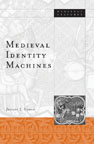
front cover of Medieval Identity Machines
Medieval Identity Machines
Jeffrey J. Cohen
University of Minnesota Press, 2003

A provocative new approach to medieval culture

In Medieval Identity Machines, Jeffrey J. Cohen examines the messiness, permeability, and perversity of medieval bodies, arguing that human identity always exceeds the limits of the flesh. Combining critical theory with a rigorous reading of medieval texts, Cohen asks if the category “human” isn’t too small to contain the multiplicity of identities. As such, this book is the first to argue for a “posthuman” Middle Ages and to make extensive use of the philosophical writings of Gilles Deleuze to rethink the medieval.

Among the topics that Cohen covers are the passionate bond between men and horses in chivalric training; the interrelation of demons, celibacy, and colonialism in an Anglo-Saxon saint’s life; Lancelot’s masochism as envisioned by Chrétien de Troyes; the voice of thunder echoing from Margery Kempe; and the fantasies that sustained some dominant conceptions of race. This tour of identity—in all its fragility and diffusion—illustrates the centrality of the Middle Ages to theory as it enhances our understanding of self, embodiment, and temporality in the medieval world.
[more]

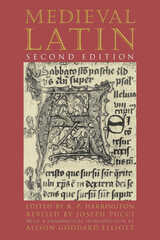
front cover of Medieval Latin
Medieval Latin
Second Edition
Edited by K. P. Harrington
University of Chicago Press, 1997
K. P. Harrington's Mediaeval Latin, the standard medieval Latin anthology used in the United States since its initial publication in 1925, has now been completely revised and updated for today's students and teachers by Joseph Pucci. This new edition of the classic anthology retains its breadth of coverage, but increases its depth by adding fourteen new selections, doubling the coverage of women writers, and expanding a quarter of the original selections. The new edition also includes a substantive grammatical introduction by Alison Goddard Elliott.

To help place the selections within their wider historical, social, and political contexts, Pucci has written extensive introductory essays for each of the new edition's five parts. Headnotes to individual selections have been recast as interpretive essays, and the original bibliographic paragraphs have been expanded. Reprinted from the best modern editions, the selections have been extensively glossed with grammatical notes geared toward students of classical Latin who may be reading medieval Latin for the first time.

Includes thirty-two full-page plates (with accompanying captions) depicting medieval manuscript and book production.
[more]

front cover of Medieval Masculinities
Medieval Masculinities
Regarding Men in the Middle Ages
Clare A. Lees
University of Minnesota Press, 1994

"Ranging from questions of epic violence and heroic embodiments of manhood to constructions of bachelorhood, husbandry, and sainthood, Medieval Masculinities is the first synthesis of medieval and gender studies to focus on masculinities."

Harry Brod, editor of The Making of Masculinities"We should not be working [exclusively] on the subjected sex any more than a historian of class can focus exclusively on peasants."-Natalie Zemon Davis, 1975 In the years since Natalie Davis made this remark, men's studies, and gender studies along with it, has earned its place in scholarship. What is often missing from such studies, however, is the insight that the concept of gender in general, and that of masculinity in particular, can be understood only in relation to individual societies, examined at specific historical and cultural moments. A brilliant application of this insight, Medieval Masculinities is the first full-length collection to explore the issues of men's studies and contemporary theories of gender within the context of the Middle Ages. Interdisciplinary and multicultural, the essays range from matrimony in medieval Italy to bachelorhood in Renaissance Venice, from friars and saints to the male animal in the fables of Marie de France, from manhood in Sir Gawain and the Green Knight, Beowulf, and the Roman d'Eneas to men as "other," whether Muslim or Jew, in medieval Castilian epic and ballad. The authors are especially concerned with cultural manifestations of masculinity that transcend this particular historical period-idealized gender roles, political and economic factors in structuring social institutions, and the impact of masculinist ideology in fostering and maintaining power. Together, their essays constitute an important reassessment of traditional assumptions within medieval studies as well as a major contribution to the evolving study of gender.ContributorsChristopher Baswell, Barnard CollegeVern L. Bullough, SUNY, BuffaloStanley Chojnacki, Michigan State UniversityJohn Coakley, New Brunswick Theological SeminaryThelma Fenster, Fordham UniversityClare Kinney, University of VirginiaClare A. Lees, University of PennsylvaniaJo Ann McNamara, Hunter CollegeLouise Mirrer, Fordham UniversityHarriet Spiegel, California State University, ChicoSusan Mosher Stuard, Haverford College
[more]

front cover of The Medieval Persian Gulf
The Medieval Persian Gulf
Brian Ulrich
Arc Humanities Press, 2023

The Persian Gulf today is home to multiple cosmopolitan urban hubs of globalization. This did not start with the discovery of oil. This book tells of the Gulf from the rise of Islam until the coming of the Portuguese, when port cities such as Siraf, Sohar, and Hormuz were entrepots for trading pearls, horses, spices, and other products across much of Asia and eastern Africa. Indeed, products traded there became a key part of the material culture of medieval Islamic civilization, and the Gulf region itself was a crucial membrane between the Middle East and the world of the broader Indian Ocean. The book also highlights the long-term presence of communities of South Asian and African ancestry, as well as patterns of religious change among Jews, Christians, Zoroastrians, and Muslims that belie the image of a region long polarized between Arabs and Persians and Sunnis and Shi’ites.

[more]

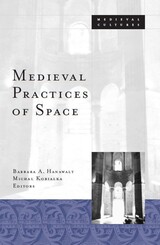
front cover of Medieval Practices Of Space
Medieval Practices Of Space
Barbara A. Hanawalt
University of Minnesota Press, 2000

Interprets space and place in the medieval era.

Interprets space and place in the medieval era.

A glance at medieval maps tells us that cartographers of the Middle Ages divided space differently than we do today. In the great mappae mundi, for instance, Jerusalem takes center stage, with an image of the crucified Christ separating one place from another. The architects of medieval cathedrals manipulated space to clarify the roles and status of all who entered. Even in the most everyday context, space was allotted according to gender and class and was freighted with infinitely subtle meanings. The contributors to this volume cross disciplinary and theoretical boundaries to read the words, metaphors, images, signs, poetic illusions, and identities with which medieval men and women used space and place to add meaning to the world.Contributors: Kathleen Biddick, U of Notre Dame; Charles Burroughs, SUNY, Binghamton; Michael Camille, U of Chicago; Tom Conley, Harvard U; Donnalee Dox, U of Arizona; Jody Enders, U of California, Santa Barbara; Valerie K. J. Flint, U of Hull, UK; Andrzej Piotrowski, U of Minnesota; Daniel Lord Smail, Fordham U.Barbara A. Hanawalt is King George III Professor of British History at Ohio State University. Michal Kobialka is associate professor of theatre at University of Minnesota.
[more]

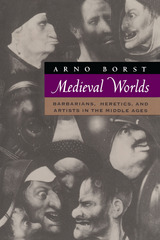
front cover of Medieval Worlds
Medieval Worlds
Barbarians, Heretics and Artists in the Middle Ages
Arno Borst
University of Chicago Press, 1992
In Medieval Worlds: Barbarians, Heretics, and Artists, medieval historian Arno Borst offers at once an imaginatively narrated tour of medieval society. Issues of language, power, and cultural change come to life as he examines how knights, witches and heretics, monks and kings, women poets, and disputatious university professors existed in the medieval world.

Clearly interested in the forms of medieval behavior which gave rise to the seeds of modern society, Borst focuses on three in particular that gave momentum to medieval religious, social, and intellectual movements: the barbaric, heretical, and artistic. Borst concludes by reflecting on his own life as a scholar and draws out lessons for us from the turbulence of the Middle Ages.
[more]

front cover of Medievalism
Medievalism
A Manifesto
Richard Utz
Arc Humanities Press, 2017
Since the inclusion of medieval studies in the modern academy, professional scholars have insisted on distinguishing their work from extra-academic lovers of medieval culture. Richard Utz analyzes the semantic, institutional, and sociopolitical history of the relationship between medieval studies and medievalism. He provides a survey of how scholars’ exteriorization of amateur interest in the medieval past narrowed the epistemological range of medieval scholarship and how reception studies, feminism, and postmodernism gradually expanded modern pastist approaches to the Middle Ages. Utz advances specific examples for reconnecting investigating scholarly subjects with their subjects of investigation, and he challenges scholars to make a conscious effort to engage in public scholarship and explore inclusive gestures toward the contributions non-academic lovers of the Middle Ages can offer. His manifesto advocates an active integration of academic medievalists’ work within the many other equally valuable artistic and sociopolitical partner contexts of reading the medieval past.
[more]

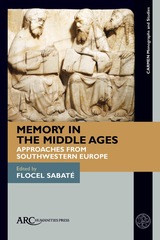
front cover of Memory in the Middle Ages
Memory in the Middle Ages
Approaches from Southwestern Europe
Flocel Sabaté
Arc Humanities Press, 2020
Memory was vital to the functioning of the medieval world. People in medieval societies shared an identity based on commonly held memories. Religions, rulers, and even cities and nations justified their existence and their status through stories that guaranteed their deep and unbroken historical roots.
The studies in this interdisciplinary collection explore how manifestations of memory can be used by historians as a prism through which to illuminate European medieval thought and value systems. The contributors draw the link between memory and medieval science, management of power, and remembrance of the dead ancestors through examples from southern Europe as a means of enriching and complicating our study of the Middle Ages; this is a region with a large amount of documentation but which to date has not been widely studied.
[more]

front cover of The Middle Ages
The Middle Ages
Johannes Fried
Harvard University Press, 2015

Since the fifteenth century, when humanist writers began to speak of a “middle” period in history linking their time to the ancient world, the nature of the Middle Ages has been widely debated. Across the millennium from 500 to 1500, distinguished historian Johannes Fried describes a dynamic confluence of political, social, religious, economic, and scientific developments that draws a guiding thread through the era: the growth of a culture of reason.

“Fried’s breadth of knowledge is formidable and his passion for the period admirable…Those with a true passion for the Middle Ages will be thrilled by this ambitious defensio.”
—Dan Jones, Sunday Times

“Reads like a counterblast to the hot air of the liberal-humanist interpreters of European history…[Fried] does justice both to the centrifugal fragmentation of the European region into monarchies, cities, republics, heresies, trade and craft associations, vernacular literatures, and to the persistence of unifying and homogenizing forces: the papacy, the Western Empire, the schools, the friars, the civil lawyers, the bankers, the Crusades…Comprehensive coverage of the whole medieval continent in flux.”
—Eric Christiansen, New York Review of Books

“[An] absorbing book…Fried covers much in the realm of ideas on monarchy, jurisprudence, arts, chivalry and courtly love, millenarianism and papal power, all of it a rewarding read.”
—Sean McGlynn, The Spectator
[more]

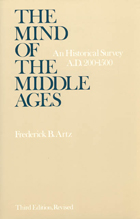
front cover of The Mind of the Middle Ages
The Mind of the Middle Ages
An Historical Survey
Frederick B. Artz
University of Chicago Press, 1980
"This is the third edition of a near standard survey of the intellectual life of the age of faith. Artz on the arts, as on philosophy, politics and other aspects of culture, makes lively and informative reading."—The Washington Post
[more]

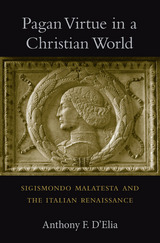
front cover of Pagan Virtue in a Christian World
Pagan Virtue in a Christian World
Sigismondo Malatesta and the Italian Renaissance
Anthony F. D'Elia
Harvard University Press, 2016

In 1462 Pope Pius II performed the only reverse canonization in history, publicly damning a living man. The target was Sigismondo Malatesta, Lord of Rimini and a patron of the arts with ties to the Florentine Renaissance. Condemned to an afterlife of torment, he was burned in effigy in several places in Rome. What had this cultivated nobleman done to merit such a fate?

Pagan Virtue in a Christian World examines anew the contributions and contradictions of the Italian Renaissance, and in particular how the recovery of Greek and Roman literature and art led to a revival of pagan culture and morality in fifteenth-century Italy. The court of Sigismondo Malatesta (1417–1468), Anthony D’Elia shows, provides a case study in the Renaissance clash of pagan and Christian values, for Sigismondo was nothing if not flagrant in his embrace of the classical past. Poets likened him to Odysseus, hailed him as a new Jupiter, and proclaimed his immortal destiny. Sigismondo incorporated into a Christian church an unprecedented number of zodiac symbols and images of the Olympian gods and goddesses and had the body of the Greek pagan theologian Plethon buried there.

In the literature and art that Sigismondo commissioned, pagan virtues conflicted directly with Christian doctrine. Ambition was celebrated over humility, sexual pleasure over chastity, muscular athleticism over saintly asceticism, and astrological fortune over providence. In the pagan themes so prominent in Sigismondo’s court, D’Elia reveals new fault lines in the domains of culture, life, and religion in Renaissance Italy.

[more]

logo for University of Wisconsin Press
Popular Culture in the Middle Ages
Smith
University of Wisconsin Press, 1986

The culture of the Middle Ages was as complex, if not as various, as our own, as the essays in this volume ably demonstrate. The essays cover a wide range of tipics, from church sculpture as "advertisement" to tricks and illusions as "homeeconomics."
[more]

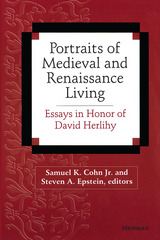
front cover of Portraits of Medieval and Renaissance Living
Portraits of Medieval and Renaissance Living
Essays in Memory of David Herlihy
Samuel K. Cohn, Jr. and Steven A. Epstein, Editors
University of Michigan Press, 1996
This volume--a collection of essays dedicated to one of this century's most distinguished medieval historians, David Herlihy--introduces the general reader to the new social history of the Middle Ages and the Renaissance. The essays address three themes: sex and the family, power and patronage in local history, and society in town and countryside. The authors use current research to illustrate how Herlihy's ideas continue to shape work about the lives of powerful and ordinary people in this long and important period of Western history.
Portraits of Medieval and Renaissance Living opens with Herlihy's final summary of his views on family history, followed by a reminiscence by his most important collaborator, Christiane Klapisch-Zuber. The first group of essays takes us inside specific familial settings, using recent methods in anthropological, legal, and women's studies to uncover new dimensions of medieval and Renaissance family life. A second group of studies focuses on the question of authority in medieval society and advances new theses about politics and society in Florence and other local settings. The final group of authors considers the special circumstances of town and countryside in Italy, England, and Spain and draws insightful generalizations across territorial and national boundaries.
Like Herlihy's own work, these essays present innovative and challenging hypotheses about significant problems in the history of medieval and Renaissance Europe. Important new material on Florence, family history, religion, the Inquisition, and taxation is presented for the first time, but the essays are not simply technical exercises focused on small or isolated pieces of research. Thus the volume will go beyond the interest of specialists in medieval and Renaissance social history and will attract a wide audience of students and scholars.
Samuel K. Cohn, Jr., is Professor of History, Brandeis University. Steven Epstein is Professor of History, University of Colorado.

[more]

logo for Brandeis University Press
The Quest for Eternity
Manners and Morals in the Age of Chivalry. [Orig. pub. as The Age of Chivalry.]
Charles T. Wood
Brandeis University Press, 1983
(First published as THE AGE OF CHIVALRY) A lively and insightful interpretation of the Middle Ages.
[more]

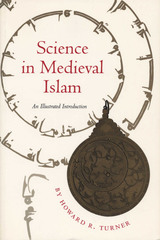
front cover of Science in Medieval Islam
Science in Medieval Islam
An Illustrated Introduction
By Howard R. Turner
University of Texas Press, 1997

During the Golden Age of Islam (seventh through seventeenth centuries A.D.), Muslim philosophers and poets, artists and scientists, princes and laborers created a unique culture that has influenced societies on every continent. This book offers a fully illustrated, highly accessible introduction to an important aspect of that culture—the scientific achievements of medieval Islam.

Howard Turner opens with a historical overview of the spread of Islamic civilization from the Arabian peninsula eastward to India and westward across northern Africa into Spain. He describes how a passion for knowledge led the Muslims during their centuries of empire-building to assimilate and expand the scientific knowledge of older cultures, including those of Greece, India, and China. He explores medieval Islamic accomplishments in cosmology, mathematics, astronomy, astrology, geography, medicine, natural sciences, alchemy, and optics. He also indicates the ways in which Muslim scientific achievement influenced the advance of science in the Western world from the Renaissance to the modern era. This survey of historic Muslim scientific achievements offers students and general readers a window into one of the world's great cultures, one which is experiencing a remarkable resurgence as a religious, political, and social force in our own time.
[more]

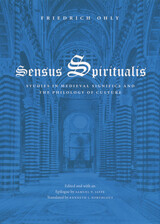
front cover of Sensus Spiritualis
Sensus Spiritualis
Studies in Medieval Significs and the Philology of Culture
Friedrich Ohly
University of Chicago Press, 2005
Of the major figures in medieval studies, there are few whose influence is greater and for whom admiration is more widespread than Friedrich Ohly (1914-96). This book represents the long-awaited English-language edition of Ohly's most important writings.

Drawn from the entire career of this great medievalist, who, more clearly and in greater detail than anyone before him, articulated the singularly allegorical mentality of the Middle Ages, the essays in this collection show the tendency of medieval thinkers and writers to see nature as a diaphanous screen held against God's sacred mysteries, simultaneously illuminating and obscuring. Ohly's work on the hermeneutics of word and image, meanwhile, traces the way his thinking opened philology to new possibilities through the dual interpretation of textual and visual media.

Including penetrating essays on poetic inspiration, the nature of beauty, sacred and profane exegesis, history as typology, and art as both object and text, this volume will be of enormous value to scholars of comparative literature, the history of art, and religion during the Middle Ages and Renaissance.
[more]

front cover of The Shock of Medievalism
The Shock of Medievalism
Kathleen Biddick
Duke University Press, 1998
In The Shock of Medievalism Kathleen Biddick explores the nineteenth-century foundations of medieval studies as an academic discipline as well as certain unexamined contemporary consequences of these origins. By pairing debates over current academic trends and issues with innovative readings of medieval texts, Biddick exposes the presuppositions of the field of medieval studies and significantly shifts the objects of its historical inquiry.
Biddick describes how the discipline of medieval studies was defined by a process of isolation and exclusion—a process that not only ignored significant political and cultural issues of the nineteenth century but also removed the period from the forces of history itself. Wanting to separate themselves from popular studies of medieval culture, and valuing their own studies as scientific, nineteenth-century academics created an exclusive discipline whose structure is consistently practiced today, despite the denials of most contemporary medieval scholars. Biddick supports her argument by discussing the unavowed melancholy that medieval Christians felt for Jews and by revealing the unintentional irony of nineteenth-century medievalists’ fabrication of sentimental objects of longing (such as the “gothic peasant”). The subsequent historical distortions of this century-old sentimentality, the relevance of worker dislocation during the industrial revolution, and other topics lead to a conclusion in which Biddick considers the impact of an array of factors on current medieval studies.
Simultaneously displacing disciplinary stereotypes and altering an angle of historical inquiry, The Shock of Medievalism challenges accepted thinking even as it produces a new direction for medieval studies. This book will provoke scholars in this field and appeal to readers who are interested in how historicizing processes can affect the development of academic disciplines.

[more]

front cover of Time, Work, and Culture in the Middle Ages
Time, Work, and Culture in the Middle Ages
Jacques Le Goff
University of Chicago Press, 1980
Jacques Le Goff is a prominent figure in the tradition of French medieval scholarship, profoundly influenced by the Annales school, notably, Bloch, Febvre, and Braudel, and by the ethnographers and anthropologists Mauss, Dumézil, and Lévi-Strauss. In building his argument for "another Middle Ages" (un autre moyen âge), Le Goff documents the emergence of the collective mentalité from many sources with scholarship both imaginative and exact.


[more]

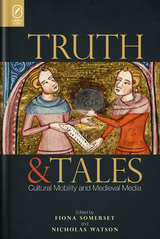
front cover of Truth and Tales
Truth and Tales
Cultural Mobility and Medieval Media
Edited by Fiona Somerset and Nicholas Watson
The Ohio State University Press, 2015
In the medieval period, as in the media culture of the present, learned and popular forms of talk were intermingled everywhere. They were also highly mobile, circulating in speech, writing, and symbol, as performances as well as in material objects. The communication through and between different media we all negotiate in daily life did not develop from a previous separation of orality and writing, but from a communications network not unlike our own, if slower, and similarly shaped by disparities of access. Truth and Tales: Cultural Mobility and Medieval Media, edited by Fiona Somerset and Nicholas Watson, develops a variety of approaches to the labor of imaginatively reconstructing this network from its extant artifacts.
 
Truth and Tales includes fourteen essays by medieval literary scholars and historians. Some essays focus on written artifacts that convey high or popular learning in unexpected ways. Others address a social problem of concern to all, demonstrating the genres and media through which it was negotiated. Still others are centered on one or more texts, detailing their investments in popular as well as learned knowledge, in performance as well as writing. This collective archaeology of medieval media provides fresh insight for medieval scholars and media theorists alike.
[more]

front cover of Turning over a New Leaf
Turning over a New Leaf
Change and Development in the Medieval Book
Erik Kwakkel
Amsterdam University Press, 2012
Books before print – manuscripts – were modified continuously throughout the medieval period. Focusing on the ninth and twelfth centuries, this volume explores such material changes as well as the varying circumstances under which handwritten books were produced, used and collected. An important theme is the relationship between the physical book and its users. Can we reflect on reading practices through an examination of the layout of a text? To what extent can we use the contents of libraries to understand the culture of the book? The volume explores such issues by focusing on a broad palette of texts and through a detailed analysis of manuscripts from all corners of Europe.
[more]

front cover of Viewing the Morea
Viewing the Morea
Land and People in the Late Medieval Peloponnese
Sharon E. J. Gerstel
Harvard University Press
The fourteen essays in Viewing the Morea focus on the late medieval Morea (Peloponnese), beginning with the bold attempt of Western knights to establish a kingdom on foreign soil. Reinserted into this tale of Crusader foundation are the large numbers of Orthodox villagers who shared the region and created their own narrative of an eternal and sacred empire generated by the pains of loss and the hopes of refoundation. Layered upon the historical and physical topography of the region are the traces of the Venetians, whose “right eye,” Modon, was located at the peninsula’s southwestern tip. How these groups interacted and how they asserted identity is at the center of inquiry in these essays. Also at the core of this study is the understanding of place and memory—the recollection of the ancient history of the Peloponnese, the architectural and cartographic marking of its mountains and valleys, the re-creation of distant capitals on its land, and the refashioning of the Morea for a Renaissance audience. The authors look at the Morea and its people in the broadest possible manner and with careful attention to written and material evidence, historiography, economic networks, and the making—or retelling—of myths.
[more]

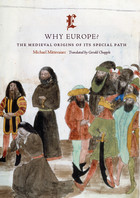
front cover of Why Europe?
Why Europe?
The Medieval Origins of Its Special Path
Michael Mitterauer
University of Chicago Press, 2010

Why did capitalism and colonialism arise in Europe and not elsewhere? Why were parliamentarian and democratic forms of government founded there? What factors led to Europe’s unique position in shaping the world? Thoroughly researched and persuasively argued, Why Europe? tackles these classic questions with illuminating results.

Michael Mitterauer traces the roots of Europe’s singularity to the medieval era, specifically to developments in agriculture. While most historians have located the beginning of Europe’s special path in the rise of state power in the modern era, Mitterauer establishes its origins in rye and oats. These new crops played a decisive role in remaking the European family, he contends, spurring the rise of individualism and softening the constraints of patriarchy. Mitterauer reaches these conclusions by comparing Europe with other cultures, especially China and the Islamic world, while surveying the most important characteristics of European society as they took shape from the decline of the Roman empire to the invention of the printing press. Along the way, Why Europe? offers up a dazzling series of novel hypotheses to explain the unique evolution of European culture.

[more]


Send via email Share on Facebook Share on Twitter