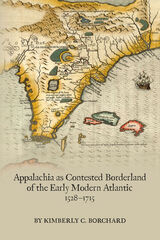
front cover of Appalachia as Contested Borderland of the Early Modern Atlantic, 1528-1715
Appalachia as Contested Borderland of the Early Modern Atlantic, 1528-1715
Kimberly C. Borchard
Arizona Center for Medieval and Renaissance Studies, 2021
While political activists have long decried the cultural and economic marginalization of Appalachia in the twentieth and twenty-first centuries, Appalachia has similarly been excluded from the study of colonial expansion, transatlantic conflict, and slavery in the early modern Atlantic world. Drawing on sources in Spanish, Portuguese, French, Latin, and English, this monograph underscores the chaotically international, polyglot nature of early Appalachian history and foregrounds the region as a locus of imperial conflict during the early modern period. It likewise explores the European obsession with Appalachian mineral resources from 1528 to 1715, reframing Appalachian history within the fields of Latin American, early American, and Atlantic history. Ultimately, Appalachia as Contested Borderland of the Early Modern Atlantic provides new perspectives for scholars and students and suggests new directions for research in Native American and Indigenous studies, environmental studies, and Appalachian studies.
[more]


front cover of A Contested Borderland
A Contested Borderland
Competing Russian and Romanian Visions of Bessarabia in the Second Half of the 19th and Early 20th Century
Andrei Cusco
Central European University Press, 2017
Bessarabia¿mostly occupied by modern-day republic of Moldova¿was the only territory representing an object of rivalry and symbolic competition between the Russian Empire and a fully crystallized nation-state: the Kingdom of Romania. This book is an intellectual prehistory of the Bessarabian problem, focusing on the antagonism of the national and imperial visions of this contested periphery. Through a critical reassessment and revision of the traditional historical narratives, the study argues that Bessarabia was claimed not just by two opposing projects of ‘symbolic inclusion,’ but also by two alternative and theoretically antagonistic models of political legitimacy. By transcending the national lens of Bessarabian / Moldovan history and viewing it in the broader Eurasian comparative context, the book responds to the growing tendency in recent historiography to focus on the peripheries in order to better understand the functioning of national and imperial states in the modern era.
[more]


Send via email Share on Facebook Share on Twitter