
 A SCHOLARLY BOOK REPOSITORY
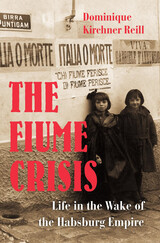
Recasting the birth of fascism, nationalism, and the fall of empire after World War I, Dominique Kirchner Reill recounts how the people of Fiume tried to recreate empire in the guise of the nation.
The Fiume Crisis recasts what we know about the birth of fascism, the rise of nationalism, and the fall of empire after World War I by telling the story of the three-year period when the Adriatic city of Fiume (today Rijeka, in Croatia) generated an international crisis.
In 1919 the multicultural former Habsburg city was occupied by the paramilitary forces of the flamboyant poet-soldier Gabriele D’Annunzio, who aimed to annex the territory to Italy and became an inspiration to Mussolini. Many local Italians supported the effort, nurturing a standard tale of nationalist fanaticism. However, Dominique Kirchner Reill shows that practical realities, not nationalist ideals, were in the driver’s seat. Support for annexation was largely a result of the daily frustrations of life in a “ghost state” set adrift by the fall of the empire. D’Annunzio’s ideology and proto-fascist charisma notwithstanding, what the people of Fiume wanted was prosperity, which they associated with the autonomy they had enjoyed under Habsburg sovereignty. In these twilight years between the world that was and the world that would be, many across the former empire sought to restore the familiar forms of governance that once supported them. To the extent that they turned to nation-states, it was not out of zeal for nationalist self-determination but in the hope that these states would restore the benefits of cosmopolitan empire.
Against the too-smooth narrative of postwar nationalism, The Fiume Crisis demonstrates the endurance of the imperial imagination and carves out an essential place for history from below.
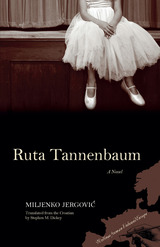
Using their shared Jewish heritage as a starting point, Jergovic constructs a fictional family history populated by historical figures with the precocious Ruta at the center. Stephen Dickey’s translation masterfully captures Jergovic´’s colloquial yet deeply observed style, which animates the tangled and troubled history of persecution and war in Croatia.
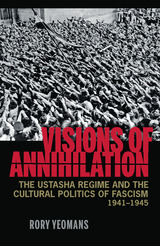
The fascist Ustasha regime and its militias carried out a ruthless campaign of ethnic cleansing that killed an estimated half million Serbs, Jews, and Gypsies, and ended only with the defeat of the Axis powers in World War II.
In Visions of Annihilation, Rory Yeomans analyzes the Ustasha movement’s use of culture to appeal to radical nationalist sentiments and legitimize its genocidal policies. He shows how the movement attempted to mobilize poets, novelists, filmmakers, visual artists, and intellectuals as purveyors of propaganda and visionaries of a utopian society. Meanwhile, newspapers, radio, and speeches called for the expulsion, persecution, or elimination of “alien” and “enemy” populations to purify the nation. He describes how the dual concepts of annihilation and national regeneration were disseminated to the wider population and how they were interpreted at the grassroots level.
Yeomans examines the Ustasha movement in the context of other fascist movements in Europe. He cites their similar appeals to idealistic youth, the economically disenfranchised, racial purists, social radicals, and Catholic clericalists. Yeomans further demonstrates how fascism created rituals and practices that mimicked traditional religious faiths and celebrated martyrdom.
Visions of Annihilation chronicles the foundations of the Ustasha movement, its key actors and ideologies, and reveals the unique cultural, historical, and political conditions present in interwar Croatia that led to the rise of fascism and contributed to the cataclysmic events that tore across the continent.
-Steve Rapp, Associate Professor of Caucasian, Byzantine, and Eurasian History, and Director, Program in World History and Cultures Department of History, Georgia State University Atlanta
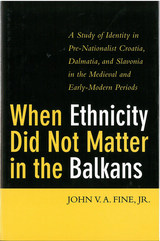
When Ethnicity Did Not Matter in the Balkans is a study of the people who lived in what is now Croatia during the Middle Ages (roughly 600-1500) and the early-modern period (1500-1800), and how they identified themselves and were identified by others. John V. A. Fine, Jr., advances the discussion of identity by asking such questions as: Did most, some, or any of the population of that territory see itself as Croatian? If some did not, to what other communities did they consider themselves to belong? Were the labels attached to a given person or population fixed or could they change? And were some people members of several different communities at a given moment? And if there were competing identities, which identities held sway in which particular regions?
In When Ethnicity Did Not Matter in the Balkans, Fine investigates the identity labels (and their meaning) employed by and about the medieval and early-modern population of the lands that make up present-day Croatia. Religion, local residence, and narrow family or broader clan all played important parts in past and present identities. Fine, however, concentrates chiefly on broader secular names that reflect attachment to a city, region, tribe or clan, a labeled people, or state.
The result is a magisterial analysis showing us the complexity of pre-national identity in Croatia, Dalmatia, and Slavonia. There can be no question that the medieval and early-modern periods were pre-national times, but Fine has taken a further step by demonstrating that the medieval and early-modern eras in this region were also pre-ethnic so far as local identities are concerned. The back-projection of twentieth-century forms of identity into the pre-modern past by patriotic and nationalist historians has been brought to light. Though this back-projection is not always misleading, it can be; Fine is fully cognizant of the danger and has risen to the occasion to combat it while frequently remarking in the text that his findings for the Balkans have parallels elsewhere.
John V. A. Fine, Jr. is Professor of History at the University of Michigan.
READERS
Browse our collection.
PUBLISHERS
See BiblioVault's publisher services.
STUDENT SERVICES
Files for college accessibility offices.
RECENTLY PUBLISHED





UChicago Accessibility Resources
home | accessibility | search | about | contact us
BiblioVault ® 2001 - 2024
The University of Chicago Press