
 A SCHOLARLY BOOK REPOSITORY
Harlem Renaissance writer Dorothy West led a charmed life in many respects. Born into a distinguished Boston family, she appeared in Gershwin’s Porgy and Bess, then lived in the Soviet Union with a group that included Langston Hughes, to whom she proposed marriage. She later became friends with Jacqueline Kennedy Onassis, who encouraged her to finish her second novel, The Wedding, which became the octogenarian author’s first bestseller.
Literary Sisters reveals a different side of West’s personal and professional lives—her struggles for recognition outside of the traditional literary establishment, and her collaborations with talented African American women writers, artists, and performers who faced these same problems. West and her “literary sisters”—women like Zora Neale Hurston and West’s cousin, poet Helene Johnson—created an emotional support network that also aided in promoting, publishing, and performing their respective works. Integrating rare photos, letters, and archival materials from West’s life, Literary Sisters is not only a groundbreaking biography of an increasingly important author but also a vivid portrait of a pivotal moment for African American women in the arts.
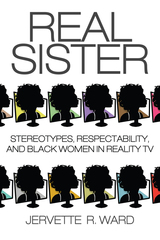
The first book of scholarship devoted to the issue of how black women are depicted on reality television, Real Sister offers an even-handed consideration of the genre. The book’s ten contributors—black female scholars from a variety of disciplines—provide a wide range of perspectives, while considering everything from Basketball Wives to Say Yes to the Dress. As regular viewers of reality television, these scholars are able to note ways in which the genre presents positive images of black womanhood, even as they catalog a litany of stereotypes about race, class, and gender that it tends to reinforce.
Rather than simply dismissing reality television as “trash,” this collection takes the genre seriously, as an important touchstone in ongoing cultural debates about what constitutes “trashiness” and “respectability.” Written in an accessible style that will appeal to reality TV fans both inside and outside of academia, Real Sister thus seeks to inspire a more nuanced, thoughtful conversation about the genre’s representations and their effects on the black community.
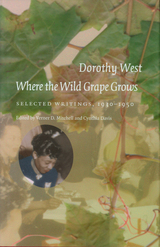
During these years, West and Johnson knew virtually everyone in New York's artistic, intellectual, and political circles. Their friends included Langston Hughes, Zora Neale Hurston, Carl Van Vechten, Richard Wright, Arna Bontemps, Claude McKay, and many others. West moved easily between the bohemian milieu of her artistic soul mates and the bourgeois, respectable soirees of prominent social and political figures.
In this book, Professors Mitchell and Davis provide a carefully researched profile of West and her circle that serves as an introduction to a well-edited, representative collection of her out-of-print, little-known, or unpublished writings, supplemented by many family photographs. The editors document West's "womanist" upbringing and her relationships with her mother, Rachel Benson West, and other strong-minded women, including her longtime companion Marian Minus.
The volume includes examples of West's probing social criticism in the form of WPA essays and stories, as well as her interviews with Southern migrants. A centerpiece of the book is her unpublished novella, Where the Wild Grape Grows, which explores with grace and gentle irony the complex relationship of three retired women living on Martha's Vineyard. Several of West's exquisitely observed nature pieces, published over a span of twenty years in the Vineyard Gazette, are also reprinted.

When Where the Wild Grape Grows was published in 2005 by the University of Massachusetts Press, it was the first book-length critical study of Dorothy West. Since then, the publication of more volumes on West and her circle testify to popular and academic interest in under-represented artists of the Harlem Renaissance, many of whom appeared first in West’s literary magazine, Challenge (1934-1937). Challenge included poems by West’s cousin Helene Johnson as well as by her friends Lucia Mae Pitts, Waring Cuney, Pauli Murray, Grace Walker, Mae Cowdery, Marcia Prendergast, and Bessie Calhoun Bird. West also published work by her romantic partner Marian Minus and by Juanita DeShields (the first Black Canadian graduate of McGill University) and the Trinidadian author Alfred Mendes. She included artwork by Mildred Jones and journalism by Eslanda Robeson and Dorothy Peterson. In addition to her editorial activities, West corresponded with important African American musicians including Maud Cuney Hare, Alberta Hunter, and Henry T. Burleigh, and with sculptors Augusta Savage and Richmond Barthé. Just as West mentored others, she was encouraged by such academic luminaries as Columbia Professors Blanche Colton Williams and Dorothy Scarborough, and by the controversial novelist Erskine Caldwell.
The new Introduction to Wild Grape will include fresh research on these individuals, many of whom formed part of West’s social and artistic circle. Lucia Pitts, for example, was a poet who served in the famous WAC (Women’s Army Corps) 6888th Battalion. The work of Marian Minus and Mae Cowdery has received critical attention recently and they also merit closer investigation. The Boston writer and musicologist Maud Cuney Hare was an artistic mentor to West; her cousin Waring Cuney was a close friend: both will receive more attention in the paperback edition. The artist Mildred Jones accompanied West and twenty other young African Americans to Russia in 1932 as participants in an ultimately aborted propaganda film on race relations in America; Jones studied with the important Russian Modernist painter Aleksandr Deyneka.
The original edition of Wild Grape cites two stories about West’s Russian experiences (penned under the pseudonym Mary Christopher in 1934), “Room in Red Square” and “Russian Correspondence,” but the volume does not include the actual stories. The stories are interesting because they shed light on West’s unrequited romance with Langston Hughes and her relationships with other members of the group, and they offer a unique perspective on daily life in the U.S.S.R. Both stories will be published in the new edition, along with a detailed discussion of new research about West’s visit to Russia.
A third uncollected story, “Cook” (1934), written by West under the pseudonym Jane Isaac will also be included. This story is extremely important to West’s oeuvre and her artistic development; it includes characters, themes, tropes, and plot lines that she expanded and developed in her two novels, The Living Is Easy (1948) and The Wedding (1995).
Since 2005, new material has been added to the West archive in Harvard’s Schlesinger Library. The section of Wild Grape devoted to West’s correspondence will include additional unpublished letters which underscore West’s dedication to African American art and culture.
The book includes the Benson-West family tree in Appendix II. Several scholars have expressed appreciation for this information which has not been published elsewhere; the chart will be updated to include the birth of several of West’s descendants.
READERS
Browse our collection.
PUBLISHERS
See BiblioVault's publisher services.
STUDENT SERVICES
Files for college accessibility offices.
RECENTLY PUBLISHED




UChicago Accessibility Resources
home | accessibility | search | about | contact us
BiblioVault ® 2001 - 2025
The University of Chicago Press