
 A SCHOLARLY BOOK REPOSITORY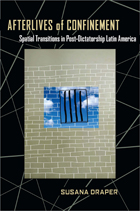
The afterlife of prisons became an important tool in the “forgetting” of past politics, while also serving as a reminder to citizens of the liberties they now enjoyed. In Draper’s analysis, these symbols led the populace to believe they had attained freedom, although they had only witnessed the veneer of democracy—in the ability to vote and consume.
In selected literary works by Roberto Bolaño, Eleuterio Fernández Huidoboro, and Diamela Eltit and films by Alejandro Agresti and Marco Bechis, Draper finds further evidence of the emptiness and melancholy of underachieved goals in the afterlife of dictatorships. The social changes that did not occur, the inability to effectively mourn the losses of a now-hidden past, the homogenizing effects of market economies, and a yearning for the promises of true freedom are thematic currents underlying much of these texts.
Draper’s study of the manipulation of culture and consumerism under the guise of democracy will have powerful implications not only for Latin Americanists but also for those studying neoliberal transformations globally.
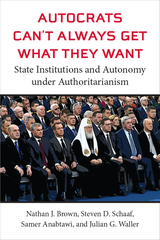
In Autocrats Can’t Always Get What They Want, the authors find that when state bodies form strong institutional patterns and forge links with key allies both inside the state and outside of it, they can define interests and missions that are different from those at the top of the regime. By focusing on three such structures (parliaments, constitutional courts, and official religious institutions), the book shows that the degree of autonomy realized by a particular part of the state rests on how thoroughly it is institutionalized and how strong its links are with constituencies. Instead of viewing authoritarian governance as something that reduces politics to rulers’ whims and opposition movements, the authors show how it operates—and how much what we call “authoritarianism” varies.
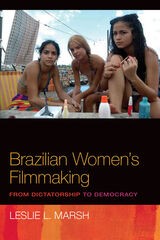
At most recent count, there are no fewer than forty-five women in Brazil directing or codirecting feature-length fiction or documentary films. In the early 1990s, women filmmakers in Brazil were credited for being at the forefront of the rebirth of filmmaking, or retomada, after the abolition of the state film agency and subsequent standstill of film production. Despite their numbers and success, films by Brazilian women directors are generally absent from discussions of Latin American film and published scholarly works.
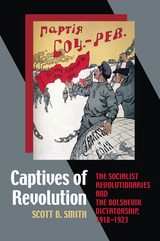
The Socialist Revolutionaries (SRs) were the largest political party in Russia in the crucial revolutionary year of 1917. Heirs to the legacy of the People’s Will movement, the SRs were unabashed proponents of peasant rebellion and revolutionary terror, emphasizing the socialist transformation of the countryside and a democratic system of government as their political goals. They offered a compelling, but still socialist, alternative to the Bolsheviks, yet by the early 1920s their party was shattered and its members were branded as enemies of the revolution. In 1922, the SR leaders became the first fellow socialists to be condemned by the Bolsheviks as “counter-revolutionaries” in the prototypical Soviet show trial.
In Captives of the Revolution, Scott B. Smith presents both a convincing account of the defeat of the SRs and a deeper analysis of the significance of the political dynamics of the Civil War for subsequent Soviet history. Once the SRs decided to openly fight the Bolsheviks in 1918, they faced a series of nearly impossible political dilemmas. At the same time, the Bolsheviks fatally undermined the revolutionary credentials of the SRs by successfully appropriating the rhetoric of class struggle, painting a simplistic picture of Reds versus Whites in the Civil War, a rhetorical dominance that they converted into victory over the SRs and any left-wing alternative to Bolshevik dictatorship. In this narrative, the SRs became a bona fide threat to national security and enemies of the people—a characterization that proved so successful that it became an archetype to be used repeatedly by the Soviet leadership against any political opponents, even those from within the Bolshevik party itself.
In this groundbreaking study, Smith reveals a more complex and nuanced picture of the postrevolutionary struggle for power in Russia than we have ever seen before and demonstrates that the Civil War—and in particular the struggle with the SRs—was the formative experience of the Bolshevik party and the Soviet state.
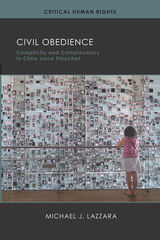
Michael J. Lazzara boldly argues that today's Chile is a product of both complicity and complacency. Combining historical analysis with deft literary, political, and cultural critique, he scrutinizes the post-Pinochet rationalizations made by politicians, artists, intellectuals, bystanders, former revolutionaries-turned-neoliberals, and common citizens. He looks beyond victims and perpetrators to unveil the ambiguous, ethically vexed realms of memory and experience that authoritarian regimes inevitably generate.
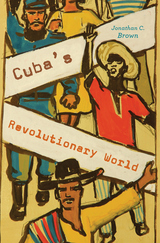
On January 2, 1959, Fidel Castro, the rebel comandante who had just overthrown Cuban dictator Fulgencio Batista, addressed a crowd of jubilant supporters. Recalling the failed popular uprisings of past decades, Castro assured them that this time “the real Revolution” had arrived. As Jonathan Brown shows in this capacious history of the Cuban Revolution, Castro’s words proved prophetic not only for his countrymen but for Latin America and the wider world.
Cuba’s Revolutionary World examines in forensic detail how the turmoil that rocked a small Caribbean nation in the 1950s became one of the twentieth century’s most transformative events. Initially, Castro’s revolution augured well for democratic reform movements gaining traction in Latin America. But what had begun promisingly veered off course as Castro took a heavy hand in efforts to centralize Cuba’s economy and stamp out private enterprise. Embracing the Soviet Union as an ally, Castro and his lieutenant Che Guevara sought to export the socialist revolution abroad through armed insurrection.
Castro’s provocations inspired intense opposition. Cuban anticommunists who had fled to Miami found a patron in the CIA, which actively supported their efforts to topple Castro’s regime. The unrest fomented by Cuban-trained leftist guerrillas lent support to Latin America’s military castes, who promised to restore stability. Brazil was the first to succumb to a coup in 1964; a decade later, military juntas governed most Latin American states. Thus did a revolution that had seemed to signal the death knell of dictatorship in Latin America bring about its tragic opposite.
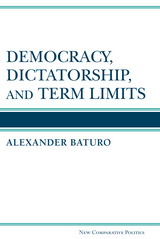
A national constitution or other statute typically specifies restrictions on executive power, often including a limit to the number of terms the chief executive may hold office. In recent decades, however, some presidents of newly established democracies have extended their tenure by various semilegal means, thereby raising the specter—and in some cases creating the reality—of dictatorship.
Alexander Baturo tracks adherence to and defiance of presidential term limits in all types of regimes (not only democratic regimes) around the world since 1960. Drawing on original data collection and fieldwork to investigate the factors that encourage playing by or manipulating the rules, he asks what is at stake for the chief executive if he relinquishes office. Baturo finds that the income-generating capacity of political office in states where rent-seeking is prevalent, as well as concerns over future immunity and status, determines whether or not an executive attempts to retain power beyond the mandated period. Democracy, Dictatorship, and Term Limitswill appeal to scholars of democratization and executive power and also to political theorists.
Recipient of 2019 John Brinckerhoff Jackson Book Prize, Foundation for Landscape Studies
2021 On the Brinck Book Award Winner
“Burle Marx created a new and modern grammar for international landscape design.”
—Lauro Cavalcanti, quoted in the New York Times
“The real creator of the modern garden.”
—American Institute of Architects
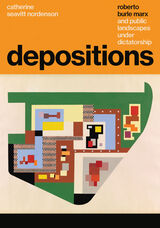
Presenting the first English translation of Burle Marx’s “depositions,” this volume highlights the environmental advocacy of a preeminent Brazilian landscape architect who advised and challenged the country’s military dictatorship.
Roberto Burle Marx (1909–1994) is internationally known as one of the preeminent modernist landscape architects. He designed renowned public landscapes in Brazil, beginning with small plazas in Recife in the 1930s and culminating with large public parks in the early 1960s, most significantly the Parque do Flamengo in Rio de Janeiro. Depositions explores a pivotal moment in Burle Marx’s career—the years in which he served as a member of the Federal Cultural Council created by the military dictatorship in the mid-1960s. Despite the inherent conflict and risk in working with the military regime, Burle Marx boldly used his position to advocate for the protection of the unique Brazilian landscape, becoming a prophetic voice of caution against the regime’s policies of rapid development and resource exploitation.
Depositions presents the first English translation of eighteen environmental position pieces that Burle Marx wrote for the journal Cultura , a publication of the Brazilian Ministry of Education and Culture, from 1967 through 1973. Catherine Seavitt Nordenson introduces and contextualizes the depositions by analyzing their historical and political contexts, as well as by presenting pertinent examples of Burle Marx’s earlier public projects, which enables a comprehensive reading of the texts. Addressing deforestation, the establishment of national parks, the place of commemorative sculpture, and the unique history of the Brazilian cultural landscape, Depositions offers new insight into Burle Marx’s outstanding landscape oeuvre and elucidates his transition from prolific designer to prescient counselor.
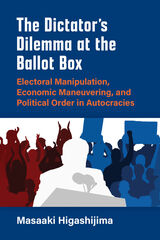
Contrary to our stereotypical views, dictators often introduce elections in which they refrain from employing blatant electoral fraud. Why do electoral reforms happen in autocracies? Do these elections destabilize autocratic rule? The Dictator’s Dilemma at the Ballot Box argues that strong autocrats who can garner popular support become less dependent on coercive electioneering strategies. When autocrats fail to design elections properly, elections backfire in the form of coups, protests, and the opposition’s stunning election victories. The book’s theoretical implications are tested on a battery of cross-national analyses with newly collected data on autocratic elections and in-depth comparative case studies of the two Central Asian republics of Kazakhstan and Kyrgyzstan.
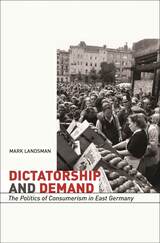
An investigation into the politics of consumerism in East Germany during the years between the Berlin Blockade of 1948-49 and the building of the Berlin Wall in 1961, Dictatorship and Demand shows how the issue of consumption constituted a crucial battleground in the larger Cold War struggle.
Based on research in recently opened East German state and party archives, this book depicts a regime caught between competing pressures. While East Germany's leaders followed a Soviet model, which fetishized productivity in heavy industry and prioritized the production of capital goods over consumer goods, they nevertheless had to contend with the growing allure of consumer abundance in West Germany. The usual difficulties associated with satisfying consumer demand in a socialist economy acquired a uniquely heightened political urgency, as millions of East Germans fled across the open border.
A new vision of the East-West conflict emerges, one fought as much with washing machines, televisions, and high fashion as with political propaganda, espionage, and nuclear weapons. Dictatorship and Demand deepens our understanding of the Cold War.

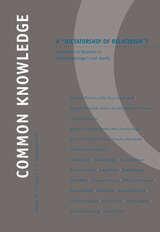
One essay relates the arguments of Ratzinger to those of two other German scholars—the conservative political theorist Ernst Wolfgang Böckenförde and the liberal philosopher and sociologist Jürgen Habermas—since all three men assume that social order depends on the existence of doctrinal authority (divine or otherwise). The contributors here argue for an intellectual and social life free of the desire for an “infantilizing” authority. One proposes that the Christian god is a relativist who prefers limitation and ambiguity; another, initially in agreement with Ratzinger about the danger relativism poses to faith and morals, then argues that this danger is what makes relativism valuable. The issue closes with the first English translation of an extract from a book on Catholic-Jewish relations by Cardinal Carlo Maria Martini, one of the Catholic Church’s most progressive figures.
Contributors. David Bloor, Daniel Boyarin, Mary Baine Campbell, Lorraine Daston, Arnold I. Davidson, John Forrester, Kenneth J. Gergen, Simon Goldhill, Jeffrey F. Hamburger, Julia Kristeva, Carlo Maria Cardinal Martini, Christopher Norris, Joseph Cardinal Ratzinger, Richard Shusterman, Barbara Herrnstein Smith, Jeffrey Stout, Gianni Vattimo
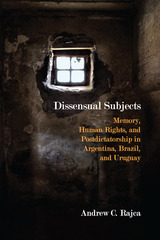
Through an engaging exploration of the concept of “never again” (nunca más/nunca mais) and close analysis of photography exhibits, audiovisual installations, and other art forms in spaces of cultural memory, the book explores how aesthetic interventions can suggest alternative ways of framing human rights subjectivity beyond the rhetoric of liberal humanitarianism. The book visits sites of memory, two of which functioned as detention and torture centers during dictatorships, to highlight the tensions between the testimonial tenor of permanent exhibits and the aesthetic interventions of temporary installations there. Rajca thus introduces perspectives that both undo common understandings of authoritarian violence and its effects as well as reconfigure who or what are made visible as subjects of memory and human rights in postdictatorship countries.
Dissensual Subjects offers much to those concerned with numerous interlocking fields: memory, human rights, political subjectivity, aesthetics, cultural studies, visual culture, Southern Cone studies, postdictatorship studies, and sites of memory.
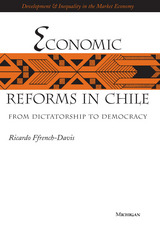
Written in accessible and readable prose, Economic Reforms in Chile begins with an overview of the Chilean economy during the last fifty years. This historical time frame is divided into three periods of economic reform. The first period covers the Pinochet regime, during which the more orthodox neoliberalism was implemented. The second period includes the Pinochet dictatorship, during which economic policy shifted toward pragmatism, particularly in the areas of trade and finance; it also includes the crisis of 1982 and its effects. The third period begins in 1990 with the return to democratic elections and the significant reforms to prior reforms. This section also examines the search for growth-with-equity, success in investment and growth performance, macroeconomic sustainability, and the reduction of poverty. Ffrench-Davis addresses several "paradoxes," or results that defy the expectations of policymakers, in order to analyze the significance of comprehensive macroeconomic equilibrium and its implications for sustainable stability, growth, and equity.
Economic Reforms in Chile will be of interest to economists, political scientists, and policymakers involved with the economies of emerging and developing countries.
Ricardo Ffrench-Davis is Principal Regional Advisor, ECLAC, Santiago, and Professor of Economics, University of Chile.
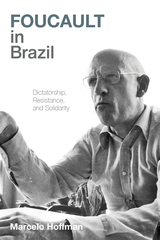
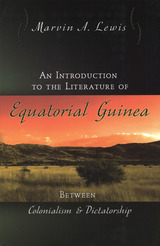
Spain’s only former colony in sub-Saharan Africa, Equatorial Guinea is home to a literature of transition—songs of freedom in which authors reflect on their identity within the context of recent colonialism and dictatorship.
An Introduction to the Literature of Equatorial Guinea is the first book-length critical study of this literature, a multigenre analysis encompassing fifty years of poetry, drama, essays, and prose fiction. Both resident and exiled authors offer insights into the impact of colonialism and dictatorship under Spanish rule and consider the fruits of “independence” under the regimes of Francisco Macías Nguema and Teodoro Obiang Nguema. Examining these works from the perspective of postcolonial theory, Marvin A. Lewis shows how writings from Equatorial Guinea depict the clash of traditional and European cultures and reflect a dictatorship that produced poverty, misery, and oppression. He assesses with particular care the impact of the Macías reafricanization process and its manifestations in literature.
In showing how the views of the nation correspond and diverge in works of writers such as Maria Nsue Angue, Donato Ndongo-Bidyogo, and Juan Tomás Ávila Laurel, Lewis brings to light artists who articulate their concerns in Spanish but are African in their souls. In analyzing the works of both renowned and emerging writers, he marks the themes that contribute to the formation of national identity: Hispanic heritage, the myth of Bantu unity, “bonding in adversity” during the Nguema regime, and the Equatoguinean diaspora.
Lewis provides an accessible introduction to the work of central writers in a new area of literary study and includes the most exhaustive and up-to-date bibliography available on the subject. His is a groundbreaking work that broadens our understanding of African literature and will be the bedrock for future studies of this Hispanic corner of Africa.
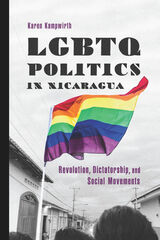
Karen Kampwirth is a renowned scholar of the Nicaraguan Revolution, who has been writing at the intersection of gender and politics for decades. In this chronological telling of the last fifty years of political history in Nicaragua, Kampwirth deploys a critical new lens: understanding politics from the perspective of the country’s LGBTQ community. Kampwirth details the gay and lesbian guerrillas in the 1960s and 1970s, Nicaragua’s first openly gay television wizard in the 1980s, and the attempts by LGBTQ revolutionaries to create a civil rights movement and the subsequent squashing of that movement by the ruling Sandinista party. She analyzes the shifting political alliances, the rise of strong feminist and LGBTQ movements in Nicaragua, and the attempts by the administration of Daniel Ortega to co-opt and control these movements.
Ultimately, this is a story of struggle and defeat, progress and joy. This timely book provides a well-documented review of LGBTQ politics in modern Nicaragua, helping us to see the Sandinista Revolution and its ongoing aftermath in a new light.
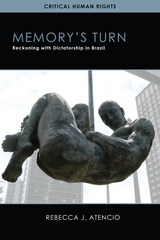
In clear and engaging prose, Rebecca J. Atencio tells the story of the slow turn to memory in Brazil, a turn that has taken place in both politics and in cultural production. She shows how testimonial literature, telenovelas, literary novels, theatrical plays, and memorials have interacted with policies adopted by the Brazilian state, often in unexpected ways. Under the right circumstances, official and cultural forms of reckoning combine in Brazil to produce what Atencio calls cycles of cultural memory. Novel meanings of the past are forged, and new cultural works are inspired, thus creating the possibility for further turns in the cycle.
The first book to analyze Brazil’s reckoning with dictatorship through both institutional and cultural means, Memory’s Turn is a rich, informative exploration of the interplay between these different modes of memory reconstruction.
Winner, Alfred B. Thomas Award, Southeastern Council of Latin American Studies
Honorable Mention, Roberto Reis Book Prize, Brazilian Studies Association
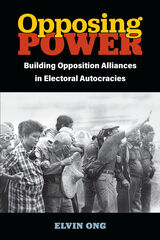
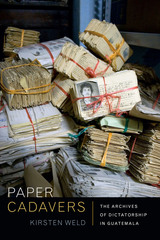
The unearthing of the archives renewed fierce debates about history, memory, and justice. In Paper Cadavers, Weld explores Guatemala's struggles to manage this avalanche of evidence of past war crimes, providing a firsthand look at how postwar justice activists worked to reconfigure terror archives into implements of social change. Tracing the history of the police files as they were transformed from weapons of counterinsurgency into tools for post-conflict reckoning, Weld sheds light on the country's fraught transition from war to an uneasy peace, reflecting on how societies forget and remember political violence.
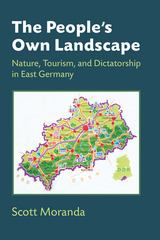
East Germany’s Socialist Unity Party aimed to placate a public well aware of the higher standards of living enjoyed elsewhere by encouraging them to participate in outdoor activities and take vacations in the countryside. Scott Moranda considers East Germany’s rural landscapes from the perspective of both technical experts (landscape architects, biologists, and physicians) who hoped to dictate how vacationers interacted with nature, and the vacationers themselves, whose outdoor experience shaped their understanding of environmental change. As authorities eliminated traditional tourist and nature conservation organizations, dissident conservationists demanded better protection of natural spaces. At the same time, many East Germans shared their government’s expectations for economic development that had real consequences for the land. By the 1980s, environmentalists saw themselves as outsiders struggling against the state and a public that had embraced mainstream ideas about limitless economic growth and material pleasures.
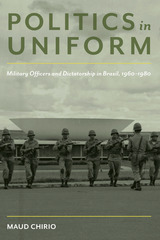
This book is a translation, with expanded material for English-language readers, of Maud Chirio's original Portuguese-language work, A política nos quartéis: Revoltas e protestos de oficiais na ditadura militar brasileira, which was awarded the Thomas E. Skidmore Prize by the Brazilian National Archives and Brazilian Studies Association.
Ermakoff distinguishes several mechanisms of alignment in troubled and uncertain times and assesses their significance through a fine-grained examination of actors’ beliefs, shifts in perceptions, and subjective states. To this end, he draws on the analytical and methodological resources of perspectives that usually stand apart: primary historical research, formal decision theory, the phenomenology of group processes, quantitative analyses, and the hermeneutics of testimonies. In elaborating this dialogue across disciplinary boundaries, Ruling Oneself Out restores the complexity and indeterminate character of pivotal collective decisions and demonstrates that an in-depth historical exploration can lay bare processes of crucial importance for understanding the formation of political preferences, the paradox of self-deception, and the makeup of historical events as highly consequential.
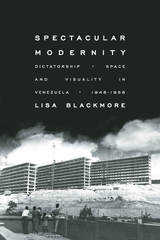
In cultural history, the 1950s in Venezuela are commonly celebrated as a golden age of modernity, realized by a booming oil economy, dazzling modernist architecture, and nationwide modernization projects. But this is only half the story. In this path-breaking study, Lisa Blackmore reframes the concept of modernity as a complex cultural formation in which modern aesthetics became deeply entangled with authoritarian politics. Drawing on extensive archival research and presenting a wealth of previously unpublished visual materials, Blackmore revisits the decade-long dictatorship to unearth the spectacles of progress that offset repression and censorship. Analyses of a wide range of case studies—from housing projects to agricultural colonies, urban monuments to official exhibitions, and carnival processions to consumer culture—reveal the manifold apparatuses that mythologized visionary leadership, advocated technocratic development, and presented military rule as the only route to progress. Offering a sharp corrective to depoliticized accounts of the period, Spectacular Modernity instead exposes how Venezuelans were promised a radically transformed landscape in exchange for their democratic freedoms.
Nancy J. Gates-Madsen reads between the lines of Argentine cultural texts (fiction, drama, testimonial narrative, telenovela, documentary film) to explore the fundamental role of silence—the unsaid—in the expression of trauma. Her careful examination of the interplay between textual and contextual silences illuminates public debate about the meaning of memory in Argentina—which stories are being told and, more important, which are being silenced. The imposition of silence is not limited to the military domain or its apologists, she shows; the human rights community also perpetuates and creates taboos.
Avelar starts by offering new readings of works produced before the dictatorship era, in what is often considered the boom of Latin American fiction. Distancing himself from previous celebratory interpretations, he understands the boom as a manifestation of mourning for literature’s declining aura. Against this background, Avelar offers a reassessment of testimonial forms, social scientific theories of authoritarianism, current transformations undergone by the university, and an analysis of a number of novels by some of today’s foremost Latin American writers—such as Ricardo Piglia, Silviano Santiago, Diamela Eltit, João Gilberto Noll, and Tununa Mercado. Avelar shows how the ‘untimely’ quality of these narratives is related to the position of literature itself, a mode of expression threatened with obsolescence.
This book will appeal to scholars and students of Latin American literature and politics, cultural studies, and comparative literature, as well as to all those interested in the role of literature in postmodernity.
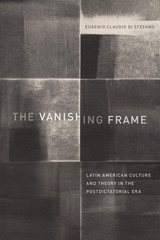
In the postdictatorial era, Latin American cultural production and criticism have been defined by a series of assumptions about politics and art—especially the claim that political freedom can be achieved by promoting a more direct experience between the textual subject (often a victim) and the reader by eliminating the division between art and life. The Vanishing Frame argues against this conception of freedom, demonstrating how it is based on a politics of human rights complicit with economic injustices. Presenting a provocative counternarrative, Eugenio Claudio Di Stefano examines literary, visual, and interdisciplinary artists who insist on the autonomy of the work of art in order to think beyond the politics of human rights and neoliberalism in Latin American theory and culture.
Di Stefano demonstrates that while artists such as Diamela Eltit, Ariel Dorfman, and Albertina Carri develop a concept of justice premised on recognizing victims’ experiences of torture or disappearance, they also ignore the injustice of economic inequality and exploitation. By examining how artists such as Roberto Bolaño, Alejandro Zambra, and Fernando Botero not only reject an aesthetics of experience (and the politics it entails) but also insist on the work of art as a point of departure for an anticapitalist politics, this new reading of Latin American cultural production offers an alternative understanding of recent developments in Latin American aesthetics and politics that puts art at its center and the postdictatorship at its end.
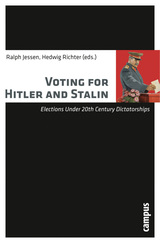
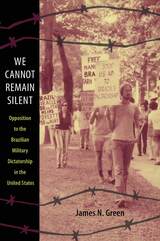
Green interviewed many of the activists who educated journalists, government officials, and the public about the abuses taking place under the Brazilian dictatorship. Drawing on those interviews and archival research from Brazil and the United States, he describes the creation of a network of activists with international connections, the documentation of systematic torture and repression, and the cultivation of Congressional allies and the press. Those efforts helped to expose the terror of the dictatorship and undermine U.S. support for the regime. Against the background of the political and social changes of the 1960s and 1970s, Green tells the story of a decentralized, international grassroots movement that effectively challenged U.S. foreign policy.
READERS
Browse our collection.
PUBLISHERS
See BiblioVault's publisher services.
STUDENT SERVICES
Files for college accessibility offices.
RECENTLY PUBLISHED





UChicago Accessibility Resources
home | accessibility | search | about | contact us
BiblioVault ® 2001 - 2024
The University of Chicago Press