logo for Central European University Press
The Art of Witnessing
Documentary Literature, Film and Theater in Eastern Europe and the Baltics
Johanna Lindbladh
Central European University Press, 2026
This volume discusses documentary film, theatre, and literature from the 1960s to the 2020s in Belarus, Russia, Ukraine, and the Baltic states. It presents new developments in documentary aesthetics in the region but also expands on the political, medial, and aesthetic developments that shaped Soviet attitudes towards documentary arts and their legacy. Russia’s full-blown invasion of Ukraine has given documentary practices a new urgency. All over the region, documentary art has become a tool to counter-act the media and memory conflict waged, evidence practices of decolonization and address the archival heritage of totalitarian times. The book reflects on documentary approaches as an interdisciplinary and collaborative artistic tool in politically transformative and violent times. The innovative volume is designed as a research monograph for scholars and students of literature, culture, film, theatre, memory and trauma studies, but also at general readers interested in the documentary arts.
[more]

front cover of Assembly Lines
Assembly Lines
Montage in Postwar French Film
Ivan Cerecina
University of Minnesota Press, 2026

A bold new understanding of montage and French cinematic history

Amid the tumult of change that swept through French society in the wake of World War II, a trio of visionary filmmakers sought to make meaning of the chaos by revitalizing a common method: montage. Revealing Nicole Védrès, Alain Resnais, and Chris Marker as more than just groundbreaking auteurs, Ivan Cerecina shows how their collective infusion of montage with avant-garde aesthetics renewed the art of cinema while helping France reckon with its past and imagine its future.

Assembly Lines challenges a dominant story of postwar French film, championed by critics at important film journals like Cahiers du cinéma, that has generally centered realist film aesthetics. Working against this tendency, Cerecina shows how Védrès, Resnais, and Marker revitalized montage as a technique in response to the crises of the times, using it to process the ravages of the recent past, expose hidden connections, and uncover signs of coming catastrophe. Wedding insightful analyses of films and French cultural history with writings from lesser-heard voices like André Malraux, Jacques Brunius, and Henri Langlois, Assembly Lines illuminates obscured networks of critics, filmmakers, and historians to reshape our conception of French film and documentary. Meanwhile, Cerecina’s in-depth archival research unearths vital documents, including correspondence and production notes on Védrès’s Paris 1900 and Resnais’s Night and Fog.

More than a cinematic retrospective, Cerecina’s investigation of montage is also a call to action today as contemporary crises prompt reevaluation of our cultural histories. Assembly Lines exemplifies a powerful, future-oriented practice of historical reflection with implications that go well beyond the study of film.

Retail e-book files for this title are screen-reader friendly with images accompanied by short alt text and/or extended descriptions.

[more]

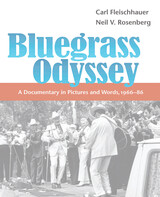
front cover of Bluegrass Odyssey
Bluegrass Odyssey
A Documentary in Pictures and Words, 1966-86
Carl Fleischhauer and Neil V. Rosenberg
University of Illinois Press, 2006
The fruit of four decades of collaboration between bluegrass music’s premier photographer and premier historian, Bluegrass Odyssey is a satisfying and visually alluring journey into the heart of a truly American music. Combining more than two hundred of Carl Fleischhauer’s photographs with Neil V. Rosenberg’s expert commentary, this elegant visual documentary captures the music-making with the culture and community that foster it.
[more]

front cover of Border Mediascapes
Border Mediascapes
Cinematic Itineraries at the Edge of Europe
Francesco Zucconi
University of Minnesota Press, 2026

How the cinematic gaze reveals the hidden operations of border zones


Examining a variety of documentary films made along the borders of Europe since the turn of the twenty-first century, Border Mediascapes takes a cinematic eye to the technologies employed in governing spatial movement. Working at the intersections of social sciences, political theory, contemporary media, and cinema aesthetics, this book expands our understanding of the border as not just a static political boundary inscribed on a map but a complex, dynamic network of human and nonhuman agents. 


Francesco Zucconi asserts that contemporary borders are environments defined by media: a perpetually shifting set of interactions between physical bodies and sensors, surveillance cameras, satellites, mapping programs, digital signage, and cellular devices. Analyzing documentaries filmed by or in collaboration with migrants, Border Mediascapes demonstrates how cinema can be used to reveal the otherwise unseen apparatuses that facilitate systematized practices of recognition, expulsion, and erasure.


As he details the ways specific border technologies measure and identify individuals as part of the larger project of territorial control, Zucconi illustrates the effectiveness of cinema for capturing the entanglement of geopolitics and biopolitics. Viewing the cinematic perspective as simultaneously analytical, critical, and complicit with the new technological frontier, Zucconi shows how the medium can deepen our understanding of borders as sites of power, resistance, and resilience.


Retail e-book files for this title are screen-reader friendly with images accompanied by short alt text and/or extended descriptions.

[more]

logo for Intellect Books
Constructions of the Real
Intersections of Documentary-based Film Practice and Theory
Edited by Christine Rogers, Kim Munro, Liz Burke, and Catherine Gough-Brady
Intellect Books, 2023
A presentation of nonfiction and documentary filmmaking as a space for formal experimentation and creative interpretation of the world.

Constructions of the Real gathers a wide range of writing from nonfiction and documentary filmmakers from around the world who undertake theoretically informed practice and think through making. The filmmakers and writers featured here explore the rich space between the academy and industry, and they reflect on, interrogate, and explicate their filmmaking practices in relation to questions of form, content, and process. Engaging with current debates about the role of creative scholarship, the contributors make a powerful claim for nonfiction filmmaking as a knowledge-making practice for revealing, critiquing, and interpreting the world.
 
[more]

front cover of Conversations with Third Reich Contemporaries
Conversations with Third Reich Contemporaries
From Luke Holland’s Final Account
Stefanie Rauch
University College London, 2025
A collection of filmmaker Luke Holland’s interviews with elderly Germans who witnessed—or participated in—the atrocities of the Holocaust. 

Conversations with Third Reich Contemporaries presents excerpts from filmed interviews conducted by British documentary filmmaker Luke Holland across a span of over a decade. These interviews were compiled into the German-language documentary film Final Account (2020), completed shortly before Holland’s death. Most interviewees were young adults when the war ended; some had benefited from Nazism, and others had directly enacted persecution or state violence. In addition to making this vital interview collection more widely accessible, the sourcebook raises critical awareness of issues around representation, authenticity, memory, and the co-production of narratives, reshaping discussions around the role of “ordinary” citizens under the Third Reich. It is the first sourcebook to engage directly with issues of representation and identity after 1945. 
[more]

front cover of Documenting Iran
Documenting Iran
Filmmakers and Social Change
Persheng Vaziri
University of Texas Press, 2026

An ethnographic study of how Iranian documentary filmmakers navigate censorship and creativity to shape civic discourse.

Iranian filmmakers have overcome significant obstacles to create a distinctive, globally renowned cinema. Filmmaker and educator Persheng Vaziri explores how documentarians, in particular, have developed a dynamic and creative environment by negotiating limited resources and official constraints. Through their films, they share hard truths—and artful narratives—with fellow Iranians and viewers the world over.

Documenting Iran introduces key historical foundations of documentary filmmaking amid generations of political change—first under the shah and later the Islamic government—before turning to the experiences of contemporary directors and writers. Drawing on interviews and ethnographic encounters, Vaziri describes the creative practices and pragmatic choices that provide documentarians relative independence from state censorship and other curbs on artistic production. Relying on poetic aesthetics, international connections, and the accumulated knowledge of a tight-knit local community, filmmakers engage with controversial topics like women’s rights, marriage and divorce laws, environmental degradation, and encounters with Western culture. Documentarians have thus created an activist cinema both subtle and persuasive enough to challenge dogmatic rule and uphold progressive elements of Iranian society.

[more]

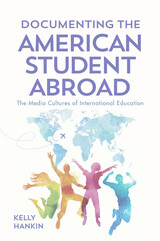
front cover of Documenting the American Student Abroad
Documenting the American Student Abroad
The Media Cultures of International Education
Kelly Hankin
Rutgers University Press, 2021
1 in 10 undergraduates in the US will study abroad. Extoled by students as personally transformative and celebrated in academia for fostering cross-cultural understanding, study abroad is also promoted by the US government as a form of cultural diplomacy and a bridge to future participation in the global marketplace.

In Documenting the American Student Abroad, Kelly Hankin explores the documentary media cultures that shape these beliefs, drawing our attention to the broad range of stakeholders and documentary modes involved in defining the core values and practices of study abroad. From study abroad video contests and a F.B.I. produced docudrama about student espionage to reality television inspired educational documentaries and docudramas about Amanda Knox, Hankin shows how the institutional values of "global citizenship," "intercultural communication," and "cultural immersion" emerge in contradictory ways through their representation.

By bringing study abroad and media studies into conversation with one another, Documenting the American Student Abroad: The Media Cultures of International Education offers a much needed humanist contribution to the field of international education, as well as a unique approach to the growing scholarship on the intersection of media and institutions. As study abroad practitioners and students increase their engagement with moving images and digital environments, the insights of media scholars are essential for helping the field understand how the mediation of study abroad rhetoric shapes rather than reflects the field's central institutional ideals
[more]

front cover of Down Syndrome Culture
Down Syndrome Culture
Life Writing, Documentary, and Fiction Film in Iberian and Latin American Contexts
Benjamin Fraser
University of Michigan Press, 2024
People with Down syndrome possess a culture. They are producers of culture. And in the 21st century, this culture is increasingly visible as a global phenomenon. Down Syndrome Culture examines Down syndrome alongside its social, cultural, and artistic representation. Author Benjamin Fraser draws upon neomaterialist and posthumanist approaches to disability as well as the work of disability theorists such as David Mitchell, Sharon Snyder, Susan Antebi, Tobin Siebers, and Stuart Murray. By particularly focusing on Down syndrome, he showcases the unique place that it holds as an intellectual and developmental disability—one that fits between the social and medical models of disability—within the disability studies field. 

Down Syndrome Culture also pushes the traditionally Anglophone borders of disability studies by examining examples in Spanish, Catalan, and Portuguese-language texts, and incorporating the work of thinkers in Iberian and Latin American studies. Through a close analysis of life writing, documentaries, and fiction films, the book emphasizes the central role of people with Down syndrome in contemporary cultural production. Chapters discuss the autobiography of Andy Trias Trueta, the social actors of the documentary Los niños [The Grown-Ups] (2016), dancers from Danza Mobile, and a variety of fiction films, challenging ableist understandings of disability in nuanced ways. Ultimately, this book reveals the lives, cultural work, and representations of people with trisomy 21 in an international context.
[more]

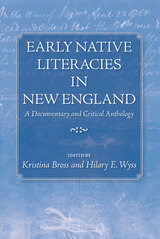
front cover of Early Native Literacies in New England
Early Native Literacies in New England
A Documentary and Critical Anthology
Kristina Bross
University of Massachusetts Press, 2008

Designed as a corrective to colonial literary histories that have excluded Native voices, this anthology brings together a variety of primary texts produced by the Algonquian peoples of New England during the seventeenth, eighteenth, and very early nineteenth centuries. Included among these written materials and objects are letters, signatures, journals, baskets, pictographs, confessions, wills, and petitions, each of which represents a form of authorship. Together they demonstrate the continuing use of traditional forms of memory and communication and the lively engagement of Native peoples with alphabetic literacy during the colonial period. Each primary text is accompanied by an essay that places it in context and explores its significance. 

Written by leading scholars in the field, these readings draw on recent trends in literary analysis, history, and anthropology to provide an excellent overview of the field of early Native studies. They are also intended to provoke discussion and open avenues for further exploration by students and other interested readers. Above all, the texts and commentaries gathered in this volume provide an opportunity to see Native American literature as a continuity of expression that reflects choices made long before contact and colonization, rather than as a nineteenth—or even twentieth-century invention.

Contributors include Heidi Bohaker, Heather Bouwman, Joanna Brooks, Kristina Bross, Stephanie Fitzgerald, Sandra Gustafson, Laura Arnold Leibman, Kevin McBride, David Murray, Laura Murray, Jean O'Brien, Ann Marie Plane, Philip Round, Jodi Schorb, David Silverman, and Hilary E. Wyss.

[more]

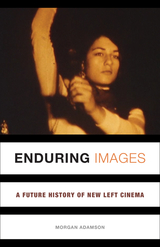
front cover of Enduring Images
Enduring Images
A Future History of New Left Cinema
Morgan Adamson
University of Minnesota Press, 2018

An integrated look at the political films of the 1960s and ’70s and how the New Left transformed cinema

A timely reassessment of political film culture in the 1960s and ’70s, Enduring Images examines international cinematic movements of the New Left in light of sweeping cultural and economic changes of that era. Looking at new forms of cinematic resistance—including detailed readings of particular films, collectives, and movements—Morgan Adamson makes a case for cinema’s centrality to the global New Left. 

Enduring Images details how student, labor, anti-imperialist, Black Power, and second-wave feminist movements broke with auteur cinema and sought to forge local and international solidarities by producing political essay films, generating new ways of being and thinking in common. Adamson produces a comparative and theoretical account of New Left cinema that engages with discussions of work, debt, information, and resistance. Enduring Images argues that the cinemas of the New Left are sites to examine, through the lens of struggle, the reshaping of global capitalism during the pivotal moment in which they were made, while at the same time exploring how these movements endure in contemporary culture and politics.  

Including in-depth discussions of Third Cinema in Argentina, feminist cinema in Italy, Newsreel movements in the United States, and cybernetics in early video, Enduring Images is an essential examination of the political films of the 1960s and ’70s.

[more]

logo for Intellect Books
Engaging with Reality
Documentary and Globalization
Ib Bondebjerg
Intellect Books, 2014
As our world becomes more globalized, documentary film and television tell more cosmopolitan stories of the world’s social, political, and cultural situation. Ib Bondebjerg examines how global challenges are reflected and represented in documentaries from the United States, the United Kingdom, and Scandinavia after 2001. The documentaries deal with the war on terror, the globalization of politics, migration, the multicultural challenge, and climate change.

Engaging with Reality is framed by theories of globalization and delves into the development of a new global media culture. It also deals with theories of documentary genres and their social and cultural functions. It discusses cosmopolitanism and the role and forms of documentary in a new digital and global media culture. It will be essential reading for those looking to better understand documentary and the new transnational approach to modern media culture.
[more]

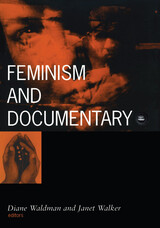
front cover of Feminism And Documentary
Feminism And Documentary
Diane Waldman
University of Minnesota Press, 1999

The first book of essays to explore the intersection of these two vital disciplines.

Documentary and feminist film studies have long been separate or parallel universes that need to converse or collide. The essays in this volume, written by prominent scholars and filmmakers, demonstrate the challenges that feminist perspectives pose for documentary theory, history, and practice. They also show how fuller attention to documentary enriches and complicates feminist theory, especially regarding the relationship between gender and sexuality, race and ethnicity, class and nation.

Feminism and Documentary begins with a substantial historical introduction that highlights several of the specific areas that contributors address: debates over realism, the relationship between filmmaker and subject, historical thinking about documentary and thinking about the historical documentary, biography and autobiography, and the use of psychoanalysis. Other essays, most of which appear here for the first time, range from broad overviews to close analyses of particular films and videos and from discussions of well-known works such as Roger and Me and Don’t Look Back to lesser known texts that might revise the canon. The collection includes an extensive filmography and videography with useful distribution information and a bibliography of work in this neglected area of scholarship. Lucid, sophisticated, and eye-opening, this book will galvanize documentary studies and demonstrate the need for women’s and cultural studies to grapple with visual media. Contributors: Michelle Citron, Northwestern U; Gloria J. Gibson, Indiana U; Chris Holmlund, U of Tennessee; Alexandra Juhasz, Pitzer College; Ann Kaneko; Anahid Kassabian, Fordham U; David Kazanjian, U of California, Berkeley; Susan Knobloch; Silvia Kratzer-Juilfs; Deborah Lefkowitz; Julia Lesage, U of Oregon; Laura U. Marks, Carleton U, Ottawa; Paula Rabinowitz, U of Minnesota; Michael Renov, USC; Patricia R. Zimmermann, Ithaca College.
[more]

logo for University of Michigan Press
Fictions of the Real
Synergies Between Screen and Stage in Argentine Performance
Brenda Werth
University of Michigan Press, 2026
Brenda Werth’s Fictions of the Real traces the transformation of “the real” and its transnational conceptualization by Argentine artists in the twenty-first century, focusing on artists who engage in both documentary theater and filmmaking. Werth places the work of Lola Arias, Romina Paula, Federico León, Mariano Pensotti, and Grupo Krapp in dialogue with the distinct but intertwined lineages of theater and film exploring the intermedial dimensions of these artists’ theatrical work, resonances in their documentary films, and the transmedial relationships between their documentary plays and films. Focusing on the dynamic and shifting context of Argentina between 1998 and 2023, a period roughly bookmarked by the economic crisis of 2001 and the COVID-19 pandemic, this book explores how these artists disrupt the relations of power and counter political manipulation with their own evocative fictions of the real as they engage in the roles of translators, curators, researchers, archivists, and collaborators.
[more]

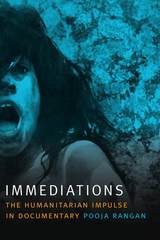
front cover of Immediations
Immediations
The Humanitarian Impulse in Documentary
Pooja Rangan
Duke University Press, 2017
Endangered life is often used to justify humanitarian media intervention, but what if suffering humanity is both the fuel and outcome of such media representations? Pooja Rangan argues that this vicious circle is the result of immediation, a prevailing documentary ethos that seeks to render human suffering urgent and immediate at all costs. Rangan interrogates this ethos in films seeking to “give a voice to the voiceless,” an established method of validating the humanity of marginalized subjects, including children, refugees, autistics, and animals. She focuses on multiple examples of documentary subjects being invited to demonstrate their humanity: photography workshops for the children of sex workers in Calcutta; live eyewitness reporting by Hurricane Katrina survivors; attempts to facilitate speech in nonverbal autistics; and painting lessons for elephants. These subjects are obliged to represent themselves using immediations—tropes that reinforce their status as the “other” and reproduce definitions of the human that exclude non-normative modes of thinking, being, and doing. To counter these effects, Rangan calls for an approach to media that aims not to humanize but to realize the full, radical potential of giving the camera to the other.
[more]

logo for Intellect Books
The Intellect Handbook of Documentary
Edited by Kate Nash and Deane Williams
Intellect Books, 2025
The growth of documentaries and their role in culture, activism, and social impact.

The Intellect Handbook of Documentary is an important go-to resource for practitioners, scholars, and students in this burgeoning field. It tackles key topics and debates including the role of documentary in post-truth culture, the rise of streaming giants, and the implications for national documentary cultures, as well as the shifting, increasingly hybrid, practices of documentary activism and the professionalization of impact. Featuring work by key figures in international documentary scholarship and talented emerging scholars, the Handbook is a landmark publication for documentary studies in the twenty-first century.

The Handbook is broad in its scope, incorporating historical, theoretical, empirical, and practical scholarship. It is organized around ten key themes and debates: What and where is documentary (studies); documentary in an age of epistemic uncertainty; documentary histories; documentary and the archive; audio and visualities; documentary relationalities; beyond the Anthropocene; digital and documentary practices; documentary and (new) politics; and a golden age of documentary distribution and funding. Importantly, the Handbook incorporates the voices and practices of practitioners from the Global South, challenging the dominance of Western voices in documentary scholarship.
[more]

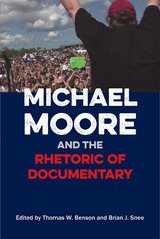
front cover of Michael Moore and the Rhetoric of Documentary
Michael Moore and the Rhetoric of Documentary
Edited by Thomas W. Benson and Brian J. Snee
Southern Illinois University Press, 2015

Not afraid to tackle provocative topics in American culture, from gun violence and labor policies to terrorism and health care, Michael Moore has earned both applause and invective in his career as a documentarian. In such polarizing films as Bowling for Columbine, Fahrenheit 9/11, and Sicko, Moore has established a unique voice of radical nostalgia for progressivism, and in doing so has become one of the most recognized documentary filmmakers of all time.

In the first in-depth study of Moore’s feature-length documentary films, editors Thomas W. Benson and Brian J. Snee have gathered leading rhetoric scholars to examine the production, rhetorical appeals, and audience reception of these films. Contributors critique the films primarily as modes of public argument and political art. Each essay is devoted to one of Moore’s films and traces in detail how each film invites specific audience responses.

Michael Moore and the Rhetoric of Documentary reveals not only the art, the argument, and the emotional appeals of Moore’s documentaries but also how these films have revolutionized the genre of documentary filmmaking.
[more]

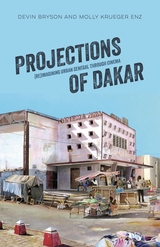
front cover of Projections of Dakar
Projections of Dakar
(Re)Imagining Urban Senegal through Cinema
Devin Bryson and Molly Krueger Enz
Ohio University Press, 2024
Projections of Dakar studies the audiovisual creations and practices of twenty-first-century Senegalese filmmakers living, working, and distributing their films in urban Senegal. Although some observers have described contemporary Senegalese cinema as a dying industry, this book shows that it retains great potential. Senegalese cinematic practitioners are forging unique, dynamic responses to social challenges and producing content in innovative forms.

Like contemporary Senegalese cinema, African urban centers are often perceived as sites of despair and social decay. In each chapter of this book, Devin Bryson and Molly Krueger Enz focus on a particular urban issue and analyze how Senegalese filmmakers document and reimagine it from diverse perspectives and contexts. The authors draw from interviews and ethnographic observations to center filmmakers’ practices and conceptualizations of contemporary cinema in Dakar. Bryson and Enz trace developments in production, distribution, viewership, and audience response since 2012 to study how these films and their production both reveal and contribute to how people live in the city, relate to one another, build their lives, advocate for change, find joy and meaning, and build community. They also document and articulate more equitable and inclusive forms of these activities. Ultimately, the book illustrates how Senegalese filmmakers reimagine Africa as a place that will lead to a better future for its inhabitants.
[more]

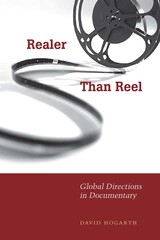
front cover of Realer Than Reel
Realer Than Reel
Global Directions in Documentary
By David Hogarth
University of Texas Press, 2006

Television and globalization have transformed the traditional documentary almost beyond recognition, converting what was once a film genre devoted to public service and education into a popular televisual commodity with productions ranging from serious public affairs programming to TV "reality" shows and "docusoaps." Realer Than Reel offers a state-of-the-art overview of international documentary programming that investigates the possibilities documentary offers for local and public representation in a global age, as well as what actually constitutes documentary in a time of increasing digitalization and manipulation of visual media.

David Hogarth focuses on public affairs, nature, and reality shows from around the world, drawing upon industry data, producer interviews, analyses of selected documentary programs, and firsthand observations of market sites. He looks at how documentary has become a transnational product through exports, co-ventures, and festival contacts; how local and regional "place" is represented in global documentary, especially by producers such as Discovery Networks International and the National Geographic Channel; how documentary addresses the needs of its viewers as citizens through public service broadcasting; and how documentary is challenging accepted conventions of factuality, sense, and taste. The concluding chapter considers the future of both documentary as a genre and television as a global factual medium, asking whether TV will continue to "document" the world in any meaningful sense of the term.
[more]

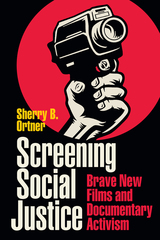
front cover of Screening Social Justice
Screening Social Justice
Brave New Films and Documentary Activism
Sherry B. Ortner
Duke University Press, 2023
In Screening Social Justice, award-winning anthropologist Sherry B. Ortner presents an ethnographic study of Brave New Films, a nonprofit film production company that makes documentaries intended to mobilize progressive grassroots activism. Ortner positions the work of the company within a tradition of activist documentary filmmaking and within the larger field of “alternative media” that is committed to challenging the mainstream media and telling the truth about the world today. The company’s films cover a range of social justice issues, with particular focus on the hidden workings of capitalism, racism, and right-wing extremism. Beyond the films themselves, Brave New Films is also famous for its creative distribution strategies. All of the films are available for free on YouTube. Central to the intention of promoting political activism, the films circulate through networks of other activist and social justice organizations and are shown almost entirely in live screenings in which the power of the film is amplified. Ortner takes the reader inside both the production process and the screenings to show how a film can be made and used to mobilize action for a better world.
[more]

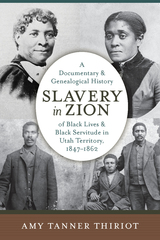
front cover of Slavery in Zion
Slavery in Zion
A Documentary and Genealogical History of Black Lives and Black Servitude in Utah Territory, 1847-1862
Amy Tanner Thiriot
University of Utah Press, 2022
According to an Akan proverb, “It is not wrong to go back for that which you have forgotten.” This belief underlies historian Amy Tanner Thiriot’s work in Slavery in Zion, which combines genealogical and historical research to bring to light events and relationships unknown or misunderstood for well over a century. The total number of enslaved people in Utah’s early history has remained an open question for many years, due in part to the nature of nineteenth-century records, and an exact number is undetermined. But while writing this book Thiriot documented around one hundred enslaved or indentured Black men, women, and children in Utah Territory.
 
Slavery in Zion has two major parts. The first section provides an introductory history, chapters on southern and western experiences, and information on life after emancipation. The second section is a biographical encyclopedia of names, relationships, and events. Although Slavery in Zion contains material applicable to legal history and the history of race and Mormonism, its most important contribution is as an archive of the experiences of Utah’s enslaved Black people, at last making their stories an integral part of the record of Utah and the American West—no longer forgotten or written out of history.
[more]

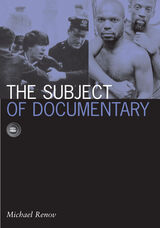
front cover of Subject Of Documentary
Subject Of Documentary
Michael Renov
University of Minnesota Press, 2004
The documentary, a genre as old as cinema itself, has traditionally aspired to objectivity. Whether making ethnographic, propagandistic, or educational films, documentarians have pointed the camera outward, drawing as little attention to themselves as possible. In recent decades, however, a new kind of documentary has emerged in which the filmmaker has become the subject of the work. Whether chronicling family history, sexual identity, or a personal or social world, this new generation of nonfiction filmmakers has defiantly embraced autobiography. In The Subject of Documentary, Michael Renov focuses on how documentary filmmaking has become an important means for both examining and constructing selfhood. By looking at key figures in documentary filmmaking as well as noncanonical video art and avant-garde artists, Renov broadens the definition of what counts as documentary, and explores the intersection of the personal and political, considering how memory can create a way into asking troubling questions about identity, oppression, and resiliency. Offering historical context for the explosion of personal nonfiction filmmaking in the 1980s and 1990s, Renov analyzes films in which the subjectivity of the filmmaker is expressly defined in relation to political struggle or historical trauma, from Haskell Wexler's Medium Cool to Jonas Mekas's Lost, Lost, Lost. And, looking beyond the traditional documentary, Renov contemplates such nontraditional modes of autobiographical practice as the essay film, the video confession, and the personal Web page.Unique in its attention to diverse expressions of personal nonfiction filmmaking, The Subject of Documentary forges a new understanding of the heightened role and function of subjectivity in contemporary documentary practice.Michael Renov is professor of critical studies at the USC School of Cinema-Television. He is the editor of Theorizing Documentary and the coeditor of Resolutions: Contemporary Video Practices (Minnesota, 1996) and Collecting Visible Evidence (Minnesota, 1999).
[more]

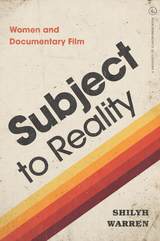
front cover of Subject to Reality
Subject to Reality
Women and Documentary Film
Shilyh Warren
University of Illinois Press, 2019
Revolutionary thinking around gender and race merged with new film technologies to usher in a wave of women's documentaries in the 1970s. Driven by the various promises of second-wave feminism, activist filmmakers believed authentic stories about women would bring more people into an imminent revolution. Yet their films soon faded into obscurity.

Shilyh Warren reopens this understudied period and links it to a neglected era of women's filmmaking that took place from 1920 to 1940, another key period of thinking around documentary, race, and gender. Drawing women’s cultural expression during these two explosive times into conversation, Warren reconsiders key debates about subjectivity, feminism, realism, and documentary and their lasting epistemological and material consequences for film and feminist studies. She also excavates the lost ethnographic history of women's documentary filmmaking in the earlier era and explores the political and aesthetic legacy of these films in more explicitly feminist periods like the Seventies.

Filled with challenging insights and new close readings, Subject to Reality sheds light on a profound and unexamined history of feminist documentaries while revealing their influence on the filmmakers of today.
[more]

logo for Intellect Books
Truth or Dare
Art and Documentary
Edited by Gail Pearce and Cahal McLaughlin
Intellect Books, 2007
The new wave of documentaries that prominently feature their filmmakers, such as the works of Michael Moore and Morgan Spurlock, have attracted fresh, new audiences to the form—but they have also drawn criticism that documentaries now promote entertainment at the expense of truth. Truth or Dare examines the clash between the authenticity claimed by documentaries and their association with imagination and experimental contemporary art. An experienced group of practitioners, artists, and theorists here question this binary, and the idea of documentary itself, in a cross-disciplinary volume that will force us to reconsider how competing interests shape filmmaking. 


[more]

front cover of Turning the Page
Turning the Page
Storytelling as Activism in Queer Film and Media
Coon, David R
Rutgers University Press, 2018
First runner-up for the 2019 John Leo and Dana Heller Award from the Popular Culture Association

Surprisingly, Hollywood is still clumsily grappling with its representation of sexual minorities, and LGBTQ filmmakers struggle to find a place in the mainstream movie industry. However, organizations outside the mainstream are making a difference, helping to produce and distribute authentic stories that are both by and for LGBTQ people. 

Turning the Page introduces readers to three nonprofit organizations that, in very different ways, have each positively transformed the queer media landscape. David R. Coon takes readers inside In the Life Media, whose groundbreaking documentaries on the LGBTQ experience aired for over twenty years on public television stations nationwide. Coon reveals the successes of POWER UP, a nonprofit production company dedicated to mentoring filmmakers who can turn queer stories into fully realized features and short films. Finally, he turns to Three Dollar Bill Cinema, an organization whose film festivals help queer media find an audience and whose filmmaking camps for LGBTQ youth are nurturing the next generation of queer cinema. 

Combining a close analysis of specific films and video programs with extensive interviews of industry professionals, Turning the Page demonstrates how queer storytelling in visual media has the potential to empower individuals, strengthen communities, and motivate social justice activism.  
[more]


Send via email Share on Facebook Share on Twitter