
 A SCHOLARLY BOOK REPOSITORY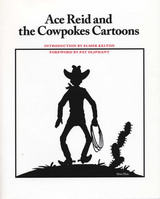
Winner, Mitchell A. Wilder Award for Publication Design, Texas Association of Museums
Folks across the West know a cowpoke named Jake. A good-hearted guy, he's always up to his eyebrows in debt or drought or prickly pears looking for them dad-blamed ole wild cows. In fact, he's so real a fella that it's hard to believe that Ace Reid made him up.
This book brings together 139 of Ace Reid's popular "Cowpokes" cartoons, reproduced in large format to show the artistry and attention to detail that characterized Reid's work. Grouped around themes such as work, weather, bankers, and friends, they reveal the distinctive "you might as well laugh as cry" sense of humor that ranch folks draw on to get through hard work and hard times.
In the foreword, Washington Post cartoonist Pat Oliphant offers an appreciation of Reid's "Cowpokes" cartoons, noting that "Ace's work has a magic of its own, and it owes nothing to anyone else." Reid's longtime friend Elmer Kelton recounts Ace's life and career in the introduction, describing how a shy boy who grew up on ranch work transformed himself into an artist-entrepreneur who never met a stranger and who made ranch work the subject of his real love, cartooning. This collector's volume belongs on the shelf of everyone who loves the "Cowpokes" cartoons, knows a fella like Jake, or enjoys the dry wit of the American cowboy.
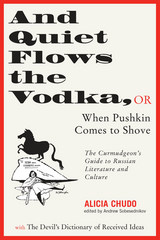
Written in the tradition of 1066 and All That, The Pooh Perplex, and The Classics Redefined, And Quiet Flows the Vodka will, with any luck, be the final word on the ghastly first two millennia of Russian literature, history, and culture.

The Architect’s Dream demonstrates that the goal of creating meaningful architecture can take a variety of critical and philosophical paths. Sean Pickersgill draws on a broad range of subject areas, including film, philosophy, anthropology, mathematics, and economics, to show that the path to meaningful creative practice is always based on an understanding of the principal drivers for change in society. The Architect’s Dream is not a recipe book for others to reproduce; rather, it requires the engaged reader to use their own creative abilities to find the potential in each proposition, and it will encourage the scholastic architect to continue to mine the rich veins of intellectual culture to demonstrate the hidden purposiveness inherent in all meaningful architecture.
Taking up works from Andy Warhol, Kevin Young, Don DeLillo, and Hari Kunzru, Archival Fictions considers how these writers have constructed a speculative history of media technology through formal experimentation. Although media technologies have determined the extent of what can be written, recorded, and remembered in the immediate aftermath of print's hegemony, Paul Benzon argues that literary form provides a vital means for critical engagement with the larger contours of media history. Drawing on approaches from media poetics, film studies, and the digital humanities, this interdisciplinary study demonstrates how authors who engage technology through form continue to imagine new roles for print literature across the late twentieth and early twenty-first centuries.
"It took me fifteen years to discover that I had no talent for writing, but I couldn't give it up because by then I was too famous."
—Robert Benchley
A Braided Heart provides a friendly, personal, and smart guide to the writing life. It also offers clear and original instruction on craft elements at the forefront of today’s emerging forms in creative nonfiction: from the short-short, to the braided form, to the hermit crab essay. An acknowledged expert in these forms, Brenda Miller gives writers practical advice on how to sustain and invigorate their writing practice, while also encouraging readers to explore their own writing lives.
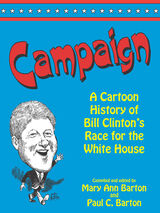
For many people, in the United States and abroad, the dramas of the campaign created the character of Clinton. From the Gennifer Flowers debacle to Clinton’s
resurrection at the Democratic National Convention and the triumph of the election win, the incisive cartoons in this collection capture Clinton’s emerging image in a way that no written word can. The forty-five contributing artists use these cartoons to depict the breathtaking and colorful events that only a presidential campaign can produce and offer hours of entertainment for any reader.
Bollywood movies have been long known for their colorful song-and-dance numbers and knack for combining drama, comedy, action-adventure, and music. But when India entered the global marketplace in the early 1990s, its film industry transformed radically. Production and distribution of films became regulated, advertising and marketing created a largely middle-class audience, and films began to fit into genres like science fiction and horror. In this bold study of what she names New Bollywood, Sangita Gopal contends that the key to understanding these changes is to analyze films’ evolving treatment of romantic relationships.
"Every writer has advice for aspiring writers. Mine is predicated on formative years spent cleaning my father’s calf pens: Just keep shoveling until you’ve got a pile so big, someone has to notice. The fact that I cast my life’s work as slung manure simply proves that I recognize an apt metaphor when I accidentally stick it with a pitchfork. . . . Poetry was my first love, my gateway drug—still the poets are my favorites—but I quickly realized I lacked the chops or insights to survive on verse alone. But I wanted to write. Every day. And so I read everything I could about freelancing, and started shoveling."
The pieces gathered within this book draw on fifteen years of what Michael Perry calls "shovel time"—a writer going to work as the work is offered. The range of subjects is wide, from musky fishing, puking, and mountain-climbing Iraq War veterans to the frozen head of Ted Williams. Some assignments lead to self-examination of an alarming magnitude (as Perry notes, "It quickly becomes obvious that I am a self-absorbed hypochondriac forever resolving to do better nutritionally and fitness-wise but my follow-through is laughable.") But his favorites are those that allow him to turn the lens outward: "My greatest privilege," he says, "lies not in telling my own story; it lies in being trusted to tell the story of another."
Western ruins have long been understood as objects riddled with temporal contradictions, whether they appear in baroque poetry and drama, Romanticism’s nostalgic view of history, eighteenth-century paintings of classical subjects, or even recent photographic histories of the ruins of postindustrial Detroit. Decay and Afterlife pivots away from our immediate, visual fascination with ruins, focusing instead on the textuality of ruins in works about disintegration and survival. Combining an impressive array of literary, philosophical, and historiographical works both canonical and neglected, and encompassing Latin, Italian, French, German, and English sources, Aleksandra Prica addresses ruins as textual forms, examining them in their extraordinary geographical and temporal breadth, highlighting their variability and reflexivity, and uncovering new lines of aesthetic and intellectual affinity. Through close readings, she traverses eight hundred years of intellectual and literary history, from Seneca and Petrarch to Hegel, Goethe, and Georg Simmel. She tracks European discourses on ruins as they metamorphose over time, identifying surprising resemblances and resonances, ignored contrasts and tensions, as well as the shared apprehensions and ideas that come to light in the excavation of these discourses.

"The mission of the press is to spread culture while destroying the attention span."
"Art serves to rinse out our eyes."
Uniquely combining humor with profundity and venom with compassion, Dicta and Contradicta is a bonanza of scandalous wit from Vienna's answer to Oscar Wilde.
From the decadent turn of the century to the Third Reich, the acerbic satirist Karl Kraus was one of the most famous–and feared–intellectuals in Europe. Through the polemical and satirical magazine Die Fackel (The torch), which he founded in 1899, Kraus launched wicked but unrelentingly witty attacks on literary and media corruption, sexual repression and militarism, and the social hypocrisy of fin-de-siècle Vienna.
Kraus's barbed aphorisms were an essential part of his running commentary on Viennese culture. These miniature gems, as sharp as diamonds, demonstrate Kraus's highly cultivated wit and his unerring eye for human weakness, flaccidity, and hypocrisy. Kraus shies away from nothing; the salient issues of the day are lined up side by side, as before a firing squad, with such perennial concerns as sexuality, religion, politics, art, war, and literature. By turns antagonistic, pacifistic, realistic, and maddeningly misogynistic, Kraus's aphorisms provide the sting that precedes healing.
For Dicta and Contradicta, originally published in 1909 (with the title Spruche und Widerspruche) and revised in 1923, Kraus selected nearly 1,000 of the scathing aphorisms that had appeared in Die Fackel. In this new translation, Jonathan McVity masterfully renders Kraus's multilayered meanings, preserving the clever wordplay of the German in readable colloquial English. He also provides an introductory essay on Kraus's life and milieu and annotations that clarify many of Kraus's literary and sociohistorical allusions.
Reevaluates early modern poems of praise as, paradoxically, challenging an artistic economy that values exchange and productivity
Early modern poems of praise typically insist that they do not have a purpose or enact real labor beyond their effortless listing of laudable qualities. And yet the poets discussed in this study, including Ben Jonson, Andrew Marvell, Anne Bradstreet, Lucy Hutchinson, and John Milton, hint at an alternative aesthetic economy at work in their verse. Poetic praise, it turns out, might show us a social world outside the organizing principle of exchange.
In Economies of Praise: Value, Labor, and Form in Seventeenth‑Century English Poetry, Ryan Netzley explores how poems of praise imagine alternatives to market and gift economies and point instead to a self-contained aesthetic economy that works against a more expansive and productivist understanding of literary art. By depicting exchange as inconsequential, unproductive, and redundant rather than a necessary constituent of social order, these poems model for modern readers a world without the imperative to create, appraise, and repeatedly demonstrate one’s own value.
Edward Lear’s Nonsense Birds collects more than sixty of Lear’s bird illustrations from across his entire body of work. Often, the birds have hilariously human characteristics. There is, for instance, a Good-Natured Grey Gull, a Hasty Hen, and a Querulous Quail. The Judicious Jay is chiefly concerned with good grooming. The Vicious Vulture, meanwhile, turns out to be a wordsmith whose verses on vellum celebrate veal. Each bird is endowed with a unique personality, while collectively they form a wonderfully amusing flock. Also included are a series of twenty-four hand-colored illustrations.
Bright and beautifully illustrated, this book will make a perfect gift for children of all ages and will also be welcomed by all who love Lear’s work or are interested in learning more about his fascination with birds.
A butler school in Houston, a livestock auction in Little Rock, a home for "frozen guys" in California, JFK's humidor in Manhattan—all are jumping off points for Friedman's baleful and sharply satirical scrutiny of American life and behavior in the second half of the twentieth century. Travel with Friedman from Harlem to Hollywood, from Port-au-Prince to Etta's Eat Shop in Chicago. In these pieces, which were published in literary and mass-circulation magazines from the 1960s to the 1990s, you'll meet such luminaries as Castro and Clinton, Natalie Wood and Clint Eastwood, and even Friedman's friends Irwin Shaw, Nelson Algren, and Mario Puzo. Friedman is a master of the essay, whether the subject is crime reporting ("Lessons of the Street"), Hollywood shenanigans ("My Life among the Stars"), or his outrageous adventures as the editor of pulp magazines (the classic "Even the Rhinos Were Nymphos"). We could sing his praises as a journalist, humorist, and social critic. But, as Buckley tells us, being Bruce Jay Friedman is enough.
Bruce Jay Friedman is the author of seven novels (including The Dick, Stern, and A Mother's Kisses), four collections of short stories, four full-length plays (including Scuba Duba and Steambath), and the screenplays for the movies Splash and Stir Crazy.
Evolutionary Patterns demonstrates the rich variety of clues to evolution that can be gleaned from the fossil record. Chief among these are the major trends and anomalies in species development revealed only by "deep time," such as periodic mass extinctions and species that remain unchanged in form for millions of years. Contributors explore modes of development, the tempo of speciation and extinction, and macroevolutionary patterns and trends. The result is an important contribution to paleobiology and evolutionary biology, and a spirited defense of the fossil record as a crucial tool for understanding evolution and development.
The contributors are Ann F. Budd, Efstathia Bura, Leo W. Buss, Mike Foote, Jörn Geister, Stephen Jay Gould, Eckart Hâkansson, Jean-Georges Harmelin, Lee-Ann C. Hayek, Jeremy B. C. Jackson, Kenneth G. Johnson, Nancy Knowlton, Scott Lidgard, Frank K. McKinney, Daniel W. McShea, Ross H. Nehm, Beth Okamura, John M. Pandolfi, Paul D. Taylor, and Erik Thomsen.
Deeply informed by Martell’s extensive knowledge of modern British, Irish, American, and World Literatures, this progressive work positions modernism as central to the study of narratives of resistance against social and environmental degradation. Analyzed works include those of Thomas Hardy, E. M. Forster, Virginia Woolf, Joseph Conrad, George Russell, and James Joyce.
In light of climate change, fossil fuel supremacy, nutritional dearth, and other pressing food issues, modernist texts bring to life an era of crisis and anxiety similar to our own. In doing so, Martell summons the past as a way to employ the modernist term of “defamiliarizing” the present so that entrenched perceptions can be challenged. Our current food regime is both new and constantly evolving with the first industrial food trades. Studying earlier cultural responses to them invites us to return to persistent problems with new insights and renewed passion.
Considering canonical artists such as Rodin and Klee, seminal authors such as Kafka and Döblin, and largely neglected thinkers in aesthetics and art history such as those associated with Empathy Aesthetics, Maskarinec unpacks the manifold anthropological and aesthetic concerns and historical lineage embedded in the idea of form as the precarious achievement of uprightness.
The Forces of Form in German Modernism makes a decisive contribution to our understanding of modernism and to contemporary discussions about form, empathy, materiality, and human embodiment.
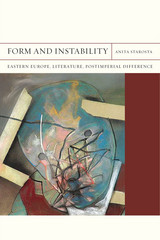
Located at the intersection of comparative literature, area studies, and literary theory, this interdisciplinary study has a twofold commitment: to Eastern Europe on the one hand and to literature on the other. It aims to intervene in the way we conceive of Eastern Europe by seeking to develop a more equitable way of thinking, one that avoids subordinating it to Eurocentric narratives of progress. At the same time, it marshals literature as both object and method of this rethinking, in order to extend existing conceptions of the usefulness and of the proper organization of literary studies. The three terms in the title of this book mark a passage—via literature—from “Eastern Europe” as an inadequate and obsolescent category to “post-imperial difference” as a more accurate, if provisional, account of the region. By way of original readings of particular texts, and by attending to literature as a critical

Divided into four parts, the papers collected in Volume II explore language in use; semantics and pragmatics; text and discourse; and language in society.
Divided into four parts, the papers collected in Volume III explore the organization of linguistic knowledge; the foundations of constructing grammar; construction grammar analyses; and constructions and language in use.
Form and Reform: Reading across the Fifteenth Century challenges the idea of any definitive late medieval moment and explores instead the provocatively diverse, notably untidy, and very rich literary culture of the age. These essays from leading medievalists, edited by Shannon Gayk and Kathleen Tonry, both celebrate and complicate the reemergence of the fifteenth century in literary studies. Moreover, this is the first collection to concentrate on the period between 1450 and 1500—the crucial five decades, this volume argues, that must be understood to comprehend the entire century’s engagement with literary form in shifting historical contexts.

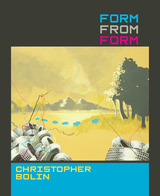
“Was it a crater or a sinkhole?” asks a voice in one of the mysterious, wonderstruck poems in Christopher Bolin’s Form from Form, whose cadences modulate with the energies of form-making, deformation, and elusive reformation. Natural forms and forms of human manufacture, forms of absence and those of urgent desire construct and deconstruct each other in Bolin’s singular music, which blends unnerving plainness and obliqueness, the childlike and the alien.
As their sites drift from workers’ camps to city squares, isolated coasts to windswept plains, the poems in Form from Form trace a map of a fragmented ecology, dense with physical detail of altered landscapes and displaced populations. In tones of austere beauty and harsh discordance, these poems provide a “field guide to luminescent things,” a visionary fretwork of the possibilities and impossibilities of faith in the present moment.
The meaning of any linguistic expression resides not only in the words, but also in the ways that those words are conveyed. In her new study, Miako N. P. Rankin highlights the crucial interrelatedness of form and meaning at all levels in order to consider specific types of American Sign Language (ASL) expression. In particular, Form, Meaning, and Focus in American Sign Language considers how ASL expresses non-agent focus, similar to the meaning of passive voice in English.
Rankin’s analyses of the form-meaning correspondences of ASL expressions of non-agent focus reveals an underlying pattern that can be traced across sentence and verb types. This pattern produces meanings with various levels of focus on the agent. Rankin has determined in her meticulous study that the pattern of form-meaning characteristic of non-agent focus in ASL is used prolifically in day-to-day language. The recognition of the frequency of this pattern holds implications regarding the acquisition of ASL, the development of curricula for teaching ASL, and the analysis of ASL discourse in effective interpretation.
Immanuel Kant’s claim that the categorical imperative of morality is based in practical reason has long been a source of puzzlement and doubt, even for sympathetic interpreters. Kant’s own explanations, which mainly concern his often-criticized formula of universal law, are laconic and obscure, leading interpreters to dismiss them in favor of less ambitious claims involving his other famous formulas.
In The Form of Practical Knowledge, Stephen Engstrom provides an illuminating new interpretation of the categorical imperative, arguing that we have exaggerated and misconceived Kant’s break with tradition: Kant never departs from the classical conception of practical reason as a capacity for knowledge of the good. His distinctive contribution is the idea that morality’s imperatives express the form of such knowledge.
By developing an account of practical knowledge that situates Kant’s ethics within his broader epistemology and rethinks numerous topics in his moral psychology and in his account of practical reason (including desire, intention, choice, will, as well as pleasure, happiness, and the good), Engstrom’s work promises to deepen and to reshape our understanding of Kantian ethics.
By any measure—international reputation, influence upon fellow writers and later generations, number of books published, scholarly and critical attention—Robert Creeley (1926–2005) is a literary giant, an outstanding, irreplaceable poet. For many decades readers have remarked upon the almost harrowing emotional nakedness of Creeley’s writing. In the years since his death, it may be that the disappearance of the writer allows that nakedness to be observed more readily and without embarrassment.
Written by the foremost critics of his poetry, Form, Power, and Person in Robert Creeley’s Life and Work is the first book to treat Creeley’s career as a whole. Masterfully edited by Stephen Fredman and Steve McCaffery, the essays in this collection have been gathered into three parts. Those in “Form” consider a variety of characteristic formal qualities that differentiate Creeley from his contemporaries. In “Power,” writers reflect on the pressure exerted by emotions, gender issues, and politics in Creeley’s life and work. In “Person,” Creeley’s unique artistic and psychological project of constructing a person—reflected in his correspondence, teaching, interviews, collaborations, and meditations on the concept of experience—is excavated. While engaging these three major topics, the authors remain, as Creeley does, intent upon the ways such issues appear in language, for Creeley’s nakedness is most conspicuously displayed in his intimate relationship with words.
Contributors
Charles Altieri
Rachel Blau DuPlessis
Stephen Fredman
Benjamin Friedlander
Alan Golding
Michael Davidson
Steve McCaffery
Peter Middleton
Marjorie Perloff
Peter Quartermain
Libbie Rifkin
From Mariano Azuela's 1915 novel Los de abajo to Rosamaría Roffiel's Amora of 1989, fragmented narrative has been one of the defining features of innovative Mexican fiction in the twentieth century. In this innovative study, Carol Clark D'Lugo examines fragmentation as a literary strategy that reflects the social and political fissures within modern Mexican society and introduces readers to a more participatory reading of texts.
D'Lugo traces defining moments in the development of Mexican fiction and the role fragmentation plays in each. Some of the topics she covers are nationalist literature of the 1930s and 1940s, self-referential novels of the 1950s that focus on the process of reading and writing, the works of Carlos Fuentes, novels of La Onda that came out of rebellious 1960s Mexican youth culture, gay and lesbian fiction, and recent women's writings.
With its sophisticated theoretical methodology that encompasses literature and society, this book serves as an admirable survey of the twentieth-century Mexican novel. It will be important reading for students of Latin American culture and history as well as literature.
In the spring of 1968, the English faculty at the University of Wisconsin-Madison (UW) voted to remedialize the first semester of its required freshman composition course, English 101. The following year, it eliminated outright the second semester course, English 102. For the next quarter-century, UW had no real campus-wide writing requirement, putting it out of step with its peer institutions and preventing it from fully joining the “composition revolution” of the 1970s. In From Form to Meaning, David Fleming chronicles these events, situating them against the backdrop of late 1960s student radicalism and within the wider changes taking place in U.S. higher education at the time.
Fleming begins with the founding of UW in 1848. He examines the rhetorical education provided in the university’s first half-century, the birth of a required, two semester composition course in 1898, faculty experimentation with that course in the 1920s and 1930s, and the rise of a massive “current-traditional” writing program, staffed primarily by graduate teaching assistants (TAs), after World War II. He then reveals how, starting around 1965, tensions between faculty and TAs concerning English 101-102 began to mount. By 1969, as the TAs were trying to take over the committee that supervised the course, the English faculty simply abandoned its long-standing commitment to freshman writing.
In telling the story of composition’s demise at UW, Fleming shows how contributing factors—the growing reliance on TAs; the questioning of traditional curricula by young instructors and their students; the disinterest of faculty in teaching and administering general education courses—were part of a larger shift affecting universities nationally. He also connects the events of this period to the long, embattled history of freshman composition in the United States. And he offers his own thoughts on the qualities of the course that have allowed it to survive and regenerate for over 125 years.
“Bottom line is, I’m the kind of guy who’s happy to go to the opera, but I should like to be allowed to wear steel-toed boots with my evening suit. I like to read Harper’s with a chaser of Varmint Hunter Magazine. Maybe that’s why I enjoy a good show under canvas. Here we sit, brain-deep in arts and culture, but we’re also just people hanging out in a tent, some of us wearing boots, a few of us wearing Birkenstocks, but best of all we’re breathing free fresh air filled with music.”
From Scandihoovian Spanglish to snickering chickens, New York Times bestselling author and humorist Michael Perry navigates a wide range of topics in this collection of brief essays drawn from his weekly appearances on the nationally syndicated Tent Show Radio program. Fatherhood, dumpster therapy, dangerous wedding rings, Christmas trees, used cars, why you should have bacon in your stock portfolio, loggers in clogs—whatever the subject, Perry has a rare ability to touch both the funny bone and the heart.
In premodern China, elite painters used imagery not to mirror the world around them, but to evoke unfathomable experience. Considering their art alongside the philosophical traditions that inform it, The Great Image Has No Form explores the “nonobject”—a notion exemplified by paintings that do not seek to represent observable surroundings.
François Jullien argues that this nonobjectifying approach stems from the painters’ deeply held belief in a continuum of existence, in which art is not distinct from reality. Contrasting this perspective with the Western notion of art as separate from the world it represents, Jullien investigates the theoretical conditions that allow us to apprehend, isolate, and abstract objects. His comparative method lays bare the assumptions of Chinese and European thought, revitalizing the questions of what painting is, where it comes from, and what it does. Provocative and intellectually vigorous, this sweeping inquiry introduces new ways of thinking about the relationship of art to the ideas in which it is rooted.
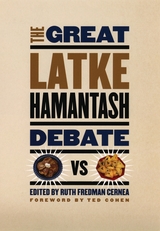
What began as an informal gathering is now an institution that has been replicated on campuses nationwide. Highly absurd yet deeply serious, the annual debate is an
opportunity for both ethnic celebration and academic farce. In poetry, essays, jokes, and revisionist histories, members of elite American academies attack the latke-versus-hamantash question with intellectual panache and an unerring sense of humor, if not chutzpah. The Great Latke-Hamantash Debate is the first collection of the best of these performances, from Martha Nussbaum's paean to both foods—in the style of Hecuba's Lament—to Nobel laureate Leon Lederman's proclamation on the union of the celebrated dyad. The latke and the hamantash are here revealed as playing a critical role in everything from Chinese history to the Renaissance, the works of Jane Austen to constitutional law.
Philosopher and humorist Ted Cohen supplies a wry foreword, while anthropologist Ruth Fredman Cernea provides historical and social context as well as an overview of the Jewish holidays, latke and hamantash recipes, and a glossary of Yiddish and Hebrew terms, making the book accessible even to the uninitiated. The University of Chicago may have split the atom in 1942, but it's still working on the equally significant issue of the latke versus the hamantash.
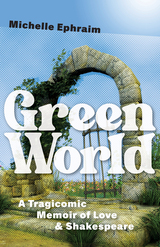
At twenty-three, Michelle Ephraim was failing at everything. The only child of reclusive Holocaust-survivor parents who were dismayed by her literary studies, she found herself dumped by her boyfriend and bombing out of graduate school. Then, one night, she crashed a Shakespeare recitation party. Loopy from vodka and never having read a single line of Shakespeare, she was transfixed. Shakespeare, she decided, was the lifeline she needed.
Green World is the hilarious and heartbreaking story of Ephraim’s quest to become a Shakespeare scholar and to find community and home. As she studies Shakespeare, Ephraim’s world uncannily begins to mirror the story of the Jewish daughter in The Merchant of Venice, and she finds herself in a Green World, an idyllic place where Shakespeare’s heroines escape their family trauma. Green World reckons with global, historical, and personal tragedy and shows how literature—comic and tragic—can help us brave every kind of anguish.
I started thinking: Western civilization is neither healthy, happy, nor holy. Humor is all three. Humor is not only holy, it's Heavenly. And if you are surprised to be told that humor is Heavenly, you need to read this book because you reveal your misunderstanding of both humor and Heaven. If you ask, 'Is there laughter in Heaven?' my answer is: 'You can't be serious!'"
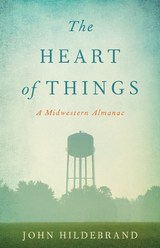
In this remarkable book of days, John Hildebrand charts the overlapping rings—home, town, countryside—of life in the Midwest. Like E. B. White, Hildebrand locates the humor and drama in ordinary life: church suppers, Friday night football, outdoor weddings, garden compost, family reunions, roadside memorials, camouflage clothing. In these wry, sharply observed essays, the Midwest isn’t The Land Time Forgot but a more complicated (and vastly more interesting) place where the good life awaits once we figure exactly out what it means. From his home range in northwestern Wisconsin, Hildebrand attempts to do just that by boiling down a calendar year to its rich marrow of weather, animals, family, home—in other words, all the things that matter.
The Ideal of the Practical is a study of efforts by a segment of the upper class in an aristocratic Latin American society to alter cultural values in the society, creating stronger orientations toward the technical and the practical. Frank Safford describes attempts by members of Colombia’s nineteenth-century political elite to use technical education as a means of nurturing energetic upper-class entrepreneurs and an industrious working class in a static agrarian economy. In the course of his analysis, Safford sketches the historical development of scientific and technical education and of the engineering profession in Colombia.
The book opens with a description of the economic and social context of early nineteenth-century Colombia. It then discusses some early experiments with manual industrial training between 1820 and 1850. Later chapters deal with the careers of upper-class youths sent abroad for scientific and technical training, the growth of indigenous engineering education, and the crystallization of a Colombian engineering profession. While the book primarily explores the nineteenth century, it also touches on eighteenth-century Spanish Bourbon antecedents and provides an epilogue on the twentieth-century evolution of technical elites in Colombia.
The author focuses on the reasons why the implantation of technical education and technical orientations proved difficult. He examines the interplay between various obstructions: on the one hand, a hierarchical social structure and aristocratic social values and, on the other, obstructions created by fundamental geographic and economic conditions. He concludes that, while Colombian leaders had hoped that technical education and the development of values oriented toward the technical would spearhead economic growth, in fact economic growth proved a prerequisite for the effective implantation of technical orientations and training.
This book closes the gap in research on this subject. By developing the frameworks of Head Driven Phrase Structure Grammar and Situation Semantics, the authors provide an account that rigorously integrates syntactic, semantic, and contextual dimensions of interrogatives. The challenge of providing exhaustive coverage of the interrogative constructions of English, including various constructions that occur solely in dialogue interaction, leads to new insights about a variety of contentious theoretical issues. These include matters of semantic ontology, the quantificational status of wh-phrases, the semantic effect of wh-fronting, the status of constructions in grammatical theory, the integration of illocutionary information in the grammar, and the nature of ellipsis resolution in dialogue. The account is stated with sufficient rigor to enable fairly direct computational implementation.
“Jewish stories,” writes Adam Biro, “resemble every people’s stories.” Yet at the same time there is no better way to understand the soul, history, millennial suffering, or, crucially, the joys of the Jewish people than through such tales—“There’s nothing,” writes Biro, “more revelatory of the Jewish being.”
With Is It Good for the Jews? Biro offers a sequel to his acclaimed collection of stories Two Jews on a Train. Through twenty-nine tales—some new, some old, but all finely wrought and rich in humor—Biro spins stories of characters coping with the vicissitudes and reverses of daily life, while simultaneously painting a poignant portrait of a world of unassimilated Jewish life that has largely been lost to the years. From rabbis competing to see who is the most humble, to the father who uses suicide threats to pressure his children into visiting, to three men berated by the Almighty himself for playing poker, Biro populates his stories with memorable characters and absurd—yet familiar—situations, all related with a dry wit and spry prose style redolent of the long tradition of Jewish storytelling.
A collection simultaneously of foibles and fables, adversity and affection, Is It Good for the Jews? reminds us that if in the beginning was the word, then we can surely be forgiven for expecting a punch line to follow one of these days.

Sol sits on the sidewalk bench and waits patiently for nearly half an hour. Finally, Abe reappears.
"Well," asks Sol, "what are they up to? Who are they trying to convert? Why do they care? Did you get the $1,000?"
Indignantly Abe replies, "Money. That's all you people care about."
Ted Cohen thinks that's not a bad joke. But he also doesn't think it's an easy joke. For a listener or reader to laugh at Abe's conversion, a complicated set of conditions must be met. First, a listener has to recognize that Abe and Sol are Jewish names. Second, that listener has to be familiar with the widespread idea that Jews are more interested in money than anything else. And finally, the listener needs to know this information in advance of the joke, and without anyone telling him or her. Jokes, in short, are complicated transactions in which communities are forged, intimacy is offered, and otherwise offensive stereotypes and cliches lose their sting—at least sometimes.
Jokes is a book of jokes and a book about them. Cohen loves a good laugh, but as a philosopher, he is also interested in how jokes work, why they work, and when they don't. The delight at the end of a joke is the result of a complex set of conditions and processes, and Cohen takes us through these conditions in a philosophical exploration of humor. He considers questions of audience, selection of joke topics, the ethnic character of jokes, and their morality, all with plenty of examples that will make you either chuckle or wince. Jokes: more humorous than other philosophy books, more philosophical than other humor books.
"Befitting its subject, this study of jokes is . . . light, funny, and thought-provoking. . . . [T]he method fits the material, allowing the author to pepper the book with a diversity of jokes without flattening their humor as a steamroller theory might. Such a book is only as good as its jokes, and most of his are good. . . . [E]ntertainment and ideas in one gossamer package."—Kirkus Reviews
"One of the many triumphs of Ted Cohen's Jokes-apart from the not incidental fact that the jokes are so good that he doesn't bother to compete with them-is that it never tries to sound more profound than the jokes it tells. . . . [H]e makes you feel he is doing an unusual kind of philosophy. As though he has managed to turn J. L. Austin into one of the Marx Brothers. . . . Reading Jokes makes you feel that being genial is the most profound thing we ever do-which is something jokes also make us feel-and that doing philosophy is as natural as being amused."—Adam Phillips, London Review of Books
"[A] lucid and jargon-free study of the remarkable fact that we divert each other with stories meant to make us laugh. . . . An illuminating study, replete with killer jokes."—Kevin McCardle, The Herald (Glasgow)
"Cohen is an ardent joke-maker, keen to offer us a glimpse of how jokes are crafted and to have us dwell rather longer on their effects."—Barry C. Smith, Times Literary Supplement
"Because Ted Cohen loves jokes, we come to appreciate them more, and perhaps think further about the quality of good humor and the appropriateness of laughter in our lives."—Steve Carlson, Christian Science Monitor
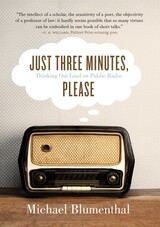
What’s wrong with the contemporary American medical system? What does it mean when a state’s democratic presidential primary casts 40% of its votes for a felon incarcerated in another state? What’s so bad about teaching by PowerPoint? What is truly the dirtiest word in America?
These are just a few of the engaging and controversial issues that Michael Blumenthal, poet, novelist, essayist, and law professor, tackles in this collection of poignant essays commissioned by West Virginia Public Radio.
In these brief essays, Blumenthal provides unconventional insights into our contemporary political, educational, and social systems, challenging us to look beyond the headlines to the psychological and sociological realities that underlie our conventional thinking.
As a widely published poet and novelist, Blumenthal brings along a lawyer’s analytical ability with his literary sensibility, effortlessly facilitating a distinction between the clichés of today’s pallid political discourse and the deeper realities that lie beneath. This collection will captivate and provoke those with an interest in literature, politics, law, and the unwritten rules of our social and political engagements.
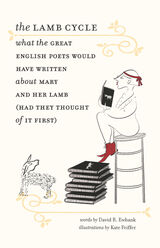
In The Lamb Cycle, David R. Ewbank achieves the unthinkable—he writes so convincingly in the style of the great English poets that one could be lulled into thinking that Shakespeare himself was inspired to muse upon the subject of “Mary Had a Little Lamb.” Ewbank captures not only the style of each of the poets he chooses, but also their preoccupations and subject matter. So D.H. Lawrence’s Mary longs for her lamb as any woman longing for her lover, whilst T.S. Eliot’s Mary is recollected by an old man looking back on his life. Alexander Pope writes an “An Essay on Lambs,” and Tennyson’s lotus eaters become “The Clover Eater.” Brilliantly written, sophisticated, and laugh-out-loud funny, these poems, enhanced by Kate Feiffer’s charming illustrations, will enchant anyone who has ever read an English poem.

Maimonides’ Guide of the Perplexed has traditionally been read as an attempt to harmonize reason and revelation. Another, more recent interpretation takes the contradiction between philosophy and religion to be irreconcilable, and concludes that the Guide prescribes religion for the masses and philosophy for the elite. Moving beyond these familiar debates, Josef Stern argues that the perplexity addressed in this famously enigmatic work is not the conflict between Athens and Jerusalem but the tension between human matter and form, between the body and the intellect.
Maimonides’ philosophical tradition takes the perfect life to be intellectual: pure, undivided contemplation of all possible truths, from physics and cosmology to metaphysics and God. According to the Guide, this ideal cannot be realized by humans. Their embodied minds cannot achieve scientific knowledge of metaphysics, and their bodily impulses interfere with exclusive contemplation. Closely analyzing the arguments in the Guide and its original use of the parable as a medium of philosophical writing, Stern articulates Maimonides’ skepticism about human knowledge of metaphysics and his heterodox interpretations of scriptural and rabbinic parables. Stern shows how, in order to accommodate the conflicting demands of the intellect and the body, Maimonides creates a repertoire of spiritual exercises, reconceiving the Mosaic commandments as training for the life of the embodied mind. By focusing on the philosophical notions of matter and form, and the interplay between its literary form and subject matter, Stern succeeds in developing a unified, novel interpretation of the Guide.
Meaning, Form, and Body brings together renowned figures in the field of cognitive linguistics to discuss two related research areas in the study of linguistics: the integration of form and meaning and language and the human body. Among the numerous topics discussed are grammatical constructions, conceptual integration, and gesture.
Media Materialities brings together a team of scholars to analyze the increasingly complex relationships between media forms and formats, materiality, and meaning. Deploying a number of different qualitative methodologies, the contributors address three overarching concepts: form, format, and ephemeral meaning. They investigate a range of media artifacts, such as 8mm film, board game maps, videogames, cassette tapes, transistor radios, and Twitter. Their goal is to create spaces for conversation and debate about the implications that this plurality of material meanings might have for the study of media, culture, and society.
Including some 260 drawings, this collection is the first comprehensive focus on his work as an artist, a cartoonist, and an illustrator. With commentary from a host of preeminent cartoonists and writers, including Ian Frazier, Seymour Chwast, and Michael Maslin, A Mile and a Half of Lines celebrates the significance of Thurber’s spontaneous, unstudied, and novel drawing style that not only altered the nature of American cartooning but also expanded the very possibilities of an illustrated line. Coinciding with the first major retrospective of Thurber’s art presented by the Columbus Museum of Art in 2019, A Mile and a Half of Lines showcases both classic Thurber as well as visual material never before seen in print.
“These notes are about the process of design: the process of inventing things which display new physical order, organization, form, in response to function.” This book, opening with these words, presents an entirely new theory of the process of design.
In the first part of the book, Christopher Alexander discusses the process by which a form is adapted to the context of human needs and demands that has called it into being. He shows that such an adaptive process will be successful only if it proceeds piecemeal instead of all at once. It is for this reason that forms from traditional un-self-conscious cultures, molded not by designers but by the slow pattern of changes within tradition, are so beautifully organized and adapted. When the designer, in our own self-conscious culture, is called on to create a form that is adapted to its context he is unsuccessful, because the preconceived categories out of which he builds his picture of the problem do not correspond to the inherent components of the problem, and therefore lead only to the arbitrariness, willfulness, and lack of understanding which plague the design of modern buildings and modern cities.
In the second part, Mr. Alexander presents a method by which the designer may bring his full creative imagination into play, and yet avoid the traps of irrelevant preconception. He shows that, whenever a problem is stated, it is possible to ignore existing concepts and to create new concepts, out of the structure of the problem itself, which do correspond correctly to what he calls the subsystems of the adaptive process. By treating each of these subsystems as a separate subproblem, the designer can translate the new concepts into form. The form, because of the process, will be well-adapted to its context, non-arbitrary, and correct.
The mathematics underlying this method, based mainly on set theory, is fully developed in a long appendix. Another appendix demonstrates the application of the method to the design of an Indian village.
This, in a nutshell, is the central problem in the theory of art. It has fascinated philosophers from Plato to Wittgenstein. And it fascinates artists and art historians, who have always drawn extensively on philosophical ideas about language and representation, and on ideas about vision and the visible world that have deep philosophical roots.
John Hyman’s The Objective Eye is a radical treatment of this problem, deeply informed by the history of philosophy and science, but entirely fresh. The questions tackled here are fundamental ones: Is our experience of color an illusion? How does the metaphysical status of colors differ from that of shapes? What is the difference between a picture and a written text? Why are some pictures said to be more realistic than others? Is it because they are especially truthful or, on the contrary, because they deceive the eye?
The Objective Eye explores the fundamental concepts we use constantly in our most innocent thoughts and conversations about art, as well as in the most sophisticated art theory. The book progresses from pure philosophy to applied philosophy and ranges from the metaphysics of color to Renaissance perspective, from anatomy in ancient Greece to impressionism in nineteenth-century France. Philosophers, art historians, and students of the arts will find The Objective Eye challenging and absorbing.

Of Huck and Alice was first published in 1983. Minnesota Archive Editions uses digital technology to make long-unavailable books once again accessible, and are published unaltered from the original University of Minnesota Press editions.
Huck Finn and Alice B. Toklas allow Mark Twain and Gertrude Stein to slip away from the cramped and smothery intentions of proper writing. Like Krazy Kat, who transforms the hurt of Ignatz Mouse's brick into humorous bliss, Huck and Alice brilliantly misrepresent painful authority. As exemplars of humorous skepticism, Mark Twain and Gertrude Stein are at the center of this far-ranging book that begins with an examination of Jacksonian dialect humor, ends with an account of the humorous style in post-modern American fiction, and considers along the way the sweet parlance of Krazy Kat, the meaning of Harpo Marx's silence, and the iconicity of Woody Allen's face. Schmitz's analysis of the humorous style explores the texture of its language, discusses its preferred forms, and shows how the humorist frames his or her question within the text.
On Development is, as John Tyler Bonner says, “a book on ideas,” the ideas at stake in the contest to unravel the mechanisms of life. This fluent discussion of developmental biology synthesizes decades of intensive progress in specialized areas of the science: from the dramatic deciphering of the genetic code to detailed analyses of animal behavior patterns. Placing these discoveries in an evolutionary context, Bonner explores the continuities and the transitoriness of individual lives and individual forms.
He begins by discussing the ubiquity among organisms of developmental cycles and their universal properties, including senescence and death. He argues that the life cycle itself is an object of natural selection and shows how, in any species, it reflects the evolutionary tradeoff between energy requirements of the individual and reproductive efficiency of the species. Although nucleic acids are thought to be the ultimate and fundamental source of genetic regulation, Bonner points out that a massive amount of information required for normal development is not directly controlled by nuclear DNA during the life cycle. Each life cycle is governed by some immediate instructions from the genes and by many gene-initiated instructions that were given in previous life cycles and have accumulated in various parts of the fertilized egg. All of these instructions taken together govern the development of a new organism.
Acknowledging the great value of reductionist theories in biology, Bonner constructs his synthetic view of development without resorting to vitalist concepts or to hand-waving explanations. He draws examples and evidence from more than half a century of biological research, from sources as diverse as Spemann and Spiegelman. Certain organisms, such as the cellular slime molds, upon which Bonner himself has conducted a number of original experiments, and the social insects provide crucial examples of dramatic evolutionary increments in biological complexity and offer insight into the control mechanisms that make such advances possible.
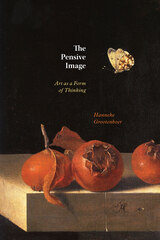
While the philosophical dimension of painting has long been discussed, a clear case for painting as a form of visual thinking has yet to be made. Traditionally, vanitas still life paintings are considered to raise ontological issues while landscapes direct the mind toward introspection. Grootenboer moves beyond these considerations to focus on what remains unspoken in painting, the implicit and inexpressible that manifests in a quality she calls pensiveness. Different from self-aware or actively desiring images, pensive images are speculative, pointing beyond interpretation. An alternative pictorial category, pensive images stir us away from interpretation and toward a state of suspension where thinking through and with the image can start.
In fluid prose, Grootenboer explores various modalities of visual thinking— as the location where thought should be found, as a refuge enabling reflection, and as an encounter that provokes thought. Through these considerations, she demonstrates that artworks serve as models for thought as much as they act as instruments through which thinking can take place. Starting from the premise that painting is itself a type of thinking, The Pensive Image argues that art is capable of forming thoughts and shaping concepts in visual terms.
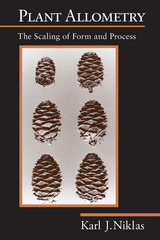
Niklas covers a broad spectrum of plant life, from unicellular algae to towering trees, including fossil as well as extant taxa. He examines the relation between organic size and variations in plant form, metabolism, reproduction, and evolution, and draws on the zoological literature to develop allometric techniques for the peculiar problems of plant height, the relation between body mass and body length, and size-correlated variations in rates of growth. For readers unfamiliar with the basics of allometry, an appendix explains basic statistical methods.
For botanists interested in an original, quantitative approach to plant evolution and function, and for zoologists who want to learn more about the value of allometric techniques for studying evolution, Plant Allometry makes a major contribution to the study of plant life.
This volume emphasizes not only methods of biomechanical analysis but also the ways in which it allows one to ask, and answer, a host of interesting questions. As Niklas points out in the first chapter, "From the archaic algae to the most derived multicellular terrestrial plants, from the spectral properties of light-harvesting pigments in chloroplasts to the stacking of leaves in the canopies of trees, the behavior of plants is in large part responsive to and intimately connected with the physical environment. In addition, plants tend to be exquisitely preserved in the fossil record, thereby giving us access to the past." Its biomechanical analyses of various types of plant cells, organs, and whole organisms, and its use of the earliest fossil records of plant life as well as sophisticated current studies of extant species, make this volume a unique and highly integrative contribution to studies of plant form, evolution, ecology, and systematics.
"Play Redux excels in tying together intellectual traditions that are rooted in literary studies, cognitive science, play studies and several other fields, thereby creating a logical whole. Through this, the book makes service to several academic communities by pointing out their points of contact. This is clearly an important contribution to a growing academic field, and will no doubt become important in many future discussions about digital games and play."
---Frans Mäyrä, University of Tampere, Finland
"David Myers has researched video games longer than anyone else. Play Redux shows him continually relevant, never afraid of courting controversy."
---Jesper Juul, IT University of Copenhagen, Denmark
Play Redux is an ambitious description and critical analysis of the aesthetic pleasures of video game play, drawing on early twentieth-century formalist theory and models of literature. Employing a concept of biological naturalism grounded in cognitive theory, Myers argues for a clear delineation between the aesthetics of play and the aesthetics of texts. In the course of this study, Myers asks a number of interesting questions: What are the mechanics of human play as exhibited in computer games? Can these mechanisms be modeled? What is the evolutionary function of cognitive play, and is it, on the whole, a good thing? Intended as a provocative corrective to the currently ascendant, if not dominant, cultural and ethnographic approach to game studies and play, Play Redux will generate interest among scholars of communications, new media, and film.
David Myers is Reverend Aloysius B. Goodspeed Distinguished Professor at the School of Mass Communication, Loyola University New Orleans.
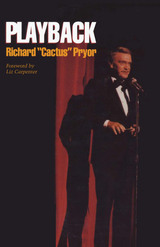
From the town that brought you Molly Ivins, Liz Carpenter, John Henry Faulk, and Greater Tuna, here's Cactus Pryor. For decades, Cactus' wit and wisdom have delighted radio listeners, as well as the many social, political, business, and philanthropic groups throughout the United States whose functions have been enlivened by this accomplished master of ceremonies and after-dinner speaker.
Now the University of Texas Press takes great pleasure in bringing you this quintessential Texas humorist. Playback gathers over forty of Cactus Pryor's favorite radio essays, translating "ear words into eye words," as he puts it. In these pieces, Cactus paints vivid word pictures of people and places, offering readers the same "you are there" immediacy that makes his radio broadcasts so popular. In them, you'll take a sentimental journey with Cactus and his wife to the Maui grave site of Charles Lindbergh—discover how legendary University of Texas football coach Darrell Royal faced the agony of defeat with humor—meet unsung heroes like the 104-year-old who's teaching himself to read and write—get acquainted with the notable folks Cactus has known, including Lady Bird Johnson, John Wayne, Jane Fonda, and James Michener—and, of course, share Cactus' love of family, friends, and the Texas coast.
As Bailey White's essays on National Public Radio have introduced listeners across the country to the lifeways of the Deep South, so Cactus Pryor offers a humorous, revealing look at how we Texans view ourselves, our neighbors, and the world. Read Playback now, and see what you've been missing.
Praise for Annie Finch
“A self-proclaimed ‘postmodern poetess,’ Annie Finch lives up to the moniker, presenting a simultaneously thorough and mercurial array of musings on poetics focusing on form and meter, remaining three beats ahead of the rank-and-file herd of traditional prosodists.”
—Art New England
For beginning or advanced students of poetry focused on the art of structuring a poem, A Poet’s Ear serves as a handbook to writing in numerous fixed forms. Here, Annie Finch’s remarkably in-depth introduction to poetic form in English opens a new and exciting world to contemporary poets. From the basic meters and traditional European forms of the ballad and the sonnet to poetic forms brought to English from worldwide cultures and postmodern forms and techniques, A Poet’s Ear serves as both a survey and a guide to the exploration of poetic form. More diverse and comprehensive than any other form handbook, A Poet’s Ear will be essential to the serious student of poetry.
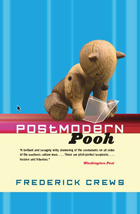
Questions of Form was first published in 1989. Minnesota Archive Editions uses digital technology to make long-unavailable books once again accessible, and are published unaltered from the original University of Minnesota Press editions.
In Questions on Form, Joelle Proust traces the concept of the analytic proposition from Kant's development of the notion down to its place in the work of Rudolf Carnap, a founder of logical empiricism and a key figure in contemporary analytic philosophy. Using a method known in France as topique comparative,she provides a rigorous exposition of analyticity, situating it within four major philosophical systems—those of Kant, Bolzano, Frege, and Carnap—and clearly delineating its development from one system to the next.
Proust takes as her point of departure Kant's distinction between analytic and synthetic judgments. Though she makes clear that Kant drew on Locke, Hume, and Leibniz, she argues that his notion of analyticity was innovative, not simply an elaboration of something already found in their work. She shows that the analytic proposition unexpectedly (given its modest status in Kant) came to play an important part in efforts to convert problems considered "transcendental" into questions of belonging to formal logic.
Ultimately, her comparison of their systems reveals that the concept of the analytic, however specific its rile in each, remains linked to a foundationalist strategy—in effect, to the transcendentalist questions Kant used when he reinterpreted the findings of his empiricist predecessors. Hence, this book's provocative claim: today's so-called logical empiricism owes much more to Kant's notion of science than to Hume's.
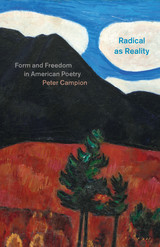
Through close readings of the great modernists, midcentury objectivists, late twentieth-century poets, his contemporaries, and more, Campion unearths an American poetic landscape that is subtler and more varied than most critics have allowed. He discovers commonalities among poets considered opposites, dramatizes how form and history are mutually entailing, and explores how the conventions of poetry, its inheritance, and its inventions sprang from the tensions of ordinary life. At its core, this is a book about poetic making, one that reveals how the best poets not only receive but understand and adapt what comes before them, reinterpreting the history of their art to create work that is, indeed, radical as reality.
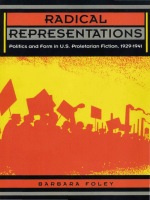
Josephine Herbst, William Attaway, Jack Conroy, Thomas Bell and Tillie Olsen, are among the radical writers whose work Foley reexamines. Her fresh approach to the U.S. radicals' debates over experimentalism, the relation of art to propaganda, and the nature of proletarian literature recasts the relation of writers to the organized left. Her grasp of the left's positions on the "Negro question" and the "woman question" enables a nuanced analysis of the relation of class to race and gender in the proletarian novel. Moreover, examining the articulation of political doctrine in different novelistic modes, Foley develops a model for discussing the interplay between politics and literary conventions and genres.
Radical Representations recovers a literature of theoretical and artistic value meriting renewed attention form those interested in American literature, American studies, the U. S. left, and cultural studies generally.
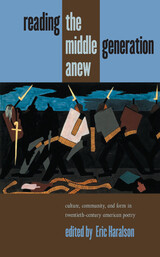
In addition to having worked during the broad middle of the last century, these poets constitute the center of twentieth-century American poetry in the larger sense, refuting invidious connotations of “middle” as coming after the great moderns and being superseded by a proliferating postmodern experimentation. This middle generation mediates the so-called American century and its prodigious body of poetry, even as it complicates historical and aesthetic categorizations.
Taking diverse formal and thematic angles on these poets—deconstructionist, biographical-historical, and more formalist accounts—this book re-examines their between-ness and ambivalence: their various positionings and repositionings in aesthetic, political, and personal matters. The essays study the interplay between these writers and such shifting formations as religious discourse, consumerism, militarism and war, the ideology of America as “nature’s nation,” and U.S. race relations and ethnic conflicts. Reading the Middle Generation Anew also shows the legacy of the middle generation, the ways in which their lives and writings continue to be a shaping force in American poetry. This fresh and invigorating collection will be of great interest to literary scholars and poets.
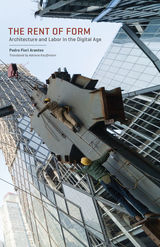
A critique of prominent architects’ approach to digitally driven design and labor practices over the past two decades
With the advent of revolutionary digital design and production technologies, contemporary architects and their clients developed a taste for dramatic, unconventional forms. Seeking to amaze their audiences and promote their global brands, “starchitects” like Herzog & de Meuron and Frank Gehry have reaped substantial rewards through the pursuit of spectacle enabled by these new technologies. This process reached a climax in projects like Gehry’s Guggenheim Bilbao and the “Bilbao effect,” in which spectacular architectural designs became increasingly sought by municipal and institutional clients for their perceived capacity to enhance property values, which author Pedro Fiori Arantes calls the “rent of form.”
Analyzing many major international architectural projects of the past twenty years, Arantes provides an in-depth account of how this “architecture of exception” has come to dominate today’s industry. Articulating an original, compelling critique of the capital and labor practices that enable many contemporary projects, Arantes explains how circulation (via image culture), consumption (particularly through tourism), the division of labor, and the distribution of wealth came to fix a certain notion of starchitecture at the center of the industry.
Significantly, Arantes’s viewpoint is not that of Euro-American capitalism. Writing from the Global South, this Brazilian theorist offers a fresh perspective that advances ideas less commonly circulated in dominant, English-language academic and popular discourse. Asking key questions about the prevailing logics of finance capital, and revealing inconvenient truths about the changing labor of design and the treatment of construction workers around the world, The Rent of Form delivers a much-needed reevaluation of the astonishing buildings that have increasingly come to define world cities.
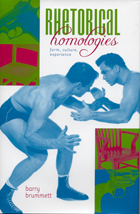
A highly developed study of the relationships between rhetoric and public culture.
One of the most widely used ideas in scholarship of the humanities and social sciences is that of homology: a formal pattern structuring different kinds of texts, ideas, and experiences. Rhetorical Homologies explores the central meaning of this form in a variety of discourses and also examines the kind of homologies that shape audience responses to personal, public, and political issues. Barry Brummett is most interested in homologies among very different orders of experience and texts: experiences on the battlefield that are homologous to those at a dining room table, for instance. What the common patterns that underlie such cases mean, why they are interesting, and why homology is rhetorical are the subjects of this study.
Brummett focuses on a wide range of topics, from the homologies between rhetoric and weapons throughout history to the homology of ritual injuries as manifested in representations of Christian martyrs, Laurel and Hardy films, the African-American practice of playing the dozens, and televised professional wrestling. Brummett also explores the homology of the Wise Woman, using rhetorical representations of Sojourner Truth and Oprah Winfrey. In a concluding chapter, Brummett argues that the idea of homology is important in understanding how social life is organized in general and that the centrality of discourse in organizing experience makes rhetorical homologies an important perspective for general knowledge beyond the boundaries of this study.
Vincent Barletta explores rhythm through three historical moments, each addressing it as a phenomenon that transcends poetry, aesthetics, and even temporality. He reveals rhythm to be a power that holds us in place, dispossesses us, and shapes the foundations of our world. In these moments, Barletta encounters rhythm as a primordial and physical binding force that establishes order and form in the ancient world, as the anatomy of lived experience in early modern Europe, and as a subject of aesthetic and ethical questioning in the twentieth century.
A wide-ranging book covering a period spanning two millennia and texts from over ten languages, Rhythm will expand the conversation around this complex and powerful phenomenon.
Raised on a small dairy farm in the Driftless Area in the mid-twentieth century, Gary Jones gets real about his rural roots. In this collection of interrelated stories, Jones writes with plainspoken warmth and irreverence about farm, family, and folks on the ridge. Readers will meet Gramp Jones, whose oversized overalls saved him from losing a chunk of flesh to an irate sow; the young one-room-school teacher who helped the kids make sled jumps at recess; Charlotte, the lawn-mowing sheep who once ended up in the living room; Victor the pig-cutter, who learned his trade from folk tradition rather than vet school; and other colorful characters of the ridge. Often humorous and occasionally touching, Jones’s essays paint a vivid picture that will entertain city and country folk alike.
New York Times bestselling author, humorist, and newspaper columnist Michael Perry returns with a new collection of bite-sized essays from his Sunday Wisconsin State Journal column, “Roughneck Grace.” Perry’s perspectives on everything from cleaning the chicken coop to sharing a New York City elevator with supermodels will have you snorting with laughter on one page, blinking back tears on the next, and--no matter your zip code--nodding in recognition throughout.
Long recognized as one of the most important eighteenth-century works on aesthetics and the visual arts, Johann Gottfried Herder's Plastik (Sculpture, 1778) has never before appeared in a complete English translation. In this landmark essay, Herder combines rationalist and empiricist thought with a wide range of sources—from the classics to Norse legend, Shakespeare to the Bible—to illuminate the ways we experience sculpture.
Standing on the fault line between classicism and romanticism, Herder draws most of his examples from classical sculpture, while nevertheless insisting on the historicity of art and of the senses themselves. Through a detailed analysis of the differences between painting and sculpture, he develops a powerful critique of the dominance of vision both in the appreciation of art and in our everyday apprehension of the world around us. One of the key articulations of the aesthetics of Sturm und Drang, Sculpture is also important as an anticipation of subsequent developments in art theory.
Jason Gaiger's translation of Sculpture includes an extensive introduction to Herder's thought, explanatory notes, and illustrations of all the sculptures discussed in the text.
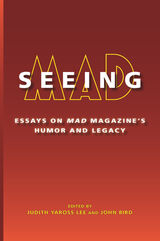
Mad magazine stands near the heart of post-WWII American humor, but at the periphery in scholarly recognition from American cultural historians, including humor specialists. This book fills that gap, with perceptive, informed, engaging, but also funny essays by a variety of scholars. The chapters, written by experts on humor, comics, and popular culture, cover the genesis of Mad; its editors and prominent contributors; its regular features and departments and standout examples of their contents; perspectives on its cultural and political significance; and its enduring legacy in American culture.
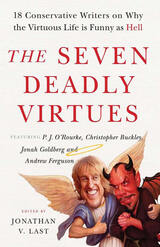
The book’s contributors include Sonny Bunch, Christopher Buckley, David “Iowahawk” Burge, Christopher Caldwell, Andrew Ferguson, Jonah Goldberg, Michael Graham, Mollie Hemingway, Rita Koganzon, Matt Labash, James Lileks, Rob Long, Larry Miller, P. J. O’Rourke, Joe Queenan, Christine Rosen, and Andrew Stiles. Jonathan V. Last, senior writer at the Weekly Standard, editor of the collection, is also a contributor. All eighteen essays in this book are appearing for the first time anywhere.
In the book’s opening essay, P. J. O’Rourke observes: “Virtue has by no means disappeared. It’s as much in public view as ever. But it’s been strung up by the heels. Virtue is upside down. Virtue is uncomfortable. Virtue looks ridiculous. All the change and the house keys are falling out of Virtue’s pants pockets.”
Here are the virtues everyone (including the book’s contributors) was taught in Sunday school but have totally forgotten about until this very moment. In this sanctimony-free zone:
• Joe Queenan observes: “In essence, thrift is a virtue that resembles being very good at Mahjong. You’ve heard about people who can do it, but you’ve never actually met any of them.”
• P. J. O’Rourke notes: “Fortitude is quaint. We praise the greatest generation for having it, but they had aluminum siding, church on Sunday, and jobs that required them to wear neckties or nylons (but never at the same time). We don’t want those either.”
• Christine Rosen writes: “A fellowship grounded in sociality means enjoying the company of those with whom you actually share physical space rather than those with whom you regularly and enthusiastically exchange cat videos.”
• Rob Long offers his version of modern day justice: if you sleep late on the weekend, you are forced to wait thirty minutes in line at Costco.
• Jonah Goldberg offers: “There was a time when this desire-to-do-good-in-all-things was considered the only kind of integrity: ‘Angels are better than mortals. They’re always certain about what is right because, by definition, they’re doing God’s will.’ Gabriel knew when it was okay to remove a mattress tag and Sandalphon always tipped the correct amount.”
• Sonny Bunch dissects forbearance, observing that the fictional Two Minutes Hate of George Orwell’s 1984 is now actually a reality directed at living, breathing people. Thanks, in part, to the Internet, “Its targets are designated by a spontaneously created mob—one that, due to its hive-mind nature—is virtually impossible to call off.”
By the time readers have completed The Seven Deadly Virtues, they won’t even realize that they’ve just been catechized into an entirely different—and better—moral universe.
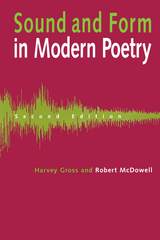
Poet, critic, and editor Robert McDowell has updated this classic text in the light of the poetic and critical developments of the last three decades. Segments on Dickinson, Robinson, Frost, Jeffers, and Lowell, among other poets, have been greatly expanded, and Ashbery, Creeley, Ginsberg, Hall, Kees, Kumin, Levertov, Levine, O'Hara, Plath, Rich, Simpson, and Wilbur added, among others. The epilogue discusses a new generation of poets whose works will likely be read well into the next century-- among others, Thomas M. Disch, Rita Dove, Dana Gioia, Emily Grosholz, Mark Jarman, Molly Peacock, Gjertrud Schnackenberg, Timothy Steele, Mary Swander, and Marilyn Nelson Waniek.
Over the last ten years, the most inspiring topic of conversation and argument among poets and their readers has been the resurgence of narrative and traditional forms. The new Sound and Form in Modern Poetry is a seminal text in this discussion, examining not only this movement but all of the important developments (Dadaism, Surrealism, Imagism, Language Poetry, and the Confessional School) that have defined our poetry in the twentieth century and have set the stage for poetry's continued life in the twenty-first. The original Sound and Form in Modern Poetry enjoyed extensive classroom use as a text; the revised version promises to be even more accessible, and more essential, for years to come.
The late Harvey Gross was Professor of Comparative Literature, State University of New York at Stony Brook.
Robert McDowell is publisher and editor of Story Line Press, and is also poet, critic, translator, fiction writer, and essayist.
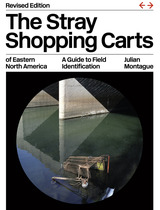
Abandoned shopping carts are everywhere, and yet we know so little about them. Where do they come from? Why are they there? Their complexity and history baffle even the most careful urban explorer.
Thankfully, artist Julian Montague has created a comprehensive and well-documented taxonomy with The Stray Shopping Carts of Eastern North America. Spanning thirty-three categories from damaged, fragment, and plow crush to plaza drift and bus stop discard, it is a tonic for times defined increasingly by rhetoric and media and less by the plain objects and facts of the real world. Montague’s incomparable documentation of this common feature of the urban landscape helps us see the natural and man-made worlds—and perhaps even ourselves—anew.
First published in 2006 to great perplexity and acclaim alike, Montague’s book now appears in refreshed and expanded form. Told in an exceedingly dry voice, with full-color illustrations and photographs throughout, it is both rigorous and absurd, offering a strangely compelling vision of how we approach, classify, and understand the environments around us. A new afterword sheds light on the origins of the project.
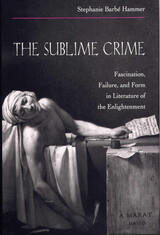
In this hermeneutic analysis of seven literary texts, Stephanie Barbé Hammer studies the roles of criminal protagonists in the dramas of George Lillo (The London Merchant) and Friedrich Schiller (The Robbers) and in the narratives of Abbé de Prévost (Manon Lescaut), Henry Fielding (Jonathan Wild), Marquis de Sade (Justine), William Godwin (Caleb Williams), and Heinrich von Kleist (Michael Kohlhaas).
Hammer reflects the current interest in cultural critique by utilizing the social theories of Michel Foucault and the feminist approaches of Hélène Cixous and Eve Sedgwick to redefine the Enlightenment as a movement of thought rather than as a strictly defined period synonymous with the eighteenth century. In addition, through the examination of the works of three post–World War II authors (Jean Genet, Anthony Burgess, and Peter Handke), Hammer suggests that the Enlightenment’s artistic representations of criminality are unparalleled by subsequent modern literature.
Hammer explains that the seven works she focuses on have been dismissed as failures by readers who have misunderstood the texts’ aesthetic elements. While claiming that the form of these works breaks down under the pressure of their criminal protagonists, she asserts that this formal failure actually contributes to the success of the works as art. The works "fail" because, like the criminal characters themselves, they break laws. The criminal protagonist effectively sabotages the official story that the text seeks to tell by deflecting the plot, style, and formal requirements in question, subverting its message—be it moral, sentimental, or libertine— through a kind of structural undermining, forcing the text beyond its own formal boundaries. For example, Hammer maintains that the presence of the criminal figure, Millwood, in Lillo’s bourgeois tragedy actually makes the play covertly antibourgeois.
Hammer insists that the criminal’s subversive presence in these seven works inaugurates new insight, and her analysis thereby challenges late twentieth-century readers to continue the investigation that the works themselves have begun.
This book will prove indispensable to scholars of comparative literature, especially eighteenth-century specialists, as well as to all individuals interested in cultural critique.
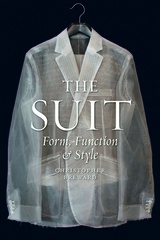
The Suit unpicks the story of this most familiar garment, from its emergence in western Europe at the end of the seventeenth century to today. Suit-wearing figures such as the Savile Row gentleman and the Wall Street businessman have long embodied ideas of tradition, masculinity, power, and respectability, but the suit has also been used to disrupt concepts of gender and conformity. Adopted and subverted by women, artists, musicians, and social revolutionaries through the decades—from dandies and Sapeurs to the Zoot Suit and Le Smoking—the suit is also a device for challenging the status quo. For all those interested in the history of menswear, this beautifully illustrated book offers new perspectives on this most mundane, and poetic, product of modern culture.
This book addresses a simple question: Are animals designed economically? The pronghorn can run at speeds of up to 60 kilometers an hour and can maintain this speed for nearly a full hour. Clearly, the form of this elegant animal is beautifully matched to the function it needs to perform.
This is symmorphosis. The theory of symmorphosis predicts that the size of the parts in a system must be matched to the overall functional demand. Moreover, it predicts that animals must provide their complex systems with a functional capacity that can cope with the highest expected functional demands, possibly including some safety margin to prevent the system from failing when it is overloaded. In Symmorphosis, Ewald Weibel tests these predictions by working out the quantitative relations between form and function.
Physiologists will value this book because Weibel shows them that morphological information can be as quantitative as physiological data. Anatomists will value the book for its demonstration that advanced integrative physiology crucially depends on adequate but rigorously quantitative and testable information on structural design. Finally, anyone interested in the origins of the diverse forms of animals will be fascinated by Weibel's demonstrations that show how animals as different as shrews, pronghorns, dogs, goats--even humans--all develop from essentially the same blueprint by variation of design. This is a hidden beauty of the animal kingdom, which can be uncovered by a rigorous investigation of the quantitative relations of form and function.
In this study of the practice of contemporary painter Gerhard Richter, Florian Klinger proposes a fundamental change in the way we think about art today. In reaction to the exhaustion of the modernist-postmodernist paradigm’s negotiation of the “essence of art,” he takes Richter to pursue a pragmatist model that understands artistic form as action. Here form is no longer conceived according to what it says—as a vehicle of expression, representation, or realization of something other than itself—but strictly according to what it does.
Through its doing, Klinger argues, artistic form is not only more real but also more shared than non-artistic reality, and thus enables interaction under conditions where it would otherwise not be possible. It is a human practice aimed at testing and transforming the limits of shared reality, urgently needed in situations where such reality breaks down or turns precarious. Drawing on pragmatist thought, philosophical aesthetics, and art history, Klinger’s account of Richter’s practice offers a highly distinctive conceptual alternative for contemporary art in general.

As Biro recounts these tales, we hear not only his voice and the voice of his father, but those of generations of storytellers who have used humor to teach about the truly important issues in life—the delicacy of love, the fragility of friendship, the pitfalls of self-righteousness, the costs of narrow-mindedness, and the unpredictability of life itself. Biro artfully spins each story, lingering on the details, guiding the reader to the inevitable—yet always unexpected—punchline.
Taken individually, these stories will make you laugh out loud; taken as a whole, they form an invaluable record of the sensibilities of an entire people. Biro writes: "These Jewish stories of which not a single one happened to me, and of which I did not invent a single one, do describe me, do characterize me, do explain me. They are always my own story. And yours."
Included are 100 of the most insightful, thought-provoking, and uplifting aphorisms about books, the joy of reading, intellectual freedom, and librarianship. You’ll find quotes from authors such as Celeste Ng, Suheir Hammad, Azar Nafisi, Junot Díaz, and Ta-Nehisi Coates; entertainers like Ziggy Marley and Stephen Colbert; and leaders such as Malala Yousafzai—all highlighting the impact of libraries and librarians.
This diverse and delightful collection makes a perfect gift for showing your appreciation to valued colleagues, volunteers, board members, and bibliophiles. And your purchase funds advocacy, awareness, and accreditation programs for library and information professionals worldwide!
In Unquiet Tropes, Tsou reconceptualizes the literature as a set of highly particular classical rhetorical tropes including antanaclasis, rhetorical question, apophasis, catachresis, and allegory. Looking at five canonical works—Aiiieeeee!, No-No Boy, China Men, Blu’s Hanging, and Native Speaker—Tsou shows how these texts use figurative means to confront the problem of race. She also explores how traces of Asian American history live on through these figures.
Each case study in Unquiet Tropes considers a different scenario—defiance, coercion, necessity, error, and deceit—to show how literary representation from the 1950s through 1997 has responded to a specific political condition.

Twenty-four linguists analyze natural and social differences in language form, use, and attitudes.
Even as a fourth-generation Jewish Texan, S. L. Wisenberg has always felt the ghost of Europe dogging her steps, making her feel uneasy in her body and in the world. At age six, she’s sure that she hears Nazis at her bedroom window and knows that after they take her away, she’ll die without her asthma meds. In her late twenties, she infiltrates sorority rush at her alma mater, curious about whether she’ll get a bid now. Later in life, she makes her first and only trip to the mikvah while healing from a breast biopsy (benign this time), prompting an exploration of misogyny, shame, and woman-fear in rabbinical tradition.
With wit, verve, blood, scars, and a solid dose of self-deprecation, Wisenberg wanders across the expanse of continents and combs through history books and family records in her search for home and meaning. Her travels take her from Selma, Alabama, where her Eastern European Jewish ancestors once settled, to Vienna, where she tours Freud’s home and figures out what women really want, and she visits Auschwitz, which—disappointingly—leaves no emotional mark.
Winner of the Westerners International Co-Founders Awards of the Western History Association, 1990.
The Revised Boy Scout Manual was a work Burroughs revisited many times, but which has never before been published in its complete form. Based primarily on recordings of a performance of the complete piece found in the archives at the OSU libraries, as well as various incomplete versions of the typescript found at Arizona State University and the New York Public Library archives, this lost masterpiece of satiric subversion is finally available in its entirety.
Martin Heidegger considered Jünger “the only genuine follower of Nietzsche,” singularly providing “an interpretation which took shape in the domain of that metaphysics which already determines our epoch, even against our knowledge; this metaphysics is Nietzsche's doctrine of the ‘will to power.’” In The Worker, Jünger examines some of the defining questions of that epoch: the nature of individuality, society, and the state; morality, justice, and law; and the relationships between freedom and power and between technology and nature.
This work, appearing in its entirety in English translation for the first time, is an important contribution to debates on work, technology, and politics by one of the most controversial German intellectuals of the twentieth century. Not merely of historical interest, The Worker carries a vital message for contemporary debates about world economy, political stability, and equality in our own age, one marked by unsettling parallels to the 1930s.
The way Venable figures it, he’s roaring along the road (at about twenty-seven miles per hour, the average speed for someone his age) to Codgerville. You Gotta Laugh to Keep From Cryin’ highlights the observations and lifestyle changes (and a few other things he can’t quite seem to remember at the moment) that Venable has made along the way.
From the day his wife discovers his first ear hair, Venable begins to recognize the signs of old age. Though he had reconciled himself to daily fiber and a distinguished head of gray, he is one step further to an insatiable desire for cafeteria food and permanently leaving his car’s right turn signal flashing.
The news isn’t all bad, though. To his surprise, Venable discovers that his new appearance and habits have qualified him for the senior discount on breakfast at his favorite restaurant. After reading about a scientific study concluding that men’s brains shrink faster than women’s in the normal aging process, Venable has a new source of excuses to explain to his wife why he is missing important dates, times, places, and appointments.
As an official CIT (Codger In Training), Venable delights in other newfound freedoms. He can stand in a fast-food line and stare at the menu for a full two minutes without saying a word (besides, he can’t hear the people behind him grumbling). He can drive as slowly as he likes and has perfected the art of maintaining a death grip on the steering wheel of his car. And he really doesn’t have to listen to anyone anymore; he can merely turn their way from time to time and mumble, “Huh?”
From the swinging doors whose “Push/Pull” directions elude him to the high-tech mysteries of ATMs designed to baffle the elderly, Sam Venable’s rollicking view of life after fifty will leave readers laughing and happy to be a member of the AARP set.
The Author: Sam Venable, recognized for his humor writing in 2000, 2001, and 2002 by the Tennessee Press Association, is a columnist for the Knoxville News-Sentinel. He is the author of a number of books, including Rock-Elephant: A Story of Friendship and Fishing and Mountain Hands: A Portrait of Southern Appalachia. He lives in Knoxville, Tennessee.
READERS
Browse our collection.
PUBLISHERS
See BiblioVault's publisher services.
STUDENT SERVICES
Files for college accessibility offices.
RECENTLY PUBLISHED




UChicago Accessibility Resources
home | accessibility | search | about | contact us
BiblioVault ® 2001 - 2024
The University of Chicago Press