
 A SCHOLARLY BOOK REPOSITORY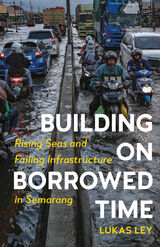
A timely ethnography of how Indonesia’s coastal dwellers inhabit the “chronic present” of a slow-motion natural disaster
Ice caps are melting, seas are rising, and densely populated cities worldwide are threatened by floodwaters, especially in Southeast Asia. Building on Borrowed Time is a timely and powerful ethnography of how people in Semarang, Indonesia, on the north coast of Java, are dealing with this global warming–driven existential challenge. In addition to antiflooding infrastructure breaking down, vast areas of cities like Semarang and Jakarta are rapidly sinking, affecting the very foundations of urban life: toxic water oozes through the floors of houses, bridges are submerged, traffic is interrupted.
As Lukas Ley shows, the residents of Semarang are constantly engaged in maintaining their homes and streets, trying to live through a slow-motion disaster shaped by the interacting temporalities of infrastructural failure, ecological deterioration, and urban development. He casts this predicament through the temporal lens of a “meantime,” a managerial response that means a constant enduring of the present rather than progress toward a better future—a “chronic present.”
Building on Borrowed Time takes us to a place where a flood crisis has already arrived—where everyday residents are not waiting for the effects of climate change but are in fact already living with it—and shows that life in coastal Southeast Asia is defined not by the temporality of climate science but by the lived experience of tidal flooding.
No fewer than forty million people have come to rely on the Colorado River system in modern times—a river system immersed in an unprecedented, unrelenting megadrought for more than two decades. Attempting to navigate this “new normal,” policymakers are in the midst of negotiating new management rules for the river system, a process coinciding with the compact’s centennial that must be completed by 2026.
Animated by this remarkable confluence of events, Cornerstone at the Confluence leverages the centennial year to reflect on the compact and broader “Law of the River” to envision the future. It is a volume inviting dialogue about how the Colorado River system’s flows should be apportioned given climate change, what should be done about environmental issues such as ecosystem restoration and biodiversity protection, and how long-standing issues of water justice facing Native American communities should be addressed.
In one form or another, all these topics touch on the concept of “equity” embedded within the compact—a concept that tees up what is perhaps the foundational question confronted by Cornerstone at the Confluence: Who should have a seat at the table of Colorado River governance?
The Green River, the most significant tributary of the Colorado River, runs 730 miles from the glaciers of Wyoming to the desert canyons of Utah. Over its course, it meanders through ranches, cities, national parks, endangered fish habitats, and some of the most significant natural gas fields in the country, as it provides water for 33 million people. Stopped up by dams, slaked off by irrigation, and dried up by cities, the Green is crucial, overused, and at-risk, now more than ever.
Fights over the river’s water, and what’s going to happen to it in the future, are longstanding, intractable, and only getting worse as the West gets hotter and drier and more people depend on the river with each passing year. As a former raft guide and an environmental reporter, Heather Hansman knew these fights were happening, but she felt driven to see them from a different perspective—from the river itself. So she set out on a journey, in a one-person inflatable pack raft, to paddle the river from source to confluence and see what the experience might teach her. Mixing lyrical accounts of quiet paddling through breathtaking beauty with nights spent camping solo and lively discussions with farmers, city officials, and other people met along the way, Downriver is the story of that journey, a foray into the present—and future—of water in the West.
This book provides an extensive knowledge base on all aspects of the San Pedro, from flora and fauna to hydrology and human use to preservation. It describes the ecological patterns and processes of this aridland river and explores both the ongoing science-driven efforts by nonprofit groups and government agencies to sustain and restore its riparian ecosystems and the science that supports these management decisions.
An interdisciplinary team of fifty-seven contributors—biologists, ecologists, geomorphologists, historians, hydrologists, lawyers, political scientists—weave together threads from their diverse perspectives to reveal the processes that shape the past, present, and future of the San Pedro’s riparian and aquatic ecosystems. They review the biological communities of the San Pedro and the stream hydrology and geomorphology that affect its riparian biota. They then look at conservation and management challenges along three sections of the San Pedro, from its headwaters in Mexico to its confluence with the Gila River, describing legal and policy issues and their interface with science; activities related to mitigation, conservation, and restoration; and a prognosis of the potential for sustaining the basin’s riparian system.
These chapters demonstrate the complexity of the San Pedro’s ecological and hydrological conditions, showing that there are no easy answers to the problems—and that existing laws are inadequate to fully address them. Collectively, they offer students, professionals, and environmental advocates a better grasp of the San Pedro’s status as well as important lessons for restoring physical processes and biotic communities to rivers in arid and semiarid regions.

The study of streams and rivers combines ecology, chemistry, hydrology, and geology to reveal factors that control the biological diversity and functioning of these unique ecosystems. Although stream ecology is a relatively young discipline, foundational papers published over the past half-century have shaped our current understanding of these ecosystems and have informed our efforts to manage and protect them. Organized thematically, each chapter of this book—on topics including the physical template, communities, food webs, ecosystem energetics, and nutrient dynamics—offers summaries of the key literature, history and context on the topic, and forward-looking discussions that examine how past research has influenced current studies and may shape future efforts.
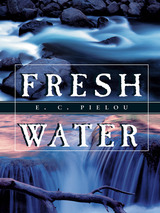
"[A] keen and detailed look at the life and history of fresh water. . . . Dip into Fresh Water. It will both stimulate and satisfy as only good natural history can."—Toronto Globe and Mail
"Pielou's ease with her subject and her no-nonsense style of writing will satisfy and inspire the poet as well as the naturalist."—Denize Springer, Express Books
"[Pielou's] writing is didactic and definitive, in places even charming, and is buttressed by clear illustrations. . . . A welcome addition to the genre of literature designed to bridge the gap between scientists . . . and the intelligent and concerned lay public."—Daniel Hillel, Nature
"A wonderful natural history of one of life's necessities, a refreshing break from the grand theory and special pleading of many a science book. . . . Read it."—Fred Pearce, New Scientist
Dryland degradation and desertification now affect almost a billion people around the world. Tragically, the biological resources and productivity of millions of acres of land are lost to desertification each year because people remain unaware of strategies and techniques that could improve yields, reduce risk, and begin healing the world's deserts. A Guide for Desert and Dryland Restoration is the first book to offer practical, field-tested solutions to this critical problem.
Author David Bainbridge has spent more than 25 years actively involved in restoring lands across the American Southwest. A Guide for Desert and Dryland Restoration presents the results of his years of fieldwork, as well as research and experience from scientists and practitioners around the globe.
The book discusses the ecology of desert plants, explores the causes of desertification and land abuse, and outlines the processes and procedures needed to evaluate, plan, implement, and monitor desert restoration projects. It sets forth economical and practical field-tested solutions for understanding site characteristics, selecting and growing plants, and ensuring that they survive with a minimal amount of water and care. Each chapter represents a guide to a critical topic for environmental restoration; extensive photographs, diagrams and drawings give detailed information for immediate application, and additional resources are included in appendixes.
A Guide for Desert and Dryland Restoration is the first comprehensive book focused on restoring arid regions, and clearly demonstrates that arid lands can be successfully rehabilitated. In addition to restorationists, the book will be an invaluable resource for anyone working in arid lands, including farmers, ranchers, gardeners, landscapers, outdoor recreation professionals, and activists.

The Negev, first published in 1971, told the story of some twenty years of study of southern Israel’s desert. It synthesized the findings of botanists, geologists, soil scientists, agronomists, archaeologists, historians, and engineers and told how the applications of their work produced an agricultural surplus in this forbiddingly dry, hot region.
Now Michael Evenari has amplified the book with data from another decade of work. He describes the efforts at a new farm at Wadi Mashash, extends the weather data another ten years, presents further work on the adaptations of plants and animals to desert conditions, and takes a much deeper look at the historical precedents for the method of runoff agriculture, which has made the desert bloom.
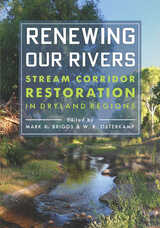
Our rivers are in crisis and the need for river restoration has never been more urgent. Water security and biodiversity indices for all of the world’s major rivers have declined due to pollution, diversions, impoundments, fragmented flows, introduced and invasive species, and many other abuses.
Developing successful restoration responses are essential. Renewing Our Rivers addresses this need head on with examples of how to design and implement stream-corridor restoration projects. Based on the experiences of seasoned professionals, Renewing Our Rivers provides stream restoration practitioners the main steps to develop successful and viable stream restoration projects that last. Ecologists, geomorphologists, and hydrologists from dryland regions of Australia, Mexico, and the United States share case studies and key lessons learned for successful restoration and renewal of our most vital resource.
The aim of this guidebook is to offer essential restoration guidance that allows a start-to-finish overview of what it takes to bring back a damaged stream corridor. Chapters cover planning, such emerging themes as climate change and environmental flow, the nuances of implementing restoration tactics, and monitoring restoration results. Renewing Our Rivers provides community members, educators, students, natural resource practitioners, experts, and scientists broader perspectives on how to move the science of restoration to practical success.
"Remarkable." —New York Times Book Review
"Clear-eyed treatise...Postel makes her case eloquently." —Booklist, starred review
"An informative, purposeful argument." —Kirkus
We have disrupted the natural water cycle for centuries in an effort to control water for our own prosperity. Yet every year, recovery from droughts and floods costs billions of dollars, and we spend billions more on dams, diversions, levees, and other feats of engineering. These massive projects not only are risky financially and environmentally, they often threaten social and political stability. What if the answer was not further control of the water cycle, but repair and replenishment?
Sandra Postel takes readers around the world to explore water projects that work with, rather than against, nature’s rhythms. In New Mexico, forest rehabilitation is safeguarding drinking water; along the Mississippi River, farmers are planting cover crops to reduce polluted runoff; and in China, “sponge cities” are capturing rainwater to curb urban flooding.
Efforts like these will be essential as climate change disrupts both weather patterns and the models on which we base our infrastructure. We will be forced to adapt. The question is whether we will continue to fight the water cycle or recognize our place in it and take advantage of the inherent services nature offers. Water, Postel writes, is a gift, the source of life itself. How will we use this greatest of gifts?
This book explores the sea and its meanings from ancient myths to contemporary geopolitics, from Atlantis to the Mediterranean migrant crisis. Richard Hamblyn traces a cultural and geographical journey from estuary to abyss, beginning with the topographies of the shoreline and ending with the likely futures of our maritime environments. Along the way he considers the sea as a site of work and endurance; of story and song; of language, leisure, and longing. By meditating on the sea as both a physical and a cultural presence, the book shines new light on the sea and its indelible place in the human imagination.
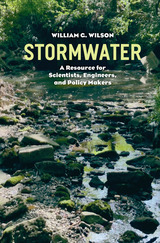
As Wilson shows, rivers of runoff flowing from manmade surfaces—such as roads, sidewalks, and industrial sites—carry a glut of sediments and pollutants. Unlike soil, pavement does not filter or biodegrade these contaminants. Oil, pesticides, road salts, metals, automobile chemicals, and bacteria all pour into stormwater systems. Often this runoff discharges directly into waterways, uncontrolled and untreated, damaging valuable ecosystems. Detailing the harm that can be caused by this urban runoff, Wilson also outlines methods of control, from restored watersheds to green roofs and rain gardens, and, in so doing, gives hope in the face of an omnipresent threat. Illustrated throughout, Stormwater will be an essential resource for urban planners and scientists, policy makers, citizen activists, and environmental educators in the stormy decades to come.
Water is an endangered resource, imperiled by population growth, mega-urbanization, and climate change. Scientists project that by 2050, freshwater shortages will affect 75 percent of the global population. Steven Mithen puts our current crisis in historical context by exploring 10,000 years of humankind’s management of water. Thirst offers cautionary tales of civilizations defeated by the challenges of water control, as well as inspirational stories about how technological ingenuity has sustained communities in hostile environments.
As in his acclaimed, genre-defying After the Ice and The Singing Neanderthals, Mithen blends archaeology, current science, and ancient literature to give us a rich new picture of how our ancestors lived. Since the Neolithic Revolution, people have recognized water as a commodity and source of economic power and have manipulated its flow. History abounds with examples of ambitious water management projects and hydraulic engineering—from the Sumerians, whose mastery of canal building and irrigation led to their status as the first civilization, to the Nabataeans, who created a watery paradise in the desert city of Petra, to the Khmer, who built a massive inland sea at Angkor, visible from space.
As we search for modern solutions to today’s water crises, from the American Southwest to China, Mithen also looks for lessons in the past. He suggests that we follow one of the most unheeded pieces of advice to come down from ancient times. In the words of Li Bing, whose waterworks have irrigated the Sichuan Basin since 256 BC, “Work with nature, not against it.”
Tidal Marsh Restoration provides the scientific foundation and practical guidance necessary for coastal zone stewards to initiate salt marsh tidal restoration programs. The book compiles, synthesizes, and interprets the current state of knowledge on the science and practice of salt marsh restoration, bringing together leaders across a range of disciplines in the sciences (hydrology, soils, vegetation, zoology), engineering (hydraulics, modeling), and public policy, with coastal managers who offer an abundance of practical insight and guidance on the development of programs.
The work presents in-depth information from New England and Atlantic Canada, where the practice of restoring tidal flow to salt marshes has been ongoing for decades, and shows how that experience can inform restoration efforts around the world. Students and researchers involved in restoration science will find the technical syntheses, presentation of new concepts, and identification of research needs to be especially useful as they formulate research and monitoring questions, and interpret research findings.
Tidal Marsh Restoration is an essential work for managers, planners, regulators, environmental and engineering consultants, and others engaged in planning, designing, and implementing projects or programs aimed at restoring tidal flow to tide-restricted or diked salt marshes.
Robert Glennon captures the irony—and tragedy—of America’s water crisis in a book that is both frightening and wickedly comical. From manufactured snow for tourists in Atlanta to trillions of gallons of water flushed down the toilet each year, Unquenchable reveals the heady extravagances and everyday inefficiencies that are sucking the nation dry.
The looming catastrophe remains hidden as government diverts supplies from one area to another to keep water flowing from the tap. But sooner rather than later, the shell game has to end. And when it does, shortages will threaten not only the environment, but every aspect of American life: we face shuttered power plants and jobless workers, decimated fi sheries and contaminated drinking water.
We can’t engineer our way out of the problem, either with traditional fixes or zany schemes to tow icebergs from Alaska. In fact, new demands for water, particularly the enormous supply needed for ethanol and energy production, will only worsen the crisis. America must make hard choices—and Glennon’s answers are fittingly provocative. He proposes market-based solutions that value water as both a commodity and a fundamental human right.
One truth runs throughout Unquenchable: only when we recognize water’s worth will we begin to conserve it.
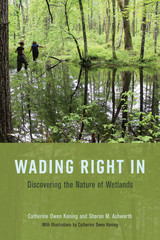
In Wading Right In, Catherine Owen Koning and Sharon M. Ashworth take us on a journey into wetlands through stories from the people who wade in the muck. Traveling alongside scientists, explorers, and kids with waders and nets, the authors uncover the inextricably entwined relationships between the water flows, natural chemistry, soils, flora, and fauna of our floodplain forests, fens, bogs, marshes, and mires. Tales of mighty efforts to protect rare orchids, restore salt marshes, and preserve sedge meadows become portals through which we visit major wetland types and discover their secrets, while also learning critical ecological lessons.
The United States still loses wetlands at a rate of 13,800 acres per year. Such loss diminishes the water quality of our rivers and lakes, depletes our capacity for flood control, reduces our ability to mitigate climate change, and further impoverishes our biodiversity. Koning and Ashworth’s stories captivate the imagination and inspire the emotional and intellectual connections we need to commit to protecting these magical and mysterious places.
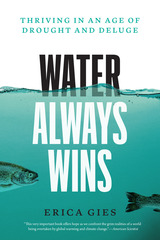
Nearly every human endeavor on the planet was conceived and constructed with a relatively stable climate in mind. But as new climate disasters remind us every day, our world is not stable—and it is changing in ways that expose the deep dysfunction of our relationship with water. Increasingly severe and frequent floods and droughts inevitably spur calls for higher levees, bigger drains, and longer aqueducts. But as we grapple with extreme weather, a hard truth is emerging: our development, including concrete infrastructure designed to control water, is actually exacerbating our problems. Because sooner or later, water always wins.
In this quietly radical book, science journalist Erica Gies introduces us to innovators in what she calls the Slow Water movement who start by asking a revolutionary question: What does water want? Using close observation, historical research, and cutting-edge science, these experts in hydrology, restoration ecology, engineering, and urban planning are already transforming our relationship with water.
Modern civilizations tend to speed water away, erasing its slow phases on the land. Gies reminds us that water’s true nature is to flex with the rhythms of the earth: the slow phases absorb floods, store water for droughts, and feed natural systems. Figuring out what water wants—and accommodating its desires within our human landscapes—is now a crucial survival strategy. By putting these new approaches to the test, innovators in the Slow Water movement are reshaping the future.
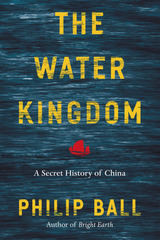
Water, Ball shows, is a key that unlocks much of Chinese culture. In The Water Kingdom, he takes us on a grand journey through China’s past and present, showing how the complexity and energy of the country and its history repeatedly come back to the challenges, opportunities, and inspiration provided by the waterways. Drawing on stories from travelers and explorers, poets and painters, bureaucrats and activists, all of whom have been influenced by an environment shaped and permeated by water, Ball explores how the ubiquitous relationship of the Chinese people to water has made it an enduring metaphor for philosophical thought and artistic expression. From the Han emperors to Mao, the ability to manage the waters ― to provide irrigation and defend against floods ― was a barometer of political legitimacy, often resulting in engineering works on a gigantic scale. It is a struggle that continues today, as the strain of economic growth on water resources may be the greatest threat to China’s future.
The Water Kingdom offers an unusual and fascinating history, uncovering just how much of China’s art, politics, and outlook have been defined by the links between humanity and nature.
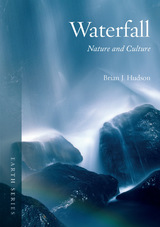
From Niagara Falls in the United States to Angel Falls in Venezuela, Victoria Falls in Africa, and Hannoki Falls in Japan, waterfalls provide some of the world’s loveliest panoramas. With their glistening spray and deafening roar, these astonishing natural wonders attract hordes of people each year who seek out, with cameras in hand, these terrifying and sublime examples of natural beauty.
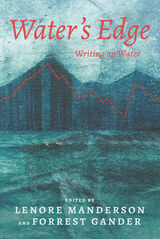
A wide-ranging consideration of water’s plenitude and paucity—and of our relationship to its many forms
Water is quotidian, ubiquitous, precious, and precarious. With their roots in this element, the authors of Water’s Edge reflect on our natural environment: its forms, textures, and stewardship. Born from a colloquium organized by the editors at the Institute at Brown for Environment and Society, the anthology features a diverse group of writers and artists from half a dozen countries, from different fields of scholarship and practice: artists, biologists, geologists, poets, ecocritics, actors, and anthropologists. The contributors explore and celebrate water while reflecting on its disturbances and pollution, and their texts and art play with the boundaries by which we differentiate literary forms.
In the creative nonfiction, poetry, and visual art collected here, water moves from backdrop to subject. Ashley Dawson examines the effects of industrial farming on the health of local ecosystems and economies. Painter Kulvinder Kaur Dhew captures water’s brilliance and multifaceted reflections through a series of charcoal pieces that interlace the collection. Poet Arthur Sze describes the responsibility involved in the careful management of irrigation ditches in New Mexico. Rather than concentrating their thoughts into a singular, overwhelming argument, the authors circulate moments of apprehension, intimation, and felt experience. They are like tributaries, each carrying, in a distinctive style, exigent and often intimate reports concerning a substance upon which all living organisms depend.
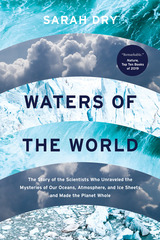
From the glaciers of the Alps to the towering cumulonimbus clouds of the Caribbean and the unexpectedly chaotic flows of the North Atlantic, Waters of the World is a tour through 150 years of the history of a significant but underappreciated idea: that the Earth has a global climate system made up of interconnected parts, constantly changing on all scales of both time and space. A prerequisite for the discovery of global warming and climate change, this idea was forged by scientists studying water in its myriad forms. This is their story.
Linking the history of the planet with the lives of those who studied it, Sarah Dry follows the remarkable scientists who summited volcanic peaks to peer through an atmosphere’s worth of water vapor, cored mile-thick ice sheets to uncover the Earth’s ancient climate history, and flew inside storm clouds to understand how small changes in energy can produce both massive storms and the general circulation of the Earth’s atmosphere. Each toiled on his or her own corner of the planetary puzzle. Gradually, their cumulative discoveries coalesced into a unified working theory of our planet’s climate.
We now call this field climate science, and in recent years it has provoked great passions, anxieties, and warnings. But no less than the object of its study, the science of water and climate is—and always has been—evolving. By revealing the complexity of this history, Waters of the World delivers a better understanding of our planet’s climate at a time when we need it the most.
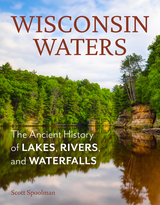
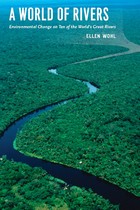
Far from being the serene, natural streams of yore, modern rivers have been diverted, dammed, dumped in, and dried up, all in efforts to harness their power for human needs. But these rivers have also undergone environmental change. The old adage says you can’t step in the same river twice, and Ellen Wohl would agree—natural and synthetic change are so rapid on the world’s great waterways that rivers are transforming and disappearing right before our eyes.
A World of Rivers explores the confluence of human and environmental change on ten of the great rivers of the world. Ranging from the Murray-Darling in Australia and the Yellow River in China to Central Europe’s Danube and the United States’ Mississippi, the book journeys down the most important rivers in all corners of the globe. Wohl shows us how pollution, such as in the Ganges and in the Ob of Siberia, has affected biodiversity in the water. But rivers are also resilient, and Wohl stresses the importance of conservation and restoration to help reverse the effects of human carelessness and hubris.
What all these diverse rivers share is a critical role in shaping surrounding landscapes and biological communities, and Wohl’s book ultimately makes a strong case for the need to steward positive change in the world’s great rivers.
The quality and availability of fresh water are of critical importance to human and ecosystem health. Given its central role in the functioning of all living systems, water is arguably the most important of all natural resources.
Produced biennially, The World's Water provides a timely examination of the key issues surrounding freshwater resources and their use. Each new volume identifies and explains the most significant current trends worldwide, and offers the best data available on a variety of water-related topics.
This 2004-2005 edition of The World's Water features overview chapters on: conservation and efficiency as key tools for meeting freshwater needs; bottled water quality, costs, and trends; United Nations millennium development goals; groundwater issues; case studies of water privatization; the economic value of water; California water policy and climate change.
The World's Water is the most comprehensive and up-to-date source of information and analysis on freshwater resources and the political, economic, scientific, and technological issues associated with them. It is an essential reference for water resource professionals in government agencies and nongovernmental organizations, researchers, students, and anyone concerned with water and its use.
Produced biennially, The World's Water is the most comprehensive and up-to-to date source of information and analysis on freshwater resources. Each new volume examines critical global trends and offers the best data available on a variety of topics related to water.
Volume 8 features chapters on hydraulic fracturing (fracking), water footprints, sustainable water jobs, and desalination financing, among other timely issues. Water briefs provide concise updates on topics including the Dead-Sea and the role of water in the Syrian conflict.
The World's Water is coauthored by MacArthur "genius" Peter H. Gleick and his colleagues at the world-renowned Pacific Institute. Since the first volume was published in 1998, the series has become an indispensable resource for professionals in government agencies and nongovernmental organizations, researchers, students, and anyone concerned with water and its use.
READERS
Browse our collection.
PUBLISHERS
See BiblioVault's publisher services.
STUDENT SERVICES
Files for college accessibility offices.
RECENTLY PUBLISHED



UChicago Accessibility Resources
home | accessibility | search | about | contact us
BiblioVault ® 2001 - 2024
The University of Chicago Press