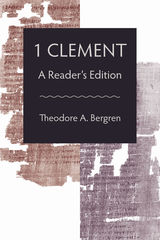
front cover of 1 Clement
1 Clement
A Reader's Edition
Theodore A. Bergren
Catholic University of America Press, 2020
The present volume is a "reader's edition" of 1 Clement, an important early Christian epistolary writing in Greek that probably dates from the late first century CE. The volume is designed for rapid reading and for classroom use. On each left-facing page is printed a running, sequential section of the Greek text. Next to that, on each right-facing page, are recorded all of the more unusual words in that section of Greek text, with dictionary form, part of speech, and definition(s). All of the more common words in that same section of Greek text are included in a comprehensive glossary at the end of the book. This system, then, is designed so that the reader of the Greek text will not have to stop to look up every unusual Greek word in a printed or online dictionary. He or she will simply have to look to the facing page. Such constant lookups in a printed or online dictionary are tedious and time-consuming, and have little pedagogical value. Since in the present edition the words recorded on the right-facing page are not parsed, the reader is still faced with the challenge of parsing the word and determining its place in the overall structure of the sentence. It is this process that does serve a useful pedagogical purpose, and the present system preserves the challenge of this process. The introduction to the volume covers (1) 1 Clement’s genre, date, setting in life, purpose, sources, and main themes; (2) the compositional outline of the book; (3) the book’s authorship, history of reception, and textual attestation; (4) discussion of the present “reader’s edition”; (5) a list of scriptural quotations and allusions; and (6) a comprehensive bibliography on the text of 1 Clement.
[more]

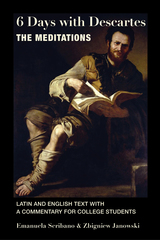
front cover of 6 Days with Descartes
6 Days with Descartes
The Meditations, Latin and English Text with a Commentary for College Students
Rene Descartes
St. Augustine's Press, 2019

This new edition of Descartes’ Meditations by Zbigniew Janowski, wrote extensively on Descartes and 17th c. philosophy, was prepared with the first-year college student in mind. unlike all existing editions in english, which contain bare text of the Meditations, the novelty of this edition is that it includes a short commentary to each meditation, in which the editors help the reader follow Descartes’ steps and arguments.

In addition to their brief commentaries, the author also included short footnotes to the books and articles by contemporary Cartesian specialists who discuss in greater detail specific questions and problems which the text of the Meditations raises. In doing so, the author hopes to familiarize students with authors and titles of major works on Descartes, and with on-going scholarly controversies which this masterpiece of modern thought still inspires

Six Days with Descartes: The Meditations, Latin and English Text with a Commentary for College Students can also serve as a helpful tool for young and less experienced teachers of philosophy.

[more]

logo for University of London Press
The Afterlife of Virgil
Edited by P Mack and John North
University of London Press, 2017
Virgil has always been copied, studied, imitated, and revered as perhaps the greatest poet of the Latin language. He has been centrally important to the transmission of the classical tradition, and has played a unique role in European education. In recognition of the richness of his reception the fourth conferences in the joint Warburg Institute and Institute of Classical Studies series on the afterlife of the Classics was devoted to the afterlife of Virgil.  This volume focuses on the reception of the Eclogues and the Aeneid in three main areas: Italian Renaissance poetry, scholarship and visual art; English responses to Virgil’s poetry; and emerging literatures in Eastern Europe in the seventeenth and eighteenth centuries. Contributors are Giulia Perucchi, M. Elisabeth Schwab, Clementina Marsico, David Quint, Marilena Caciorgna, Maté Vince, Hanna Paulouskaya, Tim Markey, Charles Martindale, and Francesca Bortoletti.  
[more]

front cover of The Ahhiyawa Texts
The Ahhiyawa Texts
Gary M. Beckman
SBL Press, 2011
Twenty-six texts found in the Hittite capital of Hattusa dating from the fifteenth–thirteenth centuries B.C.E. contain references to a land known as “Ahhiyawa,” which most scholars now identify with the Late Bronze Age Mycenaean world. The subject of continuing study and controversy since they were first published in 1924, the letters are still at the center of Mycenaean-Hittite studies and are now considered in studies and courses concerned with Troy, the Trojan War, and the role of both Mycenaeans and Hittites in that possible conflict. This volume offers, for the first time in a single source, English translations of all twenty-six Ahhiyawa texts and a commentary and brief exposition on each text’s historical implications. The volume also includes an introductory essay to the whole Ahhiyawa “problem” as well as a longer essay on Mycenaean-Hittite interconnections and the current state of the discipline.
[more]

front cover of An Answer Key to 'A Primer of Ecclesiastical Latin'
An Answer Key to 'A Primer of Ecclesiastical Latin'
John R. Dunlap
Catholic University of America Press, 2006

front cover of Aristophanes' Clouds
Aristophanes' Clouds
A Commentary
S. Douglas Olson
University of Michigan Press, 2021

This is the first substantial commentary on Clouds since Dover’s 1968 edition. Intended for intermediate Greek students at undergraduate and graduate levels, the commentary pays careful attention to the basic characteristics of ancient Greek syntax, as well as to how Greek words are formed and can be analyzed.  It offers robust staging notes, information about daily life in late 5th-century Athens, and constant reference to the rhetorical and dramatic strategies of the text. Full support is offered for those interested in the metrical structure of the songs, but in a way that allows instructors to leave such issues aside, should they choose to do so. The first and second appendices offer a basic means of entry into the rich but complex world of the comic fragments. An English-language bibliography is provided. The edition will interest professional classicists of all sorts seeking an accessible introduction to one of Aristophanes’ greatest plays, to philosophers concerned with Socrates and the sophistic movement, and to theater professionals who wish to stage the play.

[more]

front cover of Augustine’s Soliloquies in Old English and in Latin
Augustine’s Soliloquies in Old English and in Latin
Leslie Lockett
Harvard University Press, 2022

A new edition featuring Saint Augustine’s dialogue on immortality from a tenth-century Latin manuscript, accompanied by an Old English vernacular adaptation translated into modern English for the first time in a hundred years.

Around the turn of the tenth century, an anonymous scholar crafted an Old English version of Saint Augustine of Hippo’s Soliloquia, a dialogue exploring the nature of truth and the immortality of the soul. The Old English Soliloquies was, perhaps, inspired by King Alfred the Great’s mandate to translate important Latin works. It retains Augustine’s focus on the soul, but it also explores loyalty—to friends, to one’s temporal lord, and to the Lord God—and it presses toward a deeper understanding of the afterlife. Will we endure a state of impersonal and static forgetfulness, or will we retain our memories, our accrued wisdom, and our sense of individuated consciousness?

This volume presents the first English translation of the complete Old English Soliloquies to appear in more than a century. It is accompanied by a unique edition of Augustine’s Latin Soliloquia, based on a tenth-century English manuscript similar to the one used by the translator, that provides insight into the adaptation process. Both the Latin and Old English texts are newly edited.
[more]

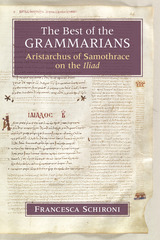
front cover of The Best of the Grammarians
The Best of the Grammarians
Aristarchus of Samothrace on the Iliad
Francesca Schironi
University of Michigan Press, 2018
A founding father of the “art of philology,” Aristarchus of Samothrace (216–144 BCE) made a profound contribution to ancient scholarship. In his study of Homer’s Iliad, his methods and principles inevitably informed, even reshaped, his edition of the epic. This systematic study places Aristarchus and his fragments preserved in the Iliadic scholia, or marginal annotations, in the context and cultural environment of his own time.

Francesca Schironi presents a more robust picture of Aristarchus as a scholar than anyone has offered previously. Based on her analysis of over 4,300 fragments from his commentary on the Iliad, she reconstructs Aristarchus’ methodology and its relationship to earlier scholarship, especially Aristotelian poetics. Schironi departs from the standard commentary on individual fragments, and instead organizes them by topic to produce a rigorous scholarly examination of how Aristarchus worked.

Combining the accuracy and detail of traditional philology with a big-picture study of recurrent patterns and methodological trends across Aristarchus’ work, this volume offers a new approach to scholarship in Alexandrian and classical philology. It will be the go-to reference book on this topic for many years to come, and will usher in a new way of addressing the highly technical work of ancient scholars without losing philological accuracy. This book will be valuable to classicists and philologists interested in Homer and Homeric criticism in antiquity, Hellenistic scholarship, and ancient literary criticism.
[more]

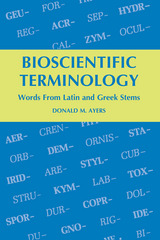
front cover of Bioscientific Terminology
Bioscientific Terminology
Words from Latin and Greek Stems
Donald M. Ayers
University of Arizona Press, 1972
A Valuable Classroom Tool:

Separate sections on Latin and Greek derivations. Each section has 20 lessons—with assignments following each lesson—giving the user a vast technical vocabulary and increased word-recognition ability. 

A Definitive Reference:

Hundreds of Greek and Latin stems, prefixes, and suffixes show the precise application of the classical languages to biological and medical usage. Topic-organized bibliography, index of bases.
[more]

front cover of Catalogus Translationum et Commentariorum, Volume 8
Catalogus Translationum et Commentariorum, Volume 8
Virginia Brown
Catholic University of America Press, 1960
Considered a definitive source for scholars and students, this highly acclaimed series illustrates the impact of Greek and Latin texts on the Middle Ages and Renaissance.
[more]

front cover of Catalogus Translationum et Commentariorum, Volume 9
Catalogus Translationum et Commentariorum, Volume 9
Virginia Brown
Catholic University of America Press, 1960
Considered a definitive source for scholars and students, this highly acclaimed series illustrates the impact of Greek and Latin texts on the Middle Ages and Renaissance.
[more]

front cover of A Commentary on Aristophanes' Knights
A Commentary on Aristophanes' Knights
Carl Arne Anderson and T. Keith Dix
University of Michigan Press, 2020
A Commentary on Aristophanes’ Knights presents a fresh look at the play that cemented Aristophanes’ reputation as a rising star in comic theater. Knights offers an examination of social and political life in ancient Athens during the empire-destroying Peloponnesian War, as well as giving us Aristophanes’ comic send-up of the dangerous populist demagogue Cleon. This is a thoroughly modern commentary on a key play in the theatrical genre of Old Comedy, which satirized virtually every aspect of Athenian life in a period when Athens was at the height of its power and international prestige.

In addition to the complete Greek text and commentary, this volume includes a substantial introduction to the playwright’s career and to the historical and political background of the play. It includes advice for students on grammar and syntax, meter, festivals and staging, as well as topical and literary references and allusions that will help guide students to a mature appreciation of the comedy’s humor, seriousness, and artistic quality. Priced and sized for classroom use, this is the first full commentary on Knights since 1901 and will be widely welcomed.
[more]

front cover of A Commentary on Cicero, De Natura Deorum II
A Commentary on Cicero, De Natura Deorum II
Andrew R. Dyck
University of Michigan Press, 2025
Distinguished Latinist Andrew R. Dyck presents the first English commentary on Cicero’s De Natura Deorum II in over fifty years. This text is the only connected exposition of Stoic theology to survive from the ancient world. It includes an argument for the existence of the gods from the construction of the cosmos taken up by later thinkers, as well as an exposition of the world-order and divine providence according to Stoic doctrine. After a period in which Cicero’s philosophical works were treated mainly as sources for reconstructing the thought of earlier philosophers, they are now coming to be appreciated as intelligent and skillful works in their own right. This book will assist students and others studying Cicero’s De Natura Deorum II by providing its historical context, improved Latin text, and a detailed commentary with references to the latest literature on the subject.
[more]

front cover of Commentary on Thucydides, Book 3
Commentary on Thucydides, Book 3
Rachel Bruzzone
University of Michigan Press, 2025
Thucydides’ History of the Peloponnesian War is one of the most significant historical and political texts of Ancient Greece, enjoying a broad appeal among the educated general public since at least 1628. The past decade has seen the historian garner significant attention even in the popular press, as scholars and politicians alike have sought to employ the History to analyze current international relations. Despite this popularity, the complexity of Thucydides’ Greek has left the original language surprisingly challenging. 

Commentary on Thucydides, Book 3 remedies this situation by offering detailed linguistic explanations and grammatical clarifications designed to appeal both to seasoned Classicists and to a broader group of non-specialist readers who may still be developing their Greek language skills. Starting with 428 BCE, Book 3 covers a critical period of the Peloponnesian War in which the conflict began to manifest its extraordinary violence and scale. The book contains influential and controversial discussions, including Thucydides’ own analysis of the nature of war and the ways that it teaches “lessons of violence” to individuals and states. Book 3 also features the famous Mytilenean Debate, an argument premised on the thesis that all international relations are, or should be, fundamentally amoral. Educated readers have always looked to Thucydides in turbulent times, and this commentary will open up his text to a wider audience.
[more]

front cover of The Concise Greek-English Lexicon of the New Testament
The Concise Greek-English Lexicon of the New Testament
Frederick William Danker
University of Chicago Press, 2009

Frederick William Danker, a world-renowned scholar of New Testament Greek, is widely acclaimed for his 2000 revision of Walter Bauer’s A Greek-English Lexicon of the New Testament and Other Early Christian Literature. With more than a quarter of a million copies in print, it is considered the finest dictionary of its kind.

Danker’s Concise Greek-English Lexicon of the New Testament will prove to be similarly invaluable to ministers, seminarians, translators, and students of biblical Greek. Unlike other lexica of the Greek New Testament, which give only brief glosses for headwords, The Concise Greek-English Lexicon offers extended definitions or explanations in idiomatic English for all Greek terms.

Each entry includes basic etymological information, short renderings, information on usage, and plentiful biblical references. Greek terms that could have different English definitions, depending on context, are thoughtfully keyed to the appropriate passages. An overarching aim of The Concise Greek-English Lexicon is to assist the reader in recognizing the broad linguistic and cultural context for New Testament usage of words.

The Concise Greek-English Lexicon retains all the acclaimed features of A Greek-English Lexicon in a succinct and affordable handbook, perfect for specialists and nonspecialists alike.
[more]

front cover of A Course on Words
A Course on Words
Waldo E. Sweet and Glenn M. Knudsvig
University of Michigan Press, 1989
A great many students enter an etymology course with only one goal -- to learn new words with the hope that they will be more successful in classwork, in standardized exams, or in a variety of work-related situations. In A Course on Words students will indeed learn new words, but, more important, they will gain an understanding of how words are built and how they can use this information to analyze new words that they will encounter outside the classroom. They will spend most of the time learning elements of words that will enable them to determine the meanings of many new words in the future. As one student put it, this book seems to "sensitize us to words and get us to think about words."

The book is unusual in that it offers both programmed and nonprogrammed material. Each type of material is designed to provide students with the maximum amount of involvement and practice. The students do not simply read definitions of words, as is the case with some courses. Rather, they engage in many different activities; not only defining words but analyzing and build­ing them, and learning to use context to derive meaning. The programmed approach enables students to do the work on their own and receive immediate checks of their answers. Classroom time, therefore, is free for review, reinforcement of programmed activities, work on the non­programmed material, and attention to the needs of individual students. The book also includes at the end a set of Supplementary Exercises for each unit. The nonprogrammed materials include "Review Exercises," "Words of Interesting Origin," "Easily Confused Words," and "Latin Phrases." These provide practice in concepts learned in the unit and an opportunity to explore a wide variety of topics, such as eponymous words and the literal meanings of Latin expressions used in English.
[more]

front cover of Ecclesiastical Latin
Ecclesiastical Latin
A Primer on the Language of the Church
Charles G. Kim, Jr.
Catholic University of America Press, 2024
Ecclesiastical Latin: A Primer on the Language of the Church offers a thorough introduction to the Latin language in 32 chapters, which can be completed in one academic year. The text presents each section in plain language, fully explaining complicated grammar terms which may be unfamiliar to a contemporary audience. Every chapter includes copious examples and practice sentences of the grammar covered, as well as stories drawn from the Vulgate, or Church tradition. In addition to encountering the vocabulary and grammar in practice sentences, the text also offers prayers from the liturgy which illustrate the grammar, as well as sentences which come directly from the corpus of original Ecclesiastical Latin. By the end of the book, students will feel comfortable reading through the Vulgate or praying the liturgy in Latin with more understanding. The grammar structures for each chapter roughly follow the organization of grammar as it is presented in Hans Orberg's Lingua Latina. The student can thus practice more of the language in full immersion with confidence, while also learning the vocabulary and style of later Ecclesiastical Latin.
[more]

front cover of Elementary Classical Greek, Revised Edition
Elementary Classical Greek, Revised Edition
Frederick Williams
Southern Illinois University Press, 2004

Now in paperback for the first time, Elementary Classical Greek is a trusted handbook for learning the language that does not presuppose a knowledge of Latin. Based on the premise that average American students can learn the language, the lessons are thorough but not pedantic, simple but not superficial, and the textbook has been proven in the classroom and for independent learners.

Elementary Classical Greek stresses a clear and orderly presentation of the language, accompanied by individual sentences or short passages that illustrate grammar, give practice in reading, and help build vocabulary. Drawing on decades of experience teaching classical Greek, Frederick Williams presents a text in which grammatical explanations are clear, succinct, and correct and the selected readings are varied, interesting, and useful. Included in the nearly one-hundred reading passages are excerpts from Plato’s Ion and Republic, Aristophanes’s Clouds, and Paul’s first letter to the Corinthians.

The popular textbook is designed for a course meeting for two semesters. There are twenty-four lessons in all, with appendixes on prepositions, Greek numbers, and the Greek verb, plus Greek-English and English-Greek vocabularies, a grammatical index of subjects, and a list of Greek authors cited. Selected readings are presented first in simple, then more complex, language until the reader is led to the actual words of the ancient author—all within the same lesson. This elementary device helps bridge many of the difficult gaps between modern English and ancient Greek.
[more]

front cover of Engaging Classical Texts in the Contemporary World
Engaging Classical Texts in the Contemporary World
From Narratology to Reception
Louise Pratt and C. Michael Sampson, Editors
University of Michigan Press, 2018
Contemporary classicists often find themselves advocating for the value and relevance of Greco-Roman literature and culture, whether in the classroom, or social media, or newsprint and magazines. In this collection, twelve top scholars apply major critical approaches from other academic fields to open new channels for dialogue between ancient texts and the contemporary world.

This volume considers perennial favorites of classical literature—the Iliad and Odyssey, Greek tragedy, Roman comedy, the Argonautica, and Ovid’s Metamorphoses—and their influence on popular entertainment from Shakespeare’s plays to Hollywood’s toga films. It also engages with unusual and intriguing texts across the centuries, including a curious group of epigrams by Artemidorus found on the island sanctuary of Thera, mysterious fragments of two Aeschylean tragedies, and modern-day North African novels. These essays engage an array of theoretical approaches from other fields—narratology, cognitive literary theory, feminist theory, New Historicist approaches to gender and sexuality, and politeness theory—without forsaking more traditional philological methods. A new look at hospitality in the Argonautica shows its roots in the changed historical circumstances of the Hellenistic world. The doubleness of Helen and her phantom in Euripides’ Helen is even more complex than previously noted. Particularly illuminating is the recurrent application of reception studies, yielding new takes on the ancient reception of Homer by Apollonius and of Aeschylus by Macrobius, the reception of Plautus by Shakespeare, and more contemporary examples from the worlds of cinema and literature.

Students and scholars of classics will find much in these new interpretations and approaches to familiar texts that will expand their intellectual horizons. Specialists in other fields, particularly English, comparative literature, film studies, and gender and sexuality studies, will also find these essays directly relevant to their work.
[more]


front cover of Everyday Sermons from Worcester Cathedral Priory
Everyday Sermons from Worcester Cathedral Priory
An Early-Fourteenth-Century Collection in Latin
Joan Greatrex
Arc Humanities Press, 2019
Edited and with commentary by Joan Greatrex, this book makes available for the first time in printed form the sermon manuscript, MS Q. 18, which survives in its original home in the medieval cathedral library at Worcester. At first glance this small, untidy quarto-size manuscript appears to be merely an unremarkable collection of early fourteenth-century Latin sermons. However, unlike other surviving sermon manuscripts from cathedral priories and major Benedictine abbeys, which had sermons of notable figures like Augustine, Gregory the Great, and Bernard of Clairvaux, the Worcester MS Q. 18 is by contrast a home-grown production consisting only of homilies prepared by mostly anonymous members of the Worcester monastic community. And they are a rare, if not unique, example of working copies of sermons, with the Latin text reworked, altered, and corrected by a number of monks, giving us a unique insight into the mind and the mentality of a medieval monastic community.
[more]

logo for Karolinum Press
Fasciculus Moralitatis
Omelie Morales de Infantia Saluatoris
Caesarius of Heisterbach
Karolinum Press, 2023
The first critical edition of Caesarius’ Omelie morales de infantia Saluatoris—Homilies on Jesus’ Childhood.

Primarily known as the author of the Dialogus miraculorum—a collection of exemplary stories that secured his reputation as the master of Cistercian storytelling—Caesarius of Heisterbach was also the author of several sermons and homilies. Although they are not as well known today, his Homilies on Jesus’ Childhood are exceptional in many ways. Readers will immediately notice Caesarius’s versatility as he employs an impressive array of persuasive techniques: quoting scholarly works, interpreting Hebrew names and letters, delving into etymology and numerology, and including numerous examples to instruct both the learned and the common person.
[more]

front cover of Florentine Codex
Florentine Codex
Book 1: Book 1: The Gods
Bernardino de Sahagun
University of Utah Press, 1981

Two of the world’s leading scholars of the Aztec language and culture have translated Sahagún’s monumental and encyclopedic study of native life in Mexico at the time of the Spanish Conquest. This immense undertaking is the first complete translation into any language of Sahagún’s Nahuatl text, and represents one of the most distinguished contributions in the fields of anthropology, ethnography, and linguistics.

Written between 1540 and 1585, the Florentine Codex (so named because the manuscript has been part of the Laurentian Library’s collections since at least 1791) is the most authoritative statement we have of the Aztecs’ lifeways and traditions—a rich and intimate yet panoramic view of a doomed people.

The Florentine Codex is divided by subject area into twelve books and includes over 2,000 illustrations drawn by Nahua artists in the sixteenth century.

Book One describes in detail the gods of the Aztec people, including Uitzilopochtli, Tlatoc, and Quetzalcoatl. This colorful and clear translation brings to life characteristics of each god, describing such items as clothing or adornment worn by individual gods, as well as specific personality traits.

[more]

logo for Harvard University Press
From Latin to Italian
An Historical Outline of the Phonology and Morphology of the Italian Language
C.H. Grandgent
Harvard University Press
A guidebook for students of Romance philology, this volume presents the phonetic and morphological principles that emerge from a study of the development of the ancient tongue into the standard of speech of today. Inasmuch as this language is in its origin mainly Tuscan, and especially Florentine, the examination has to do mostly with Florence and Tuscany, but other dialects are cited when they have at any period made contributions to the literary vocabulary. The discussion of inflectional forms really includes the more conspicuous changes in syntax. In the midst of a mass of detail the author has attempted to keep the fundamental outlines of his subject clear. He has tried also to explain the phenomena in the light of our present knowledge of phonetics and of linguistic history.
[more]

logo for Georgetown University Press
From Latin to Romance in Sound Charts
Peter Boyd-Bowman
Georgetown University Press, 1980

This handbook offers a synopsis of the regular changes that Latin words underwent in the course of their evolution into modern Romance languages (Italian, Spanish, Portuguese, and French, with their English cognates). Although it is intended for the nonspecialist, students of Romance philology will find it useful as a ready reference and as a source of abundant examples of Latin sound changes.

The synopsis is presented in the form of separate alphabetical charts for each major sound change. The rules, stated as simply as possible, do not generally explain the evolution of the changes, but only the end results. For those desiring further information, there are notes after most rules outlining exceptions to or modifications of that rule and often sketching successive stages in the development of the sound. Several minor or sporadic sound changes are also treated in note form. Each chart is supplemented by a list of additional words illustrating the same sound change.

From Latin to Roman in Sound Charts has been used successfully as a graduate level text for such courses as History of Spanish, History of French, and Romance Linguistics.
[more]

front cover of FROM OLD WOMAN TO OLDER WOMEN
FROM OLD WOMAN TO OLDER WOMEN
Contemporary Culture and Women’s Narratives
Sally Chivers
The Ohio State University Press, 2003

Sally Chivers provides a fascinating look at and challenge to how North American popular culture has portrayed old age as a time of disease, decline, and death. Within contemporary Canadian literary and film production, a tradition of articulate central elderly female characters challenges what the aging body has come to signify in a broader cultural context. Rather than seek positive images of aging, which can do their own prescriptive damage, the author focuses on constructive depictions that provide a basis on which to create new stories and readings of growing old. This type of humanities approach to the study of aging promises neither to fixate on nor avoid consideration of the role of the body in the much broader process of getting older. The progression implied in the title from the solitary symbol of The Old Woman toward a community of older women, indicates not a move toward euphemism, but rather an increasing and necessary awareness of the social and cultural dimensions of aging.
[more]

front cover of From Puella to Platus
From Puella to Platus
An Introduction to Latin Language and Thought, Volume 2
Tamara Trykar-Lu
Catholic University of America Press, 2019
Whether to enlarge your general education, improve your English, or just because you are curious about the society that has had such a lasting influence on our history, our language, our thoughts, and our culture, you should and can learn Latin. Tamara Trykar-Lu's charming and delightful introduction to Latin, From Puella to Plautus, Part I, is designed for beginning to intermediate Latin study, at the high school or college level, either with the aid of a teacher and classroom or simply for personal enjoyment and enrichment. A thorough review of English grammar with detailed explanations makes it easy for the reader to grasp new concepts in Latin. Learning Latin vocabulary becomes manageable once you realize how much ‘Latin’ vocabulary there is in English. You will quickly learn to read Latin with short stories and, gradually, more demanding selections. Readers will translate the story of Romulus and Remus and the founding of Rome, but also the tale of Nivea -- Snow White -- and some parts of Shakespeare's plays. Short sections show how English developed, how Latin influenced it, and where they both belong in the world of languages. Each chapter ends with a brief outline of some aspect of Roman culture, such as housing, fauna and flora, games, crafts, water supply, and cooking – with recipes. And last but not least there are informative tidbits, drawings, cartoons, jokes, riddles, crossword puzzles, and, of course, pictures distributed throughout the book. For while foreign-language study should be logical, coherent, and rigorous, it need not be heavy-handed or pedantic, and certainly not dull. Ideal for use in courses or for brushing up your language skills, From Puella to Plautus is a lively and engaging book about the Latin language and life in the Roman Empire.
[more]

front cover of From Puella to Plautus
From Puella to Plautus
An Introduction to Latin Language and Thought, Volume 1
Tamara Trykar-Lu
Catholic University of America Press, 2019
Whether to enlarge your general education, improve your English, or just because you are curious about the society that has had such a lasting influence on our history, our language, our thoughts, and our culture, you should and can learn Latin. Tamara Trykar-Lu's charming and delightful introduction to Latin, From Puella to Plautus, Part I, is designed for beginning to intermediate Latin study, at the high school or college level, either with the aid of a teacher and classroom or simply for personal enjoyment and enrichment. A thorough review of English grammar with detailed explanations makes it easy for the reader to grasp new concepts in Latin. Learning Latin vocabulary becomes manageable once you realize how much ‘Latin’ vocabulary there is in English. You will quickly learn to read Latin with short stories and, gradually, more demanding selections. Readers will translate the story of Romulus and Remus and the founding of Rome, but also the tale of Nivea -- Snow White -- and some parts of Shakespeare's plays. Short sections show how English developed, how Latin influenced it, and where they both belong in the world of languages. Each chapter ends with a brief outline of some aspect of Roman culture, such as housing, fauna and flora, games, crafts, water supply, and cooking – with recipes. And last but not least there are informative tidbits, drawings, cartoons, jokes, riddles, crossword puzzles, and, of course, pictures distributed throughout the book. For while foreign-language study should be logical, coherent, and rigorous, it need not be heavy-handed or pedantic, and certainly not dull. Ideal for use in courses or for brushing up your language skills, From Puella to Plautus is a lively and engaging book about the Latin language and life in the Roman Empire.
[more]

front cover of A Grammar of Ugaritic
A Grammar of Ugaritic
John Screnock
SBL Press, 2022
A Grammar of Ugaritic is an accessible yet academically rigorous textbook for first-year students of Ugaritic. Eight digestible lessons include more than 150 exercises to strengthen readers’ understanding through translation and composition of not only vocalized Ugaritic but also transcribed texts and cuneiform script—strategies that develop language skills and provide a sound basis for classroom teaching. Short stories interspersed among the lessons help students consolidate their knowledge and bolster recognition of forms. An introduction to the language and its historical context, glossaries, paradigms, and a bibliography and guide for further learning supplement the lessons. Students who work through the grammar in the classroom or individually will be rewarded with the ability to read real Ugaritic texts in cuneiform.
[more]

front cover of Greek for Reading
Greek for Reading
Gerda Seligson
University of Michigan Press, 1994
A highly innovative approach to Classical Greek for beginning students
[more]

logo for Harvard University Press
Greek Grammar
Herbert Weir Smyth
Harvard University Press
Sponsored by the Department of Classics of Harvard University, a revised edition of the late Professor Smyth’s A Greek Grammar for Colleges is now available. All necessary corrections have been made, and the book retains the form which has long made it the most complete and valuable work of its kind. In this descriptive grammar the author offers a treatment of Greek syntax which is exceptionally rich as well subtle and varied.
[more]

front cover of A Greek-English Lexicon of the New Testament and Other Early Christian Literature
A Greek-English Lexicon of the New Testament and Other Early Christian Literature
Walter Bauer
University of Chicago Press, 2000
Described as an "invaluable reference work" (Classical Philology) and "a tool indispensable for the study of early Christian literature" (Religious Studies Review) in its previous edition, this new updated American edition of Walter Bauer's Wörterbuch zu den Schriften des Neuen Testaments builds on its predecessor's staggering deposit of extraordinary erudition relating to Greek literature from all periods. Including entries for many more words, the new edition also lists more than 25,000 additional references to classical, intertestamental, Early Christian, and modern literature.

In this edition, Frederick W. Danker's broad knowledge of Greco-Roman literature, as well as papyri and epigraphs, provides a more panoramic view of the world of Jesus and the New Testament. Danker has also introduced a more consistent mode of reference citation, and has provided a composite list of abbreviations to facilitate easy access to this wealth of information.

Perhaps the single most important lexical innovation of Danker's edition is its inclusion of extended definitions for Greek terms. For instance, a key meaning of "episkopos" was defined in the second American edition as overseer; Danker defines it as "one who has the responsibility of safeguarding or seeing to it that something is done in the correct way, guardian." Such extended definitions give a fuller sense of the word in question, which will help avoid both anachronisms and confusion among users of the lexicon who may not be native speakers of English.

Danker's edition of Bauer's Wörterbuch will be an indispensable guide for Biblical and classical scholars, ministers, seminarians, and translators.
[more]

front cover of Historical Linguistics and Biblical Hebrew
Historical Linguistics and Biblical Hebrew
Steps Toward an Integrated Approach
Robert Rezetko
SBL Press, 2014

A philologically robust approach to the history of ancient Hebrew

In this book the authors work toward constructing an approach to the history of ancient Hebrew that overcomes the chasm of academic specialization. The authors illustrate how cross-textual variable analysis and variation analysis advance research on Biblical Hebrew and correct theories based on extra-linguistic assumptions, intuitions, and ideologies by focusing on variation of forms/uses in the Masoretic text and variation between the Masoretic text and other textual traditions.

Features:

  • A unique approach that examines the nature of the sources and the description of their language together
  • Extensive bibliography for further research
  • Tables of linguistic variables and parallels
[more]

front cover of Hittite Diplomatic Texts
Hittite Diplomatic Texts
Gary M. Beckman
SBL Press, 1999
This work presents full translations of more than 50 documents from the files of the "foreign office" of the Hittite Empire: 21 treaties, 18 diplomatic letters, and 18 royal edicts and miscellaneous records concerning the relations of the Hittites with their Anatolian and Syrian vassals, as well as with other great powers such as Egypt, Assyria, and Babylonia. Originally composed in Hittite or in the Akkadian lingua franca of the day, many of these texts have never before appeared in English. A short introduction places each document in its historical and cultural context, and a general essay acquaints the reader with the diplomatic practice of the Late Bronze Age. This collection of documents is a major source book for historians of the Ancient Near East and for students of cuneiform and Biblical law. It will also prove useful for those investigating the relationship between Biblical covenant theology and its possible antecedents in older Near Eastern treaty patterns.
[more]

front cover of Hittite Myths, Second Edition
Hittite Myths, Second Edition
Harry A. Hoffner
SBL Press, 1998
This work contains the first English translations of a collection of Hittite myths. The translations are based on the original tablets on which the myths were written and take into account recent textual discoveries and published studies on the texts. Revised and corrected, this second edition includes an additional newly published Hurrian myth. In addition to translations, the volume includes a series of brief introductions to the myths, a glossary of names and technical terms, and indexes of proper names and topics/subjects. Accessible to nonspecialists, the translations also preserve column and line count for the convenience of scholars.
[more]

logo for Harvard University Press
Hippota Nestor and Beyond
Selected Essays
Douglas Frame
Harvard University Press
In Hippota Nestor and Beyond: Selected Essays, Douglas Frame revisits the Homeric figure of Nestor, who he argues derives from twin figures in Indo-European myth, and dates the composition and performance of the Iliad and Odyssey to the late eighth or early seventh century BCE at a festival of twelve Ionian cities in Asia Minor. Frame takes up subjects such as the evidence for Nestor’s Indo-European origins; the related origins of the Greek word noos, “mind”; the Phaeacians in the Odyssey as the key to the circumstances in which the Homeric poems were created; Nestor’s role connecting the two poems into a one whole. Other essays in the collect break new ground with respect to the circumstances of the poems’ performance; the purpose of the poems in their historical setting; the relation of the poems to other poetic monuments of the time; the reception of the poems in the Greek mainland after their origin in Ionia; and a closer tracking of the Indo-European origins of the figure hippota Nestor, “the horseman Nestor,” in light of the invention of the chariot in the Russian steppes c. 2000 BCE.
[more]

front cover of <i>Hippota Nestor</i> and Beyond
Hippota Nestor and Beyond
Selected Essays
Douglas Frame
Harvard University Press
In Hippota Nestor and Beyond: Selected Essays, Douglas Frame revisits the Homeric figure of Nestor, who he argues derives from twin figures in Indo-European myth, and dates the composition and performance of the Iliad and Odyssey to the late eighth or early seventh century BCE at a festival of twelve Ionian cities in Asia Minor. Frame takes up subjects such as the evidence for Nestor’s Indo-European origins; the related origins of the Greek word noos, “mind”; the Phaeacians in the Odyssey as the key to the circumstances in which the Homeric poems were created; Nestor’s role connecting the two poems into a one whole. Other essays in the collect break new ground with respect to the circumstances of the poems’ performance; the purpose of the poems in their historical setting; the relation of the poems to other poetic monuments of the time; the reception of the poems in the Greek mainland after their origin in Ionia; and a closer tracking of the Indo-European origins of the figure hippota Nestor, “the horseman Nestor,” in light of the invention of the chariot in the Russian steppes c. 2000 BCE.
[more]

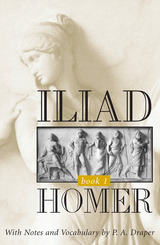
front cover of Iliad, Book 1
Iliad, Book 1
Homer
University of Michigan Press, 2002
Homer's Iliad has captivated readers and influenced writers and artists for more than two thousand years. Reading the poem in its original language provides an experience as challenging as it is rewarding. Most students encountering Homeric Greek for the first time need considerable help, especially with vocabulary and constructions that differ from the more familiar Attic forms. For anyone who has completed studies in elementary Greek, this edition provides the assistance necessary to read, understand, and appreciate the first book of the Iliad in its original language.
Structured to maximize reading ease, P. A. Draper's volume stands out among introductions to the Greek Iliad. Readers of this edition will appreciate the positioning of all notes facing the Greek text; the frequent vocabulary entries; the complete glossary; the appendix on basic Homeric forms and grammar; and the copious annotations on vocabulary, grammar, meter, historical and mythological allusions, and literary interpretation.
Primarily designed as a textbook, this volume will be an effective classroom tool and a useful acquisition for any library supporting a classics program. The book will find readers among high school and college Greek students, advanced students in Homer or epic poetry classes, graduate students working on reading-list requirements, and anyone interested in maintaining Greek reading skills.
P. A. Draper is Humanities Librarian, Cooper Library, Clemson University.
[more]

logo for Catholic University of America Press
Into God, student edition
Itinerarium Mentis in Deum of Saint Bonaventure
Regis J. Armstrong
Catholic University of America Press

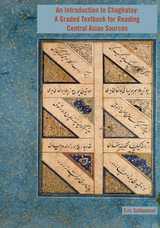
front cover of An Introduction to Chaghatay
An Introduction to Chaghatay
A Graded Textbook for Reading Central Asian Sources
Eric Schluessel
Michigan Publishing Services, 2018
The Chaghatay language was used across Central Asia from the 1400s through the 1950s. Chroniclers, clerks, and poets in modern-day Afghanistan, Xinjiang, Uzbekistan, and beyond wrote countless volumes of text in Chaghatay, from the famed Baburnama to the documents of everyday life. However, even more and more material in Chaghatay is becoming available to scholars, few are able to read the language with ease.

An Introduction to Chaghatay is the first textbook in over a century to introduce this language to English-speaking students. This book is designed to build a foundation in reading Chaghatay without assuming any background knowledge on the part of the reader. These graded, cumulative lessons include common vocabulary, accessible grammar explanations, and examples of Chaghatay manuscripts. Authentic texts introduce the student to different genres, including hagiographies, documents, “stories of the prophets,” and newspapers while introducing critical skills in paleography.

Eric Schluessel is Assistant Professor of Chinese History and Politics at the University of Montana. He holds a PhD in History and East Asian Languages from Harvard University, an MA in Linguistics from the School of Oriental and African Studies, and an MA in Central Eurasian Studies from Indiana University. He is the author of several articles on the history of Chinese Central Asia and is currently preparing a critical edition and translation of Mullah Musa Sayrami’s Tarikh-i Hamidi, a chronicle of Xinjiang in the nineteenth century.
 
[more]

front cover of An Introduction to the Study of Medieval Latin Versification
An Introduction to the Study of Medieval Latin Versification
Dag Norberg
Catholic University of America Press, 2004
Dag Norberg's analysis and interpretation of Medieval Latin versification, which was published in French in 1958 and remains the standard work on the subject, appears here for the first time in English with a detailed, scholarly introduction by Jan Ziolkowski that reviews the developments of the past fifty years.
[more]

front cover of Ireland and the Classical World
Ireland and the Classical World
By Philip Freeman
University of Texas Press, 2000

On the boundary of what the ancient Greeks and Romans considered the habitable world, Ireland was a land of myth and mystery in classical times. Classical authors frequently portrayed its people as savages—even as cannibals and devotees of incest—and evinced occasional uncertainty as to the island's shape, size, and actual location. Unlike neighboring Britain, Ireland never knew Roman occupation, yet literary and archaeological evidence prove that Iuverna was more than simply terra incognita in classical antiquity.

In this book, Philip Freeman explores the relations between ancient Ireland and the classical world through a comprehensive survey of all Greek and Latin literary sources that mention Ireland. He analyzes passages (given in both the original language and English) from over thirty authors, including Julius Caesar, Strabo, Tacitus, Ptolemy, and St. Jerome. To amplify the literary sources, he also briefly reviews the archaeological and linguistic evidence for contact between Ireland and the Mediterranean world.

Freeman's analysis of all these sources reveals that Ireland was known to the Greeks and Romans for hundreds of years and that Mediterranean goods and even travelers found their way to Ireland, while the Irish at least occasionally visited, traded, and raided in Roman lands. Everyone interested in ancient Irish history or Classics, whether scholar or enthusiast, will learn much from this pioneering book.
[more]

front cover of Iron Age Hieroglyphic Luwian Inscriptions
Iron Age Hieroglyphic Luwian Inscriptions
Annick Payne
SBL Press, 2012
Hieroglyphic Luwian belongs to the Anatolian group of ancient languages and was inscribed primarily on stone, using an indigenous Anatolian pictorial writing system. These Hieroglyphic Luwian inscriptions were written over a period of centuries in the region of Anatolia and northern Syria. Their authors were primarily the rulers of the so-called Neo-Hittite states, contemporaries and neighbors of early Israel. This volume collects some of the most important and representative of the inscriptions in transliteration and translation, organized by genre. Each text is accompanied by relevant information on provenance, dating, and other points of interest that will engage specialist and nonspecialist alike.
[more]

front cover of Juvenal and Persius
Juvenal and Persius
Juvenal
Harvard University Press, 2004

Mordant verse satire.

The bite and wit of two of antiquity’s best satirists are captured in this Loeb Classical Library edition.

Persius (AD 34–62) and Juvenal (writing about sixty years later) were heirs to the style of Latin verse satire developed by Lucilius and Horace, a tradition mined in Susanna Braund’s introduction and notes. Her notes also give guidance to the literary and historical allusions that pepper Persius’ and Juvenal’s satirical poems—which were clearly aimed at a sophisticated urban audience. Both poets adopt the mask of an angry man, and sharp criticism of the society in which they live is combined with flashes of sardonic humor in their satires. Whether targeting common and uncommon vices, the foolishness of prayers, the abuse of power by emperors and the Roman elite, the folly and depravity of Roman wives, or decadence, materialism, and corruption, their tone is generally one of righteous indignation.

Juvenal and Persius are seminal as well as stellar figures in the history of satirical writing. Juvenal especially had a lasting influence on English writers of the Renaissance and succeeding centuries.
[more]

logo for Harvard University Press
Latin
A Historical and Linguistic Handbook
Mason Hammond
Harvard University Press, 1976

front cover of Latin and Greek in American Education
Latin and Greek in American Education
With Symposia on the Value of Humanistic Studies
Edited by Francis W. Kelsey
University of Michigan Press, 1911
Latin and Greek in American Education is a volume of papers stemming from the Michigan Classical Conference’s examination of the methods and strategies for teaching Latin and Greek and their relation to public life, and the relationship between classics and law, theology, politics, and medicine. Included in the volume is “The Case for the Classics” by Paul Shorey.
[more]

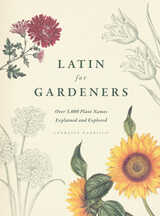
front cover of Latin for Gardeners
Latin for Gardeners
Over 3,000 Plant Names Explained and Explored
Lorraine Harrison
University of Chicago Press, 2012

Since Latin became the standard language for plant naming in the eighteenth century, it has been intrinsically linked with botany. And while mastery of the classical language may not be a prerequisite for tending perennials, all gardeners stand to benefit from learning a bit of Latin and its conventions in the field. Without it, they might buy a Hellebores foetidus and be unprepared for its fetid smell, or a Potentilla reptans with the expectation that it will stand straight as a sentinel rather than creep along the ground.

An essential addition to the gardener’s library, this colorful, fully illustrated book details the history of naming plants, provides an overview of Latin naming conventions, and offers guidelines for pronunciation. Readers will learn to identify Latin terms that indicate the provenance of a given plant and provide clues to its color, shape, fragrance, taste, behavior, functions, and more. 
Full of expert instruction and practical guidance, Latin for Gardeners will allow novices and green thumbs alike to better appreciate the seemingly esoteric names behind the plants they work with, and to expertly converse with fellow enthusiasts. Soon they will realize that having a basic understanding of Latin before trips to the nursery or botanic garden is like possessing some knowledge of French before traveling to Paris; it enriches the whole experience.
[more]

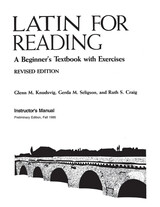
front cover of Latin for Reading
Latin for Reading
A Beginner's Textbook with Exercises
Glenn M. Knudsvig, Ruth S. Craig, and Gerda M. Seligson
University of Michigan Press, 1986
This text enables students to learn to read Latin
[more]

front cover of Latin for Reading
Latin for Reading
A Beginner's Textbook with Exercises
Glenn M. Knudsvig, Ruth S. Craig, and Gerda M. Seligson
University of Michigan Press, 1986
This text enables students to learn to read Latin
[more]

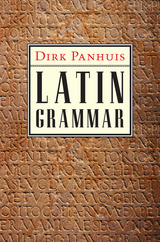
front cover of Latin Grammar
Latin Grammar
Dirk Panhuis
University of Michigan Press, 2006
In Latin Grammar, Dirk Panhuis has created an innovative reference that makes use of many of the advances that have taken place in linguistics during the last half century. Using a syntactic—instead of the traditional morphological—approach to syntax, Panhuis explains linguistic concepts clearly, thoroughly describing the structure of the sentence and its parts. For ease of use, Panhuis often presents the theory in well-organized tables and charts, and provides the reader with illustrative texts by Latin authors.
Back Cover

Through clear structuring of language phenomena, Panhuis provides a reference that integrates traditional linguistic knowledge with linguistic innovation and didactic clarity. This concise reference, ideal for students and instructors of Latin in high schools and colleges, will supplant the out-dated grammars of Allen & Greenough and Hale & Buck.

Dirk Panhuis graduated in classical philology at the State University of Ghent, Belgium, in 1963 and obtained his PhD in linguistics at the University of Michigan, Ann Arbor, in 1981. He has been assistant and academic secretary of the Institut Supérieur Pédagogique in Kananga (Democratic Republic of Congo) and a teaching assistant at the University of Michigan. He taught classical languages in high schools of the Flemish Community in and around Louvain (Belgium) until his retirement in 2002.


"Panhuis brings a very welcome linguistic orientation to the study of Latin, an approach not found in the older traditional grammars currently used at the college level. Among the features likely to prove most helpful for students is the presentation of information in clear and easily readable charts and grids, and the explanations accompanying the English translations, allowing students to see clearly how to render a Latin structure into English both literally and idiomatically."
Back Cover continued
—Deborah Ross, Department of Classical Studies, University of Michigan

"This innovative grammar incorporates current viewpoints of syntax and semantics, making it a unique tool, especially for the study of sentence structure."—Philip Baldi, Professor of Linguistics and Classics, Pennsylvania State University

"In his Latin Grammar, Panhuis artfully integrates traditional description and modern analysis. It will provide intermediate and advancing Latin students mature help in understanding Latin syntax and offers material on the dynamics of text which is unique for an introductory reference tool. Not to be overlooked is its value as a resource to those who teach Latin."
—Charles Elerick, Professor of Languages and Linguistics, The University of Texas at El Paso
[more]

front cover of A Latin Reader for Colleges
A Latin Reader for Colleges
H. L. Levy
University of Chicago Press, 1989
Selections from Aulus Gellius' Attic Nights, The Lives of Nepos, Phaedrus' Fables in verse, and some Caesar are carefully aimed to interest and challenge, but not overtax, the college student who is not yet ready for complicated readings in Latin.
[more]

front cover of Latin
Latin
Story of a World Language
Jürgen Leonhardt
Harvard University Press, 2013

The mother tongue of the Roman Empire and the lingua franca of the West for centuries after Rome’s fall, Latin survives today primarily in classrooms and texts. Yet this “dead language” is unique in the influence it has exerted across centuries and continents. Jürgen Leonhardt has written a full history of Latin from antiquity to the present, uncovering how this once parochial dialect developed into a vehicle of global communication that remained vital long after its spoken form was supplanted by modern languages.

Latin originated in the Italian region of Latium, around Rome, and became widespread as that city’s imperial might grew. By the first century BCE, Latin was already transitioning from a living vernacular, as writers and grammarians like Cicero and Varro fixed Latin’s status as a “classical” language with a codified rhetoric and rules. As Romance languages spun off from their Latin origins following the empire’s collapse—shedding cases and genders along the way—the ancient language retained its currency as a world language in ways that anticipated English and Spanish, but it ceased to evolve.

Leonhardt charts the vicissitudes of Latin in the post-Roman world: its ninth-century revival under Charlemagne and its flourishing among Renaissance writers who, more than their medieval predecessors, were interested in questions of literary style and expression. Ultimately, the rise of historicism in the eighteenth century turned Latin from a practical tongue to an academic subject. Nevertheless, of all the traces left by the Romans, their language remains the most ubiquitous artifact of a once peerless empire.
[more]

front cover of A Latin-Greek Index of the Vulgate New Testament
A Latin-Greek Index of the Vulgate New Testament
Theodore A. Bergren
SBL Press, 2003
“Scholars who work with Latin materials that have been or might have been translated from Greek originals are often frustrated by the lack of reference tools that can aid in determining accurately translational equivalences between the two languages. Greek-Latin or Latin-Greek lexica are inadequate, for they tend to give ‘ideal’ translational equivalences rather than ones actually attested in some text. The problem is acute, for example, in the study of the Vulgate New Testament, for which no reference tool has existed by which one could determine quickly the entire range of Greek translational equivalents for a given Latin word. The present work is intended to go some distance toward fulfilling this need.” — from the introduction
[more]

front cover of Letters and Orations
Letters and Orations
Cassandra Fedele
University of Chicago Press, 2000
By the end of the fifteenth century, Cassandra Fedele (1465-1558), a learned middle-class woman of Venice, was arguably the most famous woman writer and scholar in Europe. A cultural icon in her own time, she regularly corresponded with the king of France, lords of Milan and Naples, the Borgia pope Alexander VI, and even maintained a ten-year epistolary exchange with Queen Isabella and King Ferdinand of Spain that resulted in an invitation for her to join their court. Fedele's letters reveal the central, mediating role she occupied in a community of scholars otherwise inaccessible to women. Her unique admittance into this community is also highlighted by her presence as the first independent woman writer in Italy to speak publicly and, more importantly, the first to address philosophical, political, and moral issues in her own voice. Her three public orations and almost all of her letters, translated into English, are presented here for the first time.
[more]

front cover of A Lexicon to the Latin Text of the Theological Writings of Emanuel Swedenborg (1688-1772)
A Lexicon to the Latin Text of the Theological Writings of Emanuel Swedenborg (1688-1772)
John Chadwick
Swedenborg Foundation Publishers, 2008
A Lexicon to the Latin Textof the Theological Writings of Emanuel Swedenborg (1688–1772) by Dr. John Chadwick and Dr. Jonathan S. Rose is a unique specialist dictionary of fourteen thousand Neo-Latin words and their usages as contained in eighteenth-century theological works of Emanuel Swedenborg.
 
Beyond its use for scholars of Swedenborg, the Lexicon is also of great assistance to students and academics of history, philosophy, theology and science, and anyone who encounters texts written in Neo-Latin (the branch of Latin that was in use by learned writers and thinkers from the Renaissance period through to the Enlightenment and beyond). The Lexicon is beautifully and simply designed and easy to navigate. In addition to a preface by editor John Chadwick, this edition also features a new introduction by Jonathan S. Rose containing an important section on the morphology of Swedenborg’s Neo-Latin (as distinct from the morphology of classical Latin); an appreciation of the life of John Chadwick by John Elliott; an appendix with a detailed listing of the various Latin editions of Swedenborg’s theological works; and an appendix on Swedenborg’s use of the Latin Bible of Sebastian Schmidt.
[more]

front cover of The Lives of Latin Texts
The Lives of Latin Texts
Papers Presented to Richard J. Tarrant
Lauren Curtis
Harvard University Press, 2021

The papers in this volume are based on a 2018 conference in the Department of the Classics at Harvard University in honor of Richard Tarrant, Pope Professor of the Latin Language and Literature, on the occasion of his retirement.

The breadth of authors, genres, periods, and topics addressed in The Lives of Latin Texts is testament to Richard Tarrant’s wide-ranging influence on the fields of Latin literary studies and textual criticism. Contributions on stylistic, dramatic, metapoetic, and philosophical issues in Latin literature (including authors from Virgil, Horace, and Seneca to Ovid, Terence, Statius, Caesar, and Martial) sit alongside contributions on the history of textual transmission and textual editing. Other chapters treat the musical reception of Latin literature. Taken together, the volume reflects on the impact of Richard Tarrant’s scholarship by addressing the expressive scope and the long history of the Latin language.
[more]

front cover of Lives of the Great Languages
Lives of the Great Languages
Arabic and Latin in the Medieval Mediterranean
Karla Mallette
University of Chicago Press, 2021
The story of how Latin and Arabic spread across the Mediterranean to create a cosmopolitan world of letters.
 
In this ambitious book, Karla Mallette studies the nature and behaviors of the medieval cosmopolitan languages of learning—classical Arabic and medieval Latin—as they crossed the Mediterranean. Through anecdotes of relationships among writers, compilers, translators, commentators, and copyists, Mallette tells a complex story about the transmission of knowledge in the period before the emergence of a national language system in the late Middle Ages and early modernity.

Mallette shows how the elite languages of learning and culture were only tenuously related to the languages of everyday life. These languages took years of study to master, marking the passage from intellectual childhood to maturity. In a coda to the book, Mallette speculates on the afterlife of cosmopolitan languages in the twenty-first century, the perils of monolingualism, and the ethics of language choice. The book offers insight for anyone interested in rethinking linguistic and literary tradition, the transmission of ideas, and cultural expression in an increasingly multilingual world.
 
[more]

front cover of Medieval Latin
Medieval Latin
Second Edition
Edited by K. P. Harrington
University of Chicago Press, 1997
K. P. Harrington's Mediaeval Latin, the standard medieval Latin anthology used in the United States since its initial publication in 1925, has now been completely revised and updated for today's students and teachers by Joseph Pucci. This new edition of the classic anthology retains its breadth of coverage, but increases its depth by adding fourteen new selections, doubling the coverage of women writers, and expanding a quarter of the original selections. The new edition also includes a substantive grammatical introduction by Alison Goddard Elliott.

To help place the selections within their wider historical, social, and political contexts, Pucci has written extensive introductory essays for each of the new edition's five parts. Headnotes to individual selections have been recast as interpretive essays, and the original bibliographic paragraphs have been expanded. Reprinted from the best modern editions, the selections have been extensively glossed with grammatical notes geared toward students of classical Latin who may be reading medieval Latin for the first time.

Includes thirty-two full-page plates (with accompanying captions) depicting medieval manuscript and book production.
[more]

front cover of The Myths of Fiction
The Myths of Fiction
Studies in the Canonical Greek Novels
Edmund P. Cueva
University of Michigan Press, 2004

The tradition of historical literature begun by Herodotus and Thucydides molded the early Greek novel. As the genre evolved, however, Greek novels moved away from their historical roots to become more heavily influenced by mythological traditions. Edmund Cueva's new book examines the literary uses to which the ancient novelists put their mythological material. His work offers a stimulating discussion of myths and their rise to prominence as the key feature of the fully developed Greek novel. He also takes into account the impact of the Roman conquest on the development of the Greek novel, the last true literary creation of the Greek world. The Myths of Fiction will interest scholars of Greek literarure, imperial history, literary myth, intertextuality, and comparative literature.

Edmund Cueva is Associate Professor and Chair of Classics at Xavier University.

[more]

logo for Harvard University Press
A New Introduction to Greek
Third Edition Revised and Enlarged
Alston Hurd Chase and Henry Phillips, Jr.
Harvard University Press

Major revisions in this widely used text include:
1. Larger typefaces for all Greek paradigms;
2. Greatly expanded vocabularies, both Greek-English and English-Greek;
3. New review exercises for each lesson in both Greek and English;
4. New appendices listing 75 irregular verbs with their principal parts and the prepositions with their meanings. At many points the expositions, notes, and lesson vocabularies are expanded and the English sentences revised.
[more]

front cover of On the Latin Language, Volume I
On the Latin Language, Volume I
Books 5–7
Varro
Harvard University Press

Ancient Roman word lore.

Varro (M. Terentius), 116–27 BC, of Reate, renowned for his vast learning, was an antiquarian, historian, philologist, student of science, agriculturist, and poet. He was a republican who was reconciled to Julius Caesar and was marked out by him to supervise an intended national library.

Of Varro’s more than seventy works involving hundreds of volumes we have only his treatise On Agriculture (in LCL 283) and part of his monumental achievement De Lingua Latina (On the Latin Language), a work typical of its author’s interest not only in antiquarian matters but also in the collection of scientific facts. Originally it consisted of twenty-five books in three parts: etymology of Latin words (Books 1–7); their inflections and other changes (Books 8–13); and syntax (Books 14–25). Of the whole work survive (somewhat imperfectly) Books 5–10. These are from the section (Books 4–6) that applied etymology to words of time and place and to poetic expressions; the section (Books 7–9) on analogy as it occurs in word formation; and the section (Books 10–12) that applied analogy to word derivation. Varro’s work contains much that is of very great value to the study of the Latin language.

The Loeb Classical Library edition of On the Latin Language is in two volumes.
[more]

front cover of On the Latin Language, Volume II
On the Latin Language, Volume II
Books 8–10 and Fragments
Varro
Harvard University Press

Ancient Roman word lore.

Varro (M. Terentius), 116–27 BC, of Reate, renowned for his vast learning, was an antiquarian, historian, philologist, student of science, agriculturist, and poet. He was a republican who was reconciled to Julius Caesar and was marked out by him to supervise an intended national library.

Of Varro’s more than seventy works involving hundreds of volumes we have only his treatise On Agriculture (in LCL 283) and part of his monumental achievement De Lingua Latina (On the Latin Language), a work typical of its author’s interest not only in antiquarian matters but also in the collection of scientific facts. Originally it consisted of twenty-five books in three parts: etymology of Latin words (Books 1–7); their inflections and other changes (Books 8–13); and syntax (Books 14–25). Of the whole work survive (somewhat imperfectly) Books 5–10. These are from the section (Books 4–6) that applied etymology to words of time and place and to poetic expressions; the section (Books 7–9) on analogy as it occurs in word formation; and the section (Books 10–12) that applied analogy to word derivation. Varro’s work contains much that is of very great value to the study of the Latin language.

The Loeb Classical Library edition of On the Latin Language is in two volumes.
[more]

logo for Catholic University of America Press
Os Praesens Ciceronis Epistularis
The Immedaite Mouth of Cicero in His Letters
Reginald Foster
Catholic University of America Press
The Immediate Mouth of Cicero in His Letters, consists of two books. An audiobook presents the integral Latin and English texts of 51 letters Cicero wrote to family and close associates all recited by Reginald Foster. A printed book presents the teaching method of Reginald exemplified by 160 imagined dialogues between a teacher and students working with original thoughts of Cicero to learn the Latin language from the first encounter. This companion volume to The Bones' Meats Abundant analyses how Cicero expressed himself in the Latin of these same 51 letters, with cross references to fuller explanations in The Mere Bones of Latin. Audio book LISTEN to Cicero writing to family and close associates recited by Reginald Foster who embodies that living voice of the master Latinist. READ along while listening and RECITE together with the audio. CONSULT the English text of our translations. Printed book LEARN from the first encounter with the Latin language by reading from Cicero's letters and COMPLETE your understanding through regular readings. Teach the Latin language using excerpts from Cicero's letters from the first day. Understand how Reginald taught the Latin language using solid, unmodified, original Latin texts. Learn to teach from Reginald.
[more]

front cover of Ossa Latinitatis Sola Ad Mentem Reginaldi Rationemque
Ossa Latinitatis Sola Ad Mentem Reginaldi Rationemque
Reginaldus Thomas Foster
Catholic University of America Press, 2016
From the first encounter with the Latin language to its full presentation, the objective of Ossa Latinitatis Sola is to get people into immediate contact with and understanding of Latin authors, and for these encounters to grow into a love and use of the entire language in all its literary types and periods of time and authors of the past 2,300 years.
[more]

front cover of Ossa Ostensa
Ossa Ostensa
A Proven System for Demystifying Latin, Book 2
Laura Pooley
Catholic University of America Press, 2023
Ossa Ostensa is the world’s first comprehensive example of how to teach and learn the Latin language using the unique teaching system of the internationally recognized authority Reginald Foster. Laura Pooley – prize-winning graduate of the University of Oxford and currently a supervisor at the University of Cambridge, brings to life the year she spent in Rome studying Latin with Reginaldus. His inspiring and transformative method of teaching combines with Laura’s twenty years of teaching experience to produce concise and crystal-clear explanations of the language. The three ‘experiences’ of Latin: beginners, intermediates and advanced, are divided between three user-friendly workbooks. Each workbook comprises around thirty lessons, where the language is presented in hand-out form requiring very little modification by prospective teachers. Each language area is then illustrated by translated reading examples. After each lesson, Laura provides translation practice targeted to the taught content. These Latin passages are divided into Classical and Post-Classical literature, to appeal to the interests of all Latin students. Not only that, but each passage is accompanied by teaching questions and translation hints, the mainstay of Reginaldus’ classroom persona and pedagogy so famously encapsulated in his Ludi. Students therefore can exercise recent language content and develop deep and spontaneous fluency in the Latin language. Enjoy continuing your experience of learning with Reginaldus with book 2 of the Ossa Ostensa series, where the significant language areas of participles and subjunctives are met for the first time.
[more]

logo for Catholic University of America Press
Ossa Ostensa
A Proven System for Demystifying Latin, Book 3
Laura Pooley
Catholic University of America Press

front cover of Ossa Ostensa
Ossa Ostensa
A proven system for demystifying Latin, Book One
Laura Pooley
Catholic University of America Press, 2021
Ossa Ostensa is the world’s first comprehensive example of how to teach and learn the Latin language using the unique teaching system of the internationally recognized authority Reginald Foster. Laura Pooley – prize-winning graduate of the University of Oxford and currently a supervisor at the University of Cambridge, brings to life the year she spent in Rome studying Latin with Reginaldus. His inspiring and transformative method of teaching combines with Laura’s twenty years of teaching experience to produce concise and crystal-clear explanations of the language. The three ‘experiences’ of Latin: beginners, intermediates and advanced, are divided between three user-friendly workbooks. Each workbook comprises around thirty lessons, where the language is presented in hand-out form requiring very little modification by prospective teachers. Each language area is then illustrated by translated reading examples. After each lesson, Laura provides translation practice targeted to the taught content. These Latin passages are divided into Classical and Post-Classical literature, to appeal to the interests of all Latin students. Not only that, but each passage is accompanied by teaching questions and translation hints, the mainstay of Reginaldus’ classroom persona and pedagogy so famously encapsulated in his Ludi. Students therefore can exercise recent language content and develop deep and spontaneous fluency in the Latin language. For the first time, the experience of learning with Reginaldus is available to everyone.
[more]

front cover of Ossium Carnes Multae e Marci Tullii Ciceronis Epistulis / The Bones’ Meats Abundant from the Epistles of Marcus Tullius Cicero
Ossium Carnes Multae e Marci Tullii Ciceronis Epistulis / The Bones’ Meats Abundant from the Epistles of Marcus Tullius Cicero
Reginaldus Thomas Foster
Catholic University of America Press, 2021
Beginners and experts alike will find a complete immersion into the workings and nature of the Latin language embodied in the incomparable, insuperable epistles of the great Marcus Tullius Cicero, something which other commentators pass over or scorn. This second volume puts “meat on the bones” of the Latin language presented in the first volume: Ossa Latinitatis Sola: The Mere Bones of Latin. The personal letters of Cicero provide ample meat to enflesh the skeletal structure of the language, thus the title: Ossium Carnes Multae: The Bones’ Meats Abundant from the epistles of Marcus Tullius Cicero. Part 1 presents 51 complete letters from the Tyrell-Purser text. Facing each letter is an image of its oldest manuscript edition as early as the ninth century, which are preserved and guarded in the Medicea Laurentiana library in Florence, Italy, witnessing to the human hand preserving this monument of world heritage for over two millennia. Part 2 follows with a most careful rendition into English of Tully’s living, telephone-like Latin discourse. A thorough treatment and explanation of noteworthy elements of his natural talk follows with numerous references to the Encounters in Volume I. All this has students, learners, teachers, experts of the Latin language in mind and is humbly designed to deepen the understanding and appreciation of specific expressions and peculiarities of Cicero’s language itself. Part 3 provides 500 sentences consisting of from 1 to 5 words and suited for the beginnings or continuation of Latin conversations: 200 declarations, 100 questions, 100 exclamations, 100 injunctions drawn from his letters. The volume is amply indexed. All this has been done to enhance the study and use of Latin, to popularize Cicero’s correspondence, to prepare the reader for Volume III which will deal again with the letters and their usefulness for Latin conversation.
[more]

front cover of Patience and Salvation in Third Century North Africa
Patience and Salvation in Third Century North Africa
A Christian Latin Reader
Sarah Wear
Catholic University of America Press, 2022
Patience and Salvation in Third Century North Africa: A Christian Latin Reader features the entirety of Tertullian’s To Martyrs and The Passion of Perpetua and Felicity, with selections from Cyprian’s On the Good of Patience and a short appendix on Augustine’s Commentary on Psalm 121.6. The Latin text has facing vocabulary and theological, historical, philosophical, and grammatical notes. In the first three centuries, Roman Carthage produced some of the earliest literature composed originally in Latin by Christians. Tertullian’s Ad Martyras (197); Passio Perpetuae et Felicitatis (203), and Cyprian’s De Bono Patientiae (256) all embody the force of this new genre of Latin literature. With this literature, we see a variant of Latin often denoted “Christian Latin.” Christian Latin featured linguistic elements marked by characteristics of biblical Latin, later Latin, as well as vulgarisms. In addition to converging philologically, Tertullian, the author of the Passio, and Cyprian align themselves in topos: they all ask the question of how one can endure torment and anxiety in this world. Patience (patientia), derived from the verb for “to suffer” (patior), is a virtue that allows one to endure troubles, anxieties, and physical pains with the hope of eternal happiness and salvation in heaven. In this Reader, the student will find three different literary perspectives on this theme. The book also draws parallels to the works of Seneca and Cicero on patience and suffering.
[more]

front cover of People, Personal Expression, and Social Relations in Late Antiquity, Volume II
People, Personal Expression, and Social Relations in Late Antiquity, Volume II
Selected Latin Texts from Gaul and Western Europe
Ralph W. Mathisen
University of Michigan Press, 2003

Late Antiquity, which lies between Classical Antiquity and the Middle Ages (ca. A.D. 250-750), heralded the gradual decline of Mediterranean classical civilization, and the initial formation of a strictly western European, Christian society. During this period, three momentous developments threatened the paternalistic Roman social system: the rise of the Christian church, the disintegration of the Roman Empire in the west, and the establishment of the barbarian kingdoms.

The first of its type, this volume presents a collection of Latin source documents illustrating the social upheaval taking place in the Late Roman and early medieval worlds. The texts included in this volume provide the original Latin for the selections that are translated in People, Personal Expression, and Social Relations in Late Antiquity, Volume I. The 140 selected texts gathered from 70 different sources offer the reader firsthand experience with the ways that the Latin language was being used during the transformative period of Late Antiquity.

Ralph W. Mathisen is Professor of Ancient and Byzantine History; Louise Fry Scudder Professor of Humanities; and Director, Biographical Database for Late Antiquity at the University of South Carolina.
[more]

front cover of Philodemus, On Death
Philodemus, On Death
W. Benjamin Henry
SBL Press, 2009
On Death, by the Epicurean philosopher Philodemus of Gadara, is among the most significant philosophical treatments of the theme surviving from the Greco-Roman world. The author was an influential figure in first-century B.C.E. Roman society, associated with poets such as Virgil and politicians such as the father-in-law of Julius Caesar. The surviving copies of his treatises were carbonized following the eruption of Vesuvius in 79 C.E. This edition contains the Greek text, newly reconstituted with the help of the infrared imaging technology that has revolutionized the study of Philodemus s works in the twenty-first century, and completely translated into English for the first time. An extensive introduction provides background on Philodemus and his writings, accompanying notes enrich the text, and forty-four pages of photographs illustrate the papyrus manuscript from which the translation is drawn.
[more]

front cover of Philodemus, On Property Management
Philodemus, On Property Management
Voula Tsouna
SBL Press, 2013
Philodemus was an important Epicurean philosopher active in southern Italy in the first century B.C.E. His treatise On Property Management, whose surviving part is completely translated here into English for the first time, focuses primarily on the vices or virtues involved in the acquisition and preservation of property and wealth. The extant remains of the work contain the most extensive and thorough treatment of property management found in any Hellenistic author. Philodemus criticizes rival writings by Xenophon and Theophrastus on the subject of oikonomia, or property management, and defends his own Epicurean views on the topic. More systematic and philosophical than rival approaches, the treatise clarifies many moral issues pertaining to the possession and preservation of property and wealth and provides plausible answers to a cluster of moral questions.
[more]

logo for Harvard University Press
Philology in a Digital Age
Selected Papers
Gregory Crane
Harvard University Press

Philology in a Digital Age: Selected Papers brings together more than four decades of scholarship by Gregory Crane documenting the evolution of Classical Studies during the rise of digital technologies—including both published and previously unpublished essays ranging from early proposals in the 1980s to recent reflections on the role of AI, open data, and multilingual inclusion in the humanities. Together, these essays trace the transformation of Greco-Roman philology as it enters a new phase of engagement with digital media.

Drawing on his unique perspective as a traditionally trained classicist, an early architect of the Perseus Digital Library, and a professor working across the disciplines of Classics, Digital Humanities, and Computer Science, Crane explores the profound implications of transitioning from physical to digital infrastructure, not only in terms of access and scale, but in rethinking the very practice and goals of philology. Emphasizing lived understanding over static texts or tools, he argues for a field that must continuously adapt to new technologies while remaining committed to open, inclusive scholarship. Philology in a Digital Age is both a record of a scholarly transformation and a call to envision the future of humanistic inquiry in a world of ubiquitous digitization.
[more]

front cover of Philology in a Digital Age
Philology in a Digital Age
Selected Papers
Gregory Crane
Harvard University Press

Philology in a Digital Age: Selected Papers brings together more than four decades of scholarship by Gregory Crane documenting the evolution of Classical Studies during the rise of digital technologies—including both published and previously unpublished essays ranging from early proposals in the 1980s to recent reflections on the role of AI, open data, and multilingual inclusion in the humanities. Together, these essays trace the transformation of Greco-Roman philology as it enters a new phase of engagement with digital media.

Drawing on his unique perspective as a traditionally trained classicist, an early architect of the Perseus Digital Library, and a professor working across the disciplines of Classics, Digital Humanities, and Computer Science, Crane explores the profound implications of transitioning from physical to digital infrastructure, not only in terms of access and scale, but in rethinking the very practice and goals of philology. Emphasizing lived understanding over static texts or tools, he argues for a field that must continuously adapt to new technologies while remaining committed to open, inclusive scholarship. Philology in a Digital Age is both a record of a scholarly transformation and a call to envision the future of humanistic inquiry in a world of ubiquitous digitization.
[more]

front cover of Princes and Political Cultures
Princes and Political Cultures
The New Tiberian Senatorial Decrees
Greg Rowe
University of Michigan Press, 2002
An investigation of the transformation of the Roman state from Republic to dynastic monarchy
[more]

front cover of Proverbs
Proverbs
An Eclectic Edition with Introduction and Textual Commentary
Michael V. Fox
SBL Press, 2015

A new critical text for Proverbs drawing from many manuscripts

This first volume of The Hebrew Bible: A Critical Edition series, features a critical text of Proverbs with extensive text-critical introductions and commentaries. This and future HBCE volumes bring together a scholar’s critical decisions into a single text. construct an eclectic text, drawing from many manuscripts or placing entirely variant texts side by side. A common approach for critical editions of other ancient books, including the New Testament, the eclectic approach and scope used in the HBCE is a first of its kind for the Hebrew Bible.

Features:

  • Emendations set in context rather than singly and marginally
  • Introduction that sets out the method and purpose of the volume
  • Extensive list of abbreviations and sigla
[more]

front cover of Reading Medieval Latin with the Legend of Barlaam and Josaphat
Reading Medieval Latin with the Legend of Barlaam and Josaphat
Donka D. Markus
University of Michigan Press, 2018

In Reading Medieval Latin with the Legend of Barlaam and Josaphat, Donka D. Markus offers comprehensive commentary on the 13th-century Dominican theologian Jacobus de Voragine’s retelling of the ancient story of the life of the Buddha that will resonate with contemporary students of Latin.

Jacobus’s version of the legend serves as a compelling, original Latin text. Vividly conveyed through parables, fables, and anecdotes, it naturally lends itself to a critical consideration of ethical principles and philosophical truths commonly shared across many cultures. With its rich stylistic devices and authentic classical Latin word order, it provides superb training for reading rhetorical prose before advancing to the works of more complex classical prose authors. At the same time, the text offers a unique opportunity for systematically learning the special features of Late and Medieval Latin. Included in this volume are two presentations of Jacobus’s text: one maintaining the original orthography reflecting Latin as it appears in medieval manuscripts, and one in which the orthography follows Classical Latin norms.

This textbook is designed for intermediate-level learners of Classical or Medieval Latin, whether in college, high school, or by self-directed study. The 5,000-word narrative text lends itself to a semester-long experience of reading one continuous work of prose. Each of the legend’s embedded stories can also be read as an independent selection with the help of the ample commentary, vocabulary, and grammar guidance. The extensive introduction provides the necessary background to contextualize the legend in its Latin iteration and sufficient historical information to make the reading meaningful for those without prior knowledge of Buddhism or medieval history. Additionally, this work makes Latin attractive to students of diverse backgrounds, as it highlights the language’s important role in disseminating the universally shared cultural legacy of humanity.
[more]

front cover of A Sanskrit Grammar
A Sanskrit Grammar
Manfred Mayrhofer
University of Alabama Press, 1972
A translation of the revised version of the 1965 German edition
 
Translated for the benefit of English­speaking students of Sanskrit and students of comparative Indo-European linguistics. Mayrhofer's Sanskrit grammar can be used successfully in three different types of course: in elementary Sanskrit courses along with such an elementary text as Jan Gonda's A Concise Elementary Grammar of the Sanskrit Language, with exercises, reading selections, and a glossary, translated from the German by Gordon B. Ford, Jr.; in courses where the linguistic structure of Sanskrit is to be presented; and, finally, in comparative lndo-European courses together with such texts as Antoine Meillet's Introduction to the Comparative Study of the Inda-European Languages, translated from the French by Gordon B. Ford, Jr. All three groups of students should find this im­portant book extremely useful, and I hope that its publication in an English edition will promote the study of Sanskrit in the English-speaking world.
 
[more]

front cover of A Sourcebook for Ancient Greek
A Sourcebook for Ancient Greek
Grammar, Poetry, and Prose
John Tomarchio
Catholic University of America Press, 2022
This book was designed for students transitioning from the study of Greek grammar to translation of texts. It was developed in classroom use for classroom use, in the context of an integrated Great Books program in liberal arts and sciences. It is meant for students not only of Classics, but more, for students of Humanities interested in direct engagement of primary sources. Each Greek text offered for translation was chosen for its theoretical interest as well as the interest of its Greek. The selections of Greek literature offered in this Sourcebook are wide-ranging. The indisputable standard of excellence for classicists is of course the Attic dialect of Athens in its glory. However, this Sourcebook is meant for students of liberal arts and sciences whose interests range far more widely. Thus, it does not hesitate to extend not only backward to the archaic Greek of Homer, but also forward to the koine Greek of the Alexandrian and Roman empires. Greek works were chosen for being seminal to Western thinking today, chosen to give students of Western arts and sciences introductions to its Greek sources Naturally, Greek grammar is taught to the newcomer analytically and sequentially, but the continuing student needs to synthesize these distended enumerations of elements and principles. Accordingly, grammatical synopses are not appended as reference tables but placed front and center as objects of study. The grammar tables offer synoptic views of integral parts of Greek grammar to show the form and logic of the whole part of speech or part of a sentence. On the basis of these tables, detailed grammatical notes and commentary appended to Greek selections that follow are tailored for continuing students.
[more]

front cover of A Student Commentary on Pausanias Book 2
A Student Commentary on Pausanias Book 2
Patrick Paul Hogan
University of Michigan Press, 2018
Patrick Paul Hogan guides students through Pausanias’ description of the strategic and rich city of Corinth and its neighbors
[more]

front cover of A Student Commentary on Plato’s Euthyphro
A Student Commentary on Plato’s Euthyphro
Charles Platter
University of Michigan Press, 2019
The Euthyphro is crucially important for understanding Plato’s presentation of the last days of Socrates, dramatized in four brief dialogues: Euthyphro, Apology, Crito, and Phaedo. In addition to narrating this evocative series of events in the life of Plato’s philosophical hero, the texts also can be read as reflecting how a wise man faces death. This particular dialogue contains Socrates’ vivid examination of the intentions of Euthyphro to prosecute his own father for murder and culminates in an attempt to understand holiness—a topic central both to Euthyphro’s justification of his actions and to the charge of impiety that Socrates faces before the Athenian court.
 
This accessible student commentary by Charles Platter presents an introduction to the Euthyphro, the full Greek text, and a commentary designed for undergraduates and selected graduate students. As part of the series Michigan Classical Commentaries, now edited by Josiah Osgood and Alexander Sens at Georgetown University, and K. Sara Myers at the University of Virginia, the volume is sized and priced for student use.
 
[more]

logo for Harvard University Press
The Taktika of Leo VI
Leo VI
Harvard University Press, 2010
Although he probably never set foot on a battlefield, the Byzantine emperor Leo VI (886–912) had a lively interest in military matters. Successor to Caesar Augustus, Constantine, and Justinian, he was expected to be victorious in war and to subject barbarian peoples to Rome, so he set out to acquire a solid knowledge of military equipment and practice. The Byzantines had inherited a voluminous series of military treatises from antiquity on nearly every aspect of warfare, from archery to battle formations and the art of besieging or defending. Leo intended to review all this, summarize it, and present an elementary handbook for his officers on how to prepare soldiers for war and how to move them on campaign and on the battlefield. He included a chapter on naval warfare and he explained Saracen (Arab) methods of war and how to defeat them. The Tactical Constitutions, or Taktika, were the result. Painstakingly prepared from a tenth century manuscript now in Florence, this is the first modern critical edition of the complete text of the Taktika and includes a facing English translation, explanatory notes, and extensive indexes.
[more]

front cover of A Translator’s Defense
A Translator’s Defense
Giannozzo Manetti
Harvard University Press, 2016
Giannozzo Manetti (1396–1459) was an Italian diplomat and a celebrated humanist orator and scholar of the early Renaissance. Son of a wealthy Florentine merchant, he turned away from a commercial career to take up scholarship under the guidance of the great civic humanist, Leonardo Bruni. Like Bruni he mastered both classical Latin and Greek, but, unusually, added to his linguistic armory a command of Biblical Hebrew as well. He used his knowledge of Hebrew to make a fresh translation of the Psalms into humanist Latin, a work that implicitly challenged the canonical Vulgate of St. Jerome. His Apologeticus (1455–59) in five books was a defense of the study of Hebrew and of the need for a new translation. As such, it constituted the most extensive treatise on the art of translation of the Renaissance. This ITRL edition contains the first complete translation of the work into English.
[more]

front cover of Translocalities/Translocalidades
Translocalities/Translocalidades
Feminist Politics of Translation in the Latin/a Américas
Sonia E. Alvarez, Claudia de Lima Costa, Verónica Feliu, Rebecca J. Hester, Norma Klahn, and Millie Thayer, eds.
Duke University Press, 2014
Translocalities/Translocalidades is a path-breaking collection of essays on Latin American, Caribbean, and United States–based Latina feminisms and their multiple translations and cross-pollinations. The contributors come from countries throughout the Américas and are based in diverse disciplines, including media studies, literature, Chicana/o studies, and political science. Together, they advocate a hemispheric politics based on the knowledge that today, many sorts of Latin/o-americanidades—Afro, queer, indigenous, feminist, and so on—are constructed through processes of translocation. Latinidad in the South, North and Caribbean "middle" of the Américas, is constituted out of the intersections of the intensified cross-border, transcultural, and translocal flows that characterize contemporary transmigration throughout the hemisphere, from La Paz to Buenos Aires to Chicago and back again. Rather than immigrating and assimilating, many people in the Latin/a Américas increasingly move back and forth between localities, between historically situated and culturally specific, though increasingly porous, places, across multiple borders, and not just between nations. The contributors deem these multidirectional crossings and movements, and the positionalities engendered, translocalities/translocalidades.

Contributors. Sonia E. Alvarez, Kiran Asher, Victoria (Vicky) M. Bañales, Marisa Belausteguigoitia Rius, Maylei Blackwell, Cruz C. Bueno, Pascha Bueno-Hansen, Mirangela Buggs, Teresa Carrillo, Claudia de Lima Costa, Isabel Espinal, Verónica Feliu, Macarena Gómez-Barris, Rebecca J. Hester, Norma Klahn, Agustín Lao-Montes, Suzana Maia, Márgara Millán, Adriana Piscitelli, Ana Rebeca Prada, Ester R. Shapiro, Simone Pereira Schmidt, Millie Thayer
[more]

front cover of Traversing the Frontier
Traversing the Frontier
The Man'yōshū Account of a Japanese Mission to Silla in 736–737
H. Mack Horton
Harvard University Press, 2012

In the sixth month of 736, a Japanese diplomatic mission set out for the kingdom of Silla, on the Korean peninsula. The envoys undertook the mission during a period of strained relations with the country of their destination, met with adverse winds and disease during the voyage, and returned empty-handed. The futile journey proved fruitful in one respect: its literary representation—a collection of 145 Japanese poems and their Sino-Japanese (kanbun) headnotes and footnotes—made its way into the eighth-century poetic anthology Man’yōshū, becoming the longest poetic sequence in the collection and one of the earliest Japanese literary travel narratives.

Featuring deft translations and incisive analysis, this study investigates the poetics and thematics of the Silla sequence, uncovering what is known about the actual historical event and the assumptions and concerns that guided its re-creation as a literary artifact and then helped shape its reception among contemporary readers. H. Mack Horton provides an opportunity for literary archaeology of some of the most exciting dialectics in early Japanese literary history.
[more]

front cover of Understanding Language
Understanding Language
A Guide for Beginning Students of Greek and Latin
Donald Fairbairn
Catholic University of America Press, 2011
Understanding Language includes major sections on the noun and verb systems of the classical languages.
[more]

front cover of The Vulgate Bible
The Vulgate Bible
Swift Edgar
Harvard University Press, 2010

The Vulgate Bible, compiled and translated in large part by Saint Jerome at the intersection of the fourth and fifth centuries CE, was used from the early Middle Ages through the twentieth century in the Western European Christian (and, later, specifically Catholic) tradition. Its significance can hardly be overstated. The text influenced literature, visual art, music, and education during the Middle Ages and Renaissance, and its contents lay at the heart of much of Western theological, intellectual, artistic, and even political history of that period. At the end of the sixteenth century, as a variety of Protestant vernacular Bibles became available, professors at a Catholic college first at Douay, then at Rheims, translated the Vulgate into English, among other reasons to combat the influence of rival theologies.

This volume elegantly and affordably presents the text of the Pentateuch, the first five books of the Bible, beginning with the creation of the world and the human race, continuing with the Great Flood, God’s covenant with Abraham, Israel’s flight from Egypt and wanderings through the wilderness, the laws revealed to Moses, his mustering of the twelve tribes of Israel, and ending on the eve of Israel’s introduction into the Promised Land. This is the first volume of the projected six-volume set of the complete Vulgate Bible.
[more]

front cover of The Vulgate Bible
The Vulgate Bible
Swift Edgar
Harvard University Press, 2010

This is the third volume of a projected six-volume set of the complete Vulgate Bible. Compiled and translated in large part by Saint Jerome at the turn of the fifth century CE, the Vulgate Bible permeated the Western Christian (and later specifically Catholic) tradition from the early medieval period through the twentieth century. It influenced literature, visual arts, music, and education during the Middle Ages and Renaissance, and its contents lay at the heart of Western theological, intellectual, artistic, and even political history during that period. At the end of the sixteenth century, as Protestant vernacular Bibles became available, professors at a Catholic college first at Douay, then at Rheims, translated the Vulgate Bible into English, primarily to combat the influence of rival theologies.

Volume III presents the Poetical Books of the Bible. It begins with Job’s argument with God, and unlike other Bibles the Vulgate insists on the title character’s faith throughout that crisis. The volume proceeds with the soaring and intimate lyrics of the Psalms and the Canticle of Canticles. Three books of wisdom literature, all once attributed to King Solomon, also are included: Proverbs, Ecclesiastes, and Wisdom. Ecclesiasticus, an important deuterocanonical book of wisdom literature, concludes the volume. The seven Poetical Books mark the third step in a thematic progression from God’s creation of the universe, through his oversight of grand historical events, and finally into the personal lives of his people.
[more]

front cover of The Vulgate Bible
The Vulgate Bible
Angela M. Kinney
Harvard University Press, 2010

This is the fourth volume of a projected six-volume Vulgate Bible. Compiled and translated in large part by Saint Jerome at the turn of the fifth century ce, the Vulgate Bible permeated the Western Christian tradition through the twentieth century. It influenced literature, art, music, and education, and its contents lay at the heart of Western theological, intellectual, artistic, and political history through the Renaissance. At the end of the sixteenth century, professors at a Catholic college first at Douay, then at Rheims, translated the Vulgate Bible into English to combat the influence of Protestant vernacular Bibles.

Volume IV presents the writings attributed to the “major” prophets (Isaiah, Jeremiah, Ezekiel, and Daniel), which feature dire prophecies of God’s impending judgment, punctuated by portentous visions. Yet profound grief is accompanied by the promise of mercy and redemption, a promise perhaps illustrated best by Isaiah’s visions of a new heaven and a new earth. In contrast with the Historical Books, the planned salvation includes the gentiles.
[more]

front cover of The Vulgate Bible
The Vulgate Bible
Angela M. Kinney
Harvard University Press, 2010

This is the fifth volume of a projected six-volume Vulgate Bible. Compiled and translated in large part by Saint Jerome at the turn of the fifth century ce, the Vulgate Bible permeated the Western Christian tradition through the twentieth century. It influenced literature, art, music, and education, and its contents lay at the heart of Western theological, intellectual, artistic, and political history through the Renaissance. At the end of the sixteenth century, professors at a Catholic college first at Douay, then at Rheims, translated the Vulgate Bible into English to combat the influence of Protestant vernacular Bibles.

Volume V presents the twelve minor prophetical books of the Old Testament, as well as two deuterocanonical books, 1 and 2 Maccabees. While Jewish communities regarded the works of the twelve minor prophets as a single unit (the Dodecapropheton), the Vulgate Bible treats them individually in accordance with Christian tradition. The themes of judgment and redemption featured prominently in the major prophets (Volume IV) are further developed by the minor prophets. The books of 1 and 2 Maccabees conclude the volume. Their doctrinal controversies and highly influential martyrdom narratives anticipate the development of Christian hagiography both as a genre and as a theological vehicle.

[more]

front cover of The Vulgate Bible
The Vulgate Bible
Angela M. Kinney
Harvard University Press, 2010

This volume completes the six-volume Vulgate Bible. Compiled and translated in large part by Saint Jerome at the turn of the fifth century ce, the Vulgate Bible permeated the Western Christian tradition through the twentieth century. It influenced literature, art, music, and education, and its contents lay at the heart of Western theological, intellectual, artistic, and political history through the Renaissance. At the end of the sixteenth century, professors at a Catholic college first at Douay, then at Rheims, translated the Vulgate Bible into English to combat the influence of Protestant vernacular Bibles.

Volume VI presents the entirety of the New Testament. The gospel narratives delineate the story of Jesus’s life, death, and resurrection. Acts continues the account of the first Christians, including the descent of the Holy Spirit, the conversion of Saul of Tarsus (the Apostle Paul), and the spread of Christianity through sermons and missionary journeys. Collected epistles answer theological and pragmatic concerns of early church communities. Of these epistles, Romans is notable for its expression of Paul’s salvation theory, and Hebrews for its synthesis of Jewish and Hellenistic elements. The apocalyptic vision of Revelation concludes the volume with prophecies grisly and glorious, culminating in the New Jerusalem.
[more]

front cover of The Vulgate Bible, Volume II
The Vulgate Bible, Volume II
Swift Edgar
Harvard University Press, 2010

This is the second volume, in two parts, of a projected six-volume set of the complete Vulgate Bible.

Compiled and translated in large part by Saint Jerome at the turn of the fifth century CE, the Vulgate Bible was used from the early medieval period through the twentieth century in the Western Christian (and later specifically Catholic) tradition. It influenced literature, visual arts, music, and education during the Middle Ages and Renaissance, and its contents lay at the heart of Western theological, intellectual, artistic, and even political history during that period. At the end of the sixteenth century, as Protestant vernacular Bibles became available, professors at a Catholic college first at Douay, then at Rheims, translated the Vulgate Bible into English, primarily to combat the influence of rival theologies.

Volume II presents the Historical Books of the Bible, which tell of Joshua’s leading the Israelites into the Promised Land, the judges and kings, Israel’s steady departure from God’s precepts, the Babylonian Captivity, and the return from exile. The focus then shifts to shorter, intimate narratives: the pious Tobit, whose son’s quest leads him to a cure for his father’s blindness; Judith, whose courage and righteousness deliver the Israelites from the Assyrians; and Esther and Mordecai, who saved all the Jews living under Ahasuerus from execution. These three tales come from books that were canonical in the Middle Ages but now are often called “apocryphal,” with the partial exception of the Book of Esther.
[more]

front cover of The Vulgate Bible, Volume II
The Vulgate Bible, Volume II
Swift Edgar
Harvard University Press, 2010

This is the second volume, in two parts, of a projected six-volume set of the complete Vulgate Bible.

Compiled and translated in large part by Saint Jerome at the turn of the fifth century CE, the Vulgate Bible was used from the early medieval period through the twentieth century in the Western Christian (and later specifically Catholic) tradition. It influenced literature, visual arts, music, and education during the Middle Ages and Renaissance, and its contents lay at the heart of Western theological, intellectual, artistic, and even political history during that period. At the end of the sixteenth century, as Protestant vernacular Bibles became available, professors at a Catholic college first at Douay, then at Rheims, translated the Vulgate Bible into English, primarily to combat the influence of rival theologies.

Volume II presents the Historical Books of the Bible, which tell of Joshua’s leading the Israelites into the Promised Land, the judges and kings, Israel’s steady departure from God’s precepts, the Babylonian Captivity, and the return from exile. The focus then shifts to shorter, intimate narratives: the pious Tobit, whose son’s quest leads him to a cure for his father’s blindness; Judith, whose courage and righteousness deliver the Israelites from the Assyrians; and Esther and Mordecai, who saved all the Jews living under Ahasuerus from execution. These three tales come from books that were canonical in the Middle Ages but now are often called “apocryphal,” with the partial exception of the Book of Esther.
[more]

front cover of Workbook to Accompany the Second Edition of Donald M. Ayers's English Words from Latin and Greek Elements
Workbook to Accompany the Second Edition of Donald M. Ayers's English Words from Latin and Greek Elements
Revised Edition
Helena Dettmer and Marcia Lindgren
University of Arizona Press, 2005
For more than forty years, English Words from Latin and Greek Elements, by Donald M. Ayers, has shown thousands of students the way to a broader vocabulary by teaching them to recognize the classical roots found in many English words. When the second edition of that text appeared in 1986, it was joined by a workbook that has proven exceptionally popular in reinforcing those vocabulary skills. Each lesson in the Workbook complements the text with a variety of exercises: short-answer, matching, multiple choice, word analysis, fill-in-the-blank, and true-false.

The Workbook has now been revised to make it more relevant and useful. It features a new dictionary exercise and word analysis exercises, the replacement of true-false exercises that have caused the most difficulty for students, and the elimination of archaic words and other items that have become dated. The authors have also improved the clarity of the instructions for individual exercises, in some cases adding notes or providing sample answers. As part of the revised front matter, there is a new introduction written just for students to help them get the most out of the workbook. English Words and the Workbook have met with unqualified success in English and Classics courses at both the advanced secondary and college levels. This revision of the Workbook helps to ensure the continuing relevance of the roots approach to vocabulary building for tomorrow’s students.
[more]


Send via email Share on Facebook Share on Twitter