
 A SCHOLARLY BOOK REPOSITORY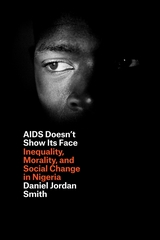
Drawing on twenty years of fieldwork in Nigeria, Smith tells a story of dramatic social changes, ones implicated in the same inequalities that also factor into local perceptions about AIDS—inequalities of gender, generation, and social class. Nigerians, he shows, view both social inequality and the presence of AIDS in moral terms, as kinds of ethical failure. Mixing ethnographies that describe everyday life with pointed analyses of public health interventions, he demonstrates just how powerful these paired anxieties—medical and social—are, and how the world might better alleviate them through a more sensitive understanding of their relationship.

In the literature and aesthetic theory of modern times, we have witnessed the revival of the claim that the conventions and artifices of civilization are the source of many ills. Far from establishing harmonious relationships between individuals, they have sometimes legitimized forms of violence and oppression. But while conventions and artifices may be a source of evil, they are also a means by which evils can be reduced or overcome.
One of our greatest living critics, Jean Starobinski pursues this line of reflection by taking us back to the thought of the eighteenth century. Civilization, he argues, has always been entangled with barbarism. As a form of politeness, a refinement of manners, civilization was said to legitimize deceit. But aren’t the conventions of civilized living, however objectionable, a blessing in disguise? It is the task of art, he contends, to make the most of these conventions, to use the very disguises of civilization to counter the barbarism they mask. Tracing this idea through seventeenth- and eighteenth-century French literature, Starobinski charts the historical and intellectual limits of criticism itself.
These reflections are nourished by a series of sensitive and perceptive studies: the use of the word "civilization" in the Age of Enlightenment; the classical doctrine of civility and the art of flattery; fable and mythology in the seventeenth and eighteenth centuries; the relations between exile, satire, and tyranny in Montesquieu; philosophy and style in the writings of Voltaire; and the search for the remedy of the disease in the thought of Rosseau. A development and refinement of themes that have preoccupied Starobinski throughout his career, Blessings in Disguise is criticism at its best, testing its own limits and extending ours.
Can one be happy and free, and nonetheless be moral? This question occurs at the core of daily life and is, as well, a question as old as philosophy itself. In Can Virtue Make Us Happy? The Art of Living and Morality, Otfried Höffe, one of Europe’s most well-known philosophers, offers a far-reaching and foundational work in philosophical ethics.
As long as one understands "happiness" purely as a feeling of subjective well-being, Höffe argues, there is at best only an accidental unity between it and morality. However, if one means by "happiness" the quality of doing well in the sense of one’s own successful existence, then one must include actions that undoubtedly have a moral character and are named virtues. He uses clear and general language to present what one understands by "happiness" and "freedom" while illuminating the blind alleys in the history of philosophy as well as the difficulties raised by the issues themselves. What has priority: good ends or right action? Is freedom always anarchy? Is it possible to think of a freedom enhanced by morality? Is "morality" only a pretty word for stupidity? Does humanity have a good or a bad character? Is there such a thing as evil? Höffe offers us enlightened philosophical reflection and foundational orientation but no simple formulas; this is precisely what is at stake because anyone who wishes to live a self-determined life rejects any and all formulas.
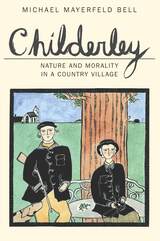
Why do these villagers find country living so compelling? Why, despite our urban lives, do so many of us strive for a home in the country, closer to nature? Michael Bell suggests that we are looking for a natural conscience: an unshakeable source of identity and moral value that is free from social interests—comfort and solace and a grounding of self in a world of conflict and change.
During his interviews with over a hundred of Childerley's 475 residents—both working-class and professional—Bell heard time and again of their desire to be "country people" and of their anxiety over their class identities. Even though they often knowingly participate in class discrimination themselves—and see their neighbors doing the same—most Childerleyans feel a deep moral ambivalence over class. Bell argues they find in class and its conflicts the restraints and workings of social interests and feel that by living "close to nature" they have an alternative: the identity of a "country person," a "villager that the natural consicence gives."
Yet there are clear parallels between the ways in which the villagers conceive of nature and of social life, and Bell traces these parallels across Childerleyans' perspectives on class, gender, and politics. Where conventional theories would suggest that what the villagers see as nature is a reflection of how they see society, and that the natural conscience must be a product of social interests, Bell argues that ideological processes are more complex. Childerleyans' understandings of society and of the natural conscience shape each other, says Bell, through a largely intuitive process he calls resonance.
For anyone who has ever lived in the countryside or considered doing so, this book is not to be missed. It will also be of particular interest to scholars of British studies and the sociology of knowledge and culture, and to those who work on problems of environment, community, class, and rural life.
"[An] exemplary piece of fieldwork. . . . These gentle conclusions . . . reminds us (when we most need reminding) of the skillful ethnographer's enduring capacity to make the everyday seem truly extraordinary."—Laurie Taylor, New Statesman & Society
"Bell's achievement, and his perceptions, are impressive."—J.W.M. Thompson, London Times
"Races along with all the gossipy compulsion of a blockbuster."—Frances Hardy, Daily Mill
"I believe this view of how people relate to the different domains of their experience is absolutely right. . . . The reader, this ready anyway, finishes Childerley with the feeling that she has just returned from visiting a remote Hampshire village and has learned something, not just about that place, but about human social life lived in other places and lived through place itself."—Wendy Griswold, American Journal of Sociology
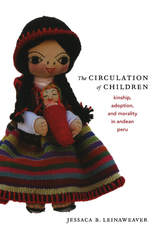
Leinaweaver provides insight into the emotional and material factors that bring together and separate indigenous Andean families in the highland city of Ayacucho. She describes how child circulation is intimately linked to survival in the city, which has had to withstand colonialism, economic isolation, and the devastating civil war unleashed by the Shining Path. Leinaweaver examines the practice from the perspective of parents who send their children to live in other households, the adults who receive them, and the children themselves. She relates child circulation to international laws and norms regarding children’s rights, adoptions, and orphans, and to Peru’s history of racial conflict and violence. Given that history, Leinaweaver maintains that it is not surprising that child circulation, a practice associated with Peru’s impoverished indigenous community, is alternately ignored, tolerated, or condemned by the state.
Religious traditions in the United States are characterized by ongoing tension between assimilation to the broader culture, as typified by mainline Protestant churches, and defiant rejection of cultural incursions, as witnessed by more sectarian movements such as Mormonism and Hassidism. However, legal theorist and Catholic theologian Cathleen Kaveny contends there is a third possibility—a culture of engagement—that accommodates and respects tradition. It also recognizes the need to interact with culture to remain relevant and to offer critiques of social, political, legal, and economic practices.
Kaveny suggests that rather than avoid the crisscross of the religious and secular spheres of life, we should use this conflict as an opportunity to come together and to encounter, challenge, contribute to, and correct one another. Focusing on five broad areas of interest—Law as a Teacher, Religious Liberty and Its Limits, Conversations about Culture, Conversations about Belief, and Cases and Controversies—Kaveny demonstrates how thoughtful and purposeful engagement can contribute to rich, constructive, and difficult discussions between moral and cultural traditions.
This provocative collection of Kaveny's articles from Commonweal magazine, substantially revised and updated from their initial publication, provides astonishing insight into a range of hot-button issues like abortion, assisted suicide, government-sponsored torture, contraception, the Ashley Treatment, capital punishment, and the role of religious faith in a pluralistic society. At turns masterful and inspirational, A Culture of Engagement is a welcome reminder of what can be gained when a diversity of experiences and beliefs is brought to bear on American public life.
Beyleveld then classifies all the criticisms that Gewirth's argument has received and measures them against his reconstruction of the argument. The overall result is an immensely rich picture of the argument, in which all of its complex issues and key moves are clearly displayed and its validity can finally be discerned.
The comprehensiveness of Beyleveld's treatment provides ready access to the entire debate surrounding the foundational argument of Reason and Morality. It will be required reading for all who are interested in Gewirth's theory and deontological ethics and will be of central importance to moral and legal theorists.
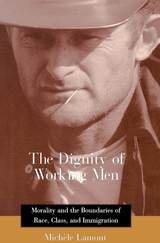
Michèle Lamont takes us into the world inhabited by working-class men--the world as they understand it. Interviewing black and white working-class men who, because they are not college graduates, have limited access to high-paying jobs and other social benefits, she constructs a revealing portrait of how they see themselves and the rest of society.
Morality is at the center of these workers' worlds. They find their identity and self-worth in their ability to discipline themselves and conduct responsible but caring lives. These moral standards function as an alternative to economic definitions of success, offering them a way to maintain dignity in an out-of-reach American dreamland. But these standards also enable them to draw class boundaries toward the poor and, to a lesser extent, the upper half. Workers also draw rigid racial boundaries, with white workers placing emphasis on the "disciplined self" and blacks on the "caring self." Whites thereby often construe blacks as morally inferior because they are lazy, while blacks depict whites as domineering, uncaring, and overly disciplined.
This book also opens up a wider perspective by examining American workers in comparison with French workers, who take the poor as "part of us" and are far less critical of blacks than they are of upper-middle-class people and immigrants. By singling out different "moral offenders" in the two societies, workers reveal contrasting definitions of "cultural membership" that help us understand and challenge the forms of inequality found in both societies.
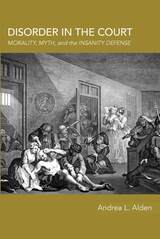
The insanity defense is considered one of the most controversial, most misunderstood, and least straightforward subjects in the American legal system. Disorder in the Court: Morality, Myth, and the Insanity Defense traces the US legal standards for the insanity defense as they have evolved from 1843, when they were first codified in England, to 1984, when the US government attempted to revise them through the Insanity Defense Reform Act. Throughout this period “insanity” existed primarily as a legal term rather than a medical one; yet the testimony of psychiatric experts is required in cases in which an insanity defense is raised.
The adjudication of such cases by courtroom practice is caught between two different but overlapping discourses, the legal and the medical, both of which have historically sought to assert and maintain firm disciplinary boundaries. Both expert and lay audiences have struggled to understand and apply commonplace definitions of sanity, and the portrayal of the insanity defense in popular culture has only served to further frustrate such understandings.
Andrea L. Alden argues that the problems with understanding the insanity defense are, at their foundation, rhetorical. The legal concept of what constitutes insanity and, therefore, an abdication of responsibility for one’s actions does not map neatly onto the mental health professions’ understandings of mental illness and how that affects an individual’s ability to understand or control his or her actions. Additionally, there are multiple layers of persuasion involved in any effort to convince a judge, jury—or a public, for that matter—that a defendant is or is not responsible for his or her actions at a particular moment in time.
Alden examines landmark court cases such as the trial of Daniel McNaughtan, Durham v. United States, and the trial of John Hinckley Jr. that signal the major shifts in the legal definitions of the insanity defense. Combining archival, textual, and rhetorical analysis, Alden offers a close reading of texts including trial transcripts, appellate court opinions, and relevant medical literature from the time period. She contextualizes these analyses through popular texts—for example, newspaper articles and editorials—showing that while all societies have maintained some version of mental illness as a mitigating factor in their penal systems, the insanity defense has always been fraught with controversy.
"This is a welcome and immensely provocative book. For those of us who favor ethical theorizing done in close proximity to psychology and anthropology, it provides new and illuminating theory and research relevant to perennial debates about the origins of moral sense, its psychological organization, and the objectivity and unity of the moral."—Owen Flanagan, Ethics
The contributors are Augusto Blasi, Lawrence Blum, Judy Dunn, M. Ann Easterbrooks, Carolyn Pope Edwards, Robert Emde, Carol Gilligan, Charles C. Helwig, William F. Johnson, Jerome Kagan, Melanie Killen, Sharon Lamb, Manamohan Mahapatra, Joan G. Miller, Edward Mueller, Richard A. Shweder, Catherine Snow, Elliot Turiel, and Grant Wiggins.
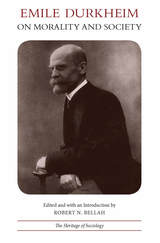
The first two selections of the volume set the context for the development of Durkheim's sociology of morality. Section I, "The French Tradition of Social Thought," gives Durkheim's picture of how his sociology is to be situated relative to the general French tradition. Section II, "Sociology and Social Action," shows Durkheim grappling with moral and political issues in his society and indicates the immediate social context of his thinking.
The remaining selections indicate some of the major substantive areas of Durkheim's sociology of morality. Section III, taken from The Division of Labor in Society, demonstrates his basically evolutionary approach to the development of moral norms in society. Section IV, "The Learning of Morality," gives examples of Durkheim's work on socialization. Section V, "Social Creativity," deals with the important question of how new moral norms arise in society.
Essays in Religion and Morality brings together a dozen papers of varying length to these two themes so crucial to the life and thought of William James. Reflections on the two subjects permeate, first, James's presentation of his father's Literary Remains; second, his writings on human immortality and the relation between reason and faith; third, his two memorial pieces, one on Robert Gould Shaw and the other on Emerson; fourth, his consideration of the energies and powers of human life; and last, his writings on the possibilities of peace, especially as found in his famous essay "The Moral Equivalent of War."
These speeches and essays were written over a period of twenty-four years. The fact that James did not collect and publish them himself in a single volume does not reflect on their intrinsic worth or on their importance in James's philosophical work, since they include some of the best known and most influential of his writings. All the essays, throughout their varied subject matter, are consistently and characteristically Jamesian in the freshness of their attack on the problems and failings of humankind and in their steady faith in human powers.
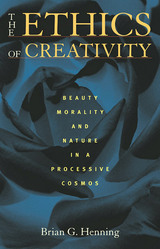
A central concern of nearly every environmental ethic is its desire to extend the scope of direct moral concern beyond human beings to plants, nonhuman animals, and the systems of which they are a part. Although nearly all environmental philosophies have long since rejected modernity’s conception of individuals as isolated and independent substances, few have replaced this worldview with an alternative that is adequate to the organic, processive world in which we find ourselves. In this context, Brian G. Henning argues that the often overlooked work of Alfred North Whitehead has the potential to make a significant contribution to environmental ethics. Additionally inspired by classical American philosophers such as William James, John Dewey and Charles Sanders Pierce and environmental philosophers such as Aldo Leopold, Peter Singer, Albert Schweitzer, and Arne Naess, Henning develops an ethical theory of which the seminal insight is called “The Ethics of Creativity.”
By systematically examining and developing a conception of individuality that is equally at home with the microscopic world of subatomic events and the macroscopic world of ecosystems, The Ethics of Creativity correctly emphasizes the well-being of wholes, while not losing sight of the importance of the unique centers of value that constitute these wholes. In this way, The Ethics of Creativity has the potential to be a unique voice in contemporary moral philosophy.
Almost every thoughtful person wonders at some time why morality says what it says and how, if at all, it speaks to us. David Wiggins surveys the answers most commonly proposed for such questions--and does so in a way that the thinking reader, increasingly perplexed by the everyday problem of moral philosophy, can follow. His work is thus an introduction to ethics that presupposes nothing more than the reader's willingness to read philosophical proposals closely and literally.
Gathering insights from Hume, Kant, the utilitarians, and a twentieth-century assortment of post-utilitarian thinkers, and drawing on sources as diverse as Aristotle, Simone Weil, and Philippa Foot, Wiggins points to the special role of the sentiments of solidarity and reciprocity that human beings will find within themselves. After examining the part such sentiments play in sustaining our ordinary ideas of agency and responsibility, he searches the political sphere for a neo-Aristotelian account of justice that will cohere with such an account of morality. Finally, Wiggins turns to the standing of morality and the question of the objectivity or reality of ethical demands. As the need arises at various points in the book, he pursues a variety of related issues and engages additional thinkers--Plato, C. S. Peirce, Darwin, Schopenhauer, Leibniz, John Rawls, Montaigne and others--always emphasizing the words of the philosophers under discussion, and giving readers the resources to arrive at their own viewpoint of why and how ethics matters.
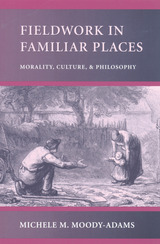
The persistence of deep moral disagreements—across cultures as well as within them—has created widespread skepticism about the objectivity of morality. Moral relativism, moral pessimism, and the denigration of ethics in comparison with science are the results. Fieldwork in Familiar Places challenges the misconceptions about morality, culture, and objectivity that support these skepticisms, to show that we can take moral disagreement seriously and yet retain our aspirations for moral objectivity.
Michele Moody-Adams critically scrutinizes the anthropological evidence commonly used to support moral relativism. Drawing on extensive knowledge of the relevant anthropological literature, she dismantles the mystical conceptions of “culture” that underwrite relativism. She demonstrates that cultures are not hermetically sealed from each other, but are rather the product of eclectic mixtures and borrowings rich with contradictions and possibilities for change. The internal complexity of cultures is not only crucial for cultural survival, but will always thwart relativist efforts to confine moral judgments to a single culture. Fieldwork in Familiar Places will forever change the way we think about relativism: anthropologists, psychologists, historians, and philosophers alike will be forced to reconsider many of their theoretical presuppositions.
Moody-Adams also challenges the notion that ethics is methodologically deficient because it does not meet standards set by natural science. She contends that ethics is an interpretive enterprise, not a failed naturalistic one: genuine ethical inquiry, including philosophical ethics, is a species of interpretive ethnography. We have reason for moral optimism, Moody-Adams argues. Even the most serious moral disagreements take place against a background of moral agreement, and thus genuine ethical inquiry will be fieldwork in familiar places. Philosophers can contribute to this enterprise, she believes, if they return to a Socratic conception of themselves as members of a rich and complex community of moral inquirers.

“The Forest of Taboos may be considered among the most important books ever written by an anthropologist. Valeri writes superbly, and this book makes a fundamental contribution to one of the most central lines of thought in twentieth-century anthropology. He shows that taboo is finally comprehensible.”—John Stephen Lansing, University of Michigan
“The Forest of Taboos is no conventional ethnography, more an extended meditative essay on its subject, erudite, rich in ideas and data, wide-ranging in its theoretical inspiration, and self-consciously literary in form. It is a fitting memorial to an author whose life was so tragically cut short.”—Roy Ellen, University of Kent at Canterbury
This eloquent and profound book, completed by Valerio Valeri shortly before his death in 1998, contends that the ambivalence felt by all humans about sex, death, and eating other animals can be explained by a set of coordinated principles that are expressed in taboos. In elegant prose, Valeri evokes the world of the Huaulu, forest hunters of Indonesia. The hidden attractions of the animal world, which invades the human world in perilous ways, he shows, also delineate that which the Huaulu regard as most human about themselves.

theology--available again!
"As a critic of the contemporary
theological scene, Van Harvey has few, if any, competitors. This is nowhere
clearer than in The Historian and the Believer . . . the classic
discussion of its topic. Rich in insight and penetrating in argument,
it is one book that belongs in the library of every theologian and seminarian."
-- Schubert M. Ogden, author of Doing Theology Today
Is it possible to be both
a historian and a Christian? Van Harvey's classic The Historian and
the Believer posed that question when it was first published.
In this printing, the author
has provided a new introduction in which he reflects on how he would reframe
his original argument in order to bring out more fully the basic theological
intention underlying his view that Christian faith cannot rest on dubious
historical claims.
From reviews of the first
edition:
"Probably the most interesting
piece of American theological writing to appear this year." -- John
Reumann, Union Seminary Quarterly Review
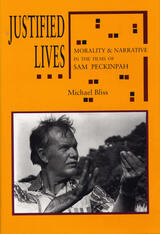
In the first book to critically examine each of the fourteen feature films Sam Peckinpah directed during his career, Michael Bliss stresses the persistent moral and structural elements that permeate Peckinpah’s work.
By examining the films in great detail, Bliss makes clear the moral framework of temptation and redemption with which Peckinpah was concerned while revealing the director’s attention to narrative. Bliss shows that each of Peckinpah’s protagonists is involved with attempting, in the words of Ridethe High Country’s Steve Judd, "to enter my house justified."
The validity of this systematic method is clearly demonstrated in the chapter devoted to The Wild Bunch. Byenumerating the doublings and triplings of action and dialogue found in the film, Bliss underscores its symbolic and structural complexity. Beginning the chapters treating Junior Bonner and The Getaway with analyses of their important title sequences, Bliss shows how these frequently disregarded pieces present in miniature the major moral and narrative concerns of the films. In his chapter on The Osterman Weekend, Bliss makes apparent Peckinpahs awareness of and concern with the self-reflexive nature of filmmaking itself.
Bliss shows that like John Ford, Peckinpah moved from optimism to pessimism. The films of the director’s early period, from The Deadly Companions to Cable Hogue, support the romantic ideals of adventure and camaraderie and affirm a potential for goodness in America. In his second group of films, which begins with Straw Dogs and ends with Bring Me the Head of Alfredo Garcia, both heroes and hope have vanished. It is only in The Osterman Weekend that Peckinpah appears finally to have renewed his capacity for hope, allowing his career to close in a positive way.
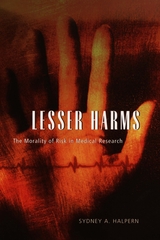
Today's scientists follow federal guidelines for research on human subjects developed during the 1960s and 1970s. But long before these government regulations, medical investigators observed informal rules when conducting human research. They insisted that the dangers of natural disease should outweigh the risks of a medical intervention, and they struggled to accurately assess the relative hazards. Halpern explores this logic of risk in immunization controversies extending as far back as the eighteenth century. Then, focusing on the period between 1930 and 1960, she shows how research physicians and their sponsors debated the moral quandaries involved in moving vaccine use from the laboratory to the clinic.
This probing work vividly describes the efforts of clinical investigators to balance the benefits and dangers of untested vaccines, to respond to popular sentiment about medical hazards, and to strategically present risk laden research to sponsors and the public.
A philosophical challenge to the ableist conflation of disability and pain
More than 2,000 years ago, Aristotle said: “let there be a law that no deformed child shall live.” This idea is alive and well today. During the past century, Supreme Court Justice Oliver Wendell Holmes Jr. argued that the United States can forcibly sterilize intellectually disabled women and philosopher Peter Singer argued for the right of parents to euthanize certain cognitively disabled infants. The Life Worth Living explores how and why such arguments persist by investigating the exclusion of and discrimination against disabled people across the history of Western moral philosophy.
Joel Michael Reynolds argues that this history demonstrates a fundamental mischaracterization of the meaning of disability, thanks to the conflation of lived experiences of disability with those of pain and suffering. Building on decades of activism and scholarship in the field, Reynolds shows how longstanding views of disability are misguided and unjust, and he lays out a vision of what an anti-ableist moral future requires.
The Life Worth Living is the first sustained examination of disability through the lens of the history of moral philosophy and phenomenology, and it demonstrates how lived experiences of disability demand a far richer account of human flourishing, embodiment, community, and politics in philosophical inquiry and beyond.
Engage compelling arguments that challenge prominent positions in Pauline studies
In this innovative book, William E. W. Robinson takes the reader on a journey through Romans 8:1–17 using Conceptual Metaphor Theory and Conceptual Integration Theory. Robinson delineates the underlying cognitive metaphors, their structure, their function, what they mean, and how Paul’s audiences then and now are able to comprehend their meaning. He examines each metaphor in the light of relevant aspects of the Greco-Roman world and Paul’s Jewish background. Robinson contends that Paul portrays the Spirit as the principal agent in the religious-ethical life of believers. At the same time, his analysis demonstrates that the conceptual metaphors in Romans 8:1–17 convey the integral role of believers in ethical conduct. In the process, he addresses thorny theological issues such as whether Spirit and flesh signal an internal battle within believers or two conflicting ways of life. Finally, Robinson shows how this study is relevant to related Pauline passages and challenges scholars to incorporate these methods into their own investigation of biblical texts.
Features:
- Sustained argument that sheds new light on how Paul communicates with his audiences
- Substantial contribution to current debates about central theological concepts
- Conceptual Metaphor Theory and Conceptual Integration Theory applied to the metaphors in Romans 8:1-17

Here, for the first time, is the story of the book's impact. In writing his groundbreaking polemic, David Watkin had taken on the entire modernist establishment, tracing it back to Pugin, Viollet-le-Duc, Corbusier, and others who claimed that their chosen style had to be truthful and rational, reflecting society's needs. Any critic of this style was considered antisocial and immoral. Only covertly did the giants of the architectural establishment support the author. Watkin gives an overview of what has happened since the book's publication, arguing that many of the old fallacies still persist. This return to the attack is a revelation for anyone concerned architecture's past and future.
Morality and Architecture Revisited contains the entire text of the book Morality and Architecture , plus additonal material by David Wakin on the controversy that the the book created.

A concise and accessible introduction to natural law ethics, this book introduces readers to the mainstream tradition of Western moral philosophy. Building on philosophers from Plato through Aquinas to John Finnis, Alfonso Gómez-Lobo links morality to the protection of basic human goods — life, family, friendship, work and play, the experience of beauty, knowledge, and integrity — elements essential to a flourishing, happy human life.
Gómez-Lobo begins with a discussion of Plato's Crito as an introduction to the practice of moral philosophy, showing that it requires that its participants treat each other as equals and offer rational arguments to persuade each other. He then puts forth a general principle for practical rationality: one should pursue what is good and avoid what is bad. The human goods form the basis for moral norms that provide a standard by which actions can be evaluated: do they support or harm the human goods? He argues that moral norms should be understood as a system of rules whose rationale is the protection and enhancement of human goods. A moral norm that does not enjoin the preservation or enhancement of a specific good is unjustifiable. Shifting to a case study approach, Gómez-Lobo applies these principles to a discussion of abortion and euthanasia. The book ends with a brief treatment of rival positions, including utilitarianism and libertarianism, and of conscience as our ultimate moral guide.
Written as an introductory text for students of ethics and natural law, Morality and the Human Goods makes arguments consistent with Catholic teaching but is not based on theological considerations. The work falls squarely within the field of philosophical ethics and will be of interest to readers of any background.
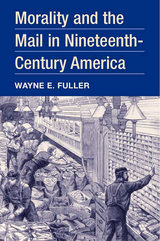
Drawing on House and Senate documents, postmasters general reports, and the Congressional Record, as well as sermons, speeches, and articles from numerous religious and secular periodicals, Fuller illuminates the problems the changed postal system posed for evangelicals, from Sunday mail delivery and Sunday newspapers to an avalanche of unseemly material brought into American homes via improved mail service and reduced postage prices. Along the way, Fuller offers new perspectives on the church and state controversy in the United States as well as on publishing, politics, birth control, the lottery, censorship, Congress’s postal power, and the waning of evangelical Protestant influence.
In TheMorality of Everyday Life, Thomas Fleming offers an alternative to the enlightened liberalism espoused by thinkers as different as Kant, Mill, Rand, and Rawls. Philosophers in the liberal tradition, although they disagree on many important questions, agree that moral and political problems should be looked at from an objective point of view and a decision made from a rational perspective that is universally applied to all comparable cases.
Fleming instead places importance on the particular, the local, and moral complexity. He advocates a return to premodern traditions, such as those exemplified in the texts of Aristotle, the Talmud, and the folk wisdom in ancient Greek literature, for a solution to ethical predicaments. In his view, liberalism and postmodernism ignore the fact that human beings by their very nature refuse to live in a world of universal abstractions.
While such modern philosophers as Kant and Kohlberg have regarded a mother’s self-sacrificing love for her children as beneath their level of morality, folk wisdom tells us it is nearly the highest morality, taking precedence over the duties of citizenship or the claims of humanity. Fleming believes that a modern type of “casuistry” should be applied to these moral conflicts in which the line between right and wrong is rarely clear.
This volume will appeal to students of ethics and classics, as well as the general educated reader, who will appreciate Fleming’s jargon-free prose. Teachers will find this text useful because each chapter is a self-contained essay that could be used as the basis for classroom discussion.
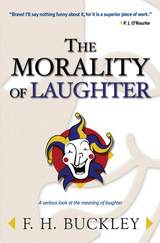
superior piece of work.”
—P. J. O’Rourke
“F. H. Buckley’s The Morality of Laughter is at once
a humorous look at serious matters and a serious
book about humor.”
—Crisis Magazine
“Buckley has written a . ne and funny book that will
be read with pleasure and instruction.”
—First Things
“. . . written elegantly and often wittily. . . .”
—National Post
“. . . a fascinating philosophical exposition of
laughter. . . .”
—National Review
“. . . at once a wise and highly amusing book.”
—Wall Street Journal Online
“. . . a useful reminder that a cheery society is a
healthy one.”
—Weekly Standard

Fr. Servais Pinckaers’s work is well on its way to being accepted as the work on Catholic moral thinking for the coming generation of laymen and students. Pinckaers sharply distinguishes this view of morality from modern “moralities of obligation,” which regard the moral life primarily as obedience to rules that limit human freedom and curb human desires. Pinckaers sees moralities of obligation as the logical outcome of a new understanding of human freedom. Instead of regarding freedom as the capacity to engage in excellent acts of virtue (freedom for excellence), the modern view understands freedom as the radical ability to do good or evil indifferently (freedom of indifference). Pinckaers argues convincingly that this view of freedom and the morality of obligation that flows from it have impoverished the Catholic understanding of the moral life. This work offers the reader a compelling itinerary of moral development, rooted in the theology of St. Paul and the morality of the Gospels.
Now, for a new generation of students, the book is made available in an ebook version.
In addition, under the direction of Fr. Michael Sherwin, a teacher’s edition of the work is to be published, which will greatly aid the teacher in high school or home school to help his or her students to gain the most from this seminal work.
“As Alasdair MacIntyre notes in the preface, the work of Pinckaers attracted strong and fully justified notice in this country with the publication in English of his The Sources of Christian Ethics. As Pinckaers himself notes in the text, excellently translated by Michael Sherwin, the interest should in no way be limited to Roman Catholics. Morality recasts the earlier book in an argument that is both lower and upper case ‘catholic,’ and is accessible to readers and teachers outside the limited circle of moral theologians and academic ethicists. Pinckaers contends that Christian morality is not first of all about obligations but about happiness, understanding that the happiness of union with God is our natural destiny made possible by grace. The Sermon on the Mount is at the center of an approach to morality that turns on the distinction between ‘freedom for excellence’ and ‘freedom of indifference,’ the former understood as human flourishing and the latter as a ‘neutral’ capacity to choose between controversies. The proposal of Morality is thoroughly Christ-centered, humanistic, and faithful to the magisterial teaching of the Church. Warmly recommended.” - First Things
“If you want to have the experience of reflecting on Catholic morality as though you were reading about it for the first time, treat yourself to Father Servais Pinckaers’ Morality: The Catholic View. He has recovered the classical view of the moral life as the quest for happiness and has presented it with disarming simplicity. Bringing us back to the Sermon on the Mount and Romans 12–15, the writings of Augustine and Aquinas, and the theme of natural law, he has freed those texts from the layers of legalism which has hidden their liberating, spiritual powers for moral living. By distinguishing freedom of indifference from freedom for excellence, he has restored a wise vision of freedom. No one has shown better the role of virtues as building blocks for morality. Catechists need to read this book.” Rev. Alfred McBride, O.Praem., Professor of Homilectics and Catechetics at Blessed Pope John XXIII Seminary, Weston, Massachusetts
“Father Pinckaers has given us a masterful exposition of Christian living. The clarity and brevity of his presentation – captured well by the translator – make this book ideal for classroom and parish use. “Readers will find the historical and systematic observations very informative.” Romanus Cessario, St. John’s Seminary, Brighton, Massachusetts

Since at least the time of Plato, religious explanations of the metaphysical foundations of morality have typically fallen into one of two camps: natural law theory, according to which morality is fundamentally explained by facts about human nature—facts that God is responsible for—and divine command theory, which holds that moral obligations arise directly from God’s commands or some other prescriptive act of the divine will. J. Caleb Clanton and Kraig Martin offer an accessible analysis of these traditional views, reconstruct the various arguments for and against them, and offer an extended consideration of the historical emergence of the divide between these positions within the Christian tradition. Nature and Command goes on to develop and defend a theory that combines these two views—a metaethical approach that has not yet received the scholarly attention it deserves.
Along the way, the authors make use of underexplored theological resources drawn from the Stone-Campbell movement, a nineteenth-century restoration movement that culminated in one of the largest Protestant groups in America by the dawn of the twentieth century. Nature and Command summons the resources of this particular Christian heritage—its first principles, call for unity, and ecumenism—to solve one of the great dilemmas of moral philosophy and theology dating back to Plato’s Euthyphro.
This historically aware, argumentatively rigorous, and highly readable volume will serve as a valuable resource for moral philosophy and ethics, as well as for mining the Stone-Campbell Restoration tradition for historical and theological insights.
Frequently cited and just as often disputed, Elizabeth Anscombe’s “Modern Moral Philosophy” (1958) and “The First Person” (1975) are touchstones of twentieth-century analytic philosophy. Though the arguments Anscombe advances in these papers are familiar to philosophers, their significance remains widely misunderstood, says James Doyle.
No Morality, No Self offers a fresh interpretation of Anscombe’s still-controversial theses about ethical reasoning and individual identity, specifically, her argument that the term “moral” (as it occurs in such contexts as “moral obligation”) is literally meaningless, and that “I” does not refer to some special entity called a “self”—a pair of claims that philosophers have responded to with deep skepticism. However unsettling Anscombe’s conclusions may be, Doyle shows the underlying seriousness of the British philosopher’s reasoning, exposing with clarity and concision how the counterarguments of Anscombe’s detractors are based on a flawed or incomplete understanding of her ideas.
Doyle zeroes in on the central conundrum Anscombe posed to the referentialist school: namely, that it is impossible to give a noncircular explanation of how “I” refers to the person who utters it. He shows where the refutations of philosophers including Lucy O’Brien, Gareth Evans, and Ian Rumfitt fall short, and throws light on why “I” developed features that make it look as if it functions as a referring expression. Reconciling seemingly incompatible points of view, Doyle argues that “I” does refer to a self, but not in a way anyone suspected—a surprising conclusion that is entirely à propos of Anscombe’s provocative thought.
A New Statesman Book of the Year
Winner of the Helen and Howard R. Marraro Prize
Winner of the Aldo and Jeanne Scaglione Prize for Italian Studies
“Extraordinary…I could not put it down.”
—Margaret MacMillan
“Reveals how ideology corrupts the truth, how untrammeled ambition destroys the soul, and how the vanity of white male supremacy distorts emotion, making even love a matter of state.”
—Sonia Purnell, author of A Woman of No Importance
When Attilio Teruzzi, a decorated military officer and early convert to the Fascist cause, married a rising American opera star, his good fortune seemed settled. The wedding was blessed by Mussolini himself. Yet only three years later, Teruzzi, now commander of the Black Shirts, renounced his wife. Lilliana was Jewish, and fascist Italy would soon introduce its first race laws.
The Perfect Fascist pivots from the intimate story of a tempestuous courtship and inconvenient marriage to the operatic spectacle of Mussolini’s rise and fall. It invites us to see in the vain, unscrupulous, fanatically loyal Attilio Teruzzi an exemplar of fascism’s New Man. Victoria De Grazia’s landmark history shows how the personal was always political in the fascist quest for manhood and power. In his self-serving pieties and intimate betrayals, his violence and opportunism, Teruzzi is a forefather of the illiberal politicians of today.
“The brilliance of de Grazia’s book lies in the way that she has made a page-turner of Teruzzi’s chaotic life, while providing a scholarly and engrossing portrait of the two decades of Fascist rule.”
—Caroline Moorhead, Wall Street Journal
“Original and important…A probing analysis of the fascist ‘strong man.’ De Grazia’s attention to Teruzzi’s private life, his behavior as suitor and husband, deepens and enriches our understanding of the nature of leadership in Mussolini’s regime and of masculinity, virility, and honor in Italian fascist culture.”
—Robert O. Paxton, author of The Anatomy of Fascism
“This is a perfect book!…Its two entwined narratives—one political and public, the other personal and private—help us understand why the personal is political for those who insist on reshaping people and society.”
—Azar Nafisi, author of Reading Lolita in Tehran

Short-listed for the Juan E. Méndez Book Award for Human Rights in Latin America from Duke University Libraries
How do victims and perpetrators of political violence caught up in a complicated legal battle experience justice on their own terms? Phenomenal Justice is a compelling ethnography about the reopened trials for crimes against humanity committed during the brutal military dictatorship that ruled Argentina between 1976 and 1983. Grounded in phenomenological anthropology and the anthropology of emotion, this book establishes a new theoretical basis that is faithful to the uncertainties of justice and truth in the aftermath of human rights violations. The ethnographic observations and the first-person stories about torture, survival, disappearance, and death reveal the enduring trauma, heartfelt guilt, happiness, battered pride, and scratchy shame that demonstrate the unreserved complexities of truth and justice in post-conflict societies. Phenomenal Justice will be an indispensable contribution to a better understanding of the military dictatorship in Argentina and its aftermath.
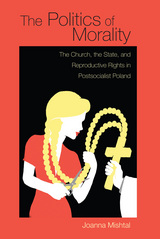
After the fall of the state socialist regime and the end of martial law in 1989, Polish society experienced both a sense of relief from the tyranny of Soviet control and an expectation that democracy would bring freedom. After this initial wave of enthusiasm, however, political forces that had lain concealed during the state socialist era began to emerge and establish a new religious-nationalist orthodoxy. While Solidarity garnered most of the credit for democratization in Poland, it had worked quietly with the Catholic Church, to which a large majority of Poles at least nominally adhered. As the church emerged as a political force in the Polish Sejm and Senate, it precipitated a rapid erosion of women’s reproductive rights, especially the right to abortion, which had been relatively well established under the former regime.
The Politics of Morality is an anthropological study of this expansion of power by the religious right and its effects on individual rights and social mores. It explores the contradictions of postsocialist democratization in Poland: an emerging democracy on one hand, and a declining tolerance for reproductive rights, women’s rights, and political and religious pluralism on the other. Yet, as this thoroughly researched study shows, women resist these strictures by pursuing abortion illegally, defying religious prohibitions on contraception, and organizing into advocacy groups. As struggles around reproductive rights continue in Poland, these resistances and unofficial practices reveal the sharp limits of religious form of governance.
Presenting arguments for and against the morality of profit making, the contributors examine the nature of profits and which ethical theories can support them. Two essays address how profits are made: one explores entrepreneurship as a legitimate source of profit, while another argues that recent advances in welfare economics weaken the case for the morality of profits. The other chapters focus on ethical theory, covering the right to profits from economic rent; the morality of how profits are used—those directed toward library or university endowments, for example, are considered morally acceptable—and whether or not profits are deserved.
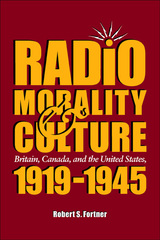
Radio, Morality, and Culture: Britain, Canada, and the United States, 1919–1945 examines the moral controversies surrounding radio’s development during its formative years. In comparing the fledgling medium in Great Britain, Canada, and the United States, Robert S. Fortner documents how the church failed to participate in radio’s moral development and instead engaged in internecine warfare over issues of legitimacy and orthodoxy.
The church was arguing about theological turf and dealing with internal disputes while radio policy was being developed and communications history was being written. Fortner reveals how the church, doomed to play little more than a bit part in the future of radio, eventually lost its voice altogether in the continuing development of electronic media. Fortner effectively synthesizes cultural history and theory, communication studies, and the role religious organizations played in shaping the content and character of early radio. Geared to scholars of history, communications, and theology, Radio, Morality, and Culture provides a useful resource for research, scholarship, and public policy.
"This is a fascinating study of an apparently intractable problem. Gewirth has provided plenty of material for further discussion, and his theory deserves serious consideration. He is always aware of possible rejoinders and argues in a rigorous manner, showing a firm grasp of the current state of moral and political philosophy."—Mind
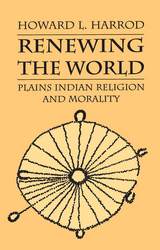
"Harrod's discussion of kinship and reciprocity in Northwest Plains cosmology contains valuable insight into Native American worldview, and his emphasis on the moral dimension of ritual process is a major addition to the too-often ignored subject of Native American moral life." —Journal of Religion
"Includes the major works on Blackfoot, Crow, Cheyennes, and Arapaho religion, the works to which anyone who wishes to understand the religious life of these tribes must continue to turn." —Choice
"Plains people, Harrod suggests, refracted nature and conceived an environmental ethic through a metaphor of kinship. He is particularly skillful in characterizing the ambiguity Plains people expressed at the necessity of killing and eating their animal kin. Renewing the World also contributes to another new and uncultivated science we might call 'ecology of mind'." —Great Plains Quarterly
The Rhetoric of Morality and Philosophy, one of the most groundbreaking works of twentieth-century Platonic studies, is now back in print for a new generation of students and scholars to discover. In this volume, distinguished classicist Seth Benardete interprets and pairs two important Platonic dialogues, the Gorgias and the Phaedrus, illuminating Socrates’ notion of rhetoric and Plato’s conception of morality and eros in the human soul.
Following his discussion of the Gorgias as a dialogue about the rhetoric of morality, Benardete turns to the Phaedrus as a discourse about genuine rhetoric, namely the science of eros, or true philosophy. This novel interpretation addresses numerous issues in Plato studies: the relation between the structure of the Gorgias and the image of soul/city in the Republic, the relation between the structure of Phaedrus and the concept of eros, and Socrates’ notion of ignorance, among others.
Common morality—in the form of shame, outrage, and stigma—has always been society’s first line of defense against ethical transgressions. Social mores crucially complement the law, Mark Osiel shows, sparing us from oppressive formal regulation.
Much of what we could do, we shouldn’t—and we don’t. We have a free-speech right to be offensive, but we know we will face outrage in response. We may declare bankruptcy, but not without stigma. Moral norms constantly demand more of us than the law requires, sustaining promises we can legally break and preventing disrespectful behavior the law allows.
Mark Osiel takes up this curious interplay between lenient law and restrictive morality, showing that law permits much wrongdoing because we assume that rights are paired with informal but enforceable duties. People will exercise their rights responsibly or else face social shaming. For the most part, this system has worked. Social order persists despite ample opportunity for reprehensible conduct, testifying to the decisive constraints common morality imposes on the way we exercise our legal prerogatives. The Right to Do Wrong collects vivid case studies and social scientific research to explore how resistance to the exercise of rights picks up where law leaves off and shapes the legal system in turn. Building on recent evidence that declining social trust leads to increasing reliance on law, Osiel contends that as social changes produce stronger assertions of individual rights, it becomes more difficult to depend on informal tempering of our unfettered freedoms.
Social norms can be indefensible, Osiel recognizes. But the alternative—more repressive law—is often far worse. This empirically informed study leaves little doubt that robust forms of common morality persist and are essential to the vitality of liberal societies.

Righteous Revolutionaries illustrates how states appeal to popular morality—shared understandings of right and wrong—to forge new group identities and mobilize violence against perceived threats to their authority. Jeffrey A. Javed examines the Chinese Communist Party’s mass mobilization of violence during its land reform campaign in the early 1950s, one of the most violent and successful state-building efforts in history. Using an array of novel archival, documentary, and quantitative historical data, this book illustrates that China’s land reform campaign was not just about economic redistribution but rather part of a larger, brutally violent state-building effort to delegitimize the new party-state’s internal rivals and establish its moral authority.
Righteous Revolutionaries argues that the Chinese Party-state simultaneously removed perceived threats to its authority at the grassroots and bolstered its legitimacy through a process called moral mobilization. This mobilization process created a moral boundary that designated a virtuous ingroup of “the masses” and a demonized outgroup of “class enemies,” mobilized the masses to participate in violence against this broadly defined outgroup, and strengthened this symbolic boundary by making the masses complicit in state violence. Righteous Revolutionaries shows how we can find traces of moral mobilization in China today under Xi Jinping’s rule. In an era where states and politicians regularly weaponize moral emotions to foment intergroup conflict and violence, understanding the dynamics of violent mobilization and state authority are more relevant than ever before.
Once the importance of this moral and practical conflict is acknowledged, the authors argue, authoritative rules become the central problems of jurisprudence. The inevitable gap between rules and background morality cannot be bridged, they claim, although many contemporary jurisprudential schools of thought are misguided attempts to do so. Alexander and Sherwin work through this dilemma, which lies at the heart of such ongoing jurisprudential controversies as how judges should reason in deciding cases, what effect should be given to legal precedent, and what status, if any, should be accorded to “legal principles.” In the end, their rigorous discussion sheds light on such topics as the nature of interpretation, the ancient dispute among legal theorists over natural law versus positivism, the obligation to obey law, constitutionalism, and the relation between law and coercion.
Those interested in jurisprudence, legal theory, and political philosophy will benefit from the edifying discussion in The Rule of Rules.

The Scope of Morality was first published in 1980. Minnesota Archive Editions uses digital technology to make long-unavailable books once again accessible, and are published unaltered from the original University of Minnesota Press editions.
The scope of morality, Peter A. French contends, is much narrower than many traditional and contemporary works in ethical theory suggest. We trivialize morality if we think it has something to say about everything we do; it touches us all, but not at all times.
This essay in philosophical ethics focuses upon the origin, purpose, and function of the various concepts to be found in a more or less mature morality. The author draws a distinction between moral concepts that arise from an individual's wish to live a worthwhile life and those directed towards the development of virtue in the moral community. Moral concepts, in his view, are subjective creations of human beings rather than laws with an objective basis in nature. The ethics of sociobiology, of the lifeboat and spaceship models, and of game theory all come under his critical eye in this useful and progressive work. The Scope of Morality, says Hector-Neri Castaneda, "represents a serious effort at discussing the nature of morality, taking into account the most important contributions of recent writers."

Why should we avoid doing moral wrong? The inability of philosophy to answer this question in a compelling manner—along with the moral skepticism and ethical confusion that ensue—result, Stephen Darwall argues, from our failure to appreciate the essentially interpersonal character of moral obligation. After showing how attempts to vindicate morality have tended to change the subject—falling back on nonmoral values or practical, first-person considerations—Darwall elaborates the interpersonal nature of moral obligations: their inherent link to our responsibilities to one another as members of the moral community.
As Darwall defines it, the concept of moral obligation has an irreducibly second-person aspect; it presupposes our authority to make claims and demands on one another. And so too do many other central notions, including those of rights, the dignity of and respect for persons, and the very concept of person itself. The result is nothing less than a fundamental reorientation of moral theory that enables it at last to account for morality's supreme authority—an account that Darwall carries from the realm of theory to the practical world of second-person attitudes, emotions, and actions.

The soldier-poets provide important insights into the ethical dimensions of their physical and psychological surroundings before, during, and after the war. They also offer profound perspectives on the relationships between American soldiers and the Vietnamese people. From firsthand experiences, they reflect on what it meant to be witnesses, victims, and perpetrators of the war's violence. And they advance an uncompromising vision of moral responsibility that indicts a range of culprits for the harms caused by the conflict. Gilbert explores the powerful and perceptive work of these soldier-poets through the lens of morality and presents a radically alternative, deeply personal, and ethically penetrating account of the American war in Vietnam.

"The man value of this book seems to me to be that it shows the force of the Hebrew-Christian moral tradition in the hands of a creative philosopher. Throughout the book, one cannot but feel that a serious philosopher is trying to come to terms with his religious-moral background and to defend it against the prevailing secular utilitarian position which seems to dominate academic philosophy."—Bernard Gert, Journal of Medicine and Philosophy
A thought-provoking examination of how insights from neuroscience challenge deeply held assumptions about morality and law.
As emerging neuroscientific insights change our understanding of what it means to be human, the law must grapple with monumental questions, both metaphysical and practical. Recent advances pose significant philosophical challenges: how do neuroscientific revelations redefine our conception of morality, and how should the law adjust accordingly?
Trialectic takes account of those advances, arguing that they will challenge normative theory most profoundly. If all sentient beings are the coincidence of mechanical forces, as science suggests, then it follows that the time has come to reevaluate laws grounded in theories dependent on the immaterial that distinguish the mental and emotional from the physical. Legal expert Peter A. Alces contends that such theories are misguided—so misguided that they undermine law and, ultimately, human thriving.
Building on the foundation outlined in his previous work, The Moral Conflict of Law and Neuroscience, Alces further investigates the implications for legal doctrine and practice.
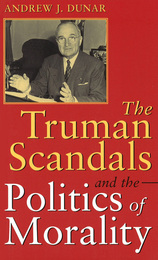
The Truman Scandals and the Politics of Morality is a thoroughly researched effort offering an excellent historical narrative of the scandals and accusations of scandal that bedeviled Harry Truman throughout his political career. The book is particularly significant in light of the connections the author establishes between Truman's early political experiences and his subsequent difficulties as president.
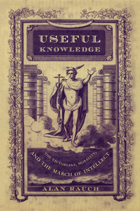
Rauch discusses both the influence and the ideology of knowledge in terms of how it affected nineteenth-century anxieties about moral responsibility and religious beliefs. Drawing on a wide array of literary, scientific, and popular works of the period, the book focusses on the growing importance of scientific knowledge and its impact on Victorian culture. From discussions of Jane Webb Loudon’s The Mummy! and Mary Shelley’s Frankenstein, to Charlotte Brontë’s The Professor, Charles Kingsley’s Alton Locke, and George Eliot’s Mill on the Floss, Rauch paints a fascinating picture of nineteenth-century culture and addresses issues related to the proliferation of knowledge and the moral issues of this time period. Useful Knowledge touches on social and cultural anxieties that offer both historical and contemporary insights on our ongoing preoccupation with knowledge.
Useful Knowledge will appeal to readers interested in nineteenth century history, literature, culture, the mediation of knowledge, and the history of science.
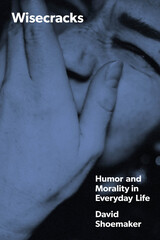
A good sense of humor is key to the good life, but a joke taken too far can get anyone into trouble. Where to draw the line is not as simple as it may seem. After all, even the most innocent quips between friends rely on deception, sarcasm, and stereotypes and often run the risk of disrespect, meanness, and harm. How do we face this dilemma without taking ourselves too seriously?
In Wisecracks, philosopher David Shoemaker examines this interplay between humor and morality and ultimately argues that even morally suspect humor is an essential part of ethical life. Shoemaker shows how improvised “wisecracks” between family and friends—unlike scripted stand-up, sketches, or serials—help us develop a critical human skill: the ability to carry on and find the funny in tragedy. In developing a new ethics of humor in defense of questionable gibes, Wisecracks offers a powerful case for humor as a healing presence in human life.
READERS
Browse our collection.
PUBLISHERS
See BiblioVault's publisher services.
STUDENT SERVICES
Files for college accessibility offices.
RECENTLY PUBLISHED




UChicago Accessibility Resources
home | accessibility | search | about | contact us
BiblioVault ® 2001 - 2024
The University of Chicago Press