
 A SCHOLARLY BOOK REPOSITORY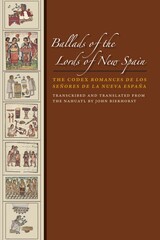
Compiled in 1582, Ballads of the Lords of New Spain is one of the two principal sources of Nahuatl song, as well as a poetical window into the mindset of the Aztec people some sixty years after the conquest of Mexico. Presented as a cancionero, or anthology, in the mode of New Spain, the ballads show a reordering—but not an abandonment—of classic Aztec values. In the careful reading of John Bierhorst, the ballads reveal in no uncertain terms the pre-conquest Aztec belief in the warrior's paradise and in the virtue of sacrifice.
This volume contains an exact transcription of the thirty-six Nahuatl song texts, accompanied by authoritative English translations. Bierhorst includes all the numerals (which give interpretive clues) in the Nahuatl texts and also differentiates the text from scribal glosses. His translations are thoroughly annotated to help readers understand the imagery and allusions in the texts. The volume also includes a helpful introduction and a larger essay, "On the Translation of Aztec Poetry," that discusses many relevant historical and literary issues.
In Bierhorst's expert translation and interpretation, Ballads of the Lords of New Spain emerges as a song of resistance by a conquered people and the recollection of a glorious past.
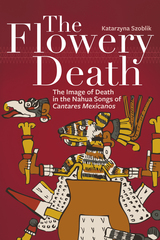
The Flowery Death is a groundbreaking exploration of xochimiquiztli, or “flowery death,” a central concept in the pre-Hispanic Nahua worldview. In the highly militarized societies of the Valley of Mexico, dying in honor of the gods—on the battlefield, in ritual sacrifice, or in childbirth—was not only a social expectation but also a path to spiritual glory. While this idea appears throughout colonial sources, previous studies have relied largely on the writings of Bernardino de Sahagún and other European chroniclers, whose perspectives often simplify or distort Indigenous understandings.
Drawing on the rich oral tradition preserved in the sixteenth-century manuscript Cantares Mexicanos, this book provides one of the first English translations of these songs since John Bierhorst’s 1985 translation. It combines paleographic fidelity, literal English translation, and detailed interpretation, revealing the metaphor- and symbol-rich meanings behind the songs. The book is divided into two interrelated parts: The first reconstructs the Nahua worldview, contextualizing war, death, and sacrifice through myths, chronicles, and visual sources; the second presents selected songs, offering readers the tools to understand their metaphors, historical references, and symbolic language, making the work both a scholarly reference and an accessible guide for students and enthusiasts.
By examining the cultural, religious, and social significance of xochimiquiztli, The Flowery Death provides fresh insights into Nahua ideology, gender roles, and collective memory. It is essential reading for anyone interested in Mesoamerican culture, early colonial history, and the power of Indigenous oral traditions.
READERS
Browse our collection.
PUBLISHERS
See BiblioVault's publisher services.
STUDENT SERVICES
Files for college accessibility offices.
RECENTLY PUBLISHED





UChicago Accessibility Resources
home | accessibility | search | about | contact us
BiblioVault ® 2001 - 2026
The University of Chicago Press