
 A SCHOLARLY BOOK REPOSITORY
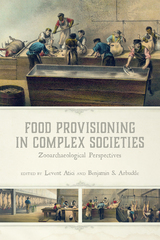
Through creative combinations of ethnohistoric evidence, iconography, and contextual analysis of faunal remains, this work offers new insight into the mechanisms involved in food provisioning for complex societies. Contributors combine zooarchaeological and historical data from global case studies to analyze patterns in centralization and bureaucratic control, asymmetrical access and inequalities, and production-distribution-consumption dynamics of urban food provisioning and animal management.
Taking a global perspective and including both prehistoric and historic case studies, the chapters in the volume reflect some of the current best practices in the zooarchaeology of complex societies. Embedding faunal evidence within a broader anthropological explanatory framework and integrating archaeological contexts, historic texts, iconography, and ethnohistorical sources, the book discerns myriad ways that animals are key contributors to, and cocreators of, complex societies in all periods and all places. Chapters cover the diverse sociopolitical and economic roles wild animals played in Bronze Age Turkey; the production and consumption of animal products in medieval Ireland; the importance of belief systems, politics, and cosmologies in Shang Dynasty animal provisioning in the Yellow River Valley; the significance of external trade routes in the kingdom of Aksum (modern Sudan); hunting and animal husbandry at El Zotz; animal economies from two Mississippian period sites; and more.
Food Provisioning in Complex Societies provides an optimistic roadmap and heuristic tools to explore the diverse, resilient, and contingent processes involved in food provisioning. The book represents a novel and productive way forward for understanding the unique, yet predictably structured, provisioning systems that emerged in the context of complex societies in all parts of the world. It will be of interest to zooarchaeologists and archaeologists alike.
Contributors: Joaquin Arroyo-Cabrales, Fiona Beglane, Roderick Campbell, Kathryn Grossman, Patricia Martinez-Lira, Jacqueline S. Meier, Sarah E. Newman, Terry O'Connor, Tanya M. Peres, Gypsy C. Price, Elizabeth J. Reitz, Kim Shelton, Marcus Winter, Helina S. Woldekiros
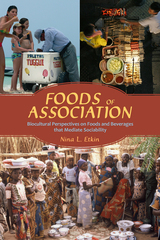
This fascinating book examines the biology and culture of foods and beverages that are consumed in communal settings, with special attention to their health implications. Nina Etkin covers a wealth of topics, exploring human evolutionary history, the Slow Food movement, ritual and ceremonial foods, caffeinated beverages, spices, the street foods of Hawaii and northern Nigeria, and even bottled water. Her work is framed by a biocultural perspective that considers both the physiological implications of consumption and the cultural construction and circulation of foods. For Etkin, the foods and beverages we consume are simultaneously “biodynamic substances and cultural objects.”
The book begins with a look at the social eating habits of our primate relatives and discusses our evolutionary adaptations. It then offers a history of social foods in the era of European expansion, with a focus on spices and “caffeinated cordials.” (Of course, there were some powerful physiological consequences of eating foods brought home by returning explorers, and those are considered too—along with consequences for native peoples.) From there, the book describes “street food,” which is always served in communal settings. Etkin then scrutinizes ceremonial foods and beverages, and considers their pharmacological effects as well. Her extensive examination concludes by assessing the biological and cultural implications of bottled water.
While intended primarily for scholars, this enticing book serves up a tantalizing smorgasbord of food for thought.
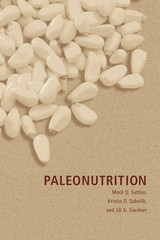
This is the most comprehensive and up-to-date book on the topic. Intended for students and professionals, it describes the nature of paleonutrition studies, reviews the history of paleonutrition research, discusses methodological issues in the reconstruction of prehistoric diets, presents theoretical frameworks frequently used in paleonutrition research, and showcases examples in which paleonutritional analyses have been successfully conducted on prehistoric individuals, groups, and populations. It offers an integrative approach to understanding state-of-the-art anthropological dietary, health, and nutritional assessments. The most recent and innovative methods used to reconstruct prehistoric diets are discussed, along with the major ways in which paleonutrition data are recovered, analyzed, and interpreted.
Paleonutrition includes five contemporary case studies that provide useful models of how to conduct paleonutrition research. Topics range from ancient diets in medieval Nubia to children’s health in the prehistoric American Southwest to honey use by an ethnographic group of East African foragers. As well as providing interesting examples of applying paleonutrition techniques, these case studies illustrate the mutually beneficial linkages between ethnography and archaeology.
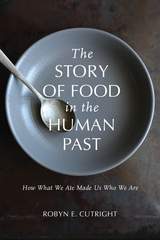
Explore how food shaped humanity in this compelling archaeological journey.
The Story of Food in the Human Past: How What We Ate Made Us Who We Are uses case studies from recent archaeological research to tell the story of food in human prehistory. Beginning with the earliest members of our genus, Robyn E. Cutright investigates the role of food in shaping who we are as humans during the emergence of modern Homo sapiens and through major transitions in human prehistory such as the development of agriculture and the emergence of complex societies.
This fascinating study begins with a discussion of how food shaped humans in evolutionary terms by examining what makes human eating unique, the use of fire to cook, and the origins of cuisine as culture and adaptation through the example of Neandertals. The second part of the book describes how cuisine was reshaped when humans domesticated plants and animals and examines how food expressed ancient social structures and identities such as gender, class, and ethnicity. Cutright shows how food took on special meaning in feasts and religious rituals and also pays attention to the daily preparation and consumption of food as central to human society.
Cutright synthesizes recent paleoanthropological and archaeological research on ancient diet and cuisine and complements her research on daily diet, culinary practice, and special-purpose mortuary and celebratory meals in the Andes with comparative case studies from around the world to offer readers a holistic view of what humans ate in the past and what that reveals about who we are.
READERS
Browse our collection.
PUBLISHERS
See BiblioVault's publisher services.
STUDENT SERVICES
Files for college accessibility offices.
RECENTLY PUBLISHED




UChicago Accessibility Resources
home | accessibility | search | about | contact us
BiblioVault ® 2001 - 2026
The University of Chicago Press