
 A SCHOLARLY BOOK REPOSITORY
Results by Title
5 books about Outer space
5 books about Outer space
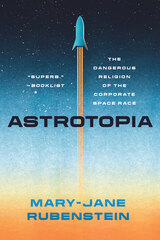
Astrotopia
The Dangerous Religion of the Corporate Space Race
Mary-Jane Rubenstein
University of Chicago Press, 2022
A revealing look at the parallel mythologies behind the colonization of Earth and space—and a bold vision for a more equitable, responsible future both on and beyond our planet.
As environmental, political, and public health crises multiply on Earth, we are also at the dawn of a new space race in which governments team up with celebrity billionaires to exploit the cosmos for human gain. The best-known of these pioneers are selling different visions of the future: while Elon Musk and SpaceX seek to establish a human presence on Mars, Jeff Bezos and Blue Origin work toward moving millions of earthlings into rotating near-Earth habitats. Despite these distinctions, these two billionaires share a core utopian project: the salvation of humanity through the exploitation of space.
In Astrotopia, philosopher of science and religion Mary-Jane Rubenstein pulls back the curtain on the not-so-new myths these space barons are peddling, like growth without limit, energy without guilt, and salvation in a brand-new world. As Rubenstein reveals, we have already seen the destructive effects of this frontier zealotry in the centuries-long history of European colonialism. Much like the imperial project on Earth, this renewed effort to conquer space is presented as a religious calling: in the face of a coming apocalypse, some very wealthy messiahs are offering an other-worldly escape to a chosen few. But Rubenstein does more than expose the values of capitalist technoscience as the product of bad mythologies. She offers a vision of exploring space without reproducing the atrocities of earthly colonialism, encouraging us to find and even make stories that put cosmic caretaking over profiteering.
As environmental, political, and public health crises multiply on Earth, we are also at the dawn of a new space race in which governments team up with celebrity billionaires to exploit the cosmos for human gain. The best-known of these pioneers are selling different visions of the future: while Elon Musk and SpaceX seek to establish a human presence on Mars, Jeff Bezos and Blue Origin work toward moving millions of earthlings into rotating near-Earth habitats. Despite these distinctions, these two billionaires share a core utopian project: the salvation of humanity through the exploitation of space.
In Astrotopia, philosopher of science and religion Mary-Jane Rubenstein pulls back the curtain on the not-so-new myths these space barons are peddling, like growth without limit, energy without guilt, and salvation in a brand-new world. As Rubenstein reveals, we have already seen the destructive effects of this frontier zealotry in the centuries-long history of European colonialism. Much like the imperial project on Earth, this renewed effort to conquer space is presented as a religious calling: in the face of a coming apocalypse, some very wealthy messiahs are offering an other-worldly escape to a chosen few. But Rubenstein does more than expose the values of capitalist technoscience as the product of bad mythologies. She offers a vision of exploring space without reproducing the atrocities of earthly colonialism, encouraging us to find and even make stories that put cosmic caretaking over profiteering.
[more]
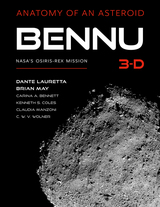
Bennu 3-D
Anatomy of an Asteroid
Dante Lauretta, Brian May, Carina A. Bennett, Kenneth S. Coles, Claudia Manzoni, and C. W. V. Wolner
University of Arizona Press, 2023
Bennu, named for the ancient Egyptian phoenix, was the chosen destination of OSIRIS-REx, NASA’s premier mission of asteroid exploration, launched in 2016. Study of the asteroid is important in safeguarding the future of planet Earth, but Bennu is also a time capsule from the dawn of our Solar System, holding secrets over four-and-a-half billion years old about the origin of life and Earth as a habitable planet.
In 2020 the OSIRIS-REx spacecraft successfully landed on the surface of Bennu and collected pristine asteroid material for delivery to Earth in September 2023. Scientific studies of the samples, along with data collected during the rendezvous, promise to help find answers to some of humanity’s deepest questions: Where did we come from? What is our destiny in space?
This book, the world’s first complete (and stereoscopic) atlas of an asteroid, is the result of a unique collaboration between OSIRIS-REx mission leader Dante Lauretta and Brian May’s London Stereoscopic Company. Lauretta’s colleagues include Carina Bennett, Kenneth Coles, and Cat Wolner, as well as Brian May and Claudia Manzoni, who became part of the ultimately successful effort to find a safe landing site for sampling. The text details the data collected by the mission so far, and the stereo images have been meticulously created by Manzoni and May from original images collected by the OSIRIS-REx cameras.
In 2020 the OSIRIS-REx spacecraft successfully landed on the surface of Bennu and collected pristine asteroid material for delivery to Earth in September 2023. Scientific studies of the samples, along with data collected during the rendezvous, promise to help find answers to some of humanity’s deepest questions: Where did we come from? What is our destiny in space?
This book, the world’s first complete (and stereoscopic) atlas of an asteroid, is the result of a unique collaboration between OSIRIS-REx mission leader Dante Lauretta and Brian May’s London Stereoscopic Company. Lauretta’s colleagues include Carina Bennett, Kenneth Coles, and Cat Wolner, as well as Brian May and Claudia Manzoni, who became part of the ultimately successful effort to find a safe landing site for sampling. The text details the data collected by the mission so far, and the stereo images have been meticulously created by Manzoni and May from original images collected by the OSIRIS-REx cameras.
[more]
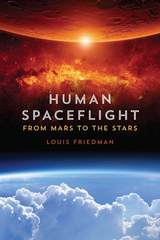
Human Spaceflight
From Mars to the Stars
Louis Friedman
University of Arizona Press, 2015
Mars, the red planet named for the god of war, a mysterious dust-ridden place, is most like Earth in its climate and seasons. Of all the possible destinations in space to travel, Mars is the most likely for humans to reach. According to esteemed scientist Louis Friedman, it may be the only destination outside the moon to ever see human footprints.
Far from diminishing our future in space, Human Spaceflight lays out a provocative future for human space travel. The noted aerospace engineer and scientist says that human space exploration will continue well into the future, but space travel by humans will stop at Mars. Instead, nanotechnology, space sails, robotics, biomolecular engineering, and artificial intelligence will provide the vehicles of the future for an exciting evolution not just of space travel but of humankind.
Friedman has worked with agencies around the globe on space exploration projects to extend human presence beyond Mars and beyond the solar system. He writes that once we accept Mars as the only viable destination for humans, our space program on planet Earth can become more exciting and more relevant. Mars, he writes, will take hundreds, even thousands, of years to settle. During that time, humans and all our supporting technologies will evolve, allowing our minds to be present throughout the universe while our bodies stay home on Earth and Mars.
Far from diminishing our future in space, Human Spaceflight lays out a provocative future for human space travel. The noted aerospace engineer and scientist says that human space exploration will continue well into the future, but space travel by humans will stop at Mars. Instead, nanotechnology, space sails, robotics, biomolecular engineering, and artificial intelligence will provide the vehicles of the future for an exciting evolution not just of space travel but of humankind.
Friedman has worked with agencies around the globe on space exploration projects to extend human presence beyond Mars and beyond the solar system. He writes that once we accept Mars as the only viable destination for humans, our space program on planet Earth can become more exciting and more relevant. Mars, he writes, will take hundreds, even thousands, of years to settle. During that time, humans and all our supporting technologies will evolve, allowing our minds to be present throughout the universe while our bodies stay home on Earth and Mars.
[more]
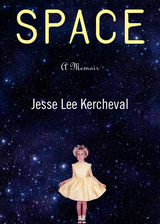
Space
A Memoir
Jesse Lee Kercheval
University of Wisconsin Press, 2014
Jesse Lee Kercheval opens her story in Cocoa, Florida, in 1966 as a precocious ten-year-old whose family—father, mother, two little girls—is trying to ride the Space Race’s tide of optimism. But even as the rockets keep going up, the Kercheval family slowly spirals down.
[more]
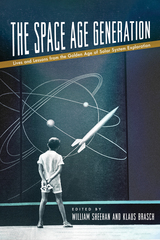
The Space Age Generation
Lives and Lessons from the Golden Age of Solar System Exploration
William Sheehan and Klaus Brasch
University of Arizona Press, 2024
In 1957 Sputnik launched toward the stars. President Kennedy then announced that the United States would send men to the Moon and then return them to Earth.These pivotal moments sparked an unequaled bound forward in human innovation and scientific exploration.
At the heart of this momentous time were the men and women working behind the scenes. Scientists, historians, and astronomers share their memories and contributions from this unparalleled era in essays told in their own words. They are the remarkable generation who witnessed and contributed to some of space science’s most stunning achievements. Here they have recorded their memories—their childhood inspirations, their challenges, failures, and triumphs—for future generations.
A unique and authoritative record of a momentous period in human history, The Space Age Generation highlights the golden age of space exploration and the people who made it happen.
Contributors
Leo Aerts
Alexander Basilevsky
Klaus Brasch
Clark R. Chapman
Dale P. Cruikshank
William K. Hartmann
William Leatherbarrow
Baerbel Koesters Lucchitta
Yvonne Pendleton
Peter H. Schultz
William Sheehan
Paolo Tanga
Charles A. Wood
At the heart of this momentous time were the men and women working behind the scenes. Scientists, historians, and astronomers share their memories and contributions from this unparalleled era in essays told in their own words. They are the remarkable generation who witnessed and contributed to some of space science’s most stunning achievements. Here they have recorded their memories—their childhood inspirations, their challenges, failures, and triumphs—for future generations.
A unique and authoritative record of a momentous period in human history, The Space Age Generation highlights the golden age of space exploration and the people who made it happen.
Contributors
Leo Aerts
Alexander Basilevsky
Klaus Brasch
Clark R. Chapman
Dale P. Cruikshank
William K. Hartmann
William Leatherbarrow
Baerbel Koesters Lucchitta
Yvonne Pendleton
Peter H. Schultz
William Sheehan
Paolo Tanga
Charles A. Wood
[more]
READERS
Browse our collection.
PUBLISHERS
See BiblioVault's publisher services.
STUDENT SERVICES
Files for college accessibility offices.
RECENTLY PUBLISHED




UChicago Accessibility Resources
home | accessibility | search | about | contact us
BiblioVault ® 2001 - 2026
The University of Chicago Press