front cover of After the Holodomor
After the Holodomor
The Enduring Impact of the Great Famine on Ukraine
Andrea Graziosi
Harvard University Press

Over the last twenty years, a concerted effort has been made to uncover the history of the Holodomor, the Great Famine of 1932–1933 in Ukraine. Now, with the archives opened and the essential story told, it becomes possible to explore in detail what happened after the Holodomor and to examine its impact on Ukraine and its people.

In 2008 the Ukrainian Research Institute at Harvard University hosted an international conference entitled “The Great Famine in Ukraine: The Holodomor and Its Consequences, 1933 to the Present.” The papers, most of which are contained in this volume, concern a wide range of topics, such as the immediate aftermath of the Holodomor and its subsequent effect on Ukraine’s people and communities; World War II, with its wartime and postwar famines; and the impact of the Holodomor on subsequent generations of Ukrainians and present-day Ukrainian culture. Through the efforts of the historians, archivists, and demographers represented here, a fuller history of the Holodomor continues to emerge.
[more]

front cover of Along Ukraine's River
Along Ukraine's River
A Social and Environmental History of the Dnipro
Roman Adrian Cybriwsky
Central European University Press, 2018

The River Dnipro (formerly better known by the Russian name of Dnieper) is intimately linked to the history and identity of Ukraine. Cybriwsky discusses the history of the river, from when it was formed and its many uses and modifications by human agencies from ancient times to the present.

From key vantage points along the river’s course—its source in western Russia, through Belarus and Ukraine, to the Black Sea—interesting stories shed light on past and present life in Ukraine. Scenes set along the river from Russian and Ukrainian literature are evoked, as well as musical compositions and works of art. Topics include the legacy of the region’s cultural ancestors as the Kyivan Rus, the period of Cossack dominion, the epic battles for the river’s bridges in World War II, the building of dams and huge reservoirs by the Soviet Union, and the crisis of Chornobyl (Chernobyl). The author argues that the Dnipro and the farmlands along it are Ukraine’s chief natural resources, and that the country's future depends on putting both to good use.

Written without academic pretence in an informal style with dashes of humor, Along Ukraine's River is illustrated with original line drawings, maps, and photographs.

[more]

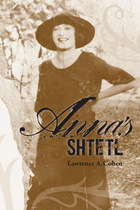
front cover of Anna's Shtetl
Anna's Shtetl
Lawrence A. Coben
University of Alabama Press, 2007
A rare view of a childhood in a European ghetto
 
Anna Spector was born in 1905 in Korsun, a Ukrainian town on the Ros River, eighty miles south of Kiev. Held by Poland until 1768 and annexed by the Tsar in 1793 Korsun and its fluid ethnic population were characteristic of the Pale of Settlement in Eastern Europe: comprised of Ukrainians, Cossacks, Jews and other groups living uneasily together in relationships punctuated by violence. Anna’s father left Korsun in 1912 to immigrate to America, and Anna left in 1919, having lived through the Great War, the Bolshevik Revolution, and part of the ensuing civil war, as well as several episodes of more or less organized pogroms—deadly anti-Jewish riots begun by various invading military detachments during the Russian Civil War and joined by some of Korsun’s peasants.
 
In the early 1990s Anna met Lawrence A. Coben, a medical doctor seeking information about the shtetls to recapture a sense of his own heritage. Anna had near-perfect recall of her daily life as a girl and young woman in the last days in one of those historic but doomed communities. Her rare account, the product of some 300 interviews, is valuable because most personal memoirs of ghetto life are written by men. Also, very often, Christian neighbors appear in ghetto accounts as a stolid peasant mass assembled on market days, as destructive mobs, or as an arrogant and distant collection of government officials and nobility. Anna’s story is exceptionally rich in a sense of the Korsun Christians as friends, neighbors, and individuals.
 
Although the Jewish communities in Eastern Europe are now virtually gone, less than 100 years ago they counted a population of millions. The firsthand records we have from that lost world are therefore important, and this view from the underrecorded lives of women and the young is particularly welcome.  


[more]

front cover of The Ashes of Babi Yar
The Ashes of Babi Yar
The Massacre of Jews in Kyiv
Antonella Salomoni, Translated by Antony Shugaar
University of Wisconsin Press, 2025
On September 29 and 30, 1941, in one of the largest mass murders of the Holocaust, German troops massacred 33,771 Jews at the vast gorge located near Kyiv known as Babi Yar (Babij Jar). During and after the war, the territory was modified, redesigned, and converted in order to remove the physical signs of genocide, including the exhumation and incineration of thousands of bodies. In large part this erasure was the result of policies implemented by the Soviet regime, which refused to accept that there had been a “special war” against Jews. 

Beginning with an explication of the mass murders and their aftermath, Antonella Salomoni examines the afterlife of a massacre whose physical remains were intentionally hidden. She focuses especially on how the arts—prose, poetry, music, architecture, and painting—shaped a collective narrative that, despite repression, played a crucial role in preserving the history and memory of the genocide.
[more]

front cover of The Battle for Ukrainian
The Battle for Ukrainian
A Comparative Perspective
Michael S. Flier
Harvard University Press

In 1863 the Valuev Circular restricted the use of the Ukrainian language in the Russian Empire. In the 150 years since, Ukrainian has followed a tortuous path, reflecting or anticipating tsarist, Soviet, and post-Soviet history. This volume documents that path, studying the language’s emergence in southern Rus´, its shifting fortunes in the Russian Empire and Soviet Union, and its variable status after 1991.

Ukrainian can serve as a useful prism for assessing 150 years of imperial disintegration and reformation, and worldwide state and nation building—a period in which other languages have been created, promoted, and repressed, or have come to coexist in multilingual nations. Case studies of Gaelic, Finnish, Yiddish, the Baltic group, and of language policy in Canada, India, and the former Yugoslavia illuminate similarities and differences in chronological, comparative, international, and transnational terms. The result is an interdisciplinary study that is essential for understanding language, history, and politics in Ukraine and in the post-imperial world.

[more]

front cover of Breaking the Bonds of Corruption
Breaking the Bonds of Corruption
From Academic Dishonesty to Informal Business Practices in Post-Soviet Ukraine
Elena Denisova-Schmidt
Harvard University Press
In Breaking the Bonds of Corruption, Elena Denisova-Schmidt takes a broad view of corruption and its prevalence in global societies, using the case of Ukraine to examine practices that are considered corrupt in historical, social, and economic perspectives. She investigates corrupt behavior in higher education, both in Ukraine and internationally, as well as reliance on corruption in Ukrainian business. For both areas, the author relies on studies and polling that she and her colleagues administered at a number of Ukrainian universities and with Ukrainian businesses. This is the first English-language book dedicated to examining corruption as a widespread social phenomenon in post-Soviet Ukraine and makes an important contribution to the maturing study of informal practices in Ukraine and the region.
[more]

front cover of The Causes of Post-Mobilization Leadership Change and Continuity
The Causes of Post-Mobilization Leadership Change and Continuity
A Comparative Analysis of Post-Color Revolution in Ukraine, Kyrgyzstan, and Georgia
Vasili Rukhadze
University of Michigan Press, 2021

Vasili Rukhadze examines the factors that contributed to post-uprising leadership durability in the Ukraine, Kyrgyzstan, and Georgia in 2004–12, after these countries underwent their so-called “Color Revolutions.” Using structured, focused comparison and process tracing, he argues that the key independent variable influencing post-mobilization leadership durability is ruling coalition size and cohesion. He demonstrates that if the ruling coalitions are large and fragmented, as in the Ukraine and Kyrgyzstan, the coalitions disintegrate, thus facilitating the downfall of the governments. Alternatively, if the ruling coalition is small and cohesive, as in Georgia, the coalition maintains unity, hence helping the government to stay in power.

This study advances the debate on regime changes. By drawing a clear distinction between political leaderships that come to power as a result of popular uprisings and governments that take power through normal democratic processes, military coup, or any other means, the research offers one of the first studies on post-mobilization leadership. Rukhadze helps scholars differentiate between the factors that affect durability of post-uprising leadership from those factors that impact durability of all other political leadership, in turn equipping researchers with new tools to study power politics.

[more]

front cover of Cecil the Lion Had to Die
Cecil the Lion Had to Die
Olena Stiazhkina
Harvard University Press, 2024

In 1986 Soviet Ukraine, two boys and two girls are welcomed into the world in a Donetsk maternity ward. Following a Soviet tradition of naming things after prominent Communist leaders from far away, a local party functionary offers great material benefits for naming children after Ernst Thälmann, the leader of the German Communist Party from 1925 to 1933. The fateful decision is made, and the local newspaper presents the newly born Ernsts and Thälmas in a photo on the front page, forever tying four families together.

In Cecil the Lion Had to Die, Olena Stiazhkina follows these families through radical transformations when the Soviet Union unexpectedly implodes, independent Ukraine emerges, and neoimperial Russia occupies Ukraine’s Crimea and parts of the Donbas. Just as Stiazhkina’s decision to transition to writing in Ukrainian as part of her civic stance—performed in this book that begins in Russian and ends in Ukrainian—the stark choices of family members take them in different directions, presenting a multifaceted and nuanced Donbas.

A tour de force of stylistic registers, intertwining stories, and ironic voices, this novel is a must-read for those who seek deeper understanding of how Ukrainian history and local identity shapes war with Russia.

[more]

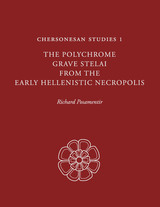
front cover of Chersonesan Studies 1
Chersonesan Studies 1
The Polychrome Grave Stelai from the Early Hellenistic Necropolis
By Richard Posamentir
University of Texas Press, 2010

Chersonesan Studies 1 presents the painted grave stelai of the Early Hellenistic necropolis of Chersonesos Taurike, a Greek city on the northern shore of the Black Sea. This unique collection of over one hundred objects is of major interest to students of ancient art and Greek culture. Their polychrome decoration has been extraordinarily well preserved, a rarity in the ancient world. They compose a remarkable, even unique, body of evidence of Greek funerary memorial sculpture: their shapes are gender-specific, their depicted objects are gender- and age-specific, and they can be ascribed to a handful of specific workshops. Their surprising uniformity requires an explanation, since comparable assemblages from other parts of the Greek world show substantial diversity in all these aspects.

This book provides the first complete catalog and description of the stelai, together with full-color illustrations of all the significant stelai and many details. Through his painstaking recovery and reassembling of fragments, as well as the use of advanced photographic techniques, Richard Posamentir has been able to add a whole new dimension to the study of these artifacts. The volume covers the history of the stelai, analysis of the workshops, and reconstruction of the necropolis that the stelai originally graced. A comparison chapter discusses how the stelai fit into the context of Greek funerary art and provides insights into the culture and society of a city on the Black Sea.

[more]

logo for Harvard University Press
Churches and States
Studies on the History of Christianity in Ukraine
Halyna Hryn
Harvard University Press
This book collects nine articles that originally appeared in the journal Harvard Ukrainian Studies and that arose from the Harvard Ukrainian Research Institute’s Millennium Project, an initiative launched in the 1980s to celebrate one thousand years of the Christianization of Kyivan Rus´. The articles cover a wide array of subjects: the ecclesiastical structure of the Christian Church in Rus´ in its earliest period (Andrzej Poppe); the conflict between Orthodoxy and the Uniate Church from 1569 to 1700 (Teresa Chynczewska-Hennel); an account of the Uniate Church and the partitions of Poland (Larry Wolff); the transformation of the Greek Catholic Church under the Austrian Empire (1848–1914) (John-Paul Himka); the Greek Catholic Church in the period between the two World Wars (Andrew Sorokowski); a rethinking of the relationship of Church and society in Galician Ukraine from 1914 to 1944 (Bohdan Budurowycz); and the Russian Orthodox Church in Ukraine during the interwar period (Bohdan Bociurkiw). The book concludes with a bio-bibliography of Bohdan Bociurkiw, a scholar who devoted his career to the study of Ukrainian Church history (Andrii Krawchuk). These essays provide new insights and a fresh perspective to the discipline.
[more]

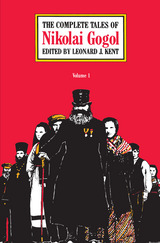
front cover of The Complete Tales of Nikolai Gogol, Volume 1
The Complete Tales of Nikolai Gogol, Volume 1
Nikolai Gogol
University of Chicago Press, 1985
Nikolai Gogol was an artist who, like Rabelais, Cervantes, Swift, and Sterne, "knew how to walk upside down in our valley of sorrows so as to make it to a merry place." This two-volume edition at last brings all of Gogol's fiction (except his novel Dead Souls) together in paperback. Volume 1 includes Evenings on a Farm near Dikanka, the early Ukrainian folktales that first brought Gogol fame, as well as "Nevsky Prospekt" and "Diary of a Madman."

"It is good to have a complete collection of Gogol's tales in paperback. . . . Professor Kent has thoroughly revised Mrs. Garnett's conscientious and skillful translation, eliminating the Victorianisms of her style, correcting mistakes and pruderies of diction, and making the whole translation sound much more contemporary and alive. But he has avoided the whimsicality and 'curliness' in which some recent translators indulged, and he has not changed or suppressed anything material. He has also supplied helpful notes which are often the first annotation in English, and he has written an introduction which steers the correct middle course between making Gogol an irresponsible artist of the grotesque and proving him a documentary historian of backward Russia."—René Wellek, Yale University
[more]

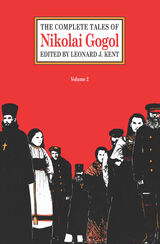
front cover of The Complete Tales of Nikolai Gogol, Volume 2
The Complete Tales of Nikolai Gogol, Volume 2
Nikolai Gogol
University of Chicago Press, 1983
Volume 2 of The Complete Tales includes Gogol's Mirgorod stories—among them that masterpiece of grotesque comedy, "The Tale of How Ivan Ivanovich Quarreled with Ivan Nikiforovich," the wonderfully satiric "Old World Landowners," and the Cossak epic "Taras Bulba." Here also is "The Nose," Gogol's final effort in the realm of the fantastic, as well as "The Coach," "The Portrait" (in its final version), and the most influential of his Petersburg stories, "The Overcoat."
[more]

front cover of David and Goliath
David and Goliath
Commentaries on the Russo-Ukrainian War
Serhii Plokhy
Harvard University Press

The biblical image of David and Goliath captures fittingly the nature of the war that Russia, the world’s largest country by surface area, unleashed on neighboring Ukraine, a country that—while still the largest on the European continent—is almost thirty times smaller and has only over a quarter of Russia’s population. Yet Ukraine’s stubborn resistance proves that it is possible to mount a successful defense against an enormously larger, more populous, and better equipped enemy, even despite its threats of nuclear apocalypse should Ukraine refuse to submit and the West dare to interfere. This volume shows that history can help reveal the reasons for Ukraine’s resolve and success on the battlefield and in the public arena.

Collected in David and Goliath for the first time are short essays, commentaries, and interviews written and given by Serhii Plokhy, the world’s preeminent scholar of Ukrainian history, on the eve and during the first two years of Russia’s full-scale invasion of Ukraine. Plokhy draws our attention to the unique nature of the truly historic events of the largest war in Europe since the end of World War II.

[more]

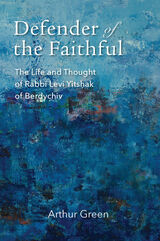
front cover of Defender of the Faithful
Defender of the Faithful
The Life and Thought of Rabbi Levi Yitshak of Berdychiv
Arthur Green
Brandeis University Press, 2022
The first scholarly biography of Levi Yitshak of Berdychiv in English in over thirty-five years.
 
Defender of the Faithful explores the life and thought of Levi Yitshak of Berdychiv (1740–1809), one of the most fascinating and colorful Hasidic leaders of his time. This is an intellectual and religious biography, a reading of the development of his thought and career. Featuring examples of Levi Yitshak’s extraordinary texts alongside insightful analysis by scholar and theologian Arthur Green, Defender of the Faithful is a compelling study of both Levi Yitshak’s theology and broader philosophy.
 
[more]

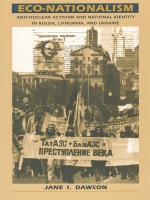
front cover of Eco-Nationalism
Eco-Nationalism
Anti-Nuclear Activism and National Identity in Russia, Lithuania, and Ukraine
Jane I. Dawson
Duke University Press, 1996
Eco-nationalism examines the spectacular rise of the anti-nuclear power movement in the former Soviet Union during the early perestroika period, its unexpected successes in the late 1980s, and its substantial decline after 1991. Jane I. Dawson argues that anti-nuclear activism, one of the most dynamic social forces to emerge during these years, was primarily a surrogate for an ever-present nationalism and a means of demanding greater local self-determination under the Soviet system. Rather than representing strongly held environmental and anti-nuclear convictions, this activism was a political effort that reflected widely held anti-Soviet sentiments and a resentment against Moscow’s domination of the region—an effort that largely disappeared with the dissolution of the USSR.
Dawson combines a theoretical framework based on models of social movements with extensive field research to compare the ways in which nationalism, regionalism, and other political demands were incorporated into anti-nuclear movements in Russia, Lithuania, Ukraine, Armenia, Tatarstan, and Crimea. These comparative case studies form the core of the book and trace differences among the various regional movements to the distinctive national identities of groups involved. Reflecting the new opportunities for research that have become available since the late 1980s, these studies draw upon Dawson’s extended on-site observation of local movements through 1995 and her unique access to movement activists and their personal archives.
Analyzing and documenting a development with sobering and potentially devastating implications for nuclear power safety in the former USSR and beyond, Eco-nationalism’s examination of social activism in late and postcommunist societies will interest readers concerned with the politics of global environmentalism and the process of democratization in the post-Soviet world.
[more]

front cover of Eternal People
Eternal People
A Novel
David Milofsky
University Press of Colorado, 1998
<i>Eternal People,/i> tells the story of Joseph Abrams, a Ukrainian Jew who finds his way to America at the end of the nineteenth-century. During a break from his studies in Russia, he returns to his shtetl in the Ukraine to find it is the target of a Cos
[more]

front cover of European Expansion and the Contested Borderlands of Late Medieval Podillya, Ukraine
European Expansion and the Contested Borderlands of Late Medieval Podillya, Ukraine
Vitaliy Mykhaylovskiy
Arc Humanities Press, 2019

This book focuses on a key zone within the eastern frontier of medieval Europe: Podillya in modern-day Ukraine. Vitaliy Mykhaylovskiy offers a definitive guide to the region, which experienced great cultural and religious diversity, together with a continuous influx of newcomers. This is where Christian farmers met Muslim nomads. This is where German town residents and Polish nobles met urban Armenians and Tatars serving in the military. The territory emerged in historical narrative when Lithuanian and Polish rulers divided the legacy of the Ruthenian Kingdom and pushed Tatars back to the steppe. For one hundred and fifty years, this territory passed through many dominions – a western part of the Golden Horde, a principality under the Koriatovych brothers, a turf partitioned among the Polish kingdom and the duchy of Lithuania. Podillya offers a unique opportunity to see interaction of so many peoples, principalities, and cultures – the eastern frontier of Europe at its most dynamic.

[more]

front cover of The Eye of the Mind
The Eye of the Mind
Vision, Memory, and Meditation in Seventeenth-Century Ukrainian Preaching
Maria Grazia Bartolini
Harvard University Press

In The Eye of the Mind, Maria Grazia Bartolini investigates how early modern Ukrainian preachers prompted their listeners to see and remember sermons by calling upon vision, memory, and mental imagery. With memorization recognized in Ukraine as a cognitive skill vital to the internalization of texts, these preachers, like their counterparts elsewhere in Europe, designed their sermons to enable listeners to see the subject matter as mental images and situate them in imaginary locations for easy recall.

Based on analysis of little-known printed and manuscript sources from the second half of the seventeenth century, Bartolini masterfully demonstrates how verbal and visual images within the sermon functioned as mnemonic devices that helped Ukrainian preachers construct and deliver sermons and evoked intellectual and emotional associations in the minds of the audience. The effect of this rhetorical practice, Bartolini argues, was to create a theatrum meditationis—a memory theater—in which the audience was encouraged to take part as spectators. By fully integrating intellectual history, visual studies, and rhetorical analysis, The Eye of the Mind provides a unique perspective on seventeenth-century religious orators and their audiences in Ukraine and beyond.

[more]

logo for Harvard University Press
Famine in the Soviet Ukraine 1932-1933
A Memorial Exhibition
Oksana Procyk, Leonid Heretz, and James E. Mace
Harvard University Press, 1986

This library exhibition catalogue is a survey of current knowledge about the Ukrainian Famine of 1932-1933. Intended to be a ready source of information and documentation as well as a guide for further research, this publication consists of a concise, well-illustrated historical narrative, a brief summary of scholarly research on the subject, excerpts from a wide range of sources, and an extensive bibliography.

The following aspects of the Famine and its historical context are presented: the Ukrainian Revolution 1917-1921; the development of Bolshevik policy toward the nationalities and the peasantry; the Ukrainian Socialist Soviet Republic arid the policy of Ukrainization; the Ukrainian cultural renaissance of the 1920s; Stalin's seizure of power--purges, collectivization, and industrialization; the Famine in the contemporary western press; the Famine in memoirs and published eyewitness accounts; the Famine in literature; and commemoration of the fiftieth anniversary of the Famine.

[more]

front cover of The Frontline
The Frontline
Essays on Ukraine’s Past and Present
Serhii Plokhy
Harvard University Press, 2023
The Frontline presents a selection of essays drawn together for the first time to form a companion volume to Serhii Plokhy’s The Gates of Europe and Chernobyl. Here he expands upon his analysis in earlier works of key events in Ukrainian history, including Ukraine’s complex relations with Russia and the West, the burden of tragedies such as the Holodomor and World War II, the impact of the Chernobyl nuclear disaster, and Ukraine’s contribution to the collapse of the Soviet Union. Juxtaposing Ukraine’s history to the contemporary politics of memory, this volume provides a multidimensional image of a country that continues to make headlines around the world. Eloquent in style and comprehensive in approach, the essays collected here reveal the roots of the ongoing political, cultural, and military conflict in Ukraine, the largest country in Europe.
[more]

front cover of The Frontline
The Frontline
Essays on Ukraine’s Past and Present
Serhii Plokhy
Harvard University Press, 2021

The Frontline presents a selection of essays drawn together for the first time to form a companion volume to Serhii Plokhy’s The Gates of Europe and Chernobyl. Here he expands upon his analysis in earlier works of key events in Ukrainian history, including Ukraine’s complex relations with Russia and the West, the burden of tragedies such as the Holodomor and World War II, the impact of the Chernobyl nuclear disaster, and Ukraine’s contribution to the collapse of the Soviet Union.

Juxtaposing Ukraine’s history to the contemporary politics of memory, this volume provides a multidimensional image of a country that continues to make headlines around the world. Eloquent in style and comprehensive in approach, the essays collected here reveal the roots of the ongoing political, cultural, and military conflict in Ukraine, the largest country in Europe.

[more]

front cover of The Future of the Past
The Future of the Past
New Perspectives on Ukrainian History
Serhii Plokhy
Harvard University Press, 2016

Ukraine is in the midst of the worst international crisis in East-West relations since the Cold War, and history itself has become a battleground in Russia-Ukraine relations. Can history and historical narratives be blamed for what has happened in the region, or can they show the path to peace and reconciliation, helping to integrate the history of the region in the broader European context?

The essays collected here address these questions, rethinking the meaning of Ukrainian history by venturing outside boundaries established by the national paradigm, and demonstrating how research on the history of Ukraine can benefit from both regional and global perspectives. The Future of the Past shows how the study of Ukraine’s past enhances our understanding of Europe, Eurasia, and the world—past, present, and future.

[more]

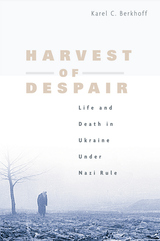
front cover of Harvest of Despair
Harvest of Despair
Life and Death in Ukraine under Nazi Rule
Karel C. Berkhoff
Harvard University Press, 2008

“If I find a Ukrainian who is worthy of sitting at the same table with me, I must have him shot,” declared Nazi commissar Erich Koch. To the Nazi leaders, the Ukrainians were Untermenschen—subhumans. But the rich land was deemed prime territory for Lebensraum expansion. Once the Germans rid the country of Jews, Roma, and Bolsheviks, the Ukrainians would be used to harvest the land for the master race.

Karel Berkhoff provides a searing portrait of life in the Third Reich’s largest colony. Under the Nazis, a blend of German nationalism, anti-Semitism, and racist notions about the Slavs produced a reign of terror and genocide. But it is impossible to understand fully Ukraine’s response to this assault without addressing the impact of decades of repressive Soviet rule. Berkhoff shows how a pervasive Soviet mentality worked against solidarity, which helps explain why the vast majority of the population did not resist the Germans. He also challenges standard views of wartime eastern Europe by treating in a more nuanced way issues of collaboration and local anti-Semitism.

Berkhoff offers a multifaceted discussion that includes the brutal nature of the Nazi administration; the genocide of the Jews and Roma; the deliberate starving of Kiev; mass deportations within and beyond Ukraine; the role of ethnic Germans; religion and national culture; partisans and the German response; and the desperate struggle to stay alive. Harvest of Despair is a gripping depiction of ordinary people trying to survive extraordinary events.

[more]

front cover of A Harvest Truce
A Harvest Truce
A Play
Serhiy Zhadan
Harvard University Press, 2024

Brothers Anton and Tolik reunite at their family home to bury their recently deceased mother. An otherwise natural ritual unfolds under extraordinary circumstances: their house is on the front line of a war ignited by Russian-backed separatists in eastern Ukraine. Isolated without power or running water, the brothers’ best hope for success and survival lies in the declared cease fire—the harvest truce. But such hopes are swiftly dashed, as it becomes apparent that the conflagration of war will not abate.

With echoes of Waiting for Godot, Serhiy Zhadan’s A Harvest Truce stages a tragicomedy in which the commonplace experiences of death, birth, and the cycles of life marked by the practices of growing and harvesting food are rendered futile and farcical in the wake of the indifferent juggernaut of war.

[more]

front cover of Heroes and Villains
Heroes and Villains
Creating National History in Contemporary Ukraine
David R. Marples
Central European University Press, 2007
Certain to engender debate in the media, especially in Ukraine itself, as well as the academic community. Using a wide selection of newspapers, journals, monographs, and school textbooks from different regions of the country, the book examines the sensitive issue of the changing perspectives – often shifting 180 degrees – on several events discussed in the new narratives of the Stalin years published in the Ukraine since the late Gorbachev period until 2005. These events were pivotal to Ukrainian history in the 20th century, including the Famine of 1932–33 and Ukrainian insurgency during the war years.
[more]

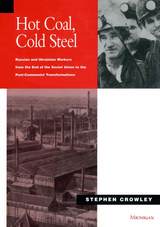
front cover of Hot Coal, Cold Steel
Hot Coal, Cold Steel
Russian and Ukrainian Workers from the End of the Soviet Union to the Post-Communist Transformations
Stephen Crowley
University of Michigan Press, 1997
Well after the disintegration of the Communist Party and the Soviet state--and through several years of economic collapse--industrial workers in almost every sector of the former Soviet Union have remained quiescent and the same ineffective and unpopular trade unions still hold a virtual monopoly on worker's representation. Why? While many argue that labor is a central variable in the development of economic and political systems, little is known about workers in the states of the former Soviet Union since the fall of Communism. In a comparative study of two groups of industrial workers--the coal miners and steelworkers--at the end of the Soviet era, Stephen Crowley sheds light on where these workers have been and where they are going.
Coal miners in the final years of the Soviet Union effectively organized and led strikes which supported the end of Communism, even though their heavy subsidies would be threatened by capitalism. Steel workers, in contrast, did not effectively organize and strike. This pattern has continued under the new governments, with the coal miners effectively organized and seeking protection from the worst consequences of marketization, while the steel workers remain weakly organized despite deteriorating economic conditions.
Based on extensive on-site research including interviews with miners and steelworkers, labor leaders and plant managers, Crowley develops a detailed picture of the conditions under which workers organize. His findings have application beyond the conditions of post-Communist Russia and Ukraine to other societies undergoing fundamental change.
This book will be of interest to sociologists and political scientists interested in the role of labor in transitional societies, the patterns of organization of labor, as well as area specialists.
Stephen Crowley is Associate Professor of Political Science, Oberlin College.
[more]

front cover of Hubris
Hubris
The American Origins of Russia's War against Ukraine
Jonathan Haslam
Harvard University Press, 2025

A leading expert on US-Russian relations reveals how the United States and its European allies set the course for the war in Ukraine—and offers a sobering indictment of American foreign policy since the fall of the Soviet Union.

Russia’s full-scale invasion of Ukraine in February 2022 should not have taken the world by surprise. The attack escalated a war that began in 2014 with the Russian annexation of Crimea, but its origins are visible as far back as the aftermath of the Cold War, when newly independent Ukraine moved to the center of tense negotiations between Russia and the West. The United States was a leading player in this drama. In fact, Jonathan Haslam argues, it was decades of US foreign policy missteps and miscalculations, unchecked and often reinforced by European allies, that laid the groundwork for the current war.

Isolated, impoverished, and relegated to a second-order power on the world stage, Russia grew increasingly resentful of Western triumphalism in the wake of the Cold War. The United States further provoked Russian ire with a campaign to expand NATO into Eastern Europe—especially Ukraine, the most geopolitically important of the former Soviet republics. Determined to extend its global dominance, the United States repeatedly ignored signs that antagonizing Russia would bring consequences. Meanwhile, convinced that Ukraine was passing into the Western sphere of influence, Putin prepared to shift the European balance of power in Russia’s favor.

Timely and incisive, Hubris reveals the assumptions, equivocations, and grievances that have defined the West’s relations with Russia since the twilight of the Soviet Union—and ensured that collision was only a matter of time.

[more]

logo for Harvard University Press
Hunger by Design
The Great Ukrainian Famine and Its Soviet Context
Halyna Hryn
Harvard University Press, 2008
The years 2002–2003 marked the seventieth anniversary of the man-made famine inflicted on Ukraine and surrounding areas by Stalin’s Soviet leadership. The Harvard Ukrainian Research Institute commemorated the anniversary with a symposium in October 2003 titled “The Ukrainian Terror-Famine of 1932–1933: Revisiting the Issues and the Scholarship Twenty Years after the HURI Famine Project.” This volume contains some of the papers presented at the symposium (previously published in Harvard Ukrainian Studies volume 25, no. 3/4), including Sergei Maksudov’s large-scale demographic study drawing on available documents of the era; Niccolo Pianciola’s description of the denomadization famine in Kazakhstan from 1931 to 1933; and Gijs Kessler’s study of events in the Urals region from the same period. Also included in this volume are Andrea Graziosi’s remarks on the present state of Famine scholarship and how it addresses the question of genocide, Hennadii Boriak’s assessment of the current state of source material, and an essay by George Grabowicz on the legacy of the Famine in Ukraine today.
[more]

front cover of The Hustynja Chronicle
The Hustynja Chronicle
Oleksiy Tolochko
Harvard University Press, 2013

Written in the early seventeenth century, the Hustynja Chronicle represents the first attempt of early modern chroniclers to write a systematic history of Ukraine. The chronological sweep of the text is ambitious, describing the history of Kyivan Rus´ and Ukraine from biblical times until the Union of Brest in 1596. The text covers many critical periods in Ukrainian history, including pre-Mongol Rus´, the expansion of the Grand Duchy of Lithuania, and the emergence of the Cossacks. Its unique style blends the older tradition of presenting information under yearly entries with a newer, more narrative style of chronicle modeled on the works of Polish chroniclers such as Stryjkowski and Bielski.

This publication marks the first time that the Hustynja Chronicle has appeared in a scholarly edition. One copy originally found in the Mharsk Monastery serves as the exemplar for the main text and is accompanied by notes representing variants from six other copies of the text. An introduction by Ukrainian historian Dr. Oleksiy Tolochko, in both the original Ukrainian and English translation, provides a detailed description and history of the chronicle. The Hustynja Chronicle is an essential source for scholars interested in medieval and early-modern Ukrainian history, philology, and chronicle writing.

[more]

front cover of I Will Mix Your Blood with Coal
I Will Mix Your Blood with Coal
Snapshots from the East of Ukraine
Oleksandr Mykhed, Tanya Savchynska, and David Mossop
Northwestern University Press, 2025
Exploring the post-Soviet landscape of the Ukrainian east in a complex journey of loss, hope, and history
 
In 2014, the Russian army, with support from local militants, occupied parts of Ukraine’s two easternmost regions—once the beating industrial heart of the Soviet Union—where coal extraction has since exhausted both the human population and the natural resources. In late 2016, Oleksandr Mykhed set out on a research trip to explore the deep history and contested present of the area from the perspective of a fellow countryman who’d never been there.
 
Mykhed brings us on a painful yet hopeful journey across the Ukrainian east, sharing conversations with locals, snippets from archival documents, and the complicated perspectives of prominent cultural figures, such as writer Serhiy Zhadan, historian Olena Stiazhkina, and philosopher Ihor Kozlovsky, who was imprisoned and tortured for nearly two years.
 
I Will Mix Your Blood with Coal invites us to meet generations of coal miners. To learn about the Belgian and British investors who founded the east’s industrial cities. To remember the harrowing events of the First and Second World Wars and the incalculable brutality of Soviet history. To see the activists who are even now working to improve the country. To hear sweet memories of a lost utopia that never existed. Mykhed provides a unique portrait of life in the east during the war, before the full-scale invasion that would change everything.
[more]

logo for University of Chicago Press
Ice-Age Hunters of the Ukraine
Richard G. Klein
University of Chicago Press, 1973

front cover of Icons Axed, Freedoms Lost
Icons Axed, Freedoms Lost
Russian Desecularization and a Ukrainian Alternative
Vyacheslav Karpov
Rutgers University Press, 2025
In Icons Axed, Freedoms Lost, Vyacheslav Karpov and Rachel L. Schroeder demonstrate how Russia went from persecuting believers to jailing critics of religion and why, in contrast, religious pluralism and tolerance have solidified in Ukraine. Offering a richly documented history of cultural and political struggles that surrounded desecularization—the resurgence of religion’s societal role—from the end of the USSR to the Russo-Ukrainian war, they show Russian critics of desecularization adhered to artistic provocations, from axing icons to “punk-prayers” in cathedrals, and how Orthodox activists, in turn, responded by vandalizing controversial exhibits and calling on the state to crush “the enemies of the Church.” Putin’s solidifying tyranny heard their calls and criminalized insults to religious feelings. Meanwhile, Ukraine adhered to its pluralistic legacies. Its churches refused to engage in Russian-style culture wars, sticking instead to forgiveness and forbearance. Icons Axed, Freedoms Lost offers original theoretical and methodological perspectives on desecularization applicable far beyond the cases of Russia and Ukraine.
 
[more]

front cover of In Isolation
In Isolation
Dispatches from Occupied Donbas
Stanislav Aseyev
Harvard University Press, 2022

In this exceptional collection of dispatches from occupied Donbas, writer and journalist Stanislav Aseyev details the internal and external changes observed in the cities of Makiïvka and Donetsk in eastern Ukraine. Aseyev scrutinizes his immediate environment and questions himself in an attempt to understand the reasons behind the success of Russian propaganda among the working-class residents of the industrial region of Donbas.

In this work of documentary prose, Aseyev focuses on the early period of the Russian-sponsored military aggression in Ukraine’s east, the period of 2015–2017. The author’s testimony ends with his arrest for publishing his dispatches and his subsequent imprisonment and torture in a modern-day concentration camp on the outskirts of Donetsk run by lawless mercenaries and local militants with the tacit approval and support of Moscow. For the first time, an inside account is presented here of the toll on real human lives and civic freedoms that the citizens of Europe’s largest country continue to suffer in Russia’s hybrid war on its territory.

[more]

front cover of Isaac Babel and the Self-Invention of Odessan Modernism
Isaac Babel and the Self-Invention of Odessan Modernism
Rebecca Jane Stanton
Northwestern University Press, 2012

In what marks an exciting new critical direction, Rebecca Stanton contends that the city of Odessa—as a canonical literary image and as a kaleidoscopic cultural milieu—shaped the narrative strategies developed by Isaac Babel and his contemporaries of the Revolutionary generation. Modeling themselves on the tricksters and rogues of Odessa lore, Babel and his fellow Odessans Val­entin Kataev and Yury Olesha manipulated their literary personae through complex, playful, and often subversive negotiations of the boundary between autobiography and fiction. In so doing, they cannily took up a place prepared for them in the Russian canon and fostered modes of storytelling that both reflected and resisted the aesthetics of Socialist Realism. Stanton concludes with a rereading of Babel’s “autobiographical” stories and examines their leg­acy in post-Thaw works by Kataev, Olesha, and Konstantin Paustovsky.

[more]

front cover of The Jewish Dark Continent
The Jewish Dark Continent
Life and Death in the Russian Pale of Settlement
Nathaniel Deutsch
Harvard University Press, 2011

At the turn of the twentieth century, over forty percent of the world’s Jews lived within the Russian Empire, almost all in the Pale of Settlement. From the Baltic to the Black Sea, the Jews of the Pale created a distinctive way of life little known beyond its borders. This led the historian Simon Dubnow to label the territory a Jewish “Dark Continent.”

Just before World War I, a socialist revolutionary and aspiring ethnographer named An-sky pledged to explore the Pale. He dreamed of leading an ethnographic expedition that would produce an archive—what he called an Oral Torah of the common people rather than the rabbinic elite—which would preserve Jewish traditions and transform them into the seeds of a modern Jewish culture. Between 1912 and 1914, An-sky and his team collected jokes, recorded songs, took thousands of photographs, and created a massive ethnographic questionnaire. Consisting of 2,087 questions in Yiddish—exploring the gamut of Jewish folk beliefs and traditions, from everyday activities to spiritual exercises to marital intimacies—the Jewish Ethnographic Program constitutes an invaluable portrait of Eastern European Jewish life on the brink of destruction.

Nathaniel Deutsch offers the first complete translation of the questionnaire, as well as the riveting story of An-sky’s almost messianic efforts to create a Jewish ethnography in an era of revolutionary change. An-sky’s project was halted by World War I, and within a few years the Pale of Settlement would no longer exist. These survey questions revive and reveal shtetl life in all its wonder and complexity.

[more]

front cover of Jews and Ukrainians in Russia's Literary Borderlands
Jews and Ukrainians in Russia's Literary Borderlands
From the Shtetl Fair to the Petersburg Bookshop
Amelia M. Glaser
Northwestern University Press, 2011

Studies of Eastern European literature have largely confined themselves to a single language, culture, or nationality. In this highly original book, Glaser shows how writers working in Russian, Ukrainian, and Yiddish during much of the nineteenth century and the early part of the twentieth century were in intense conversation with one another. The marketplace was both the literal locale at which members of these different societies and cultures interacted with one another and a rich subject for representation in their art. It is commonplace to note the influence of Gogol on Russian literature, but Glaser shows him to have been a profound influence on Ukrainian and Yiddish literature as well. And she shows how Gogol must be understood not only within the context of his adopted city of St. Petersburg but also that of his native Ukraine. As Ukrainian and Yiddish literatures developed over this period, they were shaped by their geographical and cultural position on the margins of the Russian Empire. As distinctive as these writers may seem from one another, they are further illuminated by an appreciation of their common relationship to Russia. Glaser’s book paints a far more complicated portrait than scholars have traditionally allowed of Jewish (particularly Yiddish) literature in the context of Eastern European and Russian culture.

[more]

front cover of A Laboratory of Transnational History
A Laboratory of Transnational History
Ukraine and Recent Ukrainian Historiography
Georgiy Kasianov
Central European University Press, 2009
A first attempt to present an approach to Ukrainian history which goes beyond the standard 'national narrative' schemes, predominant in the majority of post-Soviet countries after 1991, in the years of implementing 'nation-building projects'.An unrivalled collection of essays by the finest scholars in the field from Ukraine, Russia, USA, Germany, Austria and Canada, superbly written to a high academic standard. The various chapters are methodologically innovative and thought-provoking. The biggest Eastern European country has ancient roots but also the birth pangs of a new autonomous state. Its historiography is characterized by animated debates, in which this book takes a definite stance. The history of Ukraine is not written here as a linear, teleological narrative of ethnic Ukrainians but as a multicultural, multidimensional history of a diversity of cultures, religious denominations, languages, ethical norms, and historical experience. It is not presented as causal explanation of 'what has to have happened' but rather as conjunctures and contingencies, disruptions, and episodes of 'lack of history.'
[more]

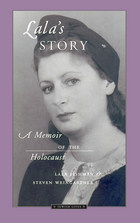
front cover of Lala's Story
Lala's Story
A Memoir of the Holocaust
Lala Fishman
Northwestern University Press, 1997
Winner of 1998 Carl Sandburg Award

Born into a middle-class Jewish family in 1932, Lala Weintraub grew up in Lvov, Poland. When the Nazis came, Lala—who had blond hair and blue eyes—survived by convincing them she was a Christian. This book tells her remarkable story. Fiercely determined and greatly aided by her Aryan looks, she managed to convince everyone—German soldiers, interrogators, fellow Poles—that she was a Polish gentile. Within a year after the Germans captured Lvov, many of Lala's family members were missing and presumed dead.

Lala's Story follows her as she moves from town to town, driven by her fear of being discovered. More than a story of survival, this is the story of a young girl's resolute struggle to defy, resist, and ultimately defeat the evil forces pursuing her.
[more]

logo for Duke University Press
Literary Politics in the Soviet Ukraine, 1917-1934
George S. N. Luckyj
Duke University Press, 1990
Literary Politics in the Soviet Ukraine, 1917–1934 illuminates the flowering of Ukrainian literature in the 1920s and the subsequent purge of Soviet Ukrainian writers during the following Stalinist decade. Upon its original publication in 1956, George S. N. Luckyj’s book won the praise of American and English critics, but was violently attacked by Soviet critics who labeled it a “slander on the Soviet Union.” In the current political environment of glasnost, the book’s findings have been acknowledged and supported by Soviet scholars. Moreover, this new critical corroboration has enabled the author to discover that the 1930s purge was more brutal than was previously estimated.
The new edition reissues Luckyj’s critical work in light of current political developments and reflects the revision of previous findings. Luckyj originally drew on published Soviet sources and the important unpublished papers of a Soviet Ukrainian writer who defected to the West to describe how the brief literary revival in the Soviet Ukraine in the 1920s was abruptly halted by Communist Party controls. The present volume features a new preface, an additional chapter covering recent Soviet attitudes toward the literature of the 1920s and 1930s, and an updated bibliography.
[more]

front cover of Lviv – Wroclaw, Cities in Parallel?
Lviv – Wroclaw, Cities in Parallel?
Myth, Memory and Migration, c. 1890-Present
Jan Fellerer
Central European University Press, 2020

After World War II, Europe witnessed the massive redrawing of national borders and the efforts to make the population fit those new borders. As a consequence of these forced changes, both Lviv and Wrocław went through cataclysmic changes in population and culture. Assertively Polish prewar Lwów became Soviet Lvov, and then, after 1991, it became assertively Ukrainian Lviv. Breslau, the third largest city in Germany before 1945, was in turn "recovered" by communist Poland as Wrocław. Practically the entire population of Breslau was replaced, and Lwów's demography too was dramatically restructured: many Polish inhabitants migrated to Wrocław and most Jews perished or went into exile. The forced migration of these groups incorporated new myths and the construction of official memory projects.

The chapters in this edited book compare the two cities by focusing on lived experiences and "bottom-up" historical processes. Their sources and methods are those of micro-history and include oral testimonies, memoirs, direct observation and questionnaires, examples of popular culture, and media pieces. The essays explore many manifestations of the two sides of the same coin—loss on the one hand, gain on the other—in two cities that, as a result of the political reality of the time, are complementary.

[more]

logo for University of Manitoba Press
Makhno and Memory
Anarchist and Mennonite Narratives of Ukraine's Civil War, 1917–1921
Sean Patterson
University of Manitoba Press, 2020

front cover of Mariupol 2013-2022
Mariupol 2013-2022
Stories of Mobilization and Resistance
Hana Josticova
Central European University Press, 2024

The chapters in this book represent successive phases of one story – that of Mariupol, formerly Ukraine’s tenth largest city, and the second largest in the Donbas region. The author, a young Slovak academic, conducted her ethnographic fieldwork in this coastal town between November 2018 and August 2021. She was one of the last academics to do research in Mariupol before its invasion and eventual occupation by Russia.

During these years, Hana Jošticová was overwhelmed by acts of mobilization and resistance that went in opposite directions: support for a Western direction of Ukraine’s future, and support for the status quo that the victory of the Euromaidan seemed to threaten.

She noted the sequence of events presented in the media and through the lens of individual frames and narratives. Her book is a collection and interpretation of memories and testimonies from both sides: those who actively resisted Russian influence; and those who sparked their own revolution, the ‘Russian Spring.’ Her focus is on self-mobilized individuals who resorted to action outside of established organizational structures spontaneously, autonomously, without resources and guarantees of safety. Her evidence indicates that popular support for the Russian Spring had less to do with Russia than with the social, economic, or cultural characteristics of the Donetsk region.

Years of immersive research convinced the author that individuals are as important as masses, ideas are as powerful as material resources, and beliefs and emotions are as critical as weapons.

[more]

front cover of Memory Crash
Memory Crash
Politics of History in and around Ukraine, 1980s–2010s
Georgiy Kasianov
Central European University Press, 2022

This account of historical politics in Ukraine, framed in a broader European context, shows how social, political, and cultural groups have used and misused the past from the final years of the Soviet Union to 2020. Georgiy Kasianov details practices relating to history and memory by a variety of actors, including state institutions, non-governmental organizations, political parties, historians, and local governments. He identifies the main political purposes of these practices in the construction of nation and identity, struggles for power, warfare, and international relations.

Kasianov considers the Ukrainian case in the context of a global increase in the politics of history and memory, with particular emphasis on a distinctive East-European variety. He pays special attention to the use and abuse of history in relations between Ukraine, Russia, and Poland.

[more]

front cover of Monuments and Territory
Monuments and Territory
War Memorials in Russian-Occupied Ukraine
Mischa Gabowitsch
Central European University Press, 2025

From the very first weeks of Russia’s large-scale attack on Ukraine in February 2022, Russian soldiers, politicians, and proxy administrators expended considerable effort interacting with monuments on newly occupied territory. Why did the invaders care enough about war memorials to divert scarce resources to destroying, maintaining, or building them amid a massive war? Why did they remove some memorials and spare others? What was the point of commemorating past victories and defeats while bombing Ukrainian cities, and how did commemorative ceremonies in the occupied territories

change over the first year of the war? What was the broader impact of monument-related practices beyond the local settings in which they occurred? And what does the Ukrainian case teach us more generally about how memorials to past wars can be used to justify new conquests? These are some of the questions this book explores, based on fieldwork in occupied Ukraine and online research.

[more]

logo for University of Manitoba Press
Monuments to Faith
Ukrainian Churches in Manitoba
Basil Rotoff
University of Manitoba Press, 1990
Ukrainians first came to Canada a century ago, seeking a new life on the western prairies. They brought with them an ancient and rich cultural tradition, deeply rooted in Christianity. The most visible symbol of this tradition is the Ukrainian church with its distinctive cupolas. As soon as the settlers were established in the new land, they began to reshape their environment by building churches in the styles they remembered from their homeland.In this richly illustrated volume, the authors trace the continuity of tradition in achitecture, art, and community life from Ukraine to the parishes of the Manitoba prairie. In a detailed examination of the exteriors and interiors of forty-nine churches, the book establishes a typology of Ukrainian church designs. Biographies of the architects, master builders, and artists are included, along with a guide to the art and architecture of a Ukrainian church.
[more]

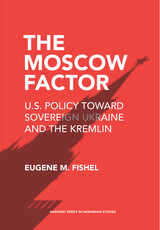
front cover of The Moscow Factor
The Moscow Factor
U.S. Policy toward Sovereign Ukraine and the Kremlin
Eugene M. Fishel
Harvard University Press, 2022

In 2014, Russia illegally annexed Crimea, bolstered a separatist conflict in the Donbas region, and attacked Ukraine with its regular army and special forces. In each instance of Russian aggression, the U.S. response has often been criticized as inadequate, insufficient, or hesitant.

The Moscow Factor: U.S. Policy toward Sovereign Ukraine and the Kremlin is a unique study that examines four key Ukraine-related policy decisions across two Republican and two Democratic U.S. administrations. Eugene M. Fishel asks whether, how, and under what circumstances Washington has considered Ukraine’s status as a sovereign nation in its decision-making regarding relations with Moscow.

This study situates the stance of the United States toward Ukraine in the broader context of international relations. It fills an important lacuna in existing scholarship and policy discourse by focusing on the complex trilateral—rather than simply bilateral—dynamics between the United States, Ukraine, and Russia from 1991 to 2016. This book brings together for the first time documentary evidence and declassified materials dealing with policy deliberation, retrospective articles authored by former policymakers, and formal memoirs by erstwhile senior officials. The study is also supplemented by open-ended interviews with former and returning officials.

[more]

front cover of The Moulding of Ukraine
The Moulding of Ukraine
The Constitutional Politics of State Formation
Kataryna Wolczuk
Central European University Press, 2002
With the disintegration of the Soviet Union, a number of new states were created that had little or no claim to any previous existence. Ukraine is one of the countries that faced not only political, social and economic transformation, but also state formation and the redefinition of national identity. This book uses Ukraine as a case study in trying to trace the key moments of decision making in the course of creating a new state while shedding the legacies of "Soviet-type" statehood.
The Moulding of Ukraine offers a systematic examination of competing ideological visions of statehood and discusses them against the backdrop of historical traditions in Ukraine. This well-documented and lucidly written book is the only coherent account available in English of the process of constitutional reform, offering an insight into post-Soviet Ukrainian politics. A useful addition to university course reading lists in Ukrainian studies, post-Soviet studies, post-communist democratization, comparative constitutionalism, state-building and institutional design.
[more]

front cover of Negotiating Marian Apparitions
Negotiating Marian Apparitions
The Politics of Religion in Transcarpathian Ukraine
Agnieszka Halemba
Central European University Press, 2015
This book concerns the politics of religion as expressed through apparitions of the Virgin Mary in Dzhublyk in Transcarpathian Ukraine. On the one hand, the analysis provides insights into the present position of Transcarpathia in regional, Ukraine-wide, and European struggles for identity and political belonging. The way in which the apparitions site has been conceived and managed raises questions concerning the fate of religious communities during and after socialism, the significance of national projects for religious organizations, and the politics of religious management in a situation in which local religious commitments are relatively strong and religious organizations are relatively weak. The analysis contributes to the ethnography and history of this particular region and of the post-socialist world in general. On the other hand, the changing status of the apparition site over the years allows investigation of the questions concerning authority, legitimacy, and power in religious organizations, especially in relation to management of religious experiences. The analysis aims at clarification of such concepts as religious institutions, organizations but also religious experiences and is relevant to anthropology, sociology and religious studies. It is argued that the important question in analyses of religious apparitions should not be how an individual experience becomes institutionalized and instrumentalized, but how experience becomes a tool for negotiation and transformation in the religious field. Key word: 1. Mary, Blessed Virgin, Saint-–Apparitions and miracles–Ukraine–Zakarpats'kaoblast'. 2. Zakarpats'ka oblast' (Ukraine)–Church history.
[more]

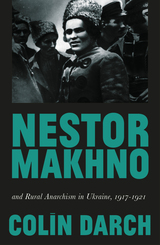
front cover of Nestor Makhno and Rural Anarchism in Ukraine, 1917-1921
Nestor Makhno and Rural Anarchism in Ukraine, 1917-1921
Colin Darch
Pluto Press, 2020
Histories of the Russian Revolution often present the Bolshevik seizure of power in 1917 as the central event, neglecting the diverse struggles of urban and rural revolutionaries across the heartlands of the Russian Empire. This book takes as its subject one such struggle, the anarcho-communist peasant revolt led by Nestor Makhno in left-bank Ukraine, locating it in the context of the final collapse of the Empire that began in 1914.

Between 1917 and 1921, the Makhnovists fought German and Austrian invaders, reactionary monarchist forces, Ukrainian nationalists and sometimes the Bolsheviks themselves. Drawing upon anarchist ideology, the Makhnovists gathered widespread support amongst the Ukrainian peasantry, taking up arms when under attack and playing a significant role - in temporary alliance with the Red Army - in the defeats of the White Generals Denikin and Wrangel. Often dismissed as a kulak revolt, or a manifestation of Ukrainian nationalism, Colin Darch analyses the successes and failures of the Makhnovist movement, emphasising its revolutionary character.

Over 100 years after the revolutions, this book reveals a lesser known side of 1917, contributing both to histories of the period and broadening the narrative of 1917, whilst enriching the lineage of anarchist history.
[more]

logo for Pluto Press
Nestor Makhno and Rural Anarchism in Ukraine, 1917-1921
Colin Darch
Pluto Press, 2020
Histories of the Russian Revolution often present the Bolshevik seizure of power in 1917 as the central event, neglecting the diverse struggles of urban and rural revolutionaries across the heartlands of the Russian Empire. This book takes as its subject one such struggle, the anarcho-communist peasant revolt led by Nestor Makhno in left-bank Ukraine, locating it in the context of the final collapse of the Empire that began in 1914.

Between 1917 and 1921, the Makhnovists fought German and Austrian invaders, reactionary monarchist forces, Ukrainian nationalists and sometimes the Bolsheviks themselves. Drawing upon anarchist ideology, the Makhnovists gathered widespread support amongst the Ukrainian peasantry, taking up arms when under attack and playing a significant role - in temporary alliance with the Red Army - in the defeats of the White Generals Denikin and Wrangel. Often dismissed as a kulak revolt, or a manifestation of Ukrainian nationalism, Colin Darch analyzes the successes and failures of the Makhnovist movement, emphasizing its revolutionary character.

Over 100 years after the revolutions, this book reveals a lesser known side of 1917, contributing both to histories of the period and broadening the narrative of 1917, whilst enriching the lineage of anarchist history.
[more]

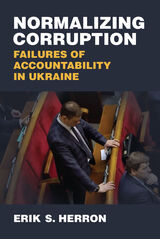
front cover of Normalizing Corruption
Normalizing Corruption
Failures of Accountability in Ukraine
Erik S. Herron
University of Michigan Press, 2020
Accountability is crucial to every successful democratic system. The failure to develop functioning mechanisms of accountability has undermined democratic consolidation worldwide. Reliable tools that hold officials accountable are essential for democratic governance; one of the key threats to accountability comes from corrupt practices, especially when they are integrated—or normalized—in the day-to-day activities of institutions. This book focuses on the experiences of contemporary Ukraine to evaluate the successes and failures of institutions, politicians, political parties, bureaucracies, and civil society. Yet, the topic is directly relevant to countries that have experienced democratic backsliding, and especially those countries that are at risk.

Normalizing Corruption addresses several interconnected questions: Under what circumstances do incumbents lose elections? How well do party organizations encourage cohesive behavior? Is executive authority responsive to inquiries from public organizations and other government institutions? How can citizens influence government actions? Do civil servants conduct their duties as impartial professionals, or are they beholden to other interests? The research builds upon extensive fieldwork, data collection, and data analysis that Erik S. Herron has conducted since 1999.
 
[more]

front cover of Omeljan Pritsak and the Intellectual Origins of the Ukrainian
Omeljan Pritsak and the Intellectual Origins of the Ukrainian "Harvard Miracle"
Andrii Portnov
Harvard University Press

Omeljan Pritsak and the Intellectual Origins of the Ukrainian “Harvard Miracle” is the first English-language intellectual biography of Omeljan Pritsak, the co-founder of the Harvard Ukrainian Research Institute and the first professor of Ukrainian history at Harvard. Andrii Portnov places Pritsak’s life and legacy in the context of Ukrainian and world historiography and illuminates the development of his scholarly interests, which emerged in interwar Poland and developed through the Sovietization of Western Ukraine and the perturbations of World War II. His scholarship ranged from German Oriental Studies in the 1940s and 1950s to North American Slavic studies to the international studies of the origins of Rus´. Pritsak’s trajectory unfolds as he faces the challenges of establishing the field of Ukrainian studies in North America while engaging with influential scholars such as Dmytro Čyževskyj, Roman Jakobson, Ivan Krypiakevych, Oleksandr Ohloblyn, and Natalia Polonska-Vasylenko.

Based on unique materials Portnov uncovered in several German archives, this concise study serves as an invitation to reassess the intellectual history of Ukrainian history. Containing unique, previously unpublished photographs from Pritsak’s personal collection at the Kyiv-Mohyla Academy, this book sheds light on the life and work of the enigmatic figure of Omeljan Pritsak—one of the most prominent, controversial, and multifaceted historians of Ukraine, Central Europe, and the Turko-Osmanic and Mongol worlds.

[more]

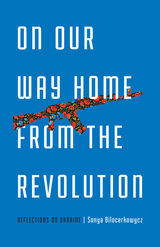
front cover of On Our Way Home from the Revolution
On Our Way Home from the Revolution
Reflections on Ukraine
Sonya Bilocerkowycz
The Ohio State University Press, 2019
One of USA Today's “10 books to help understand what's happening in Russia and Ukraine” In 2014 Sonya Bilocerkowycz is a tourist at a deadly revolution. At first she is enamored with the Ukrainians’ idealism, which reminds her of her own patriotic family. But when the romantic revolution melts into a war with Russia, she becomes disillusioned, prompting a return home to the US and the diaspora community that raised her. As the daughter of a man who studies Ukrainian dissidents for a living, the granddaughter of war refugees, and the great-granddaughter of a gulag victim, Bilocerkowycz has inherited a legacy of political oppression. But what does it mean when she discovers a missing page from her family’s survival story—one that raises questions about her own guilt? In these linked essays, Bilocerkowycz invites readers to meet a swirling cast of post-Soviet characters, including a Russian intelligence officer who finds Osama bin Laden a few weeks after 9/11; a Ukrainian poet whose nose gets broken by Russian separatists; and a long-lost relative who drives a bus into the heart of Chernobyl. On Our Way Home from the Revolution muddles our easy distinctions between innocence and culpability, agency and fate.
[more]

front cover of On the Current Situation in the Ukraine
On the Current Situation in the Ukraine
Serhii Mazlakh and Vasyl' Shakhrai
University of Michigan Press, 2025
The struggle for national liberation, the freedom to develop an independent identity—these are the issues advocated with fiery eloquence in this absorbing political tract. Written in 1919 by two Ukrainian-born Bolsheviks, On the Current Situation in the Ukraine is the first impressive statement of national communism. Vasyl' Shakhrai and Serhii Mazlakh were passionate advocates of Ukrainian independence, in particular opposition to the policies of Lenin. In their view, Lenin talked about national self-determination, but in actuality his aim was to preserve the territorial integrity of the former Russian Empire and the preeminent status of Russia. On the Current Situation in the Ukraine brought its authors expulsion from the Party; and the book is still suppressed in the Soviet Union. It remains a remarkably relevant discussion of Soviet motives and the national aspirations of states living in the shadow of a great world power.
[more]

front cover of On The Edge
On The Edge
Ukrainian - Central European - Russian Security Triangle
Margarita M. Balmaceda
Central European University Press, 2001

A new globally significant relationship arising after the break-up of the Soviet Union is the main topic of this unparalleled volume – the geopolitical link between Russia, Ukraine and the three bordering ‘Central European’ states, Hungary, Poland and Slovakia. On the Edge is a path-breaking analysis of this triangular relationship with an in-depth focus on economic, political and, more importantly, security issues.


The expansion of NATO up to Ukraine’s borders is likely to leave Ukraine in a delicate position vis-à-vis Russia. On the Edge addresses key questions, such as: how are events in Ukraine affecting the security calculations of the Central European states; Central European relations with Russia and NATO; and relations among Central European states themselves? The volume examines what Central European states can do to solidify Ukraine’s independence and help it avoid international isolation.


On the Edge gives a Central European perspective on all these issues and suggests concrete forms of co-operation.

[more]

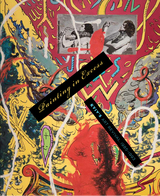
front cover of Painting in Excess
Painting in Excess
Kyiv's Art Revival, 1985-1993
Olena Martynyuk
Rutgers University Press, 2022
The upheavals of glasnost and perestroika followed by the collapse of the Soviet Union remarkably transformed the art scene in Kyiv, launching Ukrainian contemporary art as a global phenomenon. The previously calm waters of the culturally provincial capital of the Ukrainian Soviet Republic became radically stirred with new and daring art made publicly visible for the first time since the avant-garde period of the early twentieth century. As artists were freed from the dictates of the fading Communist ideology and the constraints of late socialist realism, an explosion of styles emerged, creating an effect of baroque excess. This exhibition catalogue traces and documents the diverse artistic manifestations of these transitional and exhilarating years in Kyiv while providing some historical artworks for context. Published in partnership with the Zimmerli Museum.
[more]

front cover of Peasants, Power, and Place
Peasants, Power, and Place
Revolution in the Villages of Kharkiv Province, 1914–1921
Mark R. Baker
Harvard University Press
Peasants, Power, and Place is the first English-language book to focus on Ukrainian-speaking peasants during the revolutionary period from 1914 to 1921. In contrast to the many studies written from the perspectives of the Ukrainian national movement’s leaders or the Bolsheviks or urban workers, this book portrays this period of war, revolution, and civil war from the viewpoints of the villagers—the overwhelming majority of the population of what became Ukraine. Utilizing previously unavailable archival documents, Mark R. Baker opens a unique and neglected window into the tumultuous events of those years in Ukraine and across the crumbling Russian Empire. One of Baker’s key arguments is that the peasants of Kharkiv province thought of themselves primarily as members of their particular village communities, and not as members of any nation or class—ideas to which peasants were only then being introduced. Thus this study helps to move the historiography beyond the narrow and ideologized categories created during the Cold War and still employed today. Readers will gain a broader understanding of the ways in which the majority of the population experienced these crucial years in Ukraine’s history.
[more]

front cover of The Privatization Process in Russia, the Ukraine, and the Baltic States
The Privatization Process in Russia, the Ukraine, and the Baltic States
Roman Frydman
Central European University Press, 1993
In this work, comprehensive comparative information on five former Soviet republics has been collected by teams of researchers from both within the region and from the West. Following an introduction to the economic environment in each country, it provides an overview of the privatization process, including an account of the legal framework of ownership, institutions for state regulation, an overview of privatization programmes and the initial transformation of enterprises. A key feature of the book is the authors' access to hitherto unavailable information and their ability to present a vast amount of material in an easily available format. Aimed at policy makers and business people, the work should provide a strong foundation for future research.
[more]

front cover of Regionalism without Regions
Regionalism without Regions
Reconceptualizing Ukraine's Heterogeneity
Ulrich Schmid
Central European University Press, 2019
This collective volume shows how Ukraine can best be understood through its regions and how the regions must be considered against the background of the nation. The overarching objective of the book is to challenge the dominance of the nation-state paradigm in the analyses of Ukraine by illustrating the interrelationship between national and regional dynamics of change. 
The authors—historians, sociologists, anthropologists, economists, literary critics and linguists from Ukraine, Poland, Switzerland, Germany and the USA—explicitly go beyond the perspective of an entity defined by traditional political borders and cultural, economic, historical or religious stereotypes. The research project that led to the composition of the book combined quantitative (statistical surveys conducted across Ukraine) and qualitative (in-depth interviews and focus-group discussion) methods. The authors came to the conclusion that regionalism as a defining phenomenon of Ukraine is more prominent than the regions themselves. This approach regards Ukraine as a construct in flux where different discourses intersect, concur and eventually merge through the lenses of various disciplines and methodologies.
[more]

front cover of The Resistible Rise of Antisemitism
The Resistible Rise of Antisemitism
Exemplary Cases from Russia, Ukraine, and Poland
Laura Engelstein
Brandeis University Press, 2020
Antisemitism emerged toward the end of the nineteenth century as a powerful political movement with broad popular appeal. It promoted a vision of the world in which a closely-knit tribe called “the Jews” conspired to dominate the globe through control of international finance at the highest levels of commerce and money lending in the towns and villages. This tribe at the same time maneuvered to destroy the very capitalist system it was said to control through its devotion to the cause of revolution. It is easy to draw a straight line from this turn-of-the-century paranoid thinking to the murderous delusions of twentieth-century fascism. Yet the line was not straight.

Antisemitism as a political weapon did not stand unchallenged, even in Eastern Europe, where its consequences were particularly dire. In this region, Jewish leaders mobilized across national borders and in alliance with non-Jewish public figures on behalf of Jewish rights and in opposition to anti-Jewish violence. Antisemites were called to account and forced on the defensive. In Imperial and then Soviet Russia, in newly emerging Poland, and in aspiring Ukraine—notorious in the West as antisemitic hotbeds—antisemitism was sometimes a moral and political liability. These intriguing essays explore the reasons why, and they offer lessons from surprising places on how we can continue to fight antisemitism in our times.
[more]

front cover of Resplendent Synagogue
Resplendent Synagogue
Architecture and Worship in an Eighteenth-Century Polish Community
Thomas C. Hubka
Brandeis University Press, 2022
This unique exploration of a lost religious and cultural artifact breathes new life into a forgotten but fascinating aspect of eighteenth-century Polish Jewry.
 
Thomas C. Hubka, an architectural historian, immersed himself in medieval and early modern Jewish history, religion, and culture to prepare for this remarkable study of the eighteenth-century Polish synagogue in the town of Gwozdziec, now in present-day Ukraine. Because the Gwozdziec Synagogue, like so many others, was destroyed by the Nazis, this book revives a spiritual community lost to history. Hubka selected the Gwozdziec Synagogue because of the completeness of its photographic and historical records. Graced with nearly two hundred historical photographs, architectural drawings, maps, diagrams, and color illustrations, Resplendent Synagogue vividly recreates the spiritual heart of a once-vibrant Jewish population. Hubka demonstrates that while the architectural exterior of the synagogue was largely the product of non-Jewish, regional influences, the interior design and elaborate wall-paintings signified a distinctly Jewish art form. The collaboration of Jewish and Gentile builders, craftsmen, and artists in the creation of this magnificent wooden structure attests to an eighteenth-century period of relative prosperity and communal well-being for the Jews of Gwozdziec. Part of a tradition that was later abandoned by Eastern European Jewish communities in the nineteenth and twentieth centuries, this truly resplendent synagogue exemplified a high point in Jewish architectural art and religious painting.
 
[more]

front cover of Russia's Imperial Endeavor and Its Geopolitical Consequences
Russia's Imperial Endeavor and Its Geopolitical Consequences
The Russia-Ukraine War, Volume Two
Bálint Madlovics
Central European University Press, 2024

Aside from the near-complete devastation of a sovereign state and reversal of the global balance of power, the Russian invasion of Ukraine in 2022 is leading to a radical transformation in the Eastern European and Eurasian regions – including Russia itself.

The 13 chapters in this volume examine the main geopolitical consequences of the resurgent imperialist aspirations of the Russian Federation. They examine the ideological tools of history falsification as an integral part of hybrid warfare. Turning to the economy, the book discusses how the war and economic sanctions imposed on Russia are redrawing the geopolitical map and how economic relations would change following a regime transformation. The book discusses the reactions of members of the international community to the invasion, whether threatened or neutral parties or allies. The collection therefore offers a comprehensive picture of the main consequences of the resurgent imperialist aspirations of the Russian Federation. Equipped with the conceptual tools of the analysis with a focus on the patronal features of the political-economic system, the book considers the aftermath of the war. This collection complements the book entitled Ukraine. Patronal Democracy and the Russian Invasion.

[more]

front cover of Self-Organization
Self-Organization
The Power and Limits of Ukraine's Informal Civil Society
Svitlana Krasynska
Harvard University Press

Using Ukraine as a case-in-point, Svitlana Krasynska engages diverse bodies of literature and rich empirical data to reveal the vital role and unique potential of below-the-radar civic engagement in contexts where informal practices abound—a phenomenon largely neglected by scholars of civil society who traditionally focus on formal civic organizations.

Civil society in Eastern Europe has long been labeled weak based on a general lack of citizen participation in formal civil society organizations—a key criterion for assessing civic engagement in comparative studies. However, such assessment of civil society fails to recognize the role and impact of informal civic engagement in contexts where informality permeates economic, political, and social spheres. Ukraine offers a valuable counterargument of the importance of informal civil society in Eastern Europe, especially in the post-Soviet countries.

Krasynska convincingly shows that informality constitutes an essential component of civil society, shaping popular approaches to addressing social, economic, and political issues. The trailblazing findings in Self-Organization will be of interest to scholars of democratization, informality, and area studies, and they will aid development practitioners and policy makers in determining a more effective approach to helping fledgling democracies around the world.
[more]

logo for Harvard University Press
The Shaping of a National Identity
Subcarpathian Rus', 1848-1948
Paul Robert Magocsi
Harvard University Press, 1978

front cover of She Came from Mariupol
She Came from Mariupol
Natascha Wodin
Michigan State University Press, 2022
WINNER OF THE 2017 LEIPZIG BOOK FAIR PRIZE—When Natascha Wodin’s mother died, Natascha was only ten years old—too young to find out what her mother had experienced during World War II. All the little girl knew was that they were detritus, human debris left over from the war. Years later, Natascha set out on a quest to find out what happened to her mother during that time. Why had they lived in a camp for “displaced persons”? Where did her mother come from? What had she experienced? The one thing she knew is that her parents had to leave Mariupol in Ukraine for Germany as part of the Nazi forced labor program in 1943. Armed with this limited knowledge, Natascha resolved to piece together the puzzle of her family’s past. The result is a highly praised, beautiful piece of prose that has drawn comparisons to W. G. Sebald in its approach. Like Sebald, Natascha’s aim is to reclaim the stories of those who can no longer speak for themselves. The author is not only in search of her own family’s history, but she is also aware that she is charting unmarked territory: accounts of the plight of forced laborers and displaced persons are still a rarity within literature about World War II and its atrocities. Natascha’s personal homage to her mother’s life story is an important lyrical memorial for the thousands of Eastern Europeans who were forced to leave their homes and work in Germany during the war, and a moving reflection of the plight of displaced peoples throughout the ages. This is a darkly radiant account of one person’s fate, developing momentous emotive power—its subject serves as a proxy for the fate of millions.
[more]

front cover of The Showman and the Ukrainian Cause
The Showman and the Ukrainian Cause
Folk Dance, Film, and the Life of Vasile Avramenko
Orest T. Martynowych
University of Manitoba Press, 2014

front cover of Stalin’s Liquidation Game
Stalin’s Liquidation Game
The Unlikely Case of Oleksandr Shums'kyi, His Survival in Soviet Prison, and His Subsequent Arcane Assassination
Filip Slaveski and Yuri Shapoval
Harvard University Press, 2025

Millions of innocent people were arrested in Stalin’s Soviet Union during the 1930s in different waves of mass repression. Under violent interrogation, many were forced to confess to crimes they did not commit. Rather than save their lives, as the interrogators had promised, confession was usually the last step to their execution. Very few of those arrested eventually refused to confess.

Oleksandr Shums’kyi, the Ukrainian Marxist revolutionary, was one of the most important but least known of them. He not only refused to confess but sustained for over a decade a massive protest against his repression and the Stalinist attack on his country, Ukraine. Stalin punished him mercilessly in response, paralyzing him in jail and murdering his wife, but refrained from assassinating him for more than ten years.

This book unravels the Shums’kyi riddle to explain why. In doing so, it opens a new window into understanding the history of Soviet repression and the Russian pathologies toward Ukrainian independence, which help us understand Russia’s current war against Ukraine.

[more]

front cover of State-building
State-building
A Comparative Study of Ukraine, Lithuania, Belarus, and Russia
Verena Fritz
Central European University Press, 2007
Looks at the process of state-building in Ukraine, Lithuania, Belarus, and Russia from a political economy and institutional perspective. Weak and distorted state capacity has come to be widely recognized as a key obstacle to successful transformation—including economic modernization and growth as well as the consolidation of democracy. However, so far little systematic research has been carried out on state capacity per se and on how to explain its development. The book provides new insights in considering the evolution of Ukraine since 1992, offering an in-depth view of institutional development in crucial areas and thus tracing the process of state-building. It draws comparisons with developments in Belarus, Lithuania, and Russia (based on field research). To capture the process of state-building empirically, focuses on the extraction and expenditure systems which are a central pillar of state capacity and also a central link between citizens and the state. The book also sheds light on how Ukraine’s potential ‘second transition’ currently under way will have an impact on its institutional system.
[more]

front cover of Survival as Victory
Survival as Victory
Ukrainian Women in the Gulag
Oksana Kis
Harvard University Press, 2021

Of the hundreds of thousands of Ukrainian women were sentenced to the Gulag in the 1940s and 1950s, only half survived. In Survival as Victory, Oksana Kis has produced the first anthropological study of daily life in the Soviet forced labor camps as experienced by Ukrainian women prisoners.

Based on the written memoirs, autobiographies, and oral histories of over 150 survivors, this book fills a lacuna in the scholarship regarding Ukrainian experience. Kis details the women’s resistance to the brutality of camp conditions not only through the preservation of customs and traditions from everyday home life, but also through the frequent elision of regional and confessional differences. Following the groundbreaking work of Anne Applebaum’s Gulag: A History (2003), this book is a must-read for anyone interested in gendered strategies of survival, accommodation, and resistance to the dehumanizing effects of the Gulag.

[more]

front cover of The Tatars of Crimea
The Tatars of Crimea
Return to the Homeland
Edward A. Allworth, ed.
Duke University Press, 1998
This new edition of Edward A. Allworth’s The Tatars of Crimea has been extensively updated. Five new chapters examine the situation of Crimean Tatars since the breakup of the USSR in 1991 and detail the continuing struggle of the Tatars to find peace and acceptance in a homeland.
Contributors to this volume—almost half of whom are Tatars—discuss the problematic results of the partial Tatar return to Crimea that began in the 1980s. This incomplete migration has left the group geographically split and has complicated their desire for stability as a people, whether in their own homeland or in the Central Asian diaspora. Those who have returned to the region on the Black Sea in Ukrayina (formerly Ukraine) have found themselves engulfed in a hostile political environment dominated by Russian residents attempting to stifle the resurgence of Crimean Tatar life. Specific essays address the current political situation in and around Crimea, recent elections, and promising developments in the culture, leadership, and movement toward unity among Crimean Tatars.
Beyond demonstrating the problems of one nationality caught in a fierce power struggle, The Tatars of Crimea offers an example of the challenges faced by all nationalities of the former Soviet Union who now contend with deteriorating economic and political conditions, flagrant discrimination against ethnic minorities, and the denial of civil and human rights common in many of the newly independent states.

Contributors. Ludmilla Alexeyeva, Edward A. Allworth, Mübeyyin Batu Altan, Nermin Eren, Alan W. Fisher, Riza Gülüm, Seyit Ahmet Kirimca, Edward Lazzerini, Peter Reddaway, Ayshe Seytmuratova, Andrew Wilson
[more]

front cover of Those Absences Now Closest
Those Absences Now Closest
Dzvinia Orlowsky
Carnegie Mellon University Press, 2024
Poems that reflect on the current tragedy in Ukraine.

In her newest collection, Ukrainian American poet Dzvinia Orlowsky is a witness, never a bystander, ready to stare down the demons, to “cut yourself with a dull razor.” She sets up house among the nightmares of intergenerational trauma and, as far as anyone can, humanizes them. Through her work, Orlowsky prompts us to enter our own histories instead of just watching.
[more]

front cover of Tormented Master
Tormented Master
A Life of Rabbi Nahman of Bratslav
Written by Arthur E. Green
University of Alabama Press, 1979

“If Hasidism begins in the life-enhancing spirituality of the Baal Shem Tov, it concludes in the tortuous, elitist and utterly fascinating career of Nahman of Bratslav (1722–1810) whose biography and teaching Arthur Green has set forth in his comprehensive, moving, and subtle study, Tormented Master.

            “Arthur Green has managed to lead us through the thickets of the Bratslaver discourse with a grace and facility thus far unequaled in the English language literature on Hasidism. Tormented Master is a model of clarity and percipience, balancing awed respect and honor for its subject with a ruthless pursuit of documented truth. . . . Tormented Master is sufficiently open to the agonies of religion in general and the issues of modern religion in particular to make Nahman a thinker utterly relevant to our time.

            “Nahman of Bratslav is unique in the history of Judaism, Green emphasizes, for having made the individual’s quest for intimacy with God the center of the religious way. He was a Kierkegaard before his time, believing in the utter abandon of the life of faith and the risk of paradoxicality. . . . He was, more than all others, the predecessor of Kafka, whose tales, like Nahman’s, have no explicit key and rankle, flush and irritate the spirit, compelling us—even in our failure to understand—to acknowledge their potency and challenge.”

—New York Times
[more]

front cover of The Torture Camp on Paradise Street
The Torture Camp on Paradise Street
Stanislav Aseyev
Harvard University Press, 2022

Finalist, 2024 PEN Translation Prize

In The Torture Camp on Paradise Street, Ukrainian journalist and writer Stanislav Aseyev details his experience as a prisoner from 2015 to 2017 in a modern-day concentration camp overseen by the Federal Security Bureau of the Russian Federation (FSB) in the Russian-controlled city of Donetsk. This memoir recounts an endless ordeal of psychological and physical abuse, including torture and rape, inflicted upon the author and his fellow inmates over the course of nearly three years of illegal incarceration spent largely in the prison called Izoliatsiia (Isolation). Aseyev also reflects on how a human can survive such atrocities and reenter the world to share his story.

Since February 2022, numerous cases of illegal detainment and extreme mistreatment have been reported in the Ukrainian towns and villages occupied by Russian forces during the full-scale invasion. These and other war crimes committed by Russian troops speak to the horrors wreaked upon Ukrainians forced to live in Russian-occupied zones. It is important to remember, however, that the torture and killing of Ukrainians by Russian security and military forces began long before 2022. Rendered deftly into English, Aseyev’s compelling account offers a critical insight into the operations of Russian forces in the occupied territories of Ukraine.
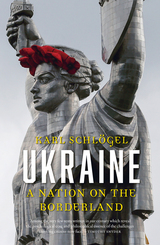
[more]

logo for Harvard University Press
The Ukraine, 1917–1921
A Study in Revolution
Taras Hunczak
Harvard University Press, 1977
The Ukraine, which had for centuries been ruled by other nations, finally gained its independence for a brief period after the First World War. During this revolutionary era, a series of Ukrainian governments were established whose political spectrum ranged from anarchism to monarchical rule. This comprehensive volume edited by Taras Hunczak includes fourteen articles by leading specialists, and is the first scholarly treatment of the problem to appear in twenty-five years.
[more]

front cover of Ukraine and the Empire of Capital
Ukraine and the Empire of Capital
From Marketisation to Armed Conflict
Yuliya Yurchenko
Pluto Press, 2017
Since 1991, nominally independent Ukraine has been in turmoil, with the Orange Revolution and the Maidan protests marking its most critical moments. Now, its borders are threatened and the civil unrest and armed conflict continue to destabilise the country. In order to understand these dramatic events, Yuliya Yurchenko looks to the country’s post-Soviet past in this ambitious analysis of contemporary Ukrainian political economy. 

Providing distinctive and unexplored reflections on the origins of the conflict, Yurchenko unpacks the four central myths that underlie Ukraine's post-Soviet reality: the myth of transition, the myth of democracy, the myth of two Ukraines, and the myth of 'the other'. In doing so, she sheds light on the current intensification of class rivalries in Ukraine, the kleptocracy, resource wars and analyses existing and potential dangers of the rightwing shift in Ukraine's polity, stressing a historic opportunity for change.

Critiquing the concept of Ukraine as ‘transition space’, she provides a sweeping analysis which includes the wider neoliberal restructuring of global political economy since the 1970s, with particular focus on Ukraine's relations with the US, the EU and Russia. This is a book for those wanting to understand the current conflict as a dangerous product of neoliberalism, of the empire of capital.
[more]

front cover of Ukraine as a Migration Nexus
Ukraine as a Migration Nexus
Perspectives on Historical and Current Population Movements
Oleksii Chebotarov
Central European University Press, 2025
This OER project examines Ukraine as a central hub in global migration and mobility, offering critical perspectives on both historical and contemporary population movements. The volume brings together case studies focused on the migration dynamics within Ukraine and its surrounding territories, integrating these with broader global migration processes. The authors critically engage with migration studies methodologies, offering fresh, empirical insights into issues like displacement, migration governance, and identity formation in the context of Ukraine's socio-political landscape. By combining historical narratives with modern theoretical approaches, the book explores how migration has shaped and continues to shape, the region’s cultural, political, and social fabric. It provides an innovative contribution to migration research, highlighting the intersection of mobility, belonging, and political contexts, particularly within East Central Europe. This collection challenges traditional migration frameworks and invites a reevaluation of established migration paradigms through the lens of Ukrainian lands.
[more]

front cover of Ukraine in the Crosshairs of Geopolitical Power Play
Ukraine in the Crosshairs of Geopolitical Power Play
Edited by Peter W. Schulze and Winfried Veit
Campus Verlag, 2020
An overview of both European and Russian objectives in Ukraine.

Peace in Ukraine seemed possible following Volodymyr Zelensky’s 2019 election. The new president reopened conversations with both the European Union and separatist authorities, bringing an end to the Donbass conflict in sight. Such an achievement promised revitalized talks between Europe and Russia, and so the nearly forgotten conflict returned to global prominence. Ukraine in the Crosshairs of Geopolitical Power Play analyzes why European and Russian objectives in Ukraine place daunting limits of any potential compromise.
[more]

front cover of Ukraine under Western Eyes
Ukraine under Western Eyes
The Bohdan and Neonila Krawciw Ucrainica Map Collection
Steven Seegel
Harvard University Press

From the Renaissance to the Enlightenment, the geopolitical placement of Ukraine drew the attention of some of Europe’s most influential cartographers. Many of these maps, including ones of exceptional rarity, were collected by the Ukrainian scholar and journalist Bohdan Krawciw.

Krawciw traced the physical and aesthetic depiction of Ukraine across its changing borders as a means of self-recognition and as a cultural and political history of the contested nation and its peoples. Of special interest are his maps of Ukraine from the nineteenth and twentieth centuries, at the crossroads of four empires: Habsburg, Ottoman, Russian, and Soviet.

As part of his personal archive, Krawciw’s maps were bequeathed to Harvard University upon his death in 1975. This book serves as both a catalog of his collection and a description of how the maps he collected serve as an invaluable source for Ukraine’s history and a symbol of Ukrainian national identity. The book contains nearly 100 examples from the collection, many in full color, as well as indices listing maps by cartographer and by place name.
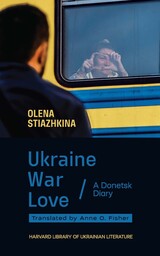
[more]

front cover of Ukraine, War, Love
Ukraine, War, Love
A Donetsk Diary
Olena Stiazhkina
Harvard University Press, 2024

In Ukraine, War, Love, Olena Stiazhkina depicts day-to-day developments in and around her beloved hometown Donetsk during Russia’s 2014 invasion and occupation of the Ukrainian city. An award-winning fiction writer, Stiazhkina chronicles an increasingly harrowing series of events with sarcasm, anger, humor, and love.

The diary opens on March 2, 2014, as the first wave of pro-Russian protest washes over eastern Ukraine in the wake of Euromaidan, the Revolution of Dignity, and it closes on August 18, 2014, the day a convoy of civilian Ukrainian refugees is deliberately slaughtered by Russian forces. Early on, Stiazhkina is captured by pro-Russian forces while she browses for books but is freed when one of her captors turns out to be a former student. Vignettes from her personal life intermingle with current events, and she examines ordinary people in extraordinary circumstances. We walk with local dogs and their owners; we meet a formidable apartment building manager who shames occupiers and dismantles their artillery from the roof of her building; we follow a family evacuated to Kyiv whose young son builds checkpoints out of Legos. Olena Stiazhkina’s Ukraine, War, Love: A Donetsk Diary is a fierce love letter to her country, her city, and her people.
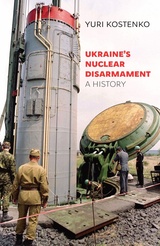
[more]

front cover of Ukraine’s Nuclear Disarmament
Ukraine’s Nuclear Disarmament
A History
Yuri Kostenko
Harvard University Press, 2021

In December 1994, Ukraine gave up the third-largest nuclear arsenal in the world and signed the Non-Proliferation Treaty, having received assurances that its sovereignty would be respected and secured by Russia, the United States, and the United Kingdom. Based on original and heretofore unavailable documents, Yuri Kostenko’s account of the negotiations between Ukraine, Russia, and the US reveals for the first time the internal debates of the Ukrainian government as well as the pressure exerted upon it by its international partners.

Kostenko presents an insider’s view on the issue of nuclear disarmament and raises the question of whether the complete and immediate dismantlement of the country’s enormous nuclear arsenal was strategically the right decision, especially in view of the 2014 annexation of Crimea by Russia, one of the guarantors of Ukraine’s sovereignty under denuclearization.
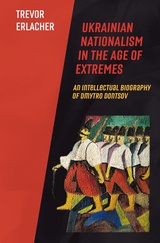
[more]

front cover of Ukraine's Patronal Democracy and the Russian Invasion
Ukraine's Patronal Democracy and the Russian Invasion
The Russia-Ukraine War, Volume One
Bálint Madlovics
Central European University Press, 2023

The Russian invasion of Ukraine in 2022 jeopardizes the country's independence and its chances for Western-style development. However, the heroic attitude of the Ukrainian people, combined with a solidifying national identity, makes the domestic foundations for a western turn stronger than ever. After the invasion, building strong foundations of liberal democracy will be a top priority. In addition to alleviating immediate problems, the country must also address its post-communist legacy and address the constraints of patronalism.

The authors of this edited volume, leading Ukrainian scholars supplemented by colleagues from Hungary, examine the chances of an anti-patronal transformation after the war. The book provides an overview of the development of Ukraine's political-economic system: color revolutions in 2004 and 2014 brought democratic transformation, but no change in the patronage system The result was patronal regime cycles instead of the emergence of a Western-type liberal democracy in the country. Building on the conceptual framework of the editors' The Anatomy of Post-Communist Regimes (CEU Press, 2020), the 12 chapters examine the impact of the war on patronal democracy, the relational economy, clientelist society, and the international environment in which Ukraine operates.

This collection is complemented by the book entitled Russia. Imperial Endeavor and Geopolitical Consequences.

[more]

front cover of The Ukrainian Challenge
The Ukrainian Challenge
Reforming Labour Market and Social Policy
ILO-CEET ILO-CEET
Central European University Press, 1995
In the coming period it will be essential for Ukraine, which currently has to face a combination of massive economic decline, hyperinflation and growing open as well as hidden unemployment, to give a very high priority to the substantial reform of labour market and social policy. This book attempts to assess the trends in social and labour market policy in Ukraine and to help to identify the priorities to follow in the restructuring of the Ukrainian economy and the reform of social policy.
[more]

front cover of Ukrainian Nationalism in the Age of Extremes
Ukrainian Nationalism in the Age of Extremes
An Intellectual Biography of Dmytro Dontsov
Trevor Erlacher
Harvard University Press, 2021

Ukrainian nationalism made worldwide news after the Euromaidan revolution and the outbreak of the Russo-Ukrainian war in 2014. Invoked by regional actors and international commentators, the “integral” Ukrainian nationalism of the 1930s has moved to the center of debates about Eastern Europe, but the history of this divisive ideology remains poorly understood.

This timely book by Trevor Erlacher is the first English-language biography of the doctrine’s founder, Dmytro Dontsov (1883–1973), the “spiritual father” of the Organization of Ukrainian Nationalists. Organizing his research of the period around Dontsov’s life, Erlacher has written a global intellectual history of Ukrainian integral nationalism from late imperial Russia to postwar North America, with relevance for every student of the history of modern Europe and the diaspora.

Thanks to the circumstances of Dontsov’s itinerant, ninety-year life, this microhistorical approach allows for a geographically, chronologically, and thematically broad yet personal view on the topic. Dontsov shaped and embodied Ukrainian politics and culture as a journalist, diplomat, literary critic, publicist, and ideologue, progressing from heterodox Marxism, to avant-garde fascism, to theocratic traditionalism.

Drawing upon archival research in Ukraine, Poland, and Canada, this book contextualizes Dontsov’s works, activities, and identity formation diachronically, reconstructing the cultural, political, urban, and intellectual milieus within which he developed and disseminated his worldview.
[more]

front cover of The Ukrainian Question
The Ukrainian Question
Russian Empire and Nationalism in the 19th Century
Alexei Miller
Central European University Press, 2003
This pioneering work treats the Ukrainian question in Russian imperial policy and its importance for the intelligentsia of the empire. Miller sets the Russian Empire in the context of modernizing and occasionally nationalizing great power states and discusses the process of incorporating the Ukraine, better known as "Little Russia" in that time, into the Romanov Empire in the late 18th and 19th centuries. This territorial expansion evolved into a competition of mutually exclusive concepts of Russian and Ukrainian nation-building projects.
[more]

front cover of The Ukrainian West
The Ukrainian West
Culture and the Fate of Empire in Soviet Lviv
William Jay Risch
Harvard University Press, 2011

In 1990, months before crowds in Moscow and other major cities dismantled their monuments to Lenin, residents of the western Ukrainian city of Lviv toppled theirs. William Jay Risch argues that Soviet politics of empire inadvertently shaped this anti-Soviet city, and that opposition from the periphery as much as from the imperial center was instrumental in unraveling the Soviet Union.

Lviv’s borderlands identity was defined by complicated relationships with its Polish neighbor, its imperial Soviet occupier, and the real and imagined West. The city’s intellectuals—working through compromise rather than overt opposition—strained the limits of censorship in order to achieve greater public use of Ukrainian language and literary expression, and challenged state-sanctioned histories with their collective memory of the recent past. Lviv’s post–Stalin-generation youth, to which Risch pays particular attention, forged alternative social spaces where their enthusiasm for high culture, politics, soccer, music, and film could be shared.

The Ukrainian West enriches our understanding not only of the Soviet Union’s postwar evolution but also of the role urban spaces, cosmopolitan identities, and border regions play in the development of nations and empires. And it calls into question many of our assumptions about the regional divisions that have characterized politics in Ukraine. Risch shines a bright light on the political, social, and cultural history that turned this once-peripheral city into a Soviet window on the West.

[more]

front cover of Ukrainians in Michigan
Ukrainians in Michigan
Paul M. Hedeen
Michigan State University Press, 2023
This history of Ukrainian immigrants in Michigan and their American descendants examines both the choices people made and the social forces that impelled their decisions to migrate and to make new homes in the state. Michigan’s Ukrainians came in four waves, each unique in time and character, beginning in the late nineteenth century and continuing in the twenty-first. Detroit attracted many of them with the opportunities it offered in its booming automobile industry. Yet others put down roots in cities and towns across the state. Wherever they settled, they established churches and community centers and continued to practice the customs of their homeland. Many Ukrainian Americans have made significant contributions to Michigan and the United States, including those who are showcased in this book. This comprehensive text also highlights cultural practices and traditional foods cherished by community members.
[more]

logo for University of Michigan Press
Unbroken Ties
The State, Interest Associations, and Corporatism in Post-Soviet Ukraine
Paul Kubicek
University of Michigan Press, 2000
Unbroken Ties examines the relationship between the state and economic interest groups representing labor, capital, and agriculture in Ukraine. The author argues that the absence of "civil society" helps to explain why, in Ukraine, the much-anticipated transition to democracy and the market has not yet been achieved.
Since the collapse of communism in Eastern Europe and the former Soviet Union, there has been a spate of books--optimistic at first--highlighting the transitions to democracy in these countries and the leading role of "civil society" in pushing forward political and economic reform. This study explains why this transition did not take place as anticipated. In essence, organized labor in Ukraine is weak and has been co-opted by the state; in the meantime, leading groups of industrialists and agricultural collectives have strong political influence and shape policies in accordance with their interests. This is very similar to the situation in Russia.
In contrast to works that implicitly assume a pluralist model of development for state-society relations, Unbroken Ties employs corporatism as the basic organizing structure for the study of state-interest group relations in post-Soviet Ukraine. Finding that much of the Soviet "residue" still functions in Ukraine, it argues that a form of state corporatism, which envisions a major role for the state in structuring and controlling interest associations, captures much of the post-Soviet Ukrainian reality. Old groups persist and prosper due to a variety of ties with state elites, whereas new and independent groups find themselves marginalized.
This book will appeal to political scientists, economists, and sociologists studying the transformation of post-communist societies, as well as those interested in the broader, more comparative aspects of democratization and economic reform.
Paul Kubicek is Kenneth Boulding Post-Doctoral Fellow, University of Colorado, Boulder.
[more]

front cover of The Voices of Babyn Yar
The Voices of Babyn Yar
Marianna Kiyanovska
Harvard University Press, 2022
With The Voices of Babyn Yar—a collection of stirring poems by Marianna Kiyanovska—the award-winning Ukrainian poet honors the victims of the Holocaust by writing their stories of horror, death, and survival by projecting their own imagined voices. Artful and carefully intoned, the poems convey the experiences of ordinary civilians going through unbearable events leading to the massacre at Kyiv’s Babyn Yar from a first-person perspective to an effect that is simultaneously immersive and estranging. While conceived as a tribute to the fallen, the book raises difficult questions about memory, responsibility, and commemoration of those who had witnessed an evil that verges on the unspeakable.
[more]

front cover of The War in Ukraine’s Donbas
The War in Ukraine’s Donbas
Origins, Contexts, and the Future
David R. Marples
Central European University Press, 2022

This collective work analyzes the ongoing conflict in Ukraine, providing a coherent picture of Ukraine and Eastern Europe in the period 2013–2020. Giving voice to different social groups, scholarly communities and agencies relevant to Ukraine’s recent history, The War in Ukraine's Donbas goes beyond simplistic media interpretations that limit the analysis to Vladimir Putin and Russian aims to annex Ukraine. Instead, the authors identify the deeper roots linked to the autonomy and history of Donbas as a region. The contributions explore local society and traditions and the alienation from Ukraine caused by the events of Euromaidan, which saw the removal of the Donetsk-based president Viktor Yanukovych. Other chapters address the refugee crisis, the Minsk Accords in 2014 and the impact of the new president Volodymyr Zelensky and his efforts to bring the war to an end by negotiations among Russia, Ukraine, France, and Germany.

The book concludes with four proposals for a durable peace in Donbas: territorial power-sharing; the conversion of rebels into legitimate political parties; amnesty for all participants of the armed conflict; and a transitional period of several years until political institutions are fully re-established.

[more]

front cover of Where Currents Meet
Where Currents Meet
Frontiers of Memory in Post-Soviet Fiction of Kharkiv, Ukraine
Tanya Zaharchenko
Central European University Press, 2016

Where Currents Meet, Tanya Zaharchenko’s path-breaking study of literature and cultural memory, moves decisively beyond the simplistic view of a post-Soviet Ukraine divided between east and west. It positions the Ukrainian and Russian components of cultural experience in the country’s east as elements of a complex continuum. Combining insights from memory studies and border studies, Zaharchenko analyzes a generation of younger riters in the city of Kharkiv—a “doubletake generation” that came of age at the time of the Soviet Union’s collapse and now revisits this experience through fiction. In the works of Serhiy Zhadan, Andreĭ Krasniashchikh, Yuri Tsaplin, Oleh Kotsarev, and others the author reveals how borderlands and frontiers, both geographical and conceptual, acquire zonal qualities of their own as these writers navigate the historical legacy they have inherited.

[more]

front cover of The World to Come
The World to Come
Ukrainian Images of the Last Judgment
Liliya Berezhnaya and John-Paul Himka
Harvard University Press

Icons and murals depicting the biblical scene of the Last Judgment adorned many Eastern-rite churches in medieval and early modern Ukraine. Dating from the twelfth to the eighteenth centuries, these images were extraordinarily elaborate, composed of dozens of discrete elements reflecting Byzantine, Novgorodian, Moldavian, and Catholic influences, in addition to local and regional traditions. Over time, the details of the iconography evolved in response to changing cultural resources, the conditions of material life at the time, and new trends in mentality and taste.

The World to Come lists and describes more than eighty Last Judgment images from present-day Ukraine, eastern Slovakia, and southeastern Poland, making it the largest compilation of its kind. Photographs show overviews and details of the images, and most are printed in full color. The icons and murals provide a valuable source of knowledge about the culture in which they were created: what was meant by good and evil, what was prophesied for the future, and what awaited in the afterlife.

[more]


Send via email Share on Facebook Share on Twitter